Showing posts with label laity. Show all posts

Tuesday, June 23, 2026

Rome has spoken: A layperson CANNOT deliver the homily


A priest delivering his homily during MassA priest delivering his homily during Mass 

Vatican Dicastery maintains that a layperson cannot deliver the homily

The Dicastery for Divine Worship and the Discipline of the Sacraments responds to the request made by the German Bishops, denying their petition for a lay person to preach the homily during Mass, even in exceptional cases, stating that the proclamation of the Word in the liturgical celebration is inseparable from the mission received sacramentally.

Vatican News 

The Dicastery for Divine Worship and the Discipline of the Sacraments has issued a clarifying text regarding who is permitted to deliver homilies.

In a letter dated June 17, 2026, addressed to the President of the German Bishops' Conference, Bishop Heiner Wilmer, the Dicastery communicated that it is not possible to grant the indult requested on March 30, 2026. An indult is "a special (and often temporary) favor granted to a physical or moral person by the Apostolic See (or the local ordinary) which confers faculties contrary to or beyond the prescriptions of the law."

The German Bishops had requested "to permit, in exceptional circumstances, a duly commissioned lay member of the faithful to preach in place of the homily during the celebration of the Eucharist."

While the Dicastery expressed appreciation for the pastoral concerns that inspired the request, it reaffirmed that the current discipline cannot be dispensed from by means of an indult, since the reservation of the homily to a priest or deacon is not a merely disciplinary norm but derives from the very nature of the liturgy.

In the text, the Dicastery reiterated that the homily, which forms an integral part of the Liturgy of the Word, is intrinsically linked to the proclamation of the Gospel and constitutes an exercise of the munus docendi entrusted to ordained ministers through the Sacrament of Holy Orders.

It added that the proclamation of the Word within the liturgical celebration is inseparable from the mission received sacramentally and from the unity that binds together Word and Sacrament in the Eucharistic celebration.

The letter also emphasized the importance of promoting the ongoing formation of ordained ministers so that the homily may fully express its pastoral and spiritual effectiveness.

Finally, the Dicastery recalled that the Church's current discipline already provides for numerous forms of proclaiming the Word and preaching that may be entrusted to lay members of the faithful outside the homily and outside the celebration of the Eucharist, in accordance with canon law and the proper nature of these different forms of proclaiming the Gospel.

Thursday, October 30, 2025

Parishes encouraged to pray Liturgy of the Hours


‘A gift from God’: Parishes encouraged to start Liturgy of Hours ahead of new edition


A woman is seen in an illustration praying the Liturgy of the Hours. (OSV News/illustration Bob Roller)


(OSV News) — Father Matthew S. Ernest still remembers when he oversaw evening prayer celebrated by Pope Francis at St. Patrick’s Cathedral in New York City in 2015.

“It was a beautiful event, and we were very grateful to welcome the Holy Father,” Father Ernest, director of the Office of Liturgy for the Archdiocese of New York, said of the liturgy, which is part of an ancient prayer called the Liturgy of the Hours.

Ahead of a new English edition of the Liturgy of the Hours for the Latin Church, Father Ernest and other liturgical experts are encouraging parishes and other Catholic communities to embrace this prayer, which is said at different points throughout the day. They spoke with OSV News and shared practical tips for parishes to introduce the Liturgy of the Hours to their congregations. In particular, they advised communities to start small and integrate the prayer into their already established schedules.

Their comments came after they addressed the national meeting of the Federation of Diocesan Liturgical Commissions, an organization established by the U.S. Conference of Catholic Bishops dedicated to liturgical formation, held Sept. 30-Oct. 2, 2025, in Baltimore.

Daily prayer of the church

The Liturgy of the Hours, or the Divine Office, is the daily prayer of the church and sanctifies the day with prayer. This liturgical prayer also takes different set forms within the Latin and 23 Eastern Catholic churches that together make the Catholic Church, and each form has prayers that vary in accordance with each particular church’s calendar.

The standard Liturgy of the Hours in the Roman Rite of the Latin Church is divided into five “hours” or parts prayed at different times each day: the office of readings; morning prayer or lauds; daytime prayer; evening prayer or vespers; and night prayer or compline. These five parts, which draw from Scripture, particularly the Psalms, usually take less than 20 minutes to pray.

“It acknowledges that every hour that we have is a gift,” Carolyn Pirtle, program director of the Notre Dame Center for Liturgy in the McGrath Institute for Church Life at the University of Notre Dame in Indiana, said of the Liturgy of the Hours. “It’s a gift from God, and it’s a gift that’s meant to be offered in praise and thanksgiving back to God.”

Many of these experts emphasized that, while priests and other religious are required to pray the Liturgy of the Hours, the laity are encouraged to pray it too, particularly the two principal hours of morning and evening prayer.

Prayer of the whole people of God

“The Liturgy of the Hours is intended to become the prayer of the whole People of God,” the Catechism of the Catholic Church confirms before citing “Sacrosanctum Concilium,” the Second Vatican Council’s Constitution on the Sacred Liturgy. “The laity, too, are encouraged to recite the divine office, either with the priests, or among themselves, or even individually.”

Pope St. Paul VI also expressed the wish that the Liturgy of the Hours, after its revision following Vatican II, would become “the prayer of the whole people of God,” and also recommended that it be prayed in parishes and by individuals at home in union with the church throughout the world.

Father Ernest, who also serves as academic dean, professor and director of liturgy at St. Joseph’s Seminary in Yonkers, New York, added that Christ’s command to “pray always” is given to all Christians. He called the Liturgy of the Hours an opportunity for parishes to embrace that call.

One step at a time

Parishes interested in introducing the Liturgy of the Hours should start with small, simple steps, these experts recommended.

Churches can begin by praying parts of the Liturgy of the Hours, Father Ernest said. He referenced Vatican II’s instructions for pastors to introduce parts of the Liturgy of the Hours, such as Sunday vespers.

“I recognize that sometimes Mass schedules can make this hard, because many of our parishes have Sunday evening Masses,” he said. “But even if a parish were to organize a monthly Sunday evening prayer that was well celebrated with music and incense and light, that can be a profound beginning.”

He also suggested parishes introduce evening prayer during special occasions, such as a church’s patronal feast day. He added that he has encouraged pastors in his archdiocese to consider concluding times of Eucharistic exposition with evening prayer.

As director of music and liturgy at St. Patrick’s Catholic Church in Bay Shore, New York, Christopher Ferraro likewise encouraged parishes to incorporate the Liturgy of the Hours into their regular schedules. Among other things, he suggested praying the Liturgy of the Hours before or after parish meetings.

“Try to connect it to something you’re already doing,” he said. “This way the people can get used to doing it, and they may see the benefits of it … and then maybe you might expand that as you go.”

Divine Office’s special link to the Mass

At the University of Notre Dame, Pirtle encouraged Catholic communities, including universities, to especially connect the Liturgy of the Hours with the Mass, also known as the Divine Liturgy in many Eastern Catholic churches.

“It’s meant to be viewed as a way to keep the graces of the Mass overflowing throughout the hours of the day,” she said of the Liturgy of the Hours. “So linking the Liturgy of the Hours to the celebration of the Mass in this kind of setting is a great way to introduce people to it and to kind of build in a fidelity to this practice.”

The University of Notre Dame practices the tradition of evening prayer at its Basilica of the Sacred Heart every Sunday, she said, crediting its Office of Campus Ministry. Before the pandemic, the university’s Center for Liturgy also hosted a monthly vespers service. Today, they work to educate ecclesial leaders about the hours.

Like other experts, she recommended that Catholic communities find a rhythm that works for them.

“I think the opportunity is to look at your routine and look at the things you offer as they currently exist, and determine whether there are moments within the current existing routine that could be further punctuated by the Liturgy of the Hours,” she said.

Music in the Liturgy of the Hours

For those interested in the music of the Liturgy of the Hours, Steven R. Janco, director of liturgy and music with the Dominican Sisters of Racine, Wisconsin, shared his recommendations.

“In terms of music and an order of service with which to start, I suggest that folks take a look at the hymnal or worship resource in their pews (if they have one),” Janco said in emailed comments. “Most of these provide an outline for evening prayer or a simpler version that uses fewer elements” as well as a selection of psalm settings and metrical versions of the two prominent canticles in the Liturgy of the Hours that can be sung to familiar hymn tunes.

He also pointed to the USCCB’s document “Sing to the Lord: Music in Divine Worship,” as a resource.

“If a parish has little or no experience with community celebration of this prayer form, the parish needs to introduce it in a gradual and accessible way that helps people feel ‘competent’ from the get-go, highlights key elements, and gradually deepens the community’s appreciation of the hours with time and repetition,” he said.

In anticipation of the newly translated English edition, these experts encouraged parishes not to be afraid to start the Liturgy of the Hours.

“This is a great opportunity to catechize folks and to get them excited about the church’s prayer,” Ferraro at St. Patrick’s said. “I’m hoping that parishes can take advantage of this time of transition to get people to pray the hours.”

Katie Yoder is an OSV News correspondent. She writes from Maryland. OSV News staff contributed to this report.

Monday, November 27, 2023

More laity, including married couples added to Vatican offices

 Pope adds married couples, Church movement reps to Vatican’s laity and family office


Jonathan Liedl

Pope Francis has added 11 new members to the Vatican office that focuses on the lay apostolate and family life, with two married couples and four figures affiliated with ecclesial movements highlighting the selections. 

The Vatican announced the pope’s picks to the Dicastery for the Laity, Family, and Life on Nov. 25.

New members include the Taiwanese couple Joseph Teyu Chou, a professor of finance, and Clare Jiayann Yeh, the founder and director of the local bishops’ Marriage and Family Pastoral Center.

Another married couple picked for the dicastery comes from France — Benoit and Véronique Rabourdin. The two are the international managers of the Amour and Vérité marriage and family ministry, an initiative of the Emmanuel Community, a French-founded public association of the faithful.

The French and Taiwanese couples join a Polish couple already serving as members of the dicastery for a total of three sets of spouses among the Vatican office’s 28 members.

In addition to the Emmanuel Community-affiliated Rabourdins, Pope Francis also added other members associated with ecclesial movements.

Father Andrea D’Auria directs the international center of the lay movement Communion and Liberation and is a member of the movement’s associated Priestly Fraternity of St. Charles Borromeo.

Founded in Italy and with about 60,000 enrolled members throughout the world, Communion and Liberation recently came into conflict with the Dicastery for Laity, Family, and Life over its plan for leadership succession, with prefect Cardinal Kevin Farrell eventually intervening to appoint its president in 2022.

Margaret Karram, president of the Work of Mary (Focolare Movement), a participant in the recent Synod on Synodality assembly at the Vatican, was also added as a new member to the dicastery, as was Father Luis Felipe Navarro Marfá, the rector of the Opus Dei-run University of the Sacred Heart in Rome.

The Dicastery for Laity, Family, and Life oversees most Catholic movements and maintains the International Associations of the Faithful Directory.

Three laywomen academics are also among the new members: Ana María Celis Brunet, an expert in abuse prevention from Chile; Maria Luisa Di Pietro, who directs the Center for Research and Studies on Procreative Health at University of the Sacred Heart; and Carmen Peña Garcia, a Spanish professor of marriage law.

In total, eight of the Vatican office’s 28 members are now women. In 2018, Pope Francis emphasized that the Dicastery for Laity, Family, and Life should promote a deeper reflection of the role of women in the Church and society.

The lone prelate added to the dicastery was Archbishop Josep Àngel Saiz Meneses of Seville, Spain. Eleven of the dicastery’s members now belong to the episcopacy, including Cardinal Victor Manuel Fernández, prefect of the Vatican’s Dicastery for the Doctrine of the Faith, and the American cardinals Robert McElroy (San Diego) and Wilton Gregory (Washington, D.C.). 

The Dicastery of Laity, Family, and Life was created in 2016 when Pope Francis combined the former pontifical councils for the laity and the family. According to its statutes, the dicastery has the responsibility “for the promotion of life and the apostolate of the lay faithful, for the pastoral care of the young, family and its mission, following God’s plan and for the protection and support of human life.”

Wednesday, October 25, 2023

Can a Synod unite Catholic Clergy and Catholic Laity?


Local Churches Already

Exploring How Synods Can Unite Clergy, Laity For Mission


(OSV News) — “Are we ready to accept that Christ is the head of the body, and that the body can only function if each part relates to the head and to the other parts?” Cardinal Jean-Claude Hollerich, relator general of the synod, asked participants in the Synod on Synodality Oct. 13.

“Can the body of our church act in harmony,” he continued, “or are the parts twisting in all directions?”

Participants in the synod’s October meeting in Rome are exploring, among various topics, the “co-responsibility” of the church’s mission — shared among bishops, clergy and laity — and what it means for how this is lived out in the local church.

Referring to St. Paul’s teaching in Corinthians that compares the church’s members to the many parts of Christ’s one body, Cardinal Hollerich told the synod hall Oct. 13 that participants had to explore the relationship between “ordained ministry and other baptismal ministries,” noting the “other charisms, other vocations and other ministries” among the people of God.

The Synod on Synodality, formally known as the 16th Ordinary General Assembly of the Synod of Bishops, is a process Pope Francis began with worldwide consultation of the faithful in 2021 on the theme “For a Synodal Church: Communion, Participation, Mission.” The synod, which includes both laity and clergy as full voting members alongside bishops, involves two global meetings — the first Oct. 4-29, with the second in October 2024.

Existing and developing forms of co-responsibility for the church’s mission, including through diocesan synodal processes, are already making an impact on the life of local churches and ministries, according to U.S. experts and diocesan officials.

Michael Brough, executive partner at the Leadership Roundtable, a nonprofit organization of laity, religious and clergy promoting best practices and accountability for “co-responsible servant leadership” in the church, said he believed there have already been “practical changes” in the Catholic Church as a result of the two-year global synod process.

“I think it’s already been a success,” Brough said. “We’ve already had a global, a worldwide — right down to the parish level — reflection on how we can best journey together as a people of faith.”

Brough suggested the synod’s 2023 and 2024 meetings in Rome are stages in the process, “where they can model for us what a more synodal church looks like — and what some of those structures of co-responsibility might look like at for us at the parish level, the diocesan level and all the way to the Vatican.”

Co-responsibility, said Brough, also requires accountability and transparency.

“The synod process provides us with an opportunity to look at leadership in the church, authority in the church and the structures of decision-making,” he said. “Who is even at the decision-making table?”

“Pope Francis has encouraged us to go to the margins,” he said. “Pope Francis has encouraged us to look and see: Do our pastoral councils, finance councils and other advisory bodies represent the parish? Do they represent the church as a whole? Whose voices are not being heard?”

At a diocesan level, some bishops have begun their own synods or have continued to deepen synodal cultures in their local churches.

The Diocese of Dallas, led by Bishop Edward J. Burns, is reaping benefits from the diocesan synodal process it began in 2021 — the first diocesan synod since 1934 — which concludes in 2024.

“There is an untapped opportunity to engage and incorporate lay leadership in the future developments of our diocese in a way that will emphasize the unique gifts of many individuals and organizations present here in Dallas,” said Lacy de la Garza, chair of the synod preparatory commission, and director of parish and community relations for Catholic Charities Dallas.

Bishop Burns — noting the ravages of the COVID-19 pandemic — presented a diocesan pastoral plan in February 2021 that called for a diocesan synod. Bishop Burns wrote, “I believe a local synod is the best way for this local church to develop the means to respond to the needs of the faithful in this increasingly challenging world.”

“There is a strong turnout and engagement,” de la Garza told OSV News. “We’ve collected over 2,000 pages of data. Main concerns mirror what you might expect: concerns about youth leaving the faith, how can we support marriages and families, how can we support priests and increase vocations to the priesthood, and how can we help people learn their faith.”

Outreach includes newsletters, videos, parish resources and a synod radio show.

“Communication about big and important ideas needs to happen in a variety of ways,” de la Garza noted, “because people process information differently, so we have diversified how we are communicating about this effort in order to reach as many people as possible.”

The Diocese originally planned 15 listening sessions. That number expanded to 30.

“The expansion was born out of an effort to maximize inclusion of experiences across our diocese,” de la Garza explained. “In particular, eight of these sessions were specially held at each of our Catholic high schools. Students were moved by their participation in this process, and we were moved by their answers.”

Diverse topics have risen that may lead to a future focus on the structure of the diocesan chancery, catechesis and evangelization, support of marriage and families, supporting of priests and increasing vocations.

“The discussions and experiences shared in our listening sessions show that our diocese is unified in seeing similar concerns,” said de la Garza. “The co-responsibility of needing to work together to address those concerns will become more apparent as we begin designing solutions, and incorporating elements of the discussions and suggestions that have been brought forward so far.”

While the Diocese of San Diego’s shepherd, Cardinal Robert W. McElroy, is participating in dialogues at the synod in Rome, his diocese is holding its own synodal dialogue sessions at parishes and schools, building upon earlier outreach.

“The Holy Father, for the universal church, and our cardinal, for our particular church here in San Diego, really don’t have the answers by design,” said Robert Ehnow, director of the diocese’s Office for Life, Peace and Justice, who serves as synod coordinator.

“In other words, if we’re true and we maintain our integrity about listening to the faithful and engaging the faithful … we have to rely on what we’re learning, and we also have to rely on the Holy Spirit to continue to guide us as we discern this process,” Ehnow told OSV News. “We’re using the process for continual discovery.”

Ehnow said the diocese did what Pope Francis had asked for the Synod on Synodality by holding “a series of listening sessions that involved, in our case, about 11,000 people in about 100 different sites.”

The diocese also developed and administered a survey to collect additional information.

Parish reports are submitted in November, and the Diocese of San Diego expects to present its findings to the community in January 2024.

Before leaving for Rome, Cardinal McElroy met with his diocesan pastoral council, synod commission and two auxiliary bishops. The 35 participants sat in a circle and talked for three hours.

Ehnow said that everybody knows, with respect to “co-responsibility,” that Cardinal McElroy is the head, and “everybody pays due respect to that.” But also in the diocese, the chancellor is a laywoman, Maria Olivia Galván, and deacons, he added, play an important role.

“Sitting in a circle and having a consultation … to hear our voices, to hear the different voices, that’s collaboration,” Ehnow said. “To a certain extent, that’s co-responsibility in itself.”

The synod’s discussion on co-responsibility is providing the context for the next phase outlined in its working document that explores “participation, governance and authority” and discerns what concrete “processes, structures and institutions” the church will need for the sake of its mission.

“What I think the Holy Father is trying to do is model a way of thinking about the issues the church faces, and model a way of trying to find answers for where God’s calling us moving forward — which is having a diversity of voices involved in the conversation,” said Matt Manion, the David Grenon Family Faculty Director at Villanova University’s Center for Church Management.

“If we’re only listening to a couple of voices that look and sound alike,” Manion said, “we could be missing out on what God’s trying to tell us.”

“If that attitude — and that approach to being church and planning for the church — can be replicated throughout dioceses and parishes, throughout the globe,” he said, “then that will lead to different strategies, different approaches, different ways of carrying forth the mission of the church.”

Wednesday, April 26, 2023

70 Laypeople will be voting members at the Synod of Bishop's Fall General Assembly


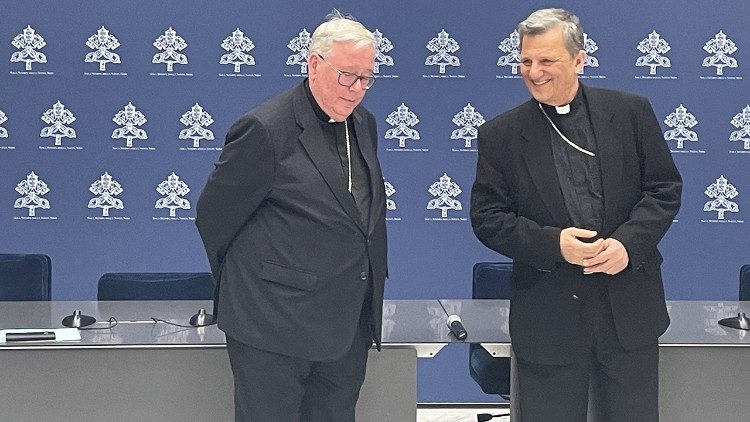
Cardinals Hollerich (L) and Grech (R) present the changes to the Synod at the Holy See Press OfficeCardinals Hollerich (L) and Grech (R) present the changes to the Synod at the Holy See Press Office 

Synod: Laymen and laywomen eligible to vote at General Assembly

The Secretariat for the Synod announces that 70 “non-bishop members” appointed by the Pope—half of whom will be women—will be able to vote at the Synod General Assembly in October.

By Salvatore Cernuzio

Neither the nature nor the name is changing—which remains the Synod of Bishops—but the composition of the participants in the October 2023 General Assembly in the Vatican on the theme of synodality is set to change, since a sizeable group of "non-bishop" members will also take part.

These 70 individuals will include lay people appointed directly by the Pope, 50 percent of whom shall be women and among whom shall be included several young people. All 70 will enjoy voting rights at the Assembly, which will consist of around 370 voting members out of more than 400 total participants.

‘Not a revolution’

These represent the main changes introduced on Wednesday by Pope Francis for the Synod Assembly, which will seal the synodal path he himself launched in the Autumn of 2021.

The changes were presented by Cardinal Mario Grech, Secretary General of the Secretariat for the Synod, and Cardinal Jean-Claude Hollerich, the Synod’s General Relator.

“This is not a revolution but an important change," they specified at a press conference at the Holy See Press Office on Wednesday.

"Non-bishop" members

The new arrangements were communicated on the same day in a letter to the heads of the Continental Assemblies held recently in Africa, Asia, the Middle East, and Oceania.

The letter states that no current regulations have been repealed, and that the 2018 Apostolic Constitution Episcopalis Communio already provided for the presence of "non-bishops" at the Synod.

The 70 non-bishop members will be chosen by the Pope from a list of 140 prepared by the 7 International Reunions of Bishops' Conferences and the Assembly of Patriarchs of Eastern Catholic Churches.

They shall represent “various groupings of the faithful of the people of God (priests, consecrated women, deacons, lay faithful)”, according to the letter.

The Synod Assembly shall also no longer include “auditors”.

A "plenary" assembly of bishops

“In this way, the specifically episcopal nature of the Synodal Assembly is not affected, but is rather confirmed," the General Secretariat of the Synod’s letter emphasizes.

"We are talking about 21 percent of the Assembly remaining a plenary assembly of bishops, with a sizable participation of non-bishops," Cardinal Hollerich reiterated further. "Their presence ensures the dialogue between the prophecy of the people of God and the discernment of the pastors."

Election and appointment

Speaking about the requirement for half of the 70 to be women and the presence of young people, the Cardinals said this is so “because that is the way our world is."

The choice of the 140 candidates, they added, shall take into account each person’s general culture, prudence, and knowledge and participation in the synodal process. As members, they have the right to vote.

This aspect is important, noted Cardinal Grech, adding that he hopes someday “we will be able to do without the vote, since the Synod is a discernment, a prayer.”

Five religious women and five religious men

The five women religious and five men religious elected by their respective organizations of Superiors General (UISG, for women religious; and, USG, for male religious) will also be eligible to vote.

These 10 men and women religious replace the ten clerics of the Institutes of Consecrated Life who attended in past Synod Assemblies.

All elections—to be held in plenary assembly and by secret ballot by the respective Synods, Councils and Bishops' Conferences—must be ratified by the Pope, and their names shall not be made public until the Pope confirms their election.

Facilitators

For the first time, the Synod will include several "facilitators".

Cardinal Grech explained that this choice was born from the experience of the Synod study groups, "which showed us that the presence of experts can create a fruitful dynamic."

"There are bishops who have never participated in the Synod, so we need to facilitate the spiritual dimension," Cardinal Hollerich explained.

He also noted that for the first time there will also be bishops from countries that do not have an Episcopal Conference represented at the Assembly. Cardinal Hollerich added that his Archdiocese of Luxembourg is one of them, along with Estonia and Moldova.

In conclusion, the two Cardinals agreed that "the Church will be more complete, and it will be a joy to have her represented in her entirety in Rome."

Saturday, April 22, 2023

Pope encourages those in various lay ministries


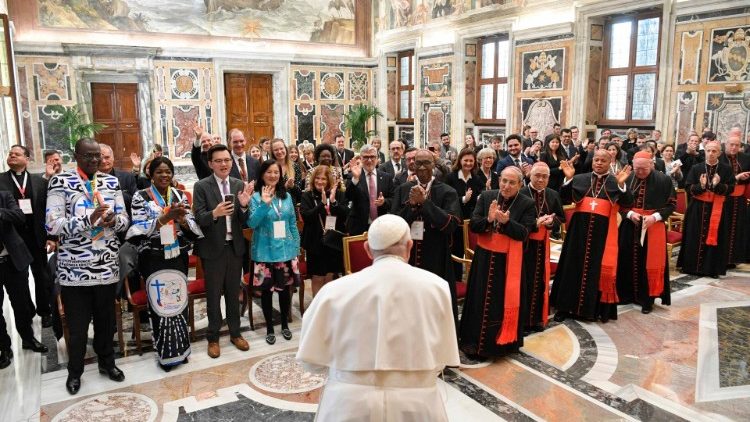
Pope Francis meeting the members of the Dicastery for Laity, Family and Life Pope Francis meeting the members of the Dicastery for Laity, Family and Life   (Vatican Media)

Pope: Lay ministers must serve and never become self-referential

Pope Francis addresses participants in Plenary Assembly of the Dicastery for Laity, Family and Life and reflects on the meaning of ministeriality in the Church and on the role of laypeople which must be focused on mission and service.

By Lisa Zengarini

Laypeople in the Church can carry out many instituted ministries, substitute services, assignments and offices, which, however, “must never become self-referential”, but always tend "to transform society" by “bringing Christian values into the social, political and economic world” of our time.

Pope Francis made this remark on Saturday in his address to the members of the Dicastery for Laity, Family and Life as they concluded their Plenary Assembly on the theme “The laity and ministeriality in the synodal Church”.

Welcoming the participants in the Clementine Hall, the Pope reaffirmed that "the willingness to serve the brethren, and in them, to serve Christ" is the true motivation that must inspire any faithful who assumes an ecclesial task and  any commitment to Christian witness in the reality where he or she lives”

The origin of the ministeriality of the Church

Referring to the theme of the three-day session, Pope Francis reflected on the meaning of ministeriality in the Church and on the role of laypeople in this context.

He noted that when we speak of Church ministries in general, the thought immediately goes to “instituted”  ministries such as the ones of lector, acolyte, and catechist “which are all well known”.

However, he said, these instituted ministries “do not represent the full extent of the ministeriality of the Church, which is broader and, ever since the first Christian communities, regards all the faithful”.  

The  common priesthood of all the faithful based on Baptism

The Pope recalled that its origin lies in Baptism and in the gifts of the Holy Spirit.

Indeed, the Sacrament is "the root of the common priesthood of all the faithful which is in turn expressed in the ministries”.

This is because all the baptized – whether lay people, celibate, married people, priests, religious – are Christifideles, that is believers in Christ, “and are therefore required to take part in the mission He entrusted to the Church, also through the assumption of specific ministries”.

The ministry of the laity in particular, the Pope continued, also “stems from the charism that the Holy Spirit distributes within the People of God for its edification”. This, the Pope said, explains even more clearly whythe ministeriality of the Church cannot "be reduced merely to instituted ministries, but rather embraces a far vaster field”.

Participating  in the prophetic and regal function of Christ

Even today, "as in the first Christian communities,  faced with particular pastoral needs, without resorting to the institution of ministries, pastors can entrust certain supplementary functions to laypeople, that is, temporary services, as in the case of the proclamation of the Word of the distribution of the Eucharist.”

Moreover, Pope Francis continued, “besides the instituted ministries, supplementary services, and other regularly entrusted offices, the laity can carry out a range of tasks, which express their participation in the prophetic and regal function of Christ: not only within the Church, but also in the environments where they live”, for example in reaching out to those affected by old and new forms of poverty, including migrants.

Family ministry

The Pope also mentioned the field of family ministry which is all the more relevant today in light of the many challenges the family is facing and which was another focus of the Plenary.

Recalling the magisterium of Pope St. John Paul II and of Pope St. Paul VI, Pope Francis highlighted, amongst other things,  the educational mission of the family as a ministry of evangelization.

Mission and service

All these ministries, services, assignments and offices, the Pope emphasized, “must never become self-referential” and have two fundamental things in common: "Mission and service", because they  "are an expression of the one mission of the Church and all are forms of service to others”.

“I like to emphasize that at the root of the term ministry there is the word minus, which means “minor”. And Jesus said so: those who command should make themselves the smallest, otherwise they do not know how to command. It is a small detail, but of great importance. Those who follow Jesus are not afraid to make themselves “inferior”, “minor”, to place themselves at the service of others. Indeed, Jesus himself taught us: “whoever would be great among you must be your servant, and whoever would be first among you must be slave of all” (Mk 10: 43-44).”

“Only by serving his brothers and sisters and, in them, Christ”, Pope Francis concluded, will “all the baptized be able to discover the meaning of their own life, joyfully experiencing being ‘a mission on this earth’ that is, being called, in different ways and forms, to ‘bring light, bless, enliven, raise up, heal and free’.

Saturday, February 18, 2023

Pope Francis calls for more laity participation


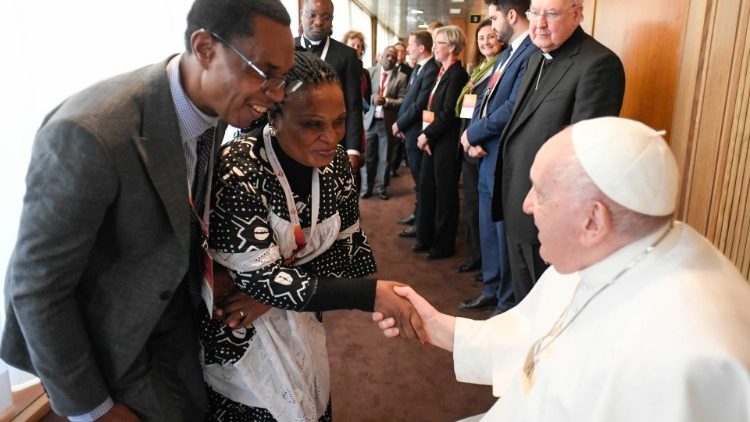
Pope Francis meeting participants in the conference hosted by the Vatican Dicastery for Laity, Family and Life on lay co-responsibility. Pope Francis meeting participants in the conference hosted by the Vatican Dicastery for Laity, Family and Life on lay co-responsibility.   (Vatican Media)

Pope Francis calls for greater lay protagonism in the Church

Pope Francis addresses the presidents and representatives of Episcopal Commissions for the Laity participating in the Conference “Pastors and lay faithful called to go forward together” and urges them to promote lay co-responsibility in their Churches in a spirit of synodality.

By Lisa Zengarini

For the Church to carry out its mission of proclaiming the merciful love of God effectively “emphasis must be placed on unity and not on separation” between clergy and laypeople, Pope Francis told participants in a conference hosted by the Vatican Dicastery for Laity, Family and Life on lay co-responsibility.

“The path that God is showing to the Church is precisely that of living communion and walking together more intensely and more concretely. He invites you to overcome the ways of acting independently”, the Pope said on Saturday as he addressed 200 presidents and representatives of Episcopal Commissions for the Laity who gathered this week in the Vatican to discuss how to improve the collaboration among laity, priests and consecrated persons in the service of the Church.  

Titled “Pastors and lay faithful called to go forward together”, the Conference was aimed at exploring the nature and foundation of lay co-responsibility in the Church also in light of the ongoing synodal process on synodality.

The Church as a body with shared responsibilities in the mission

In his address, Pope Francis insisted on the missionary dimension of synodality, in which all baptized in the Church, as one body and one People of God united by one faith in Christ, share their responsibilities like Jesus’s disciples did. “Indeed”, he said “sharing the mission brings pastors and laity closer together, creates a communion of intentions, manifests the complementarity of the different charisms and therefore arouses in everyone the desire to journey together”.

“The Church is the holy faithful People of God of Lumen Gentium, it is neither populism nor elitism. And this cannot be learned theoretically, it is understood by living it.”

A missionary Church

This missionary dimension, continued the Pope, must be at the center of the formation of the laity, “which doesn't have to be scholastic, limited to theoretical ideas”, because this leads to ideologies, “but also practical”, involving the faithful in various forms of witness, which brings them closer other people.

“The lay apostolate is above all a witness! Testimony of one's own experience, testimony of prayer, testimony of service to those in need, testimony of closeness to the poor and lonely people, testimony of acceptance, especially on the part of families. And so we are formed for the mission: going towards others. It is a training "in the field", and at the same time an effective way of spiritual growth. (…) The tragedy for the Church today (is) that Jesus keeps knocking on the door, but from within, so that we let Him go out!”

One People of God

Pope Francis went on to recall that valuing lay people in the Church is not the result of some “theological novelty”, or a "functional" solution for the shortage of priests, or worse a sort of “revenge” for those who have been put aside in the past. “Rather, it is based on a correct vision of the Church: that is of the Church as the People of God, of which the laity are full members together with ordained ministers.”

“It is therefore a question of recovering an "integral ecclesiology" ", as it was in the first centuries, in which everything is unified by belonging to Christ and by supernatural communion with him and with one's brothers, overcoming a sociological vision which distinguishes social classes and ranks and it is ultimately based on the "power" assigned to each category.”

The laity live in the world and are part of the People of God

“In this one People of God, which is the Church, the fundamental element is belonging to Christ”, not a specific status ,  Pope Francis stressed.   “In this unitary vision of the Church, where we are above all Christians, the laity live in the world and at the same time are part of the People of God“, he said, recalling Lumen Gentium, the Second Vatican Council Constitution on the Church, and the Puebla Document containing the renderings of the Third General Conference of Latin American Bishops in 1979.


Pope Francis further noted that, although the laity are mainly called to live their mission in the secular realities in which they are immersed, this does not exclude that they also have the “skills, charisms and competences to contribute to the life of the Church”: for example, in liturgical animation, catechesis , formation, in government structures and the administration of Church goods. This is why, he said, it is important for pastors to be trained, right from the seminary, “in a daily and ordinary collaboration with the laity”.

No to clericalism

Bringing his address to an end,  Pope Francis therefore insisted on the crucial importance of promoting the role of lay people , and above all women, in the Church involving them in the various fields of pastoral care and apostolate, and in the decision making processes, and entrusting them with resposibilities . “This co-responsibility lived between lay people and pastors - he said - will make it possible to overcome dichotomies, fears and mutual mistrust”.

“Clericalism must be chased away. A priest or a bishop who falls into this attitude does a lot of harm to the Church.”