Synod Briefing: 'A new way to be Church'
By Osservatore Romano
"Let us not grow weary of praying incessantly for peace."
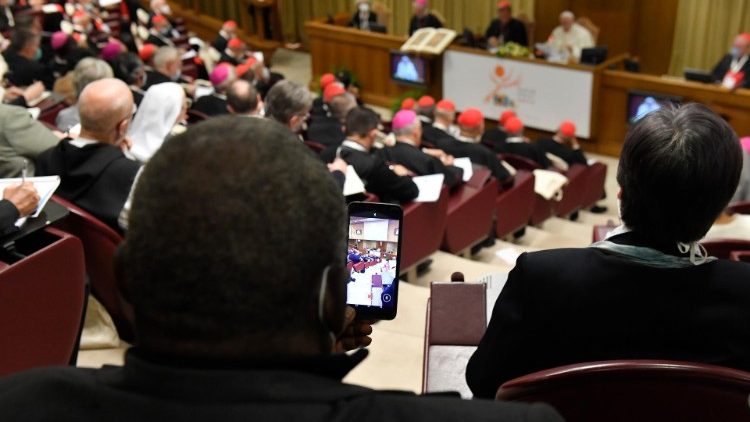
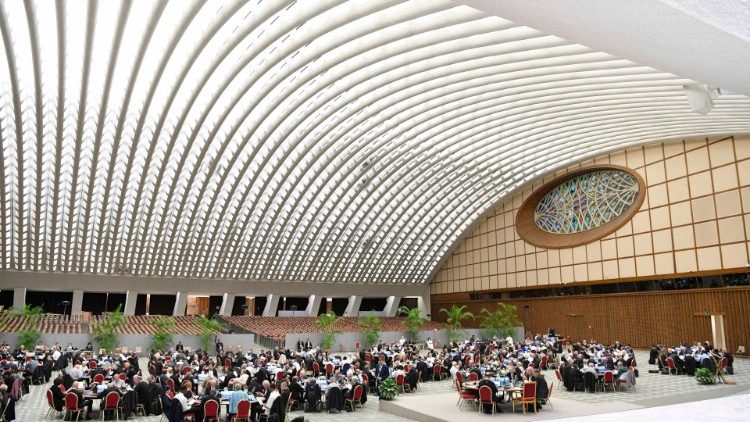
With these words, Cardinal Mario Grech, Secretary General of the General Secretariat of the Synod of Bishops, opened the proceedings in the Paul VI Hall on Friday morning, recalling that “today is a day of fasting and prayer for peace." The entire Assembly is scheduled to gather at 6 p.m. in St. Peter's Basilica for the Rosary and Eucharistic Adoration with Pope Francis.
This was announced by Dr. Paolo Ruffini, Prefect of the Dicastery for Communication and President of the Information Commission of the Synod, during Friday’s press briefing, which began at 2:20 p.m. in the Holy See Press Office and was introduced by Deputy Director Cristiane Murray.
Dr. Ruffini: Towards the vote on the "Synthesis Report"
"At this morning's General Congregation, there were 320 members present due to concurrent commitments in the Roman Curia and other meetings," Dr. Ruffini stated in reporting on the progress of the synodal works. "After prayer and before the discussion in the Circles and the free interventions—aimed at gathering questions, suggestions, and proposals regarding the next phase of the synodal process that will accompany us until October of the coming year—some information was given regarding the final drafting of the Synthesis Report."
"Yesterday, at the end of the discussion on the first draft of the Report," the Prefect explained, "we collected 1,125 collective 'modi' from the Circles and 126 individual 'modi.' All 'modi' have been and will be taken into consideration out of respect for those who submitted them. The reception work is still ongoing. The writers and experts, to whom the Assembly offered a round of applause in gratitude, are working, even at night, to prepare the updated version of the text."
Dr. Ruffini clarified that "the intent is to first consider those 'modi' that have garnered broad consensus, so they can find their place in the updated text. After incorporating the 'modi' submitted by the Working Groups, the text will be examined this evening during the meeting of the Commission for the Synthesis Report."
"In accordance with Article 33 § 2 of the Instruction on the Celebration of Synodal Assemblies," the Prefect added, "the Commission will be called to approve the text by an absolute majority. Subsequently, between tonight and tomorrow morning," he continued, "the final version of the text will be prepared, and tomorrow morning, the General Congregation scheduled in the calendar will not take place. Members will receive the text tomorrow mid-morning, and the official versions will be in English and Italian."
"In this way," Dr. Ruffini stressed, "an effort has been made to provide everyone with sufficient time to read the Synthesis Report in its final version in advance, so they can better prepare for the afternoon vote. The text given to the members is strictly confidential and may not be disseminated in any way."
"Tomorrow afternoon, the General Congregation will begin thirty minutes early, at 3:30 p.m.," the Prefect continued, explaining, "In the first part of tomorrow afternoon's General Congregation, the entire Synthesis Report will be read. After individual members have read it, the text will be collectively reread by the Assembly. Following this, the electronic vote will take place, allowing for the expression of individual votes on each paragraph of the text. To clarify the voting process this morning, a simulated vote was conducted at the end of the General Congregation. The secrecy of the vote was reaffirmed this morning. The system encrypts the data collected, preventing the identification of those who cast their votes."
Going into the details of tomorrow's vote, Dr. Ruffini said, "On the screen of each tablet provided to the Synod members, the number of each chapter of the Report and all paragraphs marked with alphabetical letters will appear. Each member must cast their vote—yes or no—for each paragraph. According to Article 35 § 3 of the Instruction on the Celebration of Synodal Assemblies, abstention is not allowed. In accordance with § 4 of the same Article 35 of the Instruction, individual paragraphs are considered approved with a two-thirds majority of the members present at the vote."
Dr. Ruffini also disclosed that "today, the Synod members were provided with meditations offered by Father Timothy Radcliffe, who was present at the briefing, during the spiritual retreat in Sacrofano. These meditations are compiled in a book available in Italian and English. And, by the express desire of the Holy Father as a gift to the Synod participants, a book (available in four languages: Italian, English, French, and Spanish) was published, containing the four letters that Father Radcliffe addressed to the Dominican Order during the years he served as the Master General."
"On Sunday, the Eucharistic celebration for the conclusion of the Synod will be held at 10 a.m. in St. Peter's Basilica," the Prefect recalled. In conclusion, Dr. Ruffini revealed, "This morning's works were introduced by the current delegated President, Ibrahim Isaac Sedrak, Patriarch of Alexandria of the Copts."
Pires: Toward greater synodal engagement
Sheila Pires, Secretary of the Information Commission, then presented the framework and contents of the interventions in the Working Groups, all focused on the subsequent phase in October 2024. The theme of the day was sharing ideas and proposals on methods and steps for the next phase of the synodal process before the second session.
Many participants, she said, suggested that the duration of the next Assembly should be three weeks, not four. They also proposed allowing more time for personal reflection and meditation, fostering better participation through interventions in the Assembly. More group meetings were requested, based not so much on language but on each individual's background.
Among the proposals was a brief summary of the Synthesis Document in more understandable language for everyone, especially for young people. It was also emphasized in the Hall "the importance of bringing 'conversations in the Spirit' to the communities to avoid the risk of discussions being disconnected from the concrete life of the people of God." Furthermore, "it was suggested to involve local communities at all levels, following a synodal path." Finally, Ms. Pires concluded, "proposals were made to apply synodality and co-responsibility, making good use of the possibilities already provided by canon law to involve young people, women, and deacons."
Mother Angelini: Bringing Benedictine experience to the Halll
Mother Maria Ignazia Angelini, a Benedictine from the Viboldone Monastery, acted as a spiritual assistant at the Synod. She first confided that "this role deeply suits me, as I participate in listening and prayer and interact with the Synod members during the various breaks between the Working Groups. I come from a monastic experience within the Church, an experience that has been marginal since its origins but with a prophetic charge, and I think of Saint Benedict."
Significantly, she continued, "being able to represent my absolute insignificance in this continuous thread of meaning in the history of the Church, stationed at the root of the issues that have been addressed, the root expressed in the monastic perspective on the life of the Church through the study of the Scriptures, prayer, and fraternal relationships, which becomes welcoming."
From this perspective, the Benedictine nun further underscored the "revolutionary" nature of the Synod, "a change in the life of the Church, in the sense of inclusivity in presence," with "an opening in the ability to listen to differences, in the ability to look at reality, at a complex and indecipherable moment in history that calls for faith to provide a vision from the highest perspective, where the presence of God becomes flesh."
"The Scriptures give us profound and luminous criteria for interpreting such terrible moments in history," Mother Angelini continued, praising the "profoundly innovative" way in which cardinals, bishops, theologians, and laity have come together, despite their differences, to pray together and listen to each other. It will be important, she concluded, "to see how we will move forward from this experience."
Father Radcliffe: Learning synodal style together
Father Timothy Peter Joseph Radcliffe, a Dominican from the British Monastery of Oxford, also spoke as a spiritual assistant at the Synod. He mentioned that synodality is a part of the Dominican way of life, founded eight hundred years ago, in which decisions are made together. Being at his fourth Synod, he observed that this one is truly different from the others. "This is an extraordinary change in the way we are the Church together," he said, noting that simply seeing cardinals and young women from Latin America and Asia sitting together to talk is transformative from the perspective of people's experiences and being the Church.
However, he assured, "it is certainly still a Synod of Bishops because it reveals very clearly what it means to be representatives of the episcopal college not as solitary individuals, but as bishops immersed in the conversation of their people," through "listening, speaking, learning together."
Father Radcliffe also alluded to the changes for the Church's future that many expect: "This means that perhaps they are not looking for the right thing because we are gathered to understand how to be the Church in a new way, rather than making specific decisions; how we can be a Church that listens, and whose members listen to each other across different cultures, and listen to tradition over time. We are learning how to make decisions together, how to listen to each other: we are at the beginning of a learning process, so there will be obstacles and mistakes, and this is okay because we are on a journey."
Moreover, he emphasized, "this learning process is of extraordinary importance today. We live in a world full of violence, with the breakdown of communication among people, as in the Middle East, Ukraine, and many parts of Africa, but also in our own countries, in Great Britain and the United States, where we see polarization. In some way, we must learn how to talk to each other and listen to each other. So, this Synod may not only be useful for healing the wounds of the Church but also for humanity."
Frère Alois: A new way of being Church
Frère Alois, Prior of the Taizé Community since 2005, following the death of Frère Roger (he will leave office on 3 December, handing it over to Frère Matthew) and participating in the Synod as a "special invitee," began by quoting an expression confided to him by a Reformed pastor present in the Hall as a fraternal delegate: "This Synod is a profound experience of communion." These are significant words that testify to how the synodal assembly has genuinely been "open to all Christians and to the world." In this regard, Frère Alois recalled the ecumenical vigil held in St. Peter's Square on September 30, attended by representatives of various Christian churches and communities: "It is an image," he said, "of what we are currently experiencing in ecumenism; it is a kairos, an opening, a moment that allows us to advance in spiritual ecumenism" based on the awareness that "we are all baptized in Christ" and "part of one body." This, he added, "has been palpable throughout the Synod," especially in listening, simplicity, willingness to dialogue, and the joy of being together. "I truly hope that this style," he wished, "can spread to many places in the world" because the synodal process "is leading us into a new way of being the Church."
No reason to fear of synodal method
In response to the first question from journalists, who asked if he considered himself one of the "builders" of this Synod in some way, given his books on communication that Pope Francis appreciated, Father Radcliffe said he did not have a particular role in this regard but participated in the common dialogue.
To the next question about the possibility of the Synod leading the Church to a new phase despite the skepticism of some, Frère Alois reiterated that he appreciated a certain evolution in the dialogue during the weeks of work. Participants from different cultural backgrounds tried to understand each other better, he said, stating that he was certain the Synod brought a transformation in their hearts according to "the path we all need to take together."
Father Radcliffe echoed this by asserting that some people fear the synodal method because they do not understand it. They are afraid that synodal debates are political in nature and cause schisms, but the opposite is happening. "The Synod is an event of prayer and faith," he emphasized.
In response to the question about what practical suggestions he would give to a parish priest to implement the concepts of this Synod, Father Radcliffe replied that the recurring theme of the Synod had been the criticism of clericalism. However, this should not alarm diocesan priests; instead, it is necessary to highlight every positive aspect of diocesan priesthood, its beauty, and to support the work of those who evangelize.
When asked about any political readings of the Synod, Father Radcliffe emphasized that he did not believe that ideological conflict had emerged from the discussions. What had emerged were cultural differences. The beauty of Catholicism, he said, lies in welcoming people from all over the world because cultures have a beautiful diversity that enriches. What may be a concern for a particular cultural environment is not the same for those living elsewhere. Learning to be respectful of others' concerns, he said, is a much more important theme than ideological issues, which were not found in the Synod.
In this regard, Brother Alois observed that we live in a world with increasing fears and anxieties. The temptation to embrace ideologies exists, but in the Church, one can truly go against the current and cross boundaries. He noted that this is evident with young people at Taizé, who want to be more understanding and respectful of different ways of expressing faith. In the Church, he concluded, a clearer way of living the beauty of diversity must be found.
Father Radcliffe, in response to a question about the admission of homosexuals to the seminary, clarified that the issue is not exclusion but rather the fact that there are people who have made their sexuality "the center of their identity," which raises doubts about their suitability for the priesthood. When asked about the fruits the Synod can yield, the Dominican theologian reiterated that it was not just a dialogue exercise but primarily a sharing of experiences, appreciating everyone's openness to "the lives and experiences of people from different places." In the same vein, the Prior of Taizé emphasized how the method of listening had been fruitful, although it would take time to see the results of what was sown. He also appreciated the fact that "in this assembly, a space for listening has been provided following a profoundly evangelical method."
Responding to a question about young people, Mother Angelini said that as she had not participated in the Working Groups, defined as a fruitful moment for experiencing the "transition from 'I' to 'we,'" her perspective is partial. However, it allowed her to grasp the seriousness of the problem. She explained the need for the Church to find an appropriate language, especially in the digital world and in the communication of new media, as well as a liturgical language that is outdated for the new generations. In this regard, the Synod highlighted the need for conversion.
Mother Angelini continued by emphasizing that the presence of the Taizé brothers at the ecumenical prayer on 30 September was a significant moment. She stated that it now falls on the members of the Synod to bring these concerns to local Churches by identifying places for mutual listening to address the major issue of young people's absence from ecclesiastical life. Since this need was expressed at the Synod, Mother Angelini continued, it is now necessary to mediate and pray for places where young people feel called, attracted, and involved in a process of ecclesiastical conversion, not just personal dialogue. They need to share their stories and be included in paths of discernment, reading of history, and practical decision-making in their local churches.
In response to a question, Dr. Ruffini reaffirmed that abstaining from the vote would not be possible and referred to the proposals discussed by each Group. In practice, the path from this point to the next assembly is still in progress and requires further discernment in dioceses. One significant aspect is how to involve the people of God, who live in very different places, which can be in a state of war or suffering, in a journey in which they are involved. The observations must be submitted to the Commission by tonight for them to be considered or for proposals to be made. Father Radcliffe added, "This is the first time that non-bishops have the right to vote."
In response to a question about the importance of healing the wounds of humanity, Father Radcliffe said it is necessary to "try to reach out to wounded people and take care of them." He mentioned the experience of Luca Casarini, a Synod participant who is involved in saving migrants at sea. "Taking care of one another allows us to heal the wounds of others, and listening to the voices of wounded people is very important because it enables us to help them in their healing," he concluded.
Regarding a possible direct connection between the Synod's reflection and the morning's statement concerning Father Rupnik - with the Pope's decision to waive the statute of limitations to allow a canonical procedure to take place – Dr. Ruffini said, "I don't think there is a connection with what the Synod has repeatedly emphasized and what the Church has been doing for years to address the issue of abuse and to undertake a journey of penance, which did not begin today, and work on the new rules that have been approved."
The Synod, however, does not deal with individual cases, Dr. Ruffini added, emphasizing the important role of Pope Francis in the fight against abuse.