Showing posts with label Mauritius. Show all posts

Monday, December 23, 2019

The Apostolic Journeys of 2019 by Pope Francis

Pope Francis boarding a plane to Maputo, Mozambique. Pope Francis boarding a plane to Maputo, Mozambique.   (ANSA)


A Pontificate on the roads of the world


In 2019 Pope Francis made 7 international Apostolic Journeys to 11 countries. His has been an “itinerant pontificate” that has focused on the world’s geographical and existential peripheries.


By Alessandro Gisotti
 “I'll tell you something: I don't like to travel.”  These are the surprising words that Pope Francis pronounced on 9 June when addressing a group of children whom he received in the Vatican as part of the “Children's Train” initiative.  
It is a well-known fact that as Archbishop Jorge Mario Bergoglio of Buenos Aires, he rarely left his diocese.  There were few international trips, mostly to Latin America or to Rome for synods and consistories.  
However, the future Pope always kept alive the missionary spirit of a traveller, which as a young man made him dream of going to Japan in the footsteps of Saint Francis Xavier. This dream which he was unable to realize as a young Argentine Jesuit, was fulfilled this year when he visited the Land of the Rising Sun.  
Frankly speaking, the future Pope never stood still in his vast Archdiocese of Buenos Aires.   He travelled far and wide, and almost always used public transport.  It was a “normal thing” for the Argentine bishop and then cardinal.  However, this caused a sensation when, immediately after his election to the papacy, some earlier photos of the new Pope in a clerical shirt sitting like an ordinary commuter in a bus in the Argentine capital began circulating. 
Hence, he was a “callejero”  (itinerant) bishop, in the midst of the people, who preferred to spend time in the “Villas Miserias” (shanty towns) in the “existential peripheries” of the metropolis, rather than in the city centre.  As bishop, he always travelled within his diocese.  And so, when he became the Shepherd of the Universal Church, Pope Francis immediately felt that his diocese was now the world and that he had to set out again, with the same spirit that had animated him until then, but on a much larger space.
In his encounter with the “Children's Train”, Pope Francis admitted that in travels “you always find people, good people and you learn a lot”.  In these candid words, one can discover the purpose of Pope Francis’ travels - meeting people and understanding the contexts.  In some way, as the Washington Post also noted recently in an article by Chico Harlan, the Pope uses his Apostolic Journeys to “reform the Church” by focusing on the peripheries from which to draw the sap to initiate new processes of evangelization.
With a record number of Apostolic Journeys, 2019 has been a remarkable year of an “itinerant”, “synodal” pontificate.  This year, Pope Francis made 7 foreign trips, visiting 11 countries on 4 continents, equalling Pope Saint John Paul II, who also visited 11 countries in 1982.
On the other hand, it is significant that this year, so full of international journeys, coincides with the centenary of Pope Benedict XV's Maximum Illud on the Church’s missionary action in the world. With his travels, Pope Francis emphasizes precisely this intrinsically missionary dimension of the Lord's disciple,  who is called to be “outward going” to announce the Good News throughout the world, because no land is far away and no people is alien to the Word of God.
“Re-reading” the Pope’s 7 foreign trips this year, one can also find the great features of his pastoral thrust:  young people, in the trip to Panama for WYD; interreligious dialogue, in trips to the Arab Emirates and Morocco; ecumenical dialogue, in visits to Bulgaria and North Macedonia and then to Romania.   In his visits to Mozambique, Madagascar and Mauritius, the themes of the protection of the environment and care of the poor were predominant.  Finally, peace and the promotion of women's and children's rights were the key points of his Asian trip to Thailand and Japan.
In his remarks to journalists, on his flight to Thailand, he noted that “it is so good for people to be informed and also to know the cultures that are far from the West”.   With his travels, the Pope actually brings light to corners of the world where the mass media would never go, but which, thanks to his presence, become “visible” to the international community, which is called to care for peoples and lands otherwise forgotten.  
These Apostolic Journeys also promote the “culture of encounter” well beyond the moment after the Pope flies back to Rome.  This is true not only for the people but also for him.  In an interview, he confided carrying in his heart the people he met in his travels, that he prayed "for them, for the painful and difficult situations", so that the inequalities he saw may be reduced.

Tuesday, September 10, 2019

Pope Francis concludes his 4th Apostolic Visit to Africa

© Vatican Media

Pope Concludes Visit to Mozambique, Madagascar, & Mauritius, Marking 4th Apostolic Visit in Africa

Francis Will Still Have His General Audience Tomorrow Morning

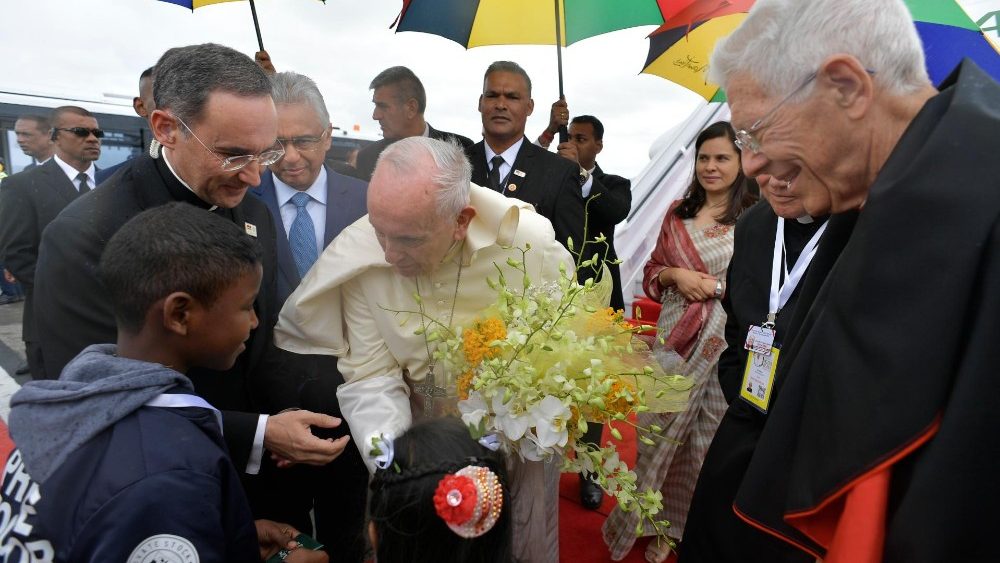
After celebrating Mass in private and saying his final farewells, Pope Francis has departed from Madagascar and is returning toward Rome.
Before leaving for the airport, Francis also greeted about ten poor elderly women at the apostolic nunciature where he was staying who represent those who the nunciature assists every Friday.
At 9:40 a.m. local time (8:40 Rome time) today, the Madagascar Airlines A340neo papal flight carrying the Pope, his entourage and journalists, took off from Madgascar’s Antananarivo Airport, en route for Rome’s Ciampino Airport.
The Holy Father’s Sept. 4-10 visit to the ‘three ‘M’s’ of Mozambique, Madagascar, and Mauritius, marked the Pope’s fourth visit to Africa, his second to Sub-Saharan Africa, and represented the Holy Father’s attention to the peripheries and the poor. It also marked his 31st Apostolic Trip.
Each of these nations had been visited by St. Pope John Paul II during his pontificate.
As is customary, Pope Francis likely this evening will visit Rome’s Basilica of Santa Maria Maggiore to thank Our Lady for the fruits of the trip, and for her help and protection.
The Holy Father will also hold his press conference on the return flight and ZENIT will provide you with the full English translation of the Q & A as soon as possible.
Tomorrow morning, the Pope will still have his weekly General Audience in the Vatican.

Monday, September 9, 2019

Before leaving Mauritis the Pope celebrates Holy Mass

© Vatican Media

Pope in Mauritius: Despite Feeling Overwhelmed, Renew Certainty in God’s Victory

Celebrating Final Mass of Trip, Urges Faithful to Pray to Mary for Persevering Joy that Doesn’t Falter or Fade (Full Homily)

“Even though we may feel overwhelmed and trapped, our hope in Jesus invites us to a renewed certainty in God’s victory…”
Pope Francis said this during the Mass he celebrated on the island of Mauritius, during his only day visiting the tiny country, during his 31st Apostolic Trip. Francis is traveling to the African nations of Mozambique, Madagascar and the island of Mauritius, Sept. 4-10, 2019.
He also reminded the island nation’s faithful to turn to Mary for “the persevering joy that does not falter nor fade.”
This evening, the Holy Father leaves Mauritius to stay overnight in Madagascar, and tomorrow, he will fly back to Rome.
Father Laval & His Trust in the Lord’s Power
Today, September 9th is the feast of Blessed Jacques Désiré Laval, often called the Apostle of Mauritius.
In the Holy Father’s homily, Francis stressed that Father Laval, through his missionary outreach and his love, gave to the Mauritian Church a new youth, a new life, that today we are asked to carry forward.
Blessed Father Laval, Francis acknowledged, also experienced moments of disappointment and difficulty with the Christian community, “but in the end, the Lord triumphed in his heart. For he had put his trust in the Lord’s power,” Francis noted.
While acknowledging the challenges for the island and in particular for its young people, Francis stressed in his homily: “Together, we can say to the Lord: We believe in you, and with the light of faith and every beat of our hearts, we know the truth of the words of the prophet Isaiah: Proclaim peace and salvation, bring the good news… that our God already reigns.”
How to Be a Good Christian
The Beatitudes–Francis reminded once again– “are like a Christian’s identity card.”
“So if anyone asks: ‘What must one do to be a good Christian?’, the answer is clear,” he said. “We have to do, each in our own way, what Jesus told us in the Sermon on the Mount.”
Despite feeling overwhelmed, invited to renew joy in God’s victory
The Argentinian Pontiff reminded them that Father Laval tells our young people, and all those who too feel voiceless and simply are living from day to day, to take up Isaiah’s proclamation, namely to break forth singing for the Lord has comforted His people.
“Even though we may feel overwhelmed and trapped, our hope in Jesus invites us to a renewed certainty in God’s victory,” he said,”not only through history but also within the hidden thread of all those little ‘histories’ that intertwine and convince us of the victory of the One who has given us the kingdom.”
Living the Gospel message, he noted, also requires recognizing that not everything around us will be perfect.
The persevering joy that never fades
Drawing attention to the statue of Mary, “the Mother who protects and accompanies us,”Francis told the faithful to pray to her for the gift of openness to the Holy Spirit.
“May she obtain for us that persevering joy that never falters or fades,” the Holy Father said, namely “the joy that constantly leads us to experience and proclaim that ‘the Most High has done great things, and holy is His name.’”
Here is the full Vatican-provided text of the homily:
* * *
Here, before this altar dedicated to Mary Queen of Peace, on this mountain from which we can see the city and the sea beyond, we are part of a great multitude, a sea of faces come from Mauritius and other islands of this Indian Ocean region to hear Jesus preach the Beatitudes. We have come to hear that same word of life that today, as two thousand years ago, has the power and the fire able to warm the coldest of hearts. Together we can say to the Lord: We believe in you, and with the light of faith and every beat of our hearts, we know the truth of the words of the prophet Isaiah: Proclaim peace and salvation, bring the good news… that our God already reigns.
The Beatitudes “are like a Christian’s identity card. So if anyone asks: ‘What must one do to be a good Christian?’, the answer is clear. We have to do, each in our own way, what Jesus told us in the Sermon on the Mount. In the Beatitudes, we find a portrait of the Master, which we are called to reflect in our daily lives” (Gaudete et Exsultate, 63). So it was with the “apostle of Mauritian unity”, Blessed Jacques-Désiré Laval, so greatly venerated in these lands. Love for Christ and for the poor so marked his life that he could
not conceive of an “aloof and sanitized” preaching of the Gospel. He knew that evangelization entails becoming all things to all people (cf. 1 Cor 9:19-22), and so he learned the language of the recently freed slaves and taught them the Good News of salvation in simple language. He was able to gather the faithful,
to train them for mission and to establish small Christian communities in the neighbourhoods, towns and nearby villages: small communities, many of which gave rise to present-day parishes. His pastoral solicitude earned the trust of the poor and outcast, and made them the first to come together and find responses to their sufferings. Through his missionary outreach and his love, Father Laval gave to the Mauritian Church a new youth, a new life, that today we are asked to carry forward.
We need to foster this missionary momentum, because it can happen that, as the Church of Christ, we can yield to the temptation to lose our enthusiasm for evangelization by taking refuge in worldly securities that slowly but surely not only affect the mission but actually hamper it and prevent it from drawing people together (cf. Evangelii Gaudium, 26). Missionary momentum always has a young and invigorating face. For it is the young who, by their vitality and generosity, can give it the beauty and freshness of youth, when they challenge the Christian community to renewal and urge us to strike out in new directions (cf. Christus Vivit, 37).
This is not always easy. It means learning to acknowledge the presence of the young and to make room for them in our communities and in our society.
It is a hard thing to say, but, despite the economic growth your country has known in recent decades, it is the young who are suffering the most. They suffer from unemployment, which not only creates uncertainty about the future, but also prevents them from believing that they play a significant part in your shared history. Uncertainty about the future makes them feel that they are on the margins of society; it leaves them vulnerable and helpless before new forms of slavery in this twenty-first century. Our young people are our foremost mission! We must invite them to find their happiness in Jesus; not by speaking to them in an aloof or distant way, but by learning how to make room for them, “learning their language”, listening to their stories, spending time with them and making them feel that they too are blessed by God.
Let us not deprive ourselves of the young face of the Church and of society. Let us not allow those who deal in death to rob the first fruits of this land!
Father Laval tells our young people, and all those who, like them, feel voiceless, simply living from day to day, to take up Isaiah’s proclamation: “Break forth together into singing, you ruins of Jerusalem; for the Lord has comforted his people, he has redeemed Jerusalem!” (Is 52:9). Even though we may feel overwhelmed and trapped, our hope in Jesus invites us to a renewed certainty in God’s victory, not only through history but also within the hidden thread of all those little “histories” that intertwine and convince us of the victory of the One who has given us the kingdom.
Living the Gospel message means that we cannot keep hoping that everything around us will be perfect, for all too often the thirst for power and worldly interests work against us. Saint John Paul II noted that: “a society is alienated if its forms of social organization, production and consumption make it more
difficult to offer [the] gift of self and to establish solidarity between people” (Centesimus Annus, 41c). In such a society, it becomes difficult to live the Beatitudes: any attempt to do so will be viewed negatively, regarded with suspicion, and met with ridicule (cf. Gaudete et Exsultate, 91). This is true, yet we must not let ourselves yield to discouragement.
At the foot of this mountain, which today I would like to be the Mount of the Beatitudes, we must also discover anew Christ’s call to be “blessed”. Only joyful Christians awaken in others the desire to follow this path. The word “blessed” means “happy”. It becomes a synonym for “holy”, for it expresses
the fact that those faithful to God and his word, by their self-giving, gain true happiness (cf. ibid., 64).
When we hear the threatening prognosis that “our numbers are decreasing”, we should be concerned not so much with the decline of this or that mode of consecration in the Church, but with the lack of men and women who wish to experience happiness on the paths of holiness. We should be concerned with the lack of men and women who let their hearts burn with the most beautiful and liberating of all messages.
Indeed, “if anything should rightly disturb us and trouble our consciences, it is the fact that so many of our brothers and sisters are living without the strength, light and consolation born of friendship with Jesus Christ, without a community of faith to support them, without meaning and a goal in life” (Evangelii Gaudium, 49).
When young people see the project of a Christian life being carried out with joy, this excites and encourages them. They too feel a desire to say, in so many words: “I too want to climb this Mount of the Beatitudes; I too want to meet the gaze of Jesus and to learn from him the path to true joy”.
Dear brothers and sisters, let us pray for our communities, that they may testify to the joy of Christian life and see a flowering of the call to holiness in the many and varied forms of life that the Spirit proposes to us. Let us pray to him for this diocese and for all those who have made the effort to come here today. Blessed Father Laval, whose relics we venerate, also experienced moments of disappointment and difficulty with the Christian community, but in the end, the Lord triumphed in his heart. For he had put his trust in the Lord’s power. Let us pray that that same power may touch the hearts of many men and women of this land, and our hearts as well, so that its newness may always be capable of renewing our lives and our communities (cf. ibid., 11). Let us not forget that the one who summons with power, who builds up the
Church, is the Holy Spirit.
The statue of Mary, the Mother who protects and accompanies us, reminds us that she herself was called “blessed”. Let us ask her for the gift of openness to the Holy Spirit. Our Lady experienced a sorrow that pierced her heart like a sword, and crossed the most painful threshold of grief as she beheld the death
of her Son. May she obtain for us that persevering joy that never falters or fades. The joy that constantly leads us to experience and proclaim that “the Most High has done great things, and holy is his name”.

Pope Francis to the leaders of Mauritius

© Vatican Media

Pope Francis Urges Mauritius’ Leaders to Work for Development for Everyone

‘I would like to encourage you to promote an economic policy focused on people and in a position to favor a better division of income, the creation of jobs and the integral promotion of the poor’

While praising efforts at economic development in Mauritius and the nation’s peaceful coexistence among various religions, Pope Francis on September 9, 2019, encouraged the nation’s leaders to do more.
He addressed national authorities, leaders of society, and the diplomatic corps at the presidential palace in Port Louis. The island nation is his final stop in his September 4-10, 2019, apostolic journey to Mozambique, Madagascar, and Mauritius. In fact, the Holy Father headed home after the address (first blessing a large number of sapling trees that will be planted throughout the island).
“Thanks to this brief visit, I have the pleasure of encountering your people, known not only for cultural, ethnic and religious diversity but above all for the beauty born of the ability to acknowledge, respect and harmonize existing differences in view of a common project,” Pope Francis said. “This sums up the history of your people, born of the arrival of migrants from different horizons and continents who brought their own traditions, cultures, and religions, and gradually learned to be enriched by the difference of others and to find ways of living together and striving to build a society committed to the common good.”
The Holy Father noted that Mauritius is a nation entirely of migrants; there was no indigenous population before the arrival of colonists from Western Europe. He urged leaders to continue to welcome migrants and foster policies that help them to be successful.
He also praised the economic development that has occurred but warned that with that success comes danger. In particular, he affirmed the need to protect the poor.
“Since its independence, your country has experienced a steady economic development that should certainly be a reason to rejoice, but also to be on guard,” Francis said. “In the present context, it appears that economic growth does not always profit everyone and even sets aside – by certain of its mechanisms and processes – a certain number of people, particularly the young.
“That is why I would like to encourage you to promote an economic policy focused on people and in a position to favor a better division of income, the creation of jobs and the integral promotion of the poor (cf. Evangelii Gaudium, 204). To encourage you not to yield to the temptation of an idolatrous economic model that feels the need to sacrifice human lives on the altar of speculation and profit alone, considering only immediate advantage to the detriment of protecting the poor, the environment and its resources.”

Today in Mauritius; stopping to remember their "blessed"

© Vatican Media

Pope Francis Visits Shrine of Father Laval in Mauritius

Holy Father Praises ‘Apostle of Mauritius’

Today, September 9th is the feast of Blessed Jacques Désiré Laval, often called the Apostle of Mauritius. And as you might imagine, it was a moment of great joy for people on the island nation that Pope Francis was present on this day and visited the Shrine of Father Laval.
In the Holy Father’s homily earlier today, Francis stressed that Father Laval, through his missionary outreach and his love, gave to the Mauritian Church a new youth, a new life, that today we are asked to carry forward.
Blessed Father Laval, Francis acknowledged, also experienced moments of disappointment and difficulty with the Christian community, “but in the end, the Lord triumphed in his heart. For he had put his trust in the Lord’s power,” Francis noted.
Father Laval was born in France in 1803 and died at 60 in 1864 in Mauritius, where he spent his life serving the poor, sick, and suffering. His feast day is observed by Christians and non-Christians alike in the country.
During his visit, Pope Francis presented a give to the shrine, an icon of “Our Lady of Tenderness”.
This delicate and subtle representation of the Virgin Mary with Child is directly inspired by the renowned icon of “Our Lady of Tenderness”, better known in Byzantine Christian culture as “Our Lady of Vladimir”.
The icon of “Our Lady of Tenderness” underlines that special and natural gentleness that there is between the Mother and Child, with that embrace culminating in the delicate contact between their cheeks. A sign of profound unity and closeness, this brings to mind the words of Psalm 17: “Keep me as the apple of your eye; hide me in the shadow of your wings”.
Abandoning herself in that embrace, and letting herself be safeguarded in faith, however, Mary does not look at Jesus, because she knows that she is looked at by Him. Instead, she turns her incredibly gentle but at the same time sorrowful gaze towards the believer who contemplates the icon and, through him, to all humanity that has drifted away from God, causing the sufferings of which the world is full. In this way, a profound spiritual dialogue is established between those who contemplate and Jesus and Mary, who bows towards the Son in search of consolation, while the gaze of the Child is entirely focused on that of the Mother as if to express compassion for those who suffer.

Sunday, September 8, 2019

Pope Francis on to Mauritius

Photo by LY Hoang Long - Mauritius Tourism

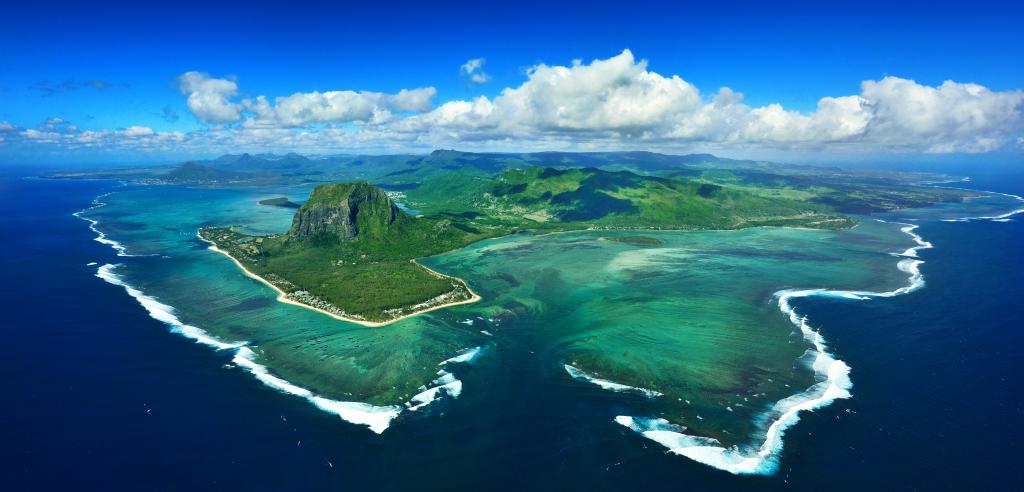
FEATURE: Francis to Visit Mauritius 30 Years After Saint John Paul II

‘Mauritius was made first and then heaven, and heaven was copied after Mauritius.’

“Mauritius was made first and then heaven, and heaven was copied after Mauritius.”
The quote is usually attributed to the great American writer Mark Twain, who was a visitor to the island nation and sang its praises. However, although he spoke the words, he was quoting an islander, not making an original observation. Having said that, there is no evidence that Twain disagreed with the heavenly analysis.
Vina MacDonald of suburban Chicago is quick to praise the beauty of Mauritius, where she was born and raised. She met her American husband, Eric, when both were in college in Paris. But she still has family on the island and said they are excited about the Pope’s visit, which begins September 9. As Vina pointed out, that date is special for everyone on Mauritius. With the Pope’s visit, it will be a national holiday and it is expected that people of all religious faiths will turn out to see the Holy Father.
Although people in any nation have their disagreements, Vina is proud to say that Mauritius is a place where people of all faiths and ethnic backgrounds get along and respect one another.
September 9 is the feast day of Blessed Father Jacques-Désiré Laval. This Spiritan Father (Holy Spirit Congregation) was the first person to be beatified by Pope John Paul II in 1979 and is regarded as the great missionary of the island, according to Aid to the Church in Need.
On arriving here in 1841 he immediately set about learning Creole and also devised a little catechism in the local language. He took the Gospel to the former slaves there who had recently been set free by the British government and tirelessly traveled by donkey to the poorest huts and shanties, dressed in his worn and repeatedly patched soutane. He died in 1864 after an immensely fruitful work of evangelization. He is still celebrated each year, in great processions which go well beyond the Catholic community alone. In 2019 these processions will take place on the 7th and 8th of September in order not to conflict with the main event, which will be the outdoor Mass celebrated in Port Louis by Pope Francis.
It had been 30 years since Saint Pope John Paul II visited Mauritius. As is the case with Pope Francis, the visit was the final stop on a 10-day tour. John Paul was coming from South Korea and Indonesia; Francis will have visited Mozambique and Madagascar.
Photo by Grey Hutton - Mauritius Tourism
Like John Paul before him, Francis will find a population of many ethnic backgrounds and faiths. There is no indigenous population, Mauritius being colonized by Western Europeans and later gaining residents from Asia and Africa. Religious faiths include Christians, Muslims, Buddhists, and Hindus.
There was a famous indigenous (albeit non-human) population when the first colonists arrived: the dodo bird. The bird was large, tasty, and easy to catch. The human arrivals to Mauritius literally ate it into oblivion. Only pictures and a few stuffed specimens remain.
Mauritius is a tiny nation, covering just 790 square miles. Population density is high with about 1.3 million people on the island. Twenty-eight percent of the population is Catholic and is served by two bishops, 93 priests, 186 women religious, and 1,335 catechists.
Pope Francis, who has become known for maintaining a rigorous travel pace, will have a packed day in Mauritius on September 9:
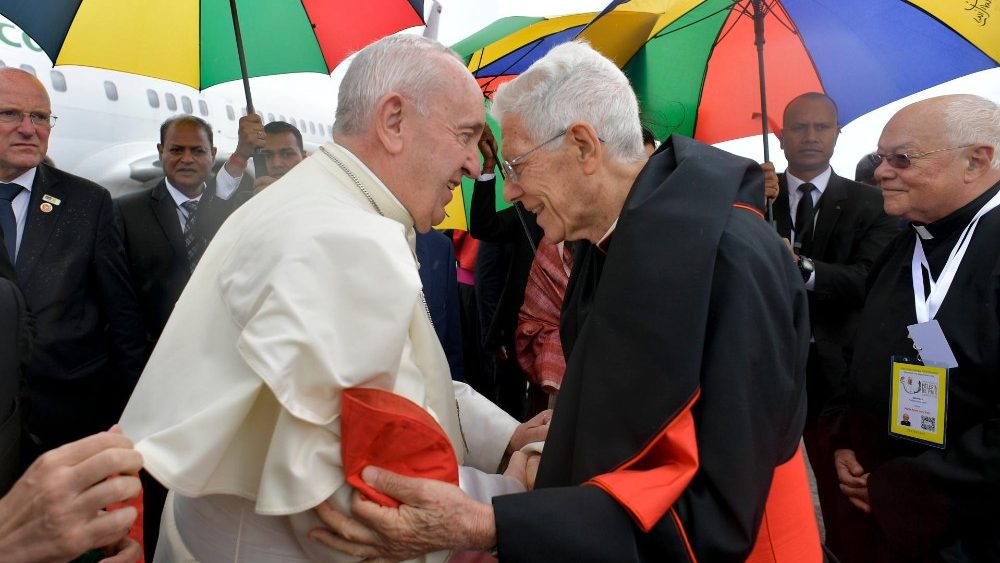
10:40 WELCOME CEREMONY at Port Louis Airport
12:15 HOLY MASS at the Monument to Mary Queen of Peace
Lunch with the bishops of CEDOI in the bishopric
16:25 PRIVATE VISIT TO THE SHRINE OF PERE LAVAL
16:55 COURTESY VISIT TO THE PRESIDENT in the Presidential Palace
17:15 MEETING WITH THE PRIME MINISTER in the Presidential Palace
17:40
18:45 FAREWELL CEREMONY at Port Louis Airport
As for the suggestion that heaven is built on the model of Mauritius, well, that clearly is hyperbole. But a perusal of the Mauritius Tourism website will provide some rather heavenly images. And if someone likes to boat, swim, dive, fish, hike, golf, savor good cooking, enjoy the beauty of nature or practice their faith in a tolerant environment, the island might seem to be a bit of heaven on earth.