Showing posts with label Madagascar. Show all posts

Sunday, February 15, 2026

Pope Leo XIV offers two specific prayer intentions at end of the Sunday Angelus


City center of Toamasina, Madagascar, following the aftermath of tropical cyclone GezaniCity center of Toamasina, Madagascar, following the aftermath of tropical cyclone Gezani  (AFP or licensors)

Pope prays for victims of devastating cyclones in Madagascar

After praying the Angelus, Pope Leo expresses his closeness with those reeling from the effects of the back-to-back cyclones in Madagascar, where some 16,000 people have been displaced.

By Kielce Gussie

Following the Angelus prayer, Pope Leo XIV expressed his closeness to the people of Madagascar, who are suffering from the effects of two cyclones in a short period of time. “I pray for the victims and their families, and for all those who have suffered serious damage,” he said.

Cyclone season in the Southwest Indian Ocean has been intense this year as Madagascar has declared a national emergency and appealed for international aid following cyclones Gezani and Fytia.


Gezani made landfall on February 10, affecting some 270,000 people and displacing thousands. National authorities have reported at least 40 people have been killed. Together with the UN and other partners, the country’s resources have been dedicated to search and rescue, evacuation, shelter, and food assistance.

Lunar New Year

The Pope also noted how billions of people in East Asia and other parts of the world are gearing up to celebrate Lunar New Year. He shared his hope that “this joyful feast” encourages “more intense family relationships and friendships; may it bring serenity to homes and to society; and may it be an opportunity to look to the future together, building peace and prosperity for all peoples.”

Lunar New Year procession marking the start of celebrations for the Year of the Horse, in Liverpool   (Temilade Adelaja)

With Lunar New Year being celebrated on February 17, Pope Leo extended his good wishes and affection to everyone before invoking God’s blessing on everyone.

Friday, August 23, 2024

Pope Francis sends a Message of the encounter with the Eucharist ahead of another national Eucharistic Congress


2021.11.05 Messa Università Cattolica del Sacro Cuore

Pope: 'Once we've encountered Christ, we can't keep Him to ourselves'

Pope Francis invites the faithful to rediscover our love of spending time with Christ and to be missionaries of His love to others, in a message sent to Madagascar's National Eucharistic Congress taking place this week.

By Deborah Castellano Lubov

"I encourage this initiative that aims to bring the sons and daughters of your Christian communities back to the essentials, helping them to rediscover the sense of Eucharistic adoration and the desire to spend time with Christ."

In a message sent Friday, Pope Francis expressed these words of support for the Eucharistic Congress taking place in the African island nation of Madagascar on August 23–26.

“Rediscover the sense of Eucharistic adoration and the desire to spend time with Christ.”

Embrace act of adoration

In the letter addressed to Bishop Marie Fabien Raharilamboniain, the President of the Episcopal Conference of Madagascar, the Pope said approaching Christ in the Eucharist "contributes to the growth of each one of you as Christians, as you are called to become more and more."

The Pope observed that this National Eucharistic Congress coincides with the celebration of the centenary of the "Eucharistic Youth Movement."

With this in mind, the Pope said he joined them in prayer and extended fraternal greetings to all participating, adding that the gathering takes on particular importance as we prepare for the second session of the Synod on Synodality.

We cannot keep Christ to ourselves

"May this occasion help you rediscover the importance of meeting, praying, and engaging with others and for others in the footsteps of Jesus in the Eucharist," he said.

"Once we have encountered Christ in adoration, once we have touched and received Him in the Eucharistic celebration," Pope Francis marveled, "it is no longer possible to keep Him to ourselves; instead, we become missionaries of His love to others."

“Once we have encountered Christ in adoration, once we have touched and received Him in the Eucharistic celebration, it is no longer possible to keep Him to ourselves.”

Eucharist compels us to love

"The Eucharist," he said, "compels us to a deeply committed love for our neighbor because we cannot truly understand and live its meaning if our hearts remain closed to our brothers and sisters." 

The Holy Father therefore invited them and members of the "Eucharistic Youth Movement," who are celebrating their centenary, to help their brothers and sisters "experience Jesus in the Eucharist."

Making lives offerings to God

"Help them," he urged, "make their own lives an offering to God, united with that of Jesus on the Altar, in order to make Him known, loved, and served ever more."

“Help them make their own lives an offering to God, united with that of Jesus on the Altar, in order to make Him known, loved, and served ever more”

The Holy Father concluded by wishing the participants a fruitful Congress and entrusting them all to the maternal protection of the Virgin Mary.

"May she intercede for you," he prayed, "so that you may deepen your relationship with Christ each day."

Monday, December 23, 2019

The Apostolic Journeys of 2019 by Pope Francis

Pope Francis boarding a plane to Maputo, Mozambique. Pope Francis boarding a plane to Maputo, Mozambique.   (ANSA)


A Pontificate on the roads of the world


In 2019 Pope Francis made 7 international Apostolic Journeys to 11 countries. His has been an “itinerant pontificate” that has focused on the world’s geographical and existential peripheries.


By Alessandro Gisotti
 “I'll tell you something: I don't like to travel.”  These are the surprising words that Pope Francis pronounced on 9 June when addressing a group of children whom he received in the Vatican as part of the “Children's Train” initiative.  
It is a well-known fact that as Archbishop Jorge Mario Bergoglio of Buenos Aires, he rarely left his diocese.  There were few international trips, mostly to Latin America or to Rome for synods and consistories.  
However, the future Pope always kept alive the missionary spirit of a traveller, which as a young man made him dream of going to Japan in the footsteps of Saint Francis Xavier. This dream which he was unable to realize as a young Argentine Jesuit, was fulfilled this year when he visited the Land of the Rising Sun.  
Frankly speaking, the future Pope never stood still in his vast Archdiocese of Buenos Aires.   He travelled far and wide, and almost always used public transport.  It was a “normal thing” for the Argentine bishop and then cardinal.  However, this caused a sensation when, immediately after his election to the papacy, some earlier photos of the new Pope in a clerical shirt sitting like an ordinary commuter in a bus in the Argentine capital began circulating. 
Hence, he was a “callejero”  (itinerant) bishop, in the midst of the people, who preferred to spend time in the “Villas Miserias” (shanty towns) in the “existential peripheries” of the metropolis, rather than in the city centre.  As bishop, he always travelled within his diocese.  And so, when he became the Shepherd of the Universal Church, Pope Francis immediately felt that his diocese was now the world and that he had to set out again, with the same spirit that had animated him until then, but on a much larger space.
In his encounter with the “Children's Train”, Pope Francis admitted that in travels “you always find people, good people and you learn a lot”.  In these candid words, one can discover the purpose of Pope Francis’ travels - meeting people and understanding the contexts.  In some way, as the Washington Post also noted recently in an article by Chico Harlan, the Pope uses his Apostolic Journeys to “reform the Church” by focusing on the peripheries from which to draw the sap to initiate new processes of evangelization.
With a record number of Apostolic Journeys, 2019 has been a remarkable year of an “itinerant”, “synodal” pontificate.  This year, Pope Francis made 7 foreign trips, visiting 11 countries on 4 continents, equalling Pope Saint John Paul II, who also visited 11 countries in 1982.
On the other hand, it is significant that this year, so full of international journeys, coincides with the centenary of Pope Benedict XV's Maximum Illud on the Church’s missionary action in the world. With his travels, Pope Francis emphasizes precisely this intrinsically missionary dimension of the Lord's disciple,  who is called to be “outward going” to announce the Good News throughout the world, because no land is far away and no people is alien to the Word of God.
“Re-reading” the Pope’s 7 foreign trips this year, one can also find the great features of his pastoral thrust:  young people, in the trip to Panama for WYD; interreligious dialogue, in trips to the Arab Emirates and Morocco; ecumenical dialogue, in visits to Bulgaria and North Macedonia and then to Romania.   In his visits to Mozambique, Madagascar and Mauritius, the themes of the protection of the environment and care of the poor were predominant.  Finally, peace and the promotion of women's and children's rights were the key points of his Asian trip to Thailand and Japan.
In his remarks to journalists, on his flight to Thailand, he noted that “it is so good for people to be informed and also to know the cultures that are far from the West”.   With his travels, the Pope actually brings light to corners of the world where the mass media would never go, but which, thanks to his presence, become “visible” to the international community, which is called to care for peoples and lands otherwise forgotten.  
These Apostolic Journeys also promote the “culture of encounter” well beyond the moment after the Pope flies back to Rome.  This is true not only for the people but also for him.  In an interview, he confided carrying in his heart the people he met in his travels, that he prayed "for them, for the painful and difficult situations", so that the inequalities he saw may be reduced.

Tuesday, September 10, 2019

Pope Francis concludes his 4th Apostolic Visit to Africa

© Vatican Media

Pope Concludes Visit to Mozambique, Madagascar, & Mauritius, Marking 4th Apostolic Visit in Africa

Francis Will Still Have His General Audience Tomorrow Morning

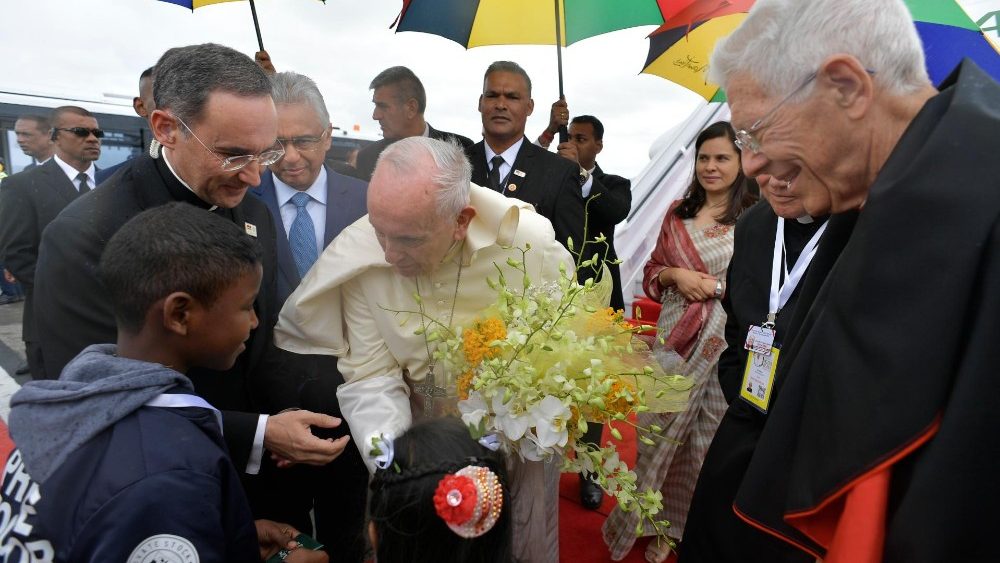
After celebrating Mass in private and saying his final farewells, Pope Francis has departed from Madagascar and is returning toward Rome.
Before leaving for the airport, Francis also greeted about ten poor elderly women at the apostolic nunciature where he was staying who represent those who the nunciature assists every Friday.
At 9:40 a.m. local time (8:40 Rome time) today, the Madagascar Airlines A340neo papal flight carrying the Pope, his entourage and journalists, took off from Madgascar’s Antananarivo Airport, en route for Rome’s Ciampino Airport.
The Holy Father’s Sept. 4-10 visit to the ‘three ‘M’s’ of Mozambique, Madagascar, and Mauritius, marked the Pope’s fourth visit to Africa, his second to Sub-Saharan Africa, and represented the Holy Father’s attention to the peripheries and the poor. It also marked his 31st Apostolic Trip.
Each of these nations had been visited by St. Pope John Paul II during his pontificate.
As is customary, Pope Francis likely this evening will visit Rome’s Basilica of Santa Maria Maggiore to thank Our Lady for the fruits of the trip, and for her help and protection.
The Holy Father will also hold his press conference on the return flight and ZENIT will provide you with the full English translation of the Q & A as soon as possible.
Tomorrow morning, the Pope will still have his weekly General Audience in the Vatican.

Sunday, September 8, 2019

Pope Francis makes final public appearance in Madagascar

© Vatican Media

Pope Francis Shares Joy of Prayer and Praise in Final Madagascar Encounter

‘I thank you, Father, Lord of heaven and earth, because you have hidden these things from the wise and the intelligent and have revealed them to little ones.’

“I conclude my visit to Madagascar here with you. As I witness your joy and think of everything else that I have seen during my brief stay on your island, my heart echoes the words spoken by Jesus in Luke’s Gospel. Filled with joy, he exclaimed: ‘I thank you, Father, Lord of heaven and earth, because you have hidden these things from the wise and the intelligent and have revealed them to little ones’ (Lk 10:21). My joy has been confirmed by your testimonies, for even those things you see as problems are signs of a Church that is alive, dynamic and striving to be each day to be a sign of the Lord’s presence.”
Those were the words of Pope Francis following a joyful reception to Madagascar’s College of Saint Michael. The Holy Father chose as his final audience the island nation’s priests, religious, consecrated, and seminarians.
“The words of the Gospel that I cited above are part of the Lord’s prayer of praise as he welcomed back the seventy-two disciples from their mission,” the Pope said. “Like yourselves, those disciples accepted the challenge of being a Church that ‘goes forth’.
“They came back with their bags full, to share everything that they saw and heard. You too dared to go forth, and you accepted the challenge of bringing the light of the Gospel to the different parts of this island.”
The Holy Father acknowledged that many of those listening live in difficult conditions. Indeed, many work among the poor and lack easy access to such basic services as water and electricity. Financial resources are scarce and the hard work can take a toll on the health of religious workers.
In that environment, the Pope reminded the crowd of their need for prayer and praise. He echoed the actions of Jesus when the 72 returned after venturing forth.
“Welcoming back his disciples and hearing of their joy, Jesus immediately praises and blesses his heavenly Father,” Francis recalled. “This makes us see something basic about our vocation. We are men and women of praise.
“Consecrated persons are able to recognize and point out the presence of God wherever they find themselves. Even better, they are able to dwell in God’s presence because they have learned how to savor, enjoy and share that presence.
“In praise, we discover the beauty of our identity as part of a people. Praise frees disciples from obsessing about ‘what ought to be done’; it restores our enthusiasm for mission and for being in the midst of our people. Praise helps us refine the ‘criteria’ by which we take stock of ourselves and others and all our missionary projects. In this way, it keeps us from losing our evangelical ‘flavor’.

The Holy Father’s Full Address


Pope Francis Sunday Homily in Madagascar

Pope's Mass in Madagascar/Vatican Media Screenshot

Pope’s Homily in Madagascar (Full Text)

‘The demands that Jesus sets before us cease to be burdensome as soon as we begin to taste the joy of the new life that he himself sets before us’

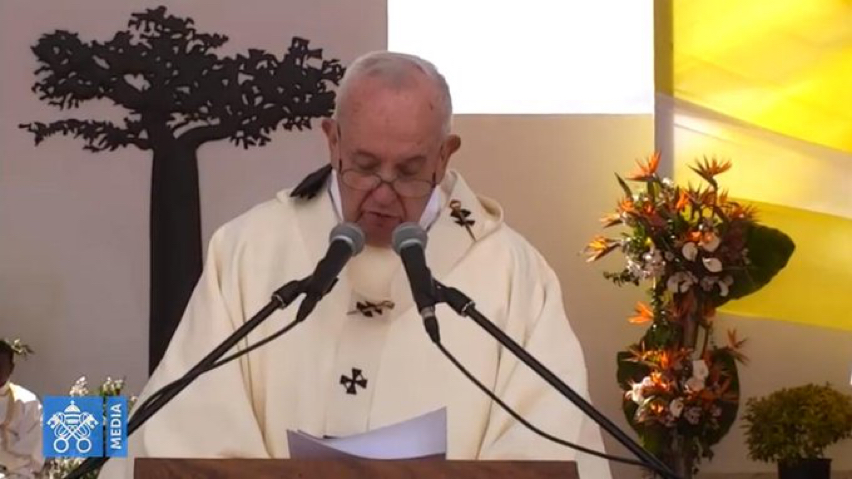
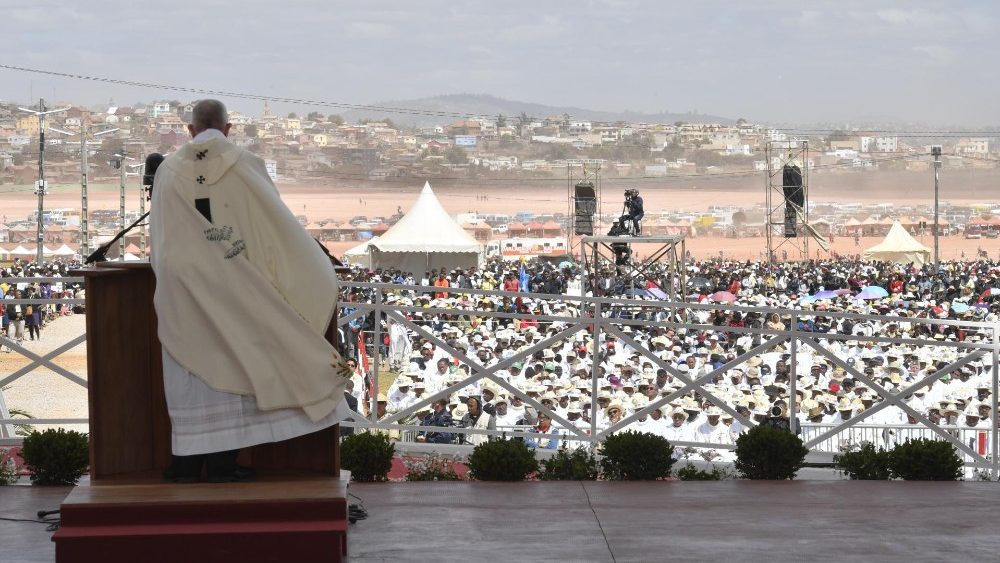
Today, Sept. 8, Pope Francis celebrated Mass in the Soa Mandrakizay diocesan field in Antananarivo, Madagascar, during his second full day of his visit to the country, during his 31st Apostolic Trip to the African nations of Mozambique, Madagascar and the island of Mauritius, Sept. 4-10, 2019.
Here is the full Vatican-provided text of the homily:
* * *
he Gospel tells us that “great multitudes accompanied Jesus” (Lk 14:25). Like the multitudes gathered along his path, you too have come in great numbers to receive his message and follow in his footsteps. But you also know that following Jesus is not easy. Today, Luke’s Gospel reminds us of how demanding that commitment can be.
We should realize that Luke sets out those demands within his account of Jesus’ ascent to Jerusalem. He starts with the parable of the banquet to which everyone is invited, especially the outcasts living on the streets, in the squares and at the crossroads. And he concludes with the three “parables of mercy”, where a party is celebrated when what was lost was found, where someone who seemed dead is welcomed with joy and restored to life with the possibility of making a new start. For us as Christians, our sacrifices only make sense in the light of the joyful celebration of our encounter with Jesus Christ.
Jesus’ first demand has to do with family relationships. The new life the Lord holds out to us seems troubling and scandalously unjust to those who think that entry into the kingdom of heaven can be limited or reduced only to bonds of blood or membership in a particular group, clan or particular culture. When “family” becomes the decisive criterion for what we consider right and good, we end up justifying and even “consecrating” practices that lead to the culture of privilege and exclusion: favouritism, patronage and, as a consequence, corruption. The Master demands that we see beyond this. He says this clearly: anyone incapable of seeing others as brothers or sisters, of showing sensitivity to their lives and situations regardless of their family, cultural or social background “cannot be my disciple” (Lk 14:26). His devoted love is a free gift given to all and meant for all.
Jesus’ second demand shows us how hard it is to follow him if we seek to identify the kingdom of heaven with our personal agenda or our attachment to an ideology that would abuse the name of God or of religion to justify acts of violence, segregation and even murder, exile, terrorism and marginalization. This demand encourages us not to dilute and narrow the Gospel message, but instead to build history in fraternity and solidarity, in complete respect for the earth and its gifts, as opposed to any form of exploitation. It encourages us to practise “dialogue as the path; mutual cooperation as the code of conduct; reciprocal understanding as the method and standard” (Document on Human Fraternity, Abu Dhabi, 4 February 2019). And not to be tempted by teachings that fail to see that the wheat and the chaff must grow together until the return of the Master of the harvest (cf. Mt 13:24-30).
Finally, how difficult it can be to share the new life that the Lord offers us when we are continually driven to self-justification, because we think that everything depends exclusively on our efforts and resources! Or, as we heard in the first reading, when the race to amass possessions becomes stifling and overwhelming, which only increases our selfishness and our willingness to use immoral means. Jesus’ demand is that we rediscover how to be grateful and to realize that, much more than a personal triumph, our life and our talents are the fruit of a gift (cf. Gaudete et Exsultate, 55), a gift created by God through the silent interplay of so many people whose names we will only know in the kingdom of heaven.
With these three demands, the Lord wants to prepare his disciples for the celebration of the coming of the kingdom of God, and to free them from the grave obstacle that, in the end, is one of the worst forms of enslavement: living only for oneself. It is the temptation to fall back into our little universe, and it ends up leaving little room for other people. The poor no longer enter in, we no longer hear the voice of God, we no longer enjoy the quiet joy of his love, we are no longer eager to do good… Many people, by shutting themselves up in this way, can feel “apparently” secure, yet they end up becoming bitter, querulous and lifeless. This is no way to live a full and dignified life; it is not God’s will for us, nor is it the life in the Spirit that has its source in the heart of the risen Christ (cf. Evangelii Gaudium, 2).
With these demands, the Lord, as he walks towards Jerusalem, asks us to lift our gaze, to adjust our priorities and, above all, to make room for God to be the centre and axis of our life.
As we look around us, how many men and women, young people and children are suffering and in utter need! This is not part of God’s plan. How urgently Jesus calls us to die to our self-centredness, our individualism and our pride! In this way, we can allow the spirit of fraternity to triumph – a spirit born from the pierced side of Jesus Christ, in which we are born as God’s family – and in which everyone can feel loved because understood, accepted and appreciated in his or her dignity. “In the face of contempt for human dignity, we often remain with arms folded or stretched out as a sign of our frustration before the grim power of evil. Yet we Christians cannot stand with arms folded in indifference, or with arms outstretched in helplessness. No. As believers, we must stretch out our hands, as Jesus does with us” (Homily for the World Day of the Poor, 18 November 2018).
The Word of God that we have just heard bids us set out once more, daring to take this qualitative leap and to adopt this wisdom of personal detachment as the basis for social justice and for our personal lives. Together we can resist all those forms of idolatry that make us think only of the deceptive securities of power, career, money and of the search for human glory.
The demands that Jesus sets before us cease to be burdensome as soon as we begin to taste the joy of the new life that he himself sets before us. It is the joy born of knowing that he is the first to seek us at the crossroads, even when we are lost like the sheep or the prodigal son. May this humble realism inspire us to take on great challenges and give you the desire to make your beautiful country a place where the Gospel becomes life, and where life is for the greater glory of God.
Let us commit ourselves and let us make the Lord’s plans our own.

Sunday Angelus from Madagascar

Copyright: Vatican Media

On Mary’s Nativity, Pope Prays She Accompanies Madagascar’s Journey in Peace & Hope (Full Angelus)

‘let us turn in prayer to the Blessed Virgin on this day that commemorates her Nativity, the dawn of salvation for humanity’

Let us turn in prayer to the Blessed Virgin on this day that commemorates her Nativity…
This was the invitation today, Sept. 8, of Pope Francis during his Angelus address in the Soa Mandrakizay diocesan field in Antananarivo, Madagascar, during his second full day of his visit to the country, during his 31st Apostolic Trip to the African nations of Mozambique, Madagascar and the island of Mauritius, Sept. 4-10, 2019.
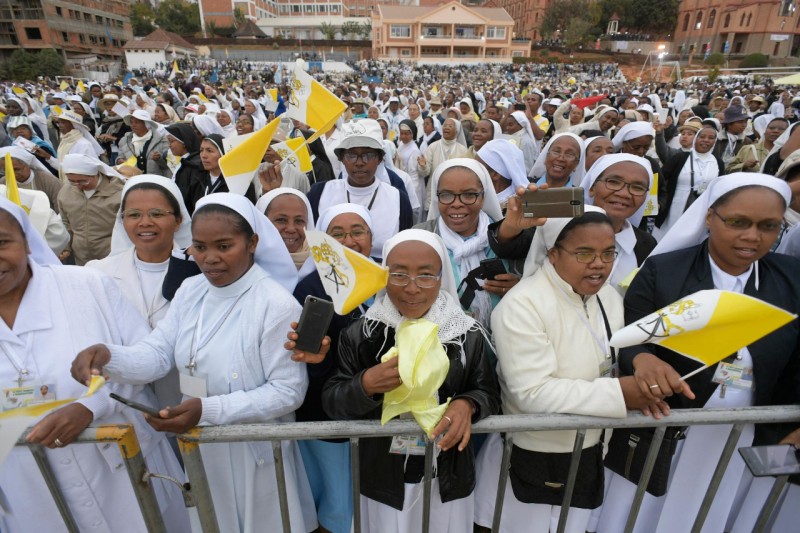
After thanking all involved for his warm welcome, the Holy Father told the some one million present at the field, “let us turn in prayer to the Blessed Virgin on this day that commemorates her Nativity, the dawn of salvation for humanity.”
“May Mary Immaculate, whom you love and venerate as your Mother and Patroness, ever accompany the journey of Madagascar in peace and hope.”
After the Angelus, the Holy Father left the field, where earlier, he had celebrated Mass, and departed for the apostolic nunciature where he would have lunch.
Here is the full Vatican-provided text of the Pope’s Angelus address:
* * *
Dear brothers and sisters, at the conclusion of this celebration, I would like to address a cordial greeting to all of you!
From the heart, I thank Archbishop Razanakolona for his kind words, and with him my other brother bishops present, the priests, consecrated persons, married couples and their families, catechists and all the faithful.
I take this occasion to express my deep gratitude to the President of the Republic and the civil authorities of the country for their generous welcome, as well as all those who have contributed in various ways to the successful outcome of my Visit. May the Lord reward you and bless all your people, through the intercession of Blessed Raphaël Louis Rafiringa, whose relics are enshrined near this altar, and Blessed Victoire Rasoamanarivo.
And now, let us turn in prayer to the Blessed Virgin on this day that commemorates her Nativity, the dawn of salvation for humanity. May Mary Immaculate, whom you love and venerate as your Mother and Patroness, ever accompany the journey of Madagascar in peace and hope.

Saturday, September 7, 2019

Pope Francis and the Bishops of Madagascar

© Vatican Media

Pope Francis Calls on Madagascar’s Bishops to be ‘Sowers’

‘We know that God wants his children to be happy in this world too, even though they are called to fulfillment in eternity.’

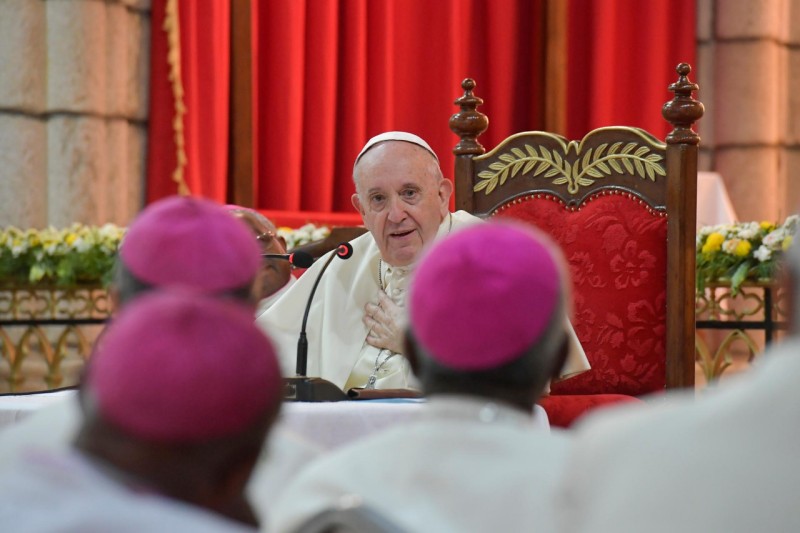
Pope Francis on September 7, 2019, reminded the bishops of Madagascar that in sowing the faith they must address the needs of the people — especially the poor — in this life, not only prepare them for eternity.
The Holy Father met with the bishops in the Cathedral of Andohalo, part of his September 4-10 apostolic journey to Africa.  He noted that their mission is carried out in a land of contradictions that has a tradition of respect for life and the dignity of the human person – but suffers from inequality and corruption. Sowing is difficult.
“We bishops, like the sower, are called to spread seeds of faith and hope on this earth. To do so, we need to develop that ‘sense of smell’ that can enable us to recognize more clearly whatever compromises, hinders or damages the sowing,” Pope Francis. He cited Evangelii Gaudium 182-183:
For this reason, “the Church’s pastors, taking into account the contributions of the different sciences, have the right to offer opinions on all that affects people’s lives since the task of evangelization implies and demands the integral promotion of each human being. It is no longer possible to claim that religion should be restricted to the private sphere and that it exists only to prepare souls for heaven. We know that God wants his children to be happy in this world too, even though they are called to fulfillment in eternity, for he has created all things ‘for our enjoyment’ (1 Tim 6:17), the enjoyment of everyone. It follows that Christian conversion demands reviewing especially those areas and aspects of life ‘related to the social order and the pursuit of the common good’. Consequently, no one can demand that religion should be relegated to the inner sanctum of personal life, without influence on societal and national life, without concern for the soundness of civil institutions, without a right to offer an opinion on events affecting society.”
The Holy Father went on to stress the need to ensure nourishment and dignified sustenance for all people and “general temporal welfare and prosperity.” Referring again to Evangelii Gaudium, he reminded the bishops of the need for all people to have education, healthcare, and employment.
“The defense of the human person is yet another aspect of our pastoral responsibility,” Francis said. “To be pastors according to God’s heart, we must be the first to choose to preach the Gospel to the poor.
“In other words, we have a particular duty to protect and remain close to the poor, the marginalized and the little ones, to children and those most vulnerable, to the victims of exploitation and abuse.”

The Holy Father’s Full Address