Showing posts with label House of Representatives. Show all posts

Monday, May 15, 2023

Despite Catholic opposition the House passes legislation for border security


Amid Catholic opposition, House passes GOP-backed border security bill

Bishop Mark Seitz of El Paso called the bill 'harmful' and 'extreme' in a letter signaling the US bishops’ opposition to the legislation. The legislation is not likely to pass the Democrat-controlled Senate.


(RNS) — Over the opposition of Catholic aid organizations, the U.S. House of Representatives passed a GOP-backed bill on Thursday (May 11) that would cut federal funding for non-governmental organizations providing services to migrants along the U.S.-Mexico border.

The Secure the Border Act bill passed by a vote of 219-213, just hours before the Title 42 public health rule, which allowed the government to quickly expel undocumented immigrants crossing the border, was set to expire with the end of the COVID-19 public health emergency.

The bill, which is not likely to pass the Democrat-controlled Senate, also aims to restrict the number of people granted asylum. It would restart border wall construction and slash a program that allows U.S. officials to accept of quickly turn away some migrants from Venezuela, Haiti and Nicaragua. 

Florida Republican Mario Díaz-Balart, who introduced the bill, spoke on the House floor Thursday in support of the proposed legislation, saying it would “restore order to the southern border” and “protect innocent minors while enforcing the rule of law.” He lambasted the Biden administration and House Democrats for having “abdicated their responsibility to uphold our national security.”

President Joe Biden, who is facing backlash from faith-based groups over new asylum restrictions he announced Wednesday, has vowed to veto the House bill.


Faith-based ministries, many of them Catholic, provide a range of services to migrants in need. 

Hope Border Institute has offered humanitarian aid in Juarez, Mexico, through a joint project with the Diocese of El Paso, helping churches and other groups to offer food, clothing and shelter to migrants. Another Catholic organization, Kino Border Initiative, provides shelter and legal services to migrants in its aid center in Nogales, Sonora, Mexico. Catholic Charities of the Rio Grande Valley operates a respite center to help migrants with food, medical and legal assistance. 

If enacted, said El Paso Bishop Mark J. Seitz in a letter to members of Congress, the bill would “fundamentally weaken our nation’s decades-long commitment to humanitarian protection.”

In December, congressional Republicans sent a letter to Catholic Charities, the U.S. branch of the Catholic humanitarian aid organization, expressing their concerns that NGOs are “fueling the drastic increase in illegal aliens crossing the southern border” and promising to “investigate your organization’s role in facilitating the border crisis, your potential violations of federal law, and your misuse of taxpayer funds,” when the GOP assumed the majority in Congress this year.

Catholic Charities responded at the time, writing, “Our life-saving humanitarian work neither violates federal laws nor endangers communities.”

Responding to the bill after it was introduced on May 2, Sister Donna Markham, president and CEO of Catholic Charities USA, submitted a letter saying the legislation would “severely hinder” the government and NGOs “from aiding migrants who need services, care, and assistance.” 

“The gospel calls us to provide shelter for those who are homeless, feed the hungry, and ‘welcome the stranger.’ The work of Catholic Charities is humanitarian not political,” Markham said. 

By prohibiting funding to faith-based organizations and other NGOs, it would cancel the “cooperation of these organizations with federal, state, and local governments in receiving newcomers, combatting human trafficking, addressing homelessness, and responding to natural disasters and other emergencies,” Markham said.

Seitz, who chairs the United States Conference of Catholic Bishops Committee on Migration, in his own letter urging lawmakers to oppose the bill, said it was so broadly written that it would affect more than Catholic efforts at the border. The bill, said Seitz, “could even be interpreted to prevent schools, houses of worship, and other organizations” from qualifying for certain grants “amid a rise in violent attacks on those places,” Seitz said.

Calling the bill’s language “overly broad, ambiguous, and unworkable,” Seitz said cutting funding to NGOs would have the opposite of its intended effect, predicting that it would “facilitate or encourage unlawful activity, including unlawful entry.”


A dozen other Catholic organizations, including Kino Border Initiative, Hope Border Institute, Franciscan Action Network and NETWORK Lobby for Catholic Social Justice, issued their own letter on May 10 to urge the House to vote against the measure, which they said will “harm both immigrants and the communities who receive them.”

The organizations said the bill will lead to further deaths and suffering of the people they are called by their faith to support, adding that the legislation will also hurt “Catholics who want to live and practice our faith while following the law.”

“For decades Catholic organizations, dioceses and congregations have partnered with federal and state governments regardless of political party, to provide succor to all in need, especially our immigrant siblings. This bill will jeopardize those successful partnerships,” the letter read.

The Secure the Border Act, according to the Catholic groups, will affect the day-to-day operations of Catholic shelter, respite and care centers, “because we believe in the dignity and sanctity of life and therefore our faith does not allow us to deny food and shelter to people simply because they do not have the right papers.”

Thursday, January 12, 2023

Born-Alive Abortion Survivors Protection Act passes the House

 Pro-Life wins in the U.S. House of Representatives


By Kate Scanlon

WASHINGTON (OSV News) — The U.S. House of Representatives Jan. 11 passed two pro-life measures, however neither has a clear path through the U.S. Senate to become law.

The Born-Alive Abortion Survivors Protection Act passed first in a 220-210 vote, with one member, Rep. Vicente Gonzalez, D-Texas, voting present, and with Rep. Henry Cuellar, D-Texas, joining Republicans to support the bill. According to proponents, the bill would require any infant that survives an abortion procedure to receive appropriate medical care for their gestational age.

A second measure, a resolution condemning violence against “pro-life facilities, groups and even churches,” also passed in a 222-209 vote. This resolution condemned the violence that erupted following the U.S. Supreme Court’s June 2022 decision in Dobbs v. Jackson Women’s Health Organization which overturned prior precedents that found a constitutional right to abortion.

Three Democrats, Rep. Gonzalez, as well as Reps. Chrissy Houlaha of Pennsylvania and Marie Perez of Washington state, joined the resolution.

Neither measure is likely to be considered by the Senate, which remains under Democratic control.

The measures come in the first week of legislative business for the new Republican majority in the House after spending their first week in power electing a House speaker, Rep. Kevin McCarthy, R-Calif.

The votes took place as some Republican leaders, including former President Donald Trump, have blamed the issue of abortion as being responsible for the GOP’s lackluster performance in November’s midterm elections.

However, the House saw Republicans publicly restate their commitment to advancing pro-life policies.

Rep. Mike Johnson, R-La., the House Republican Conference vice chairman who introduced the resolution condemning the violence against pro-life facilities, said in a statement Congress needed to “make the position of Congress crystal clear: violence, property damage, threats and intimidation tactics must be condemned, and these clear violations of federal and state laws must be prosecuted.”

Rep. Chris Smith, R-N.J., co-chair of the Congressional Pro-Life Caucus, said in remarks on the House floor that “pregnancy care centers across the country have suffered a surge of violent attacks, firebombing and vandalism by pro-abortion activists in a coordinated effort to intimidate frontline volunteers and licensed medical professionals providing critical support to mothers in need and their unborn baby boys and girls.”

“Now more than ever, we — and that includes the Biden administration — need to ensure the safety and security of the estimated 3,000 pregnancy care centers that provide life-affirming alternatives to abortion — offering critical, quality care for pregnant women facing challenging circumstances and helping to save so many unborn, innocent lives,” Smith said.

Some lawmakers supportive of legal abortion, including Rep. Diana DeGette, D-Colo., however, argued Republicans should condemn violence against abortion clinics.

“Republicans have put forth a measure that condemns attacks on anti-choice facilities but says nothing about the growing violence against women’s health clinics,” DeGette wrote on Twitter. “By ignoring these attacks, Republicans are sending a dangerous message that will embolden the extremists behind them.”

Rep. Ann Wagner, R-Mo., who sponsored the reintroduction of the Born-Alive bill, said in a statement the legislation would “provide commonsense protections for innocent children and their mothers and will ensure all babies receive the essential care they need at an incredibly vulnerable moment.”

“All children should have the right to receive life-saving care, especially those who survive an abortion,” she said.

However, Rep. Pramila Jayapal, D-Wash., chair of the House Progressive Caucus, stated the bill is redundant.

“This bill is absurd for so many reasons, number one, it is obviously ALREADY illegal to kill a baby,” she posted to Twitter, adding: “The only new action this bill takes is to threaten jail time for health care workers.”

Bishop Michael F. Burbidge of Arlington, Virginia, chairman of the U.S. Conference of Catholic Bishops’ Committee for Pro-Life Activities, praised the House for passing the Born-Alive bill.

“We commend the House of Representatives for passing legislation to protect innocent children from infanticide, and urge the Senate to follow suit,” Bishop Burbidge said in a statement. “Babies who are born alive during the process of an abortion deserve compassionate care and medical attention — just the same as any other newborn baby.”

Infants who survive botched abortions are rare, but Melissa Ohden, founder and CEO of the Abortion Survivors Network, said in a statement that tens of thousands of abortion survivors like her do exist.

“We applaud Congresswoman Wagner’s leadership in ensuring infants like me, and countless others, are guaranteed medical care and legal protections when abortions fail and life wins,” she said.

Other leading pro-life organizations praised the House for passing these measures.

Jeanne Mancini, president of the March for Life, said in a statement her organization “is grateful to House Republicans for prioritizing commonsense and compassionate pro-life bills in the new Congress.”

“We urge all legislators to vote in favor of these measures which align with the values of the vast majority of Americans,” she said.

Marjorie Dannenfelser, president of Susan B. Anthony Pro-Life America, said in a statement, that the GOP leadership recognized the federal government’s “crucial role in protecting our most vulnerable children and their mothers in the Dobbs era,” and both initiatives “affirm the sanctity of life.”

“Our government’s most sacred duty is to safeguard the lives of all Americans,” she said.

Monday, January 9, 2023

Catholics and the next Congress


The House Speaker race over, here’s what Catholics can expect from the next Congress

 
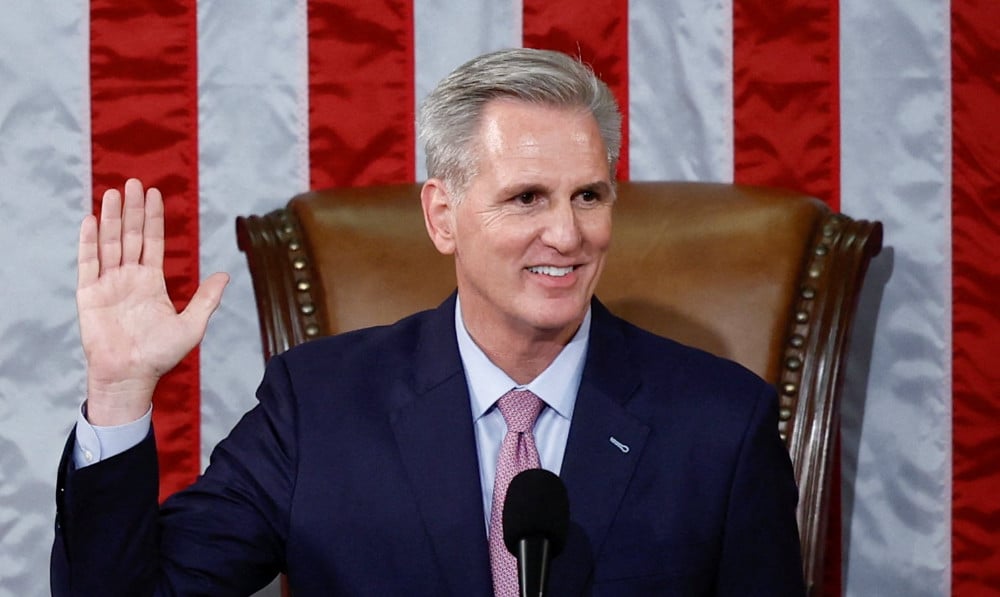
NEW HOUSE SPEAKER REP. KEVIN MCCARTHY
Rep. Kevin McCarthy, R-Calif., is sworn into office after being elected the next Speaker of the U.S. House of Representatives in a late night 15th round of voting into the fifth day of the 118th Congress at the U.S. Capitol in Washington Jan. 7, 2023. (OSV News photo/Evelyn Hockstein, Reuters)

WASHINGTON (OSV News) — Rep. Kevin McCarthy, R-Calif., was elected Speaker of the House Jan. 7 after a tumultuous process that stretched across the first week of the new term. The 118th Congress began in Washington, D.C., on Jan. 3, and will continue for the two remaining years of President Joe Biden’s current term in the White House.

The new Congress will likely be marked by significant partisanship, as Republicans take control of the House for the first time in Biden’s presidency, leaving him with a divided government for the rest of his current term.

The 2024 presidential campaign will also begin in earnest, which may increase the potential for partisanship as Republicans attempt to win the White House. Biden, a Catholic Democrat, has indicated he intends to seek reelection, while former President Donald Trump has already announced a third bid for the White House as a Republican, although he will face a primary contest with other Republicans for his party’s nomination.

The lengthy speakership battle is also a prelude to divisions within the Republican conference. The delay in his election resulted in McCarthy making a number of key concessions to garner enough votes from his conference for the office. McCarthy’s Republican opponents sought commitments from him on some of their preferred rules or legislation, most notably a House rule that would allow just one lawmaker to make a motion to “vacate the chair,” or a vote to oust the speaker. McCarthy had resisted that effort — which contributed to the retirement of Catholic and former Republican House Speaker John Boehner of Ohio — in early negotiations.

According to the House Historian’s office, the 15 ballot rounds McCarthy needed to be elected speaker were more than any U.S. House speaker since 1859, when Republican William Pennington of New Jersey was elected on the 44th round.

During its tenure, the next Congress and its speaker are also likely to offer a mixed bag of legislative results on issues of importance to Catholics. Some of those issues, including abortion and immigration, are cornerstones of increasingly partisan national debates.

Matthew Green, a professor of politics at The Catholic University of America in Washington who studies Congress and American elections, told OSV News in an interview that Republicans and Democrats have “less incentive to compromise on abortion,” than previous decades as both parties develop more firm positions on the issue. In the past, pro-life Democrats, for example, were more plentiful in Congress.

“You can’t you can’t build a cross-party coalition on abortion like you used to be able to 20, 30 years ago,” Green said.

In an Oct. 26, 2022, letter to members of both the House and Senate, U.S. bishops’ conference chairmen called for the next Congress to consider legislation that fosters “an authentically life-affirming society that prioritizes the well-being of families.” They identified areas including “radical solidarity” with mothers and infants, environmental and economic policies that support families, and policies that “recognize the central role of immigrant families within our society.”

“We implore you to work together to find bipartisan solutions and ensure that these and other similar legislative proposals are given high priority,” the bishops wrote. “We hope with a particular concern that we all can agree on coming to the aid of pregnant and single parenting women in need, so that they will have the support, comfort, and hope that they require to build their lives for the better and realize their aspirations.”

Two of the bills backed by the bishops conference passed in the omnibus bill enacted Dec. 29 in the twilight of the last Congress: the Pregnant Workers Fairness Act, a bill that prohibits employment practices that discriminate against making reasonable accommodations for pregnancy, and the PUMP for Nursing Mothers Act, a bill requires employers to provide reasonable break time for nursing mother employees to pump breast milk.

The U.S. bishops also advocated more broadly for increased support to pregnancy resource centers and federal paid family leave policies.

On the issue of abortion, a Republican House will likely stymie Democratic efforts to pass legislation to vastly increase abortion access, such as the Women’s Health Protection Act, which would have blocked most state-level abortion restrictions. Even if Democrats had maintained their control of the House in the midterm elections, that bill failed in the Democratically-controlled Senate last year, where it did not secure the requisite 60 votes to overcome the upper chamber’s filibuster rule.

Marilyn Musgrave, the vice president of government affairs at Susan B. Anthony Pro-Life America and a former representative from Colorado, told OSV News in an interview that “pro-lifers around this country can celebrate the fact that we now have divided government.”

Many of the pro-life movement’s immediate concerns, Musgrave said, such as the potential of ending the Senate filibuster or having the Women’s Health Protection Act signed into law are now extremely unlikely to come about during this Congress.

“Those threats are gone now,” she said.

Anthony J. Granado, the vice president of government relations for Catholic Charities USA, told OSV News that the organization is watching congressional action on a host of topics, including ensuring the inclusion of the Hyde and Helms amendments to prevent the use of taxpayer funds for abortion, immigration, the expired child tax credit expansion, and programs to provide resources for people who experience homelessness or underemployment, especially if there were to be a recession.

“We had an affordable housing crisis prior to the pandemic, we still have an affordable housing crisis,” Granado said.

During last year’s midterm election cycle, some Republican candidates adopted extreme language about immigration, while many others argued a large increase of migrants trying to cross the U.S.-Mexico border was a failure of the Biden administration.

Immigration reform has long evaded bipartisan negotiators, and a last-ditch effort by Democrats to do so in the lame-duck session between the midterm elections in November and the end of the 117th Congress failed. With a growing number of House Republicans increasingly opposed to those efforts, immigration reform will likely continue to languish in the next Congress.

“I don’t see much promise for a comprehensive immigration bill in the next Congress,” Green said, noting that the issue has become more politically polarizing.

“It has become an issue where the two sides see much more to gain by attacking each other than by actually trying to find a solution,” he said.

A Republican House may pass bills to tighten the border, Green said, while a Democratic Senate may pass bills to create a pathway to citizenship. But each would likely go on to die in the other chamber without the requisite number of votes to pass or without the support of party leadership to even bring it up for a vote.

That Republican opposition was demonstrated by a handful of hardline Republican House lawmakers in December, who in a letter accused Catholic Charities USA of “violating federal law and regulation” in their humanitarian work on the U.S.-Mexico border and instructed them to “preserve all information related to any expenditures submitted for reimbursement from the federal government related to migrants encountered at the southern border.”

Catholic Charities USA issued a Dec. 14 statement pushing back on that accusation, saying “it is incredibly disturbing for Catholic Charities–the domestic humanitarian arm of the U.S. Catholic Church–to be accused of violating federal laws” for its humanitarian work.

“These accusations are both fallacious and factually inaccurate,” the CCUSA statement said. “Our life-saving humanitarian work neither violates federal laws nor endangers communities.”

Asked about the letter from the lawmakers, Granado told OSV News, “We don’t decide who’s allowed into the country, but we will serve those who come to our doors because that’s what the Gospel calls us to do.” Granado also called for bipartisan work on immigration policy.

Strategically, Green said, there may not be a great deal of incentive for compromise at all in the coming Congress on any number of issues, although compromise may come in surprising ways.

“Democrats feel like they did pretty well in this election, better than they should have, so why should they help Republicans?” he said. “And then Republicans, especially in the House, see this is finally a chance to push back against Biden and Democrats.”

One area where Green said lawmakers may find compromise is supporting Ukraine in fending off Russia’s invasion.

Despite some vocal opponents of spending money in Ukraine in the GOP, Green said, “I think that the majority of Republicans in the House and Senate agree with Democrats that Russia needs to be stopped and Ukraine needs to be helped in their war against Russia.”

Kate Scanlon is a national reporter for OSV News covering Washington.

Thursday, December 8, 2022

House will follow the Senate in codifying same-sex "marriage"


House expected to pass same-sex marriage bill Thursday


The U.S. House of Representatives is expected to pass the Respect for Marriage Act (RFMA) on Thursday, sending it to President Joe Biden’s desk for his signature.

The bill, which would repeal the 1996 Defense of Marriage Act (DOMA) and recognize same-sex marriages on a federal level, has drawn criticism from Catholic leaders for not providing strong enough protections for those who believe marriage is between one man and one woman — a belief in line with Church teaching.

C-SPAN Capitol Hill Producer Craig Caplan tweeted Wednesday that the House plans to vote on the final version of the RFMA Thursday morning, followed by a bill enrollment ceremony around 11:30 a.m. in the U.S. Capitol.


The final vote comes after the U.S. Senate, with the support of 12 Republicans, voted to pass the RFMA on Nov. 29. If it passes now, Biden, a Catholic, has pledged to sign it into law

While it would not require any state to allow same-sex couples to marry, the RFMA would require states to recognize any and all marriages — regardless of “sex, race, ethnicity, or national origin” — performed in other states. 

The U.S. bishops stated in a November letter to Congress that the bill’s amendments do not sufficiently protect those with religious objections.

“The amended act will put the ministries of the Catholic Church, people of faith, and other Americans who uphold a traditional meaning of marriage at greater risk of government discrimination,” the letter stated.

“Our opposition to RMA by no means condones any hostility toward anyone who experiences same-sex attraction,” the bishops emphasized. “Catholic teaching on marriage is inseparable from Catholic teaching on the inherent dignity and worth of every human being. To attack one is to attack the other. Congress must have the courage to defend both.”

A United States Conference of Catholic Bishops’ explanation appended to the letter read: “Given all this — that the bill establishes an affirmative, enforceable, comprehensive right to federal and interstate recognition of same-sex marriages but sets out religious liberty protections that are far from comprehensive, and are neither affirmative nor enforceable outside of the limited protections in Section 6(b) — it is fair to say that the amendment treats religious liberty as a second-class right.”

Democrats blocked an amendment Monday offered by Republican Rep. Chip Roy of Texas that would have included explicit protections for Americans who believe marriage is between one man and one woman. The same amendment, which has the support of the bishops, was previously introduced in the Senate by Sen. Mike Lee of Utah.

After the vote was initially delayed, Reuters reported that the legislation was expected to pass in the House later this week with bipartisan support.

The RFMA represents one of the first legislative responses to the U.S. Supreme Court’s overturning of Roe v. Wade in June. While the majority opinion in Dobbs v. Jackson Women’s Health Organization said that “this decision concerns the constitutional right to abortion and no other right,” Democrats have pointed to Justice Clarence Thomas’ concurring opinion suggesting the court should reconsider all “substantive due process” cases, including the 2015 Obergefell decision on same-sex marriage.


DOMA, which the present bill would repeal, is a 1996 law signed by President Bill Clinton that defined marriage federally as the union of a man and a woman, reserved federal benefits to heterosexual couples, and permitted states not to recognize same-sex marriages contracted in other states. DOMA was already effectively nullified by the 2013 and 2015 Supreme Court decisions United States v. Windsor and Obergefell v. Hodges, which legalized same-sex marriage in all 50 states. 

Tuesday, August 2, 2022

U.S. Bishops to Congress: Protect human life, promote the health and safety of the family. work for the common good


US Bishops urge Congress to work to protect life, promote common goodUS Bishops urge Congress to work to protect life, promote common good 

US Bishops urge Congress to work to protect life, promote common good

Four American Bishops who chair committees of the USCCB are advocating for legislation that protects human life and promotes the health, safety and support of the family, proposing that Catholic social teaching shows the way to a better society in the wake of the US Supreme Court’s 24 June Dobbs v. Jackson ruling.

By Fr. Benedict Mayaki, SJ

The Bishops of the United States are calling on Congress to “seize this hopeful moment” to work together to protect the dignity of every human person and the common good, in the wake of the Supreme Court’s decision in Dobbs v. Jackson Women’s Health Organization which “presents a historic opportunity to reshape society for the better.”

In a statement on Monday, the Bishops express concern that since the 24 June Dobbs ruling, Congress has been taking up legislative proposals that are “harmful to the common good” and have not taken any action on the measures that the U.S Conference of Catholic Bishops (USCCB) has previously endorsed and continues to support which “would help to build up a culture of life.”

The US Supreme Court’s Dobbs ruling overturned the 1973 ruling in Roe v. Wade which legalized abortion nationwide. The Dobbs decision returned the regulation of abortion to the states.

Protecting all human life

The Bishops propose that reshaping society begins with the recognition that “human life is an inestimable gift from God with an inalienable right to life deserving of full legal protection.”

Also, they uphold that the family, founded upon the love and mutual self-gift of husband and wife, “is the first building block of society, and that raising children is both a great gift and a lifelong responsibility.”

In this light, “a principled commitment to being pro-life entails a commitment both to protecting all human life, especially the most vulnerable, and to advancing policies that help families to flourish,” the Bishop Chairmen said, urging that “the health, safety, and support of the family should be the focus of all good policymaking.”

Catholic social teaching shows a better way

The Bishops air their worry that since the Apex court’s 24 June decision, members of Congress have focused on legislation that “places no value on the lives of children until their moment of birth, severs sex and marriage from their meaning, promotes using people as means to ends, and would strip rights of conscientious objection from those who oppose these hallmarks of the throwaway culture.”

In fact, the US House of Representatives has passed, and the Senate may soon reconsider a series of bills, including the Women’s Health Protection Act, the Respect for Marriage Act, and the Right to Contraception Act, and is advancing appropriations bills that exclude longstanding provisions prohibiting federal taxpayer funding for abortion and protecting the conscience rights of healthcare providers.

To counter this, the Bishops uphold that “Catholic social teaching shows the way to a better place—a society marked by justice, mutual support, civility, friendship, mercy, and love—than where Congress is now leading,” the prelates added, as they called for legislation that would build " a culture of life."

Such bills, in the USCCB’s assessment, include, the Pregnant Workers Fairness Act; an expanded child tax credit, including for pregnant moms; the Adoption Tax Credit Refundability Act; the PFAS Action Act; and a federal paid family leave policy.”

This legislation, the Bishops say, provide support “for the health and wellbeing of pregnant and parenting women, assistance with nutrition and affordable housing, environmental restrictions on chemicals that cause birth defects, and provisions to assist low-income families.” 

Care for creation, supporting families

The American Bishops go on to welcome the “meaning consideration of needed investments in care for our common home” and stress that “care for creation is also integral to care for human life.”

Finally, they called on families and individuals, civil society, businesses, religious groups, government and members of Congress to ask themselves “how they are supporting families at this moment, particularly around welcoming new life and raising children through adulthood.”

The Monday statement was signed by Archbishop William E. Lori of Baltimore, chairman of the U.S. Conference of Catholic Bishops’ (USCCB) Committee on Pro-Life Activities, Cardinal Timothy M. Dolan of New York, chairman of the USCCB’s Committee for Religious Liberty, Archbishop Salvatore J. Cordileone of San Francisco, chairman of the USCCB’s Committee on Laity, Marriage, Family Life & Youth, and Archbishop Paul S. Coakley of Oklahoma City, chairman of the USCCB’s Committee on Domestic Justice and Human Development.

Monday, July 18, 2022

US Bishops react to Dem controlled house trying to circumvent Supreme Court


U.S. Bishops’ Pro-Life Chairman on Passage of House Bill Imposing “Abortion on Demand” Nationwide

JULY 18, 2022 BY PUBLIC AFFAIRS OFFICE

WASHINGTON - Last Friday, the U.S. House of Representatives passed the Women’s Health Protection Act, H.R. 8296, by a vote of 219 to 210. This bill would impose abortion on demand nationwide at any stage of pregnancy and would eliminate pro-life laws at every level of government -- including parental notification for minor girls, informed consent, and health and safety protections specific to abortion facilities. H.R. 8296 also would compel all Americans to support abortions here and abroad with their tax dollars and would likely force health care providers and professionals to perform, assist in, and/or refer for abortion against their deeply-held beliefs, as well as force employers and insurers to cover or pay for abortion.  

Archbishop William E. Lori of Baltimore, chairman of the U.S. Conference of Catholic Bishops’ (USCCB) Committee on Pro-Life Activities and Cardinal Timothy M. Dolan of New York, chairman of the USCCB’s Committee for Religious Liberty, issued the following statement: 

“The majority in the House of Representatives voted last Friday to pass the most unjust and extreme abortion on demand bill our nation has ever seen. Answering the needs of women by promoting taxpayer-funded elective abortion, as this bill would do, is a grave evil and a failure to love and serve women. Offering free or low-cost abortions, instead of increasing the resources women need to care for themselves and their children, is not ‘choice’ but coercion and callous abandonment. Simply repeating the mantra that abortion is healthcare doesn’t make it so. Deliberately ending the lives of defenseless and voiceless human beings is the antithesis of healthcare.   

“We implore those who see abortion as a legitimate ‘solution’ to the needs of women to abandon this path of death and despair. Instead, we invite all to join us in pursuing a vision we presented in Standing with Moms in Need, a vision that upholds the truth that every human life is sacred and inviolable—a society in which the legal protection of human life is accompanied by profound care for mothers and their children. We exhort our nation to prioritize the well-being of women, children, and families with both material resources and personal accompaniment so that no woman ever feels forced to choose between her future and the life of her child.”