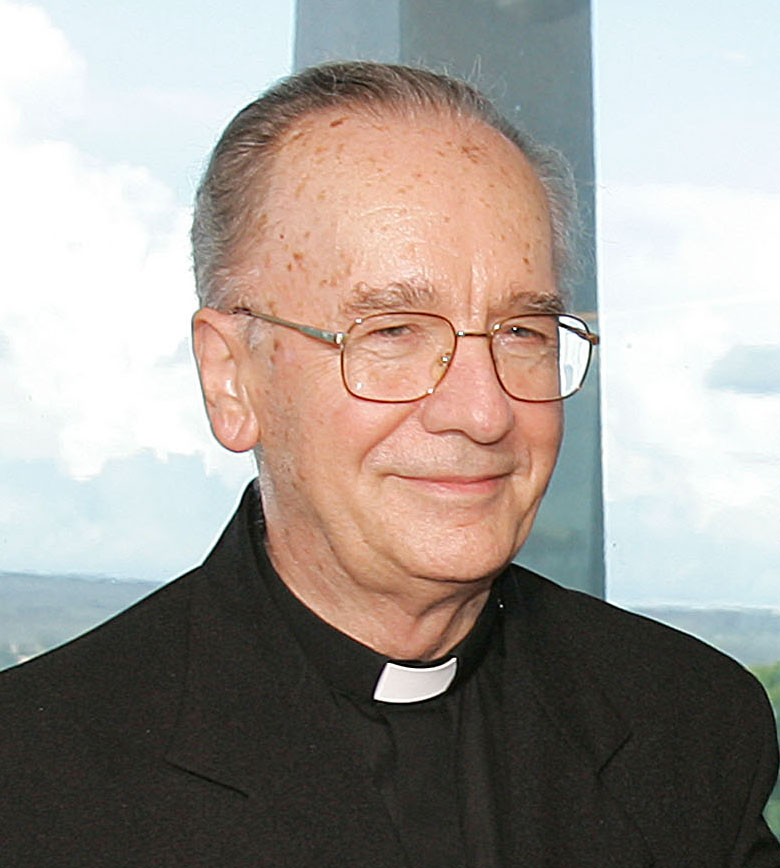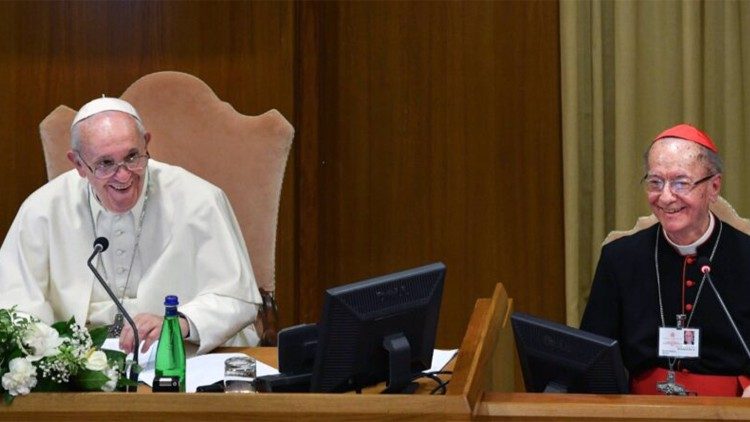
Cardinal Hummes, known as a defender of the poor, dies at 87
By Salvatore Cernuzio
"Omnes vos fratres" ("All you brothers") read Cardinal Hummes’ episcopal coat of arms, echoing the expression of St Francis of Assisi, "Brothers all", which also inspired the Pope's latest encyclical, Fratelli tutti. This was another clear sign of the unity of intent and thought that bound him to the other Francis, the reigning Pontiff, who chose his unprecedented papal name at the Cardinal's suggestion.
The sad news of his passing was announced on Monday, "with great sorrow," by Cardinal Odilo Pedro Scherer, the current Archbishop of São Paulo, in a message calling for prayers of thanksgiving for the life of his predecessor, and asking God to receive him into eternal life.
Cardinal Scherer noted that the Cardinal would lie in state in the Metropolitan Cathedral, where the faithful will be able to participate in Masses for the repose of his soul.
A heart for the poor
'Dom Cláudio', as anyone who knew Cardinal Cláudio Hummes affectionately called him, passed away on Monday. He was 87 years old and had a big heart that beat—and there is no rhetoric in stating this—for the 'poor', such as the indigenous peoples of the Amazon, consecrated and lay missionaries, the thirsty and hungry of the Global South, poorly paid workers, or the victims of climate change.
Those poor people were on his mind all the time, even in the final ballots of the 2013 Conclave that elected the Archbishop of Buenos Aires, Jorge Mario Bergoglio to the papacy. To his Argentinean friend, seated at his side, when he had reached the number of votes needed to be elected, Hummes whispered in his ear: 'Don't forget the poor'. From that intuition sprang another intuition of the newly elected Pope, regarding the choice of a papal name. Pope Francis himself revealed this to the journalists he met on 16 March 2013:
"Next to me was the Archbishop Emeritus of São Paulo, also Prefect Emeritus of the Congregation for the Clergy, Cardinal Claudio Hummes: a great friend, a great friend! When it got a little dangerous, he comforted me. And when the votes went up to two-thirds, the usual applause came, because the Pope was elected. He hugged me, kissed me, and said: 'Don't forget the poor!' And that word entered here: the poor, the poor. Then, immediately, in relation to the poor, I thought of Francis of Assisi.”
Cardinal Hummes and the pontificate of Pope Francis
Hummes rejoiced at that election and wished the Pope, through the microphones of Vatican Radio, “a lengthy pontificate”, because, he said, “the Church needs this pontificate, the Church needs this project that he manifests and that he has set in motion”.
With regard to the Church, Hummes always prayed that it would always be firm and united, not yielding to external and internal threats. "The Church defends its unity as a unity of plurality. Divisions are evil”, said the cardinal, in the face of those who wanted to question the Pope's authority.
In this Church, which he desired to be poor and always 'outgoing', the Archbishop Emeritus of São Paulo hoped that the voice of the Amazonian populations, plagued by deforestation, predatory projects, and diseases of the land and people, as well as pastoral problems, would resonate loudly. Another reason of great joy for the cardinal was the convocation of the Synod for the Pan Amazon Region in October 2019, an opportunity to focus collective attention on an often forgotten corner of the world.
Appointed general rapporteur for the Synod, in his introductory report he proposed to the participants of the assembly to focus their work on new paths for the Church in Amazonia: inculturation and interculturality, the issue of the shortage of priests, the role of deacons and women, the care of our Common Home in the spirit of integral ecology. "Indigenous peoples have shown in many ways that they want the Chuch’s support in defending and protecting their rights, in building their future. And they ask the Church to be a constant ally," the cardinal said in the new Synod Hall. "Indigenous peoples must be restored and guaranteed the right to be protagonists of their history, subjects and not objects of the spirit and action of anyone's colonialism."
Unlike those who only looked at the immediate results of the Synod, which some judged to be unsatisfactory compared to the demands of many of the participants, Hummes always cast his gaze beyond the assembly in the Vatican—that is, not to the Synod itself, but to the process that the Synod would open in Amazonia and the world.
In recent times, particularly since 2020 (the year of his appointment as president of the newly formed Amazonian Ecclesial Conference), he insisted on the 'application' of the Synod's suggestions. "The Synod is the high point that lights the way. But it continues now, the whole process will also continue in the post-synodal application, in the territory itself and in every place where there is a connection," he told Vatican Media—through which he also denounced the "serious climate and ecological crisis" that truly puts "the future of the planet and therefore the future of humanity at risk".
The same urgency was reiterated by the cardinal in a letter dated July 2021, in which he asked the world to move from 'we must do' something—that is from fine promises—to actually 'doing' something, that is, to concrete action, so that the proposals of the Synod on the Amazonian region do not fall on deaf ears, but find practical application in the different communities. "It is good to continue discerning what we must do, but even if this is good, it is not enough," the cardinal wrote.
A life of long service to the Church
Born in Montenegro, in the Brazilian state of Rio Grande del Sud, to a family of German origin, Auri Afonso (his baptismal name) took the religious name Cláudio when he entered the Order of Friars Minor in 1956. He studied philosophy in Rome and specialised in ecumenism at the Bossey Institute in Geneva; later, he was a professor, rector, theologian, and bishop.
For twenty-one years, starting in 1975, he lived in Santo André where he distinguished himself for his defence of workers, support for trade unions, and participation in strikes as the bishop responsible for the Workers' Pastoral Care throughout Brazil. In 1996, he was appointed archbishop of Fortaleza, Ceará. During his two years of ministry there, he was responsible for "family and culture" in the Brazilian Bishops' Conference in Brasilia. Later, he served as one of the organizers of the second World Meeting of Families with the Pope, held in Rio de Janeiro in 1997.
On 15 April 1998, John Paul II chose him to be Metropolitan Archbishop of São Paulo, where he gave impetus to the pastoral care of vocations, the formation of priests, and the evangelization of the city. His role in the field of mass communication was also important, because the Church, he said, had to speak to the city, bringing Catholics closer together and bringing the Gospel to families.
Pope John Paul II created him cardinal on 21 February 2001. He took part in the Conclave that elected Joseph Ratzinger as pope in April 2005. In 2006, Benedict XVI appointed him Prefect of the Congregation for the Clergy, in succession to Cardinal Darío Castrillón Hoyos. In May 2007, he participated in the Fifth Latin American Bishops' Conference, better known as the Aparecida Conference, where Cardinal Bergoglio served as rapporteur for its final document.
In 2010, Hummes resigned as prefect of the Congregation for the Clergy and as president of the International Council for Catechesis, a body attached to the Congregation, due to the age limit. On 29 June 2020, he was elected president of the Amazon Ecclesial Conference, established with a special web assembly as an "effective instrument" to implement many of the proposals that emerged from the Synod, and to become "a bridge that animates other ecclesial and socio-environmental networks and initiatives on a continental and international level". This is what Dom Cláudio sought to do until the last days of his earthly life.