Sunday, February 27, 2022

Papal Angelus Address 02.27.2022


Pope at Angelus: Strive to see clearly and speak charitably

Reflecting on the Sunday Gospel reading, Pope Francis invites us to reflect on how we look at ourselves, others and how we express ourselves in order purify our gaze and our speech.

By Vatican News staff writer

In his Sunday reflections before leading the recitation of the Angelus, Pope Francis recalled the Sunday Gospel where Jesus observed how we can sometimes focus only on the faults of others, while completely overlooking our own, noticing the speck in our borther's eye and not noticing the beam in or own. The Pope said we often find reasons to blame others while justifying ourselves, whether we focus on what is wrong in society, the Church or our world, "without first questioning ourselves and without making an effort to change ourselves first." Acting this way, we look blindly and cannot claim to be a guide or teacher for others.

“The Lord invites us to clean up our gaze. He first asks us to look within ourselves to recognize our failings.”

Seeing clearly

We must be capable of seeing our own weaknesses, the Pope said, or we will tend to only see the faults of others. And we must acknowledge our weakeness so that "the door of mercy opens up to us." After that, we can look at others with loving eyes, the way God sees us as "children who make mistakes", distinguishing the person from his mistakes. 

“God always believes in the person and is always ready to forgive errors. And he invites us to do likewise: not to look for evil in others, but good.”

Speaking charitably

Next, we need to focus on the content and tone of our speech, the Pope said, recalling that the Lord's words, “out of the abundance of the heart [the] mouth speaks.” The way we speak reveals what is in our hearts, he observed, and at times we overlook how we speak and the weight our words have for good or bad. Ideally, our words can express our thoughts and feelings honestly and respectfully, and bless God and others, he noted, while on the other hand they can also feed prejudices, harm or even destroy our brothers and sisters through gossip or slander, which "can be sharper than a knife." This is especially true in the digital world where communication is instant, he pointed out, where all too often we see anger, aggression and false news.

In conclusion, he encouraged everyone to be aware of and strive for "words that express care, respect, understanding, closeness, compassion," rather than ones that aim only to make us look good or "pollute the world" through vitriol. May we look to Mary, "whose humility God has watched over...help us purify our gaze and our speech." 

Following the Angelus

After leading the recitation of the Angelus, Pope Francis appealed for prayers for the people of Ukraine and renewed his invitation to all to participate in the March 2, Ash Wednesday day of prayer and fasting for peace in the region. He called for the opening of humanitarian corridors to welcome mothers and their children, the elderly, and all those fleeing the violence. At the same time, he called on everyone to remember those suffering in ongoing conflicts in other parts of the world, such as, Yemen, Syria and Ethiopia.

The Pope also recalled that yesterday in Granada, Spain, Fr. Gaetano Giménez Martín and fifteen companion martyrs, killed in odium fidei during the religious persecution of the 1930s in Spain, were proclaimed Blessed, praying these heroic disciples of Christ may awaken in everyone the desire to serve the Gospel with fidelity and courage. He also gave a special greeting to all those marking tomorrow's Rare Disease Day, offering his encouragement to patients, their families, and researchers working in this field to find cures and new types of care. 

Saturday, February 26, 2022

Sunday Saint of the Day


St. Leander of Seville


St. Leander of Seville, Bishop (Feast - February 27th) Leander was born at Cartagena, Spain, of Severianus and Theodora, illustrious for their virtue. St. Isidore and Fulgentius, both bishops were his brothers, and his sister, Florentina, is also numbered among the saints. He became a monk at Seville and then the bishop of the See. He was instrumental in converting the two sons Hermenegild and Reccared of the Arian Visigothic King Leovigild. This action earned him the kings's wrath and exile to Constantinople, where he met and became close friends of the Papal Legate, the future Pope Gregory the Great. It was Leander who suggested that Gregory write the famous commentary on the Book of Job called the Moralia. Once back home, under King Reccared, St. Leander began his life work of propagating Christian orthodoxy against the Arians in Spain. The third local Council of Toledo (over which he presided in 589) decreed the consubstantiality of the three Persons of the Trinity and brought about moral reforms. Leander's unerring wisdom and unflagging dedication let the Visigoths and the Suevi back to the true Faith and obtained the gratitude of Gregory the Great. The saintly bishop also composed an influential Rule for nuns and was the first to introduce the Nicene Creed at Mass. Worn out by his many activities in the cause of Christ, Leander died around 600 and was succeeded in the See of Seville by his brother Isidore. The Spanish Church honors Leander as the Doctor of the Faith.

Heroic nuns in Ukraine


By: Gina Christian

Date: February 25, 2022

PHILADELPHIA (CNS) — Women religious in Ukraine are facing Russia’s full-scale invasion of that nation with determined faith and a commitment to service.

Two sisters of the Order of St. Basil the Great spoke with CatholicPhilly.com directly from Ukraine Feb. 23 and 24 via telephone and the messaging app Viber.

“We understand that this is our new mission, to welcome the refugee,” said Basilian Sister Lucia Murashko, whose convent, the monastery of SS. Peter and Paul in Zaporizhzhia, is located about 125 miles from Donetsk in eastern Ukraine.

Earlier Feb. 24, when Russian airstrikes began to impact Ukrainian cities, Sister Murashko and her three fellow women religious welcomed two families, with more expected as residents flee the attacks.

The U.N. High Commissioner for Refugees has estimated more than 100,000 people have already left their homes in Ukraine since Russian forces openly entered that nation Feb. 24. The Ukrainian military reports losing at least 40 troops so far, with an unspecified number of civilian casualties.

Yet amid a fast-moving and fluid situation, Sister Murashko said through “a special grace of God” she “feels very calm.”

“We feel peace here,” she said. “We do not want to move from here; we want to help people and stay with them as long and as much as we can.”

Area residents are grateful for that support, she said, especially one neighbor who is eight months pregnant and advised by her doctor not to travel.

Besides, said Sister Murashko, “in the west (of Ukraine), people are not safer than they are here.”

In particular, eastern Ukraine has become all too accustomed to conflict as part of what Archbishop Borys Gudziak and fellow Ukrainian Catholic bishops in the U.S. recently called “an eight-year Kremlin-led war,” which began with Russia’s 2014 annexation of Ukraine’s Crimean Peninsula.

The same year, Russian-backed separatists proclaimed “people’s republics” in the eastern regions of Donetsk and Luhansk, together known as the Donbas.

That move came just 23 years after Ukraine gained independence following the collapse of the Soviet Union, of which it had been a part.

Memories of oppression under Soviet communism were close at hand for Basilian Sister Anna Andrusiv, whose monastery is in Lviv, in Western Ukraine.

Although born in 1988, she “felt in her heart” a unity with long-deceased sisters who hid in the same convent basement during the German occupation of Ukraine in World War II.

Her own grandmother had vivid memories of hardship, deprivation and a constant fear of “saying what you were thinking,” which could result in being sent “to Siberia,” she said.

Sister Andrusiv said she and some two dozen fellow religious — some of whom are up to 90 years old — have their emergency bags packed “in case we are bombed,” with at least three days’ supplies of “food, water warm clothes and medicine” as well as important documents.

At the same time, she and her companions said they were unafraid.

“We want you to know we are just waiting. If it’s going to happen, it will be hard, but we can take it,” she said. “We just want you to know that it’s not from us, this war. It’s like somebody came to our home and wanted to take it, and we will fight back, all of us. All of us will.”

A recent pilgrimage of men and women religious, which concluded in eastern Ukraine just hours ahead of the invasion, has provided renewed spiritual energy for the days ahead, said Sister Murashko.

“We were walking on the main street (of the town) and the people were crossing themselves … and making bows to the crucifix,” she said. “They came to us and gave us strength to serve and … to continue our mission here, so we cannot want to go anywhere else.”

Tiny Lithuania, a possible future Putin target, welcomes Ukranian refugees


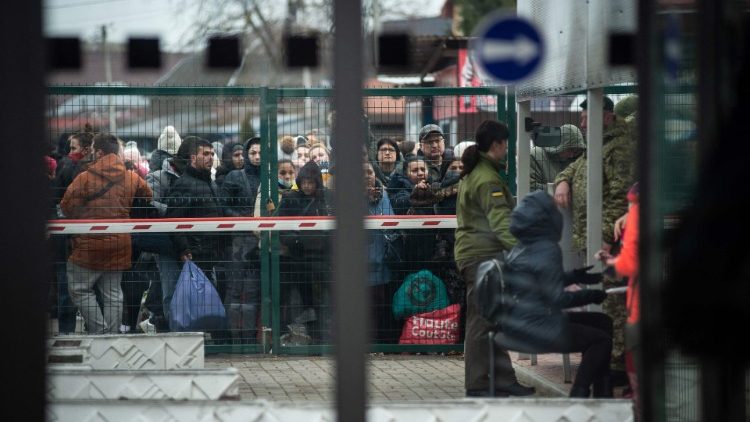
Ukrainians wait at the Slovak-Ukrainian border crossing in Velke Slemence, SlovakiaUkrainians wait at the Slovak-Ukrainian border crossing in Velke Slemence, Slovakia  (AFP or licensors)

Archbishop Grušas: Lithuania prepares to welcome Ukraine refugees

Lithuanian Archbishop Gintaras Grušas, President of the Council of European Bishop's Conferences, describes the Bishops response to the military activity in Ukraine, as well as the positive response from the people of Lithuania who prepare to welcome thousands of refugees.

By Francesca Merlo

Archbishop Gintaras Grušas, President of the Council of European Bishop's Conferences describes how “disheartened” he and his fellow bishops were when they heard of the beginning of the military actions in Ukraine. We are “joining in prayers for the people of Ukraine, for the Church in Urkaine, and we are calling for the cessation of military action”, he says.

Prayers for peace

Speaking to Vatican News’ Antonella Palermo, Archbishop Grušas of the Lithuanian Capital, Vilnius, stresses that the Bishops, and the people of Lithuania, are joining the Holy Father “in the call to prayer and fasting”, and are asking all Catholics, Christians, and people of good will to join, too, in this prayer for peace. The Holy Father has called for Wednesday 2 March to be a day of prayer and fasting for Ukraine who has been under military attack from Russia since Thursday.


Welcoming refugees

Archbishop Grušas went on to note that in Lithuaia, “we have already begun to receive refugees” and adds that this “lands nicely with the  theme of our meeting here in Florence”, Italy. Archbishop Grušas is in Florence, Italy, where he is currently attending a meeting of Bishops and Mayors of some of the cities most affected by the migratory crisis of the Mediterranean Sea. With that in mind, Archbishop Grušas continued noting that like in the Tuscan capital, “the Church and the mayors of various cities in Lithuania are working together to accommodate the influx of refugees”.

Possible numbers

He noted that although the greates number of refugees are likely to reach Poland, which sits at the border with Ukraine, many of the Ukrainin nationals already living in Lithuania have started accommodating friends and relatives who have begun to flee from Ukraine.

Just before leaving Lithuania for the meeting in Italy, the anticipated numbers of possible refugees arriving in Lithuania were low, aound 20, 25, 50, says Archbishop Grušas. “Now they’re talking about 100,00 people”. So we are trying to prepare for this as best we can, he added, noting that the people of Lithuania have already organised “various actions for support”, including a demonstration that saw the participation of around 10,000 people. “Like them”, concluded the Archbishop, we are “calling for an end to the war, and the reestablishment of peace”.

Papal Nuncio to Ukraine trapped in Kyiv asking for help for the people as war rages


Ukraine. A sacred image, symbol of hope in the warUkraine. A sacred image, symbol of hope in the war  (ANSA)

Ukraine: Nuncio stresses need for humanitarian help and prayers

Archbishop Visvaldas Kulbokas is in the nunciature in the Ukrainian capital of Kyiv where he shares the fate of the millions of civilians seeking shelter from the battles in the city: "I wonder how people will manage in a few days with the sick and with food, how will the children who have suffered this violence react? As a Christian I try to help everyone to believe in brotherhood and respect for others."

Alessandro De Carolis - Vatican City

The images of Kyiv are stark: a building gutted by a Russian missile, an ambulance stopped between a belt of armored vehicles and a blockade of horses, highways where only tanks are passing by and shooting at each other. The madness of Kyiv, where just four days ago the traffic was normally busy and people were dining out, today we see a stream of shocking images from the war front opened by Russia in Ukraine symbolizing the terrible reality an entire nation has been living through since Thursday. In the grip of the fighting civilians are trying to escape to underground areas of the city or by foot to the borders.

A direct witness to what is happening in Kyiv is the apostolic nuncio, Archbishop Visvaldas Kulbokas, whose fate, and that of his collaborators, is linked together with that being experienced by millions of the nation’s citizens. Archbishop Kulbokas recounts to Vatican News what he has seen in this interview.

Your Excellency, we are witnessing with great concern and sorrow what is happening in Ukraine. You are in Kyiv where fighting is taking place: tell us about the situation you are experiencing?

This is my biggest concern: the city of Kyiv, where I am and I allow myself to speak, is a big city, with about three million people, and now in these days is completely paralyzed by the war violence. In addition to the incoming missiles forcing people to hide as they can in basements, in subway stations, the question I ask is how are the sick doing? Those ill with any kind of disease, because it's hard to move, it's hard to get around, to find care... how are they managing?

Reports from the country show the image of a ghost town, where, in addition to health care, it is now difficult to get food and water...

Yes, knowing that difficult days were approaching, everyone tried to stockpile some food, but these will last for a few days and so the question is: what will happen if this situation continues for several days? What will be left to eat? Because there is no way to stock up now, and it is risky to stay in apartments, in rooms, it is difficult to stay in public areas... Even we, in the nunciature, we try to stay on the lower floors where there is less risk of being hit. And so it's even more difficult to go outside and find stores open, but it doesn't seem to me that they're open or able to stock up, because even the roads are cut off... What's going to happen in a few days is a very big question.

We see photos and videos of people who have taken refuge in basements, in subway tunnels, especially many women and children, who certainly do not understand what has suddenly disrupted their lives...

This is another big question. We, the adults, how do we help the children? Because maybe an adult goes through suffering, but a child... I had already met people in Italy and other European countries who grew up during the Second World War: how much suffering they are still going through today... I was thinking this morning about the children of Kyiv: when they grow up, what kind of attitude will they have towards others, having lived the first days, the first months, the first years of their lives under gunfire and missiles? This is another great question....

How are all of you doing at the nunciature?

In the nunciature we know that we are in a residential neighborhood and therefore not immediately exposed as on the main roads of the city. However, you hear the missiles going by, you hear the explosions - even last night - the battles nearby... We, the nunciature staff, are also in the lower floors ready to take refuge in the basement if we see an immediate need. But we pray: we pray for ourselves, for others, we pray for peace, we pray for the conversion of all.

What appeal would you make?

More than an appeal, I pose the question before God: what is the eternal God saying to me with this situation? What should I do with myself? And as a Christian, I understand that nothing happens that is hidden from the Lord Jesus and that even in such a heavy situation my vocation is to seek my own conversion but also to try to help others. "Others" means "all": to convert and to make sure that not only peace is found, but brotherhood, respect for one another.

The Church is praying for peace in Ukraine and will do so in a special way on March 2, as Pope Francis has asked everyone to do. A moment at which you will be strongly united....

For us, March 2 is still a long way off, we need to get there. We pray for peace at all times, because it is also a moment that inspires us, because it evokes this intense prayer, of entrustment to the Lord, of entrustment to the Virgin Mary, the Mother of all: the Mother of all, not only of Christians. We Christians know that Muslims respect the Virgin Mary very much, so let us join our prayer to theirs as well, so that the Virgin Mary intercedes for all of us.

The Church across the Americas to fast and pray for Ukraine this Ash Wednesday


Family in Ukraine seeking shelter indoorsFamily in Ukraine seeking shelter indoors 

Church in Americas unites in prayers for peace in Ukraine

Church leaders from across the Americas unite in prayer for an end to the violence in Ukraine and peace throughout the region, also affirming their participation in the March 2nd “Day of Fasting for Peace” on Ash Wednesday called for by Pope Francis.

By Sebastián Sansón Ferrari and Vatican News staff writer

The President of the United States Conference of Catholic Bishops has echoed Pope Francis' call for prayer and fasting for peace in Ukraine. Archbishop José H. Gomez of Los Angeles issued a statement on Ukraine on Thursday, saying, "On behalf of my brother bishops, I echo the Holy Father’s call for prayer and fasting to end the war in Ukraine. In times of trouble, we call on the tender mercy of God … to guide our feet to the way of peace (Lk 1:78-79). May our prayers, joined with those of people around the world, help guide those waging war to end the meaningless suffering and restore peace. Our Lady, Queen of Peace, pray for us."  

The Latin American Episcopal Council (CELAM) has also expressed its worry over the situation in Ukraine and joined Pope Francis' call to political leaders to examine their consciences and put aside everything that causes suffering and threatens peace. Archbishop Miguel Cabrejos Vidarte of Trujillo (Peru), President of CELAM, and Cardinal Odilo Pedro Scherer, Archbishop of Sao Paulo (Brazil), Secretary General, signed the communiqué. They note that in union with Pope Francis they have invited the 22 Episcopal Conferences of Latin America and the Caribbean, the ecclesial institutions of the continent and all brothers and sisters of good will to take part in the day of prayer and fasting for peace set to take place on March 2nd (Ash Wednesday). Together with the Pope, they ask that "the Queen of Peace safeguard the world from the madness of war." 

For their part, the Episcopal Conferences of the Americas immediately communicated their closeness to the Ukrainian people, their participation in the day of prayer and fasting for peace and call for the cessation of hostilities.

The Executive Committee of the Canadian Bishops' Conference made public its solidarity with the Head of the Ukrainian Catholic Church, His Beatitude Sviatoslav Shevchuk, in unison with Ecumenical Patriarch Bartholomew. "With the people of Ukraine, as well as with Canadians of Ukrainian origin and descent, we encourage the faithful and all people of good will to pray for the imminent restoration of peace, dialogue and human fraternity," they stated.

They added that, mindful of the "regrettable lessons on violence" learned in human history, they implore all those involved to "seek non-violent means to resolve disputes and disagreements." They further recalled that the use of military force "is not conducive to dialogue and peace, but endangers innocent human life, the dignity of the human person and the safety of all those caught up in this conflict."

Friday, February 25, 2022

Saturday Saint of the Day


St. Isabel of France


Sister of St. Louis and daughter of King Louis VIII of France and Blanche of Castile, she refused offers of marriage from several noble suitors to continue her life of virginity consecrated to God. She ministered to the sick and the poor, and after the death of her mother, founded the Franciscan Monastery of the Humility of the Blessed Virgin Mary at Longchamps in Paris. She lived there in austerity but never became a nun and refused to become abbess. She died there on February 23, and her cult was approved in 1521.

Christians and Jews in Ukraine pray Psalm 31 together


“FOR ME, AS A PASTOR, THAT PSALM … WELL, I READ IT DIFFERENTLY NOW, BECAUSE IT’S ABOUT OUR CURRENT SITUATION IN UKRAINE.”

Ukrainian Christians and Jews are united in praying Psalm 31 as they face war with Russia.


This Psalm of David reads:

1 In you, Lord, I have taken refuge;
    let me never be put to shame;
    deliver me in your righteousness.
2 Turn your ear to me,
    come quickly to my rescue;
be my rock of refuge,
    a strong fortress to save me.
3 Since you are my rock and my fortress,
    for the sake of your name lead and guide me.
4 Keep me free from the trap that is set for me,
    for you are my refuge.
5 Into your hands I commit my spirit;
    deliver me, Lord, my faithful God.
6 I hate those who cling to worthless idols;
    as for me, I trust in the Lord.
7 I will be glad and rejoice in your love,
    for you saw my affliction
    and knew the anguish of my soul.
8 You have not given me into the hands of the enemy
    but have set my feet in a spacious place.
9 Be merciful to me, Lord, for I am in distress;
    my eyes grow weak with sorrow,
    my soul and body with grief.
10 My life is consumed by anguish
    and my years by groaning;
my strength fails because of my affliction,
    and my bones grow weak.
11 Because of all my enemies,
    I am the utter contempt of my neighbors
and an object of dread to my closest friends—
those who see me on the street flee from me.
12 I am forgotten as though I were dead;
    I have become like broken pottery.
13 For I hear many whispering,
    “Terror on every side!”
They conspire against me
    and plot to take my life.
14 But I trust in you, Lord;
    I say, “You are my God.”
15 My times are in your hands;
    deliver me from the hands of my enemies,
    from those who pursue me.
16 Let your face shine on your servant;
    save me in your unfailing love.
17 Let me not be put to shame, Lord,
    for I have cried out to you;
but let the wicked be put to shame
    and be silent in the realm of the dead.
18 Let their lying lips be silenced,
    for with pride and contempt –
they speak arrogantly against the righteous.
19 How abundant are the good things
that you have stored up for those who fear you,
that you bestow in the sight of all,
on those who take refuge in you.
20 In the shelter of your presence you hide them
from all human intrigues;
you keep them safe in your dwelling
from accusing tongues.
21 Praise be to the Lord,
for he showed me the wonders of his love
when I was in a city under siege.
22 In my alarm I said,
“I am cut off from your sight!”
Yet you heard my cry for mercy
when I called to you for help.
23 Love the Lord, all his faithful people!
The Lord preserves those who are true to him,
but the proud he pays back in full.
24 Be strong and take heart,
all you who hope in the Lord.

The Chief Rabbi in Ukraine invited Christians to join Jews in praying the Psalm this week, drawing on established interfaith relationships to spread the word.