Thursday, July 6, 2017

Spiritual father to war torn Rabaul; died a martyr and beatified by St. Pope JPII

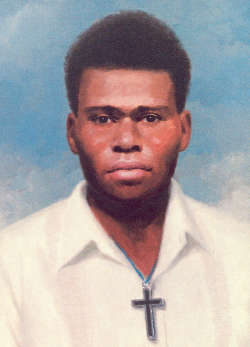
Bl. Peter To Rot

Image of Bl. Peter To Rot

Facts

Feastday: July 7
Birth: 1912
Death: 1945
Beatified By: 17 January 1995 by Pope John Paul II


On January 17, 1995, Pope John Paul II visited Papua New Guinea to celebrate the beatification of Peter To Rot (pronounced "toe rote"). Missionaries of the Sacred Heart throughout the world celebrated because Peter To Rot was intimately connected to our missions. He was trained by and worked with the MSC on the island of New Britain in Papua New Guinea.
Peter To Rot was born in 1912 in Rakunai, a village near Rabaul, the capital of New Britain. To Rot's father was Angelo To Puia, a respected chief and local leader, and his mother was Maria Ja Tumul. Peter was the third of six children. There was an older brother and sister, Joseph and Therese, a younger brother, Gabriel, and the two youngest, a boy and a girl, who died in childhood.
Peter was his father's favorite, probably because they had similar personalities and characteristics. But To Puia did not spoil his son and required as much of him as of the others. When Peter was seven, his father sent him to the village school, even though school was not mandatory. He knew the value of education if Peter was to become a leader. At school, Peter showed himself a quick and able student. His teachers noted that his journal of activities of the previous day always included morning and evening prayer.
Peter's childhood was like that of most boys his age. He served Mass, participated in sports, helped at home with daily chores, and joined in occasional practical jokes and the usual boyhood mischief. What stood out was his leadership among the boys. Even though he was the chief's son, he was neither arrogant nor bossy.
When Peter was 18, the parish priest, Fr. Laufer, MSC, spoke to his father about the possibility of To Rot becoming a priest. Angelo To Puia responded that he thought it was not yet time for one of their generation to become a priest. Perhaps one of his grandchildren would be that lucky. However he agreed that Peter could become a catechist. And so in the fall of 1930, Peter went to study at the Catechist School in Taliligap, staffed by the MSC.
Peter applied himself fully to the studies. His prayer life grew with daily participation in Mass and Communion, regular stops at church to pray during the day, and increased devotion to the Blessed Sacrament. At Taliligap his leadership abilities flowered in work, sports, recreation and prayer.
Before the end of his third year at school, Fr. Laufer sent word that he was urgently needed at the parish. To Rot returned to Rakunai and, at 21 years of age, became the youngest catechist. His main work was teaching in the parish school; but he also visited and prayed with the sick. People liked him because he was even-tempered, never moody, calm and kind. He defended the church and its teachings, engaging anyone is conversation about religion. People soon learned that he practiced what he preached.
On November 11, 1936, Peter married Paula Ja Varpit at the Rakunai church. Paula had been a student in Peter's classes and their two families arranged the wedding. Their marriage was a happy one. To Rot was an exemplary husband and they prayed together every morning and evening. He would often confide in Paula, especially as his concerns increased during the Japanese occupation.
Their first child was born on December 5, 1939. They named him To Puia, in honor of To Rot's father who had died in 1937 and gave him the Christian name of Andreas. Peter was a very proud father and often carried the child around with him, holding him and playing with him. Andreas spent more time with his father than his mother, an unusual fact in the culture. In 1942 a girl, Rufina, was born.
In January 1942, the war had come to Rabaul. After dropping bombs on people who had never even seen airplanes before, the Japanese landed in Rabaul. The soldiers sent all the missionaries to the prison camp at Vunapope. When Father Laufer left, he shook hands with Peter and said, "To Rot, I am leaving all my work here in your hands. Look after these people well. Help them, so that they don't forget about God."
To Rot willingly took on this work, even though he was afraid. He knew that God would be with him. He visited the sick, prayed with those who were dying, and prepared them to meet Jesus. He held classes for both children and adults. He helped them all to remain loyal to the teachings of Jesus. To those who were frightened by the events of the war, To Rot would encourage them saying, "This is a very bad time for us, and we are all afraid. But God our Father is with us and looking after us. We must pray and ask him to stay with us always."
Peter was also in the habit of gathering the villagers together every day for prayer. But when the bombings increased, they decided that it was unwise for them all to meet in one place. To Rot divided the people into small groups and had them meet in the caves that had been made for hiding from the bombs. The people continued their daily prayers in these caves and were filled with strength and peace, despite the dangers all around them.
Early on, the Japanese paid no attention to the people's prayer and Sunday worship. But when they started losing the war, they feared that the people's God was against them. They called in the village leaders and commanded them, "You people must not pray to your God. You cannot meet on Sundays for service, and you must not pray in the villages either. Anyone who disobeys this law will go to jail."
When the leaders brought the message from the Japanese back to their villages, it was Peter To Rot who spoke up, "The Japanese cannot stop us loving God and obeying his laws! We must be strong and we must refuse to give in to them." And so he continued to teach the people and gather them for prayer.
Another of the Japanese laws was that men could take a second wife. They wanted to gain favor with the locals and control them more easily. Again Peter To Rot objected and reprimanded anyone found with a second wife. He insisted that the villagers follow the Church's teaching about marriage and that they come to him, their catechist, to witness the marriages. Anything else was a sin before God. On several occasions he made provisions for the care of women who were being abducted to become second wives.
Some of the local young men who worked as spies for the Japanese reported these happenings. The Japanese authorities arrested To Rot. They searched the caves where he held prayer services, and searched his home as well as the houses of his two brothers, Tatamai and Telo. They confiscated To Rot's books: a Bible, catechism, song book, some notebooks and two crucifixes. From Tatamai's house they took a raincoat. And in Telo's suitcases they found an Australian bank book. All three brothers were arrested.
The Japanese police chief first interrogated the older brother, Tatamai, about church services. When Tatamai answered that he had indeed attended church services, the police chief struck him on the head with a wooden cane and sentenced him to one month in prison.
Then To Rot was interrogated about celebrating church services, his attitude concerning marriage, and his defiance of the Japanese law allowing more than one wife. To Rot was also struck on the head and repeatedly poked with the cane in his upper chest, around the heart. He was sentenced to two months in prison.
Telo, the youngest, was accused of being an Australian spy because of the bank book. He was hung on a papaya tree and beaten till he lost consciousness. In the days following, Tatamai and To Rot were sent into forced labor; Telo had been too severely beaten to work.
Telo was released after two weeks because of his health after the beating; Tatamai was released after a month; but To Rot was kept at the prison. When To Rot's village chief asked the police why he was not released, he was told that To Rot was a bad type who prevented men from having two wives and who called people to prayer.
To Rot had many visits from relatives and friends, especially his mother and his wife. They came every day and brought him food. He would encourage them and assure them that he was not afraid because he was in prison for God. To the village chief who came to see him, Peter said, "I am in prison because of the adulterers and because of the church services. Well, I am ready to die. But you must take care of the people." To another friend, Peter added, "If it is God's will, I'll be murdered for the faith. I am a child of the church and therefore for the church I will die."
One day he asked his wife Paula to bring his shaving kit, a white "laplap" (large loin cloth), his rosary and his catechist's cross. The next day, a Friday, she brought these along with some food. She also brought the two children--Andreas now 6 years old and Rufina who was 3; she was pregnant with their third child. When Paula noticed that Peter ate very little, she became anxious and upset. To Rot calmed her and said that it was his duty to die for his people and for the name of the Father and the Son and the Holy Spirit. The family stayed together for a long time, until Peter urged her to take the children and go home.
Later in the day when his mother came to visit, To Rot told her that the police were having a Japanese doctor come to give him some medicine (he had developed a slight cold). But he added, "I don't know what that means. Perhaps it is a lie. After all, I am not ill." Late in the afternoon, To Rot bathed, shaved and put on his new laplap. He stood at the door of the prison hut and prayed.
Around 7 in the evening, all the prisoners--except To Rot--were taken to a nearby farm for a party. They were surprised since this had never happened before. At about 10 o'clock, the Japanese guard told them to go to sleep. Not returning to the prison for the night was also very unusual. Because security was very light, three prisoners crept back to the prison in the darkness. There they found Peter To Rot dead on the porch of the prison house.
To Rot was on his back, one arm bent under his head, and one leg twisted at an angle under the other. His body was still warm. They noticed cotton wads in his nostrils and ears, a red welt on his neck, a strip of cloth around his head, and a small puncture hole from a syringe on his upper left arm. They knew he had been murdered, but fearing for their own lives, hid and said nothing.
In the morning at roll call, To Rot was missing and the Japanese chief sent someone to check on him. The police chief feigned surprise at To Rot's death and said that he had been very ill and must have died. Then he sent for the village chief and To Rot's relatives to come and take away the body.
The villagers and relatives removed Peter's body. As they washed his body for burial, they noticed a foul smelling foam coming from his ears, nostrils and mouth. When removing the strip of cloth from his head, they found two bleeding punctures at the back of his head. The center of his throat was crushed flat and was swollen, as if hit by a truncheon. No one believed that he had died of illness.
Peter To Rot was given a chief's burial at the new cemetery next to the church where he had ministered. Even though many people came, the funeral was held in silence, fearing what the Japanese might do if the people prayed aloud and in public. From that day on he was revered as a martyr for his faith.

So while vacationing in the Diocese of Raleigh, they just happened to get a new Bishop yesterday

Pope Francis names a new bishop for Raleigh

07-05-2017

At 6:00 a.m. EST, it was announced in Rome that our Holy Father Pope Francis appointed Bishop Luis Rafael Zarama, an auxiliary bishop of the Archdiocese of Atlanta, to serve as the 6th bishop of the Diocese of Raleigh. He will be installed at Holy Name of Jesus Cathedral on August 29, 2017.
Below the video you will find statements from Archbishop Wilton Gregory of Atlanta and Bishop Michael F. Burbidge of Arlington, as well as a short biography of Bishop Luis Zarama.


Archbishop Wilton D. Gregory (Archbishop of Atlanta) issued the following statement:
Pope Francis in today’s appointment has honored the Archdiocese of Atlanta with the gift of Bishop Luis R. Zarama to become the new Bishop of Raleigh. How fortunate that local Church is to receive such a devoted and generous servant minister. The Holy Father has chosen well even though his decision takes a deeply beloved brother and friend from our midst.
I join Bishop-Elect Shlesinger and all of the clergy, religious, and faithful of the Archdiocese of Atlanta in assuring Bishop Zarama of our prayers and warmest best wishes as he begins this new service to Christ’s Church. While we will have time to celebrate his appointment to the Diocese of Raleigh before he takes leave for his August 29th Installation, we promise him our affectionate best wishes and congratulations on this happy moment for him and for all of God’s People in the Diocese of Raleigh.
Bishop Michael F. Burbidge, former bishop of the Diocese of Raleigh and current bishop of the Diocese of Arlington, responded to the news with the following statement:
I give thanks to God for the appointment of Bishop Luis Zarama as the Sixth Bishop of Raleigh. I am proud to call him a brother bishop and good friend. Bishop Zarama is a holy, faithful and joyful bishop known and respected for his pastoral skills, administrative abilities, zeal and kindness. I have assured Bishop Zarama that he will be truly blessed with the support of such good priests, consecrated religious, deacons, seminarians, colleagues and lay faithful in the Diocese of Raleigh. I promised Bishop Zarama that he and the Diocese of Raleigh will remain in my daily prayers at this joyful and historic moment and always.
Below is a brief biography of Bishop Zarama:
Bishop Luis Zarama was born in Pasto, Colombia, on November 28, 1958. He attended the Conciliar Seminary in Pasto, Colombia, where he graduated from high school. He attended the Marian University in Pasto, earning a degree in Philosophy and Theology. He also attended the Pontificia Universidad Javeriana in Bogotá, Colombia, earning a degree in Canon Law. He was a Philosophy and Theology professor at the Carmelites School, the Learning School and the Colombia Military School for eleven years. 
Bishop Zarama was ordained to the Roman Catholic Priesthood for the Archdiocese of Atlanta on November 27, 1993. His first assignment was as parochial vicar at Sacred Heart of Jesus Catholic Church in Atlanta. He served as a member of the Vocations Committee. Bishop Zarama was the first Hispanic priest to be named pastor in the Archdiocese of Atlanta to St. Mark Catholic Church in Clarksville, GA, and St. Helena Mission in Clayton GA. He was a board member of Habitat for Humanity in Habersham County in 2005. Bishop Zarama was named Vicar General of the Archdiocese in April of 2006. He was named Chaplain of His Holiness with the title of monsignor by Pope Benedict XVI on March 7, 2007. In 2008 he was appointed to serve as the Judicial Vicar for the Archdiocese's Metropolitan Tribunal. He is also a member of the Archdiocesan Personnel Review Board. 
On July 27, 2009, His Holiness, Pope Benedict XVI, named him as Titular Bishop of Bararus and Auxiliary Bishop of the Archdiocese of Atlanta. He was ordained to the Episcopacy on September 29, 2009.
Pope Francis names a new bishop for Raleigh 6412 520 googleplus6 118 07-05-2017 At 6:00 a.m. EST, it was announced in Rome that our Holy Father Pope Francis appointed Bishop Luis Rafael Zarama, an auxiliary bishop of the Archdiocese of Atlanta, to serve as the 6th bishop of the Diocese of Raleigh. He will be installed at Holy Name of Jesus Cathedral on August 29, 2017. Below the video you will find statements from Archbishop Wilton Gregory of Atlanta and Bishop Michael F. Burbidge of Arlington, as well as a short biography of Bishop Luis Zarama. Archbishop Wilton D. Gregory (Archbishop of Atlanta) issued the following statement: Pope Francis in today’s appointment has honored the Archdiocese of Atlanta with the gift of Bishop Luis R. Zarama to become the new Bishop of Raleigh. How fortunate that local Church is to receive such a devoted and generous servant minister. The Holy Father has chosen well even though his decision takes a deeply beloved brother and friend from our midst. I join Bishop-Elect Shlesinger and all of the clergy, religious, and faithful of the Archdiocese of Atlanta in assuring Bishop Zarama of our prayers and warmest best wishes as he begins this new service to Christ’s Church. While we will have time to celebrate his appointment to the Diocese of Raleigh before he takes leave for his August 29th Installation, we promise him our affectionate best wishes and congratulations on this happy moment for him and for all of God’s People in the Diocese of Raleigh. Bishop Michael F. Burbidge, former bishop of the Diocese of Raleigh and current bishop of the Diocese of Arlington, responded to the news with the following statement: I give thanks to God for the appointment of Bishop Luis Zarama as the Sixth Bishop of Raleigh. I am proud to call him a brother bishop and good friend. Bishop Zarama is a holy, faithful and joyful bishop known and respected for his pastoral skills, administrative abilities, zeal and kindness. I have assured Bishop Zarama that he will be truly blessed with the support of such good priests, consecrated religious, deacons, seminarians, colleagues and lay faithful in the Diocese of Raleigh. I promised Bishop Zarama that he and the Diocese of Raleigh will remain in my daily prayers at this joyful and historic moment and always. Below is a brief biography of Bishop Zarama: Bishop Luis Zarama was born in Pasto, Colombia, on November 28, 1958. He attended the Conciliar Seminary in Pasto, Colombia, where he graduated from high school. He attended the Marian University in Pasto, earning a degree in Philosophy and Theology. He also attended the Pontificia Universidad Javeriana in Bogotá, Colombia, earning a degree in Canon Law. He was a Philosophy and Theology professor at the Carmelites School, the Learning School and the Colombia Military School for eleven years. Bishop Zarama was ordained to the Roman Catholic Priesthood for the Archdiocese of Atlanta on November 27, 1993. His first assignment was as parochial vicar at Sacred Heart of Jesus Catholic Church in Atlanta. He served as a member of the Vocations Committee. Bishop Zarama was the first Hispanic priest to be named pastor in the Archdiocese of Atlanta to St. Mark Catholic Church in Clarksville, GA, and St. Helena Mission in Clayton GA. He was a board member of Habitat for Humanity in Habersham County in 2005. Bishop Zarama was named Vicar General of the Archdiocese in April of 2006. He was named Chaplain of His Holiness with the title of monsignor by Pope Benedict XVI on March 7, 2007. In 2008 he was appointed to serve as the Judicial Vicar for the Archdiocese's Metropolitan Tribunal. He is also a member of the Archdiocesan Personnel Review Board. On July 27, 2009, His Holiness, Pope Benedict XVI, named him as Titular Bishop of Bararus and Auxiliary Bishop of the Archdiocese of Atlanta. He was ordained to the Episcopacy on September 29, 2009.

Powerful Christian witness unto death, by a girl, 11 years old; one of my favorite saints

St. Maria Goretti    


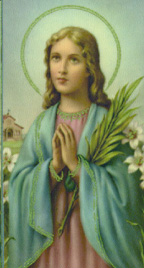
Image of St. Maria Goretti

Facts

Feastday: July 6
Patron of youth, young women, purity, and victims of rape
Birth: October 16, 1890
Death: July 6, 1902
Beatified By: by Pope Pius XII on April 27, 1947
Canonized By: by Pope Pius XII in 1950


Born on October 16 1890 in Corinaldo, in the Ancona Province in Italy, her farmworker father moved his family to Ferrier di Conca, near Anzio. When he died of malaria, Maria's mother had to struggle to feed her children.
Maria's mother, brothers, and sisters worked in the fields while she cooked, sewed, kept the house clean, and watched her youngest sister Teresa. Though the family's circumstances were extremely difficult, they were very close and loved God.
On July 5, 1902, Maria was sitting outside the steps of her home sewing her 18-year-old brother or neighbor -it is unclear which - Alessandro's shirt while he threshed beans in the barnyard. As she concentrated on her sewing, Alessandro surprised her and grabbed her from her steps. When he tried to rape her, Maria cried that it was a mortal sin and warned he would go to hell.
When Alessandro persisted, she fought him and screamed, "No! It is a sin! God does not want it!" At her words, Alessandro began to choke her and she said she would rather die than submit. Upon hearing her words, Alexander pulled out a knife and stabbed her eleven times. When she attempted to reach the door, he stabbed her three more times then fled.
Teresa woke to the sounds of her sister's cries and began to cry. Maria's family returned home and found her bleeding on the floor. They quickly took her to the nearest hospital in Nettuno, where she underwent surgery without anesthesia.
Unfortunately, her wounds were beyond the surgeon's ability to help. Halfway through the surgery, the man asked her, "Maria, think of me in Paradise."
As she lay on the table, she looked up at him and said, "Well, who knows which of us is going to be there first?"
She did not realize how terrible her situation was, and the surgeon replied, "You, Maria."
She said, "Then I will think gladly of you." She also mentioned concerns for her mother. The next day, Maria forgave Alessandro and said she wanted to see him in Heaven with her. She died that day while looking upon an image of the Virgin Mary and holding a cross to her chest.
Shortly after Maria's family discovered her, Alexander was captured and questioned. He admitted Maria was a physical virgin as he was unable to assault her and he was sentenced to thirty years. He also admitted he had attempted to persuade her to accompany him to bed on several occasions in the past and had attempted to rape her before.
Alessandro remained unrepentant for his actions until he had a dream that he was in a garden. Maria was there and gave him lilies, which immediately burned in his hands. When he woke, he was a changed man. He repented his crime and living a reformed life. When he was released 27-years-later, he went directly to Maria's mother and begged her forgiveness, which she gave, saying, "If my daughter can forgive him, who am I to withhold forgiveness?"
Maria Goretti was beatified by Pope Pius XII in a ceremony at Saint Peter's Basilica on April 27, 1947.
Three years later, on June 24, 1950, Maria was declared a saint and Alessandro was present in the St. Peter's crowd to celebrate her canonization. He later became a laybrother of the Order of Friars Minor Capuchin, where he lived in a monastery and worked as its receptionist and gardener until his death.
Saint Maria is called a martyr because she fought against Alessandro's attempts at sexual sin; however, the most important aspects of her story are how she forgave her attacker - her concern for her enemy extending even beyond death - and the miracle her forgiveness produced in his life.
Saint Maria's body can be found in the crypt of the Basilica of Nostra Signora delle Grazie e Santa Maria Goretti in Nettuno. Though several claim her body is incorrupt, she has been proven to be corrupt. Her body is kept in a statue which lies beneath the altar and has been mistaken to be all of her remains.
Images of Saint Maria often represent her with wavy hair dressed in either white or farm clothes and is often depicted holding lilies.

Wednesday, July 5, 2017

Image may contain: 1 person, sitting and indoorCalvin, now almost 5 years old &

Image may contain: 1 person, sitting and indoorKatelyn, now two years old


There is not much that pulls me away today from back home, especially with my diaconate ministry and the many new and exciting changes at work, except these two awesome grandchildren.  Calvin and Katelyn hang with us like we almost lived nearby, and believe me, we don't!  Wendy and I have 3 more full days with these awesome kids and our son and daughter-in-law.  Looking so forward to these days!

Priest, Founder, Saint


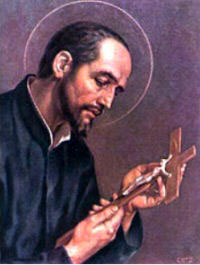
Image of St. Anthony Mary Zaccaria

Facts

Feastday: July 5
Patron of The Barnabite order
Birth: 1502
Death: 1539

Cofounder of the Barnabites. Born in 1502 in Cremona, Italy, Anthony became a medical doctor. In 1528 he was ordained a priest and cofounded the Barnabites, the religious congregation so called because it was headquartered in St. Barnabas Monastery in Milan. The Barnabites occupied the monastery in 1538, having been approved in 1533. Anthony popularized the forty-hour prayer ceremony, promoted the use of altar sacraments, and introduced the ringing of church bells on Friday. He is depicted in liturgical art in habit

Tuesday, July 4, 2017

Many pray for this "blesseds" eventual canonization

Bl. Pier Giorgio Frassati

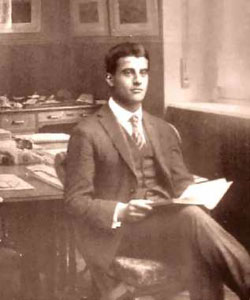
Image of Bl. Pier Giorgio Frassati

Facts

Feastday: July 4
Birth: 1901
Death: 1925
Beatified By: 20 May 1990 by Pope John Paul II

He was born in Turin into a wealthy family, who owned a newspaper called La Stampa. Though an average student, Frassati was known among his peers for his devotion and piety.
He was dedicated to works of social action, charity, prayer and community. He was involved with Catholic youth and student groups, the Apostleship of Prayer, Catholic Action, and was a third order Dominican. He would often say, "Charity is not enough; we need social reform." He helped establish a newspaper entitled Momento, whose principles were based on Pope Leo XIII's encyclical: Rerum Novarum.
Despite his family's enormous wealth and power, Frassati's father was austere and never gave his children too much spending money. Frassati, however, donated most or all of his money to people he saw as more "needy" than him, and as a result he became accustomed to giving his train-fare to the poor and running back home or riding in third class.
Despite the many organizations to which Frassati belonged, he was not a passive "joiner"; records show that he was active and involved in each, fulfilling all the duties of membership. He was strongly anti-fascist and did nothing to hide his political views.
Participating in a Church-organized demonstration in Rome, he withstood police violence and rallied the other young people by grabbing the banner which the police had knocked out of someone else's hands. He held it even higher while using the pole to ward off their blows. When the demonstrators were arrested by the police, he refused special treatment that he might have received because of his father's political position, preferring to stay with his friends. One night a group of fascists broke into his family's home to attack him and his father, but Frassati beat them off single-handedly chasing them down the street.
Frassati died in 1925 of poliomyelitis. His family expected Turin's elite and political figures to come to offer their condolences and attend the funeral; they naturally expected to find many of his friends there as well. They were surprised, however, to find the streets of the city lined with thousands of mourners as the cortege passed by. Poor people from the city petitioned the Archbishop of Turin to begin the cause for canonization. The process was opened in 1932 and he was beatified on 20 May 1990. Blessed Pier Giorgio Frassati's feast day is 4 July.
Frassati was called Man of Eight Beatitudes by Pope John Paul II, who beatified him on 20 May 1990.
Frassati is the Patron Saint of Bishop McGuinness High School in Oklahoma, where Frassati's family blessed the school in his spirit.

This Queen of Portugal is our Saint of the Day

St. Elizabeth of Portugal


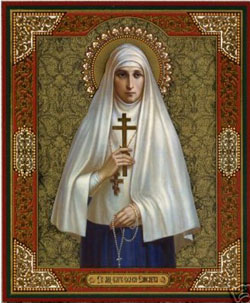
Image of St. Elizabeth of Portugal

Facts

Feastday: July 4
Patron of the Third Order of St. Francis


Elizabeth was a Spanish princess who was given in marriage to King Denis of Portugal at the age of twelve. She was very beautiful and very lovable. She was also very devout, and went to Mass every day. Elizabeth was a holy wife, but although her husband was fond of her at first, he soon began to cause her great suffering. Though a good ruler, he did not imitate his wife's love of prayer and other virtues. In fact, his sins of impurity gave great scandle to the people.
Later, to make matters worse, the King believed a lie told about Elizabeth and one of her pages by another page, who was jealous of his companion. In great anger the King ordered the one he believed guilty, to be sent to a lime-burner. The lime-burner was commanded to throw into his furnace the first page who came. The good page set out obediently, not knowing death was waiting for him. On his way he stopped for Mass, since he had the habit of going daily. The first Mass had begun, so he stayed for a second one. In the meantime, the King sent the wicked page to the lime-burner to find out if the other had been killed. And so it was this page who was thrown into the furnace! When the King learned what had happened, he realized that God had saved the good page, punished the liar, and proven Queen Elizabeth to be innocent.
This amazing event helped greatly to make the King live better. He apologized to his wife in front of everyone and began to have a great respect for her. In his last sickness, she never left his side, except for Mass, until he died a holy death. St. Elizabeth lived for eleven more years, doing even greater charity and penance. She was a wonderful model of kindness toward the poor and a successful peacemaker between members of her own family and between nations.
Because St. Elizabeth was faithful to daily Mass, she found strength to carry her many great crosses. And because her page was faithful to daily Mass, he escaped death. We should try our best to make it a habit to go to Mass daily

The evolution of Catholicism in America; profoundly disliked by the founding fathers and most colonists; she now endures as America's largest and most active Church

The Catholic Church in the United States of America
  • FR. ROBERT J. FOX
This chapter explores the early days of the English colonies, when the rights of Catholics were not respected, to the end of the nineteenth century.


people/calvertCecil Calvert
(1606 - 1675)
The English colonies were founded at the same time the Church was persecuted in England. Virginia colonists were members of the English Church; in New England the colonists were Calvinists. Catholics were not permitted in these colonies. Catholics were excluded from the Dutch colony in New York and the Swedish settlement of Delaware also.
In 1683 James II appointed Thomas Dongan governor of New York and religious liberty was granted to all. The Jesuits built a Catholic chapel in New York City, and established a Latin school there in 1685. By 1700, laws against Catholics were again put into place. Catholics of New York had to travel to Philadelphia as late as the Revolutionary War to participate in Mass and receive the sacraments.

2. Was religious freedom permitted in Maryland?

Yes. A Catholic colony was settled in Maryland by Cecil Calvert in 1634. A church and school were built as Catholic settlers arrived, accompanied by Jesuit priests. They permitted religious freedom to others and, as a result, Protestants obtained control of the colony. The English Church was then established and Catholics were denied their right to vote. The religious freedom of Catholics in Maryland was then restricted until after the Revolutionary War.

3. Were Catholics given freedom in Pennsylvania?

Yes. Under William Penn, the Quakers in Pennsylvania permitted Catholics to practice their faith. In 1730 the Church was given greater security when a Jesuit, Fr. Joseph Greaton, settled in Philadelphia and had St. Joseph's Church built. When Catholic emigrants came from Germany, they too built churches. By the end of the French and Indian War there were only 7,000 Catholics in the English colonies. Most of them lived in Maryland and Pennsylvania.

4. Summarize the development of Catholicism in other parts of the New World.

The Capuchins built a chapel in New Orleans in 1721, just three years after the city was founded. They opened a school for boys. The French king gave the Ursuline sisters permission to settle in New Orleans and they opened the first convent in the United States. They built a hospital, an orphanage, and a school for girls.
Fr. Pierre Gibault left the seminary at Quebec, Canada, and came to labor for the Church in Vincennes, Makinac, Detroit, and Peoria. The priest blessed the first church in St. Louis in 1770. He made it possible for George Rogers Clark to gain possession of the great Northwest for the United States, which included what is now Indiana, Ohio, Illinois, Michigan, and Wisconsin.
Attempts to colonize Florida failed at first because of the hostility of the Indians. Early missionaries did not succeed, even though as early as 1528 Fr. Juan Juarez, a Spanish Franciscan, was appointed bishop of Florida. He disappeared mysteriously. In 1549 a group of missionaries landed near Tampa Bay and within a few days all were savagely killed by the Indians.
Philip II in 1565 sent Admiral Pedro Menendez de Aviles, a leading naval leader of the Spanish Empire, to establish a colony in Florida. Twelve Franciscans and four Jesuits went with him to convert the Indians. Sailing along the Florida coast on August 28, 1565, Admiral Menendez saw an ideal peninsula and ordered the boats to drop anchor. On September 8 he proclaimed the founding of St. Augustine because the peninsula was found on the saint's feast day. missionaries spread out from St. Augustine to convert the Indians, with many priests losing their lives as the new, advancing civilization was resisted by the Indians.
Missionaries were determined to bring Christianity to Florida and so the priests who lost their lives were always replaced, and gradually St. Augustine developed and the new colony grew. The countryside became peaceful as missions and monasteries were founded throughout Florida and most of the Indians north of the Gulf of Mexico and east of the Mississippi River converted to the Catholic Church.
The French Huguenots then appeared and raided Spanish Catholic Indian settlements. Missionaries and the faithful were put to death with extreme cruelty. The British, who had been colonizing in the north, also began to destroy Spanish gains.
Governor Moore of South Carolina in 1704 directed a raid of the Apalachee Mission, valuable for food supplies. Franciscan missionaries were put to death; 1,400 Indians were taken into slavery by the English governor and 800 Catholic Indians were killed.
Weakened, the Spanish signed the Treaty of Paris with England in 1763m ceding Florida to the British. The Catholic faith in Florida was then even more suppressed. At the end of the American Revolution, however, the United States government returned Florida to Spanish control. In 1821 Florida was purchased as part of the United States.
in 1598 Don Juan de Onate led an expedition to establish a colony in New Mexico. It consisted of 400 soldiers, 10 missionaries, 83 supply wagons and carts, and 7,000 head of stock. Onate went as far as Wichita, Kansas, and California. Onate's expeditions to New Mexico became an economic drain and the victory of New Spain assigned Pedro de Peralta to build a new capital and to colonize. This was done. He named a site, Royal City of the Holy Faith of St. Francis, known today as Sante Fe (Holy Faith). Santa Fe was founded in 1609 and became the headquarters for future missions in New Mexico. By 1625 there were forty-three missions and 34, 000 Christian Indians.
A Jesuit priest, Fr. Eusebio Francisco Kino, labored in the Upper Pima country, which is now the Mexican state of Sonora and southern Arizona. Fr. Kino has been called "the most picturesque missionary pioneer of all North America â explorer, astronomer, cartographer, mission builder, ranchman, cattle king, and defender of the frontier." His maps were the most accurate of the time, winning fame in Europe.
Fr. Kino's mission of San Xavier del Bac, not far from what is Tucson, Arizona, is now a national monument, while still the parish church for the Pima Indians. It is the finest example of Spanish Renaissance architecture in the United States.
Fr. Kino traveled thousands of miles on horse, ever anxious to convert souls. Some of this trails became roads, and he kept journals of his extensive travels. His papers were preserved in the Huntington Library in San Marino, California. While Fr. Kino won the faith of the Pima Indians for Jesus Christ, he was always sad that he did not succeed in converting the Apache Indians.
Fr. Kino died on March 15, 1711, in poverty, as he had lived. He is venerated as a great American pioneer.
The cause for canonization of Fr. Antonio Margil, who developed missions in Texas, has been introduced. One of the missions he founded near San Antonio (San Antonio de Bexar Mission) is still used as a parish church and has been declared a National Historic Site by both the state and nation. Margil is compared to Kino and Serra as among the greatest of Spanish missionaries.
The Spanish came to Texas first but met competition from the French, who came down the Mississippi River from Canada. La Salle built Fort Prudhomme in Tipton County and Fort St. Louis in Victoria County.
Besides San Antonio, the Spanish built the missions of San Saba, San Luis, and San Francisco de los Tejas (now a lost site). The Spanish built their missions not simply as churches for worshipers but to become self-sufficient communities with farms, cattle and ranches, and homes for Indians who worked at the mission â also homes for teachers, nurses, and guards. They built hospitals, schools, and guard posts as protection from Apache and Comanche Indians.
The Spanish crown withdrew support and in 1793 the mission of San Jos de Aguayo was suppressed by the Mexican government. The Franciscans had to leave when the new Mexican government took over the missions in 1824, and with the passing of years the mission was neglected. San Jos, which had earned the name Queen of the Missions, began to be restored to its former beauty in 1912 when the archdiocese of San Antonio began a restoration program. In 1941 arrangements began whereby it was named a National Historic Site.
serra.JPG
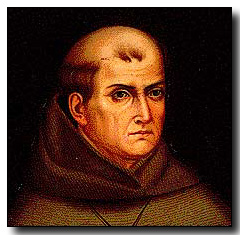
Fr. Junipero Serra
(1713 - 1784)

Fr. Junipero Serra, the great missionary of California, has been named to the Statuary Hall of our nation's capitol for the state of California. Fr. Serrra arrived in the harbor of Veracruz, Mexico, on December 6, 1749, with a group of Franciscan missionaries assigned to evangelize the Indians of northern Mexico.
The Franciscans were welcomed in the New World missions. They avoided politicizing. The viceroy of Peru wrote to King Philip II: "They are the ones who preach the doctrine with the greatest care and example, and the least avarice." This was especially true of Fr. Juniper Serra.
Fr. Junipero was known for his great oratory, and his keen philosophical mind gave him a reputation among scholars. Nonetheless, he requested an assignment as a missioner. He said: "I have wanted to carry the Gospel teachings to those who have never heard of God and the kingdom He has prepared for them."
His real missionary work did not begin until he was 56 years old, after he spent nine years among the Toltec Indians in Serra Gord and seven years as an itinerant preacher from San Fernando College in Mexico City.
Learning of California and the needs of its Indians moved him. He then received permission to begin mission work there. His motto was "Always forward, never back."
Fr. Serra walked whenever possible, in spite of poor health. He carried on a most heroic conquest of America for Christ from 1750 until his death in 1784, with no other weapon than a crucifix and the love of God. He converted the solitudes of California into an earthly paradise â where formerly fierce Indian tribes attempted to annihilate each other in cannibalistic battles.
Fr. Serra founded nine important missions in California. His successors founded twelve more. The cities of California grew around these missions. San Diego, Carmel, San Gabriel, Santa Clara, San Luis Obispo, Ventura, Capistrano, San Francisco â became centers of colonization and development in California.
Fr. Junipero Serra was always on the move, back and forth between his missions, urging all to greater charity and zeal and encouraging new converts. Not satisfied with simple conversion to the Catholic faith, this great Franciscan priest and missionary taught the Indians a better life by teaching them how to sow and harvest. He led in the development of farmlands and wine presses and helped build, with his own hands, forges, mills, and slaughter houses.
Fr. Serra once walked 2,400 miles to Mexico City to get retribution from the viceroy when a commandant of the Spanish military practiced cruelty to the Indians. His death at Carmel Mission, on August 28, 1784, marked the end of Spanish extension in the United States in the pioneer missionary era.

5. Did religion continue strong in the hearts of people after the early pioneer days?

To some extent it did, but once the hardships of the pioneer days were over and the descendants grew wealthy from trade and agriculture, the old religious spirit weakened among Protestants. The spirit of the Enlightenment overtook them and Rationalism dominated in too many cases, as many depended more on themselves than on God.
Thomas Paine, a leader of the revolutionary spirit, resembled in some respects the infidelity of Voltaire. Thoms Jefferson, who wrote the Declaration of Independence, was a deist who sympathized with the Freethinkers of France.
Catholics were blessed with heroic and saintly missionaries. Their faith continued to spread. There were three Catholics among those who signed the Declaration of Independence and the Articles of Confederation: Thomas Fitzsimmons, Daniel Carroll, and Charles Carroll of Carrolton.
The Carroll family of Maryland played a great role in the foundation of our American nation. One of the great Carroll family became a priest, namely John, who was born in Maryland on January 8, 1735. On July 1, 1784, Fr. John Carroll was appointed superior of the Catholic clergy in America. In 1789 Monsignor Carroll was appointed bishop, and was consecrated bishop of the United States in 1790, with his see at Baltimore.
When Bishop Carroll returned from England (where he was consecrated), he took a survey of his vast church. The first national census showed that in 1790 there were approximately 30,000 Catholics in a population of 3, 200,000. There were fewer than thirty priests for the widely scattered Catholic population. More than half the Catholics, about 16,000, lived in Maryland; 7,000 lived in Pennsylvania; 3,000 around Detroit and Vincennes, and 2,500 in Illinois.

Read it all, a must read for every Catholic who is American......................http://www.catholiceducation.org/en/culture/history/the-catholic-church-in-the-united-states-of-america.html

Monday, July 3, 2017

Vatican stepping up efforts to save Baby Charlie

Rome’s Bambino Gesù Hospital Is Ready to Receive Charlie Gard
Hospital’s President, Mariella Enoc, Says Baby Can Transfer to Vatican-owned Pediatric Hospital
CHARLIE GARD
Mariella Enoc, President of the Vatican-owned Bambino Jesus (‘Infant Jesus’) pediatric hospital,said the hospital is ready to receive Charlie Gard in Rome, if his parents so wish and if his State, allows it.
In a press release in Italian this Monday, July 3, 2017, she quotes Pope Francis’ tweet, posted on his account @Pontifex_it on June 30: “Defend human life, especially when it is wounded by sickness, is a commitment of love that God entrusts to every man.”
“The Holy Father’s words, regarding little Charlie, summarize well the mission of the Bambino Gesu hospital. That is why I asked the Health Director to verify with London’s Great Ormond Street Hospital, where the newborn is hospitalized, if the health conditions exist for Charlie’s eventual transfer to our hospital. We know that the case is desperate and that, apparently, effective therapies do not exist.”
Enoc expressed her closeness to Charlie’s parents saying: “We are close to the parents through prayer and, if they so desire, we are ready to receive their child in our hospital for the time that remains to him to live.”
Pope Francis addressed a message to Charlie Gard’s parents on Sunday evening, July 2, expressing his closeness, through his spokesman Greg Burke: “The Holy Father follows with affection and emotion the affair of little Charlie Gard and expresses his closeness to his parents.” Pope Francis, Burke said, “Prays for them hoping that their desire to accompany and care for their child to the end is not disregarded.”
Charlie Gard was born on August 4, 2016; he is suffering from a rare mitochondrial diseases damaging his brain.
On June 27, the European Court of Human Rights rejected the parents’ appeal to take their child to the United States for experimental treatment and the British Supreme Court ruled in favor of the cessation of respiratory assistance, hydration and nutrition, which according to the experts, like Cardinal Elio Sgreccia, president emeritus of the Pontifical Academy for life, amounts to euthanasia.