Monday, July 3, 2017

Travel day

Today is our travel day as we journey to see our NC family and catch up with grandkids Calvin & Katelyn.  Posting today and tomorrow will probably be light.

We will catch up from the tar heel state!

Sunday, July 2, 2017

Remembering the Apostle known as doubting Thomas

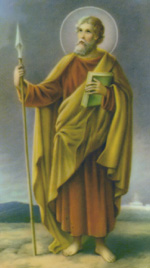
St. Thomas


Image of St. Thomas

Facts

Feastday: July 3
Patron of architects


St. Thomas was born a Jew and was called to be one of the twelve Apostles. His birth and death dates are unknown, but his feast day is celebrated July 3. He lived before the formal establishment of the Catholic Church but is recognized as the patron saint of architects.
He was a dedicated but impetuous follower of Christ. When Jesus said He was returning to Judea to visit His sick friend Lazarus, Thomas immediately exhorted the other Apostles to accompany Him on the trip which involved certain danger and possible death because of the mounting hostility of the authorities.
At the Last Supper, when Christ told His disciples that He was going to prepare a place for them to which they also might come because they knew both the place and the way, Thomas pleaded that they did not understand and received the beautiful assurance that Christ is the Way, the Truth, and the Life.
St. Thomas is best known for his role in verifying the Resurrection of his Master. Thomas' unwillingness to believe that the other Apostles had seen their risen Lord on the first Easter Sunday earned him the title of "doubting Thomas."
Eight days later, on Christ's second apparition, Thomas was gently rebuked for his skepticism and furnished with the evidence he had demanded - seeing in Christ's hands the point of the nails. Thomas even put his fingers in the nail holes and his hand into Christ's side. After verifying the wounds were true, St. Thomas became convinced of the reality of the Resurrection and exclaimed, "My Lord and My God," thus making a public Profession of Faith in the Divinity of Jesus.
St. Thomas is also mentioned as being present at another Resurrection appearance of Jesus - at Lake Tiberias, when a miraculous catch of fish occurred.
This is all that we know about St. Thomas from the New Testament. Tradition says that at the dispersal of the Apostles after Pentecost this saint was sent to evangelize to the Parthians, Medes, and Persians. He ultimately reached India, carrying the Faith to the Malabar coast, which still boasts a large native population calling themselves "Christians of St. Thomas."
According to tradition, Thomas was killed in an accident when a fowler shot at a peacock and struck Thomas instead. Following his death, some of his relics were taken to Edessa while the rest were kept in what is now known as India. They can still be found within the San Thome Basilica in Chennai, Mylapore, India.
The relics taken to Edessa were moved in 1258 to Italy, where they can be found in the Cathedral of St. Thomas the Apostle in Ortona, Italy. However, it is believed that Saint Thomas' skull rests in the Monastery of Saint John the Theologian on the Greek Island Patmos.
In art, Saint Thomas is commonly depicted as a young man holding a scroll, or as a young adult touching the resurrected Christ's wounds

Pope Francis makes clear he stands for life in case of British baby; at odds with own Academy for Life statement

Pope reverses Vatican stand on British terminally ill baby case
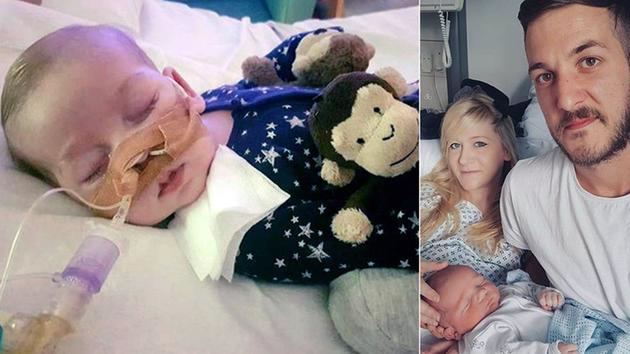
This is an undated handout photo of Charlie Gard provided by his family, at Great Ormond Street Hospital, in London.
This is an undated handout photo of Charlie Gard provided by his family, at Great Ormond Street Hospital, in London. (Family of Charlie Gard via AP)

Pope Francis called Sunday for the parents of a terminally ill British baby to be allowed to do everything possible to treat their 10-month-old son, amending the Vatican's previous position after conservatives complained.

In a statement, the Vatican press office said Francis "is following with affection and sadness the case of little Charlie Gard and expresses his closeness to his parents. For this he prays that their wish to accompany and treat their child until the end is not neglected."

The statement marked a shift from the views expressed by the head of the Vatican's Pontifical Academy for Life, the pope's bioethics advisory panel. In a June 30 statement, the academy president Monsignor Vincenzo Paglia said the parents' wishes should be respected, but that they must also be helped to understand the "unique difficulty of their situation."

He repeated the church's opposition to euthanasia, but also stressed the need to sometimes accept the limits of medicine.

Charlie, who suffers from a rare genetic condition and brain damage, is unable to breathe unaided. Last week, his parents lost a legal battle to take him to the U.S. for trial therapy.

Conservative blogs had harshly criticized Paglia's statement, saying it was condescending to the parents and had entirely missed a crucial issue at play: that both the hospital and the courts had intervened against the parents' wishes.

Paglia's statement "patronizes Charlie Gard's parents even as it distorts their situation and endorses a legal judgment against their wishes that was clothed in the language of euthanasia advocates," wrote Michael Brendan Dougherty in the National Review.

Conservatives have been highly critical of Francis' reform of the academy, which under the previous two pontificates had been a source of hard-line orthodoxy on all life issues. Francis recently overhauled the academy's membership, removing some of its most outspoken conservative experts

Hello July, why so hot?

July is one of the two months, August being the other, that I just do not like the weather.  And this hot summer stuff we experience here in the deep Gulf South can tend to do a number on your body and your mind.  It's just too damn hot this week, the first of July, brings here a 105 heat index.  And it will be like this until August when we get the gift of 110 heat index.  Sadly, this can continue well into September, but September brings hope and plenty of football.  So here I go, it's time to survive July & August.  Of course, if it be too rainy or too damn hot, we will be thankful if we are sparred the visit of a hurricane.  Yes, we also have to watch out for those things too.

Man people in these parts will celebrate the 4th of July with fervor and use the close proximity to beautiful beaches to take off for Florida, Alabama and Mississippi along the water front.  You see we may be a gulf state, but Louisiana has precious few beaches, more like marshes and swamps.  For the Talbot's we mark the 4th of July with the celebration of the birth of #1 granddaughter, Katelyn.  We will head off to North Carolina and celebrate.  By the way, in July, it's pretty hot in North Carolina too.  Katelyn is our 2nd grandchild and we hope to get to know her better, in person, as we have been able to do with Calvin, who soon turns 5 years old. 

For the week ahead, our goal will be simply to spend as much quality time as possible with the grand children over the period of time we will with them.  Our weekly Skype sessions have been awesome in helping the children to be comfortable with us and they always recognize us right away when we arrive.  So we try and have lots of fun and visit fun venues so that will be the focus of the week ahead.

As a Deacon, I have tried over these past few months to take advantage of scheduling to unwind just a little and not be overbooked week in/week out.  Understand like a school year, from September thru May my plate is always full.  While in North Carolina I hope to make Mass once or twice as we have become very familiar with several of the local church parishes there. 

My work continues to be a source of great change and great demand as we continue to progress through the massive changes of being purchased by a once competitor bank.  Now almost 4 months in, my staff and I are getting the hang of things working now for Whitney Bank.  You know I reflected the other day that I have worked for 5 banks and only changed jobs once. 

Meanwhile, I have purposely avoided some of the more controversial topics of the day, political and even church related.  As a Deacon, I have decided to more and more not opine or take bait in the political wars which have become more than just partisan, now bordering on radically divisive, hate filled and otherwise just over the top.  You know as a Catholic, especially a fully practicing one, receiving the Eucharist and fully believing in the Sacrament of Reconciliation, how can we be swept in to the hateful rhetoric of our political culture and even some of the divides that haunt the Church?  Short answer, we can't.  We either become what we believe or not.  Yes, I've followed the political dust up's of the day and I have deeply followed the changes coming from the Vatican.  A good rule of thumb if you are opinionated and vocal, measure twice, cut once.

Speaking of comings(and goings), please remember in your prayers all the many Priests who are leaving parishes and arriving at new assignments.  In these parts this is occurring now, July 1st being the official move date in this Archdiocese.  For us at St. Jane de Chantal we are saying goodbye to Fr. Kevin Delerno and will welcome a new Priest, Fr. Charles Dussouy.  We look forward to the ministry of Fr. Charles and wish Fr. Kevin well in his new assignment.

All for now, in the morning I'll be NC bound but for now, preparing for evening Benediction and Mass.  And yes, it's hot!


Today's Angelus Address of Pope Francis

Angelus Address: The Missionary Does not Bring Himself but Jesus
“His Bond with Jesus Is Stronger than Any Other Bond”
Angelus / Foto: Francesco Sforza - © PHOTO.VA - OSSERVATORE ROMANO
Here is a ZENIT translation of the address Pope Francis gave today before and after praying the midday Angelus with those gathered in St. Peter’s Square.
* * *
Before the Angelus
Dear Brothers and Sisters, good morning!
Today’s liturgy presents to us the last parts of the missionary discourse of chapter 10 of Matthew’s Gospel (Cf. 10:37-42), with which Jesus instructs the twelve Apostles, at the moment in which He sends them for the first time on mission to the villages of Galilee and Judea. In this last part Jesus stresses two essential aspects for the life of the missionary disciple: the first, that his bond with Jesus is stronger than any other bond; the second, that the missionary does not bring himself but Jesus, and through him the love of the celestial Father. These two aspects are connected, because the more Jesus is at the center of the heart and life of the disciple, the more the disciple is “transparent” to His presence. They both go together.
“He who loves father or mother more than me . . .” (v. 37), says Jesus. The affection of a father, the tenderness of a mother, the sweet friendship between brothers and sisters, all this, though being very good and legitimate, cannot be put before Christ. Not because He wants us without a heart and devoid of gratitude but, rather, on the contrary, because the disciple’s condition calls for a priority relationship with the Teacher – whoever is a disciple, be it a layman, a laywoman, a priest, a Bishop: the priority relationship. Perhaps the first question we should ask a Christian is: “But do you encounter Jesus? Do you pray to Jesus?” The relationship.  The Book of Genesis could almost be paraphrased: “Therefore a man leaves his father and his mother and cleaves to his wife, and they become one flesh” (Cf. Genesis 2:24).
He who lets himself be attracted by this bond of love and of life with the Lord Jesus, becomes His representative, His “ambassador,” especially by his way of being, of living, to the point that Jesus Himself, on sending the disciples on mission, says to them: “He who receives you receives me, and he who receives me receives Him who sent me” (Matthew 10:40). It is necessary that people be able to perceive that for the disciple Jesus is truly “the Lord,” He is truly the center of his life, the all of his life. It does not matter if then, as every human person, he has his limitations and also his errors – as long as he has the humility to acknowledge them –; what is important is that he not have a double heart – and this is dangerous. I am a Christian, I am a disciple of Jesus, I am a priest, I am a Bishop, but I have a double heart. No, this is not right. He must not have a double heart but a simple, united heart; that he not have his foot in two shoes, but that he is honest with himself and with others. Double-dealing is not Christian. Therefore, Jesus prays to the Father, so that the disciples will not fall into the spirit of the world. You are either with Jesus, with the spirit of Jesus, or you are with the spirit of the world.
And here our experience as priests teaches us a very beautiful thing, a very important thing: it is precisely this reception of the holy faithful People of God, it is precisely this “cup of cold water” (v. 42), of which the Lord speaks today in the Gospel, given with affectionate faith, which helps one to be a good priest! There is reciprocity also in the mission: if you leave everything for Jesus, people recognize the Lord in you but, at the same time, it helps you to convert every day to Him, to renew and purify yourself of compromises and to overcome temptations. The closer a priest is to the People of God, the more he will feel close to Jesus, and the more a priest is close to Jesus, the more he will feel close to the People of God.
The Virgin Mary experienced personally what it means to love Jesus detaching herself from herself, giving new meaning to family bonds, beginning from faith in Him. May she help us, with her maternal intercession, to be free and happy missionaries of the Gospel.
[Original text: Italian]  [Translation by Virginia M. Forrester]
*
After the Angelus
Dear Brothers and Sisters,
The 5th of July is the feast of Venezuela’s independence. I assure my prayer for this beloved Nation and I express my closeness to the families that have lost children in the manifestations of the Square. I appeal so that violence is brought to an end and a peaceful and democratic solution is found to the crisis. May Our Lady of Coromoto intercede for Venezuela! And let us all pray to Our Lady of Coromoto for Venezuela: “Hail Mary . . .”
My greeting goes to you all, Romans and pilgrims!
In particular, I greet the Irish faithful of Belfast, and the young people of Schattdorf (Switzerland) who a short time ago received the Sacrament of Confirmation.
I greet the various parish groups and Associations, as well as the participants in the moto-pilgrimage of Cardito (Naples).
I wish you all a good Sunday. Please, do not forget to pray for me. Have a good lunch and see you soon!

Saturday, July 1, 2017

Nun, teacher, beatified by St PJP2

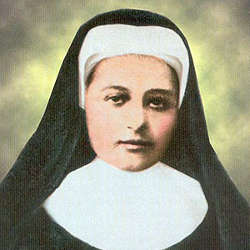
Bl. Eugenia Joubert

Image of Bl. Eugenia Joubert

Facts

Feastday: July 2
Birth: 1876
Death: 1904
Beatified By: Pope John Paul II


Eugenia Joubert - French nun, virgin, blessed the Roman Catholic Church
She was born in a devout and relatively large family of French Christians. Her parents were Peter and Antonia Joubert Celle. She was the fourth of eight children. At the age of 12, she had her First Holy Communion in her hometown of Sisters Józefitek. From 1889-1892, she attended college in Le Puy run by the Sisters of Notre Dame. In 1895, she entered the Congregation of the Sisters of the Holy Family of the Heart of Jesus, and two years obtained her religious vows. She taught catechism to children, first in Aubervilliers, near Paris, then in Saint Denis, where she exercised her novitiate, Le Puy and in Liege in Belgium today.
Since 1902, Eugenia struggled with tuberculosis. She died two months after her return to Liege at the age of 28 years old

Today was Day 1 of the Convocation of Catholic Leaders


Day 1 of the Convocation of Catholic Leaders: A Recap

Fr. Aquinas Guilbeau, OP
   

"A renewal of joy is essential for a deepening of Catholic vitality and confidence at this moment.”

The Convocation of Catholic Leaders opened yesterday in Orlando with a Mass celebrated by Timothy Cardinal Dolan, the archbishop of New York.  Joined by bishops and priests from around the country, the cardinal led nearly 3,000 convocation participants in praying for the convocation’s success. He exhorted the participants to use the weekend as a time to “acknowledge, welcome, and get to know Jesus.”
In his homily, Cardinal Dolan focused on the chosen theme of the convocation—the joy of the gospel.  He explained that joy lies at the heart of Christian mission, for Jesus himself gives joy to the believer as he sends the believer out to preach. By Christ’s design, then, joy becomes a sign of Christian mission. Mary was the first manifest this mystery, the cardinal explained, as in haste and joy she went to visit her cousin Elizabeth after the annunciation.
To underscore the connection between joy and mission, Cardinal Dolan recalled the teaching of Pope Francis in his apostolic exhortation Evangelii Gaudium (The Joy of the Gospel). He explained that, for the pope, “discipleship united for mission will be characterized and effective only with joy.” Then pointing to the other bishops present, the cardinal continued: “We, your pastors, believe with Pope Francis that a renewal of joy is essential for a deepening of Catholic vitality and confidence at this moment.”
As illustrations of the power of joy, Cardinal Dolan highlighted the examples of Jacques Maritain, Leon Bloy, and St. Junipero Sera, on whose feast yesterday’s Mass took place. In pointing to Maritain, Dolan recalled how the French philosopher’s conversion was sparked in part through the joyful witness of a Christian family, “a family”—Maritain remembered—“who smiled.” Dolan noted that it was Bloy’s family whose smiles inspired Maritain. Bloy himself know the power of Christian joy, calling it “the infallible sign of God’s presence.” Finally, Dolan recalled the California missions established by St. Junipero, which were renowned as places not only of evangelization, security, and education but also of laughing, dancing, and feasting.
Cardinal Dolan defined Christian joy as follows: “Joy isn’t pleasure; it’s not giddiness; it isn’t syrupy superficial feel-good-ism. Joy, St. Paul teaches, is a fruit of the Holy Spirit, a gift of God. St. Thomas Aquinas adds that joy flows from hope, because if we trust that all is in God’s hands—that everything works for the good of those who believe—then no trial, no adversity, no setback (even though God knows we’ve got a bumper crop of all of them) can crush us.”
At the beginning of the Mass, Bishop John Noonan of Orlando welcomed everyone to the Sunshine State, and the papal nuncio Archbishop Christophe Pierre read greetings to the convocation participants from the Holy See. Music for the liturgy was provided under the direction of Fr. Lukasz Misko, O.P., and Christopher Mueller. The choir from St. Peter Claver Church in Tampa also sang before and during the Mass.
To round out the first day of the convocation, which was largely a day of greeting and prayer, an evening of Marian devotion was led by Archbishop Gustavo Garcia-Siller of San Antonio and Bishop Martin Holley of Memphis. They presided over a rosary prayed in the many languages represented at the convocation. Tony Melendez, John Andotti, and VaLimar Jansen led the music for the evening devotion.
For more information on the convocation, visit the convocation website. To follow the weekend’s events on social media, use the hashtag #CatholicConvo.

Big move at the Vatican; Ferrer to CDF

Pope names Jesuit prelate to succeed Müller at doctrine office


In this Tuesday, Oct. 14, 2014 file photo, Cardinal Gerhard Ludwig Müller arrives for a morning session of a two-week synod on family issues at the Vatican. Pope Francis has declined to renew the mandate of the Vatican's conservative doctrine chief, tapping instead the No. 2 to lead the powerful congregation that handles sex abuse cases and guarantees Catholic orthodoxy around the world. In a short statement Saturday, July , 2017, the Vatican said Francis thanked Cardinal Gerhard Müller for his service. Müller's five-year term ends this weekend. (Credit: AP Photo/Gregorio Borgia, File.)
Pope Francis named Spanish Archbishop Luis Ladaria Ferrer as the new Prefect of the Congregation for the Doctrine of the Faith. He replaces German Cardinal Gerhard Müller, who said divorced and civilly remarried Catholics could not receive Communion unless they made a commitment to abstain from sexual relations with their new partners.

ROME - Promoting the secretary of the Congregation for the Doctrine of the Faith to the office of prefect, Pope Francis chose not to ask German Cardinal Gerhard Müller to serve a second five-year term in the post.
The Vatican announced July 1 that the pope chose as prefect Spanish Archbishop Luis Ladaria Ferrer, 73, a Jesuit theologian who had been appointed secretary of the congregation in 2008 by then-Pope Benedict XVI.
“The Holy Father Francis thanked His Eminence Cardinal Gerhard Ludwig Müller at the conclusion of his quinquennial mandate,” the Vatican announcement said. No new position was announced for Müller, who at 69 is still more than five years away from the normal retirement age for a bishop.
Anticipating an announcement of the pope’s decision June 30, both the English Rorate Caeli blog and the Italian Corrispondenza Romana blog presented the pope’s move as a dismissal of the German cardinal, who originally was appointed to the post by now-retired Pope Benedict XVI.
Francis had met that morning with Müller, whose five-year term was to end July 2.
While Francis wrote in his exhortation on the family, Amoris Laetitia, that church teaching on marriage had not changed, both Rorate Caeli and Corrispondenza Romana implied Müller was let go because he insisted that divorced and civilly remarried Catholics could not receive Communion unless they made a commitment to abstain from sexual relations with their new partners.
Other bishops and bishops’ conferences have read Francis’s document as presenting a process of discernment that in certain circumstances could allow some couples to return to the sacraments.
Müller was the first Vatican official formally confirmed in his post by Francis after his election in 2013 and was among the 19 churchmen named cardinals that year by the pope.
The prefect of the doctrinal congregation is responsible for promoting the correct interpretation of Catholic doctrine and theology; his office also is responsible for conducting investigations of clergy accused of sexually abusing minors.
Resigning from the Pontifical Commission for the Protection of Minors, Marie Collins, one of the founding members and the last remaining abuse survivor on the commission, said members of the Roman Curia were reluctant to implement the commission’s recommendations and she particularly cited  Müller.
Speaking to reporters in May on his flight from Fatima, Portugal, to Rome, Francis said Collins was “a little bit right” because of the slow pace of investigating so many alleged cases of abuse.
However, the pope said the delays were due to the need to draft new legislation and to the fact that few people have been trained to investigate allegations of abuse. Müller and Cardinal Pietro Parolin, Vatican secretary of state, he added, were looking “for new people.”
As head of the doctrinal congregation, the prefect also serves as president the Pontifical Biblical Commission, the International Theological Commission and the Pontifical Commission “Ecclesia Dei,” which is responsible for the pastoral care of traditionalist Catholics and for the ongoing reconciliation talks with the Society of St. Pius X.
The new prefect, Archbishop Ladaria Ferrer, was appointed congregation secretary by Pope Benedict after having worked with him as a member of the International Theological Commission in 1992-1997, as a consultant to the doctrinal congregation from 1995 to 2008 and as secretary general of the theological commission from 2004 until being named congregation secretary.
Archbishop Ladaria was born in Manacor, Mallorca, April 19, 1944, and earned a law degree at the University of Madrid before entering the Society of Jesus in 1966. After theology and philosophy studies in Spain and Germany, he was ordained to the priesthood July 29, 1973.
He earned a doctorate in theology from the Pontifical Gregorian University in Rome in 1975 and began teaching dogmatic theology at the Pontifical University Comillas in Madrid. Nine years later, he began teaching at the Gregorian and served as vice rector of the university from 1986 to 1994.
Before the debate over Amoris Laetitia,  Müller made headlines for his role in the Vatican critique of the U.S.-based Leadership Conference of Women Religious and for his friendship with Dominican Father Gustavo Gutierrez, considered the father of liberation theology.
In 2004, he co-authored a book, “On the Side of the Poor: The Theology of Liberation,” with Father Gutierrez. In the 1990s, when then-Cardinal Joseph Ratzinger headed the congregation before becoming Pope Benedict, Gutierrez was asked by the congregation to write and rewrite articles clarifying some of his theological and pastoral points.
In a 2012 interview with the Vatican newspaper, then-Archbishop Müller said he was invited to participate in a seminar with Gutierrez in 1988, and he went “with some reservations” because the doctrinal congregation had criticized aspects of liberation theology that it said were too influenced by Marxist ideology.
“One must distinguish between an erroneous and a correct liberation theology,” Müller told the newspaper. While a Catholic must reject Marxist ideas and analysis, he said, “we must ask ourselves sincerely: How can we speak about the love and mercy of God in the face of the suffering of so many people who do not have food, water, medical care; who don’t know how to give their own children a future; where human dignity really is lacking; where human rights are ignored by the powerful?”
Before being named prefect of the doctrinal congregation, Müller had served five years as one of its members and had been a member of the International Theological Commission from 1998 to 2003. Pope Benedict led both bodies until 2005, when he was elected pontiff.
Müller published a complete collection of works by the German-born pope and theologian.
When he was appointed prefect of the doctrinal congregation by Benedict in 2012, he told the Vatican newspaper his job in Rome would be “to relieve part of his work and not bring him problems that can be resolved” at the level of the congregation. “The Holy Father has the important mission of proclaiming the Gospel and confirming his brothers and sisters in the faith. It’s up to us to deal with the less pleasant matters so that he will not be burdened with too many things, although, naturally, he always will be informed of important matters.”
Müller is a native of Mainz, Germany. He was ordained to the priesthood in 1978 and served in his native diocese as a chaplain and high school religion teacher. With degrees in philosophy and a doctorate in theology, he was a professor of dogmatic theology in Munich from 1986 to 2002.
He was named bishop of Regensburg in 2002 and then-Cardinal Ratzinger attended his episcopal ordination. Then-Bishop Müller chose as his episcopal motto “Dominus Iesus” (Jesus is Lord), which comes from St. Paul’s Letter to the Romans and is the title of the 2000 document on salvation through Christ alone, issued by the doctrinal congregation under Ratzinger.

Established the California missions; canonized in 2015 by Pope Francis

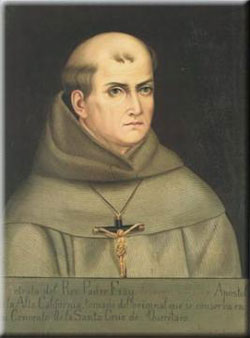
St. Junipero Serra

 
Image of St. Junipero Serra

Facts

Feastday: July 1
Patron of Vocations
Birth: 1713
Death: 1784
Beatified By: Pope John Paul II
Canonized By: September 23, 2015, Basilica of the National Shrine of the Immaculate Conception, Washington, D.C., by Pope Francis


Miguel Jose Serra was born on the island of Majorca on November 24, 1713, and took the name of Junipero when in 1730, he entered the Franciscan Order. Ordained in 1737, he taught philosophy and theology at the University of Padua until 1749.
At the age of thirty-seven, he landed in Mexico City on January 1, 1750, and spent the rest of his life working for the conversion of the peoples of the New World.
In 1768, Father Serra took over the missions of the Jesuits (who had been wrongly expelled by the government)in the Mexican province of Lower California and Upper California (modern day California). An indefatigable worker, Serra was in large part responsible for the foundation and spread of the Church on the West Coast of the United States when it was still mission territory.
He founded twenty-one missions and converted thousands of Indians. The converts were taught sound methods of agriculture, cattle raising, and arts and crafts.
Junipero was a dedicated religious and missionary. He was imbued with a penitential spirit and practiced austerity in sleep, eating, and other activities. On August 28, 1784, worn out by his apostolic labors, Father Serra was called to his eternal rest. He was beatified by Pope John Paul II on September 25, 1988. His statue, representing the state of California, is in National Statuary Hall. His feast day is July 1.