Saturday, January 2, 2016

A proposed timeline of all the Christmas accounts found in the Bible

Christmas Timeline of the Biblical Account

by Bodie Hodge and Tim Chaffey on December 21, 2010 
 
                             
When December hits, many familiar questions surrounding the birth of Christ come to mind. For example, some ask about making Christmas sermons relevant, the origin of Christmas and if it was pagan, the star of Bethlehem, the “inn” where Jesus was born, and many others. Of course, these are important topics, but it is also important to understand the timeline of events surrounding the birth of Jesus.
The Christmas timeline of the biblical account is called into question by many skeptics. They claim the nativity accounts of Matthew and Luke do not line up, and therefore the accounts should be discarded. Sometimes they go so far as to say that few are even aware of the issues with the Christmas timeline.
But is this really a problem? When we take a closer look, this claim is simply reduced to dust. The following is a plausible Christmas timeline that makes sense and works well with the information given in the Bible,1 and it has stood up to charges of twisting the text or overlooking key verses.

Circa 4 BC: the Birth of Jesus

  1. Ussher believed Jesus was born at the onset of 4 BC, and this is consistent because the king, Herod the Great, died near the end of that year, and Jesus was born during his reign.2
  2. Because of the Roman census, Joseph and Mary travel to Bethlehem from their hometown of Nazareth. Contrary to the idea of Jesus being born in a stable, He was likely born in the lower room of a house where animals often stay and subsequently laid in a manger (Luke 1:26–27; 2:4–7).
  3. The shepherds visit following the angelic announcement (Luke 2:8–12, 20).
  4. The angels worship the Christ (Luke 2:13–14).

Eight Days Later

  1. Jesus was circumcised. This probably did not occur in Jerusalem but a local synagogue or perhaps a priest came to them, as was the case for John the Baptist (Luke 1:59; 2:21; Leviticus 12:3).
  2. Jesus was given His name (Luke 2:21).

At Least 41 Days After the Birth of Jesus

  1. The Law stipulated a woman wait 40 days following the birth of a son to finish her purification (Leviticus 12:1–8). So Mary and Joseph went to the Temple in Jerusalem to offer a sacrifice of two doves or pigeons, which signified they were poor (Luke 2:22–24). This suggests the magi had not visited yet to offer their expensive gifts; otherwise Joseph and Mary probably could have afforded the lamb and dove required by the Law for those with adequate means.
  2. At the Temple, Simeon held Jesus, blessed God and the family, and prophesied in the Holy Spirit about Jesus (Luke 2:25–35).
  3. Anna, a prophetess, saw the Christ at the Temple (Luke 2:36–38).

Soon After the 41st Day

  1. The family returned to Bethlehem—not Nazareth, as some have suggested. After all, they were still in Bethlehem when the wise men later visited, and they apparently planned to return there following the flight to Egypt.3 As such, it is unlikely they would have packed up everything to go to Jerusalem for offering sacrifices. So they would have returned to Bethlehem where they left their belongings (Matthew 2:5–9).
  2. They were now staying in a house (oikian)—perhaps the same one, but probably not in the stall area since the guest room (kataluma) may have been available at this time.

Within the Year

  1. Alerted by the so-called Christmas star, an unknown number of magi from the East (perhaps Persia4) made their way to Herod's palace in Jerusalem to inquire of the Christ child (Matthew 2:1–4).
  2. Contrary to popular opinion, the star was probably not a typical event in the heavens (e.g., supernova, planetary alignment, comet, etc.) Instead, it was truly a miraculous and special star (Matthew 2:2, 7, 9–11).
  3. Jewish chief priests and scribes informed Herod that, according to Micah 5:2, Bethlehem was to be the birthplace of the Messiah (Matthew 2:4–6).

Maybe Within the Year

The Magi Arrive

  1. These magi followed the star, which moved ahead of them, bringing expensive gifts of gold, frankincense, and myrrh to Jesus—who was now a young child living in a house (Matthew 2:9–11).5
  2. They worshipped the Christ Child (Matthew 2:11).
  3. Jesus is called a “young child” (paidion, Matthew 2) instead of babe (brephos, Luke 2:16) at the time that the magi arrived. Brephos specifically refers to a baby, whether born or unborn, while paidion refers to an immature child, possibly an infant (Matthew 2:11), so we should not be dogmatic about His age.
  4. The magi returned to their homeland via a different route after being divinely warned in a dream not to go back to Herod (Matthew 2:12).

Herod and the Flight to Egypt

  1. Soon after the wise men left, Herod realized that they were not going to return and he ordered the killing of all boys in and around the region of Bethlehem who were two years of age and under (Matthew 2:16). Herod knew the approximate timing of the star’s appearance (Matthew 2:7), which may be the time that Christ was born. With this information, Herod, who was paranoid about the crown and did not want anyone taking over, would have made sure to kill the child. So he may have at least doubled the time from when the star first appeared to the wise men, thinking this would guarantee that the child would be killed, even if the information was off.
  2. An angel warned Joseph to flee to Egypt to protect his family. This trip would ultimately fulfill a prophecy (Hosea 11:1). Perhaps the new gifts helped finance that trip (Matthew 2:13–15).
  3. Baby boys two years and under in Bethlehem and surrounding region were slaughtered (Matthew 2:16).

Late 4 BC to Early 3 BC

  1. Herod died in 4 BC in Jericho and was buried in Herodion approximately 25 miles away. Reports are that the procession travelled with the body one mile per day. So it was likely 3 BC when he was buried.6 Herod’s son Archelaus succeeded him (Matthew 2:22).

Early 3 BC

  1. An angel informed Joseph that they could move back since Herod had died (Matthew 2:15, 19).
  2. Since Joseph and Mary had completed the laws and commands (Greek nomos) of the Lord, they returned to the land of Israel from Egypt and settled in Nazareth of Galilee, which became the hometown of Jesus and was where Joseph and Mary lived prior to going to Bethlehem for the census.7 (Matthew 2:22; Luke 2:39).
  3. Jesus would be called a Nazarene, fulfilling a spoken prophecy (Matthew 2:23).

Conclusion

The Christmas timeline of the biblical account makes sense when Luke and Matthew are carefully analyzed. Any alleged contradiction of the timeline at the time of Jesus Christ’s birth simply vanishes in light of the chronology given. When it comes to the Bible, it can be trusted. Sometimes we just need to take some time to carefully study God’s Word.

Friday, January 1, 2016

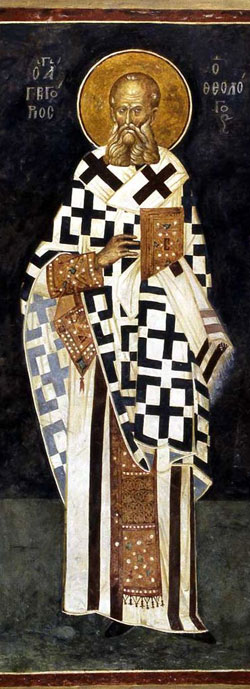
A two for one Saints day; Gregory Nazianzus Doctor of the Church and friend of Basil the Great

St. Gregory Nazianzus

 
Image of St. Gregory Nazianzus

Facts

Feastday: January 2
Birth: 329
Death: 390

Doctor of the Church, born at Arianzus, in Asia Minor, c. 325; died at the same place, 389. He was son -- one of three children -- of Gregory, Bishop of Nazianzus (329-374), in the south-west of Cappadocia, and of Nonna, a daughter of Christian parents. The saint's father was originally a member of the heretical sect of the Hypsistarii, or Hypsistiani, and was converted to Catholicity by the influence of his pious wife. His two sons, who seem to have been born between the dates of their father's priestly ordination and episcopal consecration, were sent to a famous school at Caesarea, capital of Cappadocia, and educated by Carterius, probably the same one who was afterwards tutor of St. John Chrysostom. Here commenced the friendship between Basil and Gregory which intimately affected both their lives, as well as the development of the theology of their age. From Caesarea in Cappadocia Gregory proceeded to Caesarea in Palestine, where he studied rhetoric under Thespesius; and thence to Alexandria, of which Athanasius was then bishop, through at the time in exile. Setting out by sea from Alexandria to Athens, Gregory was all but lost in a great storm, and some of his biographers infer -- though the fact is not certain -- that when in danger of death he and his companions received the rite of baptism. He had certainly not been baptized in infancy, though dedicated to God by his pious mother; but there is some authority for believing that he received the sacrament, not on his voyage to Athens, but on his return to Nazianzus some years later. At Athens Gregory and Basil, who had parted at Caesarea, met again, renewed their youthful friendship, and studied rhetoric together under the famous teachers Himerius and Proaeresius. Among their fellow students was Julian, afterwards known as the Apostate, whose real character Gregory asserts that he had even then discerned and thoroughly distrusted him. The saint's studies at Athens (which Basil left before his friend) extended over some ten years; and when he departed in 356 for his native province, visiting Constantinople on his way home, he was about thirty years of age.

a lot more here:

http://www.catholic.org/saints/saint.php?saint_id=1000


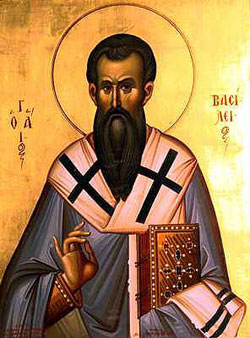
A two for one Saint day; first, Basil the Great; a hero who helped defeat Arianism

St. Basil the Great


Image of St. Basil the Great

Facts

Feastday: January 2
Patron of hospital administrators
Death: 379

St. Basil the Great was born at Caesarea of Cappadocia in 330. He was one of ten children of St. Basil the Elder and St. Emmelia. Several of his brothers and sisters are honored among the saints. He attended school in Caesarea, as well as Constantinople and Athens, where he became acquainted with St. Gregory Nazianzen in 352. A little later, he opened a school of oratory in Caesarea and practiced law. Eventually he decided to become a monk and found a monastery in Pontus which he directed for five years. He wrote a famous monastic rule which has proved the most lasting of those in the East. After founding several other monasteries, he was ordained and, in 370, made bishop of Caesaria. In this post until his death in 379, he continued to be a man of vast learning and constant activity, genuine eloquence and immense charity. This earned for him the title of "Great" during his life and Doctor of the Church after his death. Basil was one of the giants of the early Church. He was responsible for the victory of Nicene orthodoxy over Arianism in the Byzantine East, and the denunciation of Arianism at the Council of Constantinople in 381-82 was in large measure due to his efforts. Basil fought simony, aided the victims of drought and famine, strove for a better clergy, insisted on a rigid clerical discipline, fearlessly denounced evil wherever he detected it, and excommunicated those involved in the widespread prostitution traffic in Cappadocia. He was learned, accomplished in statesmanship, a man of great personal holiness, and one of the great orators of Christianity. His feast day is January 2.

Tonight turned out to be so special

At 6 PM tonight, even though it was January 1st, our parish family still had Benediction to close out an afternoon of Adoration of the Blessed Sacrament.  I was privileged to lead Benediction, praying the Litany of the Sacred Heart, reflecting on the relationship of Mary, who we honored today as Mother Of God, and the Eucharist.  Mary indeed is the Mother of the Eucharist!!  We sang the Tantum Ergo, then Benediction followed by the Divine Praises.  There was a respectable turn out to give worthy adoration and praise to Our Lord Jesus Christ!

While in Benediction I received a call and a text that someone needed a Priest in ICU stat.  How this played out tonight is incredible.  I noticed the parish priest was home, at least the car in the driveway.  I called, he answered, I explained the situation and as a faithful good Priest, he never hesitated.  I drove him to the hospital.  I wont say much here to protect confidentiality but this beautiful lady is facing probable death soon.  Father never met nor did he have any knowledge of her prior to this night.  Yet he compassionately and tenderly spoke to her, even though she was not very responsive, he prayed the appropriate prayers, administered the anointing of the sick and blessed her with the apostolic pardon.  To witness this, to respond to the prayers, to see him being Christ to a perfect stranger; just incredibly beautiful!!

Then we left and I drove him home.

I could not have experienced a better evening; a beautifully spiritual New Year's night!

Always options in blogging

Since I've expressed disappointment before over the sluggish response on blogger, click the link below and give me your feedback.

Wordpress is one of the strong options if I move, having tried it out last Lent.

Please advise:

https://abitadeacon.wordpress.com


Pope Francis opens another Holy Door today at the Basilica of St. Mary Major

#PopeFrancis "Jesus, Emmanuel, the Expectation of the nations, the “Prince of Peace” opens Holy Doors in 2016

(Vatican Radio) Pope Francis on Friday evening celebrated Mass and opened the Holy Door at the papal Basilica of St Mary Major.
The Basilica of St Mary Major, also known as Our Lady of the Snows, is one of the oldest churches dedicated to the Mother of God, and the largest in the world. So it was particularly appropriate that the Pope chose the Solemnity of Mary the Mother of God to open the Holy Door at one of Rome’s most beloved churches.
 The Holy Father has also extended permission to Bishops around the world to open Holy Doors in their own Diocese. Those passing through a Holy Door, whether in Rome or elsewhere throughout the world, are able to obtain a plenary indulgence, under the usual conditions. 
Below, please find the official translation of the prepared text for Pope Francis’ homily at the Papal Basilica of Saint Mary Major:
Homily of Pope Francis
Solemnity of Mary the Mother of God
and the Opening of the Holy Door at the Basilica of St Mary Major
Salve, Mater Misericordiae!
With this invocation we turn to the Blessed Virgin Mary in the Roman Basilica dedicated to her under the title of Mother of God. It is the first line of an ancient hymn which we will sing at the conclusion of this Holy Eucharist. Composed by an unknown author, it has come down to us as a heartfelt prayer spontaneously rising up from the hearts of the faithful: “Hail Mother of mercy, Mother of God, Mother of forgiveness, Mother of hope, Mother of grace and Mother full of holy gladness”. In these few words we find a summary of the faith of generations of men and women who, with their eyes fixed firmly on the icon of the Blessed Virgin, have sought her intercession and consolation.
It is most fitting that on this day we invoke the Blessed Virgin Mary above all as Mother of mercy. The door we have opened is, in fact, a Door of Mercy. Those who cross its threshold are called to enter into the merciful love of the Father with complete trust and freedom from fear; they can leave this Basilica knowing that Mary is ever at their side. She is the Mother of mercy, because she bore in her womb the very Face of divine mercy, Jesus, Emmanuel, the Expectation of the nations, the “Prince of Peace” (Is 9:5). The Son of God, made incarnate for our salvation, has given us his Mother, who joins us on our pilgrimage through this life, so that we may never be left alone, especially at times of trouble and uncertainty.
Mary is the Mother of God who forgives, who bestows forgiveness, and so we can rightly call her Mother of forgiveness. This word – “forgiveness” – so misunderstood in today’s world, points to the new and original fruit of Christian faith. A person unable to forgive has not yet known the fullness of love. Only one who truly loves is able to forgive and forget. At the foot of the Cross, Mary sees her Son offer himself totally, showing us what it means to love as God loves. At that moment she heard Jesus utter words which probably reflected what he had learned from her as a child: “Father, forgive them; for they do not know what they are doing” (Lk 23:24). At that moment, Mary became for all of us the Mother of forgiveness. Following Jesus’ example and by his grace, she herself could forgive those who killed her innocent Son.
For us, Mary is an icon of how the Church must offer forgiveness to those who seek it. The Mother of forgiveness teaches the Church that the forgiveness granted on Golgotha knows no limits.  Neither the law with its quibbles, nor the wisdom of this world with its distinctions, can hold it back. The Church’s forgiveness must be every bit as broad as that offered by Jesus on the Cross and by Mary at his feet. There is no other way. It is for this purpose that the Holy Spirit made the Apostles the effective ministers of forgiveness, so what was obtained by the death of Jesus may reach all men and women in every age (cf. Jn 20:19-23).
The Marian hymn continues: “Mother of hope and Mother of grace, Mother of holy gladness”. Hope, grace and holy gladness are all sisters: they are the gift of Christ; indeed, they are so many names written on his body. The gift that Mary bestows in offering us Jesus is the forgiveness which renews life, enables us once more to do God’s will and fills us with true happiness. This grace frees the heart to look to the future with the joy born of hope. This is the teaching of the Psalm: “Create in me a clean heart, O God, and put a new and right spirit within me. […] Restore to me the joy of your salvation” (51:10,12). The power of forgiveness is the true antidote to the sadness caused by resentment and vengeance. Forgiveness leads to joy and serenity because it frees the heart from thoughts of death, whereas resentment and vengeance trouble the mind and wound the heart, robbing it of rest and peace.
Let us, then, pass through the Holy Door of Mercy knowing that at our side is the Blessed Virgin Mary, the Holy Mother of God, who intercedes for us. Let us allow her to lead us to the rediscovery of the beauty of an encounter with her Son Jesus. Let us open wide the doors of our heart to the joy of forgiveness, conscious that we have been given new confidence and hope, and thus make our daily lives a humble instrument of God’s love.  
And with the love and affection of children, let us cry out to Our Lady as did the faithful people of God in Ephesus during the historic Council: “Holy Mother of God!”

Yes, the abitadeacon continues his journey to be the shrinking deacon

58 lbs since August 17th


https://www.facebook.com/photo.php?fbid=10205209987923037&set=a.2326719181193.2097402.1646080903&type=3

World Day of Peace

January 1st, New Year's Day is mots known in the Catholic world as the Solemnity of Mary, Mother of God.  Indeed this Solemnity is also a holy day of obligation so all Catholics attend Mass today.  This Solemnity completes what we call the Christmas Octave.  Octave translated is the number eight.  Catholic teaching tells us that so great a Feast is Christmas that it is celebrate as if an Octave, for eight days it as if we are celebrating Christmas at every liturgy.  Therefore, January 1st, this Solemnity of Mary, Mother of God, completes the Christmas Octave.

Less known among Catholics is that January 1st is also the World Day of Peace.  Masses may be celebrated for this intention.  Ever since the inception of this World Day of Peace the Holy Father issues a message of peace.  Below I am providing the link to the message of Pope Francis for the 2016 World Day of Peace:

http://w2.vatican.va/content/francesco/en/messages/peace/documents/papa-francesco_20151208_messaggio-xlix-giornata-mondiale-pace-2016.html

Highlights of Pope Francis New Year's Homily and New Year Address

Pope: Now's the time to end indifference, 'false neutrality'

Associated Press
            

    Pope Francis makes the sign of the cross as he celebrates a New Year mass in St. Peter's Basilica at the Vatican, Friday, Jan. 1, 2016. (AP Photo/Gregorio Borgia)
    .
    View gallery
    • .
    • .
    • .
                                                          VATICAN CITY (AP) — Wishing for a year better than 2015, Pope Francis on Friday called for an end to the "arrogance of the powerful" that relegates the weak to the outskirts of society, and to the "false neutrality" toward conflicts, hunger and persecution that triggers exoduses of refugees.


    In his New Year's homily, Francis emphasized the need to "let ourselves be reborn, to overcome the indifference which blocks solidarity, and to leave behind the false neutrality which prevents sharing."
    After celebrating Mass, the pope came to the window of a Vatican palazzo overlooking St. Peter's Square to offer new year's wishes to a crowd of tens of thousands of tourists and Romans cheering him from below.
    "At the start of the year, it's lovely to exchange wishes. Let's renew, to one another, the desire that that which awaits us is a little better" than what last year brought, Francis said. "It is, after all, a sign of the hope that animates us and invites us all to believe in life."
    "We know, however, that with the new year, everything won't change and that many of yesterday's problems will also remain tomorrow," the pope said, adding that he was making a "wish sustained by a real hope."
    As he did in his homily earlier in St. Peter's Basilica, the pope issued a caution that "the enemy of peace isn't only war, but also indifference," and he decried "barriers, suspicions, fears and closures" toward others.
    In the New Year's homily in St. Peter's, he had reflected on the "countless forms of injustice and violence which daily wound our human family."
    "Sometimes we ask ourselves how it is possible that human injustice persists unabated, and that the arrogance of the powerful continues to demean the weak, relegating them to the most squalid outskirts of our world." He continued: "We ask how long human evil will continue to sow violence and hatred in our world, reaping innocent victims."
    Francis cited no country, continent or conflict. But his words clearly evoked images of the refugees and migrants, more than 1 million of whom flooded into Europe from Africa, the Middle East and Asia in 2015, on dangerous sea or overland journeys. He spoke of "witnessing hordes of men, women and children fleeing war, hunger and persecution, ready to risk their lives simply to encounter respect for their fundamental rights."
    The Catholic church dedicates New Year's Day to the theme of peace, and Francis this year is stressing mercy as the path toward reconciliation.
    To highlight the benefits springing from forgiveness and reconciliation in the world, Francis declared a Holy Year of Mercy, which began last month and runs through November 2016. Early Friday evening, he was to visit a Rome basilica, St. Mary Major, where he sometimes slips away to pray, to open a normally sealed Holy Door as a symbolic threshold to cross toward mercy for Catholic faithful.