Tuesday, April 2, 2013

Pope Francis remembers Pope JP II on the 8th anniversary of his death

BLESSED JOHN PAUL II PRAY FOR US - on the 8th Anniversary of his passing, Pope Francis asks for his blessed predecessors intercession


Pope Francis praying at the tomb of the Pope who elevated him to Cardinal.

Today we remember Blessed John Paul II, Pope

Remember Pope John Paul II

Love between man and woman cannot be built without sacrifices and self-denial.
― Blessed John Paul II, Love and Responsibility (Anniversary of his death April 2, 2005)


The 8th Anniversary of the death of Blessed John Paul II

John Paul the Great!

Baptism

Read the Catechism in a Year image
Read the Catechism in a Year

Catechism in a Year: Day 170

Part Two: How We Celebrate the Christian Mysteries
- Section Two: The Seven Sacraments of the Church
-- Chapter One: The Sacraments of Initiation -- BAPTISM

Question 194: What is Baptism
?
Baptism is the way out of the kingdom of death into life, the gateway to the Church, and the beginning of a lasting communion with God.
Baptism is the foundational sacrament and the prerequisite for all other sacraments. It unites us with Jesus Christ, incorporates us into his redemptive death on the Cross, thereby freeing us from the power of Original Sin and all personal sins, and causes us to rise with him to a life without end. Since Baptism is a covenant with God, the individual must say Yes to it. In the baptism of children, the parents confess the Faith on behalf of the children.

Question 195: How is Baptism administered?
The classical form of administering Baptism is the threefold immersion of the candidate in the water. Usually, however, water is poured three times over the head of the candidate, while the minister of the sacrament speaks the words, “N., I baptize you in the name of the Father, and of the Son, and of the Holy Spirit.”
Water symbolizes cleansing and new life, which was already expressed in the baptism of repentance performed by John the Baptist. The Baptism that is administered with water “in the name of the Father, and of the Son, and of the Holy Spirit” is more than a sign of conversion and repentance; it is new life in Christ. That is why the ceremony also includes the signs of anointing, the white garment, and the baptismal candle.
Dig Deeper: Corresponding CCC section (1212-1245) and other references here.
Recommended Listening: The History of Salvation by Monsignor Daniel Deutsch

Monday, April 1, 2013

A dad describes that moment when the Pope embraced his disabled son

A Special Vocation: To Show People How To Love

The following is a guest post from Paul Gondreau, Professor of Theology at Providence College. Paul is serving as the Faculty Resident Director at PC/CEA’s Center for Theology and Religious Studies in Rome this semester, joined by his wife Christiana and their 5 kids. After Easter Mass in St. Peter’s Square yesterday, Pope Francis hugged their son Dominic. You can see video of the encounter at this link and can read a brief news piece here, and you can see CNN’s interview of Christiana Gondreau and Dominic here. We are grateful that Dr. Gondreau agreed to share his reflections on that event with us.
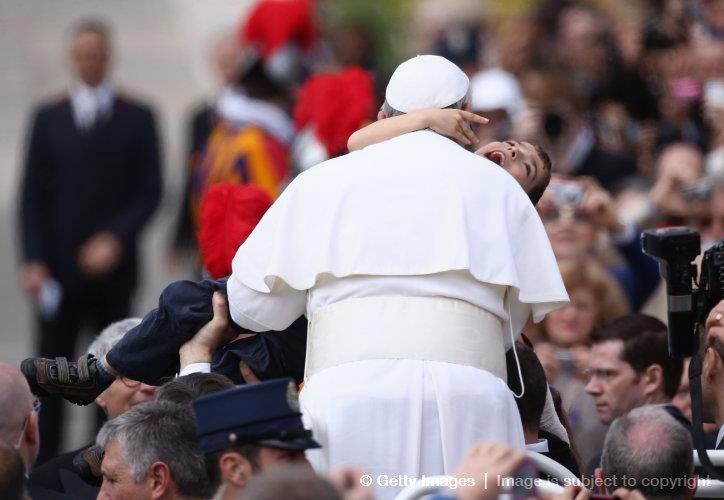
Pope Francis hugs Dominic Gondreau at Easter Mass.
Pope Francis hugs Dominic after Easter Mass.
 
“Small acts with great love,” Mother Teresa was fond of saying. Yesterday, Pope Francis bestowed an extraordinary Easter blessing upon my family when he performed such an act in embracing my son, Dominic, who has cerebral palsy. The embrace occurred when the Pope spied my son while touring the Square, packed with a quarter million pilgrims, in the “pope mobile” after Mass. This tender moment, an encounter of a modern Francis with a modern Dominic (as most know, tradition holds that St. Francis and St. Dominic enjoyed an historic encounter), moved not only my family (we were all moved to tears), not only those in the immediate vicinity (many of whom were also brought to tears by it), not only by thousands who were watching on the big screens in the Square, but by the entire world. Images of this embrace quickly went viral, and by Easter Sunday afternoon it was the lead picture on the Drudge Report, with the caption, “Change Hatred into Love” (a paraphrase of Pope Francis’ Urbi et Orbi message that followed shortly thereafter), where it remains even as I write this. Fox News, NBC Nightly News, ABC Nightly News, and CNN all showed clips of it. Lead pictures of it were found in Le Figaro, the New York Post, The Wall Street Journal, the Philadelphia Inquirer, inter alia.
It is often difficult to try to express to people who do not have special needs children what kind of untold sacrifices are demanded of us each and every day. And as for Dominic, he has already shared in Christ’s Cross more than I have throughout my entire life multiplied a thousand times over. What is the purpose in all this, I ask? Furthermore, I often tend to see my relationship with Dominic in a one-sided manner. Yes, he suffers more than me, but it’s constantly ME who must help HIM. Which is how our culture often looks upon the disabled: as weak, needy individuals who depend so much upon others, and who contribute little, if anything, to those around them.
Pope Francis’ embrace of my son yesterday turns this logic completely on its head and, in its own small yet powerful way, shows once again how the wisdom of the Cross confounds human wisdom. Why is the whole world so moved by images of this embrace? A woman in the Square, moved to tears by the embrace, perhaps answered it best when she to my wife afterward, “You know, your son is here to show people how to love.” To show people how to love. This remark hit my wife as a gentle heaven-sent confirmation of what she has long suspected: that Dominic’s special vocation in the world is to move people to love, to show people how to love. We human beings are made to love, and we depend upon examples to show us how to do this.
But how can a disabled person show us how to love in a way that only a disabled person can? Because the Cross of Christ is sweet and is of a higher order. Christ’s resurrection from the Cross proclaims that the love he offers us, the love that we, in our turn, are to show others, is the REAL reason he endured the Cross in the first place. Our stony hearts are transformed into this Christ-like love, and thereby empowered to change hatred into love, only through the Cross. And no one shares in the Cross more intimately than the disabled. And so the disabled become our models and our inspiration. Yes, I give much to my son, Dominic. But he gives me more, WAY more. I help him stand and walk, but he shows me how to love. I feed him, but he shows me how to love. I bring him to physical therapy, but he shows me how to love. I stretch his muscles and joke around with him, but he shows me how to love. I lift him in and out of his chair, I wheel him all over the place, but he shows me how to love. I give up my time, so much time, for him, but he shows me how to love.
This lesson, to repeat, confounds the wisdom of the world. Heck, it confounds me when I, as his parent, so often fail to see my son’s condition for what it is. The lesson my disabled son gives stands as a powerful testament to the dignity and infinite value of every human person, especially of those the world deems the weakest and most “useless.” Through their sharing in the “folly” of the Cross, the disabled are, in truth, the most powerful and the most productive among us.
One more thing. Pope Francis’ embrace of my son, Dominic, indicates that we should not interpret the new Pontiff’s expressed devotion to the poor, already a cornerstone of his pontificate, in facile, purely material (let alone political) categories. His Easter embrace of my son stands out as a compelling witness to the kind of “poverty” that he urges us to adopt, the poverty that he pointed to in the opening line of his Urbi et Orbi message yesterday: “I would like [the message of Christ's resurrection] to go out to every house and every family, especially where the suffering is greatest…” Parents of disabled children, stand up and find solace and encouragement in these simple yet profound words.

Another Francis but this one is our Saint of the Day

St. Francis of Paola

St. Francis of Paola
Feastday: April 2

Francis was born at Paola, Italy and was educated at the Franciscan friary of San Marco there, and when fifteen became a hermit near Paola. In 1436, he and two companions began a community that is considered the foundation of the Minim Friars. He built a monastery where he had led his eremitical life some fifteen years later and set a Rule for his followers emphasizing penance, charity, and humility, and added to the three monastic vows, one of fasting and abstinence from meat; he also wrote a rule for tertiaries and nuns. He was credited with many miracles and had the gifts of prophesy and insight into men's hearts. The Order was approved by Pope Sixtus IV in 1474 with the name Hermits of St. Francis of Assisi (changed to Minim Friars in 1492). Francis established foundations in southern Italy and Sicily, and his fame was such that at the request of dying King Louis XI of France, Pope Sixtus II ordered him to France, as the King felt he could be cured by Francis. He was not, but was so comforted that Louis' son Charles VIII, became Francis' friend and endowed several monasteries for the Minims. Francis spent the rest of his life at the monastery of Plessis, France, which Charles built for him. Francis died there on April 2nd and was canonized in 1519. His feast day is April 2.

Praying with Pope Francis all month long

Prayer intentions of Pope Francis for April

CWN - April 01, 2013
The Vatican has announced the prayer intentions of Pope Francis for April 2013    The Pope’s general intention is: "That the public, prayerful celebration of faith may give life to the faithful."    His missionary intention is: "That mission churches may be signs and instruments of hope and resurrection.”

Sacraments: intimate encounter with Christ

Read the Catechism in a Year image
Read the Catechism in a Year

Catechism in a Year: Day 169

Part Two: How We Celebrate the Christian Mysteries
- Section Two: The Seven Sacraments of the Church

Question 193:
Is there some inner logic that unites the sacraments with each other?
All sacraments are an encounter with Christ, who is himself the original sacrament. There are sacraments of initiation, which introduce the recipient into the faith: Baptism, Confirmation, and Eucharist. There are sacraments of healing: Reconciliation and the Anointing of the Sick. And there are sacraments of communion and mission: Matrimony and Holy Orders.
Baptism joins us with Christ. Confirmation gives us his Spirit. The Eucharist unites us with him. Confession reconciles us with Christ. Through the Anointing of the Sick, Christ heals, strengthens, and consoles. In the sacrament of Matrimony, Christ promises his love in our love and his fidelity in our fidelity. Through the sacrament of Holy Orders, priests have the privilege of forgiving sins and celebrating the Holy Sacrifice of the Mass.
Dig Deeper: Corresponding CCC section (1210-1211) and other references here.
Recommended Reading: Theology and Sanity by Frank Sheed

USCCB answers those who want Church to be full of elitist

Here comes everybody: divorced, gays, sinners, a couple saints


It amazes me when basic church teaching is received as if it were somethig brand new. This morning's New York Times brought the latest example with the headline: "Dolan Says the Catholic Church Should Be More Welcoming to Gay People." A glance at other media outlets finds similar news accounts. From the NBC website: "Cardinal Dolan: Church Must Embrace Gays, Lesbians." Then from the NY Daily News: "'Jesus died on the cross for them as much as He did for me’: Cardinal Dolan says church should not push away gays."

Cardinal Timothy Dolan of New York created this media storm with basic pastoral comments on ABC's "This Week with George Stephanopoulos" and CBS's "Face the Nation" with Bob Schieffer. Cardinal Dolan said the church is there for everyone.

I have two reactions.

1. The word "catholic" means all-encompasing, so how can people get the impression that the church is exclusionary? No one is carded at a Catholic Church. Shunning is not the Catholic tradition. Other news reports this week give homey examples of the church's inclusionary nature. Ann Rodgers, a reporter from the Pittsburgh Post-Gazette, was selected to carry olive braches in a Palm Sunday procession at the Vatican. Ann said she wasn't Catholic, but that wasn't a problem for orgnaizers at the Holy See. A few days afterwards, a Muslim girl in a Rome youth detention facility had her feet washed by Pope Francis at the Holy Thursday Mass of the Lord's Supper. Her standing outside the fold was no problem for the papal advance men. To reiterate Cardinal Dolan's point: Gays ae welcome in the church. So are divorced people. Heck, even in the rare instances that people are excommunicated, they're still expected at Sunday Mass. Although some sects ban you from the property for violating their rules, the Cathoic Church still wants you in the pew.

2. More people have been excommunicated by their Aunt Minnie than by the church. Much of the media, and many Catholics, miss the fact that the Catholic Church is a church of mercy and forgiveness, and most of all, communion. It is so encompassing that writer James Joyce defined Catholicsm as "here comes everybody." The church looks for ways to make things better for people. We have seven sacraments -- and three, Baptism, the Sacrament of Reconciliation and the Sacrament of the Sick, are geared to bringing people into or back into the fold, sinner or no. It's pratically impossible to get out of the Catholic Church where if you leave we call you an ex-Catholic rather than a Protestant, atheist or the latest term, a "none" (the last in deference to pollsters who force you to check some box when asked about your religious practice).

Gay marriage is the issue de jour for media. So when Caridnal Dolan on Easter spoke kindly of the gays and lesbians, media feigned shock. In reality, the Catholic Church challenges all its members -- in different ways over different issues.

But know this: The Catholic Church will battle hard to maintain the sacredness of marriage as between a man and a woman. It also offers counseling to help people avoid divorce. It patiently insists that frenetic couples entering into marriage go through pre-marital counseling, no matter how busy they are with wedding planners and caterers. For the Catholic Church marriage is worth it all, even sadly, a trip to the U.S. Supreme Court.

And know even more: God's love for his children is boundless. A disagreement on the definition of marriage is a serious disagreement. It is not, however, separation from the love of God.

April; the beginning of that other half of the year

It April 1st; a day I don't particularly like and the date on the calendar that for me means 6 months of less pleasant things.  I like cool weather, early night fall, football, fall fests, Thanksgiving and Christmas, not cutting grass.  I really enjoy October thru March.

April ushers in warmer weather, humidity, cutting grass endlessly, daylight well into the night, hurricane season, to name but a few.  It is my least favorite time of the year.

But it is what you make of it, right?  I'm ready, for now, for April because we will still have some pleasant days and this year, I have a 5 day trip planned to see Calvin, #1 grandson!  That makes April worth it all by itself!

Slowly but surely I will acclimate to everything else.  I just remember that every day is a gift from God!  And today is day 2 of the Easter octave, so Happy Easter!