Showing posts with label reverence. Show all posts

Tuesday, May 16, 2023

The beginning steps to creating a sense of the sacred


We Need to Recover a Sense of the Sacred in God’s House — and Here’s How We Can Begin

We honor Almighty God by arriving for Mass ahead of time and blessing ourselves as we enter our Father’s house.
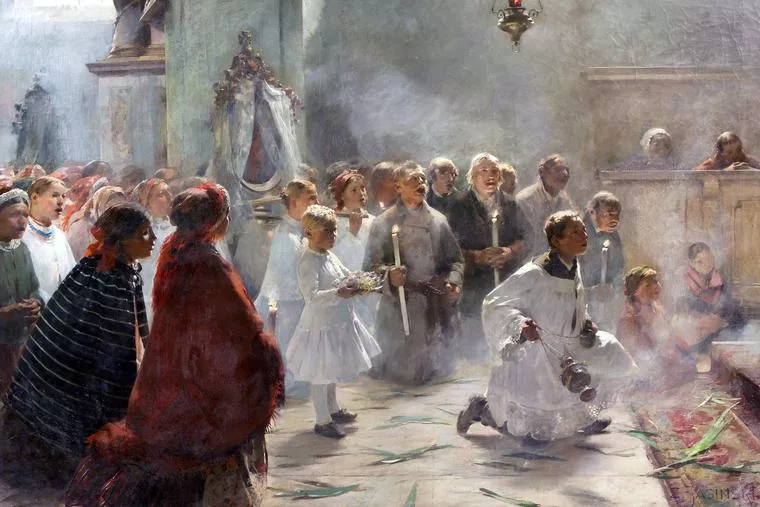


Writing in Niedziela [“Sunday”], one of the two national Catholic weekly newspapers in Poland, Father “A.P.” made these thought-provoking observations about punctuality for Mass:

The later we show up in church before Mass, the later we enter into a genuine climate of prayer. Some people like to reckon how late they can be for the Mass to “count.” Remember that the Mass is one whole, from the sign of the cross at the start of Mass until the blessing at its end: one cannot say he was ‘at Mass’ if one was only there for parts of it. It’s not just a formality: it’s better that you wait until the Lord comes and you meet Him at the altar rather than the other way around. When I am late for Mass, it's not that I am waiting for God but that God is waiting for me. Arriving at the last minute means that you need extra time to orient yourself and join in the liturgical action. You might not then hear some important words God is saying to you. So just don’t not be late: make an effort so that it’s you who waits for the Lord.

He also added these reflections about blessing ourselves as we cross the church’s threshold: 

It is worthwhile reminding yourself when you enter the Father’s house (which is a temple), that you are a child of God. That childhood began at the moment of your Baptism, when the water poured in the baptismal font cleansed you from sin and gave you new life. There is placed at the entrance to the church a bowl with holy water so that, upon entering the church to meet God, you would remind yourself of your Baptism and wash yourself of your sins. Do you make still make use of the stoup and holy water at the church door? Perhaps if you reminded yourself of your Baptism and washed away your sins, you might enter with a clean heart into the holy mystery of faith? Perhaps if you made a clear sign of the cross on your body with your hand immersed in holy water, the grace of Baptism might be renewed in you? These are, of course, but gestures which can, but do not have to, help you pray at Mass. But why should you not make use of them when they have helped whole ranks of Christ’s disciples over the centuries? Enter the church like a Christian rather than a pagan. It will markedly change your presence and behavior in that temple [translation mine].

I cite these two passages for two reasons: first, the ideas themselves are worth our taking them on board. And second, they clash with the ethos in not a few American parishes.

The latter observation comes from experience. Just last Sunday, I visited a nearby parish where, frankly, I found praying before Mass subordinate to socializing. I know there are even “liturgists” who imagine such chattering “facilitates community” and do not discourage it. I hint at my age when I mention that the examination of conscience given once upon a time to first penitents asked, “Did I talk in church?” 

Now I’m not against talking in church, as long as we get our priorities right. When we arrive in church, the first conversation we need to have is with God, i.e., in prayer. The church is the house of God: we are not in queue, making chitchat with our fellow reception liners, waiting to make a formal handshake with God.

“But what about community?” you say. Fine: have a Dunkin’ Donuts feast after Mass. Stay and talk until the cows come home. (Do ask the pastor about that.) But first things first: our conversation needs to go vertical before it goes horizontal.

I note this because, after having translated the Niedziela passage, I found a story about arriving late for Mass in the Claretian monthly, U.S. Catholic. For years, the magazine has run a feature that I think embodies proto-synodality-run-amuck: it takes a phenomenon and then asks people what they think of it, usually without challenging the results. In October 2018, Father John Molyneux assured us, “It’s OK to be late for Mass. Showing up is what matters.”

No, it’s not.

The Mass is not primarily about us, and we “useless servants” are not doing God a favor. Such disrespect would never be foisted on somebody in “real” life: I was supposed to meet the President at 10am and they said to be at the White House at 9:45am but I showed up at noon and, hey, “showing up is what matters.”

The reactions Molyneux cites and the commentators who followed it also started with the “me” focus: for them, the primary problem with arriving late for Mass is “not being greeted and welcomed.” Forget Father A.P.’s quaint notion that it’s God you’re keeping waiting.

It’s not accidental that the Polish priest connected punctuality for Mass with blessing oneself: both emphasize the holiness of this place as the house of God. Once upon a time, parents trained children how to behave in someone’s house. How should God’s children behave in his home?

Well, the “horizontalists” will tell us that “it’s our home, too.” Hopefully, when adult children return to their parents’ home, they understand how to respect where and how they belong there, i.e., they have progressed beyond entitled, spoiled brats fixated on self. 

The notion of the holiness of the church’s place was also touched upon in a story on an Italian website, criticizing how the Brescia Cathedral was turned one Saturday into a conference and lunch hall for a Catholic group. “Preference for the poor” is not an excuse for collapsing the abiding sacral and cultic dedication of a church: the city did not lack other appropriately capacious venues for a Caritas lunch. The argument is simpler: sacrality dedicated exclusively to cult is passé. Andrea Zambrano summed it up: it’s “consistent with the relativism that has also overrun the sacred and the environments of worship: today incense, tomorrow dumplings with sauce.”

Let’s not even ask about the message sent by the sell-off of former churches that have now become venues for secular, even vulgar purposes or other religious cults.

We need to recover a sense of the sacred. It starts with me, arriving for Mass ahead of time and blessing myself as I enter the Father’s house. 

Thursday, January 2, 2020

We bow our head at the name above every other name: the name of Jesus

Why Catholics bow their heads at the name of Jesus


HARLEM,NEW YORK,BURKINA FASO,CORPUS CHRISTI

Share
9k


The custom is biblically inspired and was instituted by Pope Gregory X in the 13th century.

There are many bodily gestures that Catholics perform at Mass, and one of them that was widely practiced for centuries was the custom of bowing one’s head at the mention of the name of Jesus. Even though it has not been greatly emphasized during the past few decades, it is still honored by many of the lay faithful as well as some priests.
The origin of this custom is primarily inspired by the following words of St. Paul in his letter to the Philippians.
Therefore God has highly exalted him and bestowed on him the name which is above every name, that at the name of Jesus every knee should bow, in heaven and on earth and under the earth, and every tongue confess that Jesus Christ is Lord, to the glory of God the Father. (Philippians 2:9-11)
Practically speaking, kneeling every time the name of Jesus is mentioned is rather difficult, and so Pope Gregory X found a solution. He wrote about it to the Dominican Order in 1274, expressing his desire that some physical gesture be done to honor Jesus’ name.
The following portion of his letter was printed in the book With God: A Book of Prayers and Reflections by Francis Xavier Lasance.
Recently, during the Council held at Lyons, we deemed it a useful commendation to exhort the faithful to enter the house of God with humility and devotion, and to conduct themselves while there in a becoming manner, so as to merit the divine favor and at the same time give edification.
We have also judged it proper to persuade the faithful to demonstrate more reverence for that Name above all names, the only Name in which we claim salvation — the Name of Jesus Christ, who has redeemed us from the bondage of sin. Consequently, in obedience to that apostolic precept, ‘In the Name of Jesus let every knee, be bent,’ we wish that at the pronouncing of that Name, chiefly at the Holy Sacrifice, every one would bow his head in token that interiorly he bends the knee of his heart.
Pope Gregory wanted everyone to not only honor Jesus’ name, but to interiorly submit themselves to God with a simple act of love. The Dominicans took the pope’s request seriously and became the foremost promoters of the Holy Name of Jesus in the Catholic Church, preaching about the Holy Name, forming Holy Name Societies, as well as placing altars in their churches dedicated to Jesus’ Holy Name.
The custom is a simple one and is meant to reflect an interior desire to honor Jesus, the only name by which we are saved.

Wednesday, August 21, 2019

OSV says bring back reverence to help spread belief in the Real Presence


Editorial: To spread belief in the Real Presence in the Eucharist, start with reverence


Eucharistic Adoration
(CNS photo/Christopher M. Riggs, Catholic Advance)


Earlier this month, the Pew Research Center released the results of a survey that caused quite a commotion in the Catholic community. It said, in short, that more than two-thirds (69%) of those who self-identify as Catholic say they do not believe in transubstantiation, the “source and summit” of the Faith that holds that the bread and wine used during the Eucharistic sacrifice miraculously becomes the body and blood of Jesus Christ. Rather, these same self-identifying Catholics posit that the bread and wine are only “symbols” used to commemorate the Last Supper.
Over the centuries, Eucharistic controversies have been the cause of schism, war and great divisions. But it’s this reality that has remained at the heart of the Catholic faith for more than 2,000 years. That’s why it’s even more surprising to find that 43% of that 69% not only don’t believe in the Real Presence, but they don’t actually know the Church claims it as one of its most foundational teachings.
Many within the Church have responded strongly to this information, most notably Bishop Robert Barron, auxiliary bishop of Los Angeles, who published a video blaming the collapse in catechesis on all responsible for teaching the Faith to others. “It’s been a massive failure of the Church carrying on its own tradition,” he said.
Catechesis, indeed, is critical. But there’s also something else that has been sorely lacking if the Church’s own members are to embrace Christ’s presence in the Eucharist for the miracle that it truly is — the open witness of believers.
Looking back at the numbers, we find that almost one-third, or 31%, of self-identifying Catholics say they believe that the bread and wine used at Mass actually becomes the body, blood, soul and divinity of Our Lord. But do our actions reflect these claims? Do we witness to the world, and to our fellow Catholics, that we really believe what we say we believe? While faith-formation classes are essential tools for transmitting the Faith, the reverent actions of believers can be just as effective, if not more so, as tools of catechesis — especially when it comes to witnessing what Pope St. Paul VI, in his encyclical Mysterium Fidei, called the Church’s “most precious treasure” (No. 1).
Do we genuflect reverently every time we pass the tabernacle? Do we make time to attend Eucharistic adoration or sit before Christ in the tabernacle? Do we bow or kneel before receiving Communion? Do we wear clothes to Mass that express our true belief that we are in the presence of God? Do we raise our voices in loud objection when we hear stories of the desecration of the Blessed Sacrament? Do we refrain from receiving Christ in the Eucharist when we are not in a state of grace, remembering that receiving Communion is a gift, not a right? If we truly believe what we say we believe, our actions should reflect this belief.
So, too, should our prayers. To this end, let us join our voices to that of Pope Paul VI as we pray: “May the most blessed Virgin Mary, from whom Christ the Lord took the flesh that ‘is contained, offered, received’ in this sacrament under the appearances of bread and wine, and may all the saints of God and especially those who were more inflamed with ardent devotion toward the divine Eucharist, intercede with the Father of mercies so that this common belief in the Eucharist and devotion to it may give rise among all Christians to a perfect unity of communion that will continue to flourish” (No. 75).
OSV Editorial Board: Gretchen R. Crowe, Scott P. Richert, Scott Warden, York Young