Showing posts with label reparation. Show all posts

Tuesday, October 14, 2025

The main altar at St. Peter's Basilica was reconsecrated with a penitential rite of reparation after being desecrated


Cardinal presides over act of reparation in St. Peter’s following desecration of altar


The main altar at St. Peter’s Basilica in Rome, which was desecrated on Oct. 10, 2025. | Credit: Jorge Royan (CC BY-SA 3.0)

Almudena Martínez-BordiúWalter Sánchez Silva

Cardinal Mauro Gambetti, archpriest of St. Peter’s Basilica and vicar general of the pope for Vatican City, presided Oct. 13 over a penitential rite of reparation at the main altar of the church following a serious act of desecration that had taken place on Oct. 10.

After a penitential procession that began at 12:45 p.m. local time, Gambetti sprinkled the altar with holy water and incensed it to purify it.

The rite, attended by members of the chapter of the Vatican basilica, emphasized asking God for “forgiveness” for the desecration, Father Enzo Fortunato, director of communications for St. Peter’s Basilica, told ACI Prensa, CNA’s Spanish-language news partner.

On Friday, Oct. 10, a man whose identity has not been revealed was arrested by security guards after he climbed onto the Altar of the Confession, located under Bernini’s baldachin, and urinated on it while tourists looked on in astonishment.

Pope Leo XIV expressed his consternation upon learning of the incident and asked Gambetti to perform an act of reparation to restore the sanctity of the place and ask forgiveness for what had happened.

This is the second instance of desecration in St. Peter’s Basilica in less than a year. In February, a man severely damaged part of the main altar, breaking several candelabras. In June 2023, an individual of Polish origin stripped naked in the same place as a form of protest against the war in Ukraine. 

Friday, November 1, 2024

Atlanta Catholics respond to the "black mass" with large Eucharistic Procession


In response to ‘black mass,’ thousands

join Atlanta procession to show devotion

to Eucharist


Worshippers in the Archdiocese of Atlanta participate in a. afternoon procession Oct. 25, 2024, called "Pilgrims of Hope" to show their devotion to the Eucharist and counter a satanic group's planned "black mass." Organizers of the procession said thousands of people walked a 7-mile route between St. Patrick Church and Holy Vietnamese Martyrs Church in Norcross and Our Lady of the Americas Mission in Lilburn. (OSV News photo/Andrew Nelson, Georgia Bulletin)


NORCROSS, Ga. (OSV News) — Traffic came to a standstill along Beaver Ruin Road in the northeast metro area of Atlanta Oct. 25 as Catholics, representing several parishes and speaking multiple languages, followed on foot the Blessed Sacrament as a sign of devotion.

Called “Pilgrims of Hope,” the fall procession’s route linked St. Patrick Church and Holy Vietnamese Martyrs Church in Norcross and Our Lady of Americas Mission, Lilburn, in a prayerful march defending an attack on the participants’ most sacred beliefs. Drivers took photos of the passing event, as organizers handed out rosaries to people stopped in their cars.

Organizers estimated thousands of people took part in the walk.

Ighocha Macokor, 41, a member of the Knights of Columbus at St. Patrick Church said he was walking in his first procession to “stand against evil” and to show the faith to people passing by.

Meanwhile, lawyers working for the Archdiocese of Atlanta received a response from the organizers of a so-called “black mass” scheduled for the same Friday. The organizers confirmed they intended the event as entertainment and possessed no consecrated host.
Concern about the event and its possible sacrilege of a consecrated host prompted the Archdiocese of Atlanta to call for a special day of prayer, reparation and public support for belief in the Eucharist.

Pedro Ulloa and his wife, Flor, and their two grown daughters walked in the thick of the procession. Wearing two crosses around his neck, he said the show of faith allows others to “see the good things about Jesus Christ.”

Faith calls for people to show respect to Jesus, but some choose not to, he told The Georgia Bulletin, Atlanta’s archdiocesan newspaper.

“People can see we want to make a difference,” said Ulloa.

Nancy Frost, a longtime church member, spoke about the black mass event.

“We can’t have people doing that,” she said about the alleged mistreatment of what the faithful believe to be the body of Christ. “I am proud of the people that we have in our community. It just called to me. There’s no reason I can’t do this. It moves me that this many people are out.”

The procession began at St. Patrick Church, which celebrates Sunday Mass in English, Spanish and Korean, serving a large, diverse congregation. Following the prayers, the believers set out around 3:30 p.m. for a two-hour walk to Holy Vietnamese Martyrs Church.

Under a cloudless sky, the faithful spilled over the narrow sidewalk lining the road, reciting traditional prayers in Spanish and English. Lilburn police escorted the believers along the two-and-a-half-mile route for the first leg of the pilgrimage.

A rotating crew of men and women were pulled from the crowd to shoulder the heavy wooden altar, leaving them with strained and sweaty faces. A large sunburst monstrance with the exposed Eucharist was surrounded by white flowers and candles.

Loud booms of drums greeted the Eucharist as the participants arrived at the first stop at the Vietnamese church. It was another five miles to the mission destination.

“This shows we are one united church,” said Marissa Anguiano, who works at Our Lady of Americas Mission. She said believers are hurting at the idea of others intentionally desecrating the Eucharist, which Catholics believe is Jesus’ body, soul and divinity.

“We know Jesus is alive and hurting him really brings the community together in prayer,” said Anguiano.

Around the same time that afternoon, Atlanta Archbishop Gregory J. Hartmayer updated the Catholic community on a response. Staff at archdiocesan offices were “overwhelmed with calls, emails and messages of all kinds offering support,” he said. However, the archbishop emphasized that all action from Catholics must be a sign of “love stronger than hate or violence.” He condemned any threats or violence against the venue hosting the event or its organizers.

Lawyers with Smith Gambrell Russell, on behalf of the archdiocese, prepared to take the issue to court to force the return of the Eucharist. A group planning a black mass in Oklahoma returned a stolen host after the diocese there pursued a lawsuit in 2014.

According to the archbishop’s statement, the Satanic Temple of Atlanta responded saying that “they had no such consecrated host, and no such consecrated host would be used in their black mass.” The group’s letter “called their event entertainment and defended their right to express their beliefs by mocking ours,” said the archbishop.

“While their letter continued to mock the Eucharist and our beliefs, it also demonstrated an understanding of how seriously we have taken this threat to our core belief in the Real Presence of Christ in the Eucharist,” he said.

In the end, “while there will always be people who mock and blaspheme Our Lord in the public square,” the archbishop wrote, “we know too, that he will be defended by all of us who love him.”

Archbishop Hartmayer urged “continued prayer both in reparation for all insults to Christ our Lord, but also prayer for those who do not yet know of his love for them.”

“Let us pray for those who turn to darkness. Let us pray that they will come to know that they are welcome in the arms of Jesus; that they will come to experience his true presence and experience true conversion,” he said.

Andrew Nelson is a staff writer at The Georgia Bulletin, newspaper of the Archdiocese of Atlanta.

Monday, July 29, 2024

Disbelief continues over the mocking of the Last Supper at the 2024 Summer Olympics


Paris Olympics opening ceremony denounced by bishops and Catholics globally for mocking Christianity


Caroline De Sury — OSV News


PARIS (OSV News) — The opening ceremony of the Paris Olympic Games—a sports festival aimed to unite all nations of the world—created shock and disbelief instead as Catholics around the world felt offended by the parody of the Last Supper, which was part of the opening ceremony.

The four-hour spectacle July 26 started with a parade of athletes down the Seine River, accompanied by music and dancing scenes on top French monuments.

Notre Dame Cathedral, still under construction prior to its Dec. 8 opening, was also featured with an extensive dance segment paying tribute to the construction workers who are rebuilding the icon of Paris following a 2019 fire. Dancers appeared to do aerial work on the scaffolding. The bells of the cathedral rang for the first time since the 2019 fire that nearly destroyed the building.

However as the show progressed, television cameras showed drag queens, one of whom wore a crown, seated at a table. The shape of the crown brought to mind a monstrance.

The scene was immediately interpreted as a parody of Leonardo da Vinci’s iconic wall painting in Milan’s Dominican convent of the Last Supper.

The drag queen table scene was later complemented with a nude singer appearing in the middle of a fruit basket, to represent Dionysus, ancient Greece’s God of wine, with the Olympic Games official profile on X, formerly Twitter saying the depiction made us “aware of the absurdity of violence between human beings.”

The French bishops issued a statement July 27 deploring the scenes at the opening of the Olympic Games.

While the ceremony was a “marvelous display of beauty and joy, rich in emotion and universally acclaimed,” they said, it “unfortunately included scenes of mockery and derision of Christianity, which we deeply regret.” “We would like to thank the members of other religious denominations who have expressed their solidarity with us,” the French bishops wrote.

“We are thinking of all the Christians on every continent who have been hurt by the outrageousness and provocation of certain scenes. We want them to understand that the Olympic celebration goes far beyond the ideological biases of a few artists,” the bishops stressed.

For the bishops, the values disseminated by sport and Olympism must contribute to the “need for unity and fraternity that our world so desperately needs, while respecting everyone’s convictions, around the sport that brings us together.”

Bishop Emmanuel Gobilliard of Digne, the special representative of the Holy See for the 2024 Paris Olympics, said that he “did not watch the whole opening ceremony,” as he was praying. “It is my priority as a priest,” he told OSV News, adding he saw part of the ceremony and “found it very beautiful with the athletes (and) the Olympic flame.”

He told OSV News however that on the morning following the ceremony, when he saw the images of the controversial scene massively shared on social media, he was “deeply hurt.”

“What shocked me most is that the freedom of spirit and tone claimed by those who set this up shouldn’t be directed against others,” Bishop Gobilliard said. “You can make fun of your own ideas, laugh at yourself, why not. But to mock the faith and religion of others in this way … is very shocking. That was my first reaction.”

He further stressed that the Olympic Games are the last place to create such divisions.

“Why there?” Bishop Gobilliard asked in a conversation with OSV News. “It is contrary to the Olympic Charter, to the dimension of unity that is present in its values, to the idea of bringing everyone together, without political and religious demonstrations. Why exclude believers and Christians? It was the last place to do that. We were to respect the spirit of the Olympic Charter. We are out of it now.”

The Olympic Charter is the codification of the fundamental principles of Olympism, and the rules and bylaws adopted by the International Olympic Committee. One of its opening points says, “The goal of Olympism is to place sport at the service of the harmonious development of humankind, with a view to promoting a peaceful society concerned with the preservation of human dignity.”

Bishop Gobilliard said that “all the Christians who watched it suffered this derision,” adding that “many Christian athletes suffered it, the IOC and its president, Thomas Bach. I don’t think he knew about it.”

The parody of the Last Supper was not the only ambiguous symbol at the opening ceremony. What also stirred controversy was a horsewoman dressed in armor, perched on a metal horse and galloping down the Seine with the Olympic flag—a scene in which some recognized St. Joan of Arc, the holy warrior who fought the English in the 15th century. But according to the organizers, it represented Sequana, the Celtic divinity who inhabited the Seine, and a symbol of resistance. Another controversial scene depicted a singer impersonating the decapitated body of Queen Marie Antoinette.

One week after “we all united around Our Eucharistic Lord” at the National Eucharistic Congress in Indianapolis, the da Vinci masterpiece “was depicted in heinous fashion, leaving us in such shock, sorrow and righteous anger that words cannot describe it,” said Bishop Andrew H. Cozzens of Crookston, Minnesota, chairman of the board of the National Eucharistic Congress Inc.

“We believe that the Last Supper is united with the death of Christ on the Cross and, together with the Resurrection, these events are all one in the Paschal Mystery,” he said in a July 27 statement. “This passover, which begins at the Last Supper, is the most sacred moment in the life of Jesus.”

He called the faithful “to greater prayer and fasting in reparation for this sin,” and urged them in discussing the Last Supper depiction to do so “with love and charity, but also with firmness.”

Bishop Robert E. Barron of Winona-Rochester, Minnesota, went to social media July 27 to express his outrage over what he saw at the opening ceremony. He said after coming back home from the National Eucharistic Congress, in the city he said he loves—Paris—he saw “this gross mockery of the Last Supper.”

Bishop Barron said that France, called the eldest daughter of the church, and Paris, the city of saints, “felt evidently … the right thing to do is to mock this very central moment in Christianity where Jesus in his Last Supper gives his body and blood in anticipation of the cross.”

“Would they ever dare mock Islam in a similar way?” Bishop Barron asked, saying, “We all know the answer to that.” Bishop Barron stressed that in this “deeply secularist, post-modern society,” Christians should “resist” and “make our voices heard.”

Bishop Donald J. Hying of Madison, Wisconsin, encouraged in a post on X that “In reparation for the blasphemy in Paris, let’s fast and pray, renew our devotion to the Eucharist, the Sacred Heart and the Virgin Mary.”

Bishop Daniel E. Flores of Brownsville, Texas, posted on X July 27 that his “vocabulary is not varied enough to find a word for the feeling in the pit of my stomach.”

He said he hasn’t “watched the Olympics in decades” and that “the agendas just use the athletes; they deserve more respect. So do people of Christian Faith.”

Politicians were also disgusted by the scene, with Catholic French member of European Parliament Marion Maréchale going on X to say: “To all the Christians of the world who are watching” the Paris ceremony and “felt insulted by this drag queen parody of the Last Supper, know that it is not France that is speaking but a left-wing minority ready for any provocation.”

United Kingdom’s Christian groups Voice for Justice U.K. and She leads U.K. united to call for an immediate apology “outraged at Drag queen parody of the Last Supper,” they said in a July 27 statement.

“This is not acceptable. Yet again, the word ‘inclusive’ is used to justify behavior that is overtly exclusive. Such mockery is a deliberate attack on the person of Jesus Christ and a direct challenge to the faith that underpins, and lies at the heart of, Western society,” the joint statement said.

One scene of the ceremony, however, drew unanimous praise: the surprise concert by Céline Dion. Overcoming her illness, stiff person syndrome, she paid tribute to the French singer Edith Piaf, who died in 1963, by performing her “Hymne à l’amour” from the second floor of the Eiffel Tower.

“It was magnificent,” Bishop Gobilliard said. As he spoke to OSV News July 27, he was on his way to “Club France,” the headquarters of all French athletes in the northeast of Paris.

“We are now going to live the Olympic Games with enthusiasm despite all this!” he said, referring once again to the controversial scene. It “could have been a beautiful evening of unity, fraternity and communion between us,” the bishop said, adding that one “scene spoiled it all.”

Paris skies were illuminated by the Olympic cauldron that made a first flight at the Paris Games July 26. It is attached to a balloon and will fly more than 197 feet above the Tuileries gardens from sunset each evening until 2 a.m. Organizers say it is the first Olympic flame in history to be lit without the use of fossil fuels.

Saturday, May 4, 2024

Pope call for Reparation to the Sacred Heart


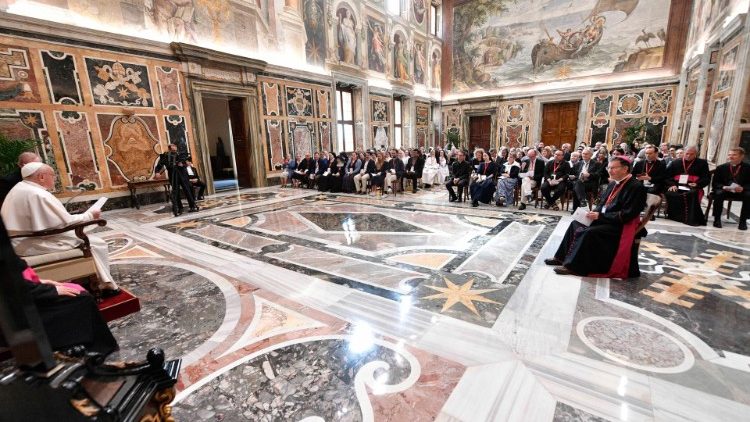
Pope Francis addressing participants in the International conference“Repairing the irreparable”  in the Clementine HallPope Francis addressing participants in the International conference“Repairing the irreparable” in the Clementine Hall  (Vatican Media)

Pope Francis: 'Rediscover the practice of reparation to the Sacred Heart '

Meeting with participants in a conference organized in Rome on the occasion of the Jubilee celebrations of the apparitions and subsequent devotion to the Sacred Heart of Jesus, Pope Francis calls for a rediscovery of this Christian practice of reparation.

By Lisa Zengarini

The meaning of reparation in the Church is the focus of an international conference organized in Rome to mark the 350th anniversary of the Apparitions of the Heart of Jesus to St. Margaret Mary of Alacoque in Paray-le-Monial,  in the French Bourgogne region.

St. Margaret Mary is known for introducing this devotion in the late 17th century which was later formally recognized and approved by Pope Clement XIII.

Repairing the wounds of abuse in the Church

Gathered in Rome from 1-5  May around the theme “Repairing the irreparable”  the some 150 participants are discussing the relevance of the practice of reparation to the Sacred Heart of Jesus,  especially in the present  context of the Catholic Church marked by the abuse scandals that have shaken the faith of many faithful and created a deep need for reparation.

Pope Francis welcomed the conference as he met with the participants on Saturday.

In his speech he recalled that the concept of reparation is often found in the Scriptures, but in the New Testament it takes the form of a spiritual process within the framework of the Redemption brought about by Christ and His sacrifice on  the Cross.

Reparation in the New Testament

“The novelty here – he said - is that it reveals the mercy of the Lord towards the sinner. Reparation therefore contributes to the reconciliation of men among themselves, but also to reconciliation with God, because the evil committed against one's neighbour is also an offense against God.”

Pope Francis went on to note that the title of the conference encourages us to hope that every wound can be healed, even if it is deep: “Complete reparation sometimes seems impossible, when possessions or loved ones are permanently lost or when certain situations have become irreversible. But the intention to make amends and to do so concretely is essential for the reconciliation process and the return of peace to the heart.”

Any reparation  begins with the recognition of one's sin

For reparation to be truly Chistian and "not just a simple act of commutative justice", he remarked,  it must presuppose "two demanding attitudes: recognizing oneself guilty and asking for forgiveness." Indeed, "any reparation, human or spiritual, begins with the recognition of one's sin."

“It is from this honest recognition of the harm done to the brother, and from the deep and sincere feeling that love has been wounded, that the desire to make amends is born.”

Asking for forgiveness

Asking for forgiveness, on the other hand, “reopens the dialogue and manifests the desire to re-establish the bond in fraternal charity”, while reparation, or the even the simple desire to make reparation, guarantees the authenticity of the request for forgiveness.   In this way, if the irreparable cannot be completely repaired, love can always be reborn, making the wound bearable.”

Concluding, Pope Francis expressed his wish that the conference "may renew and deepen the meaning of of the practice of reparation to the Sacred Heart of Jesus, introduced  by Saint Margaret Mary and which  today  is somewhat forgotten or wrongly considered obsolete.

Monday, November 6, 2023

Brooklyn Bishop disciplines pastor; offers reparation after church used in explicit and lewd music video


Brooklyn bishop disciplines pastor who allowed pop star to film music video in church


The Diocese of Brooklyn announced Saturday that a local pastor who allowed a pop star to shoot a lewd music video in the church no longer has administrative oversight over the parish.

Additionally, the diocese told CNA that Brooklyn Bishop Robert Brennan celebrated a Mass of reparation at the church on Saturday morning in response to the desecration.

“Through the offering of this Mass, Bishop Brennan has restored the sanctity of this church and repaired the harm,” the diocese said in a statement.


The music video, which has amassed over 3.6 million views, shows pop star Sabrina Carpenter dancing provocatively on the altar at the historic 19th-century Annunciation of the Blessed Virgin Mary Church in Brooklyn.

The release of the video “Feather” on Oct. 31 triggered an uproar on social media and calls for a reconsecration of the church and prayers of reparation. 

“Who is the pastor? Why did he allow this?” one social media post asked. “How on earth did the diocese allow this to happen?” another post asked.

The pastor, Monsignor Jamie Gigantiello, did not respond to CNA’s request for comment on Nov. 2 and he was not immediately available for comment on Saturday. Annunciation of the Blessed Virgin Mary Church merged with the nearby Our Lady of Mount Carmel Church to form Our Lady of Mount Carmel-Annunciation Parish in 2018.

Brennan said in a Nov. 2 statement that he was “appalled” to learn of the video and would investigate how it was allowed to take place.

In its statement Saturday, the diocese told CNA that “a review of the documents presented to the parish in advance of the production, while failing to depict the entirety of the scenes, clearly portray inappropriate behavior unsuitable for a church sanctuary.”

“In light of this,” the statement continued, “Bishop Brennan has appointed Auxiliary Bishop Witold Mroziewski as the temporary administrator of Our Lady of Mount Carmel-Annunciation Parish.” Mroziewski will assume “all administrative oversight” of the parish pending an administrative review that “will immediately commence,” the statement said.

“Additionally, Monsignor Gigantiello’s tenure as vicar for development for the diocese has concluded as of Nov. 3, 2023,” the statement said. John Quaglione, a spokesman for the diocese, told CNA Saturday that Brennan decided to remove Gigantiello from that role “following the filming of the music video.”

Brennan, assisted by the diocese’s vicar general, Monsignor Joseph Grimaldi, blessed the altar and the church with holy water Saturday, the diocese said. Father Michele Vricella, the parochial vicar at Our Lady of Mount Carmel-Annunciation Parish, and one of the parish’s deacons, Deacon Michael Chirichella, assisted Grimaldi in stripping and preparing the altar for the blessing.

The Annunciation of the Blessed Virgin Mary Parish was established in 1863, according to the New York City chapter of the American Guild of Organists.

For more than 100 years the church has been a home to Lithuanian Catholics, according to the Tablet, the diocesan newspaper.

Annunciation is “the only church in the New York metropolitan area that offers a weekly Sunday Mass in Lithuanian,” according to the Tablet.

Monday, September 17, 2018

Bishop asks for Year of Repentance, Ember Days and recitation of the St. Michael Prayer

Pittsburgh bishop announces Year of Repentance


The bishop called for the restoration of the Ember Days and the St Michael Prayer at Mass
In the wake of recent sex abuse scandals, Bishop David Zubik of Pittsburgh has announced a Year of Repentance in the diocese.
He has asked all the clerics to fast and pray for the purification of the Church, and invited all Catholics to join the initiative.
“Faced with the sinful actions of the members of our own ranks of the clergy, who are called to manifest the example of Christ, we feel both shame and sorrow, and are reminded of our own sinfulness and the need for mercy,” Bishop Zubik wrote in a Sept. 10 letter to the clerics and seminarians of the diocese.
“I invite the faithful to join with the clergy as they desire in our acts of prayer and penance. The year is open to individuals to go beyond what I am requesting as we continue to pray that the Lord come to our aid.”
The Year of Repentance will include the observance of the Ember Days, which were traditionally days of fast and abstinence.
Bishop Zubik has asked that on each of the 12 Ember Days in the coming year, clerics of the Diocese of Pittsburgh fast, abstain from meat, and make a Holy Hour.
Ember Days are tied to the seasons of the year, and are held on the Wednesday, Friday, and Saturday of four weeks: the third week of September, the third week of Advent, the first week of Lent, and the octave of Pentecost.
In the Pittsburgh diocese’s Year of Repentance, the Ember Days fall Sept. 19, 21, and 22, 2018, Dec. 19, 21, 22, 2018, March 13, 15, 16, 2019, and June 12, 14, 15, 2019.
Bishop Zubik will inaugurate the Year of Repentance Sept. 23 with Vespers and a Holy Hour at the cathedral.
The year will close with a Mass for the Assumption Aug. 15, 2019 to serve “as a sign of hope and healing for victims and for renewal in the Church through the intercession of Mary.”
In his letter, Bishop Zubik also encouraged the clerics of Pittsburgh to consider restoring the recitation of the prayer to St. Michael after all Masses.

Monday, August 20, 2018

Breaking this morning: Pope Francis responds with a lengthy letter to the People of God

Pope Francis: Letter to the People of God (full text)


Pope Francis has responded to new reports of clerical sexual abuse and the ecclesial cover-up of abuse. In an impassioned letter addressed to the whole People of God, he calls on the Church to be close to victims in solidarity, and to join in acts of prayer and fasting in penance for such "atrocities".


Letter of His Holiness Pope Francis
To the People of God

“If one member suffers, all suffer together with it” (1 Cor 12:26).  These words of Saint Paul forcefully echo in my heart as I acknowledge once more the suffering endured by many minors due to sexual abuse, the abuse of power and the abuse of conscience perpetrated by a significant number of clerics and consecrated persons.  Crimes that inflict deep wounds of pain and powerlessness, primarily among the victims, but also in their family members and in the larger community of believers and nonbelievers alike.  Looking back to the past, no effort to beg pardon and to seek to repair the harm done will ever be sufficient.  Looking ahead to the future, no effort must be spared to create a culture able to prevent such situations from happening, but also to prevent the possibility of their being covered up and perpetuated.  The pain of the victims and their families is also our pain, and so it is urgent that we once more reaffirm our commitment to ensure the protection of minors and of vulnerable adults.

1.      If one member suffers…


In recent days, a report was made public which detailed the experiences of at least a thousand survivors, victims of sexual abuse, the abuse of power and of conscience at the hands of priests over a period of approximately seventy years. Even though it can be said that most of these cases belong to the past, nonetheless as time goes on we have come to know the pain of many of the victims.  We have realized that these wounds never disappear and that they require us forcefully to condemn these atrocities and join forces in uprooting this culture of death; these wounds never go away. The heart-wrenching pain of these victims, which cries out to heaven, was long ignored, kept quiet or silenced.  But their outcry was more powerful than all the measures meant to silence it, or sought even to resolve it by decisions that increased its gravity by falling into complicity.  The Lord heard that cry and once again showed us on which side he stands.  Mary’s song is not mistaken and continues quietly to echo throughout history.  For the Lord remembers the promise he made to our fathers: “he has scattered the proud in their conceit; he has cast down the mighty from their thrones and lifted up the lowly; he has filled the hungry with good things, and the rich he has sent away empty” (Lk 1:51-53).  We feel shame when we realize that our style of life has denied, and continues to deny, the words we recite.
With shame and repentance, we acknowledge as an ecclesial community that we were not where we should have been, that we did not act in a timely manner, realizing the magnitude and the gravity of the damage done to so many lives.  We showed no care for the little ones; we abandoned them.  I make my own the words of the then Cardinal Ratzinger when, during the Way of the Cross composed for Good Friday 2005, he identified with the cry of pain of so many victims and exclaimed: “How much filth there is in the Church, and even among those who, in the priesthood, ought to belong entirely to [Christ]!  How much pride, how much self-complacency!  Christ’s betrayal by his disciples, their unworthy reception of his body and blood, is certainly the greatest suffering endured by the Redeemer; it pierces his heart.  We can only call to him from the depths of our hearts: Kyrie eleison – Lord, save us! (cf. Mt 8:25)” (Ninth Station).

2.   … all suffer together with it


The extent and the gravity of all that has happened requires coming to grips with this reality in a comprehensive and communal way.  While it is important and necessary on every journey of conversion to acknowledge the truth of what has happened, in itself this is not enough.  Today we are challenged as the People of God to take on the pain of our brothers and sisters wounded in their flesh and in their spirit.  If, in the past, the response was one of omission, today we want solidarity, in the deepest and most challenging sense, to become our way of forging present and future history.  And this in an environment where conflicts, tensions and above all the victims of every type of abuse can encounter an outstretched hand to protect them and rescue them from their pain (cf. Evangelii Gaudium, 228).  Such solidarity demands that we in turn condemn whatever endangers the integrity of any person.  A solidarity that summons us to fight all forms of corruption, especially spiritual corruption.  The latter is “a comfortable and self-satisfied form of blindness.  Everything then appears acceptable: deception, slander, egotism and other subtle forms of self-centeredness, for ‘even Satan disguises himself as an angel of light’ (2 Cor 11:14)” (Gaudete et Exsultate, 165).  Saint Paul’s exhortation to suffer with those who suffer is the best antidote against all our attempts to repeat the words of Cain: “Am I my brother's keeper?” (Gen 4:9).
I am conscious of the effort and work being carried out in various parts of the world to come up with the necessary means to ensure the safety and protection of the integrity of children and of vulnerable adults, as well as implementing zero tolerance and ways of making all those who perpetrate or cover up these crimes accountable.  We have delayed in applying these actions and sanctions that are so necessary, yet I am confident that they will help to guarantee a greater culture of care in the present and future.
Together with those efforts, every one of the baptized should feel involved in the ecclesial and social change that we so greatly need.  This change calls for a personal and communal conversion that makes us see things as the Lord does.  For as Saint John Paul II liked to say: “If we have truly started out anew from the contemplation of Christ, we must learn to see him especially in the faces of those with whom he wished to be identified” (Novo Millennio Ineunte, 49).  To see things as the Lord does, to be where the Lord wants us to be, to experience a conversion of heart in his presence.  To do so, prayer and penance will help.  I invite the entire holy faithful People of God to a penitential exercise of prayer and fasting, following the Lord’s command.[1]  This can awaken our conscience and arouse our solidarity and commitment to a culture of care that says “never again” to every form of abuse.
It is impossible to think of a conversion of our activity as a Church that does not include the active participation of all the members of God’s People.  Indeed, whenever we have tried to replace, or silence, or ignore, or reduce the People of God to small elites, we end up creating communities, projects, theological approaches, spiritualities and structures without roots, without memory, without faces, without bodies and ultimately, without lives.[2]  This is clearly seen in a peculiar way of understanding the Church’s authority, one common in many communities where sexual abuse and the abuse of power and conscience have occurred.  Such is the case with clericalism, an approach that “not only nullifies the character of Christians, but also tends to diminish and undervalue the baptismal grace that the Holy Spirit has placed in the heart of our people”.[3]   Clericalism, whether fostered by priests themselves or by lay persons, leads to an excision in the ecclesial body that supports and helps to perpetuate many of the evils that we are condemning today.  To say “no” to abuse is to say an emphatic “no” to all forms of clericalism.
It is always helpful to remember that “in salvation history, the Lord saved one people.  We are never completely ourselves unless we belong to a people.  That is why no one is saved alone, as an isolated individual.  Rather, God draws us to himself, taking into account the complex fabric of interpersonal relationships present in the human community.  God wanted to enter into the life and history of a people” (Gaudete et Exsultate, 6).  Consequently, the only way that we have to respond to this evil that has darkened so many lives is to experience it as a task regarding all of us as the People of God.  This awareness of being part of a people and a shared history will enable us to acknowledge our past sins and mistakes with a penitential openness that can allow us to be renewed from within.  Without the active participation of all the Church’s members, everything being done to uproot the culture of abuse in our communities will not be successful in generating the necessary dynamics for sound and realistic change.  The penitential dimension of fasting and prayer will help us as God’s People to come before the Lord and our wounded brothers and sisters as sinners imploring forgiveness and the grace of shame and conversion.  In this way, we will come up with actions that can generate resources attuned to the Gospel.  For “whenever we make the effort to return to the source and to recover the original freshness of the Gospel, new avenues arise, new paths of creativity open up, with different forms of expression, more eloquent signs and words with new meaning for today’s world” (Evangelii Gaudium, 11).
It is essential that we, as a Church, be able to acknowledge and condemn, with sorrow and shame, the atrocities perpetrated by consecrated persons, clerics, and all those entrusted with the mission of watching over and caring for those most vulnerable.  Let us beg forgiveness for our own sins and the sins of others.   An awareness of sin helps us to acknowledge the errors, the crimes and the wounds caused in the past and allows us, in the present, to be more open and committed along a journey of renewed conversion.
Likewise, penance and prayer will help us to open our eyes and our hearts to other people’s sufferings and to overcome the thirst for power and possessions that are so often the root of those evils.  May fasting and prayer open our ears to the hushed pain felt by children, young people and the disabled.  A fasting that can make us hunger and thirst for justice and impel us to walk in the truth, supporting all the judicial measures that may be necessary.  A fasting that shakes us up and leads us to be committed in truth and charity with all men and women of good will, and with society in general, to combatting all forms of the abuse of power, sexual abuse and the abuse of conscience.
In this way, we can show clearly our calling to be “a sign and instrument of communion with God and of the unity of the entire human race” (Lumen Gentium, 1).
“If one member suffers, all suffer together with it”, said Saint Paul.  By an attitude of prayer and penance, we will become attuned as individuals and as a community to this exhortation, so that we may grow in the gift of compassion, in justice, prevention and reparation.  Mary chose to stand at the foot of her Son’s cross.  She did so unhesitatingly, standing firmly by Jesus’ side.  In this way, she reveals the way she lived her entire life.  When we experience the desolation caused by these ecclesial wounds, we will do well, with Mary, “to insist more upon prayer”, seeking to grow all the more in love and fidelity to the Church (SAINT IGNATIUS OF LOYOLA, Spiritual Exercises, 319).  She, the first of the disciples, teaches all of us as disciples how we are to halt before the sufferings of the innocent, without excuses or cowardice.  To look to Mary is to discover the model of a true follower of Christ.
May the Holy Spirit grant us the grace of conversion and the interior anointing needed to express before these crimes of abuse our compunction and our resolve courageously to combat them.
                                                                        FRANCIS

Vatican City, 20 August 2018