Showing posts with label Vatican Council I. Show all posts

Thursday, June 13, 2024

Dialoguing the role of the Pope and the exercise of his Petrine Ministry both theologically and ecumenically


Pope Francis during a celebration in St Peter's BasilicaPope Francis during a celebration in St Peter's Basilica  (Vatican Media)

The Bishop of Rome, servant of unity

The Dicastery for Promoting Christian Unity presents a new study document that surveys the ongoing ecumenical dialogue concerning the role of the Pope and the exercise of the Petrine Ministry.

Vatican News

The Bishop of Rome is a document of the Dicastery for Promoting Christian Unity that brings together the fruits of the ecumenical dialogues on the ministry of the Pope in response to the invitation made by Pope John Paul II almost thirty years ago in the wake of the advancements made since the Council. The objective is to seek a form of the exercise of the primacy that is shared by the Churches that lived in full communion in the first centuries. Even if “not all theological dialogues have treated the topic at the same level or in the same depth,” it is possible to indicate some “new approaches” to the more controversial theological questions.

Rereading the Petrine texts

One of the fruits of the theological dialogues is a renewed reading of the “Petrine texts,” which historically have become an obstacle to unity among Christians. “Dialogue partners have been challenged to avoid anachronistic projections of later doctrinal developments and to consider afresh the role of Peter among the apostles.” For example, “a diversity of images, interpretations and models in the New Testament have been rediscovered, while biblical notions such as episkopè (the ministry of oversight), diakonia, and the concept of ‘Petrine function’, have helped develop a more comprehensive understanding of the ‘Petrine texts’.”

The origin of primacy

Another controversial issue is the Catholic understanding of the primacy of the Bishop of Rome as an institution of divine right, while most other Christians understand it as an institution of human right only. “Hermeneutical clarifications,” the document reads, have helped to put this traditional dichotomy “into a new perspective,” considering the primacy to be both of divine right and human right, that is, “both part of God’s will for the Church and mediated by human history.”

“The dialogues have emphasized instead the distinction between the theological essence and the historical contingency of primacy” and call “for a greater attention to and assessment of the historical context that conditioned the exercise of primacy in different regions and periods.”

The First Vatican Council

“The dogmatic definitions of the First Vatican Council are a significant obstacle for other Christians. Some ecumenical dialogues have registered promising progress when undertaking a ‘re-reading’ or ‘re-reception’ of this Council, opening up new avenues for a more accurate understanding of its teaching …  in light of their historical context” and of the teaching of Vatican II. This allowed a clarification of the dogmatic definition of the Pope's universal jurisdiction, “by identifying its extension and limits.”

Similarly, it became possible “to clarify the wording of the dogma of infallibility and even to agree on certain aspects of its purpose, recognizing the need, in some circumstances, for a personal exercise of the teaching ministry, given that Christian unity is a unity in truth and love.”

Despite these clarifications, the document acknowledges, “the dialogues still express concerns regarding the relation of infallibility to the primacy of the Gospel, the indefectibility of the whole Church, the exercise of episcopal collegiality and the necessity of reception.”

A ministry for the reconciled Church

Many theological dialogues have recognised “the necessity of a ministry of unity at the universal level … Referring to apostolic tradition, some dialogues argue that, from the early Church, Christianity was established on major apostolic sees occupying a specific order, the see of Rome being the first.”

Some dialogues “have maintained that there is a mutual interdependency of primacy and synodality at each level of the life of the Church: local, regional, but also universal. Another argument, of a more pragmatic nature, is founded on the contemporary context of globalization and on missionary requirements.”

“Some dialogues have pointed out that there is a mutual interdependence between primacy and synodality at every level of Church life: local, regional, but also universal. Another argument in favour, of a more pragmatic nature, concerns the contemporary context of globalisation and missionary needs.”

Moreover, “Certain criteria of the first millennium” have been “identified as points of reference and sources of inspiration for the acceptable exercise of a ministry of unity at the universal level, such as: the informal – and not primarily jurisdictional – character of the expressions of communion between the Churches; the ‘primacy of honour’ of the Bishop of Rome” and “the interdependency between the primatial and synodal dimensions of the Church.”

Primacy and synodality

Many dialogues recognise, however, that the “first millennium of Christian history … should not be idealised nor simply recreated,” in part “because a primacy at the universal level should respond to contemporary challenges.”

“Some principles for the exercise of primacy in the 21st century” have also been identified. “A first general agreement is the mutual interdependency of primacy and synodality at each level of the Church, and the consequent requirement for a synodal exercise of primacy.”

“A further agreement concerns the articulation between…  the ‘communal’ dimension based on the sensus fidei of all the baptized; the ‘collegial’ dimension, expressed especially in episcopal collegiality; and the ‘personal’ dimension expressed in the primatial function.”

A further, “crucial issue is the relationship between the local Church and the universal Church, which has important consequences for the exercise of primacy. Ecumenical dialogues helped bring about agreement on the simultaneity of these dimensions, insisting that it is not possible to separate the dialectical relationship between the local Church and the universal Church.”

The role of Bishops’ conferences

“Many dialogues stress the need for a balance between the exercise of primacy on a regional and universal level, noting that in most Christian communions the regional level is the most relevant for the exercise of primacy and also for their missional activity. Some theological dialogues with the Western Christian communions, observing an ‘asymmetry’ between these communions and the Catholic Church, call for a strengthening of Catholic episcopal conferences, including at the continental level, and for a continuing ‘decentralization’ inspired by the model of the ancient patriarchal Churches.”

Traditions and subsidiarity

The importance of the principle of subsidiarity – the idea that “no matter that can properly be dealt with at a lower level should be taken to a higher one”

“Some dialogues apply this principle in defining an acceptable model of ‘unity in diversity’ with the Catholic Church. They argue that the power of the Bishop of Rome should not exceed that required for the exercise of his ministry of unity at the universal level, and suggest a voluntary limitation in the exercise of his power – while recognizing that he will need a sufficient amount of authority to meet the many challenges and complex obligations related to his ministry.”

Practical suggestions

“A first proposal is a Catholic ‘re-reception’, ‘re-interpretation’, ‘official interpretation’, ‘updated commentary’ or even ‘rewording’ of the teachings of Vatican I” that could involve “new expressions and vocabulary faithful to the original intention but integrated into a communio ecclesiology and adapted to the current cultural and ecumenical context.”

Some dialogues have suggested that “a clearer distinction” be made “between the different responsibilities of the Bishop of Rome, especially between his patriarchal ministry in the Church of the West and his primatial ministry of unity in the communion of Churches.” There have also been calls for “a greater accent on the exercise of the ministry of the Pope in his own particular Church, the diocese of Rome…”

“A third recommendation … concerns the development of synodality within the Catholic Church. In particular, “further reflection on the authority of national and regional Catholic bishops’ conferences, their relationship with the Synod of Bishops and with the Roman Curia” has been called for. “At the universal level” the dialogues “stress the need for a better involvement of the whole People of God in the synodal processes.”

A final proposal involves “the promotion of ‘conciliar fellowship’ through regular meetings among Church leaders at a worldwide level” and the promotion of “synodality between Churches … through regular consultations and common action and witness.”

Saturday, July 18, 2020

150 years ago today at Vatican I: Primacy of the Pope and Papal Infallibilty

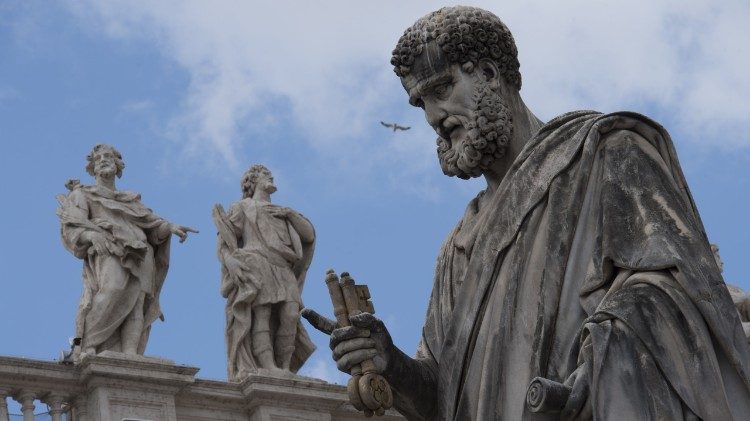
Statua San Pietro "You are Peter, and on this rock I will build My Church, and the gates of hell shall not prevail against it" (Mt 16:18) 


Primacy and infallibility: 150 years after Vatican I


After lengthy discussions, the dogmas of the Pope's primacy over the universal Church and of the infallibility of the papal magisterium were approved at Vatican Council I. What is the significance of these dogmas of the Church?


By Sergio Centofanti
One hundred fifty years ago, on 18 July 1870, the Constitution Pastor Aeternus, which defined the two dogmas of the primacy of the Pope and papal infallibility, was promulgated.

Long and heated discussions

The Dogmatic Constitution was approved unanimously by the 535 Council Fathers present “after long, fierce, and heated discussions,” as Paul VI said during a general audience in 1969. He described that day as “a dramatic page in the life of the Church, but for all that, no less clear and definitive. Eighty-three Council Fathers did not take part in the vote. The approval of the text came on the last day of the First Vatican Council, which was suspended the following day because of the start of the Franco-Prussian war. Following the capture of Rome by Italian troops on 20 September 1870 – which effectively marked the end of the Pontifical States – the Council was prorogued sine die. The conflicts that emerged during the Council led to the schism of the so-called Old Catholics.

The Dogma concerning the rationality and supernatural character of faith

The two dogmas of Pastor Aeternus were proclaimed after the dogmas concerning the rationality and the supernatural character of the faith contained in Dei Filius, the other Dogmatic Constitution of Vatican I, which was promulgated on 24 April 1870. The text states that “God, the beginning and end of all things, may be certainly known by the natural light of human reason, by means of created things (Rom 1:20).”
This dogma, as Paul VI explained in the Audience of 1969, recognises that “reason, by its own power alone, can reach certain knowledge of the Creator through creatures. The Church thus, in the age of rationalism, defends the value of reason,” maintaining, on the one hand, “the superiority of revelation and of faith over reason and its capacities”; but declaring, on the other, that “there can be no opposition between the truth of faith and the truth of reason, God being the source of both.”
In the encyclical Fides et ratio, published in 1998, Pope John Paul II affirms, “Faith and reason are like two wings on which the human spirit rises to the contemplation of truth; and God has placed in the human heart a desire to know the truth—in a word, to know himself—so that, by knowing and loving God, men and women may also come to the fullness of truth about themselves.”

The dogma of primacy

In Pastor Aeternus, Pope Pius IX, before the proclamation of the dogma on primacy, recalls Jesus’s prayer to the Father that His disciples might be “one”: Peter and his successors are the “abiding principle and visible foundation” of the unity of the Church. He solemnly affirms:
“We teach and declare that, according to the Gospel evidence, a primacy of jurisdiction over the whole church of God was immediately and directly promised to the blessed apostle Peter and conferred on him by Christ the Lord.… That which our lord Jesus Christ, the Prince of shepherds and great shepherd of the sheep, established in the blessed Apostle Peter, for the continual salvation and permanent benefit of the Church, must of necessity remain for ever, by Christ’s authority, in the Church which, founded as it is upon a rock, will stand firm until the end of time…
"Therefore, whoever succeeds to the Chair of Peter obtains by the institution of Christ himself, the Primacy of Peter over the whole Church… Both clergy and faithful, of whatever rite and dignity, both singly and collectively, are bound to submit to this power by the duty of hierarchical subordination and true obedience, and this not only in matters concerning faith and morals, but also in those which regard the discipline and government of the Church throughout the world. In this way, by unity with the Roman Pontiff in communion and in profession of the same faith, the Church of Christ becomes one flock under one supreme shepherd. This is the teaching of the catholic truth, and no one can depart from it without endangering his faith and salvation.”

The infallible Magisterium of the Pope

In the primacy of the Pope, writes Pius IX, “the supreme power of teaching is also included.” This power was conferred on Peter and his successors “for the salvation of all,” as “the constant tradition of the Church confirms.” He continues:
But since in this very age when the salutary effectiveness of the Apostolic office is most especially needed, not a few are to be found who disparage its authority, we judge it absolutely necessary to affirm solemnly the prerogative which the only-begotten Son of God was pleased to attach to the supreme pastoral office.
"Therefore, faithfully adhering to the tradition received from the beginning of the Christian faith, to the glory of God our Saviour, for the exaltation of the Catholic religion and for the salvation of the Christian people, with the approval of the sacred Council, we teach and define as a divinely revealed dogma that when the Roman pontiff speaks ex cathedra, that is, when, in the exercise of his office as shepherd and teacher of all Christians, in virtue of his supreme apostolic authority, he defines a doctrine concerning faith or morals to be held by the whole Church, he possesses, by the divine assistance promised to him in blessed Peter, that infallibility which the divine Redeemer willed His Church to enjoy in defining doctrine concerning faith or morals. Therefore, such definitions of the Roman Pontiff are of themselves, and not by the consent of the Church, irreformable.”

When infallibility occurs

Pope John Paul II explained the meaning and limits of infallibility in the General Audience of 24 March 1993: 
“Infallibility is not given to the Roman Pontiff as a private person, but inasmuch as he fulfils the office of pastor and teacher of all Christians. He also does not exercise it as having authority in himself and by himself, but ‘by his supreme apostolic authority’ and ‘by the divine assistance promised to him in Blessed Peter.’ Finally, he does not possess it as if he could dispose of it or count on it in every circumstance, but only ‘when he speaks from the chair,’ and only in a doctrinal field limited to the truths of faith and morals and those closely connected with them (...) the Pope must act as ‘pastor and doctor of all Christians,’ pronouncing on truths concerning ‘faith and morals,’ in terms which clearly express his intention to define a certain truth and to demand the definitive adherence to it by all Christians.
"This is what happened, for example, in the definition of the Immaculate Conception of Mary, about which Pius IX affirmed: ‘It is a doctrine revealed by God and must, for this reason, be firmly and constantly believed by all the faithful’; or also in the definition of the Assumption of Mary Most Holy, when Pius XII said: ‘By the authority of Our Lord Jesus Christ, of the Blessed Apostles Peter and Paul, and by our authority, we declare and define as divinely revealed dogma... etc.’ Under these conditions one can speak of extraordinary papal magisterium, whose definitions are irreformable ‘of themselves, not by the consent of the Church’ (...) The Supreme Pontiffs can exercise this form of magisterium. And this has in fact happened. Many Popes, however, have not exercised it.”

Dogmas and the development of doctrine

The International Theological Commission, in a document entitled “The Interpretation of Dogma” (published in 1990 when Cardinal Joseph Ratzinger was head of the institution), explains that infallibility does not mean falling into “a fundamental remaining in the truth,” since it must be understood in the context of the living and dynamic character of Tradition, as Dei Verbum affirms:
This tradition which comes from the Apostles develop in the Church with the help of the Holy Spirit. For there is a growth in the understanding of the realities and the words which have been handed down. This happens through the contemplation and study made by believers, who treasure these things in their hearts (see Luke, 2:19, 51) through a penetrating understanding of the spiritual realities which they experience, and through the preaching of those who have received through Episcopal succession the sure gift of truth” (DV, 8).
John Paul II is thus able to observe, in the General Audience cited above, “that the exercise of the Magisterium makes concrete and manifests the contribution of the Roman Pontiff to the development of doctrine in the Church.”

Primacy, collegiality, ecumenism

Paul VI, in the Audience of 1969, defended the relevance of the First Vatican Council and its connection with its successor, Vatican II: “The two Vatican Councils, the First and the Second, are complementary” even if they differ greatly “for many reasons.” So, the attention paid to the prerogatives of the Pope in Vatican I were extended in Vatican II to the whole People of God, with the concepts of “collegiality” and “communion.” At the same time, the focus on the unity of the Church, which has Peter as its point of visible reference, is developed in a strong commitment to ecumenical dialogue — so much so that John Paul II, in Ut unum sint, was able to launch an appeal to the various Christian communities “to find a way of exercising the primacy which, while in no way renouncing what is essential to its mission, is nonetheless open to a new situation.”
And Pope Francis, in Evangelii gaudium, speaks of a “conversion of the papacy.” He notes that “the Second Vatican Council stated that, like the ancient patriarchal Churches, episcopal conferences are in a position ‘to contribute in many and fruitful ways to the concrete realization of the collegial spirit.’ Yet this desire has not been fully realized, since a juridical status of episcopal conferences which would see them as subjects of specific attributions, including genuine doctrinal authority, has not yet been sufficiently elaborated. Excessive centralization, rather than proving helpful, complicates the Church’s life and her missionary outreach.”
And it should be remembered, too, that, according to Vatican II, “the infallibility promised to the Church resides also in the body of Bishops, when that body exercises the supreme magisterium with the successor of Peter” (Lumen gentium, 25).

To love the Pope

Going beyond adherence to dogmas, Pope St Pius X recalled, in an audience in 1912, the necessity of loving the Pope and of obeying him – and said he was grieved when this did not happen.
Saint John Bosco encouraged his collaborators and the young boys he helped to always preserve in their hearts “three white loves”: the Eucharist, Our Lady, and the Pope.
And Benedict XVI, speaking in Krakow on 27 May 2006 with young people who had grown up with John Paul II, explained in simple words what was affirmed in those truths of faith proclaimed long ago in 1870:
Do not be afraid to build your life on the Church and with the Church. You are all proud of the love you have for Peter and for the Church entrusted to him. Do not be fooled by those who want to play Christ against the Church. There is one foundation on which it is worthwhile to build a house. This foundation is Christ. There is only one rock on which it is worthwhile to place everything. This rock is the one to whom Christ said: ‘You are Peter, and on this rock I will build my Church’ (Mt 16:18).
"Young people, you know well the Rock of our times. Accordingly, do not forget that neither that Peter who is watching our gathering from the window of God the Father, nor this Peter who is now standing in front of you, nor any successive Peter will ever be opposed to you or the building of a lasting house on the rock. Indeed, he will offer his heart and his hands to help you construct a life on Christ and with Christ.
This is a working translation from the Italian original.