Showing posts with label South Sudan. Show all posts

Sunday, April 13, 2025

Pope Francis calls for peace in Sudan, Lebanon, Ukraine, Palestine, Israel and more...


FILE PHOTO: Displaced Sudanese woman rests inside a shelter at Zamzam camp in North DarfurFILE PHOTO: Displaced Sudanese woman rests inside a shelter at Zamzam camp in North Darfur 

Pope appeals for end to war in Sudan

On the eve of Holy Week, Pope Francis renews his call for dialogue in war-torn Sudan and asks the international community to provide humanitarian assistance to the beleaguered population. He does not neglect to also to pray for Lebanon and other countries wracked by conflict and violence across the globe.

By Linda Bordoni 

“The 15th of April will mark the second sad anniversary of the beginning of the conflict in Sudan, in which thousands have been killed and millions of families have been forced to flee their homes,” said Pope Francis on Sunday in a message distributed by the Holy See Press Office.

Recalling the “suffering of children, women and vulnerable people [that] cries out to heaven and begs us to act” the Pope renewed his appeal to the parties involved:

“That they may end the violence and embark on paths of dialogue, and to the international community, so that the help needed may be provided to the populations."

The war in Sudan

The war between rival militaries – the Sudanese Armed Forces (SAF) and the paramilitary Rapid Support Forces (RSF) – began on 15 April 2023 after a breakdown in the transition to civilian rule following the overthrow of long-time President Omar al-Bashir. Heavy fighting has levelled towns and cities and claimed tens of thousands of lives.

At least 12.4 million people have been uprooted from their homes, including more than 3.3 million refugees.

On Saturday, the UN aid cooperation office, OCHA, warned that “With no viable peace in sight, the Sudanese are trapped in a humanitarian crisis of industrial proportions.”

“Two out of three people need aid, that’s 30 million people… the OCHA spokesperson said, adding that this “demands a massive ramp-up of international support; what we see instead is donors pulling back funding across the world.”

Lebanon

Pope Francis, whose Sunday reflections and appeals have been distributed by the Press Office since he was hospitalized in mid-February and as he continues to convalesce at Casa Santa Marta, also appealed to men and women of goodwill to keep Lebanon in their prayers.

“Let us also remember Lebanon, where the tragic civil war began fifty years ago: with God's help, may it live in peace and prosperity,” he said.

Prayers for peace

Pope Francis also turned his thoughts to other war-torn countries across the world:

“May peace come at last to martyred Ukraine, Palestine, Israel, the Democratic Republic of Congo, to Myanmar, to South Sudan.,” he prayed.

“May Mary, Mother of Sorrows, obtain this grace for us and help us to live this Holy Week with faith.”

Sunday, November 3, 2024

Pope Francis adds several prayer intentions after the Sunday Angelus


Destruction caused by Israeli strikes in Gaza CityDestruction caused by Israeli strikes in Gaza City  (AFP or licensors)

Pope Francis: ‘May dialogue replace weapons’

Pope Francis reiterates his appeal for mediated solutions to the wars afflicting the planet and urges the faithful to contribute to helping those affected by devastating floods-in Spain's eastern Valencia region.

By Linda Bordoni

Quoting from the Italian Constitution’s Article 11 on the Repudiation of War, Pope Francis on Sunday appealed for warring parties across the world to engage in dialogue and end conflict.

The Pope’s words came as he greeted members of the Rome office of “Emergency”, a charitable organization that provides care to victims of conflict and poverty in nine countries across the world.

He noted that the charity upholds Article 11 of the Italian Constitution, which states: "Italy shall repudiate war as an instrument of offence against the liberty of other peoples and as a means for settling international disputes.“

“Repudiate war as an instrument of offence against the liberty of other peoples and as a means for settling international disputes.”

Urging all peoples to remember and put this Article into practice, the Pope said: “May this principle be applied worldwide: may war be banned and issues be addressed through law and negotiations. Let weapons fall silent, and let dialogue take their place.”

“May war be banned and issues be addressed through law and negotiations. May weapons fall silent, and may dialogue take their place.”

As always, the Pope asked all believers to join in prayer for “the tormented Ukraine, Palestine, Israel, Myanmar, South Sudan.”


Solidarity for flood victims in Spain 

Pope Francis also turned his thoughts to the people in Valencia and in other parts of Spain who have been struck by catastrophic flooding that has killed at least 214 people and left dozens unaccounted for.

“Let us continue to pray for Valencia and other people of Spain who are suffering so much these days,” he said. And he encouraged the faithful to ask themselves: “What am I doing for the people of Valencia? Am I praying? Offering something? Think about this question.”

“What am I doing for the people of Valencia? Am I praying? Offering something? Think about this question.”

The Pope has already expressed his closeness to all those affected by the deadliest flash floods in Spain's modern history, after torrential rains swept the eastern region of Valencia four days ago.

Prime Minister Pedro Sanchez on Saturday said the government was sending 5,000 more army troops to help with the searches and clean-up in addition to 2,500 soldiers already deployed.

Valencian regional authorities said on Saturday night the total number of fatalities in the region was 211, plus two from Castilla La Mancha and one in Andalusia.

Sunday, March 17, 2024

Pope offers prayers after the Angelus


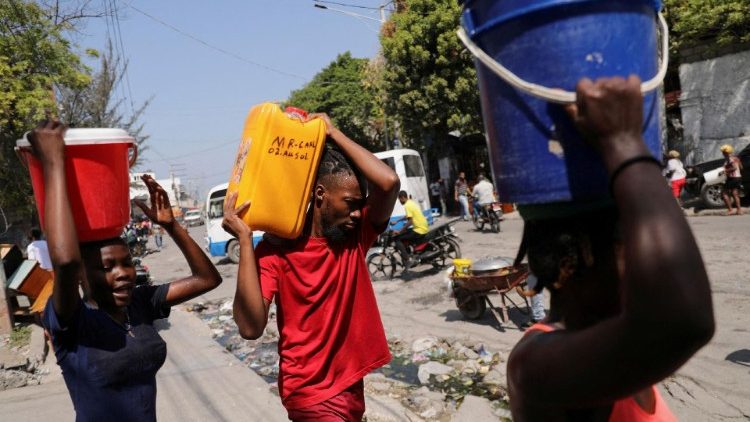
After the prime minister pledged to step down, an uneasy quiet in Haiti capitalAfter the prime minister pledged to step down, an uneasy quiet in Haiti capital 

Pope expresses relief over kidnapped released in Haiti, prays for those still held

During the Sunday Angelus, Pope Francis expresses satisfaction over the release of a teacher and four of six religious kidnapped in Haiti. He appeals for the release of those still held, and he offers prayers for war-torn Ukraine, Palestine and Israel, South Sudan, and Syria.

By Vatican News

Addressing the crowds in Saint Peter's Square during Sunday's Angelus, Pope Francis expressed his relief over the freeing almost a week ago of a teacher and four of six religious following their kidnapping in Haiti. Two remain in captivity, and the Pope appealed for their release as soon as possible, as well as for all those still held in the "beloved country, so fraught with violence."  The six religious, members of the Congregation of the Brothers of the Sacred Heart, were kidnapped last 23 February.

Unite for the common good

The Pope called on all political and social leaders in Hait to abandon narrow interests and "engage in a spirit of solidarity in the pursuit of the common good, supporting a peaceful transition to a country that, with the help of the international community, may be equipped with solid institutions capable of restoring order and tranquillity among its citizens."

Pray for war-torn peoples

Pope Francis also asked everyone to continue praying for the war-torn populations of Ukraine, Palestine and Israel, and South Sudan. And he recalled the people of Syria, asking that we not forget their plight as the nation there "has suffered greatly for a long time because of war."

Thursday, February 16, 2023

Pope Francis again expresses his concerns about war and violence


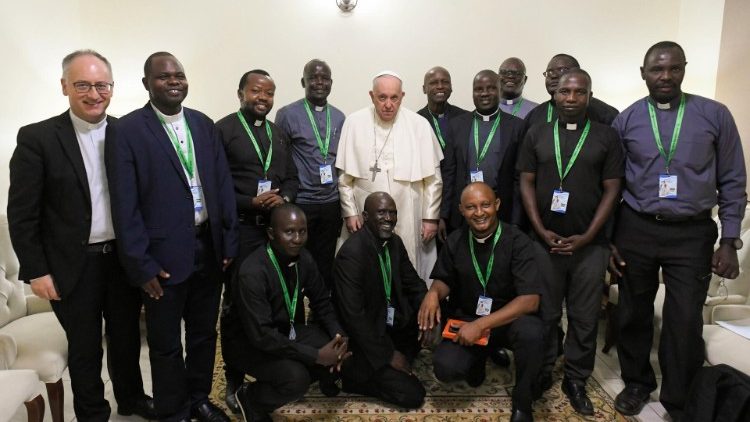
Pope Francis -  Meeting with Jesuits in South SudanPope Francis - Meeting with Jesuits in South Sudan  (Vatican Media)

Pope: The world is headed toward the abyss if it won't end war

In separate meetings with Jesuits in the Democratic Republic of Congo and in South Sudan during his recent Apostolic Journey, Pope Francis shares his concerns about war, for a synodal discussion to protect the environment in the region, and speaks out on a host of other issues.

By Antonella Palermo

War, the cruelty of violence, the protection of natural resources, the evils of the Church, the dream for Africa: these are just a few of the topics addressed by Pope Francis in the meetings he had with Jesuits in the Democratic Republic of Congo and South Sudan, meetings that have become regular appointments on the agenda of his apostolic journeys.

The whole world is at war, will people dare to stop?

On 2 February, 82 Jesuits working in the DRC, led by the Provincial, Father Rigobert Kyungu, met with the Holy Father in Kinshasa at the Nunciature. Among them was also Jesuit Donat Bafuidinsoni, bishop of Inongo.

During the conversation, the Holy Father addressed the issue of the mission of reconciliation and justice—one of the “Universal Apostolic Preferences” of the Society of Jesus. Of the DRC, the Pope said, “it is clear that issues of conflict and factional strife are strong here. But let’s open our eyes to the world: the whole world is at war!” He recalled the ongoing conflicts in Syria, Yemen, Myanmar, Latin America, and Ukraine, and asked, “will humanity have the courage, the strength, or even the opportunity to turn back? It goes forward, forward, forward to the abyss.” The Pope said he didn’t have the answer to that question, but admitted, “I am a bit pessimistic.”

The main problem: the production of arms

“Today it really seems that the main problem is the production of weapons,” the Pope said, lamenting that people continue to manufacture arms when “there is still so much hunger in the world.” He said, “It is difficult to come back from this catastrophe. And we are not talking about atomic weapons!”

However, the Pope continued, “I still believe in a work of persuasion,” adding, “We Christians have to pray a lot: ‘Lord, have mercy on us!’”

Pope Francis also recalled the stories recounted by victims of violence and unimaginable cruelty, and, in remarks to the Jesuits of South Sudan, denounced “a pagan culture of war” that is concerned only with how many weapons one has

“They are all forms of paganism.”

A commitment to saving the Congo biome

Pope Francis also reflected on the environmental issues, with all their economic repercussions, with respect to the Congo river basin, the earth’s “second green lung” after the Amazon, which is threatened by deforestation, pollution, and intensive and illegal exploitation.

Asked about the possibility of a Synod on this region like the one held for the Amazon, the Pope said there would not be a Synod, because the Synod on Amazonia was “exemplary.” The four “dreams” of the Synod, he said, can be applied to the banks of the Congo.

The planetary balance also depends on the health of the Amazon and the Congo biomes.

At the same time, he said, “it would be good for the Bishops’ Conference to engage synodically at the local level with the same criteria, but in order to pursue a discourse more related to the reality of the country.”

The Church is not a multinational company for spirituality

Speaking about the liturgies during his journey, Pope Francis expressed his appreciation for the Zairean Use—the approved, inculturated version of the Roman Rite—calling it “a work of art, a liturgical and poetic masterpiece… It is not as an adaptation, but a poetic, creative reality.”

Calling to mind once again the image of the Church as a field hospital, the Pope denounced “authoritarianism” as “one of the ugliest things in the Church … which then becomes a mirror of society wounded by worldliness and corruption.”

He insisted, “The Church is not a multinational spirituality corporation,” and invited his listeners to “Look at the saints! Heal, take care of care of the wounds the world experiences! Serve the people!” He noted that “the word ‘serve’ is very Ignatian,” referring to the founder of the Jesuit order, St Ignatius of Loyola.

‘In everything love and serve’ is the Ignatian motto. I want a Church of service.

Preparations for the anniversary of the Council of Nicaea

Pope Francis was also asked about preparations for the 1,700th anniversary of the first Council of Nicaea, which will occur in 2025. In response, he said that preparations are being made in union with the Ecumenical Patriarch of Constantinople, Patriarch Bartholomew to celebrate the occasion “as brothers,” and repeated his hopes for an agreement on the date of Easter.

Responding to a question on the possibility of resigning, Pope Francis said he does not think that resigning popes should become a normal thing. “Benedict had the courage to do it” because he felt he could not continue due to his health. “I for the moment do not have that on my agenda,” the Holy Father said, explaining, “I believe that the Pope's ministry is ad vitam [for life]. I see no reason why it should not be so.”

This also holds true for the role of Superior General of the Society, the Pope said, adding, “On this, I am ‘conservative.’”

Africa needs honest political leaders

Pope Francis also had the opportunity for an encounter with Jesuits in South Sudan, meeting in Juba on 4 February with the eleven Jesuits working in the country, as well as Father Kizito Kiyimba, Superior of the East African Province, which includes Sudan, South Sudan, Ethiopia, Uganda, Kenya, and Tanzania.

The Holy Father shared his dream that “Africa must grow” and not be exploited, a theme he had already raised in November during an online meeting with African students. Recalling that meeting during his talk with the Jesuits, Pope Francis said, “I was impressed by the intelligence of these young women and men. I really liked their way of thinking.”

He went on to say, “Africa needs politicians” like that: people who are good, intelligent, who can help their countries grow. Above all, Africa needs “politicians who do not allow themselves to be distorted by corruption.”

“Political corruption leaves no room for the country to grow; it destroys it.”

The cause of Pedro Arrupe

The Pope was also given the opportunity to speak about the cause for the canonization of Father Pedro Arrupe, the former superior general of the Society of Jesus. “His cause is moving forward,” Pope Francis said, “because one of the stages is already completed.”

He went on to explain that the biggest obstacle at the moment has to do with Arrupe’s extensive writings “He wrote so much and you have to read all of it, and that slows down the process,” the Pope said.

Asked how he himself prayed, Pope Francis said, “Clearly, I say Mass and recite the Office. Daily liturgical prayer has its own personal density.” He added that he sometimes prays the Rosary, and sometimes prays while meditating on the Gospel.

“For personal prayer, I, like everyone, have to find the best way to live it day by day.” He added, “I am afraid of prayer preachers who make abstract, theoretical prayers, who talk, and talk, and talk, but with empty words.” Instead, Pope Francis insisted that “prayer is always embodied,” and said that “one has to pray immersed in reality.”

Vatican News staff writers contributed to this report. The full text of Pope Francis’ talks with the Jesuits in the Democratic Republic of Congo and in South Sudan can be found at the website of Civiltà Cattolica.

Thursday, February 9, 2023

What the Archbishop of Juba, South Sudan said to Pope Francis as he prepared to return to Rome


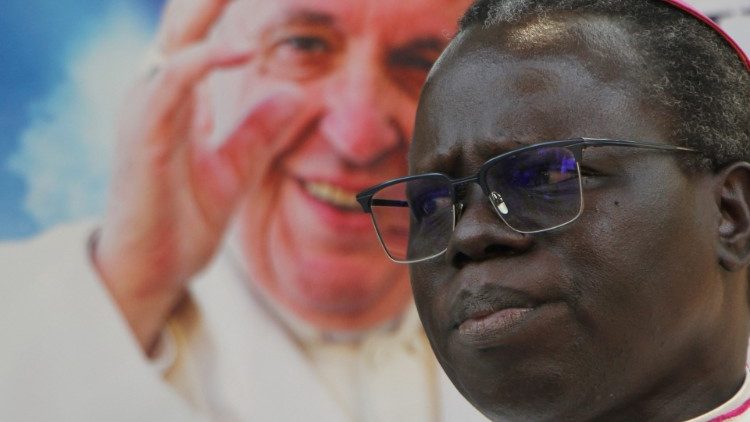
The Archbishop of Juba, Stephen Ameyu with a portrait of Pope Francis in the background.The Archbishop of Juba, Stephen Ameyu with a portrait of Pope Francis in the background. 

Archbishop of Juba’s heartfelt message to Pope Francis as he was returning to Rome.

“The peace which our country so badly needs is not a purely human peace based on personal interests, but rather the peace of Jesus,” said the Archbishop of Juba.

Paul Samasumo - Vatican City.

At 59 years old, South Sudan’s Archbishop Stephen Ameyu Martin Mulla cuts the figure of a young Bishop. Ordained in 2019 for South Sudan’s Diocese of Torit, the visit of Pope Francis to South Sudan thrust him into the world’s limelight. He has had to hit the ground running. Seasoned Bishops could be forgiven for finding the idea of hosting the Pope in their diocese daunting.

In January 2019, at 54 years, Ameyu was appointed Bishop of Torit. By the end of that same year, in December 2019, he had a new appointment as the Archbishop of Juba. He calmly weathered some pockets of resistance to his appointment as the Archbishop of Juba.

Dear brother, Stephen

“Thank you, dear brother, Stephen, for your kind words,” the Pope addressed himself to Archbishop Ameyu during the closing Juba Mass held at the John Garang Mausoleum on 5 February 2023. The colourful and solemn Eucharist was attended by all the country’s political leadership, visiting regional religious and secular representatives augmented by a more than 100 000-capacity assembly.

In his booming voice, Archbishop Ameyu assisted Pope Francis at the altar. Later, he spoke for many in South Sudan and beyond when he expressed frustration with the slow progress of implementing the complex peace agreement.

“It is discouraging that the peace process has moved forward so slowly. Your Holiness, we share your fatherly concern for the restoration of peace in our country,” he said.

Here below is the address, in full, of the Archbishop of Juba to Pope Francis.

 Closing Remarks by His Grace Archbishop Stephen Ameyu Martin Mulla

 of the Catholic Archdiocese of Juba,

on the Occasion of the Papal Visit to Juba,

3 - 5 January 2023.

        Your Holiness Pope Francis, on behalf of the members of the Sudan Catholic Bishops’ Conference, I warmly thank you and I also thank Almighty God for having allowed this historic visit to happen in our time. Furthermore, I thank you very much for taking this bold decision to visit our country, which is suffering due to the consequences of civil war. Your Holiness, I believe that your visit is a sign of solidarity with us and shows the desire to restore tranquility in this country.

        Your Holiness, you have come to our country to urge our political leaders to work for peace and for the common good of Sudan and South Sudan. You have demonstrated this concern previously in your repeated calls for reconciliation between the warring parties. In April 2019, for example, you hosted South Sudanese leaders for a two-day spiritual retreat in the Vatican, during which you urged them to strengthen the country’s faltering peace process. Amazingly, you even knelt down to kiss their feet as a symbol of humility and service of humanity. However, it is discouraging that the peace process has moved forward so slowly.

    Your Holiness, we share your fatherly concern for the restoration of peace in our country. War has brought the indiscriminate destruction of human lives and the destruction of assets such as homes and livestock.  We have experienced looting, raping, economic deterioration, and the displacement of countless people, many of whom have fled to neighbouring countries. Thus, with such negative impacts of civil war upon our innocent people, one can say: it is better to have peace than to have war, because war destroys whereas peace builds.

        Your Holiness, despite the above-mentioned challenges of civil war, the Church in Sudan and South Sudan has grown: indeed, though we have lived through tough historic periods, we have celebrated one hundred years of faith in this country. On the one hand, our Church has produced two Saints: St. Daniel Comboni and St. Josephine Bakhita, and on the other hand, the local Church has witnessed to the faith through martyrdom. Among those martyred during the first war, known as “Anyanya One” (which lasted from 1956-1972 ), were Mr. William Deng, Fr. Saturlino Ohure and Fr. Leopoldo Anyuar. There have been martyrs of the current civil war as well. Sr. Veronika Teresa Rackova, SSpS, a Slovak sister and medical doctor, was killed on May 16, 2016, while serving in the Catholic Diocese of Yei. Sr. Mary Abbud and Sr. Regina Roba, from the local congregation of the Sacred Heart of Jesus, were also killed, on August 16, 2021, while they were on their way back to Juba from the centenary celebration of Our Lady of Assumption Parish in Loa in the Catholic Diocese of Torit.

      Your Holiness, our country is truly suffering due to the civil war. Therefore, we are looking for peace and reconciliation. However, the peace which our country so badly needs is not a purely human peace based on personal interest, but rather the peace of Jesus, who says, “Peace I leave with you; my peace I give you. Not as the world gives do I give it to you” (Jn 14:27). This is a peace that must be guided by truth and love.

In conclusion, your Holiness, once again, with your friends Dr Iain and Dr Justin, we thank you for coming to our country. You have pushed us further in building peace, and we assure you of our prayers for your health as you return to Rome. May this great event of your visit bring blessings and lasting peace to this country and also in our sister country, Sudan. Thank you very much