Showing posts with label Bible. Show all posts

Tuesday, February 10, 2026

Santa Fe Archbishop criticizes Speaker Johnson for using Scripture as political weapon

Archbishop Wester warns House speaker against using Scripture to undermine human dignity

House Speaker Mike Johnson defended mass deportations in response to Pope Leo XIV’s opposition. Archbishop John Wester of Santa Fe said the lawmaker’s response was “deeply concerning.” 


House Speaker Mike Johnson speaks at the rally before the 2024 March for Life in Washington, D.C. | Credit: EWTN News


Tyler Arnold

Santa Fe, New Mexico, Archbishop John C. Wester said while nations may regulate their borders, Catholic teaching requires that all policies and rhetoric uphold the inherent dignity of migrants and avoid using Scripture as a political weapon.

Republican House Speaker Mike Johnson had put forth a biblical defense of President Donald Trump’s mass deportation efforts Feb. 3 after a reporter asked him to respond to Pope Leo XIV’s criticism of mass deportations. The pontiff cited Matthew 25:35, in which Jesus Christ speaks about those who will inherit the kingdom of God, saying “[when I was] a stranger and you welcomed me.”

In response, Johnson, a Southern Baptist, said immigration is not “frowned upon” in the Bible but instead welcomed, and “we’re going to welcome the sojourner and love our neighbor as ourself.” However, Johnson said that biblical command to welcome the stranger falls on “individuals” instead of “civil authorities,” which Wester said is contrary to Christian ethics.

Johnson said civil authorities maintain a divine right to establish immigration laws that maintain order. He called national borders and walls “biblical.” He said God “allowed us to set up our civil societies and have separate nations.”

“When someone comes into your country, comes into your nation, they do not have the right to change its laws or to change a society,” he said. “They’re expected to assimilate.”

The speaker cited Romans 13, in which St. Paul instructs Christians to be “subordinate to the higher authorities, for there is no authority except from God, and those that exist have been established by God.”

Johnson said there was not proper order under former President Joe Biden and criticized him for the number of unlawful border crossings, which he said included “many dangerous people.” He said borders are “good and right,” not because “we hate the people on the outside” but because “we love the people on the inside.”

“We should love our neighbor as ourself as individuals,” he said. “But the civil authority and the government has to maintain the law, and that is biblical and it’s right and it’s just.”

Archbishop calls comments ‘deeply concerning’

In a Feb. 6 statement, Wester — whose archdiocese is near the southern U.S. border — said “it is deeply concerning when theological language and sacred texts are used to diminish the fundamental dignity of human beings created in the image of God.”

Wester said Catholic teaching acknowledges the right of governments to manage their borders but that the right “is never absolute” and policies must “reflect the inherent dignity of every person, and must be ordered toward justice, mercy, and the common good.”

The archbishop said those with power have “a greater duty … to protect the vulnerable” and “not to treat them as political fodder.”

“To suggest that compassion, dignity, and respect for the stranger are merely personal virtues rather than obligations of society betrays a fundamental misunderstanding of Christian ethics,” the archbishop said.

“The Gospel is not a collection of sound bites for political advantage; it is the call to love our neighbors as ourselves, to defend the defenseless, and to remember that every human being bears the imprint of God,” he continued. “Reducing Scripture to a political tool undermines its transformative power and our shared humanity.”

Wester said the national right to regulate borders “must be balanced with the call to show compassion, protect human dignity, and seek just and humane solutions” and that “strong policies and humane treatment are not mutually exclusive.”

“In fact, justice demands both,” the archbishop said. “Let us pray for our leaders that they may be guided by wisdom, informed by truth, and moved by the love and mercy of Christ, who came not to condemn but to call us into communion with all people.”

The Catechism of the Catholic Church teaches that prosperous nations have an obligation, “to the extent they are able, to welcome the foreigner.” The immigrant has an obligation “to respect with gratitude the material and spiritual heritage of the country that receives them, to obey its laws, and to assist in carrying civic burdens.”

“Political authorities, for the sake of the common good for which they are responsible, may make the exercise of the right to immigrate subject to various juridical conditions,” it adds.

The U.S. Conference of Catholic Bishops (USCCB) voted 216-5 in November to adopt a special message that expresses opposition to “the indiscriminate mass deportation of people.” A November 2025 poll from EWTN News and RealClear Opinion Research found that 54% of Catholics support “broad scale” deportations, while only 30% oppose it and 17% neither support nor oppose it.

Saturday, January 25, 2025

This Sunday is Word of God Sunday


Ordinary Time: January 26th

Third Sunday in Ordinary Time, Sunday of the Word of God


The Third Sunday in Ordinary Time is the Sunday of the Word of God, instituted by Pope Francis in 2019. See Note of the Congregation for Divine Worship and the Discipline of the Sacraments on the Sunday of the Word of God.

From today's Gospel:

Jesus returned to Galilee in the power of the Spirit, and news of him spread throughout the whole region. He taught in their synagogues and was praised by all (Luke 4:14-15).

The Optional Memorials of Saints Timothy and Titus, which are ordinarily celebrated today, are superseded by the Sunday liturgy.


Commentary on the Mass Readings for the Third Sunday in Ordinary Time, Year C:
The First Reading is taken from the Book of Nehemiah, 8:2-4a, 5-6, 8-10. Nehemiah and Ezra lived in the time when the people of Israel had been returned to their land after the years of the Babylonian Captivity and it was a time of rebuilding. The people had lost their connections to their faith.

The Second Reading is from the First Letter of St. Paul to the Corinthians, 12:12-30 and refers to the Mystical Body of Christ. St. Paul concludes his description of the different parts of the body by applying it to the Church, where variety of functions does not detract from unity.

The Gospel is from St. Luke 1:1-4; 4:14-21. In the first four verses of St. Luke's Gospel which have been read to you today, you will find reason to be grateful to him. He went to a lot of trouble in order to put in a permanent form, in a written record, the essential facts concerning Christ, his words and his works, so that we "would understand (like Theophilus) the certainty of the faith in which we have been instructed."

But while we must be grateful to St. Luke, we owe a bigger debt of gratitude still to the all-good, all-wise God who moved Luke and the other Evangelists to preserve for us in writing the essential truths of the Christian faith that has been handed down to us. The Apostles were companions of Christ. They witnessed his works and his words; they remembered most of his doings and his sayings, and what they might have forgotten the Holy Spirit recalled to their memory on that first Pentecost day in Jerusalem. The first two generations of Christians received the facts of the faith from these eye-witnesses and the miracles so frequent in the infant Church were confirmation of the truth of their teaching.

But God in his wisdom provided for the many generations to come who would not have this evident confirmation of their faith. He established a teaching body in his Church which would safeguard the purity of the Christian truths, for "he himself would be with it all days," and he gave us a written record of the facts of the faith in the Gospels and the ether writings of the New Testament.

How can we ever thank God sufficiently for his thoughtfulness in our regard? We Christians of today can be as certain, as assured, of the truth of the faith that we are trying to practice as was St. Luke who was converted by St. Paul. We have a living, teaching Magisterium in the Church, which authentically preserves and interprets for us the true facts of Christ's teaching and works as written down for us by a first-generation Christian under the impulse and guidance of God's Holy Spirit. If we needed further proof of the priceless value of our New Testament Books, the virulent attacks on their authenticity, on their objectivity, and on their veracity, by enemies of the faith down to and including our own day, should be sufficient.

But they have stood the test of time and the onslaughts of biased, prejudiced criticism, for they are the word of truth, which is eternal, and comes from God.

We have a priceless gift of God in the inspired Books of the Bible. Let us show true appreciation for that gift by using it to build up a better knowledge of the Christian faith which it teaches us. There should be a Bible, or at least the New Testament, in every Christian home. It should not be an ornament on a shelf, but a fountain and source from which we can draw strength and refreshment in the daily practice of our Christian faith. Almost two thousand years ago, God's infinite goodness provided this source of strength, the "fountain of living water," for us Christians of this century. Are we grateful for his thoughtfulness? Are we nourishing our faith at this blessed fountain of his infinite wisdom and love?
—Excerpted from The Sunday Readings by Fr. Kevin O'Sullivan, O.F.M.

Thursday, April 11, 2024

Pope Francis reflects on Jesus' example in Scripture of compassion to those suffering


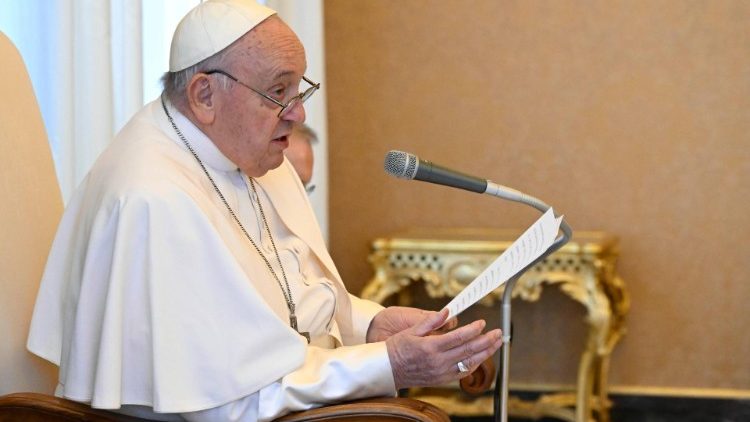
Pope Francis speaks with members of the Pontifical Biblical CommissionPope Francis speaks with members of the Pontifical Biblical Commission  (VATICAN MEDIA Divisione Foto)

Pope Francis: ‘Bible shows Jesus’ closeness to suffering humanity’

Pope Francis meets with members of the Pontifical Biblical Commission, and encourages biblical scholars to explore Jesus’ example of compassion and inclusion when faced with the suffering of others.

By Devin Watkins

The Pontifical Biblical Commission concluded its annual plenary assembly in Rome on Thursday, which focused on the theme of illness and suffering in the Bible.

Pope Francis met with members of the Commission to commend their work to explore this “deeply existential theme” that touches the life of every human person.

“Our wounded nature,” he said, “bears within itself the realities of limitation and finitude, and suffers the contradictions of evil and pain.”

Trasforming the ‘sieve of suffering’

The Pope said the topic of human suffering and illness is close to his heart, since these issues are “adversaries” that every Christian is called to confront in a humane way.

Rather than avoiding the topic of suffering like a taboo, he said, we should endure trials “by living in relation with others” and allow God to turn “the sieve of suffering” into an opportunity to mature and grow in faith.

Jesus, said Pope Francis, “exhorts us to take care of those living in situations of infirmity, with the determination to defeat illness. At the same time, He gently invites us to join our sufferings to His salvific offer, as a seed that bears fruit.”

Touching suffering, not offering trite words

Turning to the theme of compassion, the Pope noted the many Biblical passages in which Jesus is moved by those He meets who are suffering, such as the exhausted crowd which He feeds, the blind who beseech Him, and the many sick people whom He welcomes and heals.

“Jesus does not explain suffering but bends towards those who suffer,” said the Pope. “He does not approach pain with generic encouragement and sterile consolations, but accepts its drama, allowing Himself to be touched by it.”

Sacred Scripture, he added, does not offer us a “recipe book of feelings” or a handbook of prepared phrases to say to people in pain.

As is clear in the book of Job, the Bible “shows us faces, encounters, and concrete stories” that break the mould of “religious theories that link suffering with divine punishment.”

Christ, said the Pope, transformed human suffering by making it His own and offering it to the Father as a “gift of love.”

“Whoever assimilates Sacred Scripture,” he said, “purifies the religious imagination from wrong attitudes, learning to follow the path indicated by Jesus: to physically touch human suffering, with humility, gentleness, and seriousness, in order to bring, in the name of the incarnate God, the closeness of a salvific and concrete support.”

Antidote to self-closure in trials

Pope Francis then turned to the theme of “inclusion,” noting that the term is not found in the Bible but saying it “expresses a prominent trait of Jesus’ style.”

He said the Lord excluded no one from God’s salvation but rather welcomed all and offered everyone “total healing, in body, soul, and spirit.”

“Through the experience of suffering and illness,” said the Pope, “we, as the Church, are called to walk together with everyone, in Christian and human solidarity, opening opportunities for dialogue and hope in the name of common fragility.”

In conclusion, Pope Francis invited the members of the Pontifical Biblical Commission to delve into the topic of compassion and inclusion “with critical rigor and fraternal spirit.”

“The Word of God is a powerful antidote to every closure, abstraction, and ideologization of faith,” he concluded. “Understood in the Spirit in which it was written, it increases passion for God and man, ignites charity, and revives apostolic zeal.”

Saturday, January 20, 2024

This 3rd Sunday in Ordinary Time is Word of God Sunday


Ordinary Time: January 21st

Third Sunday of Ordinary Time, Sunday of the Word of God


MASS READINGS

January 21, 2024 (Readings on USCCB website)

PROPERS [show]

COLLECT PRAYER

Third Sunday in Ordinary Time, Sunday of the Word of God: Almighty ever-living God, direct our actions according to your good pleasure, that in the name of your beloved Son we may abound in good works. Through our Lord Jesus Christ, your Son, who lives and reigns with you in the unity of the Holy Spirit, God, for ever and ever.

show

RECIPES (1)

show

ACTIVITIES (1)

show

PRAYERS (3)

LIBRARY (0)

show

BLOG & PODCASTS (8)


The Third Sunday of Ordinary Time has been designated as the "Sunday of the Word of God" (the Sunday usually falls between January 21-27). See Apostolic Letter Aperuit illis which instituted this observation, and the USCCB page with ideas for Catechetical, Ecumenical, Liturgical and Prayer Material.

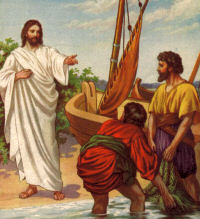
As he passed by the Sea of Galilee, he saw Simon and his brother Andrew casting their nets into the sea; they were fishermen. Jesus said to them, "Come after me, and I will make you fishers of men." Then they abandoned their nets and followed him (Mark 1:16-19).

The Memorial of St. Agnes, which is ordinarily celebrated today, is superseded by the Sunday liturgy.


Commentary on the Mass Readings for the Third Sunday in Ordinary Time, Cycle B:
The First Reading is taken from the Book of the Prophet Jonah 3:1-5, 10 and tells the story of Jonah's call from God to go to a pagan city and preach repentance to the sinful people there.

The Second Reading is from the First Letter of St. Paul to the Corinthians. St. Paul admonishes his converts to do what our Lord himself advised his follower—always to be ready for the judgment.

The Gospel is from the Gospel of Mark 1:14-20. Jesus came to announce to all men the good news of God's eternal plan for them. He spent his public life convincing the Jews of Palestine of the truth of this message, and he died on the cross because he claimed to be that he was God's divine Son, who had come in human nature to raise all men to the standing and status of adopted sons of God. That very death, cruel and unjust though it was, was part of the divine plan. He conquered death and was raised from the grave to prove that we too, if we accept his divine gospel and live by it, will be raised from the dead and reign with Christ in the kingdom of his Father forever. Christ preached this doctrine in Palestine. It is the doctrine for which he gave his human life and which he gave to his Apostles to hand down to all future generations. This is the self-same doctrine preached by Christ's Church to all men today. It is the good news of God's mercy and love toward us weak, mortal creatures. To some it seems too good to be true; it would indeed be so if God were a limited, finite being like us, but he is Being itself. He is without limit, his goodness and love are limitless as is his nature. What God can see in creatures has ever been a puzzle to thinking man. One of the psalm-writers said centuries ago: "What is man that you should spare a thought for him, the son of man that you should care for him" (Ps. 8 :4)? Many a saint too, has repeated this remark ever since.

We cannot hope to fathom the mind of God, nor do we need to. He has gone to such a length as the humiliation of his divine Son in the incarnation in order to give us a new standing in relation to himself and a new mode of eternal living after death. We are still God's creatures, "the work of his hands," but through accepting Christ and his gospel—his message of divine truth—we are no longer mere mortals. We shall die, but death is the beginning of the true life which God has arranged for us. It is no wonder that St. Paul could cry out: "O death where is your victory, O death, where is your sting?"

We Christians should be the happiest people on earth. We know why we are here, we know where we are going and we know how to get there. There are trials and troubles which beset us on our journey; there are rough parts of the road and weaknesses in our human nature which often lead us off the right road, but we are not left to our own human resources. We have help from above to strengthen and comfort us on our journey. We have divine aids in the Church which Christ set us and we have the guarantee of our Good Shepherd that he will keep us in his fold or bring us back should we foolishly wander from it (Jn. 10: 14; Lk. 1.5:4-7).

We Christians can indeed be the happiest people on earth, if we live according to the divine good news revealed to us through Christ. "Repent and believe in the gospel," Christ told the people of Galilee. The same call goes out from our loving Savior to each of us today: repent—change your outlook on life— and see it as God sees it to be for us, a short journey toward heaven. If we really believe in the gospel of Christ, the revelation of God's plan for our eternal happiness, our earthly troubles will look small, our trials and temptations will appear to us as they really are—a means of earning the eternal victory. Christ, the innocent victim for our salvation, has gone before us, carrying his heavy cross; can we refuse to carry the relatively lighter cross which he places on our shoulders as our means of making atonement for our own failings and for those of our fellowmen? God forbid that we should! If we have failed in the past, let us repent today and show our belief in the truth of the Christian gospel, by living as true Christians who are on their way to heaven.
—Excerpted from The Sunday Readings by Fr. Kevin O'Sullivan, O.F.M.

Tuesday, October 17, 2023

At the Synod Colombian Cardinal states: "cannot remove pages from the Bible"


José Miguel Gómez Rodríguez, the archbishop of Manizales in Colombia, shared his experience at the Synod of Synodality taking place this month at the Vatican, commenting on what this assembly can ultimately give to the Catholic Church and stressing that it “cannot remove pages from the Bible.”

The Synod on Synodality was announced in October 2021 with the theme “For a synodal Church: communion, participation, and mission.” Participating in the session taking place in Rome this October are 364 people including bishops, religious, priests, deacons, and laypeople. For the first time, non-bishops — including 54 women — will have the right to vote.

In an interview with ACI Prensa, CNA’s Spanish-language news partner, the archbishop of Manizales responded to the question about whether the synod could approve the blessing of homosexual couples and the ordination of women: “No, but the Church already knows that answer.”

“Before the synod, a few days before, they published the pope’s answers to some questions or doubts that some cardinals had raised and there are also these questions, in such a way that what the pope wants is for us to handle with great respect and great delicacy the questions that people have in their hearts and that we answer them with so much respect that no one is offended, that everyone has clear in their minds the why of things,” Gómez explained.

The Colombian prelate emphasized that “the synod cannot remove pages from the Bible, the synod does not have that kind of authority, nor does the pope remotely want that.”

“There is bad press against the Holy Father that’s not fair and that has as its objective the same thing that they try to do in the world, which is class struggle. They want to divide us Catholics from the pope and the pope from Catholics,” he warned.

The beauty of the Church

Regarding the topics discussed at the synod, the archbishop noted that many of these “have their origin in the desire for the Church to wake up a little more, for Catholics to not only discover the beauty of the Gospel, but the beauty of participating in the Church."

That is why, he continued, “the three big blocks of questions are called communion, participation, and mission, but there are also other questions that, to be honest, it seems to me that the pope wants us to put before our eyes, and they are those that sometimes come from certain groups, groups that sometimes shed light on themselves that they would not like to have, but that they themselves are responsible for projecting on themselves, to vindicate themselves for one thing or another.”

“These issues, of course, the synod is facing with respect, with a lot of dignity and a lot of charity,” he stressed.

Universality

Regarding his personal experience at the synod, the archbishop told ACI Prensa that the first thing he has experienced is “admiration for what is always seen at synods. This is, thanks be to God, the second one I am able to attend. The first was on the word of God. I remember that also on that occasion what surprised me most was seeing the universality of the Church, seeing the bishops from all over the world.”

A second aspect he noticed is that “the Holy Spirit is really working. Incredibly there is agreement on some things that we would not have been able to agree on from our countries of origin, considering that many of us did not even know each other. And we have very great agreement in terms of emphasis, what to insist on, suggestions. Very interesting things have come out.”

What can the Church expect from the Synod of Synodality?

When asked what the Church can expect from the Synod on Synodality, Gómez responded: “What I think we can expect from the synod is that it puts us all to work on the same task.”

“We have been seeing for many years an enormous mass of Catholics who don’t seem to be interested in the very life of the Church, for a long time thinking that the Church must be done by priests” and priests need to address that, the archbishop continued.

The Colombian prelate finally remarked that “the time has arrived when we all have to ask ourselves ‘What is up to me to do?’, and I believe that that is synodality.”

Gómez was born April 24, 1961. He was ordained a priest on Feb. 2, 1987.

He has been the director of the Department of Catechesis and Biblical Pastoral Ministry of the Standing Secretariat of the Colombian Bishops and professor of sacred Scripture at St. Joseph Major Seminary in Bogotá.

In November 2004 he was appointed bishop of Lebanon-Honda and was consecrated a bishop on Feb. 5, 2005. In February 2015 he was appointed bishop of Facatativá, where he served until April 2021, when he was named archbishop of Manizales, his current position.

Thursday, September 14, 2023

Pope encourages the ecumenical Bible study of the letters of St. Paul


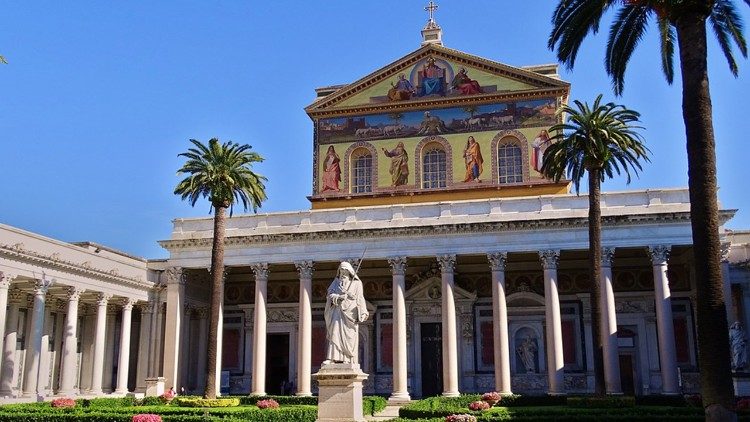
The Basilica of Saint Paul Outside the Walls, where scholars are meeting for a Colloquium on the Letters of St PaulThe Basilica of Saint Paul Outside the Walls, where scholars are meeting for a Colloquium on the Letters of St Paul 

Pope praises courageous, prophetic work of ecumenical scholars

Pope Francis meets with participants of the 26th Pauline Ecumenical Colloquium, and urges Biblical scholars to have confidence in God’s promises as a basis for fostering ecumenical dialogue.

By Christopher Wells

Pope Francis praised the work of an ecumenical group of scholars dedicated to the scriptural letters of St Paul, explaining that their “great contribution” is “the encounter between Christians who are diverse among themselves, yet united by the wisdom of Pauline teaching.”

In an address to participants of the 26th Pauline Ecumenical Colloquium, the Holy Father also emphasized the “rigorous and scholarly exegetical exchange” among academics that allows “the beauty of the Apostle’s letters and their importance for Christian and ecclesial life” to emerge.

A courageous and prophetic initiative

The Pope described the initiative as courageous in overcoming “barriers of defensiveness”; and prophetic in promoting a “healthy ‘impatience of the Spirit’” for fullness of unity and commitment to bearing witness.

“If throughout history divisions have been a source of suffering,” he said, “today we must commit ourselves to reversing course, moving forward on the paths of unity and fraternity, which begin precisely by praying, studying, and working together.”

God does not fail in His promises

Noting that Colloquium participants are focusing chapters 9-11 of St Paul’s Letter to the Romans, the Pope highlighted the “irrevocable” gifts and call of God described in Romans 11:29.

Here, he said, St Paul hands on to us a message of fundamental importance: "God does not fail in His promises of salvation and patiently carries them out, even through unexpected and surprising ways.”

Pope Francis said his support for the Colloquium’s work is based precisely on the foundation of our confidence in “the mercy and promises of God.”

While encouraging them to continue their fraternal and academic dialogue, he also invited them, “above all else,” to allow themselves “to be amazed by the countless spiritual resources contained in the Pauline letters, in order to offer Christian communities ‘new words’, able to communicate the Father’s merciful goodness, Christ’s newness of salvation and the Spirit’s renewing hope.”

He concluded with the hope that their work might foster “the ecumenical spirit” among believers, as an aid to “our common journey of seeking the Lord.”

Read the full text of the Pope's Address to Participants in the Twenty-sixth Pauline Ecumenical Colloquium.

Thursday, September 7, 2023

Pope Francis marks Italy's National Bible Week


Pope Francis with members of Italian BIblical AssociationPope Francis with members of Italian BIblical Association  (VATICAN MEDIA Divisione Foto)

Pope Francis: Christians need to be nourished with the Word of God

Pope Francis meets with members of the Italian Biblical Association and participants in Italy's National Bible Week, and calls for the Church to help the faithful draw closer to God through His Word.

By Deborah Castellano Lubov

Help nourish the faithful with the Word of God, especially at this decisive moment, where all must work together to promote Sacred Scripture.

Pope Francis gave this encouragement as he warmly greeted members of the Italian Biblical Association and professors of Sacred Scripture, gathered in Rome for Italy's 47th National Bible Week, whose theme this year is "Covenant and Alliances between Universalism and Particularism."

"Dear friends, go forth, go ahead in your mission to help God's people be nourished by the Word, so that the Bible may be increasingly the heritage of all," the Pope said.

Insisting that the Bible is "the book of the Lord's people, which upon listening to it, passes from dispersion and division, to unity," he said, "This is somewhat, always, the dynamic of the Lord: He sends and seems to disperse, but then He gathers in unity." 


The Pope told those before him that their theme this year is close to his heart and a major concern of the Church, and thanked them for analyzing covenants which closely involve the Church's relations with the contemporary world.

Working together in the service of the Word

Pope Francis pointed out that their meeting evoked another value he wished to emphasise, "that of working together in the service of the Word."

The Pope commended this being at the heart of a wide-ranging work of cooperation that the Bible Association offers, on a permanent basis, to the Church in Italy.

He recalled that the organization was one of the first theological associations in the country, still very present in the various dioceses, especially through the animation of Diocesan Bible weeks, which it supports in collaboration with the Biblical Apostolate of the Italian Bishops' Conference.

"I hope," the Pope insisted, "that this presence grows throughout the territory, avoiding all forms of elitism and preclusion."

“I hope that this presence grows throughout the territory, avoiding all forms of elitism and preclusion.”

Decisive moment requiring synergy

The Biblical Association, the Holy Father acknowledged, also works in collaboration with the Pontifical Biblical Institute, at a "decisive moment for the reform of the Pontifical Universities, where the alliance between academic institutions is not always easy."

"However," he continued, "for many of the Association's members, the Pontifical Biblical Institute remains the 'alma mater' that generated them to research and apostolate."

This, the Pope said, "offers an example of the synergy that urgently needs to be fostered, in Rome and elsewhere, between the various study institutes, not least to avoid running the risk of irreparable extinction."

The Holy Father concluded by imparting his Apostolic Blessing and asking them to remember him in their prayers.