Pope at Eucharistic Congress: Bread must be shared on the table of the world
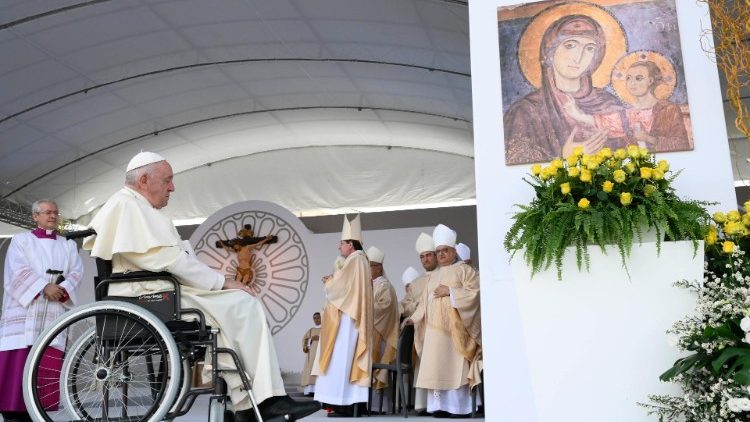
Pope Francis celebrates Holy Mass in the city of Matera at the conclusion of the 27th National Eucharistic Congress reminding Christians there is no eucharistic worship without compassion for the poor.
By Linda Bordoni
Pope Francis invited Christians to “return to the taste of bread to remember that while this earthly existence of ours is being consumed, the Eucharist anticipates the promise of resurrection and guides us towards the new life that conquers death.”
Speaking during the homily at Holy Mass to conclude the 27th National Eucharistic Congress in the southern Italian city of Matera on Sunday, the Pope reflected on the Gospel of Luke which tells of the rich man and the poor Lazarus who hoped, in vain, to be fed by the crumbs falling from the former’s table. (Lk 16, 19-31).
“The Gospel we have just heard tells us that bread is not always shared on the table of the world; it does not always emanate the fragrance of communion; it is not always broken in justice,” he said.
Inviting the faithful to reflect on the dramatic scene described by Jesus in this parable that presents us on the one hand with “a rich man dressed in purple garments and fine linen, flaunting his opulence and feasting lavishly,” and on the other with “a poor man, covered in sores, who lies at the door hoping to eat the crumbs that fall from that table,” the Pope said that faced with this contradiction, we must ask ourselves what the Sacrament of the Eucharist, “source and summit of a Christian's life” asks of us?
The primacy of God
First of all, he explained, the Eucharist reminds us of the primacy of God. The rich man in the parable is not open to a relationship with God: “he thinks only of his own well-being, of satisfying his needs, of enjoying life. He pleases himself and worships worldly wealth, he is closed in his own little world. Self-satisfied, drunk with money, dazed by vanity, there is no place in his life for God because he worships only himself.”
It is no coincidence, he continued, that we do not say his name: we call him 'rich' because his identity stems from the goods he possesses.
The Pope said this is a sad reality that we continue to see today “when we confuse what we are with what we have. When we judge people by their wealth, the titles they display, the roles they hold, or the lables on the clothes they wear.”
“It is the religion of having and appearing, which often dominates this world, but in the end leaves us empty-handed.”
On the contrary, Pope Francis continued, the poor man has a name: Lazarus, which means 'God will help'.
“Despite his condition of poverty and marginalisation, his dignity is intact because he lives in relationship with God. There is something of God in his very name, and God is the unshakeable hope of his life,” he said.
“Here then is the challenge that the Eucharist offers to our lives: to worship God and not oneself.”
Inviting the faithful to put Him at the centre, the Pope said that “if we worship ourselves, we die in the asphyxiation of our small selves; if we worship the riches of this world, they take possession of us and make us slaves; if we worship the god of appearances and inebriate ourselves in wastefulness, sooner or later life will present us with the bill.”
Instead, he added, when we adore the Lord Jesus present in the Eucharist, we also receive a new ‘look’ for our lives: “I am not the things I possess and the successes I manage to achieve; the value of my life does not depend on how much I can show off, nor does it diminish when I fail and fall.”
“I am a beloved child; I am blessed by God; He has clothed me with beauty and wants me to be free from all bondage. He who worships God does not become anyone’s slave.”
Love for our brothers and sisters
Besides the primacy of God, the Pope continued, the Eucharist calls us to love our brothers and sisters.
This Bread, he said, is the Sacrament of love. “It is Christ who offers himself and breaks himself for us and asks us to do the same.”
The rich man of the Gospel fails in this task and when at the end of his life, the Lord turns the tables, he finally notices Lazarus, but Abraham tells him: "Between us and you a great chasm is established." (Lk 16:26).
“Our eternal future depends on this present life: if we dig a chasm between ourselves and our brothers, we ‘dig our own grave’ for later,” Pope Francis explained.
“If we raise walls against our brothers now, we remain imprisoned in loneliness and death.”
The story of our time
The Pope decried the fact that this parable is still the story of our day: “the injustices, the inequalities, the unequal distribution of the earth's resources, the abuse of the powerful against the weak, the indifference to the cries of the poor, the abyss we dig every day generating marginalisation,” cannot , he said, “leave us indifferent.”
And he called on Christians to recognise that the Eucharist is the prophecy of a new world, it is the presence of Jesus that asks us to commit ourselves so that an effective conversion may take place: “from indifference to compassion, from waste to sharing, from selfishness to love, from individualism to fraternity.”
A Eucharistic Church
The Pope said a Eucharistic Church must be made up of women and men “who break as bread for all those who chew loneliness and poverty, for those who hunger for tenderness and compassion, for those whose lives are crumbling because the good leaven of hope has been lacking.”
It is a Church, he continued, that kneels before the Eucharist and worships the Lord present in the bread, but which “also knows how to bend with compassion before the wounds of those who suffer, lifting up the poor, wiping away the tears of those who suffer, making itself bread of hope and joy for all.”
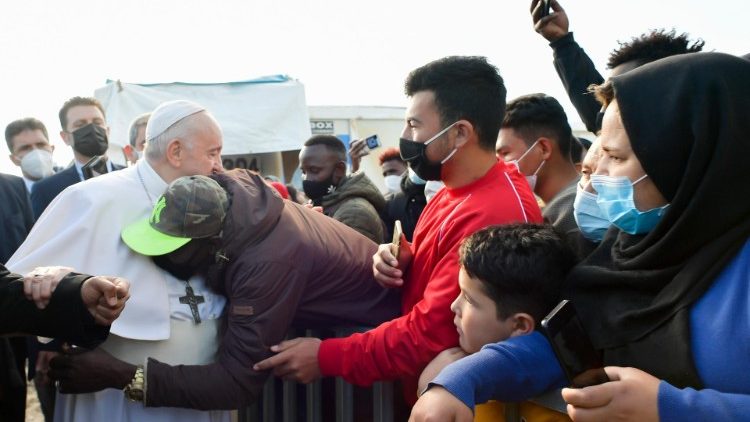
“There is no true Eucharistic worship without compassion for the many 'Lazarus' who even today, walk beside us.”
Echoing the theme of the Congress, Pope invited those present to “return to the taste of bread,” because while we are hungry for love and hope, or we are broken by the trials and sufferings of life, Jesus becomes food that feeds us and heals us.
Apostles of fraternity
“Let us return to the taste for bread, because while injustice and discrimination against the poor continue to take place in the world, Jesus gives us the Bread of Sharing and sends us out daily as apostles of fraternity, justice and peace,” he said.
“Let us return to the taste of bread to be a Eucharistic Church, which puts Jesus at the centre and becomes bread of tenderness and mercy for all.”
“Let us return to the taste of bread to remember that while this earthly existence of ours is being consumed, the Eucharist anticipates the promise of resurrection and guides us towards the new life that conquers death,” he said, inviting Christians to return to the taste of bread whenever hope fades and we feel the loneliness of the heart, inner weariness, the torment of sin, the fear of not succeeding.”
“Let us return to Jesus, let us adore Jesus, let us welcome Jesus. For He conquers death and always renews our life.”