reflections, updates and homilies from Deacon Mike Talbot inspired by the following words from my ordination: Receive the Gospel of Christ whose herald you have become. Believe what you read, teach what you believe and practice what you teach...
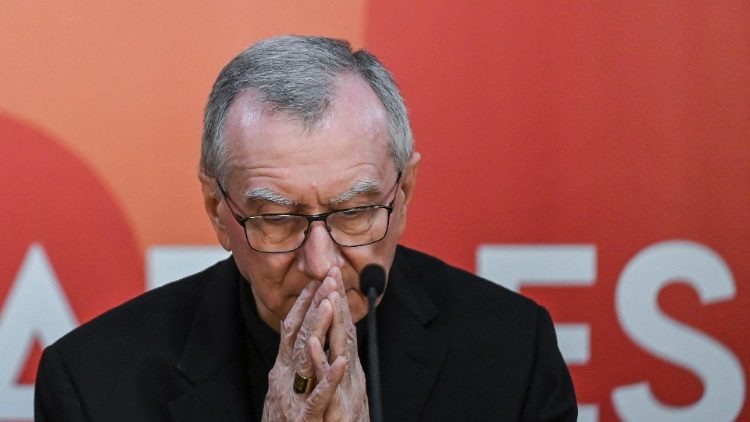
Cardinal Parolin: Europe cannot accept continued war of aggression in Ukraine
Cardinal Secretary of State Pietro Parolin calls for the Council of Europe to take action and establish “a definitive and just peace in Ukraine”.
By Devin Watkins
Heads of state and government from across Europe gathered at the 4th Summit of the Council of Europe, a two-day meeting in Reykjavík, Iceland.
Cardinal Secretary of State Pietro Parolin represented the Holy See at the Summit, since the Holy See enjoys observer status at the Council of Europe, an international organization that seeks to uphold human rights and the rule of law in Europe.
Peace project on the ropes
Speaking at the meeting on Wednesday, Cardinal Parolin offered Pope Francis’ greetings to the heads of state attending.
He noted that the official Declaration for the Summit describes the Council of Europe as “a peace project”.
However, he pointed out, citing the words of Pope Francis, the war in Ukraine shows that the “passionate quest of a politics of community and the strengthening of multilateral relations seems a wistful memory from a distant past.”
The Vatican’s Secretary of State therefore urged the European leaders to ask themselves: “Thinking not least of war-torn Ukraine, where are creative efforts for peace?”
Definitive and just peace in Ukraine
Continuing in the same vein, Cardinal Parolin said Europe must not forget the Ukrainian people who suffer and die.
“We cannot accept passively that the war of aggression in that tormented country continues,” he said.
Cardinal Secretary of State Parolin concluded his brief address to the Council of Europe Summit with an assurance that the Holy See will do its utmost to pursue peace across Europe and the world.
“This is the time to take action and establish a definitive and just peace in Ukraine, and in all the other so-called ‘grey’ areas of Europe,” he said.
Bishops from the five Nordic countries have released a letter on the traditional Christian teaching on sexuality, upholding the “embodied integrity of personhood” against modern transgender ideologies.
“Now, notions of what it is to be a human, and so a sexual being, are in flux. What is taken for granted today may be rejected tomorrow. Anyone who stakes much on passing theories risks being terribly hurt. We need deep roots,” the eight members of the Nordic bishops’ conference say in the letter, which was released Saturday.
“Let us, then, try to appropriate the fundamental principles of Christian anthropology while reaching out in friendship, with respect, to those who feel estranged by them,” they continue. “We owe it to the Lord, to ourselves, and to our world, to give an account of what we believe, and of why we believe it to be true.”
The pastoral letter is being read aloud at Masses this weekend at Catholic churches in Sweden, Norway, Finland, Denmark and Iceland. EWTN Norway provided CNA with a copy of the letter.
Cardinal Anders Arborelius, the bishop of Stockholm, Sweden, is among the document’s eight signers.
The others are: from Norway, Bishop Erik Varden of Trondheim, Bishop Berislav Grgić of Tromsø and Bishop Bernt Eidsvig of Oslo; from Denmark, Bishop Czeslaw Kozon of Copenhagen; from Iceland, Bishop Dávid Tencer of Reykjavik and Bishop Emeritus Pierre Bürcher of Reykjavik; and from Finland, Father Marco Pasinato, apostolic administrator of Helsinki.
“Our mission and task as bishops is to point towards the peaceful, life-giving path of Christ’s commandments, narrow at the outset but growing broader as we advance,” the bishops state in the letter.
“We would let you down if we offered less,“ the bishops say, adding, ”we were not ordained to preach little notions of our own.”
The bishops explain that there is room for everyone in the Church, which, according to a fourth-century text, is “the mercy of God descending on mankind.”
“This mercy excludes no one. But it sets a high ideal,” the letter states.
The pastoral letter begins by recalling the 40 days and nights of rain that flooded the Earth in the days of Noah.
It says that when Noah and his relatives stepped back onto the cleansed Earth, God made his first covenant with man, promising that a flood would never again destroy the Earth.
God asked mankind, instead, to revere God, to construct peace, and to be fruitful, the bishops said. To ratify the covenant, God created a sign: a rainbow.
“This covenantal sign, the rainbow, is claimed in our time as the symbol of a movement that is at once political and cultural,” the bishops note. “We recognize all that is noble in this movement’s aspirations. In so far as these speak of the dignity of all human beings and of their longing to be seen, we share them.”
“The Church,” the letter continues, “condemns unjust discrimination of any kind, also on the basis of gender or orientation. We declare dissent, however, when the movement puts forward a view of human nature that abstracts from the embodied integrity of personhood, as if physical gender were accidental.”
The bishops also say in the letter they protest that such a view is imposed on children as “not a daring hypothesis but a proven truth.”
Transgenderism is “imposed on minors as a heavy burden of self-determination for which they are not ready,” the bishops lament, calling it “curious” that in an intensely body-conscious society, the body is in fact taken too lightly.
People now refuse to see the body “as significant of identity, supposing that the only selfhood of consequence is the one produced by subjective self-perception, as we construct ourselves in our own image,” they observe.
The bishops explain that we are, instead, created in the image and likeness of God, in both body and soul.
“The image of God in human nature manifests itself in the complementarity of male and female,” the letter states. “Man and woman are created for one another: The commandment to be fruitful depends on this mutuality, sanctified in nuptial union.”
The letter goes on to say that the union of a man and a woman, as an image of God’s communion with mankind, is not always easy or painless.
“For some it seems an impossible option,” the bishops acknowledge. “More intimately, the integration within ourselves of masculine and feminine characteristics can be hard. The Church recognizes this. She wishes to embrace and console all who experience hardship.”
The Nordic bishops say they recognize that “the yearning for love and the search for sexual wholeness touch human beings intimately” and they want to be there to accompany everyone as they gradually grow in wisdom and virtue.
“We are called to become new women and men,” they say in the letter. “In all of us there are elements of chaos that need to be ordered. Sacramental communion presupposes coherently lived consent to the terms of the covenant sealed in Christ’s Blood.”
They point out that circumstances may mean, therefore, that a Catholic is unable to receive the sacraments for a time. But “he or she does not therefore cease to be a member of the Church. Experience of internal exile embraced in faith can lead to a deeper sense of belonging. Exiles often turn out that way in Scripture. Each of us has an exodus journey to make, but we do not walk alone.
The bishops’ letter also offers some advice to those who are perplexed by the traditional Christian teaching on sexuality.
“First: Try to acquaint yourself with Christ’s call and promise, to know him better through the Scriptures and in prayer, through the liturgy and study of the Church’s full teaching, not just of snippets here and there. Take part in the Church’s life,” the bishops counsel.
“Secondly,” they add, “consider the limitations of a purely secular discourse on sexuality. It needs to be enriched. We need adequate terms to speak of these important things.”
The Church, they say, “shall have a precious contribution to make if we recover the sacramental nature of sexuality in God’s plan, the beauty of Christian chastity, and the joy of friendship, which lets us see that great, freeing intimacy can be found also in non-sexual relationships.”
Nordic Bishops ‘concerned’ about German Church’s synodal path
The Bishops of Scandinavia send an open letter to the Bishops’ Conference of Germany, and express their ‘fraternal concern’ over the direction and content of the German Church’s synodal process.
By Devin Watkins
As the worldwide Church continues along the path toward the Synod of Bishops in 2023, representatives of the Church in Scandinavian countries have reached out to the Bishops of Germany to express their concern over the local synodal journey.
The Nordic Bishops sent those concerns to the President of the German Bishops’ Conference, Bishop Georg Bätzing, in an open letter at the conclusion of their Spring Plenary Assembly.
The Synod of Bishops, focusing on the theme of synodality, is currently in the diocesan phase of a 2-year journey which will conclude with a month-long meeting of Bishops in Rome in October 2023.
Strong bonds between German and Nordic Churches
The 8 Bishops from Sweden, Denmark, Norway, Finland, and Iceland noted the long-running ties between their Dioceses and Germany. They expressed their gratitude for the “strong bonds” uniting them, including the many German priest, bishops, and nuns who have served in Nordic countries following the Protestant Reformation.
At the same time, the Nordic Bishops said German Bishops risk reducing the Church to a visible communion at the expense of the “sacramental mystery.”
“The orientation, method and content of the Synodal Path of the Church in Germany fill us with worry.”
Concern for German Church direction
Bishop Erik Varden of Trondheim, in Norway, told Vatican News’ Charlotta Smeds that the Nordic Bishops felt called to offer their thoughts on the direction the German Church is taking with the Synod on synodality.
“We simply wanted to express our anxiety and conviction that in order to make ourselves receptive to a newness of grace and a newness of life in the Church, what is needed is not simply deliberations and countless conversations, or majority votes, but also a rediscovery of the profound sacramental mystery of the Church,” said Bishop Varden.
Church both pilgrim people and mystical body
In their statement, the Nordic Bishops said they are worried the Church in Germany is focusing excessively on the image of the pilgrim People of God, almost at the expense of other theological conceptions of the Church, such as the Church as “corpus mysticum, as Bride of Christ, and as mediatrix of graces.”
Bishop Varden said the synodal path cannot forget that “the Church is not only the People of God on pilgrimage—which needs to be organized sensibly and needs an organized route map—but is also the mystical body and the Bride of Christ.”
The statement recalled that the Church is also a “mystery of communion: communion of humankind with the Triune God; communion among the faithful; communion of all the particular Churches with the Successor of Peter.”
Defending Catholic theology against spirit of the world
The Nordic Bishops pointed out that true reforms in the Church have always “set out from Catholic teaching founded on divine Revelation and authentic Tradition.”
Reform, they added, must always defend Catholic teaching and never “capitulate to the Zeitgeist” (‘spirit of the age’ – an 18th-century philosophical idea typically associated with Georg Hegel).
The Bishops called on the German Church to not focus only on structural change and thereby turn the Church into “a project, the object of our agency."
Rather, the Nordic Bishops said the Church’s life must be “rooted in Christ”.
“Only if we live out of the fullness of [Christ’s] revelation shall we measure up to this vocation. We can hardly expect a new fullness of Catholic vitality to follow from impoverishment of the content of our faith.”
Rich legacy for real renewal
Bishop Varden noted that the German Church has a “rich legacy of sanctity, of intelligent reflection, of tremendous contributions to theology, and pastoral charity”.
That legacy, he added, gives the German Church all the resources needed to “effect a real renewal.”
The Scandinavian Bishops’ letter to their German brothers, concluded Bishop Varden, was “a statement of solidarity but also of some fraternal concern.”