Showing posts with label General Assembly - Synod. Show all posts

Tuesday, October 8, 2024

Day 5 (Monday) recap at the Synod General Assembly


Synod Briefing - Day 5: Embracing pain of people suffering from war

The press briefing on day 5 of the Synod General Assembly reveals that participants marked the Day of Prayer and Fasting for Peace with a special moment dedicated to the first anniversary of Hamas’ brutal attack on Israel and the subsequent escalation, highlighted the role of women in the Church, and focused on building bridges.

By Tiziana Campisi and Giampaolo Mattei

Monday morning’s Synod sessions, with 351 participants, “were preceded by a prayer and a moment of heartfelt participation in the suffering of people in the Middle East due to war, on a day, October 7, that is dramatically symbolic.”

Paolo Ruffini, the Prefect of the Dicastery for Communication, announced this during a briefing for journalists. He also noted that Pope Francis had sent a letter to Catholics in the Middle East “on this sad day.”

Furthermore, Dr. Ruffini shared that Cardinal Grech reminded the Synod participants that Monday was “a day of prayer and fasting,” at the Pope’s request, following Sunday evening's Rosary for Peace at the Basilica of St. Mary Major. 

Dr. Ruffini reported that Cardinal Konrad Krajewski, the Papal Almoner, announced a fundraising effort beginning in the afternoon. It will specifically provide support for the only Catholic parish in Gaza and its priest, Fr. Gabriel Romanelli, “whom the Pope calls every day to express his closeness to those who suffer.”

9 of the 21 new cardinals announced by the Pope on Sunday will take part in this initiative. They are: Luis Gerardo Cabrera Herrera, Tarcisio Isao Kikuchi, Pablo Virgilio Siongco David, Ladislav Nemet, Jaime Spengler, Ignace Bessi Dogbo, Dominique Mathieu, Roberto Repole, and Timothy Peter Joseph Radcliffe.

The work of the Synodal Assembly

The fourth General Congregation is scheduled for Tuesday, Sheila Pires, secretary of the Information Commission, announced.

“The assembly plans to elect members for the drafting committee of the Final Document, according to Article 13 of the internal regulations. Reports from the language tables will then be presented,” she said.

Following the model already adopted in the first week, Synod members will vote on the agenda for discussion, and the day will continue with open discussions.

Ms. Pires noted the first two forums on pastoral theology are scheduled for Wednesday afternoon on the topics: “The People of God, Subject of the Mission” and “The Role and Authority of the Bishop in a Synodal Church.”

The Synodal journey in Asia

The Church must build bridges and be a bridge itself. This means attention must be given to diverse cultures and religions, cultivating dialogue and synodality.

Cardinal Oswald Gracias, Archbishop of Bombay, expressed this affirmation. He is a member of the ordinary council of the Synod Secretariat, the Council of Cardinals, and the working group Pope Francis established at the beginning of his pontificate to assist in governing the Church.

During Monday’s briefing, the Cardinal emphasized that advancing in synodality requires interculturality. He added that since the Second Vatican Council, acceptance and respect for others are widely established concepts.

Cardinal Gracias used the example of the synodal journey in Asia, where an assembly in 2022 addressed topics that are currently being discussed at the Synod, noting the need to renew pastoral practices.

Two key points were working and walking together. The Cardinal explained it is essential to build the Kingdom of God in countries with diverse local cultures—but not by proselytizing—differences must be valued. A synodal approach is necessary to avoid imposing notions or concepts.


Furthering fraternity

In Asia, meetings continued until 2023, when two hundred bishops gathered to discuss respect for religions, lay movements, and the baptismal consecration of each individual.

Cardinal Gracias insisted collaboration is crucial to relationships with other faiths, saying the Church "can no longer call them other religions, but neighboring religions.”

The bishops in Asia also acknowledged the importance of the digital world and see the Synod as a continuation of their work. “I am sure that things will get better,” the Cardinal continued, “and that there will be more fraternity and love for the Church.”

One family

During the briefing, Archbishop Gintaras Grušas, President of the Council of European Bishops' Conferences and Archbishop of Vilnius, focused on how the day of prayer and fasting for world peace was highlighted in the synodal assembly on Monday morning.

He explained the solidarity with those suffering from the effects of war–like in the Middle East and Ukraine–fosters the experience that “we are all one family that prays for peace and unity.”

The Archbishop emphasized the need to strengthen ties between Churches saying, “having dialogue is our mission.” 

An increasingly attentive listening

Reciprocal listening is a skill that is growing in the Synod, Sister Mary Teresa Barron, President of the International Union of Superiors General (UISG), observed.

She believes the capacity to listen to one another has also improved, allowing for greater discernment of others’ beliefs. Listening brings people closer to those who are excluded and marginalized.

For its part, UISG, as a synodal initiative, has established an office dedicated to synodality, with an intercultural group focused on prioritizing listening and relationships to build better ones. Above all, the aim is to help those on the peripheries, Sr. Barron clarified, focusing particularly on how to continue the synodal journey in Syria, Lebanon, Russia, Ukraine, Vietnam, Myanmar, and Indonesia.

She was asked what space women can have in the Church today, and responded saying, “There are many possibilities and leadership opportunities, but they need to be explored and assessed.”

She stated it differs in practice because in some countries there may be women leaders in the Church and in others not, but the focus is not on ordained ministry. And while it is true that there are women who feel called to the priesthood, this area touches on broader themes like the call of the Holy Spirit to ministries, which is not the topic of this Synod.

However, Cardinal Gracias noted women are at the center of attention in the Church, reporting that in the last three councils of cardinals, the role of women in the Church was discussed from a theological and pastoral perspective.

Regarding ministries, charisms, and vocations, Archbishop Grušas noted the roles of the laity and families can be expressed differently in various places, and therefore, the roles of men and women must be appropriately valued.

Questions were then raised about the study group regarding the appointment of bishops, and Cardinal Gracias clarified that there are two groups focused on the bishop's role, one on the role itself and the other on the appointment process.

“The figure of the bishop is fundamental for the Church, and his appointment should be made in the best way possible,” the Cardinal affirmed, clarifying the two groups have begun to collaborate in this vital and important area for the Church.

Wednesday, October 2, 2024

Pope opens Synod General Assembly with Holy Mass in St Peter's Square


Pope Francis delivers his homily during Holy Mass for the feast of the Holy Guardian AngelsPope Francis delivers his homily during Holy Mass for the feast of the Holy Guardian Angels

Pope opens Synod General Assembly with Mass in St Peter’s Square

In his homily during Mass for the Solemn Inauguration of the Second Session of the 16th General Assembly of the Synod of Bishops, Pope Francis emphasizes the need for hearts open to dialogue and the importance of the harmony that comes from the Holy Spirit.

By Christopher Wells

Pope Francis’ homily for the opening Mass of the General Assembly of the Synod focused on the images of “voice, refuge, and a child”.

In his reflection for the feast of the Holy Guardian Angels, the Pope recalled God’s command “to listen to the voice of the Angel He had sent.”

Striving to understand the path

As the Church continues to journey along the synodal path, he said , “the Lord places in our hands the history, dreams, and hopes of a great people,” the Church spread throughout the world. He invited participants to “strive to understand the path we must follow to reach the destination the Lord desires for us.”

In order to remove obstacles to the harmony intended by the Holy Spirit, the Pope continued, we must be open to the contributions of all, in order to hear the voice of God.

A welcoming embrace, a place of refuge

With the concept of refuge, Pope Francis said protecting wings of the angel of God becomes “a symbol of what God does for us, and also a model for us to follow.” The gifts of each one are a great richness to the whole Church; but at the same time, we must be willing to reach out to one another, offering one another “a welcoming embrace and a place of refuge.”

“The more we realise that wear are surrounded by friends who love, respect, and appreciate us,” he said, “friends who want to listen to what we have to say, the more we will feel free to express ourselves spontaneously and openly.”

Like a little child

Finally, the Holy Father invoked the image of “a child,” like the one Jesus placed before the disciples, “inviting them to convert and be small like him.”

The paradox of the greatest in heaven being that one who becomes little, like a child, “is fundamental for us,” the Pope said. Although the Synod necessarily deals with great and important issues, “it is precisely for this reason that we must not lose sight of the child, whom Jesus continues to place at the centre of our meetings and work tables.”

Guided "by the breeze of the Spirit

“Brothers and sisters,” Pope Francis said in conclusion, “let us resume this ecclesial journey with an eye to the world, for the Christian community is always at the service of humanity, to proclaim the joy of the Gospel to all.”

And finally, after announcing his intention to lead the public recitation of the Rosary on Sunday to implore the Virgin Mary for the gift of peace; and proclaiming a day of prayer and fasting the next day for peace in the world, Pope Francis enjoined the faithful to continue to “journey together,” listening to the Lord and allowing ourselves “to be guided by the breeze of the Spirit.”

Friday, July 7, 2023

Bishops and many non-Bishops named to the Synod's General Assembly


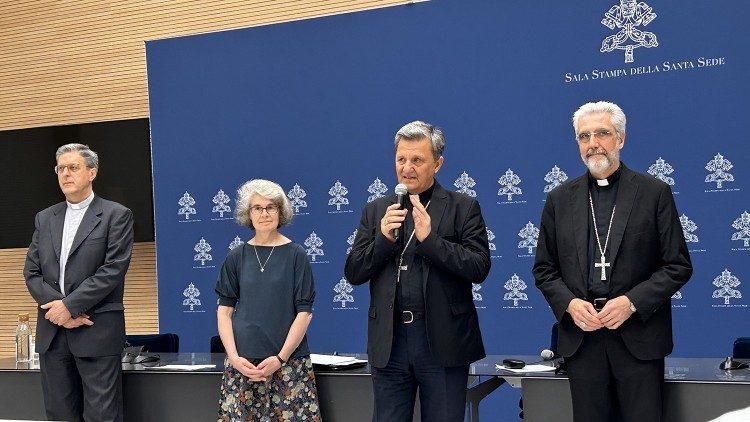
The conference at the Holy See Press OfficeThe conference at the Holy See Press Office 

Vatican releases list of participants in October Synod

Ahead of the October General Assembly of the Synod on Synodality, the Vatican unveils the list of participants which – for the first time – contains non-bishops.

By Joseph Tulloch

The General Secretariat of the Synod has unveiled the list of participants in the upcoming October synodal Assembly.

For the first time, non-bishops are among the list of attendees (which can be found here, in Italian).

Many of the non-bishop participants (who are a minority, at around 21%), were proposed by bishops’ conferences around the world, before being approved by Pope Francis. Others were appointed directly by the Pope.  

Prominent names from around the English-speaking world include Cardinal Oswald Gracias, Archbishop of Bombay; Professor Anna Rowlands, a theologian at Durham University in the United Kingdom; and US-based writer and commentator Fr James Martin, SJ.

A “mixture” of the People of God

Speaking at a press conference in the Vatican, Cardinal Grech stressed that the delegates had been selected so as to produce a “mixture” from various parts of the Church.

Most obviously, there will be an even mix of participants from six different continents, and the non-bishop members will be evenly divided by gender. Cardinal Grech also stressed, however, that there will be representatives from the various sui juris Eastern Catholic churches, and that an effort was made to include disabled Catholics too.

Cardinal Grech went on to explain that not everyone named on the list will be a “member”, and thus able to participate in discussions at the Assembly and vote on proposals. Those in section B on the list, the “Special Envoys”, will be able to discuss but not to vote, while those in section C, the “Other Participants”, will play a role in facilitating and or/advising on the process, but will neither intervene nor vote in discussions. 

The Cardinal also highlighted, finally, that the list of participants is not final – the lists of delegates from other Christian churches are still to arrive, and some names will likely be changed if members fall ill ahead of the assembly.

Spirituality and ecumenism

Next to speak was Bishop Luis Marín de San Martín, Undersecretary of the Synod, who highlighted that the upcoming assembly is not an isolated event, but rather part of a continual process.

The Spanish Bishop also stressed the synod’s spiritual dimension, pointing out that all participants will attend a three-day retreat together beforehand.

The Synod’s other Undersecretary, Sr Nathalie Becquart, noted that one of the central points to emerge from the synodal consultations was the importance of involving young people in the process. For this reason, she said, Synod organisers would be present at the upcoming World Youth Day in Lisbon, where they will have a stand.

Sr Becquart also stressed the importance of the interreligious dimension of the assembly. She highlighted in particular the ecumenical prayer vigil to be held in St Peter’s Square, entitled “Together –  Gathering of the People of God” and led by the Pope, together with the leaders of many other Christian churches.