On the 400th anniversary of the death of the Saint Francis de Sales, Pope Francis issues an Apostolic Letter entitled ‘Totum amoris est’ (‘Everything Pertains to Love’), in which he recalls how the Doctor of the Church was able to help people seek God in charity, joy and freedom in an era of great changes.
By Alessandro Di Bussolo and Vatican News staff reporter
A fine “interpreter" of his time, who in a new way had "a thirst for God," and was an "extraordinary director of souls," capable of helping people seek the Lord in their hearts and find Him in charity.
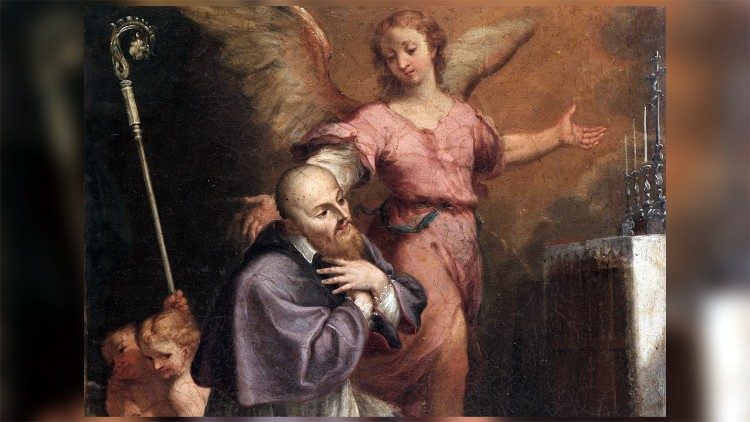
This is how Pope Francis describes St. Francis de Sales in his Apostolic Letter ‘Totum amoris est’, (‘Everything Pertains to Love’) written on the occasion of the fourth centenary of the death of the Doctor of the Church, Patron of journalists and communicators, and "exiled" Bishop of Geneva.
The Pope highlights that the great vocation of this French saint, who was born in the castle of Sales, in Savoy, on 21 August 1567, and died in Lyon on 28 December 1622, was that of asking himself "in every situation in life where the greatest love is to be found."
It is, therefore, not surprising, notes Pope Francis, that Pope St. John Paul II called him a "Doctor of Divine Love," not only for having written “a weighty Treatise on that subject, but first and foremost because he was an outstanding witness to that love”.
In changing times, new opportunities for proclamation of the Gospel
The Pope explains that, reflecting on "the legacy of Saint Francis de Sales for our time”, he found his “flexibility and his far-sighted vision” enlightening.
In early 17th-century Paris, the saintly bishop Pope Emeritus Benedict XVI once called “an apostle, preacher, writer, a man of action and of prayer”, “perceived clearly that the times were changing”. He might “never have imagined that those changes represented so great an opportunity for the preaching of the Gospel. The word of God that he had loved from his youth now opened up before him new and unexpected horizons in a rapidly changing world.”
“That same task,” says the Pope, “awaits us in our own age of epochal change.”
“We are challenged to be a Church that is outward-looking and free of all worldliness, even as we live in this world, share people’s lives and journey with them in attentive listening and acceptance. That is what Francis de Sales did when he discerned the events of his times with the help of God’s grace. Today he bids us set aside undue concern for ourselves, for our structures and for what society thinks about us, and consider instead the real spiritual needs and expectations of our people.”
Seeking God in the heart and in history
According to Saint Francis de Sales, the Pope explains, the experience of God “is intrinsic to the human heart”.
This idea, underpinning his entire life “centered on God”, is explained with "simplicity and precision" in the "Treatise", and specifically with these words: “At the very thought of God, one immediately feels a certain delightful emotion of the heart, which testifies that God is God of the human heart.”
These words are the synthesis of his thought: “It is in the heart and through the heart”, the Pope writes , “that we come to know God and, at the same time, ourselves, our own origins and depths, and our fulfilment in the call to love”. Thus, we discover that faith is not " a passive and emotionless abandonment to a doctrine stripped of the flesh and history”, but is "first and foremost an attitude of the heart" , that is born from the contemplation of the life of Jesus.
“At the school of the Incarnation, he had learned to interpret history and to approach life with confidence and trust.”
Testing love through discernment
St Francis de Sales, the Pope notes, “had come to realize that desire is at the root of all true spiritual life, but also the cause of its debasement”. For this reason, he “recognized the importance of constantly testing desire through the exercise of discernment” and found the “ultimate criterion for this assessment in love”, in asking himself "in every situation in life where the greatest love is to be found."
A theology immersed in prayer and community
According to Pope Francis, the Saint’s reflection on spiritual life is “of outstanding theological importance”, for it embodies two “essential dimensions of any genuine theology”.
The first one is the spiritual life itself, because “theologians emerge from the crucible of prayer”. The second dimension regards “the ability to think in the Church and with the Church”, as Christian theologians are called to carry out their work “immersed in the life of the community”.
He wrote important spiritual works, such as the ‘Introduction to the Devout Life’ and the ‘Treatise on the Love of God’, and thousands of letters sent to convents, to men and women in royal courts court, as well as ordinary people.
A new style, under the banner of optimism
In his spiritual direction, - the Pope explains - St Francis de Sales speaks in a new way, using a different method, “that renounced all harshness and respected completely the dignity and gifts of a devout soul, whatever its frailties”.
In this approach, the Letter notes , we can find 'the Salesian optimism', a lasting mark in the history of spirituality which flourished with Saint John Bosco some two centuries later.
Towards the end of his life, this is how he saw his time: “The world is becoming so delicate that, in a little while, no one will dare any longer to touch it except with velvet gloves, or tend its wounds except with perfumed bandages; yet what does it matter, if only men and women are healed and finally saved? Charity, our queen, does everything for her children.”
This, the Pope remarks “was no pious platitude or an expression of resignation in the face of defeat”. Rather, “it was a realization that the world was changing and the mark of a completely evangelical sense of the need to respond to those changes”.
A man of dialogue
Thus, even when confronting Protestants, “he came to realize increasingly, along with the need for theological discussion, the effectiveness of personal relationships and charity. He was a "skillful controversialist" when discussing with Calvinists , but also a man of dialogue, an inventor of original pastoral practices, such as the famous 'flying papers', hung everywhere and even slipped under the doors of houses. And this is the reason why he was chosen as the patron saint of journalists.
No imposition
The second part of the Apostolic Letter looks into the legacy of St Francis de Sales for our times, revisiting some of “the crucial decisions he made, so that we for our part can respond to today’s changes with the wisdom born of the Gospel”.
The first of those decisions was to “reinterpret and propose anew to each man and woman. the beauty of our relationship with God”.
Divine Providence draws our hearts to God’s love, he writes, without any imposition, “chains of iron”, but “by invitations, enticements and holy inspirations”. This “persuasiveness - the Pope notes - respects our human freedom.”
The second crucial choice of Saint Francis made was to approach the issue of devotion. Here too, as in our own days, the dawning of a new age had raised a number of questions.
At the beginning of the ‘Introduction to the Devout Life’, the saintly bishop clarifies the meaning of devotion, noting that “Unless you can distinguish true devotion, you can fall into error and waste your time running after some useless and superstitious devotion”.
The French saint cites several examples of false devotion: from those who consecrate their lives to fasting and believe they are devout because they don’t eat or drink, “but will not scruple to drench their tongues in the blood of theirs neighbours through gossip and slander”, to those who “mumble a string of prayers, yet remain heedless of the evil, arrogant and hurtful”. There are also those who willing to give alms to the poor, but cannot wring an ounce of mercy from their hearts to forgive his enemies.
True devotion, on the other hand, says St Francis de Sales, is “none other than a genuine love of God a manifestation of charity, therefore far from being “something abstract”, Pope Francis clarifies.
This is why, “Those who think that devotion is restricted to some quiet and secluded setting are greatly mistaken”: “Devotion is meant for everyone, in every situation, and each of us can practise it in accordance with our own vocation”, Pope Francis stresses.
“To live in the midst of the secular city while nurturing the interior life, to combine the desire for perfection with every state of life, and to discover an interior peace that does not separate us from the world but teaches us how to live in it and to appreciate it, but also to maintain a proper detachment from it. That was the aim of Francis de Sales, and it remains a valuable lesson for men and women in our own time.”
Christian life is discovering the joy of loving
In the last part of the letter, entitled "The Ecstasy of Life", Pope Francis summarizes his thoughts on the life of St Francis de Sales by remarking that “those who think they are rising to God, yet fail to love their neighbour, are deceiving both themselves and others”.
Instead, Christian life is discovering the joy of loving and "the source of this love that attracts the heart is the life of Jesus Christ" who gave his life for us.
“Saint Francis de Sales, then, while the Christian life is never without ecstasy, ecstasy is inauthentic apart from a truly Christian life. Indeed, life without ecstasy risks being reduced to blind obedience, a Gospel bereft of joy. On the other hand, ecstasy without life easily falls prey to the illusions and deceptions of the Evil one. The great polarities of the Christian life cannot be resolved and eliminated. If anything, each preserves the authenticity of the other. Truth, then, does not exist without justice, pleasure without responsibility, spontaneity without law, and vice versa.”