Showing posts with label Fr. Francesco Patton. Show all posts

Wednesday, April 1, 2026

Good Friday Stations of the Cross meditations


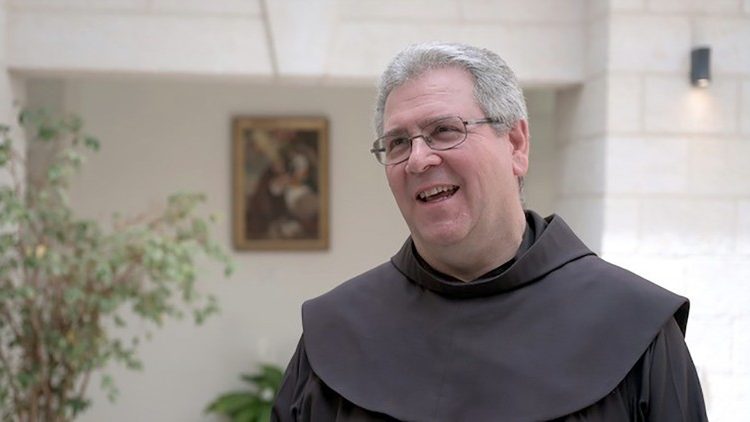
File photo of Fr. Francesco PattonFile photo of Fr. Francesco Patton  (AFP or licensors)

Fr. Patton: Good Friday meditations are not to judge, but to inspire change

Father Francesco Patton, author of the meditations for the Pope's Good Friday 'Via Crucis' at the Colosseum in Rome, notes that even today, many people are living a Way of the Cross.

By Roberto Cetera

“In the reflections and prayers, the inspiration from current reality and from concrete people is evident,” particularly from the sufferings of Christians in the Middle East due to the war.

In this way, Father Francesco Patton of the Order of Friars Minor, summarized the origin of the meditations written for the Way of the Cross that will be presided over by Pope Leo XIV at the Colosseum on Good Friday evening.

In the following interview with Vatican News, Fr. Patton, who served as the Custos of the Holy Land from 2016 until June 2025, explained how the Pope’s choice coincided with the eighth centenary of the death of St. Francis of Assisi.

Q: Father Patton, the Pope entrusted you with the writing of the meditations that will accompany the Good Friday Way of the Cross at the Colosseum. Is this an unequivocal sign of the Holy Father’s attention to the Holy Land and the tragedies afflicting the countries of the Middle East?

Since the day of his election, Pope Leo XIV has continuously invoked the gift of peace. He has expressed closeness and solidarity not only to the Holy Land but to all countries, peoples, and individuals suffering because of war.

This, after all, has been the Church’s line for over 100 years, since August 1, 1917, when Pope Benedict XV refused to bless the armies, defined the war being fought as an “useless slaughter,” and urged the leaders of the belligerent nations to reach a just and lasting peace through negotiation, respect for international law, the return of occupied territories, restoration of free movement, and disarmament to free resources to be invested in the common good and development.

Since then, the Church has always expressed closeness to populations devastated by war and repeatedly condemned armed conflicts, which continue to be an “useless slaughter.” Almost every Sunday after the Angelus and every Wednesday at the end of his catechesis at the General Audience, Pope Leo XIV has insisted on the necessity of achieving peace, not only in the Holy Land but in all countries currently involved in bloody wars.

Last Sunday, he used very strong words to reject violence perpetrated in the name of God, saying that God does not listen to the prayers of warmongers with hands stained with blood.

Q: I imagine receiving this invitation was a surprise for you.

A very big surprise, I would say. I was concretely contacted by the Secretariat of State, which told me that the Holy Father, in conjunction with the eighth centenary of the death of Saint Francis of Assisi, had instructed them to ask me to prepare the meditations.

The matter intimidated me but at the same time honored me.

Q: What inspired you most while writing these meditations?

I took inspiration from the Gospel texts, favoring the Evangelist St. John, who has a penetrating view of the mystery of the Lord’s Passion; and then from the “Writings” of Saint Francis, which are a treasure trove of Christian spirituality. In the reflections and prayers, it is evident that the inspiration also comes from current reality and from concrete people in whom, over these years, I have been able to see the characters of the Way of the Cross.

Where I speak about the suffering of mothers and women, women appear in watermark who have also been written about in L’Osservatore Romano and who today embody the figure of Mary, Veronica, and the women of Jerusalem.

Behind the reflection on the distorted conception of power and abuse of power there are international news events that are before everyone’s eyes; the Cyrenean has the face of many volunteers and humanitarian and communication workers whom I have met over these years and who risked their lives to care for someone or to make the truth known, without even being Christians.

The concrete situations named in the reflections do not want to trigger judgment on individual persons, but invite reflection, asking questions and — if necessary — even to change. The message is essentially religious and wants to express the closeness of Jesus Christ, as the incarnate Son of God, to every human person.

I tried to make the Way of the Cross at the Colosseum inspired by the Way of the Cross that we make every Friday along the Via Dolorosa and at the same time draw from the spirituality of Saint Francis to help believers “walk in the footsteps of Jesus” and non-believers discover that Jesus cares about each of us, and that in Him one can find hope and a reason for life even if it has been lost.

My desire is that, by encountering Jesus Christ and walking behind Him toward Calvary, every person may perceive His closeness and His love; perceive that Jesus Christ gave His life for each of us and wants to bring each of us “back to the Father” together with Him, to find life in its fullness thanks to Him and to live the human condition, which is finite and mortal, with the horizon of Easter, Resurrection, eternal life, and participation in God’s very life.

Q: Father Francesco, your custodial mandate has crossed through nine years of very serious events: the civil war in Syria, Covid, the war in Gaza. Now, at the end of your assignment, you have decided to remain as a simple friar in the Holy Land, on the mountain from which Moses could only see it. Why did you choose Mount Nebo?

More precisely, I offered my availability to live on Mount Nebo.After so many years spent in positions of authority and governance, I felt the need to return to living as a simple Minor Friar. Living in a small, somewhat peripheral fraternity allows me to recover a more regular rhythm of prayer, resume studying, serve pilgrims, and perform humble services.

Also, Mount Nebo has always had a great appeal to me, both because it is linked to the figure of Saint Moses, which is extraordinarily rich and that I like to deepen, and because this place was for centuries a Byzantine monastery and sanctuary, then swallowed up by historical events and left in ruins, and finally reborn a hundred years ago thanks to the friars of the Custody of the Holy Land, who here in Jordan were able to befriend the Bedouin family who owned it and who, after selling the site to the Custody in 1932, remained collaborating with us.

It is a meeting place for everyone and with everyone, frequented by Christians and Muslims alike, where all can breathe that climate of faith and peace it transmits, and where all can obtain “healing of body and soul,” as a pilgrim of the 5th century said.

Q: Christians in the Holy Land live a daily Way of the Cross, whose outcome increasingly is migration. How can one be the salt of the earth under those conditions?

It is very difficult, but not impossible. Christians living today in the Holy Land are very similar to the first generation of Christians; they have the same virtues and the same limits, and probably the same DNA. In any case, if 2000 years ago Jesus said to the few disciples He had: “Do not fear, little flock, for it has pleased your Father to give you the Hingdom’s mysteries,” it is because even then the disciples were statistically insignificant but had discovered the true meaning of life, that revealed by Jesus in the Sermon on the Mount, culminating in the Beatitudes, forgiveness of enemies, and mercy; that revealed through welcoming children, women, the poor, the sick, but also tax collectors, sinners, and prostitutes; that revealed by washing the feet of His own, then giving His life and conquering death for us.

Being Christians in the Holy Land — but in all parts of the world where Christians are few and/or persecuted — is a vocation and a mission: we are called to show the merciful face of God who welcomes every person without distinction of gender, nationality, or religion; and we are called — even in this way — to reveal the filial dignity of being created in the image and likeness of God that every person has, even those belonging to another people, even those who have erred, even those who have harmed me.

Q: Religions as instruments of peace. Yet, wars in the Middle East, unlike in past decades, increasingly have a religious reference. Even Israel, born in a secular Western-style context, today seems prey to a messianic fundamentalism. What happened?

What happened is what happened elsewhere, especially after the fall of the Berlin Wall: secular ideologies fell, and those in power began to exploit religions to create identities and opposition. We could say that the “zealots,” who at Jesus’ time justified violence in God’s name, have come back into fashion.

Today, “zealots” are everywhere: we find them in the Muslim world through a galaxy of armed fundamentalist movements; we find them in the Jewish world, well represented by settlers and those who politically support them locally and internationally; we also find them among Christians, who unfortunately invoke strange blessings going in the opposite direction to that indicated last Sunday by Pope Leo XIV and 2,000 years ago by Jesus in Gethsemane; we even find them in secular form in state laicisms that censor religious expressions in a discriminatory and persecutory way.

What is happening in Israel is not an anomaly but a global trend. In this context, the Church has a very important role to play, that of reiterating some evangelical cornerstones: one must give to Caesar what is Caesar’s but to God what is God’s.

This means desacralizing and secularizing political power while guaranteeing religious freedom for all. It is necessary to remove the ground from under both religious fundamentalism and the political exploitation of religion.

To do this, religious leaders of all religions must be convinced to cooperate in delegitimizing any exploitation of religion to justify violence. The principles laid down in the Document on Human Fraternity signed in Abu Dhabi by Pope Francis and the Grand Imam of Al-Azhar, and received in the encyclical Fratelli tutti, would be an excellent starting point for a kind of “UN” of religions.

Obviously, it is also necessary to educate the faithful in this perspective, knowing well that the “zealots” will strongly oppose this, citing religious reasons themselves.

Q: The Israeli-Palestinian conflict has lasted for 80 years now. 95% of today’s combatants have never known peace. I ask you very simply: will there ever be peace in the Holy Land?

Sooner or later there will be, inevitably, but the path will still be long; it will require a generational change, a change of political class (hoping not to go from the frying pan into the fire), and above all a cultural change. Today — unfortunately — there are no true prophets or men with a vision, but this is not a problem only in Israel and Palestine or the Middle East; it is a global problem. There are nonetheless positive signs in civil society.

I think of the movement started by the Israeli Maoz Inon and the Palestinian Aziz Abu Sarah, or the “Mothers Who Walk Barefoot for Peace,” or the “Women of Faith for Peace,” and many other small groups that are hoped to grow.

Our own schools are an example of education towards coexistence and fraternity. As I have repeatedly said over these years, there is also a political responsibility to introduce in the school system compulsory programs of education for respect and welcoming of the other, for conflict management and peace, following the model of what is done at Rondine, the citadel of peace in the Arezzo area. This is not only true for Israel and Palestine but also for European countries.

Thursday, August 15, 2024

From the beleaguered Holy Land, praises for Mary as model of peace


Assumption of the Blessed MotherAssumption of the Blessed Mother  ( (foto © Custodia di Terra Santa))

Custos of the Holy Land praises Mary as model of peace

On the Solemnity of the Assumption of the Blessed Virgin Mary, the Custos of the Holy Land, Father Francesco Patton, leads Mass at the Mount of Olives in Jerusalem, and urges the congregation to ask for the gift of peace in the Middle East.

By Adriana Masotti

Father Francesco Patton, the Custos of the Holy Land, celebrated Mass this morning, August 15th, the Solemnity of the Assumption, in the Basilica of the Agony on the Mount of Olives in Jerusalem, and his homily reflected the dramatic circumstances his land has been enduring for the past ten months. His prayer addressed to Blessed Mother on her Solemnity was one for peace and for "a humanity finally reconciled."

Evil one's attempt to sabotage 

Father Patton recalled the Passage from Revelation that the Church re-proposes every year on this occasion, namely the vision in heaven of the woman who in the desert, is about to give birth to her child, which is contrasted by a dragon, endowed with a violent and terrible but still limited destructive force, ready to devour the newborn.

The Custos acknowledged that there are many interpretations, as he recognized that the woman is the image of the Church, but also of the Virgin Mary. While in the figure of the dragon, he continued, we see "evil in all its personifications and with all the names by which it has been called."

The struggle described by St. John in the Biblical account between the woman and the dragon, he said, is nothing other than the description of the "continuous attempt that the Evil One makes to sabotage the birth of that new world willed by God," the birth of "a humanity no longer enslaved by violence, war, the market, cultural colonisation, the commodification of people."

Mary as a prophecy of our ultimate destiny

In Mary assumed into Heaven in both soul and body, the Custos of the Holy Land continued, we also catch a glimpse into our ultimate destiny, which is not "to be dragged down and overwhelmed by conflicts," but, instead, he marveled, "to be lifted up toward God and toward the new Jerusalem where there is room for all peoples, languages, and cultures."

“Our ultimate destiny is to be lifted up toward God ...”

In this sense, Fr. Patton argued, Mary is a prophecy, as she had been throughout her life, including when she lived solely according to the Father's will, when she trusted God at the angel's announcement, and when she stood at the foot of the Cross "without being overwhelmed by the scandal of gratuitous evil, innocent suffering, or unjust death."

May earth no longer be object of contention and war

Mary, singing the Magnificat, the Franciscan priest observed, was also a prophecy for our history.

With this in mind, Fr. Patton said, we are "to ask today for the gift of peace for that prophecy to be fulfilled," that is to say, "that those who want to violently impose their own politics, economy, culture, religion, no longer have power," but that rather "the little ones may live in peace, and the hostages and prisoners may return to their families."

"May the earth," the Custos prayed, "no longer be an object of contention and war, but may it be received as a gift by the meek, who know how to welcome it as a gift and are willing to take care of it rather than occupy and conquer it."

Invitation to recite Supplication for Peace on the Assumption

On 10 August, Father Patton had sent a letter to the friars of the Custody inviting them to dedicate the day of the Solemnity of the Assumption of Mary to the supplication for peace in the Middle East and in the whole world, using a certain prayer formula, for which he specifically requested ecclesiastical approval.

Cardinal Pierbattista Pizzaballa, Latin Patriarch of Jerusalem, has invited people to recite the same text at the same time, noting he himself will use it to ask for the gift of peace in view of the ceasefire talks being held in Qatar today, 15 August.

In a letter addressed to the Holy Land's faithful, Cardinal Pizzaballa had written: "We all seem to be crushed by this present mixed with so much violence and, certainly, also with anger..."

"After having spent so many words, and after having done everything possible to help and be close to everyone, especially those who are hardest hit," he said, "all that remains is for us to pray."

“All that remains is for us to pray”

Monday, November 13, 2023

Another humanitarian plea to stop bombing Gaza


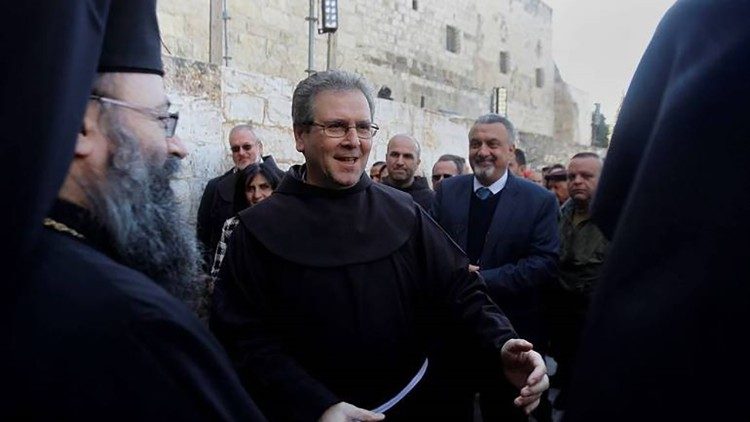
Fr. Francesco Patton, OFMCap., Custos of the Holy LandFr. Francesco Patton, OFMCap., Custos of the Holy Land 

Fr. Patton: Stop indiscriminate bombing on Gaza, life is sacred

The Custos of the Holy Land, Fr. Francesco Patton, calls for an end to indiscriminate bombings on civilians in Gaza, recalling that every human being is sacred.

By Tiziana Campisi and Lisa Zengarini

“Everyone must cooperate to stop the bombing of civilians in Gaza. We must begin to consider the human person as sacred again, regardless of ethnicity, religion and personal status.”

As the humanitarian crisis in Gaza continues to dramatically worsen, with thousands dead and injured, including new-born babies, the Custos of the Holy Land, Fr. Francesco Patton, OFMCap, has reiterated his plea for ending indiscriminate bombing on the Strip.

The Italian Franciscan friar participated in the 16th Day of the Associations of the Holy Land, which took place at the Pontifical University Antonianum in Rome on November 11.  The meeting, which is held every year, brought together the associations of volunteers working on projects in the Holy Land.

All human lives are sacred for Jews, Christians and Muslims

In an interview granted to Vatican News’ Tiziana Campisi on the sidelines of the event, Fr. Patton stressed the urgent need to save and protect human lives, which, he recalled, are sacred for Jews, Christians and Muslims.

“For Jews and Christians, man is the image and likeness of God; for Muslims, according to the Koran, man is the Caliph of God, the representative of God on earth. Therefore, believers of the three religions have a very high idea of the value and dignity of the human person.”

Places of worship must be respected    

Asked about the situation of the small Christian community enduring bombardment in Gaza, most of whom are currently sheltering in the Roman Catholic Church of the Holy Family, Fr. Patton expressed his hope that “at least places of worship are respected” and that Christians in Gaza can overcome this extremely difficult moment.


Since the war erupted over a month ago, Israeli bombings have not spared hospitals, schools, and mosques, and on October 19 the compound of the St. Porphyrios Greek Orthodox Church in Gaza was hit by an airstrike, killing 18 people and injuring several others.

In the interview, the Custos highlighted the vital importance of the presence of volunteers in the Holy Land because, he said, they contribute to creating bridges between the world and the Holy Land, not only with Christians but also with Israeli and Palestinian communities.

Concerns for a new Christian exodus from the Holy Land

As for the future, the Custos said he fears that once the war is over, there will be a new exodus of Christians from the Holy Land to the United States, Canada, and Europe.

“Many no longer feel safe, especially those who have families who do not want their children to grow up in an environment of hatred, where there is no mutual acceptance between people of different ethnic and religious backgrounds,” he explained.  

However, Fr. Patton remarked that it is vital for Christians to stay: “Christians must be deeply convinced that being Christian in the Holy Land and throughout the Middle East is a special calling, a kind of vocation, and not a curse,” he said, noting that they have an important role to play as bridges between Palestinians and Israelis, as they are not perceived as dangerous by either side.

“If they leave,” he said, “the space for coexistence will be further reduced.”

“We always stayed, even when there were no pilgrims, and we know that it is important to stay in those places and pray in those places because they recall the Mystery of our Redemption. Redemption is a dramatic event, not a walk in the park; it is something that cost Our Lord Jesus Christ His life. And consequently, we are called to follow Him as disciples, even in the midst of difficulties.”

We must all begin to consider the value of the human person again

Fr. Patton concluded the interview with a strong appeal for an end to the suffering of civilians.

“We must all begin to consider the value and dignity of the human person again. This is to avoid fueling anti-human and terrorist ideologies,” he said.

Sunday, November 5, 2023

The "Custos" of the Holy Land applauds the Pope's call for cease-fire, peace


File photo of Fr. Francesco PattonFile photo of Fr. Francesco Patton 

Fr. Patton: May Pope’s appeals for Holy Land touch hearts of world leaders

Following Pope Francis’ renewed appeal for a ceasefire in the Israel-Hamas war, the Custos of the Holy Land highlights the power of prayer for peace and urges world leaders to heed the Pope’s pleas.

By Andrea De Angelis and Roberto Cetera

Father Francesco Patton, the Custos of the Holy Land, has expressed his appreciation for Pope Francis’ most recent appeal for peace, pronounced at the Angelus prayer on Sunday.

“In God’s name, I beg you to stop: cease fire!” appealed the Pope. “I hope that avenues will be pursued so that an escalation of the conflict might be absolutely avoided”.

Sensitivity of children to suffering

Fr. Patton, who listened live to the broadcast of the Angelus, told Vatican News that he hopes the Pope’s appeal will "touch the consciences" of world leaders.

“The Pope's words first made me think about yesterday's event here in Jerusalem," he said, “where children were praying for peace.”

Israelis and Palestinians, Christians and Muslims joined together on Saturday morning at the Terra Sancta School in Jerusalem to pray for peace.

"I was struck by the prayer of a 5-year-old girl, who was praying, concerned, for her father. This fear will mark not only her childhood but probably her entire life,’ said Fr. Patton.

He added that the empathy shown by children "is probably greater than that of adults. Children have managed to recognize that suffering is experienced by everyone."

The atmosphere in Jerusalem, he noted, "remains surreal. There is palpable fear, and there are feelings of hatred and anger mixed with helplessness and pain,” he said, “which makes the need for our prayers and the need for peaceful solutions stand out even more, allowing for the protection of civilian populations, especially children.”

Cloudy future

Fr. Patton also reflected on the enormous tragedy of those who have lost their lives, noting that "at the beginning," referring to 7 October, "there was a horrible slaughter of Israeli civilians living around the Gaza Strip, with thousands of victims and 250 kidnapped.”

Now, in Gaza, he added, “we are close to 10,000 deaths, of which nearly half are children.”

“This is a tragedy that should touch the consciences of everyone, even those in power in this world, men and women who can also have a strong influence on immediate and future decisions,” he said.

The elderly in the Holy Land were also on his mind, as they endure the drama of the Israel-Hamas war that began almost a month ago.

“Their concern is for their children and grandchildren. They don't think about their future but that of their loved ones," said Fr. Patton. "I've seen this not only in Gaza but also here in Israel. Several older people no longer see a great future for their children and grandchildren and invite them to leave the country to try to build a life elsewhere.”

Amid the gathering tragedy, this feeling of helplessness adds a further element of seriousness, "even for the Christian community because it means seeing the Christian presence in the Middle East diminish."

News from Catholic parish in Gaza

Around 700 people are still sheltering in the Holy Family Catholic Parish in Gaza.

Fr. Patton said the latest information he had received was of “loud explosions that hit nearby” the Church compound.

One of the blasts,” added the Custos of the Holy Land, “even hit in the premises of the school run by the nuns."

Fr. Patton concluded the interview by recalling a video made by the children in the Gaza parish in which they invited children meeting with the Pope on Monday to pray for peace.

He said the children’s video shows “the side of Christian hope.”

Tuesday, April 4, 2023

The Cutos of the Holy land gives Holy Week interview


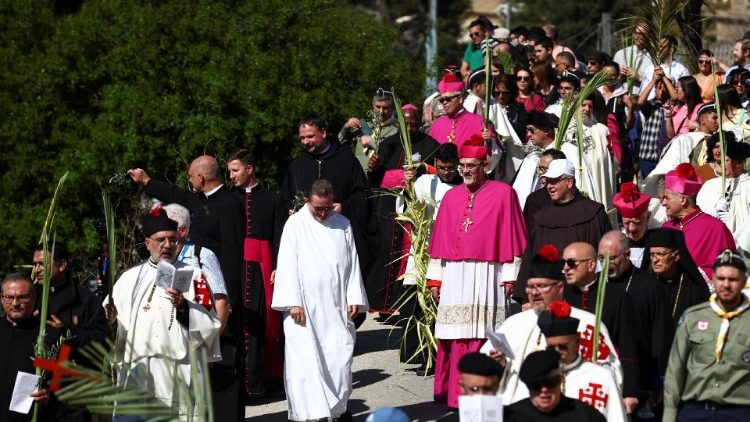
Palm Sunday procession on the Mount of Olives in JerusalemPalm Sunday procession on the Mount of Olives in Jerusalem 

Custos of the Holy Land: Jerusalem is house of prayer for all the nations

In an interview with Vatican News, the Custos of the Holy Land, Fr. Francesco Patton, OFM., discusses, that despite tensions, pilgrims continue to flock, and in safety, to Holy Week celebrations in the Holy Land, and reiterates that no pilgrim has ever been involved in any moment of tensions or act of violence.

By Deborah Castellano Lubov

Despite tensions, Holy Week celebrations continue beautifully in the Holy Land, says the Custos of the Holy Land, noting that when there are more pilgrims, there is more stability.

In an interview with Vatican News, the Custos, Fr. Francesco Patton, OFM., discussed the escalation of violence, and attacks on Christian symbols and churches, but reiterated strongly: "No pilgrim has ever been involved in the violence."


He shares that the pilgrims have flocked back to the region and that he has been moved by the beautiful displays of faith and of solidarity.

The Custos also discusses whether the situation on the ground is as dramatic as it seems and how that has affected pilgrims and Holy Week, and comments on whether adequate security measures are being taken. He also talks about the importance of the Good Friday collection for the Holy Land, as being key to its survival and mission.

The Custos of the Holy Land is the Minister Provincial (i.e. the major superior) of the Friars Minor living throughout the Middle East. He has jurisdiction over the territories of Israel, Palestine, Jordan, Lebanon, Egypt (in part), Cyprus and Rhodes, as well as numerous houses or Commissariats in various parts of the world, including in Rome and Washington.


Here is our conversation with Custos of the Holy Land, Fr. Francesco Patton, OFM.

The 'Pro Terra Sancta' collection for the Holy Land, to help preserve Christian sites and help the Christian presence, is taking place on Good Friday. Why is this important for the Holy Land?

It is the first source, economical source, for the Custody of the Holy Land. This means that it is the most important source in order to maintain the Holy Places, in order to sustain the pastoral service of our parishes and also to continue our educational task through the Christian schools, and to sustain the activities, social activities for poor and needy people. For example, in our case, it also helps the population of Syria, that is very tested by twelve years of war and now by the earthquake.

The Good Friday collection, we can say, is, for us, the most important source to survive, on the one hand, and to continue our mission here in the Holy Land.

As Custos of the Holy Land, being in such close contact with the reality on the ground, how would you describe the tensions? Is the situation as dramatic as it seems externally?

The situation in some way is dramatic, and, in some way, is also sustainable. It is dramatic. If we in this moment look at the context, the political context is not in this moment stable. 

It is dramatic if we look at the attacks that we received in the past months and the violence that was increasing, but at the same time, it is also sustainable because our presence here in the Holy Land was always a presence under pressure.

What is very important for us is to strengthen our faith. We have to keep always in our minds the words of Jesus: 'Do not be afraid.' We have always to remember that our strength comes from the Holy Spirit and from the relationship with Jesus, not from human resources.


Has the violence affected Holy Week celebrations? Have pilgrims returned to the Holy Land, as usual, or have less arrived, due to the violence?

I can say that when there are pilgrims, there is less violence, and so the pilgrims are very important, also as factor of stability. When there are no pilgrims, it is easier for the fanatics to have free hands. For example, in the recent past, at the end of January and immediately after January, we had a lot of acts of violence. This was a period with few pilgrims. A few days ago, I had seen the Palm Sunday procession. It was a very peaceful procession. There were no problems. The same was for the Way of the Cross last week, and I suppose the same this Good Friday. When there are a lot of pilgrims, the situation, I can say that is easier for us.

“The pilgrims are a factor of stability and a deterrent to violence.”

In your assessment, the pilgrims have not been deterred from arriving for Holy Week, and the celebrations thus far, have not been impacted?

In this moment, we have more or less the same number of pilgrims that we had before the pandemic, not like in 2019, but I can say like two times in 2018. In this moment, the city is overcrowded with pilgrims; and not only Christian pilgrims, because we have more or less the coincidence of the Christian Easter with the Jewish Passover and with the Muslim Ramadan. So, for example, the last Friday there were 200,000 Muslim pilgrims praying at Al-Aqsa [mosque]. The city was full of Muslim pilgrims. On Sunday, we were more than 20,000 at the Palm Sunday procession. And I suppose, that in this moment, there are thousands of Jewish civilians, also here in the city.

“In this moment, we can say that Jerusalem is really the house of prayer for all the nations.”

In the wake of those attacks, of the vandalism that has happened on Christian sites and churches, what has been, or is being, done, to protect those sites? Are authorities doing enough or taking concrete measures?

For us, it is, of course, important and necessary to ask for more security, given the acts of violence and of vandalism. Of course, it is impossible to foresee all these things and it is impossible for us to have total control. But when something happens for us, it is important to denounce the fact and to ask for security.


We want that Jerusalem be a safe place of worship for all the faithful of all the Abrahamic religions, Jerusalem is in the heart of Jewish people, of Christians, and of Muslims.

It is impossible to have 100% of security. We try to have enough security and we can say that it has never, never happened that some pilgrim was involved in acts of violence, but it is impossible to have 100% of security. Always there are people out of control and acting, we can say, like lone wolves. We can ask for protection for the holy places, but it is impossible to have security at 100 percent. As I said, never, never has it happened, that pilgrims were involved.

Is there a particularly moving moment that remains with you, from serving your people in this period?

For me, what was very moving was the opportunity that I had ten days ago to visit our friars and our local Christians in Syria, those who were affected by the earthquake, since I observed incredible solidarity between the friars and the local Christians, and not only the local Christians, but also with the local population, with the Muslims. They did an excellent job of welcoming everybody in the worst time of the earthquake, hosting them in our structures. In Aleppo, they hosted about 6,000 people, and also in Latakia, and in the villages of the Orontes River. This for me was very, very, very, very moving during the Holy Week.

For me, what will be very moving will be the celebrations during Holy Week, and at the end of the Holy Week. For me, it's very special to celebrate during the night between the Holy Saturday and the Sunday of Easter, inside the Holy Sepulchre. This is very special because it is the place in which the body of Jesus laid, but also the place from which the body of Jesus rose and brought us into the life of God. When I have the opportunity to celebrate Easter inside the Holy Aedicule, for me, it is something very, very special. I think that the Resurrection of Jesus is stronger than every evil and stronger than death.