Showing posts with label Coptic Orthodox Pope Tawadros II. Show all posts

Friday, May 12, 2023

21 Coptic Christian martyrs added to list of Catholic Saints


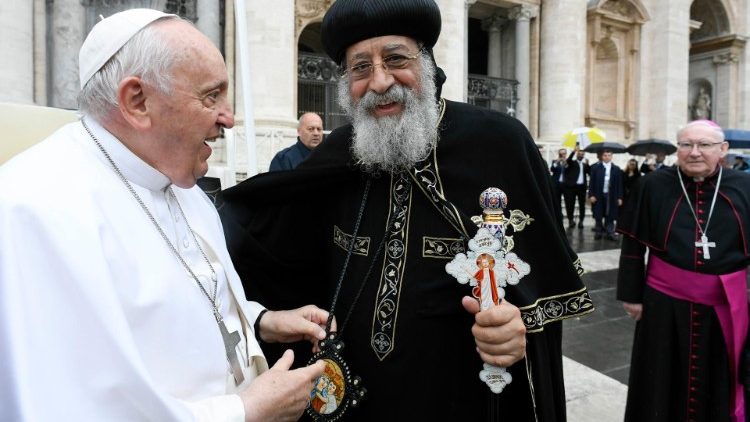
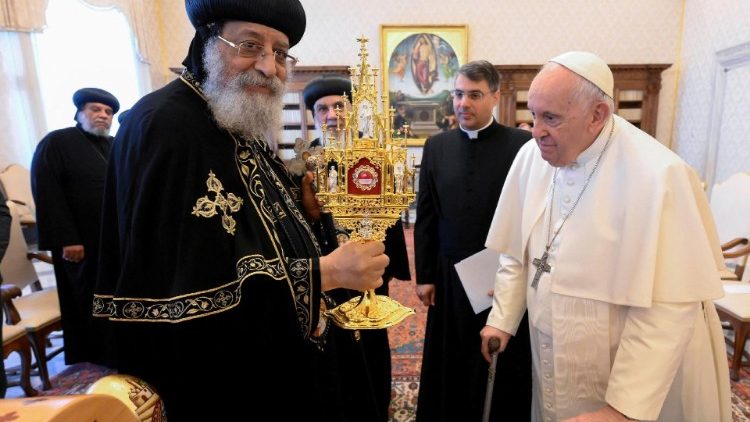
Coptic Orthodox Pope Tawadros II holds up a reliquary of the 21 martyrsCoptic Orthodox Pope Tawadros II holds up a reliquary of the 21 martyrs 

Pope Francis adds 21 Coptic Orthodox martyrs to Catholic list of saints

Pope Francis announces with Pope Tawadros II that 21 Coptic Orthodox martyrs will be inserted into the Roman Martyrology of the Catholic Church as a sign of the spiritual communion of the two Christian Churches.

By Devin Watkins

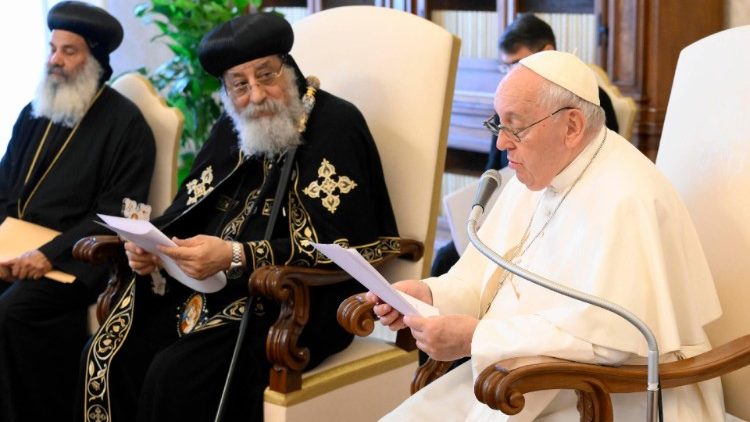
“May the prayers of the Coptic martyrs, united with those of the Theotokos, continue to help our Churches grow in friendship, until the blessed day when we can celebrate at the same altar and receive together the Body and Blood of the Savior.”

Pope Francis expressed that desire for greater Christian unity on Thursday during an audience in the Vatican with Coptic Orthodox Pope Tawadros II.

The Patriarch of the See of St. Mark has spent the last three days in Rome to commemorate the 50th anniversary of the Joint Christological Declaration, a milestone in relations between the Coptic Orthodox and Catholic Churches.

In his address, Pope Francis said 21 Coptic Orthodox martyrs would be inserted into the Roman Martyrology “as a sign of the spiritual communion that unites our two Churches.”

The 21 Coptic Christians—of whom 20 were Egyptian and 1 hailed from Ghana—were beheaded in Libya in 2015 by militants of the so-called Islamic State. A video published by the terrorist organization showed the men praying as they died.

The Coptic Orthodox Church celebrates their feast day on 15 February, the date they were martyred.

During their audience, Pope Tawadros gave Pope Francis a reliquary of the Coptic martyrs, for which Pope Francis expressed his heartfelt gratitude.

“These martyrs were baptized not only with water and the Spirit, but also in blood, in a blood that is the seed of unity for all followers of Christ,” said Pope Francis.

Invoking intercession of Coptic saints

Later on Thursday, Pope Tawadros II held a press conference at the Vatican’s Dicastery for Promoting Christian Unity.

He told reporters that the martyrs’ bodies were exhumed in 2018 and brought to Egypt. The Coptic Church built a shrine in their honor in El-Aour, the hometown village of most of the men.

“We ask for their prayers often,” said Pope Tawadros, “and we believe they continue to offer us a great blessing.”

He urged Catholics to invoke their intercession as well.


The Coptic Pope also laid out four steps to follow along the path toward reconciliation and Christian unity, pointing to the figures depicted on a cross he has displayed while in Rome.

Pope Tawadros said the first step is that of fraternity in Christ, expressed through joint activities. The second step, he added, includes mutual understanding through the study of traditions, sacraments and “everything that has to do with the Churches.”

The third step, he said, involves liturgical and informal dialogue, including dialogue among young people and members of the Churches’ respective clergy. The fourth step is prayer, “because prayer can work miracles.”

“Once we have completed these four steps,” said the Coptic Pope, “we arrive at the heart of Christ, and this takes a long time. But we believe that the Holy Spirit is with us on this journey.”

Orthodox martyrs in Catholic list of saints

This is not the first time that non-Catholic Christians have been inserted into the Roman Martyrology.

In 2001, several Orthodox saints who lived after the separation of the Catholic and Orthodox Churches in 1054 were added to the Catholic list of saints.

These include the Slavic saints Theodosius and Anthony of Pečerska (11th century), and Stephen of Perm and Sergius of Radonezh (14th century).

Thursday, May 11, 2023

Pope Francis welcomes Coptic Orthodox delegation and leader back to Vatican Thursday morning


Pope Francis and Pope Tawadros IIPope Francis and Pope Tawadros II  (ANSA)

Pope to Tawadros II: May our friendship never stop growing

Pope Francis greets Coptic Orthodox Pope Tawadros II and recalls the history of relations between Copts and Catholics as they strive to maintain a friendship that never stops growing.

By Francesca Merlo

Pope Francis on Thursday addressed Coptic-Orthodox Pope Tawadros II and his delegation, who are in Rome to celebrate 50 years of Coptic and Catholic relationships, as well as the tenth anniversary of their first meeting in 2013.

In his speech, Pope Francis noted that "in the ecumenical journey, it is important to always look ahead". He advised that we always ask ourselves "how far do we still have to go?"

However, he continued, it is also necessary to always remember, especially in times of discouragment, "to rejoice in the path already travelled and to draw on the fervour of the pioneers who have gone before us."

Giving thanks and begging

Pope Francis noted that the purpose for the commemoration today is "giving thanks and begging". He highlighted that the meeting of their predecessors Paul VI and Shenouda III, which took place in Rome from 9 to 13 May 1973, "marked a historic milestone in relations between the See of St Peter and the See of St Mark".

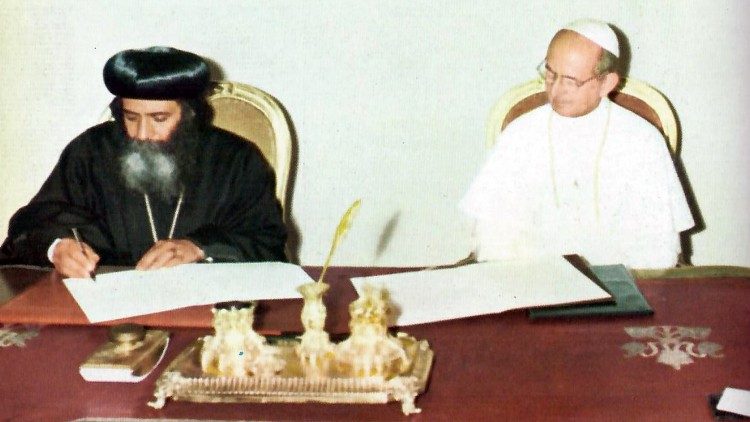
It was the first meeting between a Pope of the Coptic Orthodox Church and a Bishop of Rome, he explained, adding that "it also marked the end of a theological dispute dating back to the Council of Chalcedon, thanks to the signing on 10 May 1973 of a memorable joint Christological declaration, which later served as an inspiration for similar agreements with other Eastern Orthodox Churches."

The joint commission

That meeting led to the creation of the International Joint Commission between the Catholic Church and the Coptic Orthodox Church, which in 1979 adopted the pioneering Principles to guide the search for unity between the two Churches.

The Principles, agreed by Pope St. John Paul II and Pope Shenouda III,  stated in prophetic words that “the unity we envision does not mean the absorption of one by the other or the domination of one over the other. It is at the service of each one to help him or her better live out the specific gifts he or she has received from the Spirit of God."

Pope Francis then went on to highlight how the meeting of their predecessors "has never ceased to bear fruit in the journey of our Churches towards full communion", adding that "it is also in memory of that meeting in 1973 that Your Holiness met me here for the first time on 10 May 2013, a few months after your enthronement and a few weeks after the beginning of my pontificate. On that occasion, you proposed to celebrate every 10 May the 'Day of Friendship between Copts and Catholics', which has been celebrated regularly by our Churches ever since."

Meaning of friendship

When speaking of friendship, the Pope recalled the famous 8th-century Coptic icon depicting the Lord resting His hand on the shoulder of His friend, the holy monk Mena of Egypt. "This icon," he said, "is sometimes called the ‘icon of friendship’ because the Lord seems to want to accompany His friend and walk with him."

In fact, the Pope continued, in this journey of friendship "we are also accompanied by the martyrs, who testify that 'no one has greater love than this: to lay down one’s life for one’s friends'."

He concluded by expressing his gratitude for the precious gift of a relic of the Coptic martyrs killed in Libya on 15 February 2015, for which he said he "has no words". Pope Francis also noted that these martyrs of the Coptic-Orthodox Church would also be added to the Roman martyrology.

"May the prayers of the Coptic martyrs," the Pope concluded, "united with those of the Theotokos, continue to make our Churches grow in friendship, until the blessed day when we will be able to celebrate together at the same altar and commune with the same Body and Blood of the Saviour, 'that the world may believe'."

Wednesday, May 10, 2023

Pope Francis and Coptic Pope jointly write preface for new book celebrating the Joint Christological Declaration


Pope Paul VI and Pope Shenouda III sign the Joint Christological Declaration in 1973Pope Paul VI and Pope Shenouda III sign the Joint Christological Declaration in 1973 

Pope Francis and Pope Tawadros II praise ongoing Catholic-Coptic dialogue

Pope Francis and the Coptic Orthodox Pope Tawadros II release a jointly-written preface for a new book, celebrating the 50th anniversary of the historic “Joint Christological Declaration” that continues to strengthen ties between the Catholic and Coptic Churches.

By Devin Watkins

As the Catholic and Coptic Orthodox Churches mark fifty years since the first modern meeting between their leaders, Pope Francis and Pope Tawadros II have penned a joint preface for a new book.

Set to hit bookshelves on Wednesday, the book is entitled “The Catholic Church and the Coptic Orthodox Church. 50th Anniversary of the Meeting between Pope Paul VI and Pope Shenouda III (1973-2023)”.

The preface, released on Tuesday, traces the path of dialogue which led to that historic encounter and the fruits which it has borne over the last half century.


Ongoing journey towards full communion

The two Popes begin the preface by expressing the desire of their Churches to “journey towards full communion”, while also recalling the progress that has been made thus far.

“We also need to give thanks to God by remembering the steps already taken and the distance already travelled, which are often much more important than we imagine,” they write, adding that this recollection of history represents the purpose of the book.

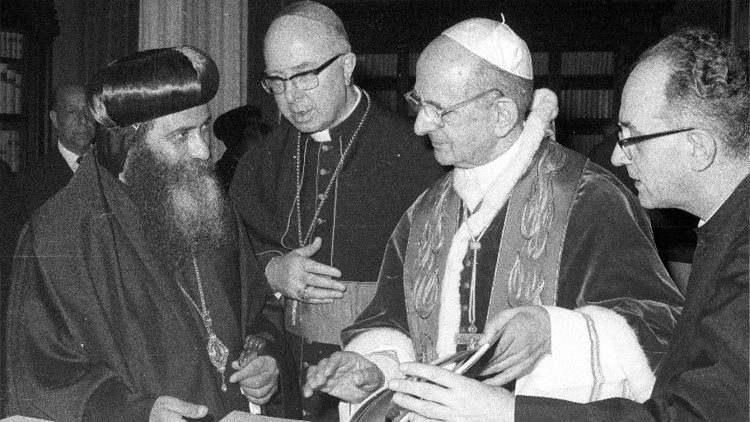
Pope Paul VI met with Pope Shenouda III in the Vatican on 9-13 May 1973, the first such meeting between “a Bishop of Rome and a Pope of the Coptic Orthodox Church” in over 1,000 years, during which they signed the landmark Joint Christological Declaration.

The declaration crowned years of ecumenical and theological dialogue between the Catholic and Coptic Orthodox Churches following the Second Vatican Council.

It also marked the end of the Christological controversy which had arisen in the wake of the Council of Chalcedon in 451.

Growing mutual understanding

The meeting between Paul VI and Shenouda III continued to bear fruit in ecumenical relations, including the creation of the Joint International Commission between the Catholic Church and the Coptic Orthodox Church.

The Commission’s work, note Pope Francis and Pope Tawadros II, led to the signing of the Principles for Guiding the Search for Unity between the Catholic Church and the Coptic Orthodox Church in 1979 between Shenouda III and John Paul II.

“This commission in turn paved the way for the foundation, in 2003, of the theological dialogue between the Catholic Church and the entire family of Oriental Orthodox Churches, a dialogue that has already produced important documents testifying to the growing understanding between our Churches,” say the two leaders.

United in fraternal love and friendship

Pope Francis and Pope Tawadros II also recall their first meeting, which took place in Rome on 10 May 2013, a date which they established as the annual “Day of Friendship between Copts and Catholics”.

The two Popes conclude their preface by expressing their hopes that the ecumenical journey between their two Churches might continue to bear fruit in response to Christ’s prayer “that they may all be one”.

“May the fraternal love and friendship that unite our Churches continue to grow until the blessed and longed-for day when we can celebrate together at the same Altar and receive from the same chalice, ‘so that the world may believe’!”

The religious and cultural significance of the Coptic Orthodox Church


Pope St Paul VI with Pope Shenouda III, Patriarch of the Coptic Orthodox Church (May 1973)Pope St Paul VI with Pope Shenouda III, Patriarch of the Coptic Orthodox Church (May 1973) 

Coptic Christians preserve 'an immeasurable treasure'

Alberto Alfredo Winterberg, a PhD student at the University of Groningen, Netherlands, at the Faculty of Theology and Religious Studies, explores the ancient Coptic Christian tradition.

By Christopher Wells

“The Coptic Orthodox Church guards an immeasurable treasure trove of religious, cultural, and historical significance,” says Alberto Alfredo Winterberg, a Ph.D. student in the Faculty of Theology and Religious Studies at the University of Groningen in the Netherlands.

Ahead of the visit by Coptic Orthodox Patriarch Tawadros II to the Vatican, Mr. Winterberg spoke to Tomasz Matyka, SJ of Vatican News about the ancient Christian tradition in Egypt.

“The Copts are the indigenous Egyptian Christian minority population,” he explains, “whose roots extend as far back as the pharaonic Egyptians from antiquity.”

Founded by St Mark

The Coptic Christian minority amounts to approximately eight to ten percent of the total population of Egypt, with most belonging to the Coptic Orthodox Church. According to tradition, it traces its origins to the foundation of the See of Alexandria by St Mark the Evangelist, the disciple of St Peter.

The formation of a distinctive Coptic Orthodox Church, Mr. Winterberg explains, “was a long process which took place in the aftermath of the Council of Chalcedon in 451.” Although Christological questions were at the forefront of disputes over the Council, Mr. Winterberg notes that political and economic issues played a significant role in divisions between the Church in Alexandria and the Roman Church.

When Egypt was conquered by Islamic forces two centuries later, Egyptian Christians were forced either to convert to Islam or pay a heavy tax. “Within a long process of economic restrictions, civil humiliations and, at times, violent persecutions against the Copts by the foreign rulers, the former Christian majority population turned into a minority. However, they survived until the present day.”

A Church of martyrs

Elaborating on the contributions of Coptic Christianity to the wider Church, Mr. Winterberg points first to the institution of monasticism, which is also connected to ancient Syria. He notes the importance of Coptic saints among the desert fathers, especially Saint Anthony the Great and Saint Pachomius, who were important influences on St Benedict, the founder of Western monasticism.

Mr. Winterberg notes, too, the history of persecution of Egyptian Christians in the early Church. “Apart from the great tradition of Coptic monks and ascetics, the Roman province of Egypt was one of the most affected by the persecution of Christians under the Emperor Diocletian,” he says. “As such, the Coptic Church particularly identifies itself as a martyr Church whose very own calendar begins in the year of 284 AD, the year on which Emperor Diocletian began his reign.”

Ecumenical and theological dialogue

The Coptic Orthodox Church is currently headed by Pope Tawadros II, the Patriarch of Alexandria, and numbers about ten million adherents. Outside of Egypt and the Middle East, significant numbers of Orthodox Copts are found in the US, Canada, Australia, France, and Germany.

Fifty years ago, on 10 May 1973, Pope Saint Paul VI and Pope Shenouda III met in the Vatican, during which they signed an historic “Joint Christological Declaration.” The Declaration followed on years of ecumenical and theological dialogue between the Catholic Church and the Coptic Orthodox Churches in the wake of the Second Vatican Council.

Historic Wednesday General Audience with head of the Coptic Church addressing the audience


Pope Francis with Coptic Pope Tawadros IIPope Francis with Coptic Pope Tawadros II  (Vatican Media)

Coptic Pope addresses pilgrims at General Audience with Pope Francis

Pope Tawadros II, head of the Coptic Orthodox Church, speaks at the Wednesday General Audience with Pope Francis, fifty years to the day after a historic Christological agreement between their two Churches.

By Joseph Tulloch

Pope Francis was joined at his weekly General Audience by Pope Tawadros II, the head of the Coptic Orthodox Church, for a special joint greeting to the faithful.

The pair exchanged greetings, and Pope Tawadros addressed the crowd gathered in St Peter’s Square, the first time the head of another Church has done so.

Tawadros’ greetings

“Beloved brother, His Holiness Pope Francis,” said Pope Tawadros, “Christ is risen, He is truly risen!”

The Coptic Orthodox leader recalled his last visit to St Peter’s Square, ten years ago today. “I look at this place,” he said, “and I go back in my memory to ten years ago, on this same date, and I remember your dear affection in welcoming me, together with the delegation of the Coptic Church.”

Pope Tawadros recalled that, on that occasion, on 10 May 2013, he had suggested that the date be celebrated as a ‘Day of Coptic-Catholic Friendship’ every year. Since then, he said, he and Pope Francis have spoken on the phone every year.  

The Coptic Orthodox leader went on to thank Francis for his visit to Egypt in 2017, recalling that the country – where his Church is based – has ancient Christian roots, and was the birthplace of monasticism.

“Despite the differences in our roots and affiliations,” he said, “we are united by the love of Christ who dwells within us, and the host of our Apostolic Fathers and saints which surrounds and guides us.”

Pope Francis’ response

“It is with great joy”, said Pope Francis in reply, “that I greet today His Holiness Tawadros II, Pope of Alexandria and Patriarch of the See of St Mark.”

“Dear friend and brother Tawadros,” he continued, “I thank you for accepting my invitation on this double anniversary, and I pray that the light of the Holy Spirit might illuminate your visit to Rome.”

“I thank you from the heart, for your commitment to the growing friendship between the Coptic Orthodox Church and the Catholic Church," added the Pope.

Laying aside his prepared remarks for a moment, he looked over to Pope Tawadros, joking that although the pair speak every year on the phone, “we remain good brothers, and we haven’t fought!”

Pope Francis concluded his address by speaking to the Coptic bishops and faithful gathered in St Peter’s Square.

“Together with you," he said, "I implore Almighty God, that, through the intercession of the saints and martyrs of the Coptic Church, He might help us to grow in communion.”