Showing posts with label Cardinal Dziwisz. Show all posts

Tuesday, October 22, 2024

Cardinal Dziwisz reflects on the life and papacy of Saint John Paul II


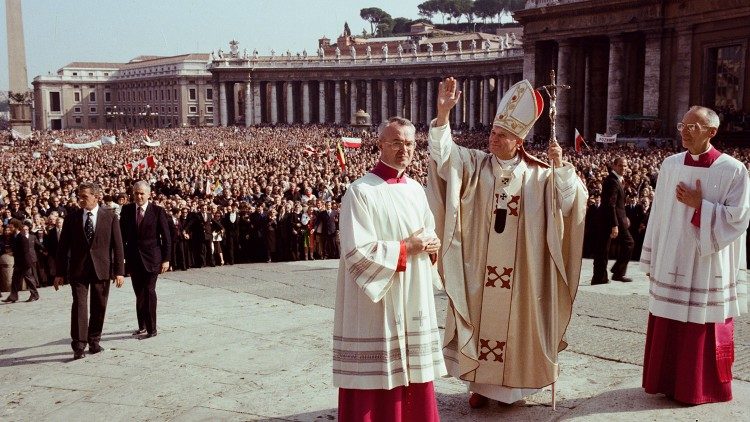
Pope St. John Paul II at the inaugural Mass of his pontificate on October 22, 1978Pope St. John Paul II at the inaugural Mass of his pontificate on October 22, 1978 

Cardinal Dziwisz: John Paul II was ‘a builder of peace and dialogue’

As the Church celebrates the liturgical memorial of St. John Paul II, Cardinal Stanisław Dziwisz recalls the Polish Pope’s unforgettable words that launched his pontificate: “Do not be afraid. Open wide the doors to Christ.”

By Fr. Andrea Vena and Fr. Paweł Rytel-Andrianik

The liturgical memorial of Pope St. John Paul II coincides with the anniversary of the beginning of his papacy on October 22, 1978.

Speaking to Vatican News, Cardinal Stanisław Dziwisz, emphasized that John Paul II's teachings on peace are more relevant today than ever, given the ongoing conflicts in Ukraine and the Middle East.

‘Engaging in effective negotiations is not humiliation’

"It is never too late to come to an understanding and to continue discussions. To reflect on one's duties, to engage in energetic negotiations does not mean to be humiliated, but to work with responsibility for peace," said John Paul II during the Angelus on March 16, 2003, just before the outbreak of the Iraq War.

Cardinal Dziwisz, who served as John Paul II's personal secretary for 39 years, reiterated in the interview that the Polish Pope did everything possible to promote peace worldwide.

"I believe that today, John Paul II's teachings are more relevant than ever, considering the ongoing wars in Ukraine and the Middle East," he remarked.

"Do not be afraid" – A timeless call

During the Eucharistic celebration marking the start of his papacy on October 22, 1978, John Paul II delivered his iconic message: "Do not be afraid! Open wide the doors for Christ!"

Referring to these words, Cardinal Dziwisz highlighted that this remains a daily call, still relevant for the Church, the modern world, individuals, and diverse communities.

Reflecting on John Paul II's teachings, which encompassed peace, the defense of life, workers' rights, the dignity of politics, the appreciation of feminine genius, the Eucharist, and divine mercy, Cardinal Dziwisz expressed gratitude to Pope Francis for his strong stance on the sanctity of life.

"We are thankful for the words spoken by Pope Francis in Brussels," said the Cardinal, as the Pope defended the dignity of human life from its beginning to its natural end.

Pope Francis and John Paul II

"We especially need his example and fatherly care, but one cannot fully understand Saint John Paul II without knowing Karol Wojtyła," wrote Pope Francis in the introduction to the recently published book La meta è la felicità (The Goal is Happiness).

The book, printed in Italian, includes 366 mostly-unpublished writings, from before the pontificate of Karol Wojtyła.

Reflecting on these words, Cardinal Dziwisz noted that John Paul II appointed Father Jorge Bergoglio as a bishop in Argentina and later created him Cardinal.

In conclusion, Cardinal Dziwisz urged everyone to seek truth and find a trustworthy guide in the teachings of every Pope, as each is a Successor of St. Peter.

Wednesday, May 29, 2019

Polish Cardinal thanks Pope Francis for defending the true legacy of Saint JP the Great

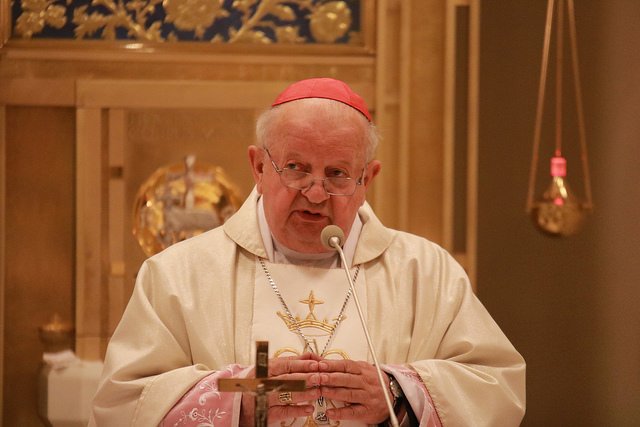
Cardinal Stanisław Dziwisz

Card. Dziwisz Thanks Pope Francis for Defending St. John Paul II

‘St. John Paul II was the first Pope who systemically introduced the protection of children and youth in the Church.’

Cardinal Stanisław Dziwisz released a letter on May 28, 2019, thanking Pope Francis for his efforts at putting an end to attempts to defame St. John Paul II.
We publish the whole text:
In connection with the repetition in the media of false information that misleads many people, I would like to remind that St. John Paul II was the first Pope who systemically introduced the protection of children and youth in the Church. His uncompromising attitude in this matter is testified by, among others, the following facts:
  1. In 1993, St. John Paul II wrote a letter to the bishops from the USA, in which he stated unequivocally: “The evangelical word ‘woe’ is of special significance, especially when Christ applies it to cases of scandal, and above all to the scandal of the ‘little ones’. How severe are the words of Christ when he speaks of such a scandal, and how great this evil must be, for ‘it would be better for him to have a great millstone hung around his neck and to be drowned in the depths of the sea’ (cfr. Mt 18:6 )”.
  2. In 1994, the Pope issued an Indult for the Church in the United States, and two years later he expanded it to the Church in Ireland. It aimed to introduce greater protection for children and young people against the crime of abuse.
  3. In 2001, the Holy Father introduced restrictive legal norms in the Church, which subsequent popes were updating. The document “Sacramentorum sanctitatis tutela” (On the protection of the sacraments’ sanctity) and the norms “On the most serious crimes” were of crucial importance. John Paul II raised the age of protection of minors up to the age of 18 years. In addition, he obliged each bishop and religious superior to report to the Congregation for the Doctrine of the Faith all crimes against minors.
  4. In 2002, St. John Paul II clearly stressed his position in this matter: “People need to know that there is no place in the priesthood and religious life for those who would harm the young” (Address to the Cardinals of the United States, April 23, 2002).
  5. During the pontificate and according to the will of St. Pope John Paul II, the Congregation for the Doctrine of the Faith began an investigation of the accusations concerning Maciel Delgollado, the founder of the Legionaries of Christ. In December 2004, the then promoter of justice and today the Archbishop Charles Scicluna was sent with another lawyer to Mexico and the United States, in order to investigate the case. The investigation was carried out after the death of John Paul II and therefore, at the beginning of the pontificate of Benedict XVI, a sentence could have been issued.
  6. In addition, it should be noted that 122 witnesses, including those being far from the Catholic Church, were interrogated in order to examine the life of John Paul II and 2414 pages of procedural documentation were prepared. The holiness of John Paul II has been confirmed by the authority of two popes: he was beatified by Pope Benedict XVI, and canonized by Pope Francis. The Holy See, considering the opinion of a board of physicians, recognized two healings through the intercession of St. John Paul II as inexplicable from a medical point of view.
For this reason, attempts to defame St. Pope John Paul II insult the feelings of millions of people around the world for whom St. John Paul II was and is an unquestionable authority and advocate in various life situations, which is expressed in thousands of testimonies about graces continually received through his intercession.
I thank the Holy Father Francis for putting an end to attempts to defame the Polish Pope, saying that no one can doubt the holiness of John Paul II.
+ Card. Stanisław Dziwisz
Senior Archbishop of the Archdiocese of Kraków
Kraków, May 28, 2019