Showing posts with label Bishop Thomas Daly. Show all posts

Tuesday, November 12, 2024

Why are Catholic hospitals doing sex-change services?


Bishops Call for Urgent Review of ‘Pediatric Sex-Change Services’ at Catholic Hospitals

Database Released In October Found That About 150 Catholic Hospitals Assisted Minors In Gender Transitioning During a Five-Year Period


The Catholic Church teaches that a person’s sex is chosen by God and is not alterable, and that trying to do so harms the person. (photo: ADragan / Shutterstock)


Bishops should discuss and act on a recent report that Catholic hospitals have provided “pediatric sex-change services” for patients 17 and younger, two bishops told EWTN News recently. 

Their comments come as the U.S. Conference of Catholic Bishops holds its annual fall meeting in Baltimore, which began Monday. 

As the Register reported last month, on Oct. 8 a medical watchdog organization called Do No Harm released a database finding that about 150 Catholic hospitals in the United States provided “pediatric sex-change services” between 2019 and 2023, including 33 Catholic hospitals that performed so-called gender-reassignment surgeries on minors. 

Bishop James Conley, who leads the Diocese of Lincoln, Nebraska, told the Register last week that he has discussed the report privately with hospital administrators, Catholic physicians, and bishops of dioceses with Catholic hospitals mentioned in the Do No Harm database. 

Though the topic is not on the agenda of the four-day U.S. bishops’ meeting, Bishop Conley said he hopes bishops at least talk about it privately. 

“We need to discuss it. We have an obligation especially to protect those who are most vulnerable — and particularly children, minors. Because this is just another form of child abuse,” said the bishop, who published a column on the subject last week in his diocesan newspaper, the Southern Nebraska Register, which was also republished by the Register.  

More than 520 minors received treatments in Catholic hospitals in about 40 states during that five-year period, according to the data. More than 150 had surgeries to alter their appearances to resemble the opposite sex, while more than 380 children were given puberty blockers or hormone therapies. 

Spokesmen for several Catholic health-care organizations mentioned in the database have declined to confirm or deny that their hospitals have provided chemical or surgical procedures that contradict the Church’s teaching on human sexuality. But they have defended the care they provide patients, including those who identify as transgender. 

Supporters of sex transitioning say that some people find themselves trapped in a body that does not reflect their self-identity, and that denying treatment needlessly prolongs or deepens their mental suffering. 

The Catholic Church teaches that a person’s sex is chosen by God and is not alterable, and that trying to do so harms the person. 

“Beyond the understandable difficulties which individuals may experience, the young need to be helped to accept their own body as it was created,” Pope Francis said in his 2016 apostolic exhortation Amoris Laetitia (The Gospel of Love). 

In 2023, the U.S. bishops’ Committee on Doctrine published guidelines that said, “Catholic health care services must not perform interventions, whether surgical or chemical, that aim to transform the sexual characteristics of a human body into those of the opposite sex or take part in the development of such procedures.” 

Bishop Conley’s diocese does not have a Catholic hospital in the Do No Harm database. But he said the report disturbed him because he believes such procedures hurt the patients they’re supposed to help. 

“All the studies indicate that rather than offer surgeries and puberty blockers and hormone therapy, which cause permanent damage, we need to accompany these young people and to help them understand better the gift of their biological sex,” Bishop Conley said. 

Bishop Thomas Daly, who leads the Diocese of Spokane, Washington, told EWTN News Nightly last month that he hopes bishops will talk about the sex-change database during regional meetings of bishops and perhaps discuss it as a body at a future meeting. 

“It’s not something that is going to go away, and so there is certainly a factor of time,” Bishop Daly said during a television interview Oct. 30. 

Bishop Daly also spoke with the Register last month. During that interview, he noted that bishops are limited in what they can do about Catholic hospitals since they don’t run them. A local bishop can take away the ability of a Catholic institution in his diocese to call itself Catholic, but otherwise has no direct authority over Catholic hospitals. 

Bishop Conley told the Register that he’s hopeful individual bishops through private conversations will be able to persuade the leaders of Catholic hospitals not to participate in procedures that deliberately alter sexual appearance. 

“I’m a big proponent of sitting down with the administration of a hospital that happens to be in the person’s diocese and discussing these questions,” Bishop Conley said. “The problem is these hospital systems have gotten so large and the administration of these hospitals is very complex so it’s really hard for a bishop to understand who is really making the decisions.” 

The Nebraska bishop told the Register that attempting to alter bodily characteristics doesn’t aid people who experience consternation over their sexual identity. 

“Obviously, there are emotional challenges in these people’s lives. But you don’t treat the emotional and mental challenges by encouraging something that has been proven to not have favorable outcomes and does not solve their challenges or their issues, that can cause irreparable damage to their bodies and their mental health,” he said. 

Bishop Conley, recounted attending a Catholic Medical Association conference in Orlando, Florida, in September during which seven adults spoke about their sex transitions during adolescence and their detransitioning as adults. 

“They shared their testimony, which was very moving, and heartbreaking in many ways, because they regretted their decision that they made when they were teenagers. But beautiful, powerful witness, and courageous witness, of their brokenness but their desire to be whole,” Bishop Conley said. 

Dr. Patrick Hunter, a pediatrician with a master’s degree in bioethics who has been studying sex transitioning for about 10 years, also spoke at the conference. 

He told the Register that Catholic hospitals aren’t the only concern when it comes to sex transitioning. 

“I don’t think any hospital should be doing this, let alone a Catholic hospital,” Hunter said. “All the evidence that anyone would benefit is low quality. Low quality means we can’t be certain what the outcomes will be. And we have increasing reports of harm and regret that should concern all of us.” 

He added, “When we don’t know what we’re doing, why are we doing it? I fear it’s being done for socio-political reasons and not for the benefit of those people who are suffering. We need to find a better way to care for them.” 

Hunter called sex transitioning bad medicine. 

“If this didn’t have anything to do with gender and sex, and frankly politics, everyone would be up in arms. You’re doing what to who, and you don’t know what’s going to happen?” Hunter said. “Historically, we’ve protected vulnerable populations. That’s a good society that does that. Now we’re taking advantage of them, for social and political agendas.” 

Friday, April 21, 2023

Safeguarding the seal of Sacramental Confession


Washington bishop: Priests would rather go to jail than break seal of confession


As Washington state lawmakers debate legislation that would end legal protections for the seal of confession, Spokane Bishop Thomas A. Daly has assured his diocese that priests would opt for a jail sentence before they would break the seal.

“I want to assure you that your shepherds, bishop and priests, are committed to keeping the seal of confession — even to the point of going to jail,” Daly wrote in a letter to Catholics in the Diocese of Spokane, which covers eastern Washington.

“The sacrament of penance is sacred and will remain that way in the Diocese of Spokane,” he said.

The bishop’s April 19 letter referred to a state Senate bill that would make priests mandatory reporters of abuse. The original Senate-passed bill included an exemption for information that priests obtain during a confession, which was included to protect the seal of confession. However, the House-passed version included an amendment that eliminated legal protections for the seal of confession and would threaten priests with jail time if they refuse to disclose information heard during a confession.

On April 17, the Senate refused to agree to the House’s amendment and sent the original bill back to the House. Now, the House must choose whether it wants to insist on its amendment, defer to the original Senate bill, or offer another alternative. If the House decides to insist on its amendment or offer another alternative, the legislation would then be sent back to the Senate again. If it defers to the original Senate language, the bill will head to the governor’s desk.

Any legislation that would try to force priests to violate the seal of confession would pit civil law against canon law. Canon 983 of the Code of Canon Law states that the seal of confession is “inviolable.”

“It is absolutely wrong for a confessor in any way to betray the penitent, for any reason whatsoever, whether by word or in any other fashion,” the canon declares.

The penalties for violating the seal of confession are strict. According to Canon 1386, if a priest “directly violates the sacramental seal,” he would incur an automatic excommunication. Any priest who violates the seal indirectly “is to be punished according to the gravity of the [offense].”

In his letter, Daly encouraged lawmakers to “make good law which is able to be followed and enforced” and remained optimistic that religious freedom would prevail.

“The state of Washington is not the first governing body to attempt to criminalize our commitment to keep the seal of confession sacred,” the bishop wrote. “History is replete with examples of kings, queens, dictators, potentates, and legislators who have attempted to have the seal of confession violated through law, coercion, or fiat. All have failed.”

A spokesperson for the Washington State Catholic Conference told CNA that the organization is working with lawmakers to craft a bill that protects children and the seal of confession.

“We are thankful for the efforts of senators on both sides of the aisle who did not concur with the amendment that eliminated the clergy-penitent privilege,” the spokesperson said. “ We are currently working with legislators to find a version of S.B. 5280 that may work for all and protect children and protect the clergy-penitent privilege. The Washington State Catholic Conference bishops continue to support legislation that makes clergy mandatory reporters of information obtained outside the sacrament of reconciliation.”

During the 2023 legislative sessions, lawmakers in Delaware and Vermont also introduced bills that could jeopardize the seal of confession. Some religious freedom advocates have argued that such laws would violate the First Amendment’s religious freedom protections and that we should expect lawsuits if any of these bills become law.

Tuesday, June 7, 2022

US Bishops continue to urge Congressional action against gun violence


U.S. bishops urge Congress to address gun violence

Carol Zimmermann | Catholic News Service
  

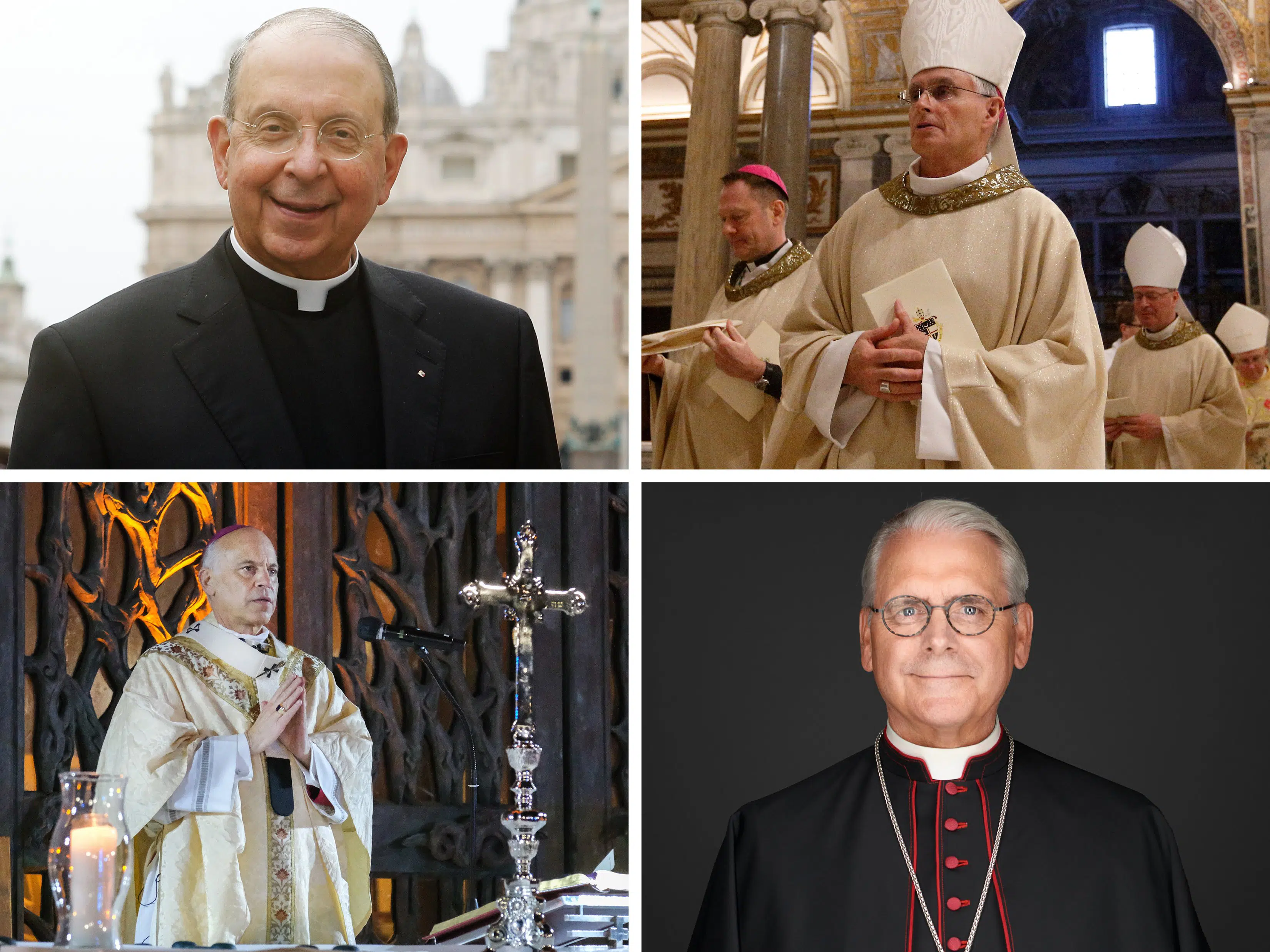
Pictured in this composite photo clockwise from top left are: Archbishop William E. Lori of Baltimore, chairman of the U.S. Conference of Catholic Bishops’ Committee on Pro-Life Activities; Bishop Thomas A. Daly of Spokane, Wash., chairman of the USCCB Committee on Catholic Education; Archbishop Paul S. Coakley of Oklahoma City, chairman of the USCCB Committee on Domestic Justice and Human Development; and Archbishop Salvatore J. Cordileone of San Francisco, chairman of the USCCB Committee on Laity, Marriage, Family Life, and Youth. (CNS composite; photos by Robert Duncan, Paul Haring, Archdiocese of Oklahoma City and Dennis Callahan of the Archdiocese of San Francisco)

WASHINGTON — In response to the multiple mass shootings in recent weeks, the chairmen of four U.S. Conference of Catholic Bishops’ committees sent a letter to Congress urging lawmakers to “stop the massacres of innocent lives.”

“We urge all members of Congress to reflect on the compassion all of you undoubtedly feel in light of these tragic events and be moved to action because of it,” the bishops wrote in a June 3 letter.

They said finding a way to stop ongoing acts violence as demonstrated in Ulvade, Texas, and Buffalo, New York, to name just a few examples, requires a broad response that examines “mental health, the state of families, the valuation of life, the influence of entertainment and gaming industries, bullying and the availability of firearms.”

And although they see a need for broad reform, they focused on guns in particular, stressing that “among the many steps toward addressing this endemic of violence is the passage of reasonable gun control measures.”

The letter was signed by Archbishop Paul S. Coakley of Oklahoma City, chairman of the Committee on Domestic Justice and Human Development; Archbishop Salvatore J. Cordileone of San Francisco, chairman of the Committee on Laity, Marriage, Family Life and Youth; Archbishop William E. Lori of Baltimore, chairman of the Committee on Pro-Life Activities; and Bishop Thomas A. Daly of Spokane, Washington, chairman of the Committee on Catholic Education.

These committee leaders noted that even though work needs to be done to address the root causes of violence, there were practical steps Congress could take right now by supporting legislation to expand background checks for gun sales.

“We urgently call on members of Congress to work together in a bipartisan fashion to make these horrific attacks less likely to happen again,” they wrote.

The bishops said the USCCB has long supported measures to address gun violence and continues to do so.

Looking at specific measures, they said they support a total ban on assault weapons and limitations on civilian access to high-capacity weapons and ammunition magazines. They also cited their support for universal background checks for all gun purchases, a more appropriate minimum age for gun ownership and a ban on bump stocks — additional gun parts which dramatically increase the guns’ rate of firing.

They pointed out that while “strengthened gun laws could reduce mass-casualty events, not even the most effective gun laws, by themselves, will suffice to address the roots of these violent attacks in our country” and stressed the need for improved mental health care access and resources as well as “peacebuilding in our communities through restorative justice models.”

“Bipartisanship is never more important than when it is required to protect life and end the culture of death. We invite you to support these measures and to be part of building up the culture of life that is so needed in our society, not just as elected officials but as mothers and fathers, grandparents, and aunts and uncles of little children or teachers whom you expect to return home safely today,” they wrote.

Monday, January 11, 2021

Where the laity are already serving as Instituted acolytes and lectors


YES, LAY PEOPLE ARE ALREADY BEING INSTALLED AS INSTITUTED LECTORS AND ACOLYTES


    A few people, including some clergy, have expressed dismay or even shock that men (and soon, women) who are not candidates for Holy Orders can become instituted Lectors and Acolytes. (You can read more about what’s prompting this discussion here.)

    But there are many dioceses around the United States that are already doing this.

    Take, for example, this item from Spokane, Washington: 

    On December 12, the feast of Our Lady of Guadalupe, Bishop Thomas Daly installed six laymen as acolytes at the Cathedral of Our Lady of Lourdes….In some cases, laymen not in preparation for holy orders may be installed as acolytes. The six new acolytes are: Dave Gibb, Gene DiRe, Justin Bullock, Dennis Johnson, Thomas Lavagetto and Rick Sparrow. Father Darrin Connall, cathedral rector and vicar general of the diocese, said of the new acolytes: “The men were chosen for their dedication to the cathedral family, and their service at the altar reflects their commitment to service in the wider community.”

    Acolytes differ from altar servers in that acolytes may perform more liturgical functions, such as purifying the eucharistic vessels, and serve as the senior altar server at a Mass. Acolytes must be at least 21 years of age, possess the necessary skills to carry out the ministry and be a member of the Church in good standing.

    The ministry has grown in popularity in Arlington, Texas, where one parish on its website describes what acolytes do:

    He is an Extraordinary Minister of Communion
    He may also perform all the duties of an altar server
    Besides the priest and the deacon, the acolyte is the only person allowed to purify the sacred vessels after communion
    With the pastor’s permission, he may expose the Blessed Sacarament for adoration, but he may not give the blessing with the monstrance
    He may carry the cross during the procession to the altar

    A parish in Lewisville, Texas also posted this item five years ago, seeking candidates:

    Bishop Olson has announced another opportunity for men in our diocese to be instituted as Acolytes. At St. Philip’s they assist with the Purification of the Sacred Vessels used during Mass, distributing Holy Communion and in other assigned ways such as exposing or reposing the Blessed Sacrament before or after Adoration when no Priest or Deacon is available. Because the ministry has its roots in the formation of ordained clergy, the ministry is reserved to men.

    Bishop Olson has expressed his desire that men chosen for this ministry should be experienced sacristans and liturgical ministers. Men must be at least 21 years of age, fully initiated and living an exemplary Christian way of life, with no impediments to sacramental reception, (e.g., if married, one must be in valid union recognized by the Church).

    A mandatory training session will be held in Fort Worth on Saturday, February 20 at St. George Catholic Church, and Acolytes will be formally instituted by the Bishop on either March 30 or April 16.

    Spend some time on Google and you can find more examples. It’s more widespread in some parts of the world than you may think.

    And soon, with women formally joining the ministry, it may become even more common.

    Thursday, October 15, 2020

    But a correct and courageous Bishop challenges McElroy, speaks truth on life


    Bishop Daly Challenges Bishop McElroy’s Statements on Abortion and the 2020 Election

    During an Oct. 13 virtual discussion about voting, the bishop of San Diego implied that Joe Biden’s overt support for abortion rights is a ‘prudential’ position that is acceptable for a Catholic politician to advance.

    Bishop Thomas Daly speaking with students gathered for the 2019 Respect Life Mass.
    Bishop Thomas Daly speaking with students gathered for the 2019 Respect Life Mass. (photo: Courtesy photo / Diocese of Spokane)

    SPOKANE, Wash. — Bishop Thomas Daly of Spokane told the Register Wednesday that he strongly disagreed with San Diego Bishop Robert McElroy’s guidance to Catholic voters, offered during a virtual discussion organized by St. Mary’s College just three weeks before the 2020 presidential election.

    In his Oct.13 remarks, Bishop McElroy indicated it was acceptable for Catholics to support Democratic nominee Joe Biden’s pro-abortion-rights stance because, according to the bishop, the “formulation of individual laws regarding abortion” lies in the “realm” of prudential judgment.

    “Reading through Bishop McElroy’s statement, I noticed that he never mentions that abortion is the ‘preeminent’ moral issue for Catholics,” Bishop Daly told the Register.

    “Bishop McElroy is a moral theologian, but one of the most important roles of a bishop is to teach, and he never mentions the Church’s teaching that abortion is the ‘preeminent’ moral issue for Catholics.”

    During the discussion, which was titled “Voting as an Authentic Disciple,” at the Indiana college, Bishop McElroy addressed the question of how Catholic voters should consider a candidate’s position on abortion. 

    According to the National Catholic Reporter, Bishop McElroy said that because the Church teaches that some actions, including abortion, are “intrinsically evil,” defined as “always and everywhere wrong,” Church leaders have argued that “candidates who seek laws opposing intrinsically evil actions automatically have a primary claim to political support in the Catholic conscience.”

    The San Diego bishop did not agree with this position and told his audience that “the framing of legislation is inescapably the realm of prudential judgment, not intrinsic evil.”

    “While a specific act of abortion is intrinsically evil, the formulation of individual laws regarding abortion is not,” he said. “It is an imperative of conscience for Catholic disciples to seek legal protections for the unborn. But whether these protections take the form of sanctioning the doctor or the pregnant mother, whether those sanctions should be civil or criminal penalties, and the volatile issues pertaining to outlawing abortions arising from rape, incest and danger to the mother are all questions of deep disagreement among advocates wholeheartedly devoted to the protection of unborn children. Like the issues of fighting poverty and addressing climate change, the issue of abortion in law and public policy is a realm where prudential judgment is essential and determinative.”


    Bishop Daly criticized his guidance in an Oct. 14 interview with the Register. 

    The 2020 election pits President Donald Trump, a Republican who has pledged to continue to implement and promote pro-life policies, against Joe Biden, a self-identified Catholic who backs Roe v. Wade, opposes the Hyde Amendment and has promised to pass legislation securing legal abortion should Roe be overturned.

    Bishop Daly recalled that before the November 2019 vote on updating the U.S. bishops’ election-year statement, “Cardinal [Blase] Cupich and Bishop McElroy wanted changes in the document, with Bishop McElroy arguing that it isn’t Catholic teaching that abortion is the preeminent issue that we face as a world, and Archbishop [Charles] Chaput stood to challenge that statement.”

    During that intense debate over the language on abortion that would be added to a letter accompanying the USCCB’s election-year guidance, “Forming Consciences for Faithful Citizenship,” Bishop McElroy argued that identifying abortion as a “preeminent priority” was at odds with Church teaching and with Pope Francis’ apostolic exhortation Gaudete et Exsultate (Rejoice and Be Glad). The exhortation states that the lives of the unborn are “equally sacred” with “the lives of the poor, those already born, the destitute, the abandoned and the underprivileged, the vulnerable infirm and elderly exposed to covert euthanasia, the victims of human trafficking, new forms of slavery, and every form of rejection.” 

    “It is not Catholic teaching that abortion is the preeminent issue that we face in the world of Catholic social teaching,” Bishop McElroy said, adding that to teach otherwise would provide “a grave disservice” to the faithful.

    Archbishop Charles Chaput of Philadelphia stood up to challenge Bishop McElroy’s argument. 

    “I am certainly not against quoting the Holy Father’s full statement. I think it’s a beautiful statement,” said Archbishop Chaput. “But I am against anyone stating that our stating it [abortion] is ‘preeminent’ is contrary to the teaching of the Pope,” he added, sparking applause. “That isn’t true.”

    Bishop McElroy also suggested in his St. Mary’s comments that voters should not question the Catholicity of a candidate who does not support pro-life policies.


    “One very sad dimension of the election cycle we are witnessing,” he said, is “the public denial of candidates’ identity as Catholics because of a specific policy position they have taken. Such denials are injurious because they reduce Catholic social teaching to a single issue. But they are offensive because they constitute an assault on the meaning of what it is to be Catholic.”

    Bishop Daly noted Bishop McElroy said it was “offensive” to question a candidate’s Catholic identity, irrespective of the polices they uphold. 

    “But in his description of what constitutes a Catholic, there is no mention of loving Christ and loving the truth,” Bishop Daly said. “The truth is that life begins at conception and must be protected and reverenced until natural death. That belief forms who we are as Catholics, but it is left out of his definition of being a Catholic, as far as I am concerned.”

    “I keep thinking of those words from Deuteronomy: ‘I have set before you life and death, the blessing and the curse. Choose life, then, that you and your descendants may live.’”

    Bishop Daly said that the San Diego bishop’s remarks “effectively constituted a defense of Biden and other prominent Catholic elected officials who publicly support unrestricted abortion.”

    “But if abortion is intrinsically evil, which Bishop McElroy admits to, how can Catholics vote for a candidate like Biden?” asked Bishop Daly.

    “He has moved in an aggressive way to do all he can to make sure abortion is available. He has walked away from the Hyde Amendment. If elected, he will push for legislation that furthers abortion. He is not passive on this issue. There is no nuance. He has taken a strong stand.”