Showing posts with label Beatification. Show all posts

Monday, November 2, 2026

A special All Saints Day Mass of Thanksgiving for the Beatification of the Georgia Martyrs


At Nov. 1 Mass of thanksgiving, archbishop says beatified Georgia Martyrs ‘are on their way to being saints’

November 1, 2026


Archbishop Gregory J. Hartmayer of Atlanta gives remarks Nov. 1, 2026, at the Cathedral Basilica of St. John the Baptist in Savannah, Ga., while presiding over the Mass of thanksgiving celebrating the Oct. 31 beatification of the five Georgia Martyrs, Franciscan friars murdered in 1597 for defending the Church's teaching on marriage. Archbishop Hartmayer served as bishop of Savannah from 2011 until his appointment to Atlanta in 2020. (OSV News photo/Lauretta Brown)

SAVANNAH, Ga. (OSV News) — Abundant gratitude was expressed for the Oct. 31 beatification of five Franciscans known as the Georgia Martyrs in a Mass of thanksgiving at the Cathedral Basilica of St. John the Baptist on Nov. 1, the solemnity of All Saints.

Presiding over the Mass was Archbishop Gregory J. Hartmayer of Atlanta, who served as bishop of Savannah from 2011 until his appointment to Atlanta in 2020. In remarks at the beginning of Mass, he expressed gratitude to his predecessors in Savannah, the diocese’s current leader Bishop Stephen D. Parkes, Franciscan leaders and others who championed the martyrs’ cause over decades.

“These were my brothers in St. Francis — Franciscans, Friars Minor,” said Archbishop Hartmayer, a Conventual Franciscan friar. “The Church asked with great patience: Did these men die because they would not betray the faith?

“In January of last year, Pope Francis answered for the full Church, and yesterday, Cardinal (Frank) Leo, legate of Pope Leo XIV, proclaimed it,” he continued. “The Church does not ‘make’ saints; she recognizes them.”

‘We can pray through their intercession’ 

Archbishop Hartmayer reflected on his own role in advancing the cause of Blessed Pedro de Corpa and companions, noting that when he was ordained bishop of Savannah, he found the cause “waiting for me,” and he worked with local Church leaders “to keep it moving” and “to make these men known to South Georgia and beyond,” which he continued in Atlanta, he said.

The Church rejoices, he said, to see the day that the martyrs who “gave their lives in 1597 on the shores of Brunswick and Darien, St. Simons (Island and) St. Catherines Island” were beatified.

“They are on their way to being saints, saints of the Church, and we can pray through their intercession now, as they are blessed, for our own needs, for the needs of others,” he said.

This is the official image by artist Jared Seff for the beatification of the Georgia Martyrs on Oct. 31, 2026, in Savannah, Ga. Seff won a competition hosted by the Diocese of Savannah, which brought in about 100 paintings. The artworks were displayed in an exhibit connected to the beatification at the Savannah Convention Center. (OSV News photo/courtesy Diocese of Savannah)

Saints ‘let God’s light shine through them’ 

The Mass of thanksgiving coincided with the solemnity of All Saints, a major feast day in the Church that commemorates all in the communion of saints, including those who have not been formally canonized and do not have a memorial on the Church’s liturgical calendar.

Preaching the Mass’ homily to a full cathedral with many families with children, Bishop Parkes described the saints as “the people who let God’s light shine through them” like stained-glass windows. 

Noting the many saints depicted in the cathedral’s windows, he said, “They are all shades, hues, colors of holiness” like the Beatitudes described in the Mass’ Gospel reading from Matthew 5:1-12.

“The shades that we see in the windows can represent the poor, persecuted, meek, merciful, the clean of heart and the peacemakers,” he said. “When we adopt those qualities, our rewards will be great in heaven.”

Georgia martyrs ‘probably amazed’ by attention

Turning to the Georgia Martyrs, Bishop Parkes said, “Saints have lived in all eras, have different personalities, many inspiring stories, including our new blessed: Pedro, Blas, Miguel, Antonio and Francisco.”

Friars Pedro de Corpa, Blas Rodríguez de Cuacos, Miguel de Añon, Antonio de Badajoz and Francisco de Veráscola, known together as the Georgia Martyrs, were missionaries who came from Spain to serve the Guale people in coastal Georgia. They were all killed within days of each other by the order of the soon-to-be chief Juanillo after Father Pedro stood by the Church’s teaching on marriage when Juanillo wanted to take a second wife.

“I can only think that these holy men in the Franciscan spirituality are probably amazed that they would be even spoken about here, over 400 years later, but we have confidence that they are praying for each one of us,” he said.

Among the Nov. 1 Mass’ concelebrants was Cardinal Leo, who, as the papal delegate, had presided over the beatification Mass, as well as Bishop Elias R. Lorenzo, an auxiliary bishop of Newark, N.J.; Bishop Jeffrey J. Walsh of Gaylord, Michigan; Bishop Isaac Dugu of Katsina-Ala, Nigeria; and Bishop Anselm Umoren, an auxiliary bishop of Abuja, Nigeria.

Martyrs’ impact on marriage

With their beatification, the Georgia Martyrs’ cause could advance to canonization with the official recognition of a miracle attributed to their intercession.

“I’ll be honest: I am not sure where all of this is going to go,” Bishop Parkes said, “but I am confident in the Holy Spirit. I am confident in the continued work, the graces that will be poured out after this beatification.”

Bishop Parkes said that the martyrs’ witness is expected to inspire diocesan efforts to further promote “the dignity of marriage and healthy family life.” He said the diocese will celebrate the martyrs on their Sept. 22 liturgical memorial, and perhaps that day pray for the advancement of the martyrs’ cause, as well as for couples in Georgia preparing for marriage.

Bishop Stephen D. Parkes of Savannah, Ga., preaches Nov. 1, 2026, at the Cathedral Basilica of St. John the Baptist in Savannah during the Mass of thanksgiving celebrating the Oct. 31 beatification of the five Georgia Martyrs. (OSV News photo/Lauretta Brown)

Bishop Parkes also suggested that marrying couples include in their wedding Mass an intercessory prayer for Blessed Pedro de Corpa and companions “to work within the newly married couple.”

“There are many other ways we can continue to offer these holy men,” he said. “We have received a gift, and with any gift that we receive, we should always accept it with gratitude, with thanksgiving in our hearts.”

Seeking ‘extraordinary favors’ 

The Mass program requested that “extraordinary favors received from God through the intercession of the Georgia Martyrs should be reported to The Cause of the Georgia Martyrs, 2170 E. Victory Drive, Savannah, Georgia, 31404, or thegeorgiamartyrs.org.”

In Rome Nov. 1, Pope Leo drew attention to the Georgia Martyrs after he prayed the Sunday Angelus in St. Peter’s Square.

“Originally from Spain, they responded generously to the Lord’s call to evangelize the peoples of the Americas, even to the point of giving their lives,” he said. “Let us invoke the intercession of these martyrs for all missionaries of the Gospel.”


Maria Wiering is senior managing editor for OSV News. Lauretta Brown, OSV News’ culture editor, reported from Savannah.

Saturday, October 31, 2026

Today in Savannah Georgia the beatification of the Georgia Martyrswith Cardinal Frank Leo presiding


The "Georgia Martyrs" (Photo courtesy of the Diocese of Savannah/public domain)The "Georgia Martyrs" (Photo courtesy of the Diocese of Savannah/public domain) 

Five Franciscan missionaries beatified in Georgia

Cardinal Frank Leo, papal legate, presides over beatification in Savannah, highlighting the missionaries’ witness to Christ, their commitment to evangelization, and their enduring example for the Church.

Vatican News

Five Spanish Franciscan missionaries who were killed in 1597 while serving the Indigenous Guale people along the coast of what is now the U.S. State of Georgia have been proclaimed Blessed during a beatification celebration in Savannah on Saturday, 31 October.

Cardinal Frank Leo, Metropolitan Archbishop of Toronto, presided over the liturgy as papal legate, bringing the greetings and closeness of Pope Leo XIV to those gathered for the occasion.

In his homily, the Cardinal described the friars who are known collectively as "Georgia Martyrs" – Pedro de Corpa, Blas Rodríguez, Miguel de Añon, Antonio de Badajóz and Francisco de Veráscola – as “shining witnesses of the Gospel”, whose lives and deaths continue to speak to the Church today.

The five Franciscans were among the missionaries who travelled from Spain to the region in the late sixteenth century to preach the Gospel and serve the Guale communities. Their deaths followed an uprising in 1597, after Friar Pedro de Corpa opposed the decision of a Guale leader, Juanillo, to take a second wife, contrary to Christian teaching on marriage. The violence spread to other Franciscan missions, where four of his companions were also killed.

The Church formally recognized the five friars as martyrs in January 2025, when Pope Francis authorized the promulgation of the relevant decree, paving the way for their beatification.

A witness that speaks across the centuries

Reflecting on the significance of the celebration, Cardinal Leo emphasized that the recognition of the five missionaries is not simply an honour for the local Church, but a gift for the universal Church. Recalling the words of St John Paul II, he said that martyrdom represents a particular gift of the Holy Spirit and a source of grace and holiness for the entire Church.

The Cardinal also linked the beatification to two significant anniversaries: the 250th anniversary of the United States Declaration of Independence and the 800th anniversary of St Francis of Assisi's death, whose Franciscan charism inspired the missionaries.

He identified three principal aspects of the friars’ witness: their response to the universal call to holiness, their defence of human dignity and the sanctity of marriage and family, and their commitment to evangelization through dialogue and charity.

He said the missionaries understood their vocation as a call to serve others and share the Gospel, even at the cost of their lives. Their example challenges Christians today to remain faithful to Christ while engaging with others through dialogue, respect and a spirit of service.

Cardinal Frank Leo

A call to renewal and reconciliation

Cardinal Leo also invited the faithful to consider how the martyrs’ witness might inspire the Church in the present day, particularly in responding to division and polarization.

Referring to the need to work for unity and healing, he recalled that “polarization is not of God”, encouraging prayer, reconciliation and concrete acts of charity.

The friars’ example, he added, should inspire families, parishes, religious communities, schools and social institutions to renew their commitment to evangelization and to bearing witness to the Gospel in everyday life.

Concluding his homily, Cardinal Leo entrusted the faithful to the intercession of the Blessed Virgin Mary and the newly beatified martyrs, inviting Christians to share their faith with courage, fidelity and joy.

“There are some things today that are still worth living and dying for,” he said.

Friday, October 23, 2026

Another U.S. Beatification coming on October 31st: The Georgia Martyrs


Georgia Martyrs’ beatification the next big event for US Church


This oil on canvas of the five Georgia Martyrs titled "Faith breaks language barriers of the five Martyrs" was created in 2021 by artist Clorinda Galdos Bell. The Franciscan friars' beatification has been set for Oct. 31, 2026, in Savannah. (OSV News photo/courtesy Clorinda Galdos Bell)


(OSV News) — While six years separate the two most recent U.S. beatifications of Blessed Michael J. McGivney in 2020 and Blessed Fulton J. Sheen on Sept. 24, mere weeks pass before the next: five Franciscan friars known as the Georgia Martyrs on Oct. 31.

Cardinal Frank Leo of Toronto will celebrate the 11 a.m. beatification Mass, which will be livestreamed on social media channels and the diocesan website, diosav.org, as well as by EWTN.

Speaking about the Georgia Martyrs with OSV News, Cardinal Leo said, “We all have that same command from the Lord Jesus to go make disciples.”

“The Georgia Martyrs offered more than self-sacrifice,” he said. “They brought it to the next level in terms of self-gift. … It was a choice and a decision to make a gift to the Lord by becoming a gift to his people, who needed to know him and to live for him.”

Who are the Georgia Martyrs?

In 1597, the Spanish Franciscans Pedro de Corpa, Blas Rodríguez de Cuacos, Miguel de Añón, Antonio de Badajoz and Francisco de Veráscola were ministering at five missions along the coast and barrier islands of present-day Georgia when they were killed out of hatred for the faith by a band of Indigenous men between Sept. 14-17.

The friars’ murders were prompted by Father de Corpa angering the heir to a Guale chiefdom, Juanillo, by telling him that as a baptized Christian, he could not follow his culture’s custom and take a second wife. Juanillo and his men killed the priest at a mission near the contemporary city of Eulonia, Georgia, before killing four of the other five Franciscan missionaries ministering in the area. The sixth friar, Francisco de Avila, was kidnapped and tortured for months before being set free. The incident is known as the 1597 Guale Uprising.

At the time, the Spaniards knew the wider coastal area as La Florida, home to the settlement of St. Augustine, established in 1565. By 1595, the friars had established five missions along the coast. Prior to their murders, the six Franciscans appear to have lived among the Guale and other indigenous peoples in peace, without a military presence, for two years. 

About a month after the friars were killed, the governor of La Florida led an expedition to locate the martyred friars’ bodies. According to the Diocese of Savannah’s website on the martyrs, there is no record of Friar Francisco’s remains being found. The bodies of Friars Blas, Miguel and Antonio were found buried in shallow graves on St. Catherines Island. The men in the October 1597 expedition reburied them, with the exception of the severed head of Friar Miguel, which they took with them. 

Less than a decade later, when Franciscans had returned to the coastline to evangelize, the friars’ bodies on St. Catherines Island were exhumed and brought to St. Augustine, but their whereabouts today are unknown. Some scholars speculate that Franciscans took the martyrs’ remains with them to Cuba when St. Augustine transferred to British rule in 1763. 

Friar Pedro de Corpa was decapitated and his body was not found; the location of his skull is uncertain. A skull recovered at the Fort King George State Historical Site in Darien may belong to Friar Pedro or Father Francisco, and testing is underway to learn more about its origins.

The Georgia Martyrs highlight missionary Church 

The National Eucharistic Pilgrimage drew attention to the martyrs in May, as the nine perpetual pilgrims spent the third day of their pilgrimage in southern Georgia, walking in a Eucharistic procession at Fort King George, where Friar Francisco is believed to have been killed.

The five Franciscans’ martyrdom is “a reminder of how the Church has, over the centuries, continued to send out missionaries to all peoples, to all nations, to faraway places,” Father Pablo Migone, vicar for mission advancement for the Diocese of Savannah, said during that visit. “That is something we have done from the very beginning from the words of Jesus to the apostles.”

Beatification details

The Beatification Mass is not ticketed, and seats in the Savannah Convention Center are first come, first served. Doors for the liturgy open at 8 a.m. Oct. 31. The convention center will host the Georgia Martyr Museum between 8-10:30 a.m. and 1-2:30 p.m. 

The Mass coincides with Halloween, the eve of All Saints’ Day. It also coincides with the Jubilee Year of their order’s founder, St. Francis of Assisi, which commemorates the 800th anniversary of his death.

On Nov. 1, Bishop Stephen D. Parkes of Savannah will celebrate a Mass of thanksgiving at 11:30 a.m. at the Cathedral Basilica of St. John the Baptist in Savannah, which will also be livestreamed at the cathedral’s website, savannahcathedral.org.

The slain Franciscans were seen as martyrs by their contemporaries

Reports from civil and religious leaders in the months and years after the Franciscans’ deaths reveal that the slain friars’ contemporaries saw them as martyrs. New research in the 20th century about the history of La Florida and the Georgia Martyrs bolstered efforts to move forward with a cause for their beatification.

With the support of the Order of Franciscans Minor, the Diocese of Savannah opened the cause for the martyrs’ canonization in February 1984 under Savannah’s Bishop Raymond W. Lessard, who died in 2016. In January 2025, Pope Francis authorized the Dicastery for the Causes of Saints to formally recognize the five friars’ martyrdom “in hatred of the faith.”

Alongside the sainthood cause for the five Georgia martyrs is a separate cause for the Martyrs of La Florida Missions, which encompasses 58 people martyred in the region between 1549 and 1715. Known as Antonio Inija and Companions, Servants of God, their collective cause officially opened Oct. 12, 2015, and includes Dominican, Franciscan and Jesuit priests; lay men and women; and children, including an unborn child.

Thursday, September 24, 2026

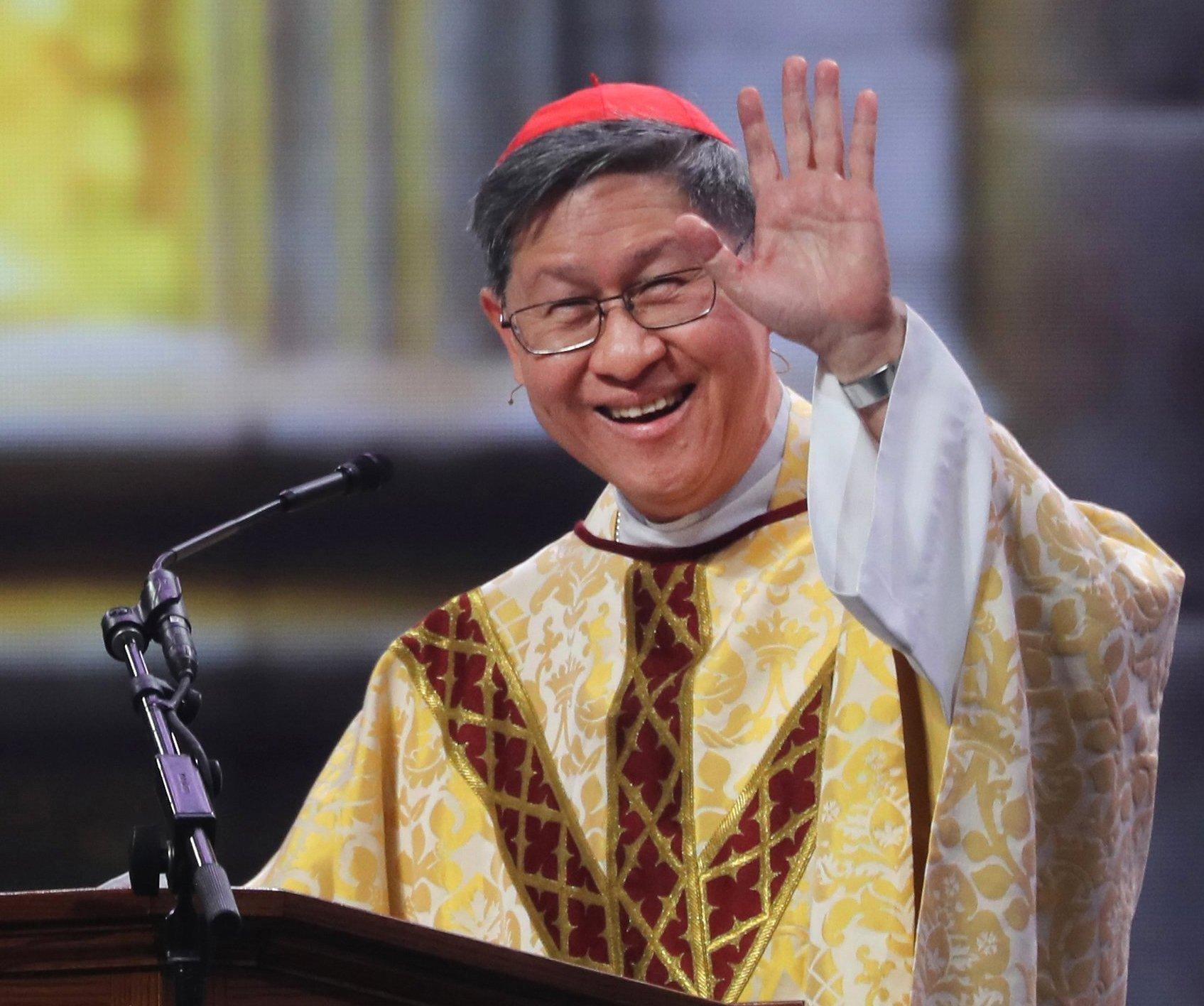
Ahead of today's Beatification in St. Louis for Fulton J. Sheen, Cardinal Tagle holds Mass in Sheen's home diocese of Peoria


Cardinal Tagle encourages faithful to adopt Archbishop Sheen’s virtues as beatification nears

 22, 2026

(OSV News) — The grace of the beatification of Archbishop Fulton J. Sheen comes with corresponding responsibility for Catholics in his home diocese of Peoria, Illinois, Cardinal Luis Antonio Tagle told Catholics there during Mass Sept. 22.

“This is a grace for all of us here, but also a heavy responsibility,” he said in his homily in Peoria’s Cathedral of St. Mary of the Immaculate Conception, where Archbishop Sheen’s remains are entombed. “From now on, when people learn that you are from Peoria, they will say, ‘Oh, are you as missionary oriented as Bishop Fulton Sheen? Are you deeply entrenched in the Word of God, like the Blessed Fulton Sheen?'”

He said, with a laugh, that he hoped that they would not deny being from Peoria, but rather answer, “Yes, I am from Peoria, and this is a blessing from the Lord.”


Beatification preparation

Cardinal Tagle celebrated the morning Mass at Peoria’s cathedral while visiting the central Illinois city of 113,000 to venerate the relics of Archbishop Sheen, who will be beatified Sept. 24. Serving as Pope Leo XIV’s papal delegate, the cardinal will preside over the beatification Mass in St. Louis, about 170 miles southwest.

Cardinal Tagle, 69, serves as a pro-prefect for the Holy See’s Dicastery for Evangelization, leading its Section for the First Evangelization and New Particular Churches, and is the archbishop emeritus of his native Manila. He is an alumnus of The Catholic University of America in Washington and in 2024 served as the Holy See’s envoy to the 10th National Eucharistic Congress in Indianapolis.

In the homily, he joked that Catholics from Peoria should not taunt the faithful from nearby Chicago, asking them, “Has Chicago produced a blessed? Oh, no? … Poor Chicago.”

Cardinal Tagle pointed to the Mass’ first reading from Proverbs 21:1-6, which reminds the faithful that “to do what is right and just is more acceptable to the Lord than sacrifice.”

“The heart of a wise person is in the hands of the Lord, and his heart allows the Lord to direct its destiny,” he said, “and when the heart is guided by the Word of the Lord, it will be just … The Lord is more pleased with the heart that is open to his will, that’s attentive to his promptings and is ready to act on his inspiration.”


A ‘heart that listens’ 

Cardinal Tagle underscored the importance of listening by relating it to the need for understanding between married couples, consecrated religious men and women and their superiors, and priests to their bishops.

“All of us expect to be listened to,” he said, but listening to one another “is at the heart of being a wise person and a follower of the Lord.”

The liturgy’s Gospel reading from Luke 8:19-21 recounted Jesus saying, “My mother and my brothers are those who hear the word of God and act on it.”

Cardinal Tagle said the reading showed that “heart that listens” in Mary, who was both Jesus’ mother and disciple. “She must have said, ‘My son recognizes that I became the worthy dwelling place, his dwelling place, because I listened to the word of God’ and after listening, made herself available.”

The obedient heart

A listening heart, the cardinal continued, also reflects the humanity of the Christian. “Pope Leo has been directing all of us to our being persons,” he said, alluding to “Magifica Humanitas,” his recent encyclical on humanity and artificial intelligence. “We are not machines. We are not gadgets. We are persons with hearts.

“Where is your heart?” he continued. “Does it still beat? Does it still hear? Does it still see? Is it still obedient? If it is a truly human heart, then it is capable of relating with God and doing what God says.”

The cardinal encouraged the congregation to follow the example of Mary and Archbishop Sheen in obedience to God. Then, when they say they are from Peoria, he said, people not only associate them with the birthplace of Archbishop Sheen, but with a place where, “like Fulton Sheen, you all listen to the word of God and act on it.”

“Then Peoria becomes part of the wider family, the wider family of God, and Jesus will be pleased,” he said.


Evening Holy Hour

At the end of Mass, Cardinal Tagle recognized the Filipino Catholics present at the Mass and briefly addressed them in their native language. He then greeted the full congregation on behalf of Pope Leo.

“When I go back to Rome, I will surely report to him about the beatification and will tell him about this Mass and your presence at this Mass,” he said.

He also noted the Holy Hour that he planned to attend later that evening, which is the penultimate Holy Hour in a nine-day series leading up to beatification.

Archbishop Sheen famously adopted a daily Holy Hour as part of his own spiritual practice while in formation for the priesthood at St. Paul Seminary from 1917-1919, and he maintained the practice through his life.

Archbishop Sheen was ordained in 1919 as a priest of the Diocese of Peoria. He taught philosophy at The Catholic University of America and rose to fame first through his radio show “The Catholic Hour” and then TV show “Life is Worth Living.” He meanwhile served as national director for the Society of the Propagation of the Faith, an arm of the Holy See now part of the Pontifical Mission Societies, supporting the Church’s evangelization and humanitarian relief efforts around the world. He was an auxiliary bishop of the Archdiocese of New York before serving as bishop of Rochester, New York, from 1966 to 1969. Upon his retirement, Pope Paul VI gave him the title “archbishop.” He continued to preach and give retreats and died at age 85 in 1979.


Maria Wiering is senior managing editor of OSV News.

He was a "master of modern media"; the soon to be beatified Fulton J. Sheen


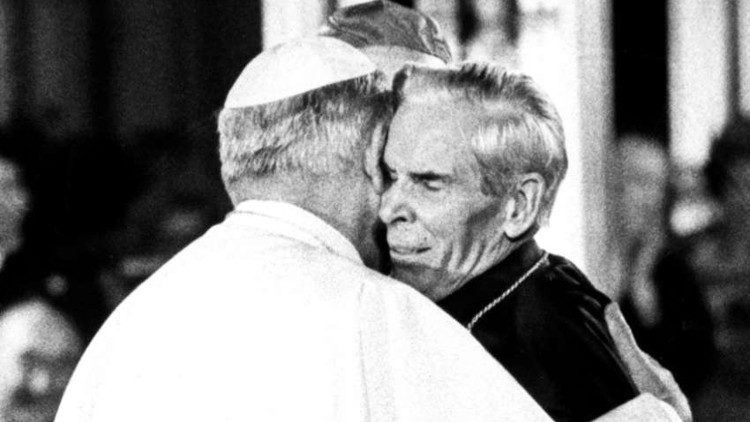
In 1979, Pope John Paul II embraced Archbishop Sheen at St. Patrick's Cathedral in New York CityIn 1979, Pope John Paul II embraced Archbishop Sheen at St. Patrick's Cathedral in New York City 

Archbishop Fulton Sheen: A 'master of modern media'

Amid the noise of our media-driven world, Bishop Louis Tylka of Peoria, Illinois, reflects on what Archbishop Fulton Sheen called “the most important conversation in a human life”—the one that takes place “in the depths of the heart.”

By Bishop Louis Tylka*

We live in an age of extraordinary communication. The devices we carry give us access to more information than previous generations could have imagined. At almost any moment, from almost anywhere in the world, we can reach another person, receive breaking news, and watch events unfold thousands of miles away.

And yet, for all this connection, many people today feel profoundly disconnected.

We are surrounded by voices and struggle to hear one another. We consume an endless stream of information, opinions and images, yet find ourselves searching for meaning. Technology promises community, but can create echo chambers in which we hear only those who already think as we do. Furthermore, without physical human interaction, the communal sense created leaves a person hungering for genuine connections. Instead of drawing us together, our methods of communication can deepen division, anxiety and loneliness.

Archbishop Fulton J. Sheen understood that the most important conversation in a human life takes place in the depths of the heart. It is one reason his voice remains so compelling today.

In 1951, Sheen was appointed Auxiliary Bishop of the Archdiocese of New York   (© Fred Palumbo, Library of Congress)

Archbishop Sheen was a master of modern media in his own era. He understood radio and television and used them with remarkable effectiveness. He entered millions of homes through The Catholic Hour and Life Is Worth Living. Standing before the cameras with his blackboard and episcopal regalia, he spoke about God, human nature, love, suffering, freedom, marriage, temptation and eternity.

What distinguished Archbishop Sheen was more than his command of these new media; it was that he knew what he wanted to communicate. He believed that beneath our ambitions, fears, distractions and sins is a human heart made for God. He observed that “nothing ever happens in the world that does not happen first inside human hearts.” That conviction ran throughout his preaching and writing.

For Archbishop Sheen, the interior life was not an escape from the world. It was where the Christian learned how to enter the world truthfully. This is an important distinction for our time. The digital world constantly invites us outward: What is happening? What is trending? What are people saying? Who agrees with me? Who is against me? What should I fear? What should I desire next? The Gospel asks different questions: Who am I before God? Whom am I called to love? Where do I need conversion? What is Christ asking of me? These questions require something increasingly difficult to find: silence.

Archbishop Sheen’s public ministry was rooted in this kind of interior encounter with Christ. For decades, he maintained the practice of a daily Holy Hour before the Blessed Sacrament. The man who spoke to millions first learned to be silent before God.

There is something deeply instructive in that for all of us, particularly those entrusted with communicating the Gospel today. Before we speak, we must listen. Before we post, we must pray. Before we seek to influence others, we must allow Christ to convert our own hearts. Archbishop Sheen understood that evangelization is more than the transmission of religious information. It is an invitation into a relationship with Jesus Christ and, through Him, with one another.

As Bishop of Peoria, I am profoundly grateful that the Church will soon number Archbishop Sheen among the Blessed. On September 24, 2026, he will be beatified in St. Louis, Missouri in an extraordinary moment of grace for our local Church, for the Church in the United States and, I believe, for the universal Church.

Earlier this year, Pope Leo XIV beautifully described Archbishop Sheen as “a light of faith, hope, and love” whose radio and television ministry touched millions with the hope of the Gospel. The Holy Father added a remarkable personal testimony: “I myself am a witness of his evangelization when I was growing up.” That testimony reminds us that we do not always know where a word spoken in faith will travel or what fruit it may bear.

Decades after Sheen stood before a television camera, his voice continues to reach new generations. His talks now circulate through digital platforms that did not exist during his lifetime. Young people encounter him online and discover that a bishop who died in 1979 somehow understands their questions about happiness, loneliness, identity, love and God. Why? Because technology has changed, but the human heart has not. Our deepest hunger remains the same.

The Church must learn to evangelize in the digital world. We should creatively use every worthy means available to proclaim Jesus Christ. Archbishop Sheen himself would surely encourage us to do so. But his witness also offers a necessary caution: We must never become so fascinated with the means of communication that we forget the purpose of communicating.

Our task is not to generate more content in an already noisy world. Our task is to help people encounter Christ — and through Christ, to encounter one another as brothers and sisters. Sometimes that encounter begins when the noise stops, the screen goes dark and a person becomes quiet enough to hear the voice of God speaking within the heart.

Archbishop Fulton Sheen understood that. Our world needs to rediscover it.

* The Most Reverend Louis Tylka is Bishop of Peoria, Illinois. Archbishop Fulton J. Sheen will be beatified September 24, 2026, in St. Louis, Missouri. More information is available at CelebrateSheen.com.