Showing posts with label Archbishop Iannone. Show all posts

Friday, September 26, 2025

Pope Leo XIV appoints new head for the Dicastery for Bishops


Archbishop Filippo Iannone, newly appointed Prefect of the Dicastery for BishopsArchbishop Filippo Iannone, newly appointed Prefect of the Dicastery for Bishops 

Pope names Archbishop Iannone as Prefect of Dicastery for Bishops

In his first appointment of a head of a Vatican department, Pope Leo names Archbishop Filippo Iannone, O. Carm. – who has been serving as Prefect of the Dicastery for Legislative texts – as Prefect of the Dicastery for Bishops.

By Salvatore Cernuzio

The choice of a successor as prefect of the Dicastery for Bishops was always expected to be among the first appointments by Pope Leo, following the precedent established by Pope Benedict XVI with his early choice of William Levada to follow him as head of the then Congregation for the Doctrine of the Faith.

Prior to his election as Pope Leo XIV, Robert Prevost headed up the Dicastery for Bishops, from January 2023, when he was transferred to Rome by Francis, until the death of the Pope in April 2025. On Friday, 26 September, Pope Leo XIV appointed Archbishop Filippo Iannone, until now Prefect of the Dicastery for Legislative Texts, as Prefect of the Dicastery for Bishops, a role that also includes presidency of the Pontifical Commission for Latin America.

Secretary and Undersecretary confirmed in their roles

The announcement of Archbishop Iannone’s appointment came in the daily Bulletin of the Holy See Press Office, which noted that the Archbishop will take up his new post on 15 October 2025.

The Press Office announced at the same time that Pope Leo has confirmed Brazilian Archbishop Ilson de Jesus Montanari as Secretary of the same Dicastery for a further five-year term (he was first named to the role by Francis in 2013). The Pope also confirmed Monsignor Ivan Kovač as Undersecretary for a further five-year term.

Archbishop Iannone’s appointment is the first nomination of a head of a Dicastery made by Pope Leo. The only other appointment to a senior role in a Roman Curia body had been made on May 22 – just days after his election – when he named Sister Tiziana Merletti, a nun of the Institute of the Franciscan Sisters of the Poor, as secretary of the Dicastery for Institutes of Consecrated Life and Apostolic Societies.

Jurist and Canon Lawyer

Archbishop Iannone, a native of Naples who will turn 68 on December 13, is a Carmelite, jurist, and canon lawyer with extensive experience in courts, pontifical universities, and the archdiocese.

He has held various positions in Rome, including serving as a member of the Supreme Tribunal of the Apostolic Signatura; a consultor to the then Congregation for Institutes of Consecrated Life; a member of the Council for Legal Affairs of the Italian Bishops’ Conference; president of the Committee for Places of Worship, and a member of the Episcopal Conference of the Italian province of Lazio.

In 2012, he was appointed vicegerent of the Diocese of Rome by Benedict XVI; later, in 2017, he was transferred by Francis to the position of adjunct secretary of the Pontifical Council for Legislative Texts. He became president of that Council the following year, on 7 April 2018.

The task of choosing the world's bishops

Archbishop Iannone is now charged with continuing the work that the future Pope had undertaken for two years. The role of Prefect of the Dicastery for Bishops is a delicate one: assisting the Pope in choosing the pastors to whom he will entrust the ecclesial communities throughout the world. After identifying priests to propose for the episcopate, the final decision rests with the Pope.

To assist in this mission, Francis appointed three women as members of the Dicastery for Bishops in July 2022: Sister Raffaella Petrini, current president of the Governorate of Vatican City State; Yvonne Reungoat, former superior general of the Daughters of Mary Help of Christians; and Maria Lia Zervino, former president of the World Union of Catholic Women's Organizations (WUFC).

Saturday, October 19, 2024

At the Synod they tackle the fight against Abuse


Archbishop Filippo Iannone, Prefect of the Dicastery for Legislative TextsArchbishop Filippo Iannone, Prefect of the Dicastery for Legislative Texts  (Vatican Media)

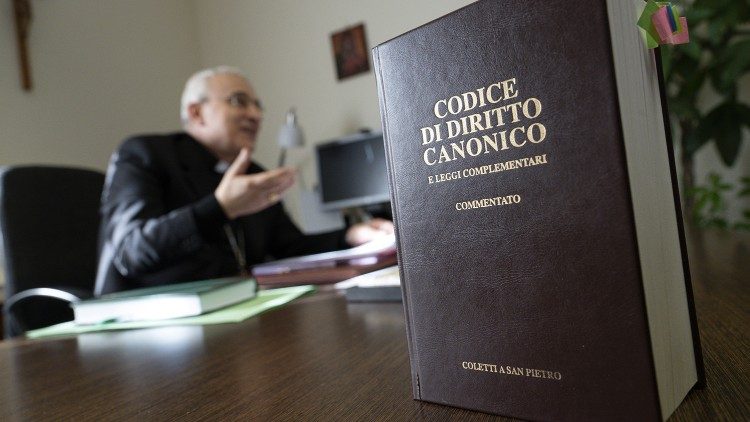
Archbishop Iannone on Church's fight against abuse and existing norms

As the Synod on Synodality explores the issue of abuse and the Church's efforts to combat it, Archbishop Filippo Iannone, Prefect of the Dicastery for Legislative Texts, speaks to Vatican News about the various procedures being implemented and the efficacy of existing canonical norms.

By Andrea Tornielli

The fight against abuse remains a constant concern within the Church, especially in recent years. The topic has also surfaced in the discussions of the ongoing Synod and continues to be monitored closely by the media.

We spoke to Archbishop Filippo Iannone, Prefect of the Dicastery for Legislative Texts, to explore some of the procedures being implemented.

Q: Can you tell us where we stand in terms of the laws in force? Are they effective?

This is certainly a topic of central concern for the entire Church, as the Pope frequently emphasizes, so it naturally found its way into the interventions of the Synod members. Canon law for the repression and punishment of crimes of abuse against minors and vulnerable adults has been updated in recent years, taking into account the experience gained in past years, various suggestions from local Churches, and individuals working at different levels in combating the phenomenon. Most importantly, it reflects the 2019 meeting in the Vatican, convened by Pope Francis, with the Presidents of Episcopal Conferences from around the world and officials from the Roman Curia.

Canon penal law has been revised, and the new motu proprio Vos estis lux mundi was promulgated, which establishes "universal procedures aimed at preventing and combating these crimes that betray the trust of the faithful." The norms followed by the Dicastery for the Doctrine of the Faith when judging crimes reserved to it have also been revised. In all the legislative texts, the focus is increasingly placed on the well-being of those whose dignity has been violated and the desire to ensure a "just" process, respecting the fundamental principles of the legal system. Among other things, the obligation for priests and consecrated persons to report potential abuses to ecclesiastical authorities if they become aware of them has been established.

Regarding the effectiveness of the norms, it is difficult to give a global judgment because it would require access to all relevant data. However, based on my personal experience, I would say yes. In any case, I would like to recall Pope Francis' words: " Even if so much has already been accomplished, we must continue to learn from the bitter lessons of the past, looking with hope towards the future.."

Q: Can you explain how the possible remission of an excommunication is granted? Are there expedited processes for this? Who is involved?

Excommunication, which canon law classifies among the censures, is the penalty that deprives a baptized person who has committed a crime (such as the desecration of the Eucharist, heresy, schism, abortion, or violation of the seal of confession by a priest) and is contumacious (i.e., disobedient) of certain spiritual goods until they cease to persist in this state and are absolved. The spiritual goods, or those attached to them, that the penalty deprives the individual of are those necessary for Christian life, primarily the sacraments.

Excommunication has a strictly “medicinal” purpose, aimed at the recovery and spiritual healing of the person affected, so that, once repentant, they may once again receive the goods from which they have been deprived (the salvation of souls is the supreme law in the Church). Consequently, to obtain remission, the person must demonstrate that this purpose has been achieved. No specific timeframes are set. The necessary condition is that the individual has truly repented of the crime and has made adequate reparation for the scandal and damage caused, or at least has seriously promised to make such reparation. Obviously, the evaluation of these circumstances must be made by the authority responsible for granting the remission of the penalty, in a pastoral spirit, taking into account the person's good disposition and the social impact of such a decision.

Q: In recent weeks, several media articles have offered various interpretations regarding the canonical procedures for reserved crimes. Could you explain what these procedures are and how they are applied?

We are dealing with crimes that, due to their gravity in matters of faith or morals, are judged exclusively by the Dicastery for the Doctrine of the Faith. The procedure followed by the Dicastery can be of two types: the so-called "administrative" procedure or the judicial procedure. In the case of an administrative process, once the procedure is concluded with an extrajudicial penal decree, the convicted individual has the possibility of appealing the decision to the College for the examination of appeals, specially constituted within the same Dicastery. The decree issued by this College is final. In the case of a judicial penal process, once the various stages of the trial have been completed, the sentence becomes final (res iudicata) and thus enforceable.

In both cases, the convicted person may request restitutio in integrum (i.e., the restoration of their original condition) from the Dicastery for the Doctrine of the Faith. It is also possible to request a review in the form of mercy; in this case, the procedure is ordinarily handled by the Supreme Tribunal of the Apostolic Signatura, but it may also be entrusted to other bodies. Given the confidential nature of such communications, the Secretariat of State coordinates the various instances and sends the relevant decisions for the execution of the adopted measures.