Ordinary Time: September 29th
Feast of Sts. Michael, Gabriel, and Raphael, Archangels
The liturgy celebrates the feast of these three archangels who are venerated in the tradition of the Church. Michael (Who is like God?) was the archangel who fought against Satan and all his evil angels, defending all the friends of God. He is the protector of all humanity from the snares of the devil. Gabriel (Strength of God) announced to Zachariah the forthcoming birth of John the Baptist, and to Mary, the birth of Jesus. His greeting to the Virgin, "Hail, full of grace," is one of the most familiar and frequent prayers of the Christian people. Raphael (Medicine of God) is the archangel who took care of Tobias on his journey.
According to the 1962 Missal of St. John XXIII the Extraordinary Form of the Roman Rite, today is the feast of St. Michael. St. Gabriel is observed on March 24 and St. Raphael on October 24.
The Catechism of the Catholic Church teaches us that, "The existence of the spiritual, non-corporeal beings that Sacred Scripture usually calls "angels" is a truth of faith. The witness of Scripture is as clear as the unanimity of Tradition" (#328).
"In her liturgy, the Church joins with the angels to adore the thrice-holy God. She invokes their assistance (in the funeral liturgy's In Paradisum deducant te angeli. . .["May the angels lead you into Paradise. . ."]). Moreover, in the "Cherubic Hymn" of the Byzantine Liturgy, she celebrates the memory of certain angels more particularly (St. Michael, St. Gabriel, St. Raphael, and the guardian angels)" (#335).
Angels are pure, created spirits. The name angel means servant or messenger of God. Angels are celestial or heavenly beings, on a higher order than human beings. Angels have no bodies and do not depend on matter for their existence or activity. They are distinct from saints, which men can become. Angels have intellect and will, and are immortal. They are a vast multitude, but each is an individual person. Archangels are one of the nine choirs of angels listed in the Bible. In ascending order, the choirs or classes are 1) Angels, 2) Archangels, 3) Principalities, 4) Powers, 5) Virtues, 6) Dominations, 7) Thrones, 8) Cherubim, and 9) Seraphim.
The previous liturgical calendar (1962) celebrated solely the feast of St. Michael on September 29. St. Gabriel was observed on March 24 and St. Raphael on October 24. This is why there are more traditions regarding "Michaelmas" instead of all three archangels.
St. Michael
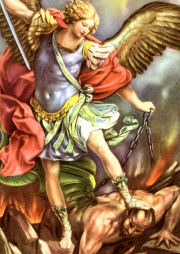 The name of the archangel Michael means, in Hebrew, who is like unto God? and he is also known as "the prince of the heavenly host." He is usually pictured as a strong warrior, dressed in armor and wearing sandals. His name appears in Scripture four times, twice in the Book of Daniel, and once each in the Epistle of St. Jude and the Book of Revelation. From Revelation we learn of the battle in heaven, with St. Michael and his angels combatting Lucifer and the other fallen angels (or devils). We invoke St. Michael to help us in our fight against Satan; to rescue souls from Satan, especially at the hour of death; to be the champion of the Jews in the Old Testament and now Christians; and to bring souls to judgment.
This day is referred to as "Michaelmas" in many countries and is also one of the harvest feast days. In England this is one of the "quarter days," which was marked by hiring servants, electing magistrates, and beginning of legal and university terms. This day also marks the opening of the deer and other large game hunting season. In some parts of Europe, especially Germany, Denmark, and Austria, a special wine called "Saint Michael's Love" (Michelsminne) is drunk on this day. The foods for this day vary depending on nationality. In the British Isles, for example, goose was the traditional meal for Michaelmas, eaten for prosperity, France has waffles or Gaufres and the traditional fare in Scotland used to be St. Michael's Bannock (Struan Micheil) — a large, scone-like cake. In Italy, gnocchi is the traditional fare.
Patronage: against danger at sea; against temptations; ambulance drivers; arms manufacturers; artists; bakers; bankers, banking; barrel makers, coopers; battle; cutlers, knife grinders, knife sharpers; dying people; emergency medical technicians, EMTs, paramedics; fencers; fencing; Greek Air Force; greengrocers; grocers; Guild of Tanners and Weavers of Barcelona, Spain; haberdashers; hatmakers, hatters, cap makers; holy death; knights; mariners, sailors, watermen; boatmen; milliners; paratroopers; police officers; radiologists (proclaimed on 15 January 1941 by Pope Pius XII); radiotherapists; scale makers; security guards; sick people; soldiers; Spanish police officers; storms at sea; swordsmiths. See CatholicSaints.info for a whole list.
Symbols and Representation: Angel with wings; dressed in armor; lance and shield; scales; shown weighing souls; millstone; piercing dragon or devil; banner charged with a dove; symbolic colors orange or gold.
St. Gabriel
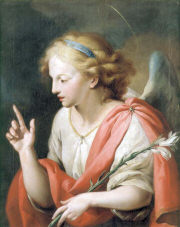 St. Gabriel's name means "God is my strength." Biblically he appears three times as a messenger. He had been sent to Daniel to explain a vision concerning the Messiah. He appeared to Zachary when he was offering incense in the Temple, to foretell the birth of his son, St. John the Baptist. St. Gabriel is most known as the angel chosen by God to be the messenger of the Annunciation, to announce to mankind the mystery of the Incarnation.
The angel's salutation to our Lady, so simple and yet so full of meaning, Hail Mary, full of grace, has become the constant and familiar prayer of all Christian people.
Patronage: Ambassadors; broadcasting; childbirth; clergy; communications; diplomats; messengers; philatelists; postal workers; public relations; radio workers; secular clergy; stamp collectors; telecommunications; Portugal; Archdiocese of Seattle, Washington.
Symbols and Representation: Archangel; scepter and lily; MR or AM shield; lantern; mirror; olive branch; scroll with words Ave Maria Gratia Plena; Resurrection trumpet; shield; spear; lily; symbolic colors, silver or blue.
St. Raphael
 Our knowledge of the Archangel Raphael comes to us from the book of Tobit. His mission as wonderful healer and fellow traveller with the youthful Tobias has caused him to be invoked for journeys and at critical moments in life. Tradition also holds that Raphael is the angel that stirred the waters at the healing sheep pool in Bethesda. His name means "God has healed."
Patronage: Blind; bodily ills; counselors; druggists; eye problems; guardian angels; happy meetings; healers; health inspectors; health technicians; love; lovers; mental illness; nurses; pharmacists; physicians; shepherds; against sickness; therapists; travelers; young people; young people leaving home for the first time; Archdiocese of Dubuque, Iowa; Archdiocese of Seattle, Washington.
Symbols and Representation: Staff; wallet and fish; staff and gourd; archangel; young man carrying a staff; young man carrying a fish; walking with Tobias; holding a bottle or flask; symbolic colors, gray or yellow.
The liturgy celebrates the feast of these three archangels who are venerated in the tradition of the Church. Michael (Who is like God?) was the archangel who fought against Satan and all his evil angels, defending all the friends of God. He is the protector of all humanity from the snares of the devil. Gabriel (Strength of God) announced to Zachariah the forthcoming birth of John the Baptist, and to Mary, the birth of Jesus. His greeting to the Virgin, "Hail, full of grace," is one of the most familiar and frequent prayers of the Christian people. Raphael (Medicine of God) is the archangel who took care of Tobias on his journey.
According to the 1962 Missal of St. John XXIII the Extraordinary Form of the Roman Rite, today is the feast of St. Michael. St. Gabriel is observed on March 24 and St. Raphael on October 24.
The Catechism of the Catholic Church teaches us that, "The existence of the spiritual, non-corporeal beings that Sacred Scripture usually calls "angels" is a truth of faith. The witness of Scripture is as clear as the unanimity of Tradition" (#328).
"In her liturgy, the Church joins with the angels to adore the thrice-holy God. She invokes their assistance (in the funeral liturgy's In Paradisum deducant te angeli. . .["May the angels lead you into Paradise. . ."]). Moreover, in the "Cherubic Hymn" of the Byzantine Liturgy, she celebrates the memory of certain angels more particularly (St. Michael, St. Gabriel, St. Raphael, and the guardian angels)" (#335).
Angels are pure, created spirits. The name angel means servant or messenger of God. Angels are celestial or heavenly beings, on a higher order than human beings. Angels have no bodies and do not depend on matter for their existence or activity. They are distinct from saints, which men can become. Angels have intellect and will, and are immortal. They are a vast multitude, but each is an individual person. Archangels are one of the nine choirs of angels listed in the Bible. In ascending order, the choirs or classes are 1) Angels, 2) Archangels, 3) Principalities, 4) Powers, 5) Virtues, 6) Dominations, 7) Thrones, 8) Cherubim, and 9) Seraphim.
The previous liturgical calendar (1962) celebrated solely the feast of St. Michael on September 29. St. Gabriel was observed on March 24 and St. Raphael on October 24. This is why there are more traditions regarding "Michaelmas" instead of all three archangels.
St. Michael
The name of the archangel Michael means, in Hebrew, who is like unto God? and he is also known as "the prince of the heavenly host." He is usually pictured as a strong warrior, dressed in armor and wearing sandals. His name appears in Scripture four times, twice in the Book of Daniel, and once each in the Epistle of St. Jude and the Book of Revelation. From Revelation we learn of the battle in heaven, with St. Michael and his angels combatting Lucifer and the other fallen angels (or devils). We invoke St. Michael to help us in our fight against Satan; to rescue souls from Satan, especially at the hour of death; to be the champion of the Jews in the Old Testament and now Christians; and to bring souls to judgment.
This day is referred to as "Michaelmas" in many countries and is also one of the harvest feast days. In England this is one of the "quarter days," which was marked by hiring servants, electing magistrates, and beginning of legal and university terms. This day also marks the opening of the deer and other large game hunting season. In some parts of Europe, especially Germany, Denmark, and Austria, a special wine called "Saint Michael's Love" (Michelsminne) is drunk on this day. The foods for this day vary depending on nationality. In the British Isles, for example, goose was the traditional meal for Michaelmas, eaten for prosperity, France has waffles or Gaufres and the traditional fare in Scotland used to be St. Michael's Bannock (Struan Micheil) — a large, scone-like cake. In Italy, gnocchi is the traditional fare.
Patronage: against danger at sea; against temptations; ambulance drivers; arms manufacturers; artists; bakers; bankers, banking; barrel makers, coopers; battle; cutlers, knife grinders, knife sharpers; dying people; emergency medical technicians, EMTs, paramedics; fencers; fencing; Greek Air Force; greengrocers; grocers; Guild of Tanners and Weavers of Barcelona, Spain; haberdashers; hatmakers, hatters, cap makers; holy death; knights; mariners, sailors, watermen; boatmen; milliners; paratroopers; police officers; radiologists (proclaimed on 15 January 1941 by Pope Pius XII); radiotherapists; scale makers; security guards; sick people; soldiers; Spanish police officers; storms at sea; swordsmiths. See CatholicSaints.info for a whole list.
Symbols and Representation: Angel with wings; dressed in armor; lance and shield; scales; shown weighing souls; millstone; piercing dragon or devil; banner charged with a dove; symbolic colors orange or gold.
St. Gabriel
St. Gabriel's name means "God is my strength." Biblically he appears three times as a messenger. He had been sent to Daniel to explain a vision concerning the Messiah. He appeared to Zachary when he was offering incense in the Temple, to foretell the birth of his son, St. John the Baptist. St. Gabriel is most known as the angel chosen by God to be the messenger of the Annunciation, to announce to mankind the mystery of the Incarnation.
The angel's salutation to our Lady, so simple and yet so full of meaning, Hail Mary, full of grace, has become the constant and familiar prayer of all Christian people.
Patronage: Ambassadors; broadcasting; childbirth; clergy; communications; diplomats; messengers; philatelists; postal workers; public relations; radio workers; secular clergy; stamp collectors; telecommunications; Portugal; Archdiocese of Seattle, Washington.
Symbols and Representation: Archangel; scepter and lily; MR or AM shield; lantern; mirror; olive branch; scroll with words Ave Maria Gratia Plena; Resurrection trumpet; shield; spear; lily; symbolic colors, silver or blue.
St. Raphael
Our knowledge of the Archangel Raphael comes to us from the book of Tobit. His mission as wonderful healer and fellow traveller with the youthful Tobias has caused him to be invoked for journeys and at critical moments in life. Tradition also holds that Raphael is the angel that stirred the waters at the healing sheep pool in Bethesda. His name means "God has healed."
Patronage: Blind; bodily ills; counselors; druggists; eye problems; guardian angels; happy meetings; healers; health inspectors; health technicians; love; lovers; mental illness; nurses; pharmacists; physicians; shepherds; against sickness; therapists; travelers; young people; young people leaving home for the first time; Archdiocese of Dubuque, Iowa; Archdiocese of Seattle, Washington.
Symbols and Representation: Staff; wallet and fish; staff and gourd; archangel; young man carrying a staff; young man carrying a fish; walking with Tobias; holding a bottle or flask; symbolic colors, gray or yellow.
The liturgy celebrates the feast of these three archangels who are venerated in the tradition of the Church. Michael (Who is like God?) was the archangel who fought against Satan and all his evil angels, defending all the friends of God. He is the protector of all humanity from the snares of the devil. Gabriel (Strength of God) announced to Zachariah the forthcoming birth of John the Baptist, and to Mary, the birth of Jesus. His greeting to the Virgin, "Hail, full of grace," is one of the most familiar and frequent prayers of the Christian people. Raphael (Medicine of God) is the archangel who took care of Tobias on his journey.
According to the 1962 Missal of St. John XXIII the Extraordinary Form of the Roman Rite, today is the feast of St. Michael. St. Gabriel is observed on March 24 and St. Raphael on October 24.
The Catechism of the Catholic Church teaches us that, "The existence of the spiritual, non-corporeal beings that Sacred Scripture usually calls "angels" is a truth of faith. The witness of Scripture is as clear as the unanimity of Tradition" (#328).
"In her liturgy, the Church joins with the angels to adore the thrice-holy God. She invokes their assistance (in the funeral liturgy's In Paradisum deducant te angeli. . .["May the angels lead you into Paradise. . ."]). Moreover, in the "Cherubic Hymn" of the Byzantine Liturgy, she celebrates the memory of certain angels more particularly (St. Michael, St. Gabriel, St. Raphael, and the guardian angels)" (#335).
Angels are pure, created spirits. The name angel means servant or messenger of God. Angels are celestial or heavenly beings, on a higher order than human beings. Angels have no bodies and do not depend on matter for their existence or activity. They are distinct from saints, which men can become. Angels have intellect and will, and are immortal. They are a vast multitude, but each is an individual person. Archangels are one of the nine choirs of angels listed in the Bible. In ascending order, the choirs or classes are 1) Angels, 2) Archangels, 3) Principalities, 4) Powers, 5) Virtues, 6) Dominations, 7) Thrones, 8) Cherubim, and 9) Seraphim.
The previous liturgical calendar (1962) celebrated solely the feast of St. Michael on September 29. St. Gabriel was observed on March 24 and St. Raphael on October 24. This is why there are more traditions regarding "Michaelmas" instead of all three archangels.
St. Michael
The name of the archangel Michael means, in Hebrew, who is like unto God? and he is also known as "the prince of the heavenly host." He is usually pictured as a strong warrior, dressed in armor and wearing sandals. His name appears in Scripture four times, twice in the Book of Daniel, and once each in the Epistle of St. Jude and the Book of Revelation. From Revelation we learn of the battle in heaven, with St. Michael and his angels combatting Lucifer and the other fallen angels (or devils). We invoke St. Michael to help us in our fight against Satan; to rescue souls from Satan, especially at the hour of death; to be the champion of the Jews in the Old Testament and now Christians; and to bring souls to judgment.
This day is referred to as "Michaelmas" in many countries and is also one of the harvest feast days. In England this is one of the "quarter days," which was marked by hiring servants, electing magistrates, and beginning of legal and university terms. This day also marks the opening of the deer and other large game hunting season. In some parts of Europe, especially Germany, Denmark, and Austria, a special wine called "Saint Michael's Love" (Michelsminne) is drunk on this day. The foods for this day vary depending on nationality. In the British Isles, for example, goose was the traditional meal for Michaelmas, eaten for prosperity, France has waffles or Gaufres and the traditional fare in Scotland used to be St. Michael's Bannock (Struan Micheil) — a large, scone-like cake. In Italy, gnocchi is the traditional fare.
Patronage: against danger at sea; against temptations; ambulance drivers; arms manufacturers; artists; bakers; bankers, banking; barrel makers, coopers; battle; cutlers, knife grinders, knife sharpers; dying people; emergency medical technicians, EMTs, paramedics; fencers; fencing; Greek Air Force; greengrocers; grocers; Guild of Tanners and Weavers of Barcelona, Spain; haberdashers; hatmakers, hatters, cap makers; holy death; knights; mariners, sailors, watermen; boatmen; milliners; paratroopers; police officers; radiologists (proclaimed on 15 January 1941 by Pope Pius XII); radiotherapists; scale makers; security guards; sick people; soldiers; Spanish police officers; storms at sea; swordsmiths. See CatholicSaints.info for a whole list.
Symbols and Representation: Angel with wings; dressed in armor; lance and shield; scales; shown weighing souls; millstone; piercing dragon or devil; banner charged with a dove; symbolic colors orange or gold.
St. Gabriel
St. Gabriel's name means "God is my strength." Biblically he appears three times as a messenger. He had been sent to Daniel to explain a vision concerning the Messiah. He appeared to Zachary when he was offering incense in the Temple, to foretell the birth of his son, St. John the Baptist. St. Gabriel is most known as the angel chosen by God to be the messenger of the Annunciation, to announce to mankind the mystery of the Incarnation.
The angel's salutation to our Lady, so simple and yet so full of meaning, Hail Mary, full of grace, has become the constant and familiar prayer of all Christian people.
Patronage: Ambassadors; broadcasting; childbirth; clergy; communications; diplomats; messengers; philatelists; postal workers; public relations; radio workers; secular clergy; stamp collectors; telecommunications; Portugal; Archdiocese of Seattle, Washington.
Symbols and Representation: Archangel; scepter and lily; MR or AM shield; lantern; mirror; olive branch; scroll with words Ave Maria Gratia Plena; Resurrection trumpet; shield; spear; lily; symbolic colors, silver or blue.
St. Raphael
Our knowledge of the Archangel Raphael comes to us from the book of Tobit. His mission as wonderful healer and fellow traveller with the youthful Tobias has caused him to be invoked for journeys and at critical moments in life. Tradition also holds that Raphael is the angel that stirred the waters at the healing sheep pool in Bethesda. His name means "God has healed."
Patronage: Blind; bodily ills; counselors; druggists; eye problems; guardian angels; happy meetings; healers; health inspectors; health technicians; love; lovers; mental illness; nurses; pharmacists; physicians; shepherds; against sickness; therapists; travelers; young people; young people leaving home for the first time; Archdiocese of Dubuque, Iowa; Archdiocese of Seattle, Washington.
Symbols and Representation: Staff; wallet and fish; staff and gourd; archangel; young man carrying a staff; young man carrying a fish; walking with Tobias; holding a bottle or flask; symbolic colors, gray or yellow.


