Monday, January 29, 2024

Papal interview tackles the two state solution in the Holy Land and the reasons behind blessings for couples in irregular relationships


File photo of Pope FrancisFile photo of Pope Francis  (Vatican Media)

Pope on Holy Land war: Without two states, true peace remains distant

In an interview with the Italian newspaper 'La Stampa', Pope Francis renews calls for a global ceasefire, warning the world is on the brink of the abyss, and says the recent declaration 'Fiducia supplicans' seeks to include, not divide.

By Vatican News

"There was the Oslo agreement—so clear—with the solution of the two states. Until that agreement is applied, true peace remains distant."

This is Pope Francis' judgment on events in the Holy Land, following the attacks by Hamas and the war that is destroying the cities of the Gaza Strip.

The Pope shared his thoughts with Domenico Agasso, a Vatican-focused journalist for the Italian newspaper, La Stampa, published on Monday.

Speaking of the many ongoing conflicts, Pope Francis invites everyone to pray for peace, expressing his belief that dialogue is the only path toward a peaceful future.

He called for all parties to "immediately stop the bombs and missiles and end hostile attitudes. Everywhere." The Pope called for a "global ceasefire," because "we are on the brink of the abyss."

Hopes for the Holy Land and Ukraine

The Pope explained his opposition to defining any war as "just," preferring to say it is legitimate to defend oneself but said it is necessary to avoid "justifying wars, which are always wrong."

He expressed his fear of a military escalation across the Middle East, but said he entertains some hope "because confidential meetings are taking place to try to reach an agreement. A truce would already be a good result."

Pope Francis defined Cardinal Pierbattista Pizzaballa, the Latin Patriarch of Jerusalem, as "a crucial figure" who "moves well" and tries to mediate.

He said he speaks by video call with the Holy Family Catholic Parish in Gaza every day, adding that the "liberation of Israeli hostages" is a priority.

Regarding Ukraine, the Pope recalled the task entrusted to Cardinal Matteo Zuppi, the president of the Italian Bishops' Conference.

"The Holy See is trying to mediate an exchange of prisoners and the return of Ukrainian civilians," said Pope Francis. "In particular, we are working with Mrs. Maria Lvova-Belova, the Russian commissioner for children's rights, for the repatriation of Ukrainian children forcibly taken to Russia. Some have already returned to their families."

'Fiducia supplicans' seeks to include

In the interview, Pope Francis recalled that "Christ calls everyone from within," referring to the Declaration Fiducia supplicans that allows for blessings of persons in irregular or same-sex couples.

"The Gospel is to sanctify everyone," he said. "Of course, there must be goodwill. And it is necessary to give precise instructions on the Christian life (I emphasize that it is not the union that is blessed, but the persons). But we are all sinners: why should we make a list of sinners who can enter the Church and a list of sinners who cannot be in the Church? This is not the Gospel."

Regarding criticisms of the document, the Pope noted that "those who vehemently protest belong to small ideological groups."

He described the Church in Africa as "a special case," since "for them, homosexuality is something 'ugly' from a cultural point of view; they do not tolerate it."

However, he added, "I trust that gradually everyone will be reassured about the spirit of the declaration," which "aims to include, not divide. It invites us to welcome and then entrust people, and to trust in God."

Pope Francis admitted to sometimes feeling alone, "but I still always strive ahead, day after day," adding that he does not fear schisms.

"In the Church, there have always been small groups that manifest reflections of a schismatic nature. One must let them carry on and pass away... and look ahead."

Sunday, January 28, 2024

Monday Saint of the Day


Bl. Boleslava Lament


Feastday: January 29
Birth: 1862
Death: 1946
Beatified: Pope John Paul II


Boleslava Lament, virgin, in the midst of political upheaval founded the Congregation of the Missionary Sisters of the Holy Family to promote Christian unity, help the poor and train the girls to Christian life.

Pope mentions several prayer intentions during today's Angelus Address


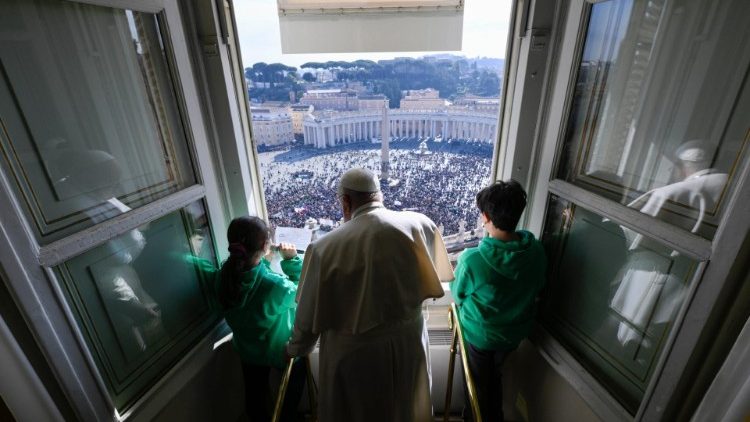
Pope Francis was joined by young people from the 'Caravan of Peace'Pope Francis was joined by young people from the 'Caravan of Peace'  (Vatican Media)

Pope: 'Wars destroy people and are defeat for humanity'

At his Angelus address on Sunday, Pope Francis decries suffering in Myanmar, the Middle East, Ukraine, and Haiti, while urging everyone to pursue paths of peace and recalling World Leprosy Day.

By Deborah Castellano Lubov

"Wars are a disaster for the peoples and a defeat for humanity," said Pope Francis, speaking to the faithful during his Sunday Angelus, as he appealed for Myanmar, the Middle East, Ukraine, and Haiti.

Focusing on Myanmar, he appealed for the facilitation of humanitarian aid and for pursuing paths of dialogue.

"For three years now," he said, "the cry of pain and the noise of weapons have taken the place of the smile that characterises the people of Myanmar."

“For three years now, the cry of pain and the noise of weapons have taken the place of the smile that characterises the people of Myanmar.”

Appeal for Myanmar

Given this, the Pope said, he joined his voice with that of Burmese Bishops in praying that "the weapons of destruction may be transformed into instruments to grow in humanity and justice."

While the Pope acknowledged that peace is a journey, he invited all parties involved "to take steps of dialogue and to clothe themselves with understanding," so that "the land of Myanmar may reach the goal of fraternal reconciliation."

"Let humanitarian aid be allowed to pass through to ensure the necessities of every person," he said.

Fighting in Myanmar against the military government that seized power three years ago has grown to the point that most say the country is now in a civil war.

Palestine, Israel, Ukraine

The Holy Father then turned to the Middle East, focusing on Palestine and Israel as the humanitarian crisis in Gaza continues.

"And the same in the Middle East, Palestine and Israel, and wherever there is fighting: respect the people!" the Pope appealed, adding, "I always think in a heartfelt way of all the victims, especially civilians, caused by the war in Ukraine."

"Please let their cry for peace be heard: the cry of the people, who are tired of violence and want the war, which is a disaster for the peoples and a defeat for humanity, to stop!"

“Please let their cry for peace be heard: the cry of the people, who are tired of violence and want the war, which is a disaster for the peoples and a defeat for humanity, to stop.”

Haiti requires renewed support

He also reminded Christians to pray for Haiti.

Despite expressing his "relief" to learn of the recent release of religious sisters and others this week, the Pope, however, appealed, "I call for the release of all those still kidnapped and for an end to all violence; for all to make their contribution to the peaceful development of the country, for which renewed support from the international community is needed."

Violence and tensions remain high in Haiti, despite the release this week of the six nuns of the Congregation of Saint Anne who were taken hostage by armed men on 19 January, along with two abducted laypeople, according to Haitian Archbishop Max Leroy Mésidor of Port-au-Prince.

Armed attack on Church in Istanbul

The Holy Father also decried today's attack on a Catholic Church in Istanbul.

During Sunday Mass, armed men targeted an Italian-language Church in the nation's capital, killing one person, according to the nation's Interior Minister, Ali Yerlikaya.

"I express my sympathy to the community of St. Mary Draperis Church in Istanbul, which suffered an armed attack during Mass that left one person dead and several wounded," he said.

World Leprosy Day

The Holy Father remembered World Leprosy Day,  which is celebrated this year on 28 January, the last Sunday of January.

This international day is an opportunity to celebrate people who have experienced leprosy, raise awareness of the disease, and call for an end to leprosy-related stigma and discrimination.

"I encourage all those involved in the rescue and social reintegration of people affected by this disease, which, although in decline, is still among the most feared and affects the poorest and most marginalised."

Also, keeping with an annual tradition, young pilgrims who participated in the “Caravan for Peace” initiative, organized by the Catholic Action group in Rome, were at the Pope's side as they read to the faithful in the Square and those following remotely their appeal for peace.

Sunday Angelus Address 01.28.2024


Pope at Angelus: When tempted or taking wrong path, invoke Jesus

During his Sunday Angelus, Pope Francis urges the faithful to resist what has the power to enslave them by invoking Jesus whenever they feel tempted or about to make a misstep, and tells them, once again, to not dialogue with the devil.

By Deborah Castellano Lubov

When you feel tempted or that the devil is leading you in the wrong direction, invoke Jesus.

This was the suggestion Pope Francis offered to the faithful during his Angelus address in St. Peter's Square on Sunday at noon.

As he reflected on today's Gospel passage according to St. Mark, which recalls Jesus freeing a person who had been possessed by an evil spirit, the Holy Father reminded the faithful that the devil wants to take hold of us, but we can resist him by staying close to the Lord.

He said the devil desires to possess in order to "chain our souls" and that, therefore, "we must guard against the "chains" that suffocate our freedom" and "enchain our hearts."

The Pope acknowledged various types of "enchainments" we all face that "make us slaves, always dissatisfied, and devour energy, goods, and affections."

Jesus frees us

Jesus, Pope Francis reassured, came to free us from all these chains, and the devil's relentless attacks.

"Jesus liberates from the power of evil and - let us note well - never dialogues with the devil! We, on the other hand," he lamented, "often let his chains hold us until they do too much harm, but then it is more difficult to free ourselves from them.

"Christ," however, he underlined, "reminds us that with the devil we never negotiate."

"What to do then when we feel tempted and oppressed?" the Pope asked, inviting "Invoke Jesus: invoke him there, where we feel the chains of evil and fear tighten most strongly."

Don't dialogue with the devil

The Pope warned against conversing with the devil.

"There is no dialogue with the devil, because if you enter into dialogue with him, he wins, always. Be careful."

"The Lord, with the power of his Spirit, wishes to repeat to the evil one even today: 'Go away, leave that heart alone, do not divide the world, families, our communities; let them live peacefully, so that the fruits of my Spirit may flourish there, not yours."

Jesus, the Holy Father highlighted, instead desires that "love, joy, meekness may reign," and that there be "freedom, peace, and care," instead of violence and cries of hatred."

Vigilance to be full of love and joy

The Lord, he reminded, wants our lives to be full of love and joy, but, reiterated, this requires our continued caution.

Jesus, the Pope suggested requires our viligance in not dialoguing with the devil, and our prayer, which allows Him to restore us.

Pope Francis concluded by asking the Blessed Mother to protect us from evil, before offering those gathered in the Square a good Sunday and a good lunch.

One can read the full text of the Pope's Angelus Address at the Vatican website.

Saturday, January 27, 2024

Sunday Saint of the Day


St. Thomas Aquinas


Feastday: January 28
Patron: of students and all universities
Birth: 1226
Death: 1274
Canonized: Pope John XXII in 1323


Thomas is believed to have been born in the castle of Roccasecca in the old county of the Kingdom of Sicily, which is now known as the Lazio region of Italy, in 1225. His parents were well-off, but as the youngest son Thomas was expected to enter the monastery.

At 5-years-old, Thomas began his education at Monte Cassino, where he remained until the military conflict between Emperor Frederick II and Pope Gregory IX reached the abbey. He was then transferred and enrolled at the studium generale in Naples.

It is believed that Thomas was introduced to his philosophical influences - Aristotle, Averroes, and Maimonides - at the university, where he also met John of St. Julian, a Dominican preacher, who influenced him to join the recently founded Dominican Order.

When Thomas' family learned of his decision, his mother Theodora arranged for him to be moved to Paris. When Thomas was travelling to Rome, his brothers captured him and returned him to their parents at the castle of Monte San Giovanni Campano.

Thomas was held captive in the castle for one year as his family tried to keep him from joining the Dominican Order. In the year he was held, Thomas tutored his sisters and communicated with members of the Dominican Order.

In an effort to change Thomas' mind, two of his brothers hired a prostitute to seduce him, but legends claim Thomas drove her off with a fire iron. That night, two angels appeared to him in a dream and strengthened his resolve to remain celibate.

When Theodora realized she could not sway her son, she tried to preserve the family name by arranging for his escape through a window. She believed a secret escape was better than appearing to accept his decision.

Following his escape in 1244, Thomas turned to Naples, then to Rome and met the Master General of the Dominical Order, Johannes von Wildeshausen.

The next year, Thomas went to study at the Faculty of the Arts at the University of Paris, where he is believed to have met Dominican scholar Albertus Mangus, the Chair of Theology at the College of St. James.

In 1248, Thomas chose to follow Mangus to the new studium generale at Cologne rather than accepting Pope Innocent IV's offer to appoint him abbot of Monte Cassino as a Dominican. Though Thomas hesitated, when they reached the university, Mangus appointed him magister studentium.

Thomas was quiet and seldom spoke at the university, leading other students to believe he was mentally delayed, but Mangus prophetically said, "You call him the dumb ox, but in his teaching, he will one day produce such a bellowing that it will be heard throughout the world."

Following the conclusion of his education, Thomas taught in Cologne as an apprentice professor and instructed students on the books of the Old Testament. It was during this time he wrote Expositio super Isaiam ad litteram, Postilla super Ieremiam, and Postilla super Threnos.

In 1252, Thomas returned to Paris to earn his master's degree in theology. As an apprentice professor, he lectured on the Bible and devoted his final three years of his education to Peter Lombard's Sentences.

Thomas composed a commentary on Sentences, titled Scriptum super libros Sententiarium and wrote De ente et essentia.
The spring of 1256 saw Thomas appointed regent master in theology at Paris, and one of his first works after assuming the office was Contra impugnantes Dei cultum et religionem, in defense of mendicant orders, which William of Saint-Amour had been attacking.

Between 1256 to 1259, Thomas spent his tenure writing several books, such as Questiones disputatae de veritate, Quaestiones quodlibetales, Expositio super librum Boethii De trinitate, and Expositio super librum Boethii De hebdomadibus. At the conclusion of his regency, Thomas was in the process of writing one of his most famous works, Summa contra Gentiles.

In 1259, Thomas completed his first regency and returned to Naples, where he was appointed general preacher. In September 1261, he was asked to lecture in Orvieto, and during his stay he finished Summa contra Gentiles, as well as Catena aurea, and Contra errores graecorum.

In 1265, Thomas was summoned to Rome to serve as the papal theologian and was later ordered by the Dominican Chapter of Agnani to teach at the studium conventuale, which was the first school to teach the full range of philosophical subjects of both moral and natural natures.

While teaching, Thomas wrote his most famous work, Summa theologiae, which he believed was particularly useful to beginning students "because a doctor of Catholic truth ought not only to teach the proficient, but to him pertains also to instruct beginners."

He continued to write and released several more books until 1268, when he was called to Paris for a second teaching regency. He was named regent master again and stayed until 1272. During this time, he wrote De virtutibus and De aeternitate mundi.

At the conclusion of his regency, the Dominicans called Thomas to establish a university wherever he wanted with a staff of whomever he wished. He established the university in Naples and took the regent master post. In 1273 Thomas was seen by the sacristan Domenic of Caserta to be crying and levitating in prayer before an icon of the crucified Christ at the Dominican convent of Naples, in the Chapel of Saint Nicholas.

During this prayer, Christ is said to have told him, "You have written well of me, Thomas. What reward would you have for your labor?"

Thomas replied, "Nothing but you, Lord."

Following this exchange, something happened but Thomas never wrote or spoke of it. He abandoned his routine and, when begged to return to work, replied, "I cannot, because all that I have written seems like straw to me."

In May of 1274, Thomas was called to the Second Council of Lyon, where his works for Pope Urban IV would be presented. While journeying to the meeting, Thomas hit his head on the branch of a fallen tree and fell ill. He was escorted to Monte Cassino to recover, then he set out again.

Unfortunately, he became ill once again and stopped at the Cistercian Fossanova Abbey, where the monks cared for him for several days.

He received his last rites and prayed, "I receive Thee, ransom of my soul. For love of Thee have I studied and kept vigil, toiled, preached and taught..."

Thomas died on March 7, 1274 during a commentary on the Song of Songs. Thomas' remains were placed in the Church of the Jacobins in Toulouse on January 28, 1369.

It is not known who beatified Thomas, but on July 18, 1323, Pope John XXII canonized him.

His original feast day was March 7, the day of his death, but because the date often falls within Lent, in 1969, a revision of the Roman Calendar changed his feast day to January 28, the date his relics were moved to Toulouse. Pope Pius V declared Saint Thomas a doctor of the church, saying Thomas was "the most brilliant light of the Church."
Saint Thomas' remains were moved to the Basilique de Sant-Sernin, Toulouse between 1789 and 1974. They were then returned to the Church of the Jacobins.

In the 16th century, the university in Paris, that Thomas often taught at, was renamed the College of Saint Thomas, and in the 20th century it was relocated to the convent of Saints Dominic and Sixtus before being transformed into the Pontifical University of Saint Thomas Aquinas.

Saint Thomas' comments and philosophical writings are still debated today, and his aesthetic theories, such as the concept of claritas, deeply influenced the literary writings of James Joyce and Italian semiotician Umberto Eco. Saint Thomas is often depicted with an open book or writing with a quill.
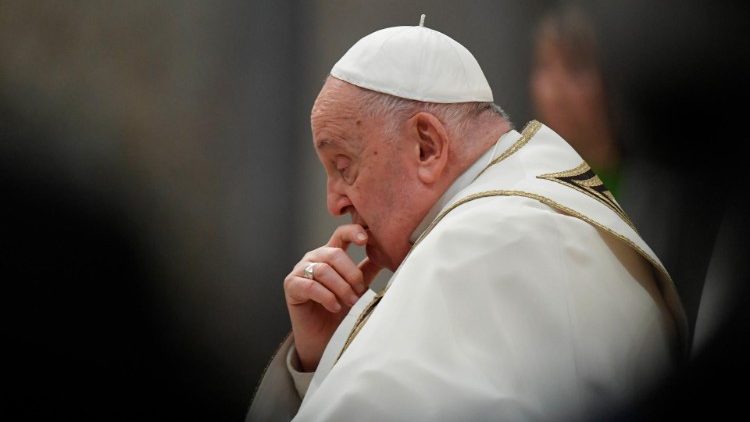

Pope speaks against hatred and violence on Holocaust Remembrance Day


Pope on Holocaust Remembrance Day: Hatred and violence deny our humanity

Pope Francis condemns hatred and violence on Holocaust Remembrance Day, emphasising the importance of remembrance in constructing a peaceful future.

By Francesca Merlo

Pope Francis has released a message on Holocaust Remembrance Day, stressing that the logic of hatred is never justified.

"Be aware", the Pope warns in his videomessage, "of how this path of death, extermination and brutality began".

"Remembrance is an expression of humanity", continues the Pope in his message. 

"Remembrance is a sign of civilisation", he adds, before concluding "Remembrance is a condition for a better future of peace and fraternity". 

Pope Francis on X

In a tweet published on Saturday, the Holy Father writes:

May our remembrance and condemnation of the horrible extermination of millions of Jews and people of other faiths, during the last century, help us all not forget that hatred and violence can never be justified, because it denies our very humanity. #WeRemember

Hatred denies humanity

During his General Audience on Wednesday, Pope Francis had already recalled the importance of Holocaust Remembrance Day, which is commemorated annually on 27 January.

During that audience the Holy Father asked that "the remembrance and condemnation of this terrible extermination of millions of Jews and people of other faiths might help everyone not to forget that the logic of hatred and violence can never be justified because it denies our own humanity".