Sunday, July 30, 2023

He ultimately founded the Society of Jesus (the Jesuits)


St. Ignatius Loyola

Feastday: July 31
Patron: Dioceses of San Sebastian and Bilbao, Biscay & Gipuzkoa, Basque Country, Military Ordinariate of the Philippines, Society of Jesus, soldiers, Educators and Education.
Birth: 1491
Death: 1556
Beatified: July 27, 1609 by Paul V
Canonized: March 12, 1622 by Gregory XV


Born Inigo Lopez de Loyola in 1491, the man known as Ignatius of Loyola entered the world in Loiola, Spain. At the time, the name of the village was spelled "Loyola," hence the discrepancy. Inigo came of age in Azpeitia, in northern Spain. Loyola is a small village at the southern end of Azpeitia.

Inigio was the youngest of thirteen children. His mother died when he was just seven, and he was then raised by Maria de Garin, who was the wife of a blacksmith. His last name, "Loyola" was taken from the village of his birth.

Despite the misfortune of losing his mother he was still a member of the local aristocracy and was raised accordingly. Inigio was an ambitious young man who had dreams of becoming a great leader. He was influenced by stories such as The Song of Roland and El Cid.

At the age of sixteen, he began a short period of employment working for Juan Velazquez, the treasurer of Castile. By the time he was eighteen, he became a soldier and would fight for Antonio Manrique de Lara, Duke of Nájera and Viceroy of Navarre.

Seeking wider acclaim, he began referring to himself as Ignatius. Ignatius was a variant of Inigio. The young Ignatius also gained a reputation as a duelist. According to one story, he killed a Moor with whom he argued about the divinity of Jesus.

Ignatius fought in several battles under the leadership of the Duke of Najera. He had a talent for emerging unscathed, despite participating in many battles. His talent earned him promotions and soon he commanded his own troops.

In 1521, while defending the town of Pamplona against French attack, Ignatius was struck by a cannonball in the legs. One leg was merely broken, but the other was badly mangled. To save his life and possibly his legs, doctors performed several surgeries. There were no anesthetics during this time, so each surgery was painful. Despite their best efforts, Ignatius' condition deteriorated. After suffering for a month, his doctors warned him to prepare for death.

On June 29, 1521, on the feast of Saints Peter and Paul, Ignatius began to improve. As soon as he was healthy enough to bear it, part of one leg was amputated which while painful, sped his recovery.

During this time of bodily improvement, Ignatius began to read whatever books he could find. Most of the books he obtained were about the lives of the saints and Christ. These stories had a profound impact on him, and he became more devout.

One story in particular influenced him, "De Vita Christi" (The life of Christ). The story offers commentary on the life of Christ and suggested a spiritual exercise that required visualizing oneself in the presence of Christ during the episodes of His life. The book would inspire Ignatius' own spiritual exercises.

As he lay bedridden, Ignatius developed a desire to become a working servant of Christ. He especially wanted to convert non-Christians.

Among his profound realizations, was that some thoughts brought him happiness and others sorrow. When he considered the differences between these thoughts, he recognized that two powerful forces were acting upon him. Evil brought him unpleasant thoughts while God brought him happiness. Ignatius discerned God's call, and began a new way of life, following God instead of men.

By the spring of 1522, Ignatius had recovered enough to leave bed. On March 25, 1522, he entered the Benedictine monastery, Santa Maria de Montserrat. Before an image of the Black Madonna, he laid down his military garments. He gave his other clothes away to a poor man.

He then walked to a hospital in the town of Manresa. In exchange for a place to live, he performed work around the hospital. He begged for his food. When he was not working or begging, he would go into a cave and practice spiritual exercises.

His time in prayer and contemplation helped him to understand himself better. He also gained a better understanding of God and God's plan for him.

The ten months he spent between the hospital and the cavern were difficult for Ignatius. He suffered from doubts, anxiety and depression. But he also recognized that these were not from God.

Ignatius began recording his thoughts and experiences in a journal. This journal would be useful later for developing new spiritual exercises for the tens of thousands of people who would follow him. Those exercises remain invaluable today and are still widely practiced by religious and laity alike.

The next year, in 1523, Ignatius made a pilgrimage to the Holy Land. His goal was to live there and convert non-believers. However, the Holy Land was a troubled place and Church officials did not want Ignatius to complicate things further. They asked him to return after just a fortnight.

Ignatius realized he needed to obtain a complete education if he wanted to convert people. Returning to Barcelona, Ignatius attended a grammar school, filled with children, to learn Latin and other beginning subjects. He was blessed with a great teacher during this time, Master Jeronimo Ardevol.

After completing his primary education, Ignatius traveled to Alcala, then Salamanca, where he studied at universities. In addition to studying, Ignatius often engaged others in lengthy conversations about spiritual matters.

These conversations attracted the attention of the Inquisition.

In Spain, the Inquisition was responsible for ferreting out religious dissent and combating heresy. The Inquisition was not as it has long been depicted in the media.

The Inquisition accused Ignatius of preaching without any formal education in theology. Without this training, it was likely that Ignatius could introduce heresy by way of conversation and misunderstanding.

Ignatius was questioned three times by the Inquisition, but he was always exonerated.

Ignatius eventually decided he needed more education, so he traveled north, seeking better schools and teachers. He was 38 years old when he entered the College of Saint Barbe of the University of Paris. This education was very structured and formalized. Later, Ignatius would be inspired to copy this model when establishing schools. The ideas of prerequisites and class levels would arise from the Jesuit schools, which here heavily inspired by Ignatius' experience in Paris.

Ignatius earned a master's degree at the age of 44. When he subsequently applied for his doctorate, he was passed over because of his age. He also suffered from ailments, which the school was concerned could impact his studies.

While at school in Paris, Ignatius roomed with Peter Faber and Francis Xavier. Faber was French and Xavier was Basque. The men became friends and Ignatius led them in his spiritual exercises. Other men soon joined their exercises and became followers of Ignatius. The group began to refer to themselves as "Friends in the Lord," an apt description.

The circle of friends, shared Ignatius' dream of traveling to the Holy Land, but conflict between Venice and the Turks made such a journey impossible. Denied the opportunity to travel there, the group then decided to visit Rome. There, they resolved to present themselves to the Pope and to serve at his pleasure.

Pope Paul III received the group and approved them as an official religious order in 1540. The band attempted to elect Ignatius as their first leader, but he declined, saying he had not lived a worthy life in his youth. He also believed others were more experienced theologically.

The group insisted however, and Ignatius accepted the role as their first leader. They called themselves the Society of Jesus. Some people who did not appreciate their efforts dubbed them "Jesuits" in an attempt to disparage them. While the name stuck, by virtue of their good work the label lost its negative connotation.

Ignatius imposed a strict, almost military rule on his order. This was natural for a man who spent his youth as a soldier. It might be expected that such rigor would dissuade people from joining, but it had the opposite effect. The order grew.

The Society of Jesus soon found its niche in education. Before Ignatius died in 1556, his order established 35 schools and boasted 1,000 members. The order was responsible for much of the work of stopping the spread of the Protestant Reformation. The Society advocated the use of reason to persuade others and combat heresy.

Today, the Society of Jesus is known for its work in educating the youth around the world. Several universities have been founded in the name of Ignatius and in the traditional Jesuit spirit. The Jesuits also perform many other important works around the globe.

Ignatius' passed away on July 31, 1556, at the age of 64. He was beatified by Pope Paul V on July 27, 1609 and canonized on March 12, 1622. His feast day is July 31. He is the patron saint of the Society of Jesus, soldiers, educators and education.

The experience of going to the celebration of World Youth Day


Going to World Youth Day Lisbon With Marian Haste

COMMENTARY: To be surrounded by hundreds of thousands of ebullient peers singing, laughing and praying in various languages provides an indelible lesson that the Catholic faith is a treasure bigger and more beautiful than most had previously realized.


World Youth Days are not just for those who are able to attend in person but are meant to renew and rejuvenate the entire Church. 

They provide the occasion for Catholics of every generation to convert and become more childlike (Matthew 18:3), to ponder the mystery of youth and to confront or revisit the pivotal questions that preoccupy this phase, especially how one is to live one’s life in correspondence to God. 

So as Pope Francis and young pilgrims from across the world prepare to convene in Lisbon Aug. 1-6 for the 37th World Youth Day, everyone in the Church should be accompanying them spiritually — not merely praying for them, but with them. 

I have been privileged to attend several World Youth Days. As a recent college graduate in 1993, I drove across the country with my twin brother for a life-changing encounter with Pope St. John Paul II in Denver. After my priestly ordination, I’ve accompanied young people from my parishes to several of these international youth gatherings, as I’ve observed those in very different stages of their spiritual journey awaken to an adventure of faith far bigger than they had previously thought possible. 

World Youth Days are a compelling experience of God, as youth leave their comfort zones and, often at considerable expense, travel great distances in search of God and what he may be asking of them. There is an inescapable focus on God, with Mass each day, the Rosary on buses, Stations of the Cross on streets, visits to churches and shrines, the sacrament of confession offered simultaneously by the pope and thousands of priests, all-night vigils of prayer, and the most well-attended celebration of Mass most will ever experience. All of these help confirm that God is indeed real, loves each of us personally, and is worthy of our love and life in return. 

World Youth Days are also a powerful encounter with the catholicity of the Church, as young people not only have the chance to pray on several occasions with the pope but also to meet and grow in communion with fellow youth from all over the world. It’s not easy to grow up as a Catholic in the United States, especially as many parishes are graying and thinning, popular culture derides Catholic faith and morals, some religious leaders behave as villains rather than heroes, and many endure broken families and the temptation to hold God accountable. 

To be surrounded by hundreds of thousands of ebullient peers singing, laughing and praying in various languages provides an indelible lesson that the Catholic faith is a treasure bigger and more beautiful than most had previously realized. They return fortified to live and share the faith as a source of hope and remedy for the loneliness and purposelessness that plague so many of their friends.

World Youth Days are, third, a great means to grow in the knowledge of the faith, both in times of formal catechesis with their chaplains, bishops, and zealous lay and religious apostles, but also informally through discussing their challenges and confusions with their fellow wayfarers. 

On the trips I’ve led, I’ve had the young pilgrims prepare brief presentations on the saints and sanctuaries we would encounter along the way, as well as give summaries of what the popes have said on previous World Youth Days. The fruits of that work have been seen not only in the presenters, but in the impact their reflections had on their fellow spiritual travelers. It has helped them to respond with greater confidence to what is always one of the principal papal summons of every World Youth Day: to go and teach all nations, beginning with the lost sheep of their own families and schools. 

As the Church prepares for Lisbon, she does so building on what has already taken place in the huge international gatherings in Rome, Buenos Aires, Santiago de Compostela, Czestochowa, Denver, Manila, Paris, Toronto, Cologne, Sydney, Madrid, Rio, Krakow and Panama, as well as in home dioceses in intervening years, on Palm Sunday originally and, more recently, on the Solemnity of Christ the King. 

The theme on which Pope Francis will be focusing in Lisbon will be the mystery of the Visitation, specifically St. Luke’s words that “Mary arose and went with haste” (Luke 1:39). In his message preparing the Church for this encounter, the Holy Father pondered how this young girl, immediately after Gabriel the Archangel appeared and she accepted to become the mother of the eternal Son of God, is a model for how every young Catholic, filled with the grace of baptism and blessed within by the Lord’s presence in Holy Communion, is summoned to get up and bring him with urgency to others. 

“Mary could have focused on herself and her own worries and fears about her new condition,” Pope Francis writes. “Instead, she entrusted herself completely to God. Her thoughts turned to Elizabeth. She got up and went forth. … The young Mary did not remain paralyzed, for within her was Jesus, the power of resurrection and new life. … [She] is a model for young people on the move, who refuse to stand in front of a mirror to contemplate themselves. … Mary’s focus is always directed outwards. She is in a permanent state of exodus, going forth from herself towards that great Other who is God and towards others, her brothers and sisters, especially those in greatest need.” 

He tackles head-on the type of indifference and lethargy that can lead youth not to get involved when others need help, or to wait for someone else to approve or take the lead. He gets practical and simple, urging them to think about all those who look forward just to a visit, like “the elderly, the sick, the imprisoned and refugees,” or those who are lonely and abandoned. “The real question in life,” he says, “is for whom am I living?” 

Mary shows us how to answer. 

To have this dialogue in Lisbon is a significant choice. The Portuguese capital was one of the great launching pads to “put out into the deep” (Luke 5:4) in search of a new world. 

“In the 15th and 16th centuries,” Pope Francis comments, “great numbers of young people — including many missionaries — set out for worlds unknown, not least to share their experience of Jesus with other peoples and nations.” The Saturday night vigil of adoration and Sunday concluding Mass will take place overlooking the majestic Vasco de Gama Bridge on the shores of the Tejo River from which the bold explorers set out. It is a setting fit to inspire the whole Church to a similar spiritual audacity. 


Lisbon is important, as well, because it is the birthplace of St. Anthony, right across from Lisbon’s Cathedral. It’s where he first received his vocation to become a great Scripture scholar and saint of charity. The church built over his home is a place where many young people have and can, through the prayers and example of this patron of lost things, find definitive direction. 

Lisbon is likewise Providential because it is less than an hour’s drive from Fatima, where Our Lady went in haste several times in 1917 to summon three Portuguese young people, and through them the Church, to personal conversion and to prayer and sacrifices for conversion of others. On Aug. 5, as Pope Francis travels to Fatima to pray with and for sick young people in the Chapel of Apparitions, it will be an occasion for the whole Church to respond anew to Mary’s appeal. 

Lisbon is likewise notable because of its history. The opening ceremony will take place in Edward VII Park, which is right next to the monumental statue and iconic roundabout of the Marquis de Pombal, who rebuilt Lisbon after the 1755 earthquake but who is infamous for his radical secularism, ruthless hatred for the Church and the clergy, and for his spiteful work to suppress the Jesuits. To have the successor of St. Peter and first Jesuit Pope bring hundreds of thousands of young people to celebrate the Catholic faith and pray next to his monument is an inspiring witness to the power of Jesus’ resurrection at work in the Church, a bold summons never to be afraid, and an unforgettable opportunity to pray for the Church’s persecutors, not just today but throughout Church history. Therefore, together with Mary, the Holy Father and Jesus — whom Pope Francis says is “the greatest gift,” “the great message entrusted to the Church” and the center and hero of World Youth Day — let us all go with haste to Lisbon and, from there, set out anew. 

Exciting week ahead: It's World Youth Day in Portugal starting August 1st


World Youth Day, the biggest event in the Catholic Church


World Youth Day, which takes place next week in Lisbon in the presence of Pope Francis and an expected one million pilgrims, is the largest Catholic event in the world.

Initiated in 1986 by Pope John Paul II, the global gathering is normally held every two or three years, although the calendar was disrupted by the coronavirus pandemic and the most recent World Youth Day was in Panama City in 2019.

The 16th international edition this year runs from August 1 to August 6, presided over by 86-year-old Pope Francis, making his first trip abroad since undergoing hernia surgery in June.

The week revolves around a series of cultural, spiritual and festive events, from concerts to debates and prayer sessions.

Events are targeted at Catholics between the age of 16 and 35, although organisers insist that everyone is welcome to attend, with no registration necessary.

More than 700 bishops and 20 cardinals will attend, alongside 20,000 volunteers and pilgrims from more than 200 countries, according to the Vatican.

The young people will initially spend time in different dioceses across Portugal, before gathering in the capital, which is preparing with about 16,000 members of law enforcement and emergency services to be deployed.

World Youth Day is spread across several venues in Lisbon, a city of 550,000 inhabitants already busy with summer tourists.

Key moments with the pope include Thursday's welcome ceremony, the Stations of the Cross on Friday, a vigil on Saturday night and large mass on Sunday morning.

The Argentine pontiff is expected to address themes such as climate change, social media and the scandal of clerical sex abuse of children that has caused enormous damage to the reputation of the worldwide Catholic Church.

The first international World Youth Day was held in Rome in 1986, following two successful gatherings of young people in the Italian capital in 1984 and 1985.

Then came Buenos Aires in Argentina (1987), Santiago de Compostela in Spain (1989), Czestochowa in Poland (1991), Denver in the United States (1993) and Manila in the Philippines (1995).

They were followed by Paris, France (1997); Rome again in 2000; Toronto, Canada (2002); Cologne, Germany (2005); Sydney, Australia (2008); Madrid, Spain in 2011; and Rio de Janeiro, Brazil in 2013.

The biggest event was Manila, which drew five million pilgrims, followed by Rio de Janeiro with 3.7 million, and Krakow, Poland in 2016 with three million.

Pope is thankful for those who fight human trafficking


World Day Against Trafficking in PersonsWorld Day Against Trafficking in Persons  (Siam Pukkato)

Pope: "God bless those who work to fight against trafficking"

Pope Francis recalls that Sunday July 30 marks two UN World Days: the World Day Against Trafficking in Persons and International Friendship Day. He calls everyone to work to stop the exploitation of persons through human trafficking while praying for all those in the fight against trafficking.

By Thaddeus Jones

During the Sunday Angelus, Pope Francis recalled that on this day, July 30, we observe two World Days declared by the United Nations. The first, International Friendship Day underscores the importance of friendship between peoples and cultures, he noted. 

The second theme marks the World Day Against Trafficking in Persons that aims to stop "the crime that turns people into commodities," said the Pope.

“Trafficking is a terrible reality, affecting too many people: children, women, workers..., so many exploited people; all living in inhuman conditions and suffering indifference and rejection by society.”

The Pope pointed out how today the crime of human trafficking is so widespread in our world. He praised those working in this area and their assistance to the victims.

“God bless those who work to fight against trafficking.”

The theme of the July 30 World Day Against Trafficking in Persons is Reach every victim of trafficking, leave no one behind. The annual UN Day aims to raise awareness of the troubling developments and trends in this area, and calls on governments, law enforcement, public services, and civil society to assess and enhance their efforts to strengthen prevention, identify and support victims, and end impunity.

Pope Francis has spoken out strongly on the scourge of this reality often in the past, saying that "Human trafficking disfigures dignity. Exploitation and subjugation limit freedom and turn people into objects to use and discard. And the system of trafficking profits from the injustice and wickedness that oblige millions of people to live in conditions of vulnerability.”

Those strong words have been particuarly appreciated by Msgr. Robert Vitillo, Secretary General of the Geneva-based Interntional Catholic Migration Commission, or ICMC.

ICMC members offer help and support to trafficking victims. They help generate awareness and resilience in vulnerable communities, and work to develop new partnerships and alliances to achieve longer-term change. The work takes place in a diverse range of national contexts around the world, from Argentina to Burkina Faso, the Central African Republic, Thailand, and South Africa, and at the international level.

In a statement and an interview with Vatican Radio, Msgr. Vitillo notes that "Human trafficking is a growing global phenomena and affects men, women, and children of all backgrounds. Recent years have seen a worldwide escalation of trafficking risks, as global economic crises, conflict, and the climate emergency drive inequality and displacement. At the same time, global conviction rates have decreased."

The Geneva-based Interntional Catholic Migration Commission, or ICMC, coordinates the efforts of Catholic outreach in this field bringing together national member organizations who work together to assist migrants. 

Pope Francis appeals for restoration of important grain agreement


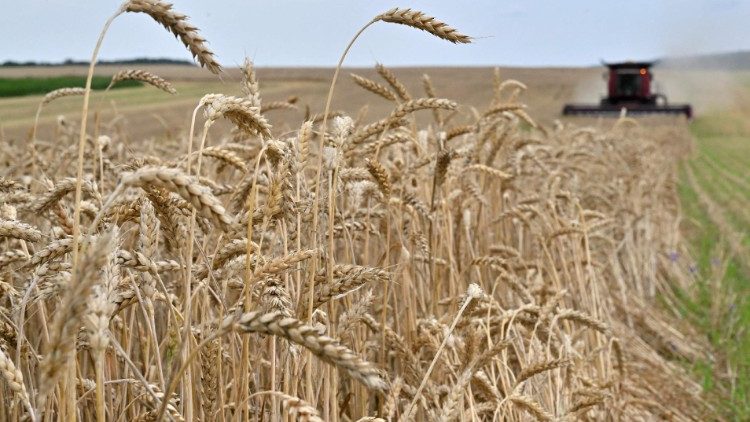
Ukraine-Russia grain crisisUkraine-Russia grain crisis  (AFP or licensors)

Pope appeals for grain agreement, "the cry of the hungry rises to Heaven"

Pope Francis has called for prayers for a restoration of the distribution of grain through the Black Sea Initiative, appealing to the authorities of the Russian Federation, so that millions who suffer hunger can be saved.

By Thaddeus Jones

Pope Francis at the conclusion of the Sunday Angelus appealed for continued prayers for "beleaguered Ukraine, where the war is destroying everything, even grain." He expressed his concern in particular over the breakdown in the Black See Initiative that has allowed grain to be shipped from ports in the region through a mutual agreement of Ukraine and Russia. 

“I appeal to my brothers, the authorities of the Russian Federation, that the Black Sea Initiative may be restored and grain may be transported safely.”

The Pope said grain is God's gift to feed humanity, and the war destruction that threatens it is a grave offense to God. 

“The cry of millions of brothers and sisters who suffer hunger rises to Heaven.”

Speaking to journalists in recent days, United Nations Secretary-General António Guterres, decried the breakdown in the Black Sea Initiative on grain shipments, as well as the bombardment of harbour installations and even deposits of grain.

He said "we are very concerned that a prolonged conflict will have even more dramatic impacts globally and particularly in relation to developing countries." A the same time he assured UN willingness to help revive the initiative, saying, "we need to do things that are possible and we are doing every effort we can to guarantee the success of both Ukrainian and Russian foods and fertilizers to global markets.

Papal Sunday Angelus 07.30.2023


Pope at Angelus: Seek, find, and welcome God's precious love

At the Sunday Angelus, Pope Francis speaks about the importance of seeking the Lord, discovering the treasure of His boundless love, and always welcoming Him into our lives.

By Thaddeus Jones

Offering his customary catechesis on the Sunday Gospel, Pope Francis spoke about Jesus' parable of the merchant in search of precious pearls when upon finding one of great value, he goes and sells all he has to buy it.

The Pope then described three actions of the merchant that we also can put into practice in our own lives: he first seeks, then he finds, and finally he buys the precious pearl.

Seek with curiosity

The first action of the "enterprising merchant" to go out and seek precious pearls demonstrates his desire to "cultivate dreams of good" and search for something new, the Pope explained, as the merchant  was not simply satisfied with what he already had, but knew there were even greater possibilities.

This curiosity and drive is what we need in seeking the "newness of the Lord, because the Lord is not repetitive" but always making "the realities of life new," said the Pope.

Keep sharp eyes

While searching for the precious pearl, the merchant then finds what he is looking for, as he has a sharp eye and knows how to recognize a pearl of great value, the Pope went on to say.

He likened it to the person who goes through a fascinating oriental market full of a variety goods, carefully examining and discerning everything on display. 

The Pope said this methodic process of careful discernment offers a teaching for us in that we also must discern what is good and precious.

He said we need to seek what matters and is of value for our lives, to train ourselves to see the "precious gems" of life from what is of no use or benefit.

“Let us not waste time and freedom on trivial things, pastimes that leave us empty inside, while life offers us every day the precious pearl of the encounter with God and with others!”

Embrace the discovery

The Pope then described the merchant's last action when he buys the pearl, selling and sacrificing everything he has, as he realizes its immense value has to be "his only wealth, the meaning of his present and his future."

This action speaks to us as well, the Pope explained, as we are invited to welcome the Lord Jesus, "the precious pearl of life, to be sought, found and made one’s own."

The Pope said "when one encounters Christ, life changes" and finds ultimate meaning in the embrace of God's love.

The ultimate Good of life

Summarizing the three actions of the wise merchant, the Pope said we should ask ourselves what we really seek in life and whether we are making an effort to search for God and do good.

He then suggested we practice discernment on what is truly good and comes from God and what leaves us empty and needs to be put aside.

Finally, the Pope suggested we look at our own lives and ask if we have given up everything to make the Lord the center of our lives, our greatest good now and always.

In conclusion, he asked the Blessed Virgin Mary to help us seek, find, and welcome the Lord into our lives with all our heart.

World Youth Day prayers

After leading the recitation of the Angelus, the Pope asked everyone to accompany him with their prayers for his journey to Portugal starting on Wednesday, 2 August, where he will preside over World Youth Day celebrations in Lisbon.

“A great many young people, from all continents, will experience the joy of the encounter with God and with their brothers and sisters, guided by the Virgin Mary, who after the annunciation “arose and went with haste” (Lk 1:39). I entrust the World Youth Day pilgrims and all young people of the world to Her, shining star of the Christian path.”

Saturday, July 29, 2023

Sunday Saint of the Day

St. Peter Chrysologus


 St. Peter Chrysologus, Bishop and Doctor of the Church (Feast-July 30) Born at Imola, Italy in 380, St. Peter was baptized, educated, and ordained a deacon by Cornelius, Bishop of Imola. St. Peter merited being called "Chrysologus" (golden-worded) from his exceptional oratorical eloquence. In 433, Pope Sixtus III consecrated him bishop of Ravenna. He practiced many corporal and spiritual works of mercy, and ruled his flock with utmost diligence and care. He extirpated the last vestiges of paganism and other abuses that had sprouted among his people, cautioning them especially against indecent dancing. "Anyone who wishes to frolic with the devil," he remarked, "cannot rejoice with Christ." He also counseled the heretic Eutyches (who had asked for his support) to avoid causing division but to learn from the other heretics who were crushed when they hurled themselves against the Rock of Peter. He died at Imola, Italy in 450 and in 1729 was made a Doctor of the Church, largely as a result of his simple, practical, and clear sermons which have come down to us, nearly all dealing with Gospel subjects.