Monday, February 27, 2023

Another tragedy at sea involving migrants fleeing to Italy


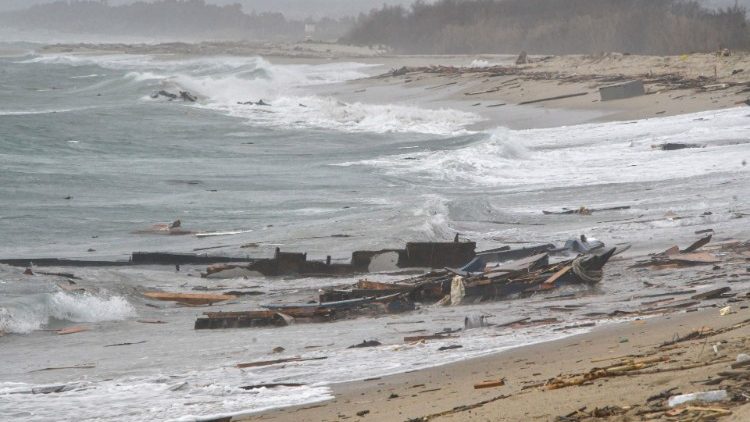
Remains of a ship along the beach where bodies believed to be of migrants were foundRemains of a ship along the beach where bodies believed to be of migrants were found  (GIUSEPPE PIPITA)

Pope prays for migrants lost at sea in most recent Mediterranean tragedy

Pope Francis prays for the dead and for those who have survived after the bodies of dozens of migrants wash up on an Italian shore.

By Francesca Merlo and Nathan Morley

Another tragedy in the Mediterranean Sea. Pope Francis on Sunday turned his thoughts on to the lives lost in yet another tragedy in which dozens of people lost their lives when their overloaded boat sank in rough seas.

Addressing the faithful gathered for his Sunday Angelus, the Holy Father explained that just off the coast of Calabria in Italy, over 40 bodies, including the bodies of many children, have been recovered.

"I pray for them", said the Pope, "for those who are lost, and for those who have survived", he added.

The Holy Father also expressed his gratitude towards all those who participate in rescue operations, as well as to all those who offer welcome to those seeking refuge. "May the Virgin Mary sustain you", he concluded. 

The tragedy

The tragedy occurred at dawn on Sunday. It is understood that the overloaded vessel bringing migrants from Iran, Pakistan, and Afghanistan smashed into rocks during rough weather.

ANSA, the Italian news agency, reports 80 survivors were found on a beach; they told rescuers at least 250 people were on board the fishing boat in which they were traveling.

Twenty-one of the survivors were taken to hospital.

It was later reported 27 bodies were found washed up at a seaside resort, with more spotted at sea – including a baby.

The perilous Mediterranean route

Just last week, a group of African migrants were drowned while dozens went missing when their overloaded boat sank off the Libyan coast.

The Mediterranean route is considered the most dangerous crossing in the world for people seeking refuge in Europe.

Countless rickety, unseaworthy boats packed with migrants have sunk in the area during the last five years.

With better weather arriving across the region, more migrant boats are expected to set sail in the coming weeks.

Sunday, February 26, 2023

The Pope and his closest collaborators at Vatican are off for a week of prayer and spiritual retreat


Pope and collaborators begin week of prayer


Kathleen N. Hattrup - published on 02/26/23

The Pope's activities will be suspended this week as he spends a few days on spiritual retreat.


Pope Francis, the cardinals in Rome, the heads of Dicasteries, and the Superiors of the Roman Curia will be taking a week of prayer. Their normal activities are suspended.

While the Pope is not gathering with his collaborators for a retreat in common, he is inviting them to “undertake a period of Spiritual Exercises in a personal way, suspending work activities and gathering themselves in prayer from the afternoon of Sunday 26 February until the afternoon of Friday 3 March, the first week of Lent.”

This week, all the Holy Father’s engagements, including the General Audience on Wednesday 1 March, will be suspended.

Monday Saint of the Day


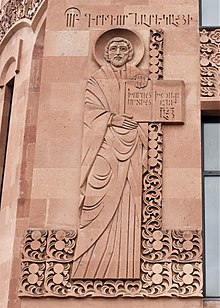
St. Gregory of Narek


Gregory was raised in a monastery and eventually entered the Narek Monastery, known as Narekavank in what is now Turkey, as a monk and lived there for nearly the entirety of his life.

At the time, Armenia was experiencing a literature, painting, architecture, and theological renaissance, in which Gregory participated.

As an Armenian monk, Gregory lived humbly and taught at the monastic school. He wrote his prayers in the encyclopedia of prayer for all nations in hopes the book would one day guide people of all stations around the world to prayer.

He was a leader of the well-developed school of Armenian mysticism at the Monastery and was asked to answer the question, "What can one offer to God, our creator, who already has everything and knows everything better than we could ever express it?"

In his Book of Prayer, also called the Book of Lamentations or the Song of Songs, Gregory wrote that the answer to the question is "the sighs of the heart." The book contains 91 prayers and was completed one year before he died.

Several miracles and traditions have been traced back to Gregory and he is known as "the watchful angel in human form."

Gregory of Narek was venerated as a saint by the Armenian Catholic Church and is also recognized as a saint of the Roman Catholic church. On April 12, 1015, Pope Francis officially proclaimed Gregory of Narek as a Doctor of the Church.

Saint Gregory has been depicted holding his book of prayer in a variety of artwork and a professor of psychiatry was able to develop a unique kind of therapy based on Saint Gregory's Book of Lamentations.

Though he has yet to be proclaimed the patron saint of a particular patronage, his Book of Prayer has been used to treat several diseases including schizophrenia, Hepatitis C, periodic disease, stress symptoms and depression.

Like me, this author really loves Lent


10 Reasons Why I Love Lent

May we clothe our hearts with the light of Christ.


Lorraine V. Murray 

It may seem strange to say I love a season of repentance, but I look forward to Lent every year with great enthusiasm. It gives me time to reflect on the many rough edges of my soul and ask God to chisel away at them. Here’s why this time of year means so much to me: 

Lent is a purely Christ-centered season, which thankfully hasn’t become tainted by consumerism. You don’t see newspaper ads touting Lenten specials at the mall or after-Lent clearance sales, nor do stores feature Lenten gifts and cards. 

I love the physical quality of Lent, which opens with a cross made of ashes upon our foreheads and the ominous proclamation that we are dust. Fridays include genuflecting and praying, as we walk spiritually with Christ during the Stations of the Cross. On Palm Sunday, we are given something tangible to remind us how Jesus was welcomed into Jerusalem. Then we have the washing of feet on Holy Thursday and that stirring moment on Good Friday, when we kneel to venerate the cross. 

Each year, when I decide on my Lenten sacrifices, I realize how blessed I really am. In truth, I’ve never gone to bed hungry, and my pleasures are many, including ice cream, chocolates and wine. Then there are ordinary things many people in the world consider luxuries, such as hot showers, clean drinking water and air conditioning. Lent calls us to remember our less fortunate brothers and sisters and to dig a little deeper in our pockets to help them. 

I love how nature moves in step with the season of Lent. As the days process toward Easter, the trees start flowering and daffodils push their buttery heads through the bleak earth. Nature’s gradual awakening from the starkness of winter echoes our Lenten attempts to reject dark habits and clothe our hearts with the light of Christ. 

Lent gives me a chance to create a do-it-yourself retreat at home. I try to spend time each day in silence, reading morning and afternoon prayers in the Liturgy of the Hours while sitting on the front steps, accompanied by robins gathering in the bird bath. Simple meals remind me of monastery fare and help me remember the poor in our world. 

Each year, I read Lenten classics such as The Pain of Christ and the Sorrow of God by Gerald Vann and The Seven Last Words of Christ by Fulton Sheen. Vann reminds us that, during Lent, we’re asked to “share in a particular way in the Passion of our Lord,” by choosing love over selfishness. This reminder is worthy of being written down and posted on my refrigerator! 

In the past, it was obvious who the Catholics were, because you could walk into their house on Fridays and detect the aroma of fried fish. At many parishes, the Knights of Columbus revive that tradition by serving fish dinners on Fridays during Lent. I love attending these events to see friends and support the Knights, who donate to many good causes in the name of Christ. 

Every Lent I read the Passion story in the four Gospels, poring over a few pages each night. These passages help me understand the meaning of sacrificial love. I am always stunned by the realization that no matter how many times I read these passages, they always reveal something completely new and remarkable, which I deeply need to hear. 

I’d be stretching the truth if I said I love going to confession, but at least during Lent I can dispense with my usual excuses. After all, if I plan to clean the entire house to prepare for Easter, shouldn’t I step into the confessional with the intention of asking God to cleanse my soul and praying he will “create in me a clean heart”?

Finally, I usually do too much during Lent. I’ll vow to stop online shopping, as well as cutting out desserts and wine. I’ll promise the Lord to pray more, attend the Stations of Cross and give generously to the poor. But there’s no question that, at times, I will fail, and fail miserably. Still, there’s comfort in knowing our failures reveal how much we rely on the love and mercy of our Lord Jesus Christ. And at heart, that’s what Lent is really about.

Politics and policies all for the common good


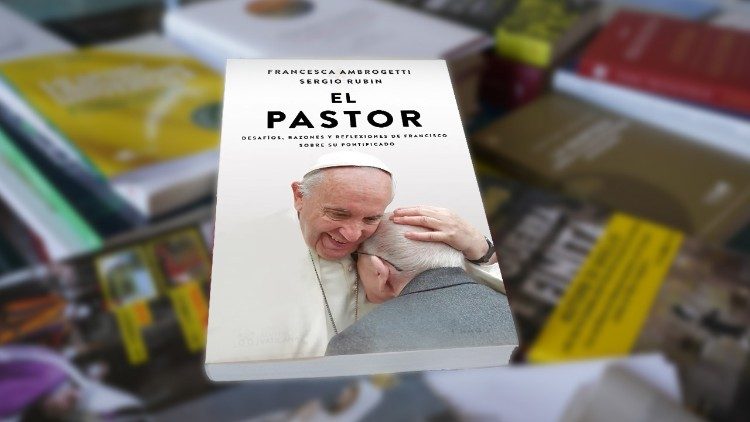
A copy of the book "El pastor"A copy of the book "El pastor" 

Pope: we must all engage in politics for the common good

"El Pastor", a book by journalists Francesca Ambrogetti and Sergio Rubin that was recently published in Argentina, is the result of several interviews with the Pope on the most important and urgent issues of the Church, from politics to economics, from reforms in the Roman Curia to threats to the 'common home'.

By Benedetta Capelli 

From 'El jesuita' (the Jesuit), written in 2010, to 'El Pastor' (the pastor), a book which has just been published in Argentina: Francesca Ambrogetti, former head of Ansa in Argentina; and Sergio Rubin, of the daily paper El Clarin, return to the figure of Jorge Mario Bergoglio. In their first book they gathered together the reflections of the Cardinal Archbishop of Buenos Aires, whereas in this second, the approach concerns the magisterium of Pope Francis, as well as the challenges faced in the ten years of his pontificate and future prospects such as "revitalizing the proclamation of the Gospel, reducing Vatican centralism, outlawing paedophilia... and fighting economic corruption". A programme of governance, he emphasises, that aims "to execute what was declared by the cardinals in the general congregations on the eve of the conclave".

The book consists of nineteen chapters and a prologue signed by Pope Francis, in which he writes, "I must acknowledge one virtue in Francesca and Sergio: their perseverance". The journalists offer an analysis of the magisterium through periodic interviews conducted over 10 years. Many topics are covered: from migration to the defence of life, the impact of the reforms of the Roman Curia, and the abuse of minors. On this last point, Pope Francis emphasises that his pontificate "will largely be evaluated by how he has dealt with this scourge".

Then, he speaks about marriage and the family, the threatened "common home", the "female genius", and "careerism" in the Church. Concerning homosexuality, Pope Francis emphasises that to "those who have suffered rejection by the Church, I would like to make it known that they are people in the Church".

The Gospel to convert a mentality

Politics is one of the central themes of the book. "Yes, I engage in politics", the Pope replies, 'because everyone must engage in politics. And what is politics? A way of life for the polis, for the city. What I do not do, nor should the Church do, is party politics. But the Gospel has a political dimension, which is to transform the social, even religious, mentality of people" so that it is directed to the common good.

Another important theme concerns the economy. Pope Francis reiterates that the beacon to follow is the Social Doctrine of the Church, that he is not condemning capitalism, but that it is necessary, as John Paul II indicated, to follow a "social market economy". Today, he adds, finance prevails and wealth is less and less participatory. "What we can all agree is that the concentration of wealth and inequality have increased. And that there are many people starving."

Clarity in Vatican finances

Pope Francis then dwells on the Vatican's financial affairs, defending the good faith of the "vast majority" of the Church's members. "But it cannot be denied," he says, "that some clerics and many, I would say, false lay 'friends' of the Church have contributed to misappropriating the movable and immovable patrimony, not of the Vatican, but of the faithful".

Referring then to the affair of the London property, he emphasised that it was precisely in the Vatican that "the suspicious purchase" was detected. "I rejoiced," says the Pope, "because it means that today the Vatican administration has the resources to shed light on the ugly things that happen inside".

With regard to State-Church relations, he says he defends "the secularity of the State, not the secularism that, for example, does not allow religious images in public spaces".

Ready to go to China

Concerning Argentina, the Pope emphasises that "accusations of Peronism are a commonplace" and calls on trade unions to defend the dignity of workers and their rights.

He also maintains that his intention to travel to the country "remains valid". 'It is unfair to say I don't want to go'.

Regarding the agreement between the Holy See and China, the Pope says he is aware of the problems and sufferings, showing himself willing to go to the Asian country "tomorrow, if it were possible!"

The Church is not a 'mail-order' mother

The Pope finally confesses to having had crises of faith, which were overcome with God's help. "In any case," he adds, "a faith that does not put us in crisis is a faith in crisis. Just as a faith that does not make us grow is a faith that must grow".

Concerning the Church of the future, he explains that closeness is the key to everything. The Church is a mother, and I do not know any mothers 'by correspondence'. The mother gives affection, touches, kisses, loves. When the Church is not close to her children because she is busy with a thousand things or communicates with them through documents, it is as if a mother communicates with her children by letter".

On 1st Sunday of Lent the Temptation of Jesus in the Desert


First Sunday of Lent: The Temptation in the Desert

SCRIPTURES & ART: We start Lent with the Temptation in the Desert because we start from our broken condition as sinners.


The Gospel for the First Sunday of Lent every year is always the Temptation of Jesus, taken in turn from Matthew (this year), Mark and Luke. All three Synoptic Gospels (Matthew, Mark and Luke) showcase the beginnings of Jesus’ public ministry the same way. Jesus is baptized by John in the River Jordan, then is “lead by the Holy Spirit” into the desert to be tempted for 40 days.

Forty days, of course, reminds us of the 40 days of Lent. They should also remind us of the 40 years Israel spent in the Sinai desert during its wanderings on the way to the Promised Land. “Wanderings” is my deliberate choice. God had freed Israel from Egyptian slavery and led them to Mount Sinai to make a covenant with them: “You will be my people and I will be your God.” But Israel wandered away from God, even at the foot of Sinai: while Moses went to receive the Ten Commandments, Israel started worshipping a golden calf. The generation that still longed for the comforts of Egypt was not material to forge a people dedicated to God. They had to die out. So Israel’s wanderings in the desert were a punishment. But they were also a preparation, a period of training to ready them to be God’s Holy People.

That is what our Lent is for, too.

Mark is sparing in discussing the temptations in the Desert. Matthew and Luke are more detailed, though they invert the order of the second and third temptations.

We start Lent with the Temptation in the Desert because we start from our broken condition as sinners. Our “normal” condition is not normal. We are not how God intended human beings to be.

Jesus, who is “true God and true man,” is also how human beings should be. And Jesus is like us “in all things but sin” (Hebrews 4:15). That is why Pope St. John Paul II never tired of repeating the teaching of Vatican II that Jesus Christ fully reveals man to himself. You want to know what being truly human should look like? See Jesus.

Indeed, Jesus as Son of God and Son of Man, could not sin. He was impeccable. But temptation — although it leads us to sin — is not in itself sin. That is why “he was tempted in every way, but without sin” (Hebrews 4:15).

Matthew, like Luke, gives specifics of three temptations Jesus faced. They both agree that the first temptation was to change stones into bread.

And Jesus had fasted. He was hungry. He was in the middle of the Judean desert on Mount Quruntul, a barren area bereft of vegetation.

Two comments:

First, notice that the Devil says “if.” It’s both a lack of knowledge and a dare. Is this sniveling guy from some one-mule town in Galilee really the Son of God? And, if he is, let him prove it by some demonstration of power.

After all, the Devil is all about power: the power of pride that led to his downfall. And, as has been pointed out, the subjunctive is the language of hell: “If you are the Son of God” (“if” appears in today’s Gospel three times); “If the King of the Universe were a friend ...” (Dante, Inferno, Canto V). “If” is the language of hell because it is the language of failure, of chances lost forever, of uncertainty about the order of the universe because the Truth is not “my truth,” i.e., hell’s truth. If only evil were really good and good really evil — and not just what demons want to label it.

Second, the first temptation is physical. Like us, the Devil doesn’t want to work harder than he has to. He pursues the most direct route to most human beings — the way to a man’s heart is through his stomach. Man is a physical and spiritual creature: today’s First Reading from Genesis makes that clear. The physical has a direct and immediate impact on us, and that’s normal: knowledge comes to us through our senses. Most people are more quickly moved by the smell of hot pizza than hot incense.

That’s not to say the physical is in any way inferior. That is a gnostic and a Cartesian viewpoint (which is why moderns have such contempt for their embodiment they think they can change their sex by thinking differently), not a Christian perspective.

So, having shot his first arrow and missed, the Devil recognizes “too weak is the temptation//For one whose soul aspires to nobler things aspires//than sensual desires” (Longfellow, Christus: A Mystery,” II, 2).

His second temptation is to take Jesus to the top of the Temple and suggest he jump off. Normal people would, of course, recognize such behavior as reckless, injurious, even suicidal. But the Devil recasts it as another dare: prove that God will protect you!

Both the first and second temptations rely upon presuming upon God. They seek for Jesus to get a certain outcome by forcing God’s hand. They seek to compel God to do things out of the ordinary in order for him to prove his loving care for his Son. This is not faith; this is presumption.

Failing a second time, the Devil’s third temptation mirrors the temptation to which the Devil himself succumbed: worship me! The Devil fell because he worshipped himself instead of God. In his pride, the universe was not big enough for the two of us! And, because the Devil never learns, he deploys that temptation against Jesus: I will give you all sorts of power and dominion if you worship me! If you change your allegiance from the one I wanted you to force to make bread out of stones or deploy angelic rescue nets to me!

And, of course, it is that ultimate idolatry that results in Jesus commanding him, “Begone, Satan!”

That should also be our Lenten rallying cry!

Today’s Gospel is illustrated by the early American artist John Ritto Penniman (1782-1841). “Christ Tempted by the Devil” dates from 1818 and is held by the Smithsonian.

Jesus is the central figure in the painting, which capture the moment just after Matthew’s third temptation, a promise of all the world’s kingdoms if Jesus would just worship Satan. Jesus on barren Mount Quruntul is in the foreground; the kingdoms of the world are in a paling light behind Jesus. Jesus drives off the Devil — “Begone, Satan!” — who is already crushed to the ground (a forefiguring of Genesis 3:15?). On the upper left of the painting (Jesus’ right) a band of angels is on its way; they “came and ministered to him.” Yes, God sends his angels to bear you up and yes, God cares for our needs — in his way and his time, not our way or our time. The essence of that temptation is worth remembering when we despair, “where is God?” The only light in this otherwise dark painting is radiated by Jesus, whose clothing — a pure white robe and a red cloak (symbolic of his blood) introduces light color, and by the four angels who push away the clouds on their way to Jesus.

I chose this painting for two reasons. One is to illustrate that religious themes sometimes played a role in early American art, which more often focused on portraiture and landscapes of a vast country whose Western exploration was just underway.

Another is to introduce Pettiman, an American artist with his own temptation problems. Born in Massachusetts, he was a successful painter and ornamental artist, who had the talent, the network (he was a friend of Gilbert Stuart, the great American artist of his day) and the clientele base to make a go of things. But Pettiman also had his temptations — temptations to which he gave in. They weren’t about food but drink — his penchant for alcohol destroyed his career, left him indebted and often in trouble with the law. He ended his days in Baltimore, where his son lived.

Temptations are not sins. What matters is what we do with them. Overcome, they make us stronger in our following of Christ. Succumbed to, they make us slaves worshipping the Devil, whose “works and empty promises” we are called to renounce — at baptism and during this Lenten season. Christ shows us we are not alone.

Pope lists several prayer intentions at end of Angelus Address


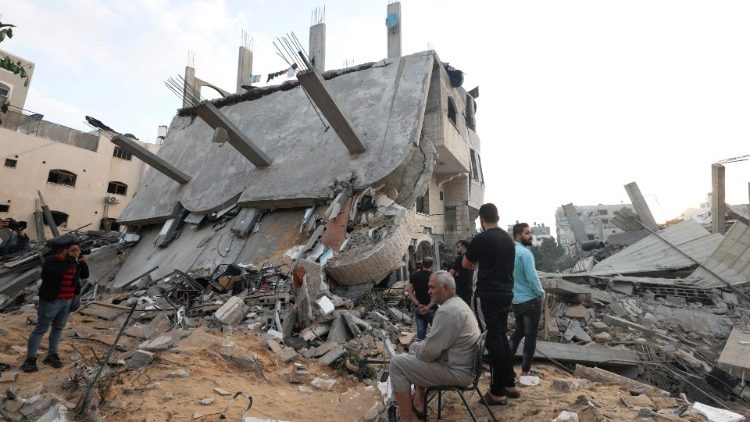
Destroyed buildings on the Gaza strip (file photo)Destroyed buildings on the Gaza strip (file photo)  (AFP or licensors)

Pope prays for an end to violence in the Holy Land, Burkina Faso and the Mediterranean Sea

In renewed appeals following his Sunday Angelus, Pope Francis calls for prayers and for peace for the countless victims of violence in the Holy Land, Burkina Faso and the Mediterranean Sea which sees so many migrants drown as they take on perilous journeys to cross it.

By Francesca Merlo

Addressing the faithful gathered in St Peter’s Square for the Sunday Angelus, after the recitation of the Marian prayer, Pope Francis turned his thoughts to the terrible news that continues to come from the Holy Land.

In light of recent tragedies, Pope Francis noted that many people, including children, are being killed and he asked, “How can we put an end to this spiral of violence?”

The Holy Father then renewed, once more, his appeal that "dialogue may reign over hatred and revenge".

“I pray to God for the Palestinians and the Israelis, that they may find the road to fraternity and peace, with the help of the international community”.

Violence in Burkina Faso

Pope Francis then shared his worries regarding the situation in Burkina Faso, where "terrorist attacks continue to take place".

Once again, Pope Francis invited all those following his Sunday Angelus to "pray for the people of that dear country", in the hope that the violence they continue to endure might not lead them to lose hope in their journey of democracy, justice, and peace. 

In recent updates from the west African nation, the so-called Islamic State group has claimed responsibility for killing over 70 soldiers, wounding dozens more, and taking five people hostage in an ambush on a military convoy in the northern part of the country. 

Another tragedy on the Mediterranean

Then, Pope Francis shared recent news of yet another shipwreck on the Mediterranean. He explained that just off the coast of Calabria in Italy, another boat carrying migrants from northern Africa had capsized, and since this morning 40 bodies, including the bodies of many children, have been recovered. "I pray for them", said the Pope, "for those who are lost, and for those who have survived", he added.

The Holy Father also expressed his gratitude towards all those who participate in rescue operations, as well as to all those who offer welcome to those seeking refuge. "May the Virgin Mary sustain you", he concluded. 

Concluding, Pope Francis asked those present not to forget Ukraine one year after the start of the Russian invasion. “And let us not forget the Syrian and Turkish people, victims of terrible earthquakes”.

Papal Sunday Angelus Address 02.26.2023


Pope: Seek unity with God, welcome His Word in face of temptation

On this first Sunday of Lent, Pope Francis speaks about the spiritual struggle of Lent and explains how in the desert Jesus defeats the temptations of the Devil, who is the "divider." He illustrates how we too must respond to temptation to sin by recalling the Word of God and putting our trust always in the Lord who is ever ready to help us in our journey of faith.

By Vatican News staff writer

Offering his customary reflections on the Sunday Gospel before leading the recitation of the Angelus, Pope Francis spoke about how Jesus in the desert was tempted by the devil - which means "divider," as the devil always wants to create divisions. The Gospel reading on this first Sunday of Lent highlights the spiritual struggle Jesus and we all face in our daily lives of opposing temptation through our trust in God and with assistance from our knowledge of the Word of God.

The Pope pointed out how the devil tries to "divide" or separate Jesus from His union with the Father. Jesus received His baptism from John and was called by the Father "My beloved Son," with the Holy Spirit descending upon Him in the form of a dove, the Pope recalled, showing the three divine Persons joined in love. Jesus came into the world to help us partake in this union of love, while the devil instead tries to divide Jesus from this unity and His mission of unity for us, the Pope went on to say. 

Challenging the three "poisons"

The Pope then explained how the devil tries to take advantage of Jesus' tiredness and hunger after fasting forty days by trying to administer three "poisons" to jeopardize His mission of unity. The poisons are attachment, mistrust, and power, he explained, adding how insidious these dangerous temptations are: attachment to material goods when the devil tries to get Jesus to stop fasting and to transform the stones into bread; mistrust by trying to get Jesus to test the Father by throwing Himself off the highest point of the temple in order to be saved; and finally power when the devil suggests Jesus take over worldly kingdoms.

“But that is just how it is, for us too: attachment to material things, mistrust and the thirst for power are three widespread and dangerous temptations, which the devil uses to divide us from the Father and to make us no longer feel like brothers and sisters among ourselves, to lead us to solitude and desperation. He wanted to do this to Jesus, he wants to do it to us: to lead us to desperation.”

Defeating the temptations

Jesus rejects and defeats the three temptations by avoiding any debate and discussion with the devil and by answering with the Word of God, the Pope underscored, noting the importance of never discussing or dialoguing with the devil. The three verses from Sacred Scripture that Jesus pronounces that oppose the three temptations speak of freedom from goods (cf. Dt 8:3), trust (cf. Dt 6:16), and service to God (cf. Dt 6:13). 

“Jesus never enters into dialogue with the devil, he does not negotiate with him, but he repels his insinuations with the beneficent Words of the Scripture. It is an invitation to us too; one cannot defeat him by negotiating with him, he is stronger than us. We defeat the devil by countering him in faith with the divine Word. In this way, Jesus teaches us to defend unity with God and among ourselves from the attacks of the divider. The divine Word that is Jesus’ answer to the temptation of the devil.”

In conclusion, the Pope suggested we reflect on how the Word of God guides our own lives and how it can help us in our spiritual struggles. If we have a recurring temptation, we should seek help from a verse of the Word of God that helps us, something we can remember, recite, and pray by "trusting in the grace of Christ," he explained.

“Let us try, it will help us in temptation, it will help us a great deal, so that, amid the voices that stir within us, the beneficent one of the Word of God will resound. May Mary, who welcomed the Word of God and with her humility defeated the pride of the divider, accompany us in the spiritual struggle of Lent.”

Saturday, February 25, 2023

The Knights of Columbus supporting the people of Ukraine


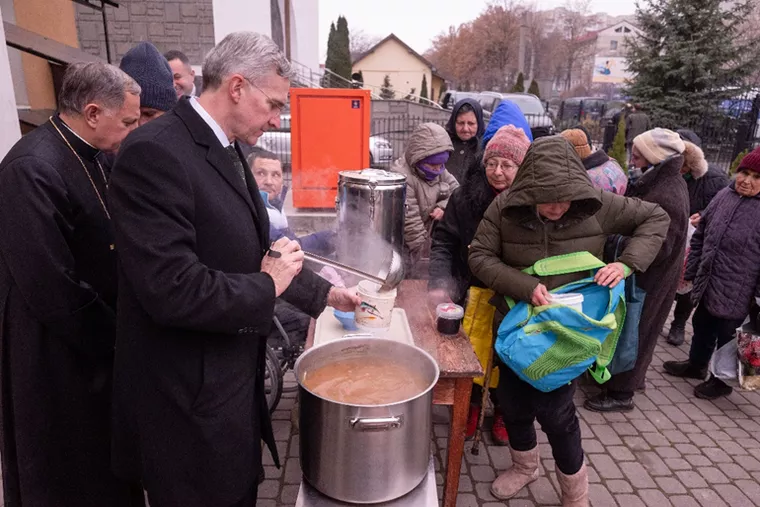
Knights of Columbus Reassure Ukrainians: ‘You’re Not Alone’

Supreme Knight Patrick Kelly gives firsthand look at ongoing aid, saying, ‘It’s a witness to the whole world that the answer to the problems we face is Jesus Christ.’


The Knights of Columbus are no strangers to stepping up with abundant aid in desperate situations. The war in Ukraine is no exception. This past year, the fraternal organization has stepped forward boldly with continuing aid in the war-torn country.

Supreme Knight Patrick Kelly shared some of what he observed and how the Knights are bringing aid to Ukraine with Register staff writer Joseph Pronechen in an email interview Feb. 24, marking the one year anniversary since the invasion. 


Please share some of your experiences visiting Ukraine and Poland: What particular things have been most moving?

I visited Ukraine and Poland twice in 2022, beginning with a trip during Holy Week.

I saw tremendous suffering, and I saw real strength. Both trips were deeply moving.


The number of refugees and displaced persons, as well as the conditions they faced, were striking. I was watching people walk across the border, mostly women and children, with nothing more than a small suitcase. They would stop at our K of C Mercy Center for warmth, something to eat and to get some rest — both physical and spiritual. Often, there would be a priest or religious sister present. They didn’t know where they would go next, and our volunteers helped connect them with resources. I saw people living in a previously abandoned monastery in Ukraine, again with very little, in terms of material goods and a great deal of uncertainty. I saw separated families, and I heard the stories of lost loved ones.

But I also saw something inspiring and just as moving — the patriotism of one nation in crisis and another nation stepping bravely forward to assist in an hour of need. In Ukraine and Poland, I saw real solidarity, which is remarkable, given the history of the region. So I was saddened and inspired. But, overall, I was even more convinced of the importance of our humanitarian support.


Who were some of the others you met with while there?

Throughout both trips, my message was one of solidarity and a commitment of continued support.

In December, I met with government officials, prominent Catholic leaders from both the Latin and Ukrainian Greek Churches, and local Knights. I also spent time with displaced Ukrainians — just hearing their stories. These stories were heart-wrenching, but I was also able to see what a concrete difference our humanitarian aid is making for real people. Lives depend on it.

I met with President Andrzej Duda of Poland. President Duda and I both recognize that while much has been accomplished, the relief work must continue for the long term. I assured President Duda of the Knights’ commitment to ongoing support.

And this support needs to include some more long-term solutions as well as immediate aid. So I was especially proud to visit Our Lady of Częstochowa parish in Radom, Poland, where we opened the Blessed Michael McGivney House, a new long-term resource center for refugees. We will need more of these kinds of resources; and the Knights — in Poland, Ukraine and around the world — are committed to providing them.


What are some of the ways Knights have been helping the people in Ukraine — Knights from the U.S., Knights in Poland? How are needs being answered?

Well, first and foremost, by raising money and getting immediate aid to people on the ground. Within 36 hours of the Russian invasion, the Knights of Columbus committed $1.5 million toward humanitarian relief and established the Ukraine Solidarity Fund. To date, the Knights have raised more than $20 million.

Less than a week after the invasion began, we began organizing our K of C Charity Convoys — truckloads of supplies, which our members brought into Ukraine.

The Knights also established Mercy Centers along the Poland-Ukraine border that served more than 300,000 people.

More recently, we began the “Powering Our Parishes” program to provide generators, especially important in the winter, as power plants have been increasingly targeted. We’re sending these generators to parishes in Ukraine, so that they can provide centers for warmth and for community, in addition to keeping the churches themselves running.

We’ve also partnered with other organizations to magnify our help, calling upon their particular areas of expertise. With these partners, we’ve provided health care to civilians, and we’re underway with a project to remove mines from fields and waterways, so that people can return to their liberated lands and restore some semblance of normal life. We’ve worked with other groups to build orphanages and provide for the education of Ukrainian children.


Since Knights always bring spiritual support into all of their efforts, can you share some thoughts on this aspect from your trips?

I think something that is sometimes overlooked — but that from a Catholic perspective is just as important as our material aid — is our spiritual support. As the Polish people once said to John Paul II in a different time, but also a time of great suffering and trial: “We want God.”

While in Ukraine, I was invited to attend a vespers service with Ukrainian Greek Catholic seminarians and to offer a few words. I told them I thought they were among the most important future leaders of Ukraine because they are to be, principally, witnesses to the faith. It is faith in Jesus Christ that can ground the culture of Ukraine and can carry it through these dark times. But even more than that, it’s a witness to the whole world that the answer to the problems we face is Jesus Christ. Knights around the world are praying regularly for the people of Ukraine and for a just end to the war.

Are there Knights in Ukraine?

We have more than 2,000 Knights in Ukraine, and that includes more than 140 who joined our ranks during the war. We also have more than 7,200 Knights across the border in Poland. So we are uniquely suited to help. We’re not an aid agency. But we are part of the affected communities.

Through our Knights in Ukraine, we get real-time information on what is needed at any given moment. This allows us to continually adapt our aid to the changing circumstances.

More importantly, this war impacts our families. And that’s why we’re not going anywhere. That is why I can say with confidence to the Ukrainians, “You’re not alone.” That is why I promised to them that we’ll be there for the long haul.


Are the Knights continuing to make this aid a priority?

Knights in Ukraine, Poland and around the world have made our response to the humanitarian needs of those impacted by the invasion a priority since Day One. We continually ask our members to pray for those affected by the war and to support our relief efforts through the Ukraine Solidarity Fund.

We hope to bring renewed attention to the humanitarian crisis in the region through our upcoming documentary In Solidarity With Ukraine, which will air on ABC network affiliates across the United States for six consecutive weekends, beginning Feb. 26. It will give a unique inside view of the situation on the ground in Ukraine, and I hope it will inspire more people to offer material and spiritual aid.


What more would you like to see the Knights doing for Ukraine and the Ukrainian people and refugees?

As we enter Lent, it is a time for deepening our prayer, fasting and almsgiving. I ask Knights around the world to pray for those suffering in this conflict, to fast for peace and justice, and to give generously to those in need, especially the women and children, who suffer most.