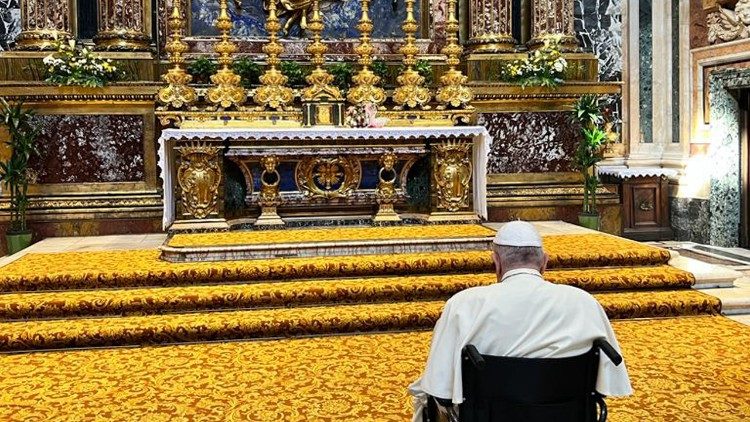
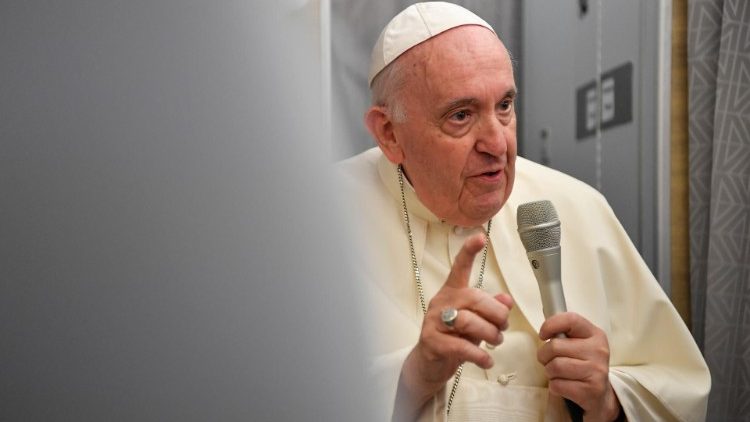
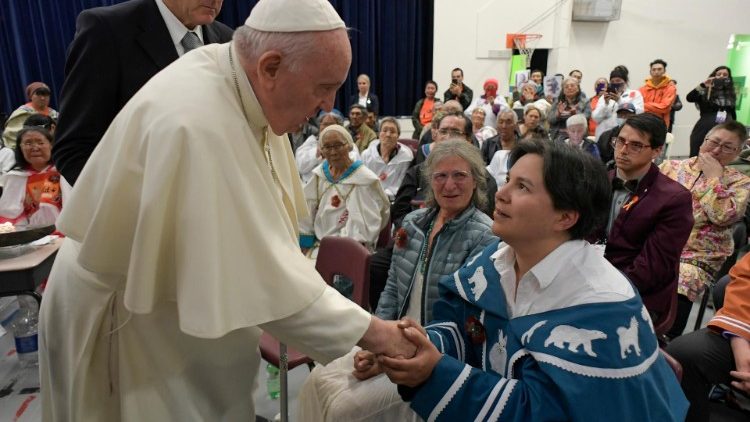
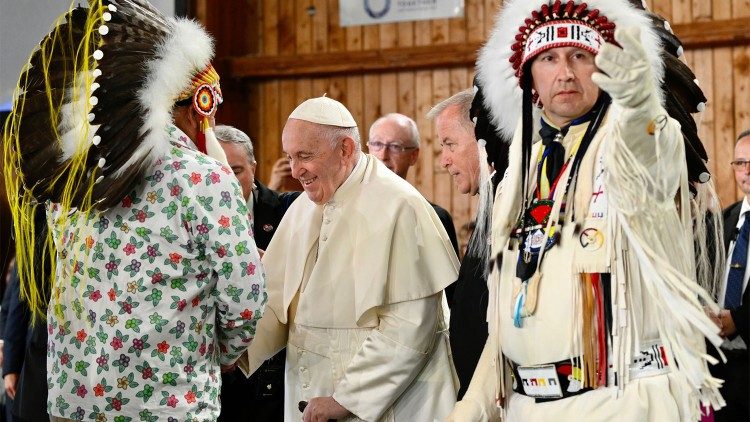
On the return flight from Canada, Pope Francis speaks about his just-concluded Apostolic Journey and about old and new colonialisms. He says he has not yet thought of resigning, making light of it, and speaks about Germany's synodal path, doctrinal development, and the importance of women in the transmission of the faith.
By Vatican News
It was a genocide of the indigenous peoples. On the return flight from Iqaluit to Rome, Pope Francis responded to a Canadian journalist's question and spoke about the themes of the just-concluded penitential pilgrimage, and of old and new colonialism.
He also addressed the issue of resigning from the papacy, repeatedly prompted by the journalists' questions, explaining that for the time being, he does not intend to resign even though he considers it a possibility. At the start of the press conference, Pope Francis thanked the journalists flying with him: “Good evening and thank you for your accompaniment, for your work here. I know you have worked hard and I thank you for the company, thank you.”
The following is a working translation of the Pope's conversation with journalists:
Jessica Ka'nhehsíio DEER (CBC RADIO - CANADA INDIGENOUS)
As a descendant of a residential school survivor, I know that survivors and their families want to see concrete actions following your apology, including the rejection of the "doctrine of discovery." Considering that this is still enshrined in the Constitution and legal systems in Canada and the United States, where indigenous peoples continue to be defrauded of their lands and deprived of power, was it not a missed opportunity to make a statement to this effect during your trip to Canada?
Pope Francis
I didn’t understand the second part of the question, could you explain what you mean by doctrine of discovery?
Jessica Ka'nhehsíio DEER
When I talk to indigenous people, they say that when people came to colonize America, there was this doctrine of discovery that somehow promoted the idea that the indigenous peoples of the new countries were inferior to the Catholics. This is how Canada and the United States became "countries."
Thank you for the question. I think this is a problem of all colonialism. Every one, even to this day: today's ideological colonizations have the same pattern. Whoever doesn't enter its path is inferior. But I want to expand on this. They were considered not only inferior: some somewhat crazy theologian even wondered if they had a soul. When John Paul II went to Africa, to the port where the slaves were boarded [Gorée Island, the Door of No Return], he offered a sign so that we would come to understand the drama, the criminal drama: those people were thrown into the ship, in dire conditions, and then they became slaves in America. It is true that there were voices that spoke out, like Bartolomeo de las Casas, for example, or Peter Claver, but they were the minority. The consciousness of human equality came slowly. And I say consciousness, because in the unconscious there is still something. We have - allow me to say it - a somewhat colonialist attitude of reducing their culture to ours. It is something that comes to us from a developed way of life, our own, because of which we sometimes lose [discard] values that they have. For example: indigenous peoples have a great value, the value of harmony with Creation, and at least some people I know express that in the word vivere bene [good living] . That does not mean, as we westerners understand, to spend it well or to live la dolce vita [the good life]: no. 'Good living' means to cherish harmony, and that to me, is the great value of the original peoples. Harmony. We are used to reducing everything to the head - Instead, the personality of the original peoples, I am speaking generally, who know how to express themselves in three languages: that of the head, that of the heart and that of the hands. But all together, and they know how to have this language with Creation. Then, this accelerated progressivism of the somewhat exaggerated, somewhat neurotic development that we have, right? I'm not speaking against development, development is good. What is not good is the anxiety over development, development, development ... You see, one of the things that our overdeveloped, commercial civilization has lost is the capacity for poetry: indigenous peoples have that poetic capacity. I'm not idealizing. Then, this doctrine of colonization, which it's true, it's bad, it's unjust, and is still used today. It the same, maybe, with silk gloves, but it is still used today. For example, some bishops from some countries have said to me, "But, our country, when they ask for credit from an international organization, they put conditions on us, even legislative, colonialist conditions. To give you credit they make you change your way of life a little bit."
Going back to the colonization of America—let’s say that of the Americas, that of the British, the French, the Spanish, the Portuguese--there has always been a danger, a mentality of "we are superior and these indigenous people don't matter," and that is serious. That's why we have to work on what you say: go back and heal, let's put it that way, what was done wrong, in the knowledge that even today the same colonialism exists. Think, for example, about one case, which is universal, and allow me to say so. Take the case of the Rohingya, in Myanmar: they are considered inferior, they have no right to citizenship. Even today.
Brittany HOBSON (THE CANADIAN PRESS)
You often say that it is necessary to speak clearly, honestly, and with parrhesia [boldly] . You know that the Canadian Truth and Reconciliation Commission described the residential school system as 'cultural genocide,' and then it was modified as genocide. The people who heard your words of apology this past week expressed their disappointment because the word genocide was not used. Would you use that term to say that members of the Church participated in genocide?
It's true, I didn't use the word because it didn't come to my mind, but I described the genocide and asked for forgiveness, pardon for this activity that is genocidal. For example, I condemned this too: taking away children, changing culture, changing mentality, changing traditions, changing a race, let's put it that way, an entire culture. Yes, genocide is a technical word. I didn't use it because it didn't come to my mind, but I described it… It's true, yes, yes, it's genocide. You can all stay calm about this. You can report that I said that it was genocide.
Maria Valentina ALAZRAKI CRASTICH (TELEVISA)
Pope Francis, we assume that this trip to Canada was also a test, a test regarding your health, for what you called this morning "physical limitations." So we would like to know -- after this week, what can you tell us about your future travels, do you want to continue traveling like this, would there be any travels that you cannot take because of these limitations or if you think that knee surgery might resolve the situation even more and permit you travel as before?
I don't know, I don't think I can continue with the same pace of the trips as before. I think that at my age and with this limitation, I have to spare myself a bit, to be able to serve the Church. But, on the other hand, I can also think about the possibility of stepping aside. With all honesty, this is not a catastrophe, it is possible to change Pope, it is possible to change, there is no problem! But I think I have to limit myself a bit with these exertions. Knee surgery for me is not an option in my case. The health care professionals say it is, but there is the whole problem of anesthesia. Ten months ago, I underwent more than six hours of anesthesia, and there are still traces. You don't play around, you don't mess around, with anesthesia. And that's why I think it is not entirely suitable. I will continue to make trips and be close to the people, because I think closeness is the way to serve. Beyond that, I do not have anything else to say. Let's hope. In Mexico, there is no visit foreseen yet, right?
Maria Valentina ALAZRAKI
No, no ... I know that, what about Kazakhstan? And if you go to Kazakhstan, shouldn't you go to Ukraine as well?
I have said that I would like to go to Ukraine. Let's see now what I find when I get home. For the moment, I would like to go to Kazakhstan. That wouldn't be too rigorous of a journey. There wouldn't be a lot of movement. There is a congress of religions. But for the moment, everything remains as is. I also need to go to South Sudan, as well as Congo, because that's a trip with the Archbishop of Canterbury and the Bishop of the Church of Scotland, since the three of us participated in the retreat two years ago... Then Congo, but that will have to be next year, because of the rainy season. We will have to see... I have all the good will in the world, but let's see what my leg says.
Carolina Pigozzi (PARIS MATCH)
You met with local members of the Society of Jesus, your family, in the archbishopric this morning, as you always do during your travels. Nine years ago returning from Brazil, I asked you, if you still feel like a Jesuit. Your answer was in the positive. On December 4, after seeing the Jesuits in Greece, you said that when someone begins a process, they need to let it develop, let it mature, and then they needs to step aside. “Every Jesuit," you said, "must do this, no 'work' belongs to him because it belongs to the Lord.” Could this statement one day apply to a Jesuit Pope?
I think so, yes.
Carolina Pigozzi
Does that mean you could step aside like the Jesuits?
Yes. Yes. It's a vocation.
Carolina Pigozzi
Being Pope or being a Jesuit?
Jesuit. Let the Lord say. The Jesuit tries, tries, he doesn't always do it, but he tries, to do the Lord's will. The Jesuit Pope must also do the same. When the Lord speaks..., if the Lord says go ahead, go ahead, if the Lord says, go to the corner, you go to the corner. It's the Lord...
Carolina Pigozzi
What you're saying means that at one point death is expected...
We're all waiting for death...
Carolina Pigozzi
What I mean is: wouldn't you need to step aside first?
Whatever the Lord says. The Lord might say resign. The Lord is in charge.
One thing that is important about St. Ignatius: St. Ignatius would dispense someone who was tired or ill from prayer, but would never dispense anyone from the examination of conscience. Twice a day, to look at what has happened in my heart today.
Not sins or no sins, but what spirit moved me today. Our vocation is to look for what happened today. If I-this is a hypothesis-see that the Lord is telling me something, that something happened to me, that I have an inspiration, I have to discern to see what the Lord is asking. It may also be that the Lord wants to send me to the corner. He is in charge. This is the religious way of life of a Jesuit, to be in spiritual discernment to make decisions, to choose a path of work, of commitment as well... Discernment is the key to the Jesuit's vocation. This is important. In this area, St. Ignatius was really an expert, because it was his own experience of spiritual discernment that brought him to conversion. And the spiritual exercises are truly a school of discernment. So the Jesuit, by vocation, must be a man of discernment: discerning situations, discerning his own conscience, discerning the decisions to be made. For this reason, being open to whatever the Lord asks of him, is kind of our spirituality.
Carolina Pigozzi
But do you feel more like a Pope or more like a Jesuit?
I never considered it that way, whether I am more Pope or Jesuit. I consider myself a servant of the Lord with the style of the Jesuits. There is no papal spirituality. That doesn't exist. Each Pope carries forth his own spirituality. Think of St. John Paul II with that beautiful Marian spirituality he had. He had it before, and he had it as Pope. Think of the many Popes who have carried on their spirituality.
The papacy is not a spirituality, it is a role, a function, a service. Each one carries it out with his own spirituality, his own graces, his own faithfulness, and also his own sins. But there is no papal spirituality. That is why there is no comparison between Jesuit spirituality and papal spirituality, because the latter does not exist. Is that clear?
Severina Elisabeth Bartonitschek (CIC)
Yesterday you also spoke of the fraternity of the Church, a community that knows how to listen and enter into dialogue, that promotes a good quality of relationships. But a few days ago, the Holy See released a statement on Germany's Synodal Way, an un-signed text. Do you think this way of communication contributes, or is an obstacle, to dialogue?
First of all, that statement was issued by the Secretariat of State... it was a mistake not to say that... I think it said [it was] a statement of the Secretariat of State but I'm not sure. It was a mistake not to sign it as Secretariat of State, but an administrative error, not of ill will. And regarding the Synodal Way, I wrote a letter. I did it on my own: a month of prayer, reflection, consultation. And I said everything I had to say about the Synodal Way. I will not say more than that, that letter I wrote two years ago is the Papal Magisterium on the Synodal Way. I went over the Curia, since I didn't carry out consultations [in the Curia], nothing. I did it as my own journey, as a pastor [on behalf of] a Church that is seeking the way, as a brother, as a father, and as a believer. And that is my message. I know that it's not easy, but everything is in that letter. Thank you.
Ignazio Ingrao (RAI - TG1)
Italy is going through a difficult time that also causes concern internationally. There is the economic crisis, the pandemic, the war, and now we are also without a government. You are the Primate of Italy: in your telegram to President Mattarella for his birthday, you spoke of a country marked by not a few difficulties and called for crucial choices. How did you experience Draghi's fall?
First of all, I do not want to meddle in Italian internal politics. Secondly, no one can say that President Draghi was not a man of high international quality. He was president of the [European Central] Bank. He had a good career. I only asked my one question: Tell me, how many governments has Italy had in this century? He told me 20. This is my response...
Ignazio Ingrao
What appeals would you make to the political movers in view of these difficult elections?
Responsibility. Civic responsibility.
Claire Giangrave (RELIGION NEWS SERVICE)
Many Catholics, but also many theologians, think that development is needed in the Church's doctrine regarding contraceptives. It would seem that even your predecessor, John Paul I, thought that a total ban perhaps needs to be reconsidered. What are your thoughts on this, in the sense: Are you open, in short, to a reevaluation in this regard? Or does the possibility exist for a couple to consider contraceptives?
This is something very timely. But know that dogma, morality, is always on a path of development, but always developing in the same direction. To use something thing that is clear, I think I've said it other times here: for the theological development of a moral or dogmatic issue, there is a rule that is very clear and illuminating. It's more or less what Vincent of Lerins did in the 10th century. He says that true doctrine, in order to go forward, to develop, must not be quiet, it develops ut annis consolidetur, dilatetur tempore, sublimetur aetate. That is, it is consolidated over time, it expands and consolidates, and becomes always more solid, but always progressing. That is why the duty of theologians is research, theological reflection, you cannot do theology with a "no" in front of it. Then it is up to the Magisterium to say no, you've gone too far, come back, but theological development must be open, that's what theologians are for. And the Magisterium must help to understand the limits. On the issue of contraception, I know there is a publication out on this and other marital issues: These are the Acts of a congress, and in a congress, there are hypotheses, then they discuss among themselves and make proposals. We have to be clear: those who participated in this congress did their duty, because they have sought to move forward in doctrine, but in an ecclesial sense, not out of it, as I said with that rule of St. Vincent of Lerins. Then the Magisterium will say, yes it is good or it is not good. Many things fall under this. Think for example about atomic weapons: today [recently] I officially declared that the use and possession of atomic weapons is immoral. Think about the death penalty: today, I can say that we are close to immorality there, because the moral conscience is not well developed. To be clear: it's ok when dogma or morality develops, but in that direction, with the three rules of Vincent of Lerins. I think this is very clear: a Church that does not develop its thinking in an ecclesial sense, is a Church that is going backward. This is today's problem, and of many who call themselves traditional. No, no, they are not traditional, they are people looking to the past, going backward, without roots - it has always been done that way, that's how it was done last century. And looking backward is a sin because it does not progress with the Church. Tradition, instead, someone said (I think I said it in one of the speeches), tradition is the living faith of those who have died. Instead, for those people who are looking backward, who call themselves traditionalists, it is the dead faith of the living. Tradition is truly the root, the inspiration by which to go forward in the Church, and this is always vertical. And looking backward is going backward, it is always closed. It is important to understand well the role of tradition, which is always open, like the roots of the tree, and the tree grows... A musician used a very beautiful phrase. Gustav Mahler used to say that tradition in this sense, is the guarantee of the future, it is not a museum piece. If you conceive of tradition as closed, that is not Christian tradition... it is always the sap of the root that carries you forward, forward, forward. So for that reason, regarding what you are saying, thinking and carrying forward faith and morals, as long as it is going in the direction of the roots, of the sap, that's ok. With these three rules of Vincent of Lerins that I mentioned.
Eva Fernandez (Cadena Cope)
At the end of August, there is a consistory. Recently, many people have asked you if you have thought about resigning. Don't worry, we won't ask you that this time. But we are curious, have you ever thought about what characteristics you would like your successor to have?
This is a work of the Holy Spirit, you know? I would never dare to think [about that]... The Holy Spirit knows how to do this better than me, better than all of us. Because He inspires the Pope's decisions, He always inspires. Because He is alive in the Church. The Church cannot be conceived without the Holy Spirit, He is the One who makes a difference, He also makes a racket - think of the morning of Pentecost-and then, He creates harmony. It is important to talk about "harmony," rather than "unity." Unity yes, but harmony, not as a fixed thing. The Holy Spirit gives you a progressive harmony, which goes on. I like what St. Basil says about the Holy Spirit: Ipse armonia est, He is harmony. He is harmony because He first makes a racket through the difference of charisms. So let us leave this work to the Holy Spirit. Regarding my resignation, I would like to say I am grateful for the beautiful article that one of you wrote [including] all the signs that could lead to a resignation, and all those that are appearing. This is a job well done by a journalist who then eventually gives an opinion, but [who in the meantime] goes in search of all the signals, not just the statements, with that subtle language that [however] also gives signs. Knowing how to read the signs or at least making the effort to interpret one sign from another, that is a job well done and I thank you for that.
Phoebe Natanson (ABC NEWS)
Sorry, Holy Father, I know you've had a lot of questions like this, but I wanted to ask, at this time, with your health difficulties and everything, has it occurred to you that it may be time to retire? Have you had any problems that have made you think about that? Have there been any difficult moments that made you think about this?
The door is open, it's a natural option, but until today I haven't knocked on that door. I haven't said it's going to go in that direction, I haven't felt the need to think about this possibility. But that doesn't mean that the day after tomorrow, I won't start thinking about it, right? But right now, sincerely, I am not. This trip has also been a bit of a test... it is true that trips shouldn't be taken in this condition, the style may have to be changed a bit, lessen them, pay off the debts of the trips that still have to be made, rearrange... But it will be the Lord who will say it. The door is open, that is true. And before I bid farewell, I would like to talk about something very important to me: the trip here to Canada was very much linked to the figure of St. Anne. I said some things about women, but especially about older women, mothers and grandmothers. And I emphasized one thing that is clear: faith must be transmitted in dialect, and - I said it clearly - the maternal dialect, the dialect of grandmothers, we received the faith in that female dialect form, and this is very important: the role of the woman in the transmission of faith and the development of faith. It is the mother or grandmother who teaches how to pray. It is the mother or grandmother who explains the first things that the child does not understand about the faith. And I can say that this dialectal transmission of faith is feminine. Someone may say to me: but theologically how do you explain it? Because, I would say, [that] the one who transmits the faith is the Church, and the Church is a woman, the Church is bride, the the Church is not male, the Church is woman. And we have to enter into that train of thought of the Church-woman, the Mother Church, which is more important than any masculine ministerial fantasy or any any masculine power. The Mater Church, the Church's maternity, which is the image of the Mother of the Lord. In that sense, it is important to emphasize the importance of this maternal dialect in the transmission of the faith. I discovered this, for example, by reading, the martyrdom of the Maccabees. Two or three times it says that Mother enouraged them through her maternal dialect. Faith must be transmitted in dialect. And that dialect is spoken by women. This is the great joy of the Church, because the Church is woman, the Church is bride. This I wanted to say this clearly, with St. Anne in mind. Thank you for your patience. Thank you for listening, rest and have a good trip.