Saturday, August 29, 2020

She founded the Little Sisters of the Poor

St. Jeanne Jugan


Feastday: August 30
Patron: of the destitute elderly
Birth: October 25, 1792
Death: August 29, 1879
Beatified: Pope John Paul II on October 3, 1982
Canonized: Pope Benedict XVI on October 11, 2009


Image of St. Jeanne Jugan
St. Jeanne Jugan, also known as Sister Mary of the Cross, L.S.P. was born on October 25, 1792 in the French region of Brittany during the French Revolution.
Jeanne grew up as the sixth of eight children to Joseph and Marie Jugan surrounded by a lot of religious and political upheavals. Her father became lost at sea when Jeanne was just four-years-old, and her mother struggled to provide for all the Jugan children.
Her mother worked diligently to make sure her children had everything they needed, including secret religious instruction when anti-Catholic persecutions were taking place.
From a young age, Jeanne learned to knit and spin wool and became a shepherdess. Barely able to read or write, Jeanne took a job as a kitchen maid for a noble family when she was 16.
Jeanne accompanied the Viscountess de la Choue when she visited the poor and the sick. As she matured, Jeanne began finding her passion in working with these people and turned down multiple marriage proposals. She told her mother God had other plans for her.
At 25, Jeanne became an Associate of the Congregation of Jesus and Mary, which was founded by St. John Eudes. She spent her time praying and working as a nurse in the town hospital. She stayed at the hospital for many years until her own health issues prevented her from performing her physically demanding tasks.
After leaving her job at the hospital, Jeanne became the servant of a member of the Eudist Third Order for 12 years. While working as a servant, Jeanne and her master found the same Catholic faith in each other and set out to begin teaching catechism to the town's children and caring for the poor.
In 1837, Jeanna and Francoise Aubert rented part of a small cottage and were joined by a 17-year-old orphan, Virgine Tredaniel. Together, they formed a small community of prayer devoted to helping the poor and teaching the catechism.
Two years later, Jeanne was approached by an elderly, blind and partially paralyzed woman named Anne Chauvin. With no one there for the woman, Jeanne carried her to her apartment and took it upon herself to begin caring for her. She let Anne have her bed and Jeanne slept in the attic.
A short time later, Jeanne took in two more old women in need of help and by 1841, she rented another space to house a dozen of elderly people. The next year, she attained an open convent and housed 40 more people.


With approval from her peers, Jeanne began focusing her attention on her new mission - assisting abandoned elderly women. This marked the beginning of the religious congregation known now as The Little Sisters of the Poor.
Jeanne constructed a simple Rule of Life for her new community of women. Each day they went around town requesting food, clothing and money for those in their care. Jeanne's carried on with her new life's work for the next four decades of her life.
More young women started to hear about Jeanne's mission and joined her. Through begging on the streets, Jeanne was able to open four more homes for her needy within those 10 years. By 1850, over 100 women had joined the congregation.
Jeanne was soon forced out of the leadership role, though. The local bishop appointed Abbe Auguste Le Pailleur as Superior General of the congregation. Jeanne was assigned to strictly begging on the streets until she was sent to retire in a life of obscurity for her final 27 years of life.
After The Little Sisters of the Poor communities began expanding throughout France, their work spread to England in 1851 and the United States founded five of their own communities from 1866 to 1871.
By 1879, Jeanne's community had over 2,400 Little Sisters. On March 1, 1879, Pope Leo XIII approved the Constitution for the congregation for seven years.
At the time of Jeanne's death, on August 29, 1879, most of the Little Sisters had no idea Jeanne was the real founder of the congregation. However, Le Pailleur was investigated and dismissed in 1890 and Jeanne became acknowledged once again as the foundress.
St. Jeanne Jugan passed away at the age of 86. She was beatified by Pope John Paul II on October 3, 1982 and canonized by Pope Benedict XVI on October 11, 2009.
During her canonization Pope Benedict XVI expressed, "In the Beatitudes, Jeanne Jugan found the source of the spirit of hospitality and fraternal love, founded on unlimited trust in Providence, which illuminated her whole life."
She is the patron saint of the destitute elderly and her feast day is celebrated on August 30.

World Mission Sunday to go on as planned

Father Sebastiano D’Ambra of the Pontifical Institute of Foreign Missions - © ACN

‘World Mission Day Will Still Be Celebrated Universally on Sunday October 18’ – Clarifies Propaganda Fide

‘Faith, in fact, by its nature is missionary, and the celebration of World Mission Day serves to keep this alive in all the faithful. essential dimension of the Christian faith’

Share this Entry

This year, World Mission Day will still be celebrated on a universal level on Sunday Oct. 18, without calendar changes.
As the world continues to battle coronavirus, this was clarified by the Congregation for the Evangelization of Peoples (‘Propaganda Fide’) in a statement it issued through the Holy See Press Office, today, Aug. 28, 2020.
“In response to some requests regarding the celebration of World Mission Day 2020,” it began, “the Congregation for the Evangelization of Peoples confirms that this year it will be celebrated on a universal level on Sunday 18 October, without calendar changes.”
“In many Dioceses,” it acknowledged, “the preparation of this Day has been underway for some time and the missionary animation of the people of God remains preeminent.”
“Faith, in fact, by its nature, is missionary,” it reminded, noting: “the celebration of World Mission Day serves to keep this essential dimension of the Christian faith alive in all the faithful.”
“Furthermore,” it concluded, “the Congregation for the Evangelization of Peoples entrusts itself to the sense of communion and co-responsibility of the bishops as regards the collection of that Day in favor of the Pontifical Mission Societies, which work in a universal context for an equitable support of the Churches in the mission territories.”

Louisiana helping Louisiana; this from the Diocese of Baton Rouge

Catholic Diocese of Baton Rouge


Letter to the Diocese of Baton Rouge
August 28, 2020

Dear Brothers and Sisters in Christ,
I am grateful to God that the people of our diocese were mostly spared the ravages of Hurricane Laura. However, Hurricane Laura inflicted devastating and long-lasting damage to the people of the southwest and northwest areas of Louisiana, particularly those living in the Diocese of Lake Charles. In response, the Diocese of Baton Rouge will be joining other dioceses, groups and individuals to offer assistance in this time of need in the following ways:
Beginning today, August 28, our diocese will provide an online giving fund portal for Hurricane Laura Disaster Relief Fund on our diocesan website [www.diobr.org]. Once on the webpage the GIVE NOW button will allow contributions to be made, to the Diocese of Lake Charles (and others if needed), to provide direct relief to victims of Hurricane Laura, and to sustain the charitable and spiritual work of the Church in these affected parts of Louisiana.
This weekend, August 29-30th and next weekend September 5-6th I am asking every parish of the Diocese to hold a special second collection for Hurricane Laura Disaster Relief which will be forwarded to the Diocese of Baton Rouge. These contributions, as well, will be offered to the Diocese of Lake Charles (and others if needed) to provide relief to victims of Hurricane Laura, and to sustain the charitable and spiritual work of the Church in these affected parts of Louisiana.
Online donations can also be made through the Catholic Charities website at [www.ccdiobr.org]. Catholic Charities in the Diocese of Baton Rouge was active the day after Hurricane Laura passed assisting evacuees who landed in Baton Rouge and were directed to local hotels rather than shelters because of the COVID-19 pandemic. Our Catholic Charities is working with the Catholic Charities of Lake Charles and Acadiana and the Diocese of Alexandria to help assess needs and distribute relief. Donations to Catholic Charities will be used to help victims of Hurricane Laura in these affected areas.
We have known the perils and losses of Hurricanes and floods throughout our diocesan history and have received generous support from the dioceses of our Province and from people across the United States who wanted to show their love, concern and support in the long hard work of recovery and rebuilding.
While it’s not possible to address every need, together as a Diocese we can make a difference in the lives of many who need help in recovering their lives. We can do so in the spirit of generosity, grateful to God for all gifts.
Please, let’s give back generously, as we have received.
In hope,
+Michael Duca
Bishop of Baton Rouge

The Facebook account of aCatholic Priest in Lake Charles LA


Fr. Jeffrey Starkovich


Day 2 - 8/28/2020
At 9:15pm tonight, I finished Morning Prayer. I had tried to start after waking up at 6:30am this morning. When I opened my eyes, I walked down the hallway to see most of my family seated at the breakfast table. Nearly all of my family (both parents, one grandmother, three sisters, their spouses, and all of their 10 children) are huddled under one roof at my parent’s home in the aftermath of Hurricane Laura. My parents put in a generator just a few months ago.
As I settled into my cup of coffee, I began thinking about the Divine Office. I was looking forward to praying with St. Augustine. “After coffee and breakfast, I’ll pray before we start work.”
Mom and the girls were making breakfast on the gas stove. My brother in law checked the weather on his phone. With just a single bar of service, internet access is spotty. Looking over his cup of coffee, he said, “Rain starts at 8am.”
For the last 24 hours, we were trying to stabilize living arrangements. I spent yesterday on my neighbor’s roof cutting plywood and patching leaks with tar paper. He needed to patch the hole in his garage apartment so he could sleep in it until his house is repaired. We finished just before sundown yesterday.
The news of rain was unwelcome. No-one has yet to see a home or building without roof damage of some kind. All the men jumped up and threw on our work clothes. Some of the clothes reeked from yesterday’s labor. One group headed to my grandmother’s house because no one had seen it yet. They wanted to check it for leaks or damage before the rain. I had not yet been to my own parish because the roads were impassible. One of our neighbors volunteered to drive to St. Pius with me. I knew the office had its roof torn off, and I needed to salvage vital parish records before the rain started.
We headed north. Downed utility poles, trees, power lines, and debris littered the roads. Four lane highways were barely passable with one lane. Everything is damaged or destroyed. Barely a tree remains standing. For 30 miles, the view was the exact same: complete devastation. After traversing a maze of debris, we arrived at the church parking lot. My stomach sank to my toes.
The church hall has a blown out window and holes punched in the metal roof. The church is missing parts of its roof, so the everything is covered in water that fell from the ceiling. The sacristy ceiling is caving in. The education building and office is missing a roof completely.
“Let’s start in the office before it rains.” I looked up and saw the squall line. Going down the walkway to the office, I pushed mangled metal out of our path. There once was an awning over the walkway. Not any more. When we finally go to the door of the office, we pushed it open. Except for a few spots, the dry walled ceiling was still in tact. Ben helped me grab the contents of a few filing cabinets and a few pictures from the wall in my office. We walked around the classrooms. We heard the rain start. I heard a crash from the next room. The ceiling caved in on classroom number 5 once the insulation and drywall got wet. We quickened our pace.
Just as we put down the last load, the bottom fell out. It rained too hard for me to take pictures. As I got into the truck, I listened to the rest of the ceiling crash down in the office.
We moved into the church. My grandmother made most of my vestments for ordination. We stuffed chasubles, albs, and stoles in the back seat of my truck. Monstrance, chalices, and the other sacred vessels, too. (The Blessed Sacrament was already safely removed before the storm).
We headed north to my rectory. I was relieved to find that the damage was relatively minor. Everything was intact, and most of my neighbor’s homes were pretty good, too. I grabbed extra clothes. I hadn’t anticipated being out of my house for a month. That’s how long the estimates are before we have electricity or water.
Before heading home, Ben and I drove around the parish. We greeted the parishioners whom I saw outside. Some had minimal damage, most lost a roof, a few lost it all. I said a few prayers with them and offered words of hope. However, almost everyone was in good spirits.
We got back home at 1:30pm. “I need to do morning prayer,” i thought to myself. “After lunch.” After all, I barely had breakfast. I grabbed two pieces of bread and two old hamburger patties from the last parish bbq a few weeks ago. We emptied refrigerators and freezers and are eating things before they spoil. Just as I took the first bite standing in the kitchen, my phone went off. “Jeff, I need the chainsaw quickly.” I walked out the door as mom was trying to get me to take chips and water with me.
I had to look for the chainsaw. The wind blew the roof off of some of dad’s shop, and the 130+mph winds scattered tools everywhere. I finally spotted the Husqvarna orange and a bottle of 2 cycle fuel. I took a bite of the burger. I added gas and oil to the chainsaw. Then I took another bite. I added choke and pulled a few times on the rope—I hate chainsaws. I took another bite. A few more pulls and it finally cranked. Chainsaw and gas can in one hand and half-eaten burger in another, I walked to my neighbors. Dad and the guys were clearing one driveway. Asa looked up and saw the woman across the street pulling on a tree so she could pull into driveway because it was blocked, too. She put her head into her hands and cried. “Hey guys, we need to go help her.” After they finished her driveway, the woman next door to her pulled up in her car, too. She couldn’t get to her house, either. A tree was in the way. She was a widow. “Since my husband died just a few years ago, I have no one else to help me. I’m just getting home from San Antonio. Someone abandoned a hospice patient before the storm hit. I drove them to a home in west Texas that agreed to take him. I couldn’t leave him to die alone. I came home to this. But I need to go check on my mom in Welsh. She’s blind and living alone.” After some time, we finally cleared everyone’s driveway. She left to go check on her mom.
It was now after 3pm. “I still need to pray morning prayer.”
“Donald still doesn’t have running water. We’ve already fixed two leaks. There’s a third one leaking somewhere.” Then the digging started. I offered to help, but my phone rang. It was the bishop. He needed me to assist communications for the diocese. “The chancery is unusable indefinitely. The roof caved in. I’m at home with my generator and barely any running water. But we must serve our people.”
With just a single bar of LTE, I fired off a half dozen emails, made a dozen phone calls, and seemingly endless texts. Within 20 minutes of checking my backlogged email, I was overwhelmed by the response. The Knights of Columbus had donated $150,000.00. Someone was sending two 18 wheelers loaded with supplies. Parishes across the country were taking second collections for us. The seminary in New Orleans wanted to send seminarian work crews. There were several offers of cleaning crews from parishes nearby dioceses to provide relief. Groups who wanted to come cook hot meals and deliver bottled water. After some time, we have plans. Food and supplies will be handed out in our parish parking lot on Monday. I helped other parishes coordinate similar efforts.
At 7pm, we sat down to a family meal of spaghetti cooked on the gas stove. We invited most of our neighbors. Mom even managed to bake an apple pie, somehow.
After cleaning up dinner and putting all the tools away, I finally sat on the bed at 8:30pm. “Lord, open my lips,” as I finally started Morning Prayer, prayed Daytime Prayer, and concluded with Evening Prayer. At 9:15pm, we gathered in the living room. I celebrated Mass on a small end table, and we asked St. Augustine for help. The Eucharist is our strength. After Mass, we discussed the plans for tomorrow and checked the forecast.
“Rain is coming soon,” Asa said. We unfolded beds on the living room floor and tucked in the kids.
Now it’s time for Night Prayer. With a few hours of sleep, we’ll awaken with a single question, “Lord, who can we help today? But please, no more rain. But if it be Your Will...”
Maybe I’ll pray the Office at the correct times tomorrow. Maybe not. No matter, we simply need You to be with us, Lord. Help us to help each other as you teach us to do.

Friday, August 28, 2020

Saturday is the Feast of the death of St. John the Baptist

The Feast of the Martyrdom of St. John the Baptist - God's Call to the New Evangelization


WASHINGTON, DC (Catholic Online) - On August 29 we will celebrate the Memorial of the Martyrdom of St. John the Baptist. Seen as the last prophet of the Old Testament and the first prophet of the New, St. John has always been an icon of one who not only spoke the truth but also challenged his hearers with a call to action. He knew that truth always demanded a decision.

Like his successor, St. Paul, who described his own vocation in Galatians 1:15, John the Baptist was set apart by God from his mother's womb and called by His grace. Even before his birth, he leaped for joy as he came into the presence of the Son of God within Mary's womb.

Truly he was, as Isaiah said, one crying in the wilderness to prepare the way of the Lord. His burden was to awaken the people to this incredible good news, letting them know that the one for whom they had been waiting - the Messiah - would be coming soon.

St. John the Baptist also wanted to be sure that the way was prepared for His coming - recognizing the way that had to be prepared was not a road of stones and dirt, but a highway of the heart. He called for people to repent and be baptized, washed of the burdens of this life that they could hear the Words of the Master when He came.

This baptism was only a foreshadowing of the one to come in Christ's Church. While his prepared the way, the sacrament would be a conveyor of grace.

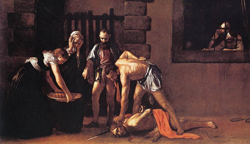
On this feast day, however, we are focused on martyrdom, his beheading. He died for the faith for which he lived. The consequences of his heralding the good news and a call to righteousness cost him his life.

He was condemned by the decree of King Herod, who himself was caught in the clutches of a vengeful wife, Herodias, formerly the wife of his brother, Philip. He was also held captive by the throws of lust toward the daughter of Herodias. The account of Herod's treachery contains more drama than a modern day soap opera.

St. John's martyrdom reminds us that the most important vocation for all Christians, Catholic and Protestant alike, is living out the Gospel. We are called to proclaim the Good News of Christ both in word and deed, which sometimes can put us in some tense situations.


Let's face it, the Gospel can become inflammatory and even more so as a culture moves farther and farther away from core values of moral living. For this reason we are reminded by the Apostle Paul in Ephesians 4 that we must speak the truth in love.

For several decades both Pope John Paul II and Pope Benedict XVI have been calling upon Catholic Christians be become involved in the New Evangelization. In fact, Pope Benedict has made this the theme for World Youth Day 2013 in Brazil.

Over the years, evangelization has been stereotyped as an attempt by self-righteous individuals to impose their values on others. Nothing could be further from the truth!

Evangelization is a movement that begins in the heart, where a Christian, whose life has been given over to Jesus Christ, eagerly shares that good news of the coming of Christ and His Kingdom into the world.

The believer also wants to let all know of Christ's passion, death and resurrection which has overcome the world, the flesh and the devil. More than anything, he or she wants others to be able to participate in this glorious and wondrous relationship with the living God, the fullness of which is found in the Catholic faith.

Such a testimony doesn't come from self-righteous individuals, but those who have encountered the living Christ through His Word and Sacraments.

From the Gospel reading appointed for the Memorial in Mark 6:17-29, we read "Herod feared John, knowing him to be a righteous and holy man, and kept him in custody. When he heard him speak he was very much perplexed, yet he liked to listen to him."

The King, although living a life of debauchery, felt something kindle in his heart when John preached. The truth was making an impact. As with any move of grace, the devil is quick to distract by re-ignited the fires of passion that the soul might be once again consumed with lust.

How like today, where the people who are hearing the Gospel and also being bombarded by messages laced with sensuality and images that inflame. It's no wonder they condemn the messenger as self-righteous as everything in them is being drawn away from the righteousness of God.

However we find the world, giving up on sharing the gospel is not an option. I'm an example of one who was touched by God's grace as my life was moving in the opposite direction.


Bill Bright was a Protestant minister who gave rise to the largest college movement for Christ in America as well as other parts of the world - Campus Crusade for Christ. He used to say, "success in witnessing [Ed - evangelization] is simply sharing Christ in the power of the Holy Spirit and leaving the results to God."

While we may not be able to control the recipient, we can prepare ourselves for the work of evangelization. The keys are found in Herod's assessment of St. John the Baptist. He was holy and righteous.

By living our faith on a daily basis, through such disciplines as prayer, reading Scripture, attending daily Mass, praying the Offices of the Church and the Rosary, we can become equipped with His love and grace for this work. Our sharing of His Gospel can come through the power of His Spirit.

Many have described the results of evangelization as being a new birth - as men and women of all ages are "born again" by water and the Spirit. How does this new birth begin? By those in the womb of life encountering the One in Mary's womb and leaping for joy.