Wednesday, January 30, 2019

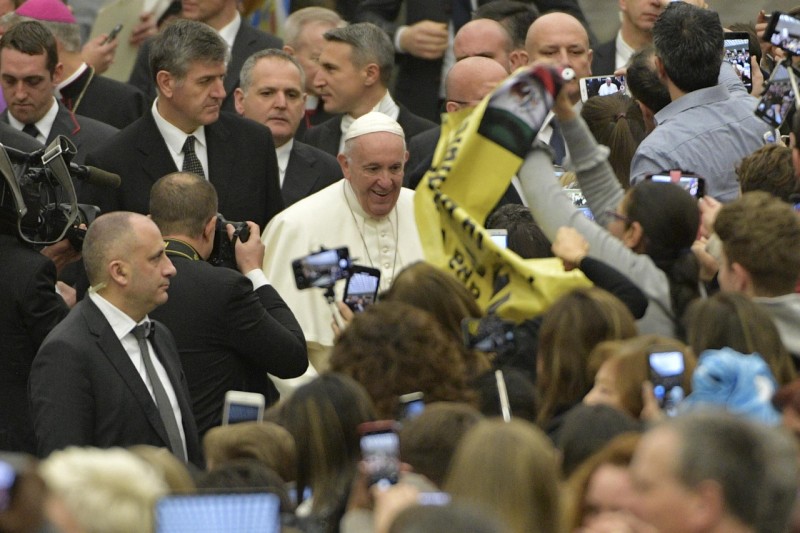
Papal General Audience 01.30.2019

© Vatican Media

Pope Francis Recalls Trip to Panama During General Audience (Full Text)

‘I invite you to render thanks to the Lord with me, for this grace that He willed to give to the Church and to the people of that dear country. ‘

The January 30, 2019, General Audience was held at 9:30 in Paul VI Hall, where the Holy Father Francis met with groups of pilgrims and faithful from Italy and from all over the world.
In his address in Italian, the Pope focused his meditation on his Apostolic Journey to Panama, which just ended, on the occasion of the 34th World Youth Day (WYD) (Biblical passage from the Gospel according to Luke 1:38-39).
After summarizing his catechesis in several languages, the Holy Father expressed special greetings to groups of faithful present.
The General Audience ended with the singing of the Pater Noster and the Apostolic Blessing.
* * *
The Holy Father’s Catechesis
Dear Brothers and Sisters, good morning!
Today I will reflect with you on the Apostolic Journey I undertook in the past days to Panama. I invite you to render thanks to the Lord with me, for this grace that He willed to give to the Church and to the people of that dear country. I thank Mister President of Panama and the other Authorities, the Bishops and I thank all the volunteers– there were so many — for their warm and friendly welcome, the same that we saw in the people everywhere, who rushed to greet us with great faith and enthusiasm.  Something that struck me very much: the people lifted the children with their arms as if saying: “Here is my pride, here is my future!” And they made us see the children, but there were so many! And the fathers and mothers were proud of that child. I thought: how much dignity there is in this gesture, and how eloquent it is for the demographic winter that we are living in Europe! The children are the pride of the family. The children are the security for the future. The demographic winter, without children, is hard!
The reason for this trip was the World Youth Day; however, to the meetings with young people were interlaced others with the country’s realities: the Authorities, the Bishops, young prisoners, the consecrated and a family house. Everything was as though “infected” and “amalgamated” by the joyful presence of the young people: a celebration for them and a celebration for Panama, and also for the whole of Central America, marked by so many dramas and needy of hope and peace, and also of justice.
The meeting of young people of native and Afro-American peoples preceded this World Youth Day. A beautiful gesture: native young people and Afro-descendent young people had five days of encounter. There are so many in that region. They opened the door of the World Day. And this was an important initiative, which manifested still better the multi-form face of the Church in Latin America: Latin America is mestiza [mixed blood]. Then, with the arrival of groups from the whole world, the great symphony was formed of faces and languages, typical of this event. To see all the flags parade together, dancing in the hands of young people, joyful to meet one another is a prophetic sign, a counter-current sign in relation to today’s sad tendency to conflictive nationalisms, which raise walls and are closed to universality, to the encounter between peoples. It’s a sign that Christian young people are leaven of peace in the world.
This WYD had a strong Marian imprint because it’s theme was the Virgin’s words to the Angel: “Behold the handmaid of the Lord; be it done unto me according to your word” (Luke 1:38). It was intense to hear these words pronounced by representatives of young people of five Continents, and especially to see it shown on their faces. As long as there are new generations capable of saying “here I am” there will be a future for the world.
Among the stages of the WYD, there is always the Via Crucis. To walk with Mary behind Jesus, who carries the cross, is the school of Christian life: one learns there patient, silent and concrete love. I will share a confidence with you: I like very much to do the Via Crucis because it is to go with Mary behind Jesus. And I always carry with me a pocket Via Crucis, which was given to me by a very apostolic person in Buenos Aires, to do it at any moment.  And when I have time, I take it and follow the Via Crucis. You, too, do the Via Crucis, because it is to follow Jesus with Mary on the way of the cross, where he gave His life for us, for our Redemption. In the Via Crucis, one learns patient, silent and concrete love. At Panama, young people carried, with Jesus and Mary, the weight of the condition of so many suffering brothers and sisters in Central America and in the whole world. Among these are so many young people victims of different forms of slavery and poverty. And, in this connection, there were very significant moments: the Penitential Liturgy I celebrated in a House of re-education of minors and the visit to the “Good Samaritan” Family-House, which hosts people affected by HIV/AIDS.
The culmination of the WYD and of the trip was the Vigil and the Mass with young people. In the Vigil — in that field full of young people who did the Vigil, they slept there and at 8 o’clock in the morning they took part in the Mass — renewed in the Vigil was the lively dialogue with all boys and girls, enthusiastic and also capable of silence and listening. They passed from enthusiasm to listening to silent prayer. I proposed Mary to them as she who, in her littleness, “influenced” more than any other the history of the world: we called her the “influencer of God.” Reflected in her “fiat” were the beautiful and strong testimonies of some young people. On Sunday morning, in the great final Eucharistic celebration, Christ Risen, with the strength of the Holy Spirit, spoke again to the world’s young people, calling them to live the Gospel today, because young people aren’t the “tomorrow”; no, they are the “today” for the “tomorrow.” They are not “in the meantime,” but they are the today, the now of the Church and of the world. And I appealed to the responsibility of the adults so that the new generations do not lack education, work, community, and family. And this is the key at this moment in the world because these things are lacking — instruction, that is, education. Work: how many young people are without it. Community: that they feel welcomed, in the family, in the society.
The meeting with all the Bishops of Central America was, for me, a moment of special consolation. Together we let ourselves be taught by the witness of the holy Bishop Oscar Romero, to learn ever better to “feel with the Church” — it was his episcopal motto –, in closeness to young people, to the poor, to priests, to the holy faithful People of God.
The consecration of the altar of the restored Cathedral of Santa Maria La Antigua in Panama had an intense symbolic value. It was closed for seven years for the restoration — a sign of rediscovered beauty, to the glory of God and for the faith and celebration of His People. The Chrism that consecrates the altar is the same that anoints the baptized, Confirmation candidates, priests, and Bishops. May the family of the Church in Panama, and in the whole world, be able to draw from the Holy Spirit ever new fruitfulness so that the pilgrimage of the young missionary disciples of Jesus Christ may continue and spread over the earth.
© Libreria Editrice Vatican
[Original text: Italian]  [ZENIT’s translation by Virginia M. Forrester]

In Italian
A warm welcome goes to the Italian-speaking pilgrims.
I’m happy to receive the Nuns of the Passion of Jesus Christ (Passionists), on the occasion of the General Chapter; the Women Religious of the “Talitha Kum Global Network”; the Brothers of Charity and the Members of the Missio Christi Institute.
I greet the Families of the Traveling Show: no doubt Sister Genevieve is there!;  the Association of Solidary European Volunteers; the “Salvade for Africa” group and the School Institutes, in particular, those of Cisterna di Latina and of Ginosa.
A particular thought goes to young people, the elderly, the sick and newlyweds.
Tomorrow we will celebrate the memorial of Saint John Bosco, father, and teacher of young people: this was a good priest! Don Bosco was able to make all young people he met feel God’s embrace, offering them hope, a house a future. May his witness help all of us to consider how important it is to educate the new generations in genuine human and spiritual values.

Tuesday, January 29, 2019

She is a patron Saint for those with cancer

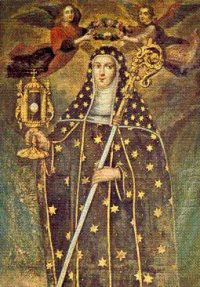
St. Aldegunais


Image of St. Aldegunais

Facts

Feastday: January 30
Patron of Cancer, Wounds
Birth: 639
Death: 684

Virgin and abess, also known as Adelgundis, Aldegonde, or Orgonne. She was a member of the royal family of the Merovingians and was raised by two saints: St. Walbert and St. Bertila, her parents. The family resided in the Hainault region of Flanders, a region of the Low Countries. Aldegundis reflused offers of marriage from other nobles and received the veil from St. Amandius, the bishop of Maastricht. She followed this ceremony of acceptance into the religious life with the foundation of a convent near the Sambre River, at a desert site called Malbode. Her sister, St. Waldetrudis, had founded a convent at Mons. Aldegundis' foundation became Mauberge, a noted Benedictine monastery, later taken over by canonesses. Aldegundis is reported to have died of cancer at the age of fifty-four.

Pope Francis delivered his weekly Angelus Address in Panama

Vatican Media Screenshot

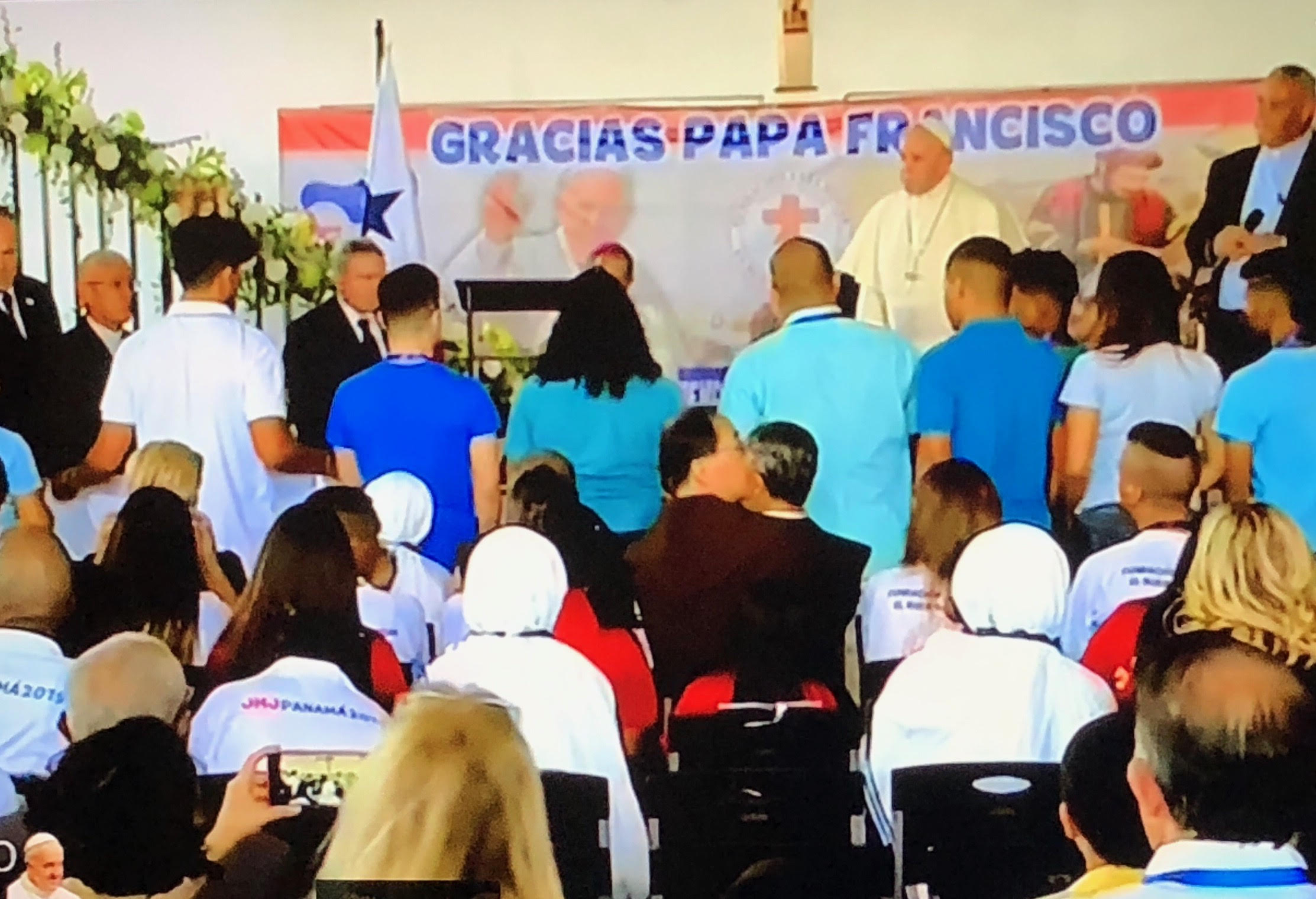
Pope’s Angelus at Casa Hogar El Buen Samaritano in Panama (Full Text)

‘That is how the miracle takes place: we feel that here we are reborn, here we are all reborn, because we feel God’s caress that enables us to dream of a more human world, and therefore of a world more divine’

Below is the Vatican-provided text of Pope Francis’ Angelus at Casa Hogar El Buen Samaritano in Panama, during his final day of his Apostolic Visit to the country to celebrate World Youth Day 2019, Jan. 22-28, 2019:
***
Dear Young Friends,
Dear Directors, Associates and Pastoral Workers,
Dear Friends,
Thank you, Father Domingo, for your words of greeting on behalf of all present. I have been looking forward very much to this meeting with you here from this Good Samaritan Home, and also with the other young people from the John Paul II Centre, the Saint Joseph Home of the Sisters of Charity and the “House of Love” of the Congregation of the Brothers of Jesus of Kkottonngae. Being with you today gives me reason for renewed hope. Thank you for giving me this.
In preparing for this meeting, I was able to read the testimony of a member of this Home that touched my heart. It said: “Here I was reborn”. This home, and all the centres you represent, are a sign of the new life that the Lord wants to give us. It is easy to confirm the faith of some of our brothers and sisters when we see it at work in anointing wounds, renewing hope and encouraging faith.
Nor are those we might call the “primary beneficiaries” of your homes the only ones to be reborn; here the Church and the faith are also born and continually recreated through love.
We begin to be reborn when the Holy Spirit grants us eyes to see others, as Father Domingo said to us, not only as the people we live with – and that is already saying a lot – but as our neighbours.
The Gospel tells us that Jesus was asked one day: “Who is my neighbour?” (cf. Lk 10:29). He did not respond with theories, or give a fine, lofty speech. Instead he told a story – the parable of the Good Samaritan – a concrete example drawn from the real life that you all know and experience. My
neighbour is before all else a face that I meet along the way, one that makes us move and be moved. To move from our fixed ways of doing things and our priorities, and to be moved so deeply by what that person is experiencing that we stop and make room for him or her on our journey. That is what the Good Samaritan realized when he saw the man left half-dead on the side of the road, not only by bandits but also by the indifference of a priest and a levite who could not be bothered to come to his aid. For indifference can also wound and kill. Some for a few miserable coins, others for fear of becoming unclean.
Whatever their reason, whether contempt or social aversion, they saw nothing
wrong in leaving that man lying on the roadside. The Good Samaritan, whether in the parable or in all of your homes, shows us that our neighbour is first of all a person, someone with a real, particular face, not something to avoid or ignore, whatever his or her situation may be. And that face reveals
our humanity, so often suffering and overlooked.
Our neighbour, then, is a face that wonderfully inconveniences our lives, because it reminds us and points our steps towards what is really important, and it frees us from all that is trite and superficial in the way we follow the Lord.
To be here is to touch the maternal face of the Church, which is capable of prophesying and creating a home, creating community. The Church’s face is usually unseen; it passes by unnoticed.
Yet it is a sign of God’s concrete mercy and tender love, a living sign of the good news of the resurrection that even now is at work in our lives.
To create a “home” is to create a family. It is to learn to feel connected to others by more than the utilitarian and practical bonds that make us feel that our life is a bit more human. To create a home is to let prophecy take flesh and make our hours and days less cold, indifferent and anonymous.
It is to create bonds by simple, everyday acts that all of us can do. A home, and this we all know very well, demands that everyone work together. No one can be indifferent or aloof, since each is a stone needed to build the home. And that also means asking the Lord to grant us the grace to learn to be patient, to forgive one another, to start over each day. How many times should I forgive and start over? Seventy times seven times, as many times as necessary. To create strong bonds requires confidence and trust nurtured daily by patience and forgiveness.
That is how the miracle takes place: we feel that here we are reborn, here we are all reborn, because we feel God’s caress that enables us to dream of a more human world, and therefore of a world more divine.
I thank all of you for your example and your generosity. I also thank your institutions, and the volunteers and benefactors. I thank all those who have made it possible for God’s love to become ever more concrete and real by gazing into the eyes of those around us and acknowledging that we
are all neighbours. Now that we are about to pray the Angelus, I entrust you to our Blessed Lady. We ask her, as a good Mother, full of tender love and closeness, to teach us to make an effort each day to discover who our neighbours are, and to help us go out quickly to meet them, to give them a home, an embrace, where care and fraternal love meet. This is a mission involving every one of us.
I encourage you now to place beneath her mantle all your concerns and needs, all your sorrows and hurts, so that, as a Good Samaritan, she will come to us and aid us by her maternal love and with her smile, the smile of a Mother.
Angelus Domini …

Monday, January 28, 2019

The feast day of the Angelic Doctor

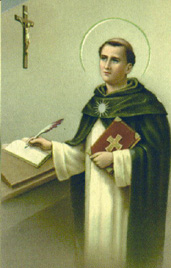
St Thomas Aquinas


Image of St. Thomas Aquinas

Facts

Feastday: January 28
Patron of students and all universities
Birth: 1226
Death: 1274
Canonized By: Pope John XXII in 1323


Thomas is believed to have been born in the castle of Roccasecca in the old county of the Kingdom of Sicily, which is now known as the Lazio region of Italy, in 1225. His parents were well-off, but as the youngest son Thomas was expected to enter the monastery.
At 5-years-old, Thomas began his education at Monte Cassino, where he remained until the military conflict between Emperor Frederick II and Pope Gregory IX reached the abbey. He was then transferred and enrolled at the studium generale in Naples.
It is believed that Thomas was introduced to his philosophical influences - Aristotle, Averroes, and Maimonides - at the university, where he also met John of St. Julian, a Dominican preacher, who influenced him to join the recently founded Dominican Order.
When Thomas' family learned of his decision, his mother Theodora arranged for him to be moved to Paris. When Thomas was travelling to Rome, his brothers captured him and returned him to their parents at the castle of Monte San Giovanni Campano.
Thomas was held captive in the castle for one year as his family tried to keep him from joining the Dominican Order. In the year he was held, Thomas tutored his sisters and communicated with members of the Dominican Order.
In an effort to change Thomas' mind, two of his brothers hired a prostitute to seduce him, but legends claim Thomas drove her off with a fire iron. That night, two angels appeared to him in a dream and strengthened his resolve to remain celibate.
When Theodora realized she could not sway her son, she tried to preserve the family name by arranging for his escape through a window. She believed a secret escape was better than appearing to accept his decision.
Following his escape in 1244, Thomas turned to Naples, then to Rome and met the Master General of the Dominical Order, Johannes von Wildeshausen.
The next year, Thomas went to study at the Faculty of the Arts at the University of Paris, where he is believed to have met Dominican scholar Albertus Mangus, the Chair of Theology at the College of St. James.
In 1248, Thomas chose to follow Mangus to the new studium generale at Cologne rather than accepting Pope Innocent IV's offer to appoint him abbot of Monte Cassino as a Dominican. Though Thomas hesitated, when they reached the university, Mangus appointed him magister studentium.
Thomas was quiet and seldom spoke at the university, leading other students to believe he was mentally delayed, but Mangus prophetically said, "You call him the dumb ox, but in his teaching, he will one day produce such a bellowing that it will be heard throughout the world."
Following the conclusion of his education, Thomas taught in Cologne as an apprentice professor and instructed students on the books of the Old Testament. It was during this time he wrote Expositio super Isaiam ad litteram, Postilla super Ieremiam, and Postilla super Threnos.
In 1252, Thomas returned to Paris to earn his master's degree in theology. As an apprentice professor, he lectured on the Bible and devoted his final three years of his education to Peter Lombard's Sentences.
Thomas composed a commentary on Sentences, titled Scriptum super libros Sententiarium and wrote De ente et essentia.
The spring of 1256 saw Thomas appointed regent master in theology at Paris, and one of his first works after assuming the office was Contra impugnantes Dei cultum et religionem, in defense of mendicant orders, which William of Saint-Amour had been attacking.
Between 1256 to 1259, Thomas spent his tenure writing several books, such as Questiones disputatae de veritate, Quaestiones quodlibetales, Expositio super librum Boethii De trinitate, and Expositio super librum Boethii De hebdomadibus. At the conclusion of his regency, Thomas was in the process of writing one of his most famous works, Summa contra Gentiles.
In 1259, Thomas completed his first regency and returned to Naples, where he was appointed general preacher. In September 1261, he was asked to lecture in Orvieto, and during his stay he finished Summa contra Gentiles, as well as Catena aurea, and Contra errores graecorum.
In 1265, Thomas was summoned to Rome to serve as the papal theologian and was later ordered by the Dominican Chapter of Agnani to teach at the studium conventuale, which was the first school to teach the full range of philosophical subjects of both moral and natural natures.
While teaching, Thomas wrote his most famous work, Summa theologiae, which he believed was particularly useful to beginning students "because a doctor of Catholic truth ought not only to teach the proficient, but to him pertains also to instruct beginners."
He continued to write and released several more books until 1268, when he was called to Paris for a second teaching regency. He was named regent master again and stayed until 1272. During this time, he wrote De virtutibus and De aeternitate mundi.
At the conclusion of his regency, the Dominicans called Thomas to establish a university wherever he wanted with a staff of whomever he wished. He established the university in Naples and took the regent master post. In 1273 Thomas was seen by the sacristan Domenic of Caserta to be crying and levitating in prayer before an icon of the crucified Christ at the Dominican convent of Naples, in the Chapel of Saint Nicholas.
During this prayer, Christ is said to have told him, "You have written well of me, Thomas. What reward would you have for your labor?"
Thomas replied, "Nothing but you, Lord."
Following this exchange, something happened but Thomas never wrote or spoke of it. He abandoned his routine and, when begged to return to work, replied, "I cannot, because all that I have written seems like straw to me."
In May of 1274, Thomas was called to the Second Council of Lyon, where his works for Pope Urban IV would be presented. While journeying to the meeting, Thomas hit his head on the branch of a fallen tree and fell ill. He was escorted to Monte Cassino to recover, then he set out again.
Unfortunately, he became ill once again and stopped at the Cistercian Fossanova Abbey, where the monks cared for him for several days.
He received his last rites and prayed, "I receive Thee, ransom of my soul. For love of Thee have I studied and kept vigil, toiled, preached and taught..."
Thomas died on March 7, 1274 during a commentary on the Song of Songs. Thomas' remains were placed in the Church of the Jacobins in Toulouse on January 28, 1369.
It is not known who beatified Thomas, but on July 18, 1323, Pope John XXII canonized him.
His original feast day was March 7, the day of his death, but because the date often falls within Lent, in 1969, a revision of the Roman Calendar changed his feast day to January 28, the date his relics were moved to Toulouse. Pope Pius V declared Saint Thomas a doctor of the church, saying Thomas was "the most brilliant light of the Church."
Saint Thomas' remains were moved to the Basilique de Sant-Sernin, Toulouse between 1789 and 1974. They were then returned to the Church of the Jacobins.
In the 16th century, the university in Paris, that Thomas often taught at, was renamed the College of Saint Thomas, and in the 20th century it was relocated to the convent of Saints Dominic and Sixtus before being transformed into the Pontifical University of Saint Thomas Aquinas.
Saint Thomas' comments and philosophical writings are still debated today, and his aesthetic theories, such as the concept of claritas, deeply influenced the literary writings of James Joyce and Italian semiotician Umberto Eco. Saint Thomas is often depicted with an open book or writing with a quill.