Thursday, June 28, 2018

Feast Day for the First Pope and the Apostle to the Gentiles

Solemnity of Saints Peter and Paul

Saint of the Day for June 29

Audio Player

Saints Peter and Paul’s Story

Peter (d. 64?). Saint Mark ends the first half of his Gospel with a triumphant climax. He has recorded doubt, misunderstanding, and the opposition of many to Jesus. Now Peter makes his great confession of faith: “You are the Messiah” (Mark 8:29b). It was one of the many glorious moments in Peter’s life, beginning with the day he was called from his nets along the Sea of Galilee to become a fisher of men for Jesus.
The New Testament clearly shows Peter as the leader of the apostles, chosen by Jesus to have a special relationship with him. With James and John he was privileged to witness the Transfiguration, the raising of a dead child to life, and the agony in Gethsemane. His mother-in-law was cured by Jesus. He was sent with John to prepare for the last Passover before Jesus’ death. His name is first on every list of apostles.
And to Peter only did Jesus say, “Blessed are you, Simon son of Jonah. For flesh and blood has not revealed this to you, but my heavenly Father. And so I say to you, you are Peter, and upon this rock I will build my church, and the gates of the netherworld shall not prevail against it. I will give you the keys to the kingdom of heaven. Whatever you bind on earth shall be bound in heaven; and whatever you loose on earth shall be loosed in heaven” (Matthew 16:17b-19).
But the Gospels prove their own trustworthiness by the unflattering details they include about Peter. He clearly had no public relations person. It is a great comfort for ordinary mortals to know that Peter also has his human weakness, even in the presence of Jesus.
He generously gave up all things, yet he can ask in childish self-regard, “What are we going to get for all this?” (see Matthew 19:27). He receives the full force of Christ’s anger when he objects to the idea of a suffering Messiah: “Get behind me, Satan! You are an obstacle to me. You are thinking not as God does, but as human beings do” (Matthew 16:23b).
Peter is willing to accept Jesus’ doctrine of forgiveness, but suggests a limit of seven times. He walks on the water in faith, but sinks in doubt. He refuses to let Jesus wash his feet, then wants his whole body cleansed. He swears at the Last Supper that he will never deny Jesus, and then swears to a servant maid that he has never known the man. He loyally resists the first attempt to arrest Jesus by cutting off Malchus’ ear, but in the end he runs away with the others. In the depth of his sorrow, Jesus looks on him and forgives him, and he goes out and sheds bitter tears. The Risen Jesus told Peter to feed his lambs and his sheep (John 21:15-17).
Paul (d. 64?). If the most well-known preacher today suddenly began preaching that the United States should adopt Marxism and not rely on the Constitution, the angry reaction would help us understand Paul’s life when he started preaching that Christ alone can save us. He had been the most pharisaic of Pharisees, the most legalistic of Mosaic lawyers. Now he suddenly appears to other Jews as a heretical welcomer of Gentiles, a traitor and apostate.
Paul’s central conviction was simple and absolute: Only God can save humanity. No human effort—even the most scrupulous observance of law—can create a human good which we can bring to God as reparation for sin and payment for grace. To be saved from itself, from sin, from the devil, and from death, humanity must open itself completely to the saving power of Jesus.
Paul never lost his love for his Jewish family, though he carried on a lifelong debate with them about the uselessness of the Law without Christ. He reminded the Gentiles that they were grafted on the parent stock of the Jews, who were still God’s chosen people, the children of the promise.

Reflection

We would probably go to confession to Peter sooner than to any of the other apostles. He is perhaps a more striking example of the simple fact of holiness. Jesus says to us as he said, in effect, to Peter: “It is not you who have chosen me, but I who have chosen you. Peter, it is not human wisdom that makes it possible for you to believe, but my Father’s revelation. I, not you, build my Church.” Paul’s experience of the risen Jesus on the road to Damascus was the driving force that made him one of the most zealous, dynamic, and courageous ambassadors of Christ the Church has ever had. But persecution, humiliation, and weakness became his day-by-day carrying of the cross, material for further transformation. The dying Christ was in him; the living Christ was his life.

Saint Paul is the Patron Saint of:

Greece

Powerful Saint of the 2nd century

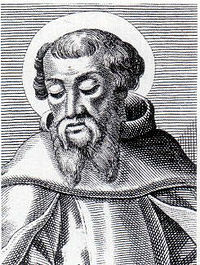
St. Irenaeus


Image of St. Irenaeus

Facts

Feastday: June 28
Death: 202

The writings of St. Irenaeus entitle him to a high place among the fathers of the Church, for they not only laid the foundations of Christian theology but, by exposing and refuting the errors of the gnostics, they delivered the Catholic Faith from the real danger of the doctrines of those heretics.
He was probably born about the year 125, in one of those maritime provinces of Asia Minor where the memory of the apostles was still cherished and where Christians were numerous. He was most influenced by St. Polycarp who had known the apostles or their immediate disciples
Many Asian priests and missionaries brought the gospel to the pagan Gauls and founded a local church. To this church of Lyon, Irenaeus came to serve as a priest under its first bishop, St. Pothinus, an oriental like himself. In the year 177, Irenaeus was sent to Rome. This mission explains how it was that he was not called upon to share in the martyrdom of St Pothinus during the terrible persecution in Lyons. When he returned to Lyons it was to occupy the vacant bishopric. By this time, the persecution was over. It was the spread of gnosticism in Gaul, and the ravages it was making among the Christians of his diocese, that inspired him to undertake the task of exposing its errors. He produced a treatise in five books in which he sets forth fully the inner doctrines of the various sects, and afterwards contrasts them with the teaching of the Apostles and the text of the Holy Scripture. His work, written in Greek but quickly translated to Latin, was widely circulated and succeeded in dealing a death-blow to gnosticism. At any rate, from that time onwards, it ceased to offer a serious menace to the Catholic faith.
The date of death of St. Irenaeus is not known, but it is believed to be in the year 202. The bodily remains of St. Irenaeus were buried in a crypt under the altar of what was then called the church of St. John, but was later known by the name of St. Irenaeus himself. This tomb or shrine was destroyed by the Calvinists in 1562, and all trace of his relics seems to have perished

The new Cardinals speak

© PHOTO.VA - Osservatore Romano

New Cardinals Speak: ‘I Am a Pastor, Not a Prince’

Soon to Become Cardinals Speak to Zenit Before Consistory

‘I am a pastor, not a prince.’
This was expressed by His Beatitude Louis Raphaël I Sako regarding his being named cardinal, as he along with other future cardinals shared their thoughts with Zenit and other journalists in the Vatican this week.
The Consistory to create new cardinals was today June 28, 2018. During Pope Francis’ Regina Caeli address on May 20, 2018, the Pope announced the upcoming consistory and the 14 who would become cardinals around the events for the June 29 Feast of Saints Peter and Paul.
The new Cardinals from around the world including Iraq, Pakistan, Portugal, Peru, Madagascar, Italy, Poland, Mexico, and Japan. Zenit spoke to some of the cardinals in the Vatican in these days.
Patriarch Sako sees being a cardinal as nothing more than service. “I am a cardinal, a pastor, not a prince,” he underscored. He stressed that being named cardinal made a significant impact on the people of Iraq.  It lets the nation’s people know they “are not isolated” and that the Holy Father “is very close to them.”
While saying he sees a better future ahead for Iraq, he expressed that for the time being a papal trip to the nation is not in the cards. However, he hopes eventually, even if for a day trip–which could include a Mass in Erbil–could become more feasible.
When speaking to Archbishop Ladaria, the head of the Vatican’s doctrinal office, he shared his surprise when he learned of his nomination. He noted that as Prefect of the Congregation for the Doctrine of the Faith, he sees his role to advise the Pope as cardinal to have at its heart “to promote the faith.”
“To promote faith,” he expressed, “means to protect it. This is our program, not another. This is what the Holy See, and the Pope, and those who have come before him, have indicated to us.”
Archbishop Becciu, 70, who has served as the Substitute within the Vatican’s Secretary of State for the last seven years but was recently appointed as prefect of the Vatican’s Congregation for the Doctrine of the Saints, when asked whether he expected to become cardinal responded: “I expected it. Traditionally, the role of Substitute was named cardinal. However, we have seen that Pope Francis has deviated from some of these traditions, those where certain roles or places that traditionally were given the porpora, were in fact named. Thus, in anything could have happened.”
When asked his opinion on the effectiveness of Vatican reform, he noted, “it is too early to tell.”
Moreover, Archbishop Petrocchi of Aquila, in Abruzzo, near Rome, joked that his unexpected appointment was an example of the Pope choosing “from the peripheries.”
Those Pope Francis had chosen to become Cardinals are: His Beatitude Louis Raphaël I Sako – Chaldean Catholic Patriarch of Babylon; His Excellency Luis Ladaria –Prefect of the Congregation for the Doctrine of the Faith; His Excellency Angelo De Donatis – Vicar General of Rome; His Excellency Giovanni Angelo Becciu – Substitute of the Secretary of State and Special Delegate for the Sovereign Military Order of Malta; His Excellency Konrad Krajewski – Almoner of the Office of Papal Charities; His Excellency Joseph Coutts – Archbishop of Karachi; His Excellency António dos Santos Marto – Bishop of Leiria-Fátima; His Excellency Pedro Barreto – Archbishop of Huancayo; His Excellency Desiré Tsarahazana – Archbishop of Toamasina; His Excellency Giuseppe Petrocchi – Archbishop of L’Aquila; His Excellency Thomas Aquinas Manyo – Archbishop of Osaka; His Excellency Sergio Obeso Rivera – Emeritus Archbishop of Xalapa; His Excellency Toribio Ticona Porco – Emeritus Bishop of Corocoro; Reverend Father Aquilino Bocos Merino – member of the Claretian order.

Family update

I don't have a lot of time this morning for a full update but thank you all for prayers and messages.  We understand that this experience with Wendy's mom is shared by millions out there; many of you have already been thru this.

Her condition is somewhat improved, the kidneys and the liver, but the congestive heart failure is bad as is the UTI.  Last night she experienced periods of rapid heart rate.  For now she is still intubated and sedated.

Wendy is exhausted; she got home last night after 11.

Please keep prayers coming

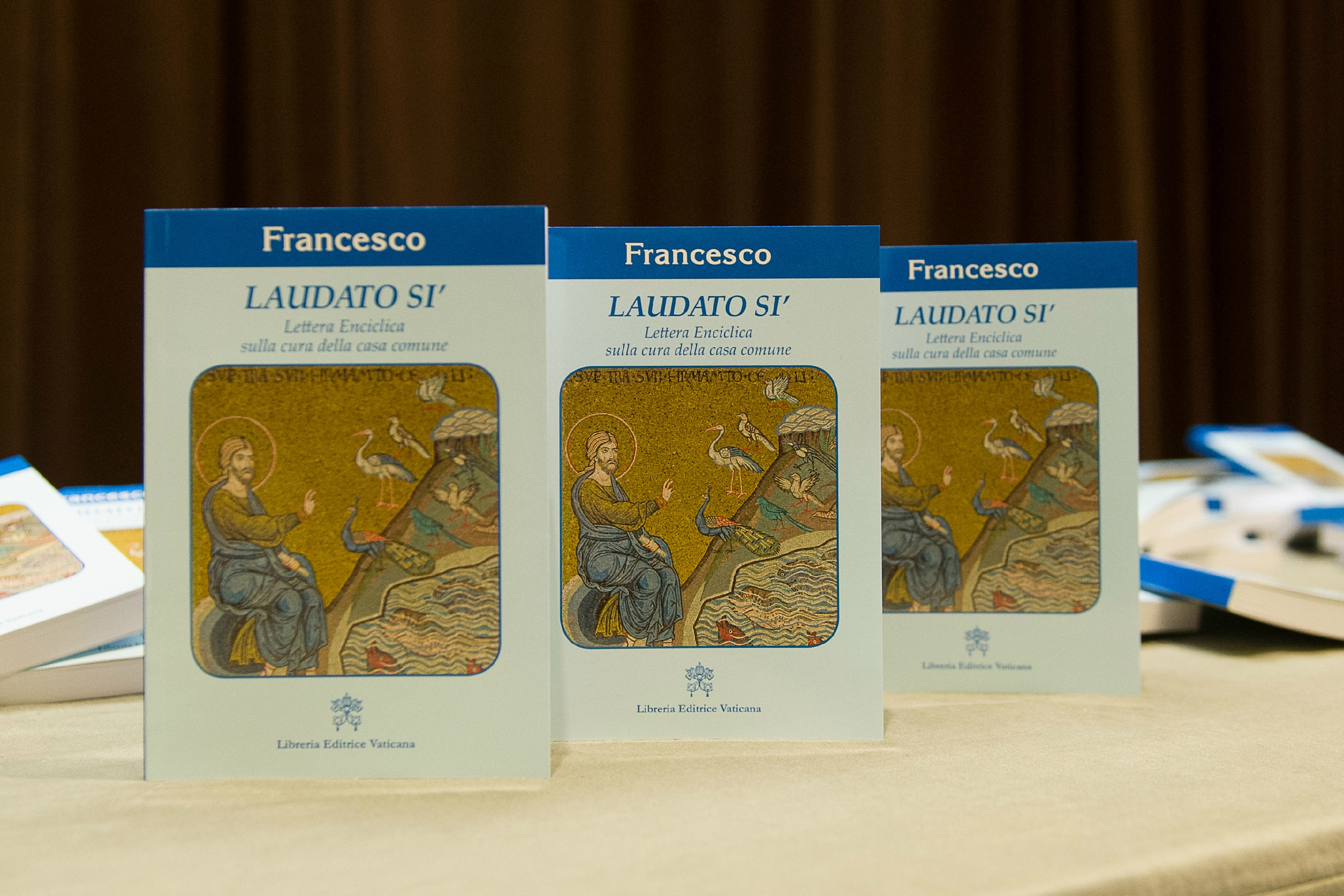
The controversial work of Pope Francis, Laudato Si, is now 3 years old

"Laudato si'"
PHOTO.VA - OSSERVATORE ROMANO

Vatican to Commemorate 3rd Anniversary of Laudato Si

‘Saving the Common Home and the Future of Life on Earth’ Is Being Hosted July 5-6 by Dicastery for Promoting Integral Human Development

The Vatican is commemorating the third anniversary of Pope Francis’ encyclical on the environment Laudato Si’ and calling for concrete action.
This afternoon, the International Conference ‘Saving the Common Home and the Future of Life on Earth,’ organized by the Vatican’s Dicastery for Promoting Integral Human Development, to take place in the Vatican’s New Synod Hall, July 5 -6, 2018, was presented in the Holy See Press Office by Card. Peter Kodwo Appiah Turkson, Prefect of the dicastery; Flaminia Giovanelli, Under-Secretary of the same Dicastery; and Fr Josh Kureethadam, SDB, Official of the same Dicastery.
“What kind of world do we want to leave to those who come after us, to children who are now growing up?” Cardinal Turkson reflected on this important question posed in the encyclical, reminding that taking this to mind and acting is necessary in order to make sure future generations are not abandoned to a damaged planet.
He also stressed that on an individual level, concrete steps must be taken to achieve change. In his dicastery’s office, they are installing a water machine to eliminate a dependence on always buying water bottles. They also, he expressed, have put together a list of recommendations for the Vatican’s Governatorate, of ways it could be more environment friendly, such as solar panels.
Flaminia Giovanelli highlighted the importance of recognizing that what we do now is what will decide the fate of future generations.
Fr Josh Kureethadam spoke about the program and participants, noting there will be climate change experts, representatives from charitable organizations, and the Vatican and pointed out that the event will start with a prayer being said by young children and that young people too will be giving a contribution.

Wednesday, June 27, 2018

Thursdays Saint of the Day

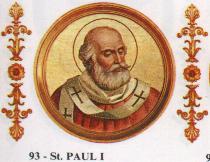
St. Paul I, Pope


Image of St. Paul I, Pope

Facts

Feastday: June 28
Birth: 700
Death: 767

Pope from 757-767. The brother of Pope Stephen 11 and a Roman, he was educated in the Lateran Palace, became a deacon under Pope Zachary, and wielded considerable influence in his brother's administration. Elected to succeed Stephen, he took as his primary concern the threat posed to Rome and the Papal States by the Lombards. Paul secured an alliance with the Frankish king Pepin the Short, thereby cementing the relationship between the Holy See and the Frankish Empire which culminated with the historically significant alliance between Pope Leo III and Charlemagne. Paul also opposed the Iconoclast policies of the Byzantine emperor Constantine V, thereby exacerbating further the deteriorating relationship between the papacy and the Byzantine Empire. He died on June 28 at St. Paul's Outside the Walls, in Rom

He immigrated to our neck of the woods and now he and his son serve the Church in Ordained ministry

Personal immigration journey unmasks the myths


If all politics is local – the precinct-tested adage of former U.S. House Speaker Tip O’Neill – then the politics of immigration is the face in the mirror.
In May, Martin Gutierrez, a division director for Catholic Charities Archdiocese of New Orleans, will be seated with his family in the front pews of St. Louis Cathedral for a Mass during which his son Andrew, a graduate of Archbishop Rummel High School, will be ordained to the transitional diaconate, the final step before ordination to the priesthood in 2019.
Then, in June, Gutierrez, 52, himself will be ordained as a permanent deacon, continuing an amazing life’s journey in which he and his parents, Octavio and Pastora, and two siblings fled civil war in Nicaragua in 1979, abandoning their home, their possessions and their relatives and friends, and wound up creating the Nicaraguan-American dream in Chalmette.
Gutierrez was 13, with a couple of English classes under his belt from Colegio San José de Calasanz in Managua, when he left with his mom, brother and sister for what they thought would be a two-week vacation in New Orleans. Tensions between the Somoza government and the Sandinista rebels flashed into war, and the summer trip turned out to be a one-way ticket to a daunting new life, a thought not lost on Gutierrez as he sees hundreds of thousands of undocumented immigrants in the U.S. caught up in a political passion play called DACA, with a curtain call scheduled for March 5 unless Congress can find political common ground.
Gutierrez’s father, who ran several shipping companies in Nicaragua, worked with an immigrant’s passion to rebuild his family’s life in a foreign land. Last year, after many years working in the shipping business in New Orleans, Octavio, 85, retired from a security detail at Jesuit High School.
Pastora, also 85, is a great-grandmother now, but Martin remembers his mom working as a bagger at Schweg­mann’s, eventually moving up to cashier and then to supervisor despite her limited English. She retired at 62 to help care for Martin’s children.
“She didn’t have time to take English classes because she was working, but she got by,” Gutierrez said. “I remember going into the store and listening to her on the speakers. I didn’t understand a thing she was saying in English, but people understood her.”
Among his many areas of responsibility, Gutierrez oversees Catholic Charities’ Immigration and Refugee Services. His life could serve as a bridge of understanding to what politely might be called the country’s schizophrenia over a decades-long, vexing policy issue fundamentally affecting a nation and its citizens.
On the one hand, Democrats are accused of wanting open borders and amnesty for undocumented immigrants to expand their political base. On the other, Republicans are accused of xenophobia for pushing for a multi-billion-dollar wall on the Mexican border and an end to “chain” migration and the immigration lottery system, all while corporate executives who generally vote Republican need the immigrants’ less expensive labor to keep their profit-loss needles pointing north.
Gutierrez likes to shatter what he calls the “myths” surrounding immigration.
  • Myth No. 1: The Catholic Church is promoting amnesty for illegal immigrants. “What we would propose is some kind of earned legalization process,” Gutierrez said. “If you’ve been here ‘X’ number of years – we understand you have to draw the line somewhere, say before 2016 or 2017 – and you can prove that you have good moral character and that you have some level of English proficiency and you’ve paid your taxes, that you’ve been a good, productive citizen, you should be a given the opportunity to earn legal status and eventual citizenship. Anything short of U.S. citizenship would create a second class of citizens in our country.”
  • Myth No. 2: Illegal immigrants don’t pay taxes. “Even undocumented immigrants pay taxes,” Gutierrez said. “You are not supposed to work here illegally – undocumented – but if you do work, you are supposed to pay taxes. And the IRS provides a tax ID number, and it is used by many immigrants to pay income tax. The only thing they can use that number for is to file their taxes. It’s not a Social Security number. It’s not something they can use to do anything else. It doesn’t give them authority or authorization to work.” In 2010 alone, undocumented immigrants paid $13 billion in payroll taxes into the Social Security trust funds, money they will never see.
  • Myth No. 3: Immigrants come to the U.S. for welfare benefits such as food stamps. “I have 21 years in this ministry, and I have not met one undocumented person who has been on welfare or is receiving these things,” Gutierrez said. “If you’re an undocumented mother and the child was born in the United States, that child can receive Medicaid and SNAP (food stamps). The mom doesn’t. The mom does get prenatal care, but once that baby is born, the mom is done. She doesn’t get any more care.”
Politics of the deal
Gutierrez doesn’t know how the political horse-trading will work out in the end, although he does feel a deal will be struck to protect the status of the 800,000 DACA immigrants who came to the U.S. as minors.
“I am a man of faith, and I hope that soon, one day – whenever – we will have comprehensive immigration reform,” Gutierrez said. “But I’m also realistic. I sometimes think the people in power – the business leaders, the politicians – prefer the status quo and just keep fighting back and forth, because, otherwise, who are they going to blame? But they also benefit from it. Big business benefits from having this pool of laborers who are willing to work for less than the minimum wage.
“The word is something is going to get done with DACA. I think it’s going to depend on what the (Trump) administration is going to get in return. It’s a shame that it has happened that way – in order for 800,000 individuals who are already productive members of our community to be able to stay here legally without worries of being deported, something else has to happen. This bargaining thing is unfortunate, but it’s our system and it’s still the best system in the world.”
A return ‘home’
Gutierrez knows that. In December 2015, he finally returned to Nicaragua after 36 years. Gutierrez remembered the directions to the two houses where his family had lived. His first home had a fertile mango tree out front, which he and his brother and sister climbed every day to soak in the sweet citrus, but the tree had been cut down.
At the second home, an older woman was standing outside when Gutierrez asked if he could show his wife and daughter his bedroom. “What was yours is no longer yours,” the woman told him sharply. But a younger man stepped in and said they could come in. Gutierrez thought that would be an emotional moment, but that would come later.
Childhood flashbacks
As Gutierrez approached Colegio San José de Calasanz, the school he attended from kindergarten through sophomore year, it was as though the building had been locked inside a 40-year time capsule.
The building is square, with classrooms on the perimeter and an interior grass courtyard with a flagpole in the middle. Gutierrez’s wife Judith then spotted something he had overlooked – the small, unadorned chapel with a tile floor and a few statues.
“I remember walking around, not feeling anything, and then I went all the way to back of the chapel,” Gutierrez said. “I was just looking around and around, and out of nowhere, this wave of tears came up. I was crying, and somehow, a video of all the big moments in my life flashed before me.”
That trip coincided with the annual pilgrimage taken to Nicaragua by two dozen Notre Dame seminarians, one of whom was Gutierrez’s son Andrew. Archbishop Gregory Aymond and Father Joe Krafft asked Gutierrez to speak to the seminarians about the arc of his life, which was filled with mangos, good friends and incense.
“It just hit me – it was like the Church of New Orleans, in a way, welcoming me back in my home country,” Gutierrez said. “The Church of New Orleans was present over there. I remember the archbishop telling me after my talk, ‘Home is where your heart is.’
“And I realized, sometimes I don’t feel like I’m American enough, and I definitely don’t feel Nicaraguan enough. I’m more proud to be an American than most people, but the church is where I really belong. To have my home church in New Orleans welcoming me back home was amazing.”
Preparing for waterworks 
As Gutierrez prepares for two ordinations in a few months – his son’s and his own – he is filling up again. He’s just as proud of his son Martin, who is a Jefferson Parish sheriff’s deputy, and his youngest daughter Jazmin is completing her master’s in counseling at the University of Holy Cross.
“I’m grateful I have not been able to forget where I came from,” Gutierrez said. “I realize in my situation I could have very easily been a DACA child. I realize how lucky, how fortunate, how blessed we have been. My oldest son serves the community as a policeman. That is basically countercultural nowadays. And Andrew’s vocation is definitely countercultural, and Jazmin is following in the path of counseling.”
On June 23, when Gutierrez is ordained as a permanent deacon, his son Andrew Gutierrez will vest him in the sanctuary of the cathedral.
“Someone was telling me that might be a first – where a son is going to vest his dad,” Gutierrez said.
Just in case, Gutierrez’s wife will be there with a hug, his police officer son will be there with a stretcher and smelling salts, and his daughter will be there to ask him, “How does this make you feel, Dad?”
Only in America.