Saturday, November 26, 2016

Pope Francis reacts to death of Fidel Castro

Pope Francis grieving Fidel Castro's death

Pope Francis met Fidel Castro in 2015
Pope Francis met Fidel Castro in 2015 Credit: PA
Pope Francis said the death of Cuba's revolutionary leader Fidel Castro was "sad news" and he was grieving.
Francis expressed his condolences in a message to Fidel's brother, President Raul Castro on Saturday.
The pope, who met Fidel Castro when he visited Cuba last year, said he had received the "sad news" and added: "I express to you my sentiments of grief."
Fidel Castro, who was a professed atheist, was baptised as a Catholic and educated in schools run by the Jesuits, the religious order of which the pope is a member

Friday, November 25, 2016

A faithful Priest; patron for altar servers

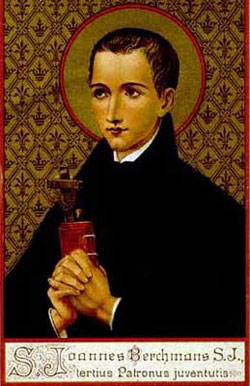
St. John Berchmans


Image of St. John Berchmans

Facts

Feastday: November 26
Patron of Altar Servers
Birth: 1599
Death: 1621


Eldest son of a shoemaker, John was born at Diest, Brabant. He early wanted to be a priest, and when thirteen became a servant in the household of one of the Cathedral canons at Malines, John Froymont. In 1615, he entered the newly founded Jesuit College at Malines, and the following year became a Jesuit novice. He was sent to Rome in 1618 to continue his studies, and was known for his diligence and piety, impressing all with his holiness and stress on perfection in little things. He died there on August 13. Many miracles were attributed to him after his death, and he was canonized in 1888. He is the patron of altar boys. His feast day is November 26.

Ready or not; it's Advent 2016

The Season of Advent in the Catholic Church

A Time of Preparation


In the Catholic Church, Advent is a period of preparation, extending over four Sundays, before Christmas. (For more details, see "When Does Advent Start?") The word Advent comes from the Latin advenio, "to come to," and refers to the coming of Christ. This refers, first of all, to our celebration of Christ's birth at Christmas; but second, to the coming of Christ in our lives through grace and the Sacrament of Holy Communion; and finally, to His Second Coming at the end of time.
Our preparations, therefore, should have all three comings in mind. We need to prepare our souls to receive Christ worthily.

First We Fast, Then We Feast

That's why Advent has traditionally been known as a "little Lent." As in Lent, Advent should be marked by increased prayer, fasting, and good works. While the Western Church no longer has a set requirement for fasting during Advent, the Eastern Church, both Catholic and Orthodox, continues to observe what is known as Philip's Fast, from November 15 until Christmas.


Traditionally, all great feasts have been preceded by a time of fasting, which makes the feast itself more joyful. Sadly, Advent today has supplanted by "the Christmas shopping season," so that by Christmas Day, many people no longer enjoy the feast.


The Symbols of Advent

In its symbolism, the Church continues to stress the penitential and preparatory nature of Advent. As during Lent, priests wear purple vestments, and the Gloria ("Glory to God") is omitted during Mass. The only exception is on the Third Sunday of Advent, known as Gaudete Sunday, when priests can wear rose-colored vestments. As on Laetare Sunday during Lent, this exception is designed to encourage us to continue our prayer and fasting, because we can see that Advent is more than halfway over.

The Advent Wreath

Perhaps the best-known of all Advent symbols is the Advent wreath, a custom which originated among German Lutherans but was soon adopted by Catholics. Consisting of four candles (three purple and one pink) arranged in a circle with evergreen boughs (and often a fifth, white candle in the center), the Advent wreath corresponds to the four Sundays of Advent. The purple candles represent the penitential nature of the season, while the pink candle calls to mind the respite of Gaudete Sunday. (The white candle, when used, represents Christmas.)

Celebrating Advent

We can better enjoy Christmas—all 12 days of it, from Christmas Day to Epiphany—if we revive Advent as a period of preparation. Abstaining from meat on Fridays, or not eating at all between meals, is a good way to revive the Advent fast. (Not eating Christmas cookies or listening to Christmas music before Christmas is another.) We can incorporate such customs as the Advent wreath, the Saint Andrew Christmas Novena, and the Jesse Tree into our daily ritual, and we can set some time aside for special scripture readings for Advent, which remind us of the threefold coming of Christ.
Holding off on putting up the Christmas tree and other decorations is another way to remind ourselves that the feast is not here yet. Traditionally, such decorations were put up on Christmas Eve, but they would not be taken down until after Epiphany, in order to celebrate the Christmas season to its fullest.


Pope Francis preaches on Friday morning

Pope’s Morning Homily: ‘Never Converse With the Devil’
At Casa Santa Marta, Francis Says ‘Hope’ to Encounter Jesus
_0002421
L'Osservatore Romano
Never converse with the devil, who seduces and ruins lives.
According to Vatican Radio, Pope Francis stressed this to faithful during his daily morning Mass at Casa Santa Marta, drawing from today’s readings, which continued reflecting on the end of the world, as discussed in the Book of Revelations.
Seducer, Liar, Trickster
The Pontiff noted how in today’s reading the angel seizes the serpent, chains it up and throws it into the abyss, which is then locked and sealed, and stressed that the serpent or devil is thrown into the abyss “so that it would no longer lead the nations astray” because it is the seducer.
“He is a liar and what’s more is the father of lies, he generates lies and is a trickster. He makes you believe that if you eat this apple you will be like a God. He sells it to you like this and you buy it and in the end he tricks you, deceives you and ruins your life.
“‘But father, what can we do to avoid being deceived by the devil?’ Jesus teaches us: never converse with the devil. One does not converse with him. What did Jesus do with the devil?  He chased him away, he asked his name but did not hold a dialogue with him.”
How to Defend Oneself
Pope Francis went on to explain how when Jesus was in the wilderness, he defended himself when replying to the devil by using the Word of God and the Word of the Bible.
Thus, the Argentine Pope stressed, we must never converse with this liar and trickster who seeks our ruin and who for this reason will be thrown into the abyss.
The Holy Father also described how today’s reading shows how the Lord will judge the great and the lowly “according to their deeds,” with the damned being thrown into the pool of fire. Francis described this as the “second death.”
Not a Torture Chamber
“Eternal damnation is not a torture chamber,” he said. “That’s a description of this second death: it is a death. And those who will not be received in the Kingdom of God, it’s because they have not drawn close to the Lord. These are the people who journeyed along their own path, distancing themselves from the Lord and passing in front of the Lord but then choosing to walk away from Him.”
What eternal damnation is, he explained, is “continually distancing oneself from God.”
“It is the worst pain, an unsatisfied heart, a heart that was created to find God but which, out of arrogance and self-confidence, distances itself from God.”
Distancing oneself from God Who gives happiness and Who loves us so much, the Pontiff admonished, is the “fire,” and the road to eternal damnation.
Pointing out how the reading’s final image ends with a vision of hope, Francis noted that if with humility, we open our hearts, we will have joy, salvation, and will receive Jesus’ forgiveness.
“Hope is what opens our hearts to the encounter with Jesus. This is what awaits us: the encounter with Jesus. It’s beautiful, very beautiful,” Pope Francis said, concluding, “He asks us only to be humble and say ‘Lord.’ It’s enough to say that word and He will do the rest.

Women Deacon Commission meets in Rome, more questions, lots more, than answers

>>>Yeah, I'm going to step into this with prayer that I trust the Holy Spirit more than my own thoughts.  This kind of stuff can get messy as the article indicates near the end.  Pope Francis has a way of thinking things thru that we apparently do not understand.  Despite many glaring and sensational headlines, this appears to be a historical study and not what the secular world wants(ordaining women) and when do they want it(now). 

I cannot and never will challenge the Holy Father but I am concerned about 2 factors that must be addressed by someone other than me.  Why are there NO Permanent Deacons on the commission and why is there an unapologetic activist for women's ordination on the commission as appointed directly by the Pope.

And I have a few questions; why now and what is the end game.

The Permanent Diaconate is about to celebrate, with the whole Church I pray, it's 50th anniversary of activation thanks to Pope Paul VI in 1967.  In these 50 years, despite the need for Permanent Deacons because of fullness or Orders, and the service of charity provided, the Diaconate is primarily an American thing, with some strength in Canada, Australia and parts of western Europe.  Across the rest of the Catholic world, not so much.  The reestablishment of the Diaconate as a permanent order is still too new to experiment or mess with. 

Make no mistake, Permanent Deacons are still a source of confusion an contradiction for SOME Priests, Bishops and Cardinals.  We must not dismiss our own contributions to this confusion.  All I know is that the Apostles, in order to be more focused on prayer and liturgy appointed seven men to be present to widows and others in need of charity.  Service is the charism of the Deacon and by our Ordination and presence on in the Sanctuary and presiding at certain Sacraments, then that Service itself becomes "sacramentalized".  I pray that this be another "move on, there is nothing to see here" moment in the life of Holy Mother Church.

By all means, when praying for our Priests, our Bishops and for and with the Holy Father, please do not forget your Permanent Deacon, the icon of Christ the Servant who came to serve and not be served.


Commission on Women Deacons Has 1st Meeting
Secretary of the Congregation for the Doctrine of the Faith chairing study group
Vatican City
ZENIT - HSM
The Vatican press office reported that today, the first meeting of the Study Commission on the Diaconate of Women took place. This commission was established by Pope Francis on August 2 with the purpose of doing an objective study on the situation of deaconesses in the early Church, mentioned for example in Romans 16.
Chaired by Archbishop Luis Ladaria Ferrer, S.J., Secretary of the Congregation for the Doctrine of the Faith, Commission members will meet in morning and evening sessions over two days in the offices of the Congregation for the Doctrine of the Faith.
The Holy Father established the commission after he told some 900 women religious belonging to the International Union of Superiors General (UISG) in May that it would be a good idea to look into the history of women deacons in the Church.
The new commission is set to do further work on the theme, which was discussed in a 2002 document (part iv) of the International Theological Commission.
In June, the Pope spoke of the commission on his return flight from Armenia, in an in-flight press conference. On that occasion, he said he had been “a little annoyed” with the press for how they had handled the news of the commission.
He explained that after he had acknowledged the issue could be studied and that he would “‘tell the Congregation for the Doctrine of the Faith to set up this commission’. The next day [the headlines read]: ‘Church opens the door to women deacons!’
“To tell the truth, I was a little annoyed with the media because this is not telling people the whole truth.”

Black Friday, bleh and it just ain't Christmas yet

The Day after Thanksgiving!  What type of day is this Friday for you?  What type of day should it be?  In just a few short hours after we rejoice in food, family and football, just 1 day after time set aside for reflection, remembrance and thanksgiving, this Friday has become something all together notThanksgiving like.  Let me explain.

It is only recent history that this Friday became "Black" Friday.  It is also just recent history that this Friday has become the start of Christmas season.  Truth be told; black Friday now starts on Thanksgiving day itself and the Christmas season gets ushered in with the trick or treat kids.   Now this is not a post to bash retail America or even those among us who actually enjoy the contact sport of competitive shopping.  More, I want this post to help us all reflect on who we are, what we've become and does it truly conform to God's will?

What do we believe God thinks of our human excesses as manifest in all things Black Friday?  Maybe He does not care, as long as we remain thankful, merciful and kind!  But an event like Black Friday asks us to carefully consider how can we flip a switch; those many switches in our lives that takes us from gratitude to greed, from care and concern to me first, from peace and reflection to anxiety and insanity?  The herculean effort MANY will make to shop until ya drop, in some cases including spending nights camped outside big box stores, how does this compare to our similar efforts to attend Mass, to embrace our faith, to put the needs of the poor and needy over our own needs to simply draw closer to God?  Why do we have the need to do what others do; to follow the crowd; to go along to get along; to take precious time from that which is really important to save a few bucks? 

I recognize that this time of year small businesses can make some important money and many individuals find much needed work or that necessary second job.  I guess I'll never understand, however, why this all has to happen in a day.  But if you find yourself working retail today, or if you happen to be one of those crazy shoppers, may peace be with you and don't forget to take God along for the ride.  Remember how you felt yesterday.  Remember what Thanksgiving really means.  Remember also that with the approach of Christmas, what are we truly celebrating?

And speaking of Christmas, why do we need to cave to the pressure and make today, the day after Thanksgiving, Christmas time?  It is foolish especially for the Christian and without a doubt for the Catholic.  We now enter Advent, a real season of hopeful anticipation and preparation.  We do remember that we await the recognition of the birth of Jesus at Christmas but we also must anticipate and prepare for His second coming while we rejoice in all the ways He comes to us everyday, in Word and Sacrament, in His Church, in the lives He surrounds us with and the life of faith He has blessed us with.  Slow down, no need to move so fast, no need to fight for the best deal or act in a manner unworthy of the Christ who lives within us.

What type of day is this for yous?  I hope it is another great day that we live in thanksgiving; living our lives for God!  And what type of week will this be for us? Do we throw ourselves in the fight of the this world or do we wait in joyful hope for the coming of our Savior, Jesus Christ?

Sad to hear of the passing of Florence Henderson

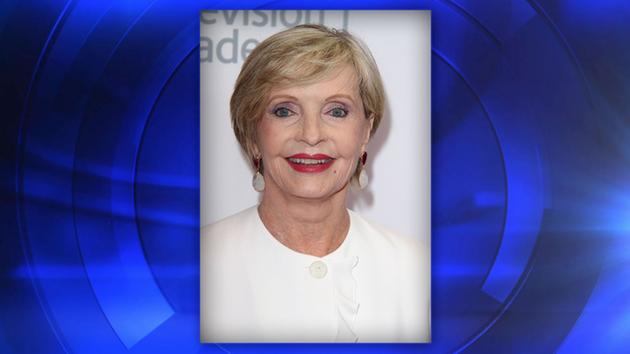
Florence Henderson, "The Brady Bunch" mom, dies

(Photo by Juan Rico/Invision for the Television Academy/AP Images)

Florence Henderson, the wholesome actress who went from Broadway star to television icon when she became Carol Brady, the ever-cheerful matriarch of "The Brady Bunch," has died, her manager and her publicist said. She was 82.

Henderson died Thursday night at Cedars-Sinai Medical Center in Los Angeles, after being hospitalized the day before, said her publicist, David Brokaw. Henderson had suffered heart failure, her manager Kayla Pressman said in a statement.

Family and friends had surrounded Henderson's hospital bedside, Pressman said.

Thursday, November 24, 2016

Faithful during imprisonment and torture she dies a martyr


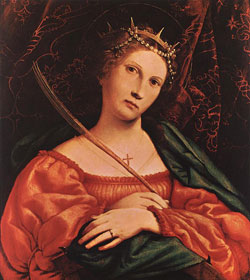
Image of St. Catherine of Alexandria

Facts

Feastday: November 25
Patron of students, unmarried girls, apologists
Birth: 287
Death: 305


Saint Catherine of Alexandria is a canonized saint in the Catholic Church who, per Christian tradition, was martyred around 305 in Alexandria, Egypt. Of course, the Church of the first Millennium was undivided. She is also recognized as the Great Martyr and Saint by the Orthodox Church. There are no surviving primary sources attesting to her existence, but the fact that her memory, and the stories about her, have been kept alive - and handed down in the tradition - certainly confirm her existence, and her life of heroic virtue and holiness.
The young saint was born around 287 in Alexandria, Egypt. At that time, Alexandria was one of the finest cities in the world, and a center of learning and culture as well as faith.
Christian tradition states she was of noble birth, possibly a princess. As a member of the nobility, she was also educated and was an avid scholar. Around the age of fourteen, she experienced a moving vision of Mary and the infant Jesus, and she decided to become a Christian.
Although she was a teenager, she was very intelligent and gifted. When the emperor Maxentius began persecuting Christians, Catherine visited him to denounce his cruelty.
Rather than order her execution, Maxentius summoned fifty orators and philosophers to debate her. However, Catherine was moved by the power of the Holy Spirit and spoke eloquently in defense of her faith. Her words were so moving that several of the pagans converted to Christianity and were immediately executed.
Unable to defeat her rhetorically or to intimidate her into giving up her belief, the emperor ordered her to be tortured and imprisoned.
Catherine was arrested and scourged. Despite the torture, she did not abandon her faith. Word of her arrest and the power of her faith quickly spread and over 200 people visited her. According to some legends, the emperor's own wife, Valeria Maximilla was converted by Catherine. The emperor eventually executed his own wife over her conversion. However, this is not mentioned in the historical record and may be a legend. It is believed that Maximilla was alive and with her husband at the Battle of the Milvian Bridge in 312, seven years after the death of Catherina.
Following her imprisonment, Maxentius made a final attempt to persuade the beautiful Catherine to abandon her faith by proposing marriage to her. This would have made her a powerful empress. Catherine refused, saying she was married to Jesus Christ and that her virginity was dedicated to him.
The emperor angrily ordered her to be executed on a breaking wheel. The breaking wheel is an ancient form of torture where a person's limbs are threaded among the spokes and their bones are shattered by an executioner with a heavy rod. It is a brutal punishment that results in a slow and painful death, normally reserved for the worst criminals.
When Catherine was presented before the wheel, she touched it and a miracle occurred that caused the wheel to shatter.
Unable to torture her to death, the emperor simply ordered her beheaded.
One account claimed that angels took her body to Mt. Sinai. In the sixth century, the Emperor Justinian ordered a monastery established in her name. The monastery, Saint Catherine's, remains to this day and is one of the oldest in the world.
Around the year 800, a legend spread that her body has been found with her hair still growing and a constant stream of oil coming from her body. Nothing exists to this day of her remains, and her very existence has been called into question.
Despite these questions, and the possibility that her story may be confused with that of one or more other saints, she is still venerated in the Eastern Orthodox Church as a Martyr. Many Roman Catholics also venerate her to this day as one of the great virgin saints of the early Church.
During the medieval period, St. Catherine was one of the most famous saints of the Church. She has was a popular subject in renaissance art and many paintings from the period are dedicated to her.
Catherine is still a very popular Catholic name.
The spiked wheel is a popular symbol often associated with St. Catherine.
Her feast day is Nov. 25, and she is the patron of a great many professions and causes. Her patronage includes students, unmarried girls, apologists and many more as well as many places around the world

Thanksgiving greetings from the US Bishops

Happy Thanksgiving From the US Bishops
“Diverse as we are, we are united in the debt we owe to God and our desire to give Him thanks”
https://upload.wikimedia.org/wikipedia/commons/1/1d/Thanksgiving_Day_--_The_dinner_(Boston_Public_Library).jpg
Wikimedia Commons
Cardinal Daniel N. DiNardo of Galveston-Houston, president of the U.S. Conference of Catholic Bishops (USCCB), and Archbishop José H. Gomez of Los Angeles, vice president of the USCCB, offer Thanksgiving Day wishes to the nation.
Full statement follows:
On Thursday, our nation will pause to give God thanks for the abundant blessings He has bestowed upon us. It is a grateful tradition people of many faiths have honored since even before our country’s founding. George Washington, Abraham Lincoln and Franklin Roosevelt all sought to establish a day of Thanksgiving for the good of our national life.
In modern times, Thanksgiving has become a day when dispersed families come together again around the dinner table. Let us pray for all those traveling this week that God may guide them safely to their loved ones. In countless parishes, Thanksgiving is also a day of service as volunteers prepare a meal for those less fortunate. Let us pray for everyone separated from the abundance of our country that God may comfort them and opportunities may open for them to fully participate in the hope of America. Let us also especially remember the elderly and those who are in need, as well as anyone who may be spending the day alone. May they experience the closeness of God.
On Thanksgiving, millions of Americans, from big cities to rural countryside, will bow their heads to say grace. They will be successful and struggling, citizen and newcomer, sisters and brothers to us all. Diverse as we are, we are united in the debt we owe to God and our desire to give Him thanks. Have a Happy Thanksgiving!