Thursday, January 2, 2025

January 3rd: Optional Memorial of the Holy Name of Jesus


Christmas: January 3rd

Wednesday of Christmas Time; Optional Memorial of the Most Holy Name of Jesus

Other Commemorations: St. Geneviève, Virgin (RM)

facebook sharing button Share
twitter sharing button Tweet
linkedin sharing button Share
pinterest sharing button Pin
email sharing button Email
sharethis sharing button

MASS READINGS

January 03, 2024 (Readings on USCCB website)

PROPERS [Show]

COLLECT PRAYER

Wednesday of Christmas Time Before Epiphany: Grant us, almighty God, that the bringer of your salvation, who for the world's redemption came forth with newness of heavenly light, may dawn afresh in our hearts and bring us constant renewal. Who lives and reigns with you in the unity of the Holy Spirit, God, for ever and ever.


Optional Memorial of the Most Holy Name of Jesus: O God, who founded the salvation of the human race on the Incarnation of your Word, give your peoples the mercy they implore, so that all may know there is no other name to be invoked but the Name of your Only Begotten Son. Who lives and reigns with you in the unity of the Holy Spirit, God, for ever and ever.

show

Recipes (1)

show

Activities (10)

show

Prayers (17)

show

Library (6)

show

Blog & Podcasts (1)

» Enjoy our Liturgical Seasons series of e-books!

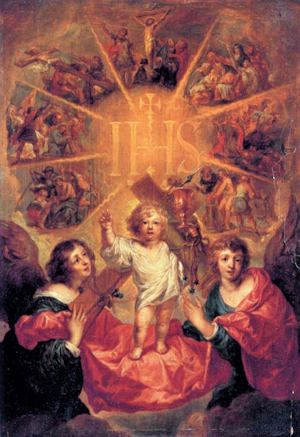
The Church celebrates the Optional Memorial of the Most Holy Name of Jesus. According to the previous liturgical calendar (1962), this feast was celebrated on January 2. In the liturgical revisions of Vatican II, the feast was removed, though a votive Mass to the Holy Name of Jesus had been retained for devotional use. With the release of the revised Roman Missal in March 2002, the feast was restored as an Optional Memorial on January 3.

The Church reveals to us the wonders of the Incarnate Word by singing the glories of His name. The name of Jesus means Savior; it had been shown in a dream to Joseph together with its meaning and to Our Lady at the annunciation by the Archangel Gabriel.

Devotion to the Holy Name is deeply rooted in the Sacred Scriptures, especially in the Acts of the Apostles. It was promoted in a special manner by St. Bernard, St. Bernardine of Siena, St. John Capistrano and by the Franciscan Order. It was extended to the whole Church in 1727 during the pontificate of Innocent XIII. The month of January has traditionally been dedicated to the Holy Name of Jesus.

The Roman Martyrology also commemorates St. Genevieve (422-500), the principal patron saint of Paris, France. She was born in 422 at the village of Nanterre, and at seven years old she dedicated herself to God. She became a consecrated virgin at the age of fifteen by the bishop of Paris. When Paris was captured by the Franks and threatened by the Huns, Genevieve stirred up the inhabitants to defense both by word and example, and Clovis himself is said to have consulted her. She died at the age of 78, and her body was solemnly enshrined in the church of Saints Peter and Paul in Paris. She is credited with saving Paris from many catastrophes, and an epidemic that swept the city in 1129 was reputedly ended through her intercession.

Most Holy Name of Jesus—Day Ten
The name of Jesus is a name of gladness, a name of hope and a name of love. A name of gladness, because if the remembrance of past transgressions afflicts us, this name comforts us, reminding us that the Son of God became man for this purpose, to make himself our Savior.

A name of hope, because he that prays to the Eternal Father in the name of Jesus may hope for every grace he asks for: If you ask the Father anything in My name, He will give it you.

A name of love. For the name of Jesus brings to our remembrance all the sufferings which Jesus has endured for us in his life and at his death.
—Excerpted from St. Alphonsus de Liguori, The Incarnation Birth and Infancy of Jesus Christ

Holy Name of Jesus
This feast marks no progress in the development of the Church year. It merely embellishes the occasion just observed when the Child received the Name Jesus as had been foretold by the angel. The feast is meant to impress on us Christians the dignity of the Holy Name. It is a relatively new feast, stemming out of devotional piety. Nevertheless, it is not difficult to find in it some liturgical or ancient Christian dogma. What did a name signify originally? The name should express the nature of a thing. Thus Adam in paradise gave the animals names in accordance with their being. Among the Jews God's name expressed His essence, Yahweh, i.e., I (alone) AM WHO AM (and cause all else to be). The Jews had the highest respect for the name of God, a reverence that finds continuation in the Our Father: "Hallowed be Thy Name."

Persons who played prominent roles in the history of salvation often received their names from God Himself. Adam — man of the earth; Eve — mother of all the living; Abraham — father of many nations; Peter — the rock. The Savior's precursor was given the name God assigned him. According to divine precedent, then, the name of the Redeemer should not be accidental, of human choosing, but given by God Himself. For His name should express His mission. We read in Sacred Scripture how the angel Gabriel revealed that name to Mary: "You shall call His name Jesus." And to St. Joseph the angel not merely revealed the name but explained its meaning: "You shall call His name Jesus, for He shall save His people from their sins." The Messiah should not only be the savior, but should be called Savior. With Jesus, therefore, the name actually tells the purpose of His existence. This is why we must esteem His name as sacred. Whenever we pronounce it, we ought to bow our heads; for the very name reminds us of the greatest favor we have ever received, salvation.
—Excerpted from The Church's Year of Grace, Pius Parsch

Christmas Reflection: The Holy Name of Jesus
His name was called Jesus, which was called by the Angel before He was conceived in the womb." Luke 2:21.
1. It is not difficult to meditate upon the Holy Name, or to use the Holy Name in prayer. More than any other name, perhaps alone among all proper names, it is appropriate to the One Who owned it. Usually the names of men are given at random; they mean nothing in themselves; a man who happens to be called John might just as well have been called Thomas or William; the mere name tells us nothing about him; it is a convenient means of distinguishing him from others, a label put upon him and little or no more With a few human beings it has been otherwise: Adam, Abraham, Josue, John the Baptist were given names that signified the men on whom they were bestowed. But with none is this so true as it is with our Lord and Saviour Jesus Christ. With care the Angel impressed it on His Mother's mind: "Thou shalt call His name Jesus," he said, and there followed the description of His future greatness. With care it was repeated to Joseph: Thou shalt call His name Jesus, for He shall save His people from their sins.

2. The Name stands as a complete summary and description of our Lord's character and office, and it is under this aspect that it has been regarded by thousands of saints, whose hearts have melted at its mere sound. To them Jesus is their God, Jesus is their King, Jesus is their Redeemer, Jesus is their Mediator, Jesus is their Saviour, Jesus is their great Priest, Jesus is their Intercessor, Jesus is the Captain under Whom they fight, Jesus is the Leader Whom they follow, Jesus is their Teacher, Jesus is the Giver of their law, Jesus is the Spouse and Shepherd of their souls, Jesus is their Light, Jesus is their Life, Jesus is the Judge before Whom they rejoice to think that they must one day stand, Jesus is their final and eternal Reward, for which alone they live.
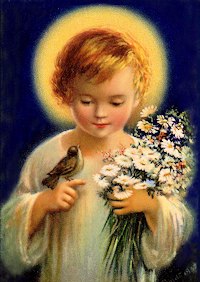
3. But He is also to them the mirror of all the most glorious and winning virtues. He is, and His Name tells them that He is, unbounded Charity, infinite Mercy, extremest Kindness, deepest Humility, most devoted Piety, transparent Simplicity, uttermost Poverty, Chastity without a stain. It is the prerogative of love to transform those who love into the likeness of Him Whom they love; and as the mere name of one who is loved cannot sound in the ear or be thought of in the mind without adding to the love which is already there, so the thought of the Holy Name and the mention of the Holy Name have a kind of sacramental power in the hearts of His saints. They seem to convey the grace which enables men to think like Him, to speak like Him, to act like Him, to sacrifice themselves like Him, and to Him, and for Him, and along with Him, to make Him known to others, not by word only, but also by reproduction of Him in themselves, and to win all men to love Him.

Bless the Lord, O my soul, and let all that is within thee bless His Holy Name. Bless the Lord, O my soul, and never forget all He hath done for thee. Ps. cii. i, 2.

1. The great saint of the Holy Name is St. Bernardine of Siena. In his missionary expeditions he carried it on a banner, and used it continually in his sermons. He has a long treatise on the Holy Name, which teems with matter for prayer. The Holy Name, he says, is first of all fruitful for beginners. For these, for sinners, " it shows the immense mercifulness of God, it enables a devout man to gain a victory in every conflict, whether with the devil, the flesh, or the world, it has the power of healing sickness when rightly used, it fills with joy and exultation those who are in any adversity." He quotes St. Peter, that "through His name all receive remission of sin who believe in Him"; St. John: "Your sins are forgiven you for His name's sake"; St. Peter again: "There is no other name under heaven given to men whereby we must be saved"; the prayer of the Church in the Acts of the Apostles, that God would "stretch forth his hand to signs and cures and wonders, to be done by the name of thy only Son Jesus"; the further statement in the Acts, that the Apostles went forth "from the presence of the Council, rejoicing that they were accounted worthy to suffer reproach for the name of Jesus."
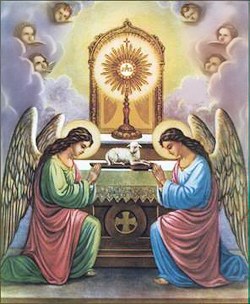
2. Next it is fruitful for the proficient. "It is cherished in their hearts and fed upon by faith, it is taken into their mouths and preached or spoken about, it is made the spring of their actions, which then become a great accumulation of merits, it is appropriated in a new way by perseverance, and then it becomes a principle of abiding and enduring life, the remedy of the frailty and fickleness which belong to our poor nature."

By virtue of this Holy Name, he tells us, we ourselves have become the sons of God. In the virtue of this Holy Name St. Paul placed all his hope of doing good. The power of the Holy Name is the power of the Holy Ghost. And for its power of endurance he asks: "Art thou not refreshed as often as thou rememberest the name of Jesus? What is there equal to it for the feeding of the mind that thinks of it, for repairing weariness, for strengthening virtues, for nourishing good and upright ways, for fostering true affections?"

3. Lastly it is fruitful for those whom he calls the perfect. The first fruit is "the sweetness with which those who meditate upon it are filled," according to the beautiful rhythm of St. Bernard, Jesu dulcis memoria. The second is the wonderful power which this Holy Name gives to the prayers and petitions of the devout soul. The third is the immense sweetness which it gives to those who continually renew its memory. The fourth is the triumph and glory which it will produce in eternity: "They shall glory in Thee, all who love Thy name/ And thus for the sake of the name of Jesus the whole soul will live, and be endowed and enriched and beautified with all its powers; it will be made like to God three and one, united to Him, enlightened by Him, and plunged in perfect peace through Him, for it is to live for ever in the state of perfect bliss, furnished with the accumulation of all good."
—Excerpted from The Prince of Peace by Alban Goodier

Pilgrimage sites announced by the Archdiocese of New Orleans for Jubilee 2025

 The following churches, shrines, basilicas in the Archdiocese of New Orleans have been designated as pilgrimage sites for Jubilee 2025:


The Cathedral Basilica of St. Louis King of France

Basilica of St. Stephen

National Votive Shrine of Our Lady of Prompt Succor

Shrine of the Vietnamese Holy Martyrs

National Shrine of Blessed Francis Xavier Seelos

St. Jude Shrine

St. Joseph Church and Shrine on the Westbank

St. Anne Church and Shrine

St. Joseph Abbey

St. Augustine Church

St. Charles Borromeo Church

St. John the Baptist Church

More details coming soon.


Pope Francis sends message of support and closeness to Archbishop Aymond for those killed and injured by the Bourbon St. terrorist attack


Law enforcement vehicles near the site of the attackLaw enforcement vehicles near the site of the attack 

Pope ‘deeply saddened’ by New Orleans terrorist attack

In a message sent to Archbishop Gregory Aymond of New Orleans, Pope Francis expresses his ‘spiritual closeness’ to those affected by the recent terrorist attack in the southern US city.

By Joseph Tulloch

Pope Francis has said he is “deeply saddened” to learn of the “loss of life and injury" caused by a recent terrorist attack in the US city of New Orleans.

On January 1, 15 people were killed, and dozens wounded, when a 42-year-old man drove a pickup truck at high speed into a crowd.

In his telegram, sent to Archbishop Gregory Aymond of New Orleans, the Pope assured the entire city of his “spiritual closeness," and commended the victims to “the loving mercy of Almighty God.”

The message, signed by Cardinal Secretary of State Pietro Parolin, added that the Pope is praying for those affected, and that, “as a pledge of peace and strength in the Lord, the Holy Father sends his blessing".


The attack

In the early hours of January 1, a man—now identified as Shamsud-Din Jabbar, a Texas native and US Army veteran—drove a rented pickup truck at high speed into a crowd in New Orleans’ bustling French Quarter.

He was subsequently killed in a gunfight with police. However, authorities have said that they believe multiple people were involved in the attack.

According to the FBI, an Islamic State flag was found in the truck, and U.S. President Joe Biden has said that the attack was inspired by the group.

On the same day, a Tesla Cybertruck exploded in flames outside the Trump International Hotel Las Vegas, killing the driver and injuring seven others.

Officials said that the FBI was investigating whether the blast was an act of terrorism. Authorities are also looking into whether the two attacks are linked. 

Wednesday, January 1, 2025

Always together with Basil; January 2nd: St. Gregory Nazianzus


St. Gregory Nazianzus


Feastday: January 2
Birth: 329
Death: 390


Doctor of the Church, born at Arianzus, in Asia Minor, c. 325; died at the same place, 389. He was son -- one of three children -- of Gregory, Bishop of Nazianzus (329-374), in the south-west of Cappadocia, and of Nonna, a daughter of Christian parents. The saint's father was originally a member of the heretical sect of the Hypsistarii, or Hypsistiani, and was converted to Catholicity by the influence of his pious wife. His two sons, who seem to have been born between the dates of their father's priestly ordination and episcopal consecration, were sent to a famous school at Caesarea, capital of Cappadocia, and educated by Carterius, probably the same one who was afterwards tutor of St. John Chrysostom. Here commenced the friendship between Basil and Gregory which intimately affected both their lives, as well as the development of the theology of their age. From Caesarea in Cappadocia Gregory proceeded to Caesarea in Palestine, where he studied rhetoric under Thespesius; and thence to Alexandria, of which Athanasius was then bishop, through at the time in exile. Setting out by sea from Alexandria to Athens, Gregory was all but lost in a great storm, and some of his biographers infer -- though the fact is not certain -- that when in danger of death he and his companions received the rite of baptism. He had certainly not been baptized in infancy, though dedicated to God by his pious mother; but there is some authority for believing that he received the sacrament, not on his voyage to Athens, but on his return to Nazianzus some years later. At Athens Gregory and Basil, who had parted at Caesarea, met again, renewed their youthful friendship, and studied rhetoric together under the famous teachers Himerius and Proaeresius. Among their fellow students was Julian, afterwards known as the Apostate, whose real character Gregory asserts that he had even then discerned and thoroughly distrusted him. The saint's studies at Athens (which Basil left before his friend) extended over some ten years; and when he departed in 356 for his native province, visiting Constantinople on his way home, he was about thirty years of age.

Read more...St. Gregory Nazianzus - Saints & Angels - Catholic Online

Usually celebrated together, Saints Basil and Gregory Nazianzen; here is St. Basil's boigraphy


St. Basil the Great


Feastday: January 2
Patron: of hospital administrators
Death: 379


St. Basil the Great was born at Caesarea of Cappadocia in 330. He was one of ten children of St. Basil the Elder and St. Emmelia. Several of his brothers and sisters are honored among the saints. He attended school in Caesarea, as well as Constantinople and Athens, where he became acquainted with St. Gregory Nazianzen in 352. A little later, he opened a school of oratory in Caesarea and practiced law. Eventually he decided to become a monk and found a monastery in Pontus which he directed for five years. He wrote a famous monastic rule which has proved the most lasting of those in the East. After founding several other monasteries, he was ordained and, in 370, made bishop of Caesaria. In this post until his death in 379, he continued to be a man of vast learning and constant activity, genuine eloquence and immense charity. This earned for him the title of "Great" during his life and Doctor of the Church after his death. Basil was one of the giants of the early Church. He was responsible for the victory of Nicene orthodoxy over Arianism in the Byzantine East, and the denunciation of Arianism at the Council of Constantinople in 381-82 was in large measure due to his efforts. Basil fought simony, aided the victims of drought and famine, strove for a better clergy, insisted on a rigid clerical discipline, fearlessly denounced evil wherever he detected it, and excommunicated those involved in the widespread prostitution traffic in Cappadocia. He was learned, accomplished in statesmanship, a man of great personal holiness, and one of the great orators of Christianity. His feast day is January 2.

Archbishop Gregory Aymond, New Orleans, issues statement after last night's horrific event


Archbishop Gregory Aymond issued the following statement on the truck attack on Bourbon Street this morning:
"Our prayers go out to those killed and injured in this morning’s horrific attack on Bourbon Street. This violent act is a sign of utter disrespect for human life. I join with others in the Roman Catholic Archdiocese of New Orleans in offering prayerful support to the victims’ families. I give thanks for the heroic duty of hundreds of law enforcement and medical personnel in the face of such evil."

Pope calls for cancellation of debt for poorer nations


Pope Francis at the AngelusPope Francis at the Angelus  (VATICAN MEDIA Divisione Foto)

Pope calls on world leaders to cancel debt of poorer nations

After his traditional New Years’ Day Angelus prayer, Pope Francis issues a powerful call to political leaders, urging them to “set a good example by canceling or significantly reducing the debts of the poorest countries.”

By Vatican News

Addressing a crowded St Peter’s Square, Pope Francis once again emphasized his firm "no" to war, declaring that it "always destroys."

He also urged that no country or people should be "crushed by debt."

Debt cancellation for poorer nations

Speaking after his traditional New Years’ Day Angelus, he made an appeal to world leaders

“God is the first to forgive debts, as we always ask in the ‘Our Father,’" Pope Francis said. "The Jubilee calls us to translate this forgiveness into social terms so that no individual, family, or people is crushed by debt. I encourage leaders of nations with Christian traditions to set an example by canceling or significantly reducing the debts of the poorest countries.”

Gratitude to peacemakers

The Pope went on to extend his heartfelt thanks to all those who, in conflict-ridden areas across the globe, are working diplomatically to promote justice and peace.

“I express my deep gratitude", he said, "to everyone who, in the many regions plagued by conflict, work toward dialogue and negotiations. Let us pray for an end to all fighting and for a decisive focus on peace and reconciliation. My thoughts go to war-torn Ukraine, Gaza, Israel, Myanmar, [North] Kivu, and so many other people in conflict.”

The destructive reality of war

The Pope referenced the Italian television program A Sua Immagine, where, he said, he had seen footage and photographs depicting the devastation caused by war.

“Brothers and sisters,” he said, “war destroys. It always destroys! War is always a defeat. Always. I express my heartfelt appreciation to all those striving for peace.”

Greeting to Italian President

The Pope extended his best wishes to Italian President Sergio Mattarella, expressing hope for “every good thing in the new year” and assuring him of his prayers. In his New Year’s address to the nation the previous evening, Mattarella echoed the Pope’s message, noting the significance of the 58th World Day of Peace and its call to the conscience of all.

“All—Heads of State and Government, leaders of international organizations, civil and religious authorities—are called to address the wounds of the world, the troubling social and economic fragmentation, and the growing threats to peaceful development among nations,” Mattarella said.

He affirmed that, on behalf of the Italian people, he takes up Pope Francis’s continuous appeals for urgent and courageous actions to secure peace and address challenges such as migration, environmental degradation, and the risks and opportunities posed by new technologies.

January 1st Papal Angelus Address


Pope at Angelus: Safeguard life to build a civilisation of peace

During the midday Angelus on the New Year's Day Solemnity of the Blessed Virgin Mary, the Mother of God, Pope Francis prays that Mary may "teach us to keep the joy of the Gospel in our hearts and bear witness to it in the world."

By Thaddeus Jones

Pope Francis led the midday Angelus prayer in a crowded Saint Peter's Square on New Year's Day, reflecting on the "surprise and the joy of Christmas." The Pope recalled today's Gospel that narrates the arrival of the shepherds in the grotto in Bethlehem after witnessing the proclamation of the angels telling them about the newborn saviour, Messiah, and Lord. The Pope described this encounter which "fills everyone with wonder", as they saw with their own eyes the infant Jesus, and they experienced "the heart of Mary, who kept and reflected on all these things."

The Pope offered his reflections following the traditional morning Mass over which he presided for the Solemnity of the Blessed Virgin Mary, the Mother of God, and the January 1st World Day of Peace.

“God saves”

Recalling the Hebrew meaning of Jesus,  “God saves”, the Pope explained how this is exactly what the Lord will do and came into the world to accomplish by offering us His very life. 

“God chose to be born for us: Jesus is the revelation of His eternal love, which brings peace into the world.”

The heart of Mary

The Pope then explained how the heart of Mary "corresponds to the newborn Messiah, who manifests the mercy of the Father." Her immaculate heart is the ear that listened to the proclamation of the Archangel Gabriel, and the hand of the bride given to Joseph, as well as the embrace experienced by Elizabeth in her old age, the Pope added.

“In Mary’s heart beats the hope of redemption and salvation for every creature.”

A mother's heart

Observing how mothers always have their children at heart, the Pope said on this New Year's Day dedicated to peace, we should remember mothers in a special way, those who "rejoice in their heart" and those who bear "a heart full of suffering, because their children have been taken away by violence, by arrogance, by hatred."

“How beautiful is peace! And how inhuman is war, which breaks the hearts of mothers!”

Living the joy of the Gospel

In conclusion, the Pope suggested we carry out our own introspection on these themes, first looking at our ability to remain in silence contemplating the birth of Jesus and how we try to cherish in our own hearts the wonderous reality and message of goodness and salvation. Also, he recommended we reflect on how we can reciprocate such a great gift by freely offering gestures of peace, forgiveness, reconciliation.

“May Mary, the Holy Mother of God, teach us to keep the joy of the Gospel in our hearts and bear witness to it in the world.”

Papal Mass for the Solemnity of Mary Mother of God; entrust 2025 to Mary


Pope Francis invites us to cherish life and entrust 2025 to Mary

Mary “immerses us once more in the mystery of Christmas” and leads us to Jesus, says Pope Francis, as he celebrates Mass for the Solemnity of the Most Holy Mother of God.

By Christopher Wells

Pope Francis marked the beginning of 2025 with the celebration of Mass for the Solemnity of Mary, the Most Holy Mother of God.

In his homily, the Holy Father said that “like a Mother,” Mary points us to her Son and leads us to Jesus.

The mystery of Christmas

Today’s feast, he said, “immerses us once more in the mystery of Christmas” – a mystery summed up in the Second Reading, where St Paul tells us that “God sent forth His Son, born of a woman.” These words “echo in our hearts today” and “remind us that Jesus, our Saviour, became flesh and is revealed in the frailty of the flesh.”

That Jesus was born of a woman reminds us “that God became truly man through a human womb” – showing us that God is not simply “some vague religious feeling or fleeting emotion,” but “has a face and a Name, and calls us to have a relationship with Him.”

Jesus, the Pope said, “is one of us, and thus is able to save us.”


Jesus shows us the face of God

St Paul’s words also “speak to us about the humanity of Christ” who is “revealed in the frailty of flesh.” Jesus’ coming as a tiny baby, through the Virgin Mary, reveals how God chooses to act: “through littleness and hiddenness.” Jesus, the Pope said, “revealed God’s love in the beauty of His humanity, dwelling in our midst, sharing our daily life… by the frailty of His humanity and His concern for the weak and vulnerable, Jesus shows us the face of God.”

Pope Francis invited us to “entrust this new year to Mary, the Mother of God,” with the hope that we might learn, “like her” to protect “the precious gift of life.”

Cherishing all human life

Today, the Pope continued, on this World Day of Peace, “all of us are invited to take up the summons that flow from the maternal heart of Mary: to cherish life, to care for life, to restore dignity to the lives of everyone ‘born of woman,’ for this is the basis for building a culture of peace.”

This, he said, is the reason for his appeal “for a firm commitment to respect the dignity of human life from conception to natural death.”

“Let us entrust to Mary this new Jubilee Year,” the Holy Father concluded. “Let us entrust to her our questions, our worries, our sufferings, our joys and all the concerns that we bear in our hearts. Let us entrust to her the whole world, so that hope may be reborn and peace may finally spring up for all the peoples of the earth.”