Thursday, February 2, 2023

Bishops from Rwanda and the DRC come together for Pope's visit


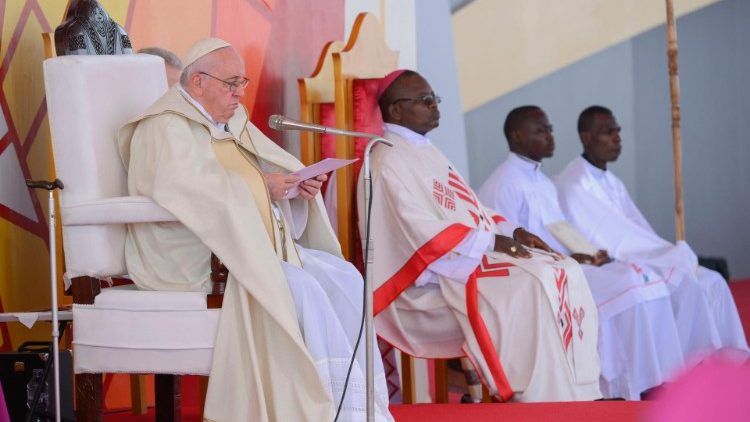
Pope Francis in DRCPope Francis in DRC  (VATICAN MEDIA Divisione Foto)EDITORIAL

Bishops of nations split by conflict unite around the Pope

Amid ongoing tensions between the bordering nations, Bishops from DRC and Rwanda come together during Pope Francis' Apostolic Visit to the Democratic Republic of Congo.

By Andrea Tornielli

"Together, we believe that Jesus always gives us the possibility of being forgiven and starting over, but also the strength to forgive ourselves, others and history!" Christ "wants to anoint us with His forgiveness" to "give us the peace and courage to forgive in turn, the courage to grant others a great amnesty of the heart."

When Pope Francis spoke these words in his homily at Mass at the Ndolo Airport in Kinshasa, celebrating the Eucharist with him were the Bishops of countries, with warring militias and rebel groupsthat have been, and are, the scene of unspeakable violence and wars, fuelled not only by external forces, but also from forces within.

Together with their brethren from the Democratic Republic of Congo, at the altar and then at a shared meal, were the Bishops of Rwanda, Burundi and Congo Brazzaville.

Before departing for their respective countries, some of them gathered around a table in a hotel and recounted this experience to Vatican Media, explaining how their presence in the DRC, and episcopal communion, can help the peace processes.

"We are living a special moment, a kairos. We must not let politics divide us, but see what we can do together," Cardinal Fridolin Ambongo Besungu, the Archbishop of Kinshasa, told us.

“The Pope's message was very powerful. While politicians sow hatred between peoples, instrumentalize xenophobia, and feed mistrust among the people, the Bishops and the Church are called to walk a different path. They must not enter into this logic.”

Cardinal Ambongo thanked his brothers from Rwanda "for coming here to Kinshasa. It took courage to do so, the courage to carry out a common mission."

His sentiment was echoed by Rwandan Cardinal Antoine Kambanda, Archbishop of Kigali, who recalls Pope Francis' desire to also go to Goma, on the border with Rwanda, a journey that was not possible because of the violence and clashes that are ongoing in that region.

“We Bishops, six out of eight, came here. The message of peace that the Pope came to bring to us concerns us all. It touches us all. It touched me personally.”

With emotion, the Cardinal recalled the genocide that took place in his country in 1994, when in 100 days, at least 800,000 people were killed because of an ethnic-political conflict.

"It was not a genocide caused by others, from outside. It was perpetrated by Rwandans. By people living together on the same hills. Each hill had its own tragedy. And we can ask ourselves today: how do you live together after going through a genocide?" he asked.

Forgiveness is a grace from God

Cardinal Kambanda's answer echoed the one just given by the Pope: "Forgiveness is the way to coexistence. To coexist, one must forgive oneself. Forgiveness is the key. Forgiveness is a grace from God, and concerns everyone: individuals, individual offenders, but also families.'

The road to forgiveness, the Rwandan Cardinal added, "is compassion, realising that the other person also suffers and that my suffering is connected to his. This is the pedagogy of the Cross". The lived experience of his country, "we share it with our brothers in the episcopate. Forgiveness also allows for a pacification of memory".

"Reconciliation is the key to living together," says the Archbishop of Gitega, Bonaventure Nahimana, President of the Burundi Bishops' Conference.

“It is the key to resolving religious, ethnic and political conflicts. This is precisely what the synod process of the Burundian Churches is focused on.”

"All the dioceses got involved. We must live in forgiveness to truly have open, welcoming, fraternal communities. Open also in welcoming the other as a brother, even when he is a foreigner. We have many Congolese refugees in Burundi. We will be credible through the way we live this."

Impact of Pope's visit

"We are here with a large delegation, not just of Bishops, but of people," explained the Archbishop of Brazaville, Bienvenu Manamika, President of the Congo Brazaville Bishops' Conference.

"The Pope's visit will have a great impact in the region," he said.

"Although our country is not directly affected by the conflicts, we are nevertheless involved. There is a saying that 'if the Democratic Republic of Congo coughs, we in Congo Brazzaville sneeze and catch the flu'."

"We all need peace," he added, "The ongoing conflict in the east of the DRC does not leave us calm. It is reminiscent of war traumas already experienced."

“We must take Pope Francis' words seriously, a message from which a de-escalation of the war can arise.”

Archbishop Manamika noted that the mere presence of the Successor of Peter brings hope and concerns everyone.

"I hope that his words are also heard by the multinational companies behind the extractive industry. There are peoples who suffer from this situation. Without justice, without dignity, there is no peace." Internal conflicts, he concluded, "depend on wider interests. But when elephants fight it is the grass that suffers. And the grass is the people. That is why we must all work and pray for peace".

The need to learn to forgive and cultivate peace

"We must all build peace. With forgiveness, with the rediscovery of the community that unites us and the mission that we have,' emphasised the Archbishop of Kisangani, Marcel Utembi Tapa, president of the Episcopal Conference of the Democratic Republic of Congo.

"We must convince ourselves that personal and institutional forgiveness are linked. As baptised, children of God, brothers and sisters, we must learn to forgive each other. The Pope is well aware of all that goes on here, and how what goes on here is a threat to peace, a problem that affects the entire sub-continental region. He invited us to develop an awareness of the fraternity that unites us and that affects not just one country but the entire region. We are all called to be missionaries of peace. His was a strong appeal to states, civil society, the Church, pastors."

The courage of these Bishops, united together with the Successor of Peter, is a small great sign of hope for these tormented lands, where ethno-political conflicts involve Christians on both sides.

Pope Francis said in his homily at Ndolo Airport: "May it be a good time for all of you in this country who call yourselves Christians but engage in violence."

“The Lord is telling you: Lay down your arms, embrace mercy.”

Pope Francis meets with the young people of DRC : "never grow discouraged"


Pope to DRC youth: ‘A different future is in your hands’

Pope Francis meets with young people and catechists from across the Democratic Republic of Congo, and urges them never to grow discouraged in their quest to resist corruption.

By Devin Watkins

On the third day of his Apostolic Journey to the DRC, Pope Francis held a lively encounter with young people and the local Church’s catechists.

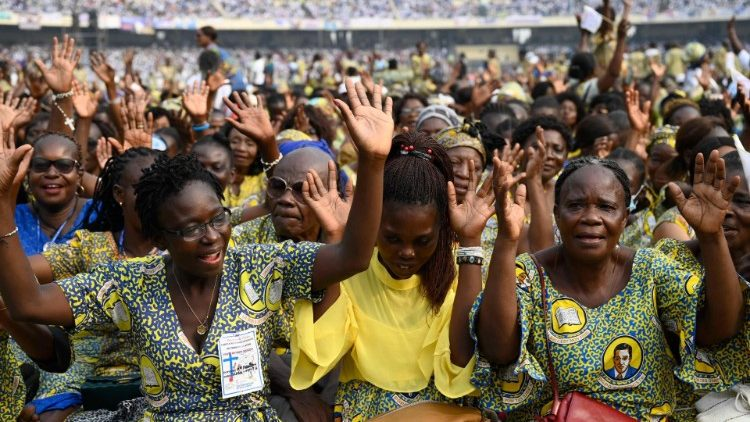
The meeting took place in the Martyr’s Stadium in Kinshasa on Thursday morning, and the Pope thanked the Congolese youth for their shows of affection and dancing.

In his address, the Holy Father invited the young people of the Democratic Republic of Congo to look at their hands and reflected on how each finger represents a different “ingredient for the future”.

First of all, he noted, no one’s hands are the same as anyone else’s, just as each person is a unique and unrepeatable treasure. At the same time, each of us have to choose whether to clench our hand into a fist or to open it in an offering to God and others.

Living prayer

Our thumb, said Pope Francis, is closest to our heart and therefore symbolizes prayer, which provides the driving force for our life.

Prayer, he added, is the basic ingredient for our future, and we need to listen to the word of God and cultivate a “living prayer” in order to grow inwardly.

“Jesus has triumphed over evil. He made of His cross the bridge to the resurrection. So, raise your hands to Him daily, praise Him and bless Him.”

We should speak to Jesus as our best friend, entrust our fears to Him, and tell Him the “deepest secrets of your life,” added the Pope.

“God loves this kind of living, concrete and heartfelt prayer,” he said. “It allows Him to intervene, to enter into your daily life in a special way, to come with his ‘power of peace’,” which is the Holy Spirit.

Community-building

Pope Francis then turned to the index finger, which represents “the community”.

He urged the young people of DR Congo not to isolate themselves from one another but to embrace those around them who seem lonely or are suffering.

The Pope offered the negative examples of drug-use or witchcraft, which makes the addict feel all-powerful but in reality ends up depriving the person of everything they hold dear.

Social media, he added, can also disorient those who spend excessive amounts of time scrolling or swiping. “Nothing can ever be a replacement for the energy that we get from being together, the sparkle in our eyes, the joy of exchanging ideas!” he said.

Rather, young Congolese are called to build community, champion fraternity, and dream of a more united world.

“I know you have repeatedly shown that, even at great sacrifice, you are ready to stand up to defend human rights and the hope of a better future for everyone in the country.”

Honesty to combat corruption

Honesty, said the Pope, offers the third ingredient for a better future, and provides an antidote to the “cancer of corruption”.

Speaking off-the-cuff, Pope Francis launched a heartfelt appeal for the people of the Democratic Republic of Congo to refuse any form of corruption, urging, in French, "say no to corruption!"

“Do not be overcome by evil," he said. "Overcome evil with good.” he said.

The Pope recalled a 26-year-old young man, Floribert Bwana Chui, who was killed 15 years ago in Goma for having blocked the passage of spoiled foodstuffs which would have harmed people's health. The young Christian man, said the Pope, prayed for guidance and said no to the "filth of corruption."

“If someone offers you a bribe, or promises you favours and lots of money, do not fall into the trap. Do not be deceived! Do not be sucked into the swamp of evil!”

Forgiveness to not repeat the past

The Pope turned to the ring finger, symbolizing “forgiveness”, and recalled that all the greatest goods in our life involve "weakness, weariness, and hardship." 

"Forgiveness," he said, "means being able to start over. To forgive does not mean forgetting the past; it means refusing to repeat it."

Service in littleness

Pope Francis noted that the pinky finger is our last and smallest finger, and represents our “service”.

Our actions for others, he said, often seem like a drop in the ocean, but “it is precisely littleness, our decision to become little, that attracts God.”

Refuse to grow discouraged

In conclusion, the Pope urged young Congolese Catholics to work for a better future in their nation by reflecting frequently on these five ingredients: prayer, community, honesty, forgiveness, and service.

“Never grow discouraged!”

Wednesday, February 1, 2023

Candlemas and Groundhog Day

 How Candlemas Day Turned Into Groundhog Day


Published: Jan 26, 2021, 9:43 PM

“If Candlemas be fair and bright, come winter, have another flight. If Candlemas bring clouds and rain, go winter, and come not again.” - English folk song


If a day to predict the arrival of spring weather sounds familiar, it probably calls to mind Groundhog Day. However, for centuries, February 2nd was celebrated as a Christian Feast Day known as Candlemas. The day also bore significance outside of Christianity, marking the halfway point between the winter solstice and the spring equinox. It was celebrated as an ancient Roman festival of light.


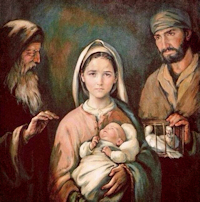
The name ‘Candlemas’ refers to the traditional processions and blessing of candles that came to characterize the feast day. It also is called the Feast of the Presentation, because it honors the day that Mary and Joseph presented the infant Jesus at the Temple according to Mosaic law.


Candlemas Day was always celebrated on February 2nd, exactly 40 days after Christmas on December 25th. Mosaic law stated that 40 days was the period of purification time after the birth of a child.


Candlemas also presented an opportunity to predict weather. According to the New England Historical Society, New Englanders who once lived in old houses looked at how far the sun would shine in through cracks in the structure to determine how far the snow would continue to blow in through to the month of May.


Like many religious celebrations, Candlemas has a secular alternative in Groundhog Day. Groundhog Day was first recognized in the United States during the late 1800s and was popularized in Pennsylvania by German settlers who had their own Candlemas Day rhymes related to the weather. The Germans connected weather prognostication to the local hedgehog. When German immigrants arrived in America, there were no hedgehogs, so they used the groundhog, the closest representative animal they could find. The tradition grew so popular it was eventually commercialized. Thousands began to flock to Punxsutawney, PA, to watch Punxsutawney Phil make his prediction

February 2nd is also the World Day for Consecrated Life


Background: World Day for Consecrated Life


February 2nd

February 2, the Feast of the Presentation of the Lord, is also the 27th World Day for Consecrated Life, a commemoration instituted by Pope St. John Paul II in 1997.

In his message for the 1st World Day for Consecrated Life, St. John Paul explained that the day has three purposes:

In the first place, it answers the intimate need to praise the Lord more solemnly and to thank him for the great gift of consecrated life, which enriches and gladdens the Christian community by the multiplicity of its charisms and by the edifying fruits of so many lives totally given to the cause of the Kingdom …

In the second place, this day is intended to promote a knowledge of and esteem for the consecrated life by the entire People of God …

The third reason regards consecrated persons directly. They are invited to celebrate together solemnly the marvels which the Lord has accomplished in them, to discover by a more illumined faith the rays of divine beauty spread by the Spirit in their way of life, and to acquire a more vivid consciousness of their irreplaceable mission in the Church and in the world. Immersed in a world which is often agitated and distracted, taken up sometimes by the press of responsibilities, consecrated persons also will be helped by the celebration of this annual World Day to return to the sources of their vocation, to take stock of their own lives, to confirm the commitment of their own consecration.

The World Day for Consecrated Life takes place on the Feast of the Presentation of the Lord, the Pontiff continued, because “the Presentation of Jesus in the Temple is an eloquent icon of the total offering of one’s life for all those who are called to show forth in the Church and in the world, by means of the evangelical counsels the characteristic features of Jesus—the chaste, poor and obedient one.”

Pope Francis’s annual messages for the day are available on the Vatican website, as are the annual messages of Pope St. John Paul II and Pope Benedict XVI’s homilies and addresses for the day. (Pope Benedict did not issue annual messages for the day.) The United States Conference of Catholic Bishops has asked parishes to commemorate the World Day for Consecrated Life on the weekend of February 4-5.

Understanding the celebration of Candlemas on February 2nd


Candlemas: The Feast of Light and Hope

By Jennifer Gregory Miller ( bio - articles - email ) | Jan 28, 2022 | In The Liturgical Year


From the Archives, originally published in 2014:

On February 2, the Church celebrates the Feast of the Presentation of the Lord, forty days after Christmas. In the 1962 calendar the feast is called the “Purification of the Blessed Virgin Mary” and commonly referred to as Candlemas. When this feast falls on a Sunday the General Norms of the Liturgical Year and Calendar specifies that Feasts of Our Lord that fall in the General Roman Calendar take precedence over the Sundays in Ordinary Time, so this feast would be celebrated instead of the Sunday in Ordinary Time..

This is considered a “Christmas feast,” even though it is not part of the Christmas season. This the last feast of the liturgical calendar that we commemorate Christ still as an infant child.

Candlemas is an ancient feast that has developed over the centuries. In the early Church’s liturgy, January 6 was a combined feast with Christmas, Epiphany and the Baptism of the Lord, with February 14 being the date for forty days after January 6. The famous pilgrim Egeria who traveled to the Holy Land between 381 and 384 AD. recorded the feast of the Presentation on the 14th. I do wonder if our modern St. Valentine’s Day might have originally been an offshoot of Candlemas falling on this date?

Another development is the color of vestments. In both forms the priests wear white, but before 1960 the priest would wear black, and then later violet vestments for the Candle blessing and lighting procession. Pope Benedict (then Joseph Cardinal Ratzinger) explains in his Seek That Which is Above: Meditations Through the Year:

In Rome this candle-lit procession supplanted a rowdy, dissolute carnival, the so-called Amburbale, which had survived from paganism right into Christian times. The pagan procession had magical features: it was supposed to effect the purification of the city and the repelling of evil powers.... Thus the element of encounter, again, was evident in this procession: the pagan world’s wild cry for purification, liberation, deliverance from dark powers, meets the “light to enlighten the Gentiles,” the mild and humble light of Jesus Christ. The failing (and yet still active) aeon of a foul, chaotic enslaved and enslaving world encounters the purifying power of the Christian message (pp. 26-27).

The liturgy focuses on the meeting of Christ with the elderly Simeon. With Simeon we rest our hope in the Lord. The Gospel includes the beautiful Canticle of Simeon, Nunc Dimittis, which is said at the Church’s Night Prayer or Compline. It the shortest of the canticles of the Breviary, but my personal favorite:

Lord, now you let your servant go in peace;
your word has been fulfilled:
my own eyes have seen the salvation
which you have prepared in the sight of every people:
a light to reveal you to the nations
and the glory of your people Israel.

Although I prayed it for many years, the Canticle took a deeper meaning after I married. My husband’s father died on this date in 1996, and I think of him whenever I pray this Canticle. It is a prayer of acceptance and resignation. It is almost as if this could have been my father-in-law’s prayer on his lips when he died.

When I pray it at night I am thanking God for all His goodness and fulfillment in His providential care for me. I accept His Will; I accept my death. I am personally repeating Simeon’s words and trying to prepare for my death. This is also a prayer of self-examination. Where have I failed to embrace His Will or serve Him? Do I accept Christ our Light in my life and carry that Light to others? Do I place my hope in Christ? It’s a personal reflection, but it has made this feast and Canticle more poignant for me.

Although this is a considered a Christmas feast, it also is clearly connected to the upcoming Lenten and Easter seasons. Mary and Joseph offering Jesus to God is the beginning of His earthly ministry for His Heavenly Father. This is the first of Our Lady’s seven sorrows, and a foreshadowing of the Cross.

Even the popular name Candlemas hints at the “light to reveal you to the nations“ that we celebrate at Easter, the ultimate feast of Light. The blessing and procession of candles is more than a strong indicator of the upcoming Paschal Candle. There is also a link to the bees—candles for church use were traditionally required to be at least 51% beeswax, and the new Roman missal translation brings back the honor of bees in the Exultet in the Easter Vigil:

On this, your night of grace, O holy Father, accept this candle, a solemn offering, the work of bees and of your servants’ hands, an evening sacrifice of praise, this gift from your most holy Church. But now we know the praises of this pillar, which glowing fire ignites for God’s honor, a fire into many flames divided, yet never dimmed by sharing of its light, for it is fed by melting wax, drawn out by mother bees to build a torch so precious.

Not every parish will have blessing of candles, but this is my favorite highlight of this feast. Unless your parish makes the requirement, it is not necessary to have only beeswax taper candles to be blessed for home use. Candles designated for religious use in the home can be any style: votive, tealight, or taper. I have a few blessed beeswax candles from previous Candlemas feasts. This past year during my heart health problems I used the candles when I received the Sacrament of the Anointing of the Sick twice and Communion in my home.

Children, especially boys, are attracted to candles as moths are to a flame. I like to incorporate candles in our activities throughout the liturgical year. For this feast, there are several entries in the Activities and Prayers that suggest having a Candlemas procession at home. A Marian hymn and maybe incorporating some of the prayers from the Mass of the day will make a wonderful celebration. And on my plan this year will be to make some beeswax candles, possibly our own home paschal candle.

And special foods for this day? While crepes are the traditional dish, dishes with a little fire are bound to bring the Light of Christ to mind, such as Snowballs on Fire or Cherries Jubilee.

With His grace may we continue to recognize the Light revealed to all nations and wholeheartedly be able to pray every day “Lord, now you let your servant go in peace.”

The Feast of the Presentation of the Lord


Ordinary Time: February 2nd

Feast of the Presentation of the Lord

Other Commemorations: St. Catherine de Ricci, Virgin (RM) ; Other Titles: Candlemas


MASS READINGS

February 02, 2023 (Readings on USCCB website)

COLLECT PRAYER

Feast of the Presentation of the Lord: Almighty ever-living God, we humbly implore your majesty that, just as your Only Begotten Son was presented on this day in the Temple in the substance of our flesh, so, by your grace, we may be presented to you with minds made pure. Through our Lord Jesus Christ, your Son, who lives and reigns with you in the unity of the Holy Spirit, God, for ever and ever.

show

RECIPES (5)

show

ACTIVITIES (25)

show

PRAYERS (11)

show

LIBRARY (5)

show

BLOG & PODCASTS (10)


Entrance Antiphon, Cf. Ps 48 (47): 10-11:

Your merciful love, O God, we have received in the midst of your temple. Your praise, O God, like your name, reaches the ends of the earth; your right hand is filled with saving justice.


Alleluia Verse, Lk 2:32:

A light of revelation to the Gentiles, and glory for your people Israel.


Preface: the Mystery of the Presentation of the Lord:

It is truly right and just, our duty and our salvation,
always and everywhere to give you thanks,
Lord, holy Father, almighty and eternal God.

For your co-eternal Son was presented on this day in the Temple
and revealed by the Spirit
as the glory of the Israel and Light of the Nations.

And so, we, too, go forth, rejoicing to encounter your Salvation,
and with the Angels and Saints
praise you, as without end we acclaim:


Communion Antiphon, Cf. Lk 2:30-31:

My eyes have seen your salvation, which you prepared in the sight of all the peoples.


Today the Church celebrates the Feast of the Presentation of the Lord which occurs forty days after the birth of Jesus and is also known as Candlemas Day, since the blessing and procession of candles is included in today's liturgy. See the prayer's section for the full rite of the Procession and Blessing of Candles at Mass.

Founded by Pope St. John Paul II in 1997, today is the World Day of Prayer for Consecrated Life. He attached it to "Candlemas Day" because the consecrated men and women are to be the light in the world, imitating Jesus, the Light of the World. The World Day of Prayer is moved to the following Sunday to be celebrated in the parishes. See USCCB for more resources.

The previous (1962) liturgical calendar refers to this feast as the "Purification of Mary." This is known as a "Christmas feast" since it points back to the Solemnity of Christmas. Many Catholics practice the tradition of keeping out the Nativity creche or other Christmas decorations until this feast day.

On February 2nd another secular tradition unfolds, , known well to schoolchildren and adults alike. The fate of Spring hangs in the balance as a burrowing animal looks for its shadow. But where did this tradition come from? See the link below for an article that explains this tradition.


Thoughts on the Liturgy

Today's First Reading from the prophet Malachi 3:1-4 gives us an important insight to understand profoundly the mystery of the Lord’s Presentation in the Temple by Mary and Joseph, in accordance with the canons of Mosaic Law. The text, taken from the Prophet Malachi says, "I am sending my messenger to prepare the way before me; and suddenly there will come to the temple the Lord who you seek" (Mal 3:1). From all the Gospels, we know that it is the Precursor, St. John the Baptist who was born 6 months before Jesus, that God sent to prepare His way. Putting these evangelical facts together, we can comprehend the words of the Prophet Malachi. The Lord God promised that He would send a Precursor to prepare His way. Since there is only 6 months between the birth of St John the Baptist and Jesus it is clear that the prophecy meant that suddenly after the Precursor, the Lord Himself will come. So, soon after the Baptist’s birth, God entered His temple. Jesus’ presentation signifies God’s entrance to His temple. God made man entered His temple, presenting Himself to those who were really searching for Him.

Today’s Gospel from Luke 2:22-40 introduces us to different people and events that in themselves provide numerous lessons and themes for further reflection. First of all, Mary and Joseph respect the Mosaic Law by offering the sacrifice prescribed for the poor: a pair of turtledoves or two young pigeons.

Simeon and Anna were two venerable elderly people dedicated to prayer and fasting and so their strong religious spirit rendered them able to recognize the Messiah. In this sense we can see in the Presentation of Jesus in the Temple an extension of the ‘Pro Orantibus Day’ (For those who pray) that is celebrated on the feast of the Presentation of Mary (21 November). On this day, the Church demonstrates its gratitude to all those in the community that dedicate themselves in a privileged way to prayer, to those who have a particular religious vocation to the contemplative life. In the figure of the venerable Simeon, Jesus’ presentation in the temple, also reminds us that prayer and contemplation are not just a waste of time or an obstacle to charity. On the contrary, time could not be better spent than in prayer as true Christian charity is a consequence of a solid interior life. Only those who pray and offer penance, like Simeon and Anna, are open to the breath of the Spirit. They know how to recognize the Lord in the circumstances in which He manifests Himself because they possess an ample interior vision, and they have learned how to love with the heart of the One whose very name is Charity.
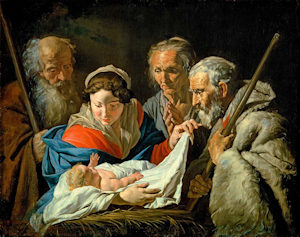
At the end of the Gospel Simeon’s prophecy of Mary’s sufferings is emphasized. Pope John Paul II taught that, ‘Simeon's words seem like a second Annunciation to Mary, for they tell her of the actual historical situation in which the Son is to accomplish his mission, namely, in misunderstanding and sorrow.’ (Redemptoris Mater, n16) The archangel’s announcement was a fount of incredible joy because it pertained to Jesus’ messianic royalty and the supernatural character of His virginal conception. The announcement of the elderly in the temple instead spoke of the Lord’s work of redemption that He would complete associating Himself through suffering to His Mother. Therefore, there is a strong Marian dimension to this feast and so in the previous Liturgical Calendar it is called the Purification of the Blessed Virgin Mary. This refers to the other aspect of the presentation that consists of the ritual purification of Jewish women after they had given birth. In Mary’s case this purification was not necessary, but it indicates the renewal of her total offering of herself to God for the accomplishment of His Divine Plan.

Simeon’s prophecy also announces that Christ will be ‘a sign of contradiction’. St Cyril of Alexandria, in one of his homilies, interpreted the words ‘sign of contradiction’ like a noble cross, as St Paul wrote to the Corinthians ‘a stumbling block to Jews and foolishness to Gentiles’ (1 Cor 1:23) […] It is a sign of contradiction in the sense that those who loose appear as foolish while in those who recognize its power [the cross] reveals salvation and life’ (cf. PG 77, 1044-1049).

—Excerpted from Congregation for the Clergy


Presentation of the Lord

The feast was first observed in the Eastern Church as "The Encounter." In the sixth century, it began to be observed in the West: in Rome with a more penitential character and in Gaul (France) with solemn blessings and processions of candles, popularly known as "Candlemas." The Presentation of the Lord concludes the celebration of the Nativity and with the offerings of the Virgin Mother and the prophecy of Simeon, the events now point toward Easter.

"In obedience to the Old Law, the Lord Jesus, the first-born, was presented in the Temple by his Blessed Mother and his foster father. This is another 'epiphany' celebration insofar as the Christ Child is revealed as the Messiah through the canticle and words of Simeon and the testimony of Anna the prophetess. Christ is the light of the nations, hence the blessing and procession of candles on this day. In the Middle Ages this feast of the Purification of the Blessed Virgin Mary, or 'Candlemas,' was of great importance.
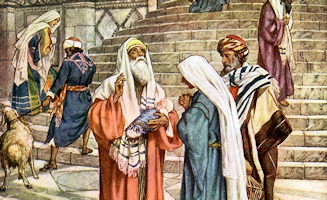
"The specific liturgy of this Candlemas feast, the blessing of candles, is not as widely celebrated as it should be, except of course whenever February 2 falls on a Sunday and thus takes precedence. There are two ways of celebrating the ceremony, either the Procession, which begins at a 'gathering place' outside the church, or the Solemn Entrance, celebrated within the church."

—From Ceremonies of the Liturgical Year


Until 1969, the ancient feast of the Presentation of Our Lord, which is of Oriental origin, was known in the West as the feast of the Purification of Our Lady, and closed the Christmas Cycle, forty days after the Lord's birth. This feast has for long been associated with many popular devotional exercises. The faithful:

  • gladly participate in the processions commemorating the Lord's entry into the Temple in Jerusalem and His encounter with God, whose house He had come to for the first time, and then with Simeon and Anna. Such processions, which in the West had taken the place of licentious pagan events, always had a penitential character, and were later identified with the blessing of candles which were carried in procession in honor of Christ, 'the light to enlighten the Gentiles' (Lk 2, 32);
  • are sensitive to the actions of the Blessed Virgin in presenting her Son in the Temple, and to her submission to the Law of Moses (Lk 12, 1-8) in the rite of purification; popular piety sees in the rite of purification the humility of Our Lady and hence, 2 February has long been regarded as a feast for those in humble service.

Popular piety is sensitive to the providential and mysterious event that is the conception and birth of new life. Christian mothers can easily identify with the maternity of Our Lady, the most pure Mother of the Head of the mystical Body—notwithstanding the notable differences in the Virgin's unique conception and birth.

These too are mothers in God's plan and are about to give birth to future members of the Church. From this intuition and a certain mimesis of the purification of Our Lady, the rite of purification after birth was developed, some of whose elements reflect negatively on birth.

The revised Rituale Romanum provides for the blessing of women both before and after birth, this latter only in cases where the mother could not participate at the baptism of her child.

It is a highly desirable thing for mothers and married couples to ask for these blessings which should be given in accord with the Church's prayer: in a communion of faith and charity in prayer so that pregnancy can be brought to term without difficulty (blessing before birth), and to give thanks to God for the gift of a child (blessing after birth).
In some local Churches, certain elements taken from the Gospel account of the Presentation of the Lord (Lk 2, 22-40), such as the obedience of Joseph and Mary to the Law of the Lord, the poverty of the holy spouses, the virginity of Our Lady, mark out 2 February as a special feast for those at the service of the brethren in the various forms of consecrated life.

The feast of 2 February still retains a popular character. It is necessary, however, that such should reflect the true Christian significance of the feast. It would not be proper for popular piety in its celebration of this feast to overlook its Christological significance and concentrate exclusively on its Marian aspects. The fact that this feast should be 'considered [...] a joint memorial of Son and Mother' would not support such an inversion. The candles kept by the faithful in their homes should be seen as a sign of Christ 'the light of the world' and an expression of faith.

—Excerpted from Directory on Popular Piety and the Liturgy


Theme of Light

The Feast of the Presentation of the Lord's second major theme is Light. We are well familiar with the beautiful symbolism associated with light. Light means Christ and the supernatural life of grace. Today the Church, responding to Simeon's words, "The Light for the enlightenment of the Gentiles," keeps a genuine "light feast." (The feast was instituted to supplant the pagan Lupercalia, a licentious frolic featuring nocturnal torchlight parades. This explains why at the blessing of the candles and in the procession the celebrant and his ministers used to wear violet, the penitential color.)

Candles are blessed for liturgical use and are also distributed to the faithful. In homes they should be lighted on the occasion of family devotions, in times of storm, household crises, or other dangers; also at the Communion of the sick and at the administration of the Sacrament of the Anointing of the Sick. The Church, moreover, wishes these candles to remind us of our baptismal candles; for the candles we held at baptism signified our heavenly adoption and our duties in the lay priesthood of Christ. Year after year we again receive a baptismal candle so that "with burning lamp" we may hasten to meet the Bridegroom when He comes for the heavenly nuptials.

In the older missal, on two occasions during today's Mass the faithful would light their candles and hold them, at the Gospel and during the Canon until Communion. For in the Gospel and during the Canon Christ is present in a special way. It is the reason why at a High Mass lighted candles and burning incense are introduced. The message which the Church wishes to tell you is this: Actually, you ought to hold burning candles in your hands at every Mass; ordinarily, however, acolytes perform that function in your stead. This feast, however, the lay people had an opportunity to exercise the office of universal or lay priesthood.—Today's Mass, therefore, is truly a "Candle-Mass," practically the only in the entire year.