Wednesday, February 1, 2023

Learning about the Zaire Rite of the Mass used specifically in the Democratic Republic of Congo


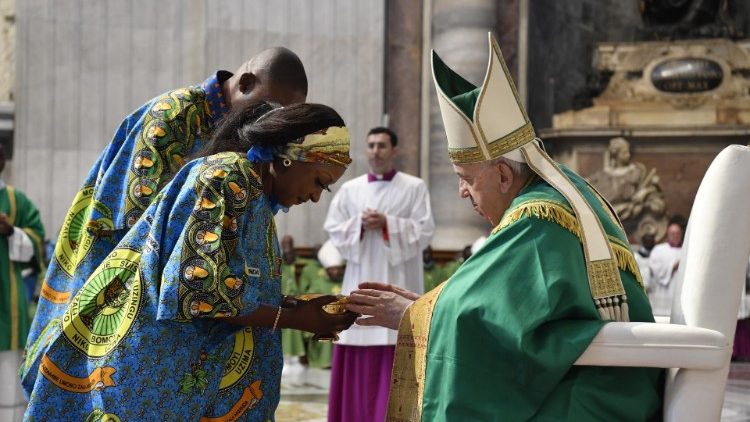
Mass in the Zaire rite for the Congolese community in Rome in 2022Mass in the Zaire rite for the Congolese community in Rome in 2022  (Vatican Media)

"Catholic and African" - The Zaire Rite

As Pope Francis continues with his visit to the Democratic Republic of Congo, Vatican News speaks to an expert on the Zaire Rite, the liturgy developed specifically for use in that country.

By Stanislas Kambashi SJ

Father Michel Libambu, a priest of the Archdiocese of Kinshasa in the Democratic Republic of Congo, is an expert on the Church Fathers and an official in the Dicastery for Divine Worship and the Discipline of the Sacraments.

In an interview with Vatican News, he describes the origins of the Zaire rite of the Mass, as well as some of its particular features, such as the invocation of the ancestors at the beginning, the seated assembly during the proclamation of the Gospel, the lively music and the dances.


What is the historical context of the "Zaire" rite, celebrated according to the "Roman Missal for the Dioceses of Zaire"?

This rite has a history: it’s the fruit of the work of missionary evangelisation, from the first evangelisation by the Portuguese to the second evangelisation by the Belgian missionaries. In this process, two important documents should be noted: one by Pope Benedict XV, who in the apostolic letter Maximum illud, published in 30 November 1919, quoting Mk 16:15, gives recommendations to missionaries, asking them to bring the Gospel, not Europe, to their missions. The Gospel must be preached with care and in depth in order to reach the soul of the people; this is a process of inculturation, already begun by Rome.

Then there is the Second Vatican Council, mainly with the document Sacrosanctum Concilium, which strongly pushed for the liturgy to be closer to the people. This document had already defined the iter to be followed (SC, 40), or, in other words, how to proceed so that the liturgy is adapted to the life, the genius of the people.

After the Council, the bishops of Zaire (the former name of the DRC) began to reread all the Council documents, including Lumen GentiumGaudium et Spesand Sacrosanctum Concilium,to examine the possibility of applying and adapting them to the context of the country. There were “Theology Weeks” at the theology faculty of Lovanium University. In 1969, immediately after the publication of the Roman Missal in the wake of Vatican II, the Episcopal Conference of Zaire submitted a draft of the Missal readapted for the celebration of Mass according to the Congolese style, at the instigation of Cardinal J. Malula, who had been appointed a member of the Liturgical Preparatory Commission for the Second Vatican Council by Pope John XXIII.

The project was presented to the Congregation for Divine Worship and the Discipline of the Sacraments. After almost 20 years of dialogue, exchange and study, the ad experimentum Missal (5th June 1974) was transformed into the definitive Missal accepted by Rome (30 April 1988); a document that was to reflect not only Africanness, but also Romanness. This is why it is called the "Roman Missal for the dioceses of Zaire". At the same time, in Kinshasa, the diocesan synod took place, a few years before the death of Cardinal Malula.  

Speaking of the structure of the Mass, the celebration according to this Missal follows the two main parts of the liturgy: the Liturgy of the Word and the Liturgy of the Eucharist. But there are also many particular features: the invocation of the ancestors at the beginning, the seated assembly during the proclamation of the Gospel, the presence of the "Nkumu", the announcer, and many others. How do you explain this structure and all these features?

This Rite is essentially within the framework of the Roman Mass, with two main parts, the table of the Word of God and the Eucharistic table. But it also has some particularities: the entrance procession with singing and clapping according to the rhythm of the hymns, the invocation of the ancestors, the singing of the gloria with dancing around the altar to reflect Christ, who is represented by the altar, the living stone that maintains the balance in our life and in our society, and the acclamation of the Gospel with procession, to welcome Christ who speaks. The Gospel is listened to while seated, as a sign of respect and veneration for the Christ who speaks. Only after the preaching is there the Kyrie: the idea is that one can be converted after listening to the Word of God, a light that enlightens us to see what needs to be corrected in order to find peace with the Lord and the community.

The celebration (sign) of peace comes after the Kyrie. A peace song is performed. In the second part it is mainly the acclamations, the proper preface and the doxology sung in melodies according to the African style. The "nkumu" are ministers, symbols of wisdom, the elders of the people around the priest.


Another special feature is the live music and dances. What would you say about these aspects and the differences with the Latin rite?

Music is part of human life. It is part of our inner structure, as St Augustine recognises in De Musica. In many African traditions, events were punctuated by music, which has many facets: feast, mourning, birth. Musical rhythm accompanies the liturgy. Dancing is also part of the essence of mankind. Singing and dancing express harmony. The psalmist says that David danced for God. Music touches our humanity, our feelings: joy, sadness, and many others. Culture becomes the filter to change the music we have in our soul.

The Zaire liturgy is marked by a strong anchoring in culture. What would you say about this aspect?

This cultural anchoring comes from the recommendation of the Pontiffs and the Second Vatican Council that the Word of God should penetrate the souls of the peoples of whom culture is the mirror. The idea was not to create a cultural liturgy. We started from the theology of the Incarnation: in Christ, God became man in order to enhance our humanity and make it divine. We remain convinced of the symbiosis between divinity and humanity (theandricity), according to the theology of divinisation of the Greek Fathers.

The Gospel purifies culture (evangelisation of culture) and culture manifests itself in the Gospel (inculturation of the Gospel). But culture is only a filter through which humanity expresses itself. What is important is our humanity, which the Lord came to save and revalue. The problem remains the interpretation of gestures, which can vary from one culture to another.


How would you evaluate the consequences of this way of celebrating on the cultural and social life of the Congolese?

When we were reading the documents of the Second Vatican Council, particular emphasis was placed on Gaudium et Spes: the joy and hopes of the people are also those of the Church. The Congolese bishops were thinking about their society: to what extent the faith celebrated in the liturgy can have an impact on daily life. If one has preached forgiveness at Mass and after the penitential act one has converted to the point of bowing, one must live this forgiveness in one's environment.

The Congolese liturgy is renowned for its vitality. What accounts for this vitality?

According to studies by specialists such as Father Placide Tempels and Father Vincent Mulago, in Bantu philosophy, Africans consider life to be a gift from God, who has given each person the gift of vital force (in theology, we would speak of "grace") to live and promote life in community. In this sense, the Church is a family. The Mass is the celebration of the gift of life that God has given us, especially during the singing of the Gloria.

Receiving the professors of the Sant'Anselmo Institute of Liturgy on the 7th May 2022, Pope Francis invited them to work on the liturgy for the people of God. One would say: lex orandi, lex credendi must be complemented by lex vivendi. A liturgy that is too formalistic does not vitalise. The liturgy is not only a lesson, but above all the life of believers who pray.

The "Roman Missal for the dioceses of Zaire" is criticsed for being "very long"...

Here we may be faced with two notions of time: chronos and kairos, and opportunitas, which is liturgical time. The afterlife we believe in is given as a prelude in the liturgy. This does not prevent time from being regulated.

The Mass according to the "Zaire rite" has two forms: simple and solemn. It can be celebrated in between 1 and 1.5 hours. During Advent and Lent, it is more sober. It is up to the local ordinary to stop the liturgy from becoming exaggerated. However, it should also be added that this rite is only celebrated once a week, at the main Mass of the parishes on Sundays at 6:30 am (first Mass). Afterwards, the other Masses are celebrated normally, like here in Rome: the children's Mass at 9.00 am, the Latin Mass at 11.00 am or the evening Mass at 6.30 pm. You can choose to attend whichever Mass you want.

Is there anything you want to add?

This rite is not the product of a laboratory, but of the life of the Church to express catholicity and Africanness. To understand it, one must not only read the books but also immerse oneself in the African context, where the Church is first of all perceived as the "Family of God", according to the inspiration of the Second Vatican Council in Lumen Gentium III, 27. One can say that it is the ecclesiological model inspired by the patristic model that is at the basis of the rite. We must consider several issues to understand it.

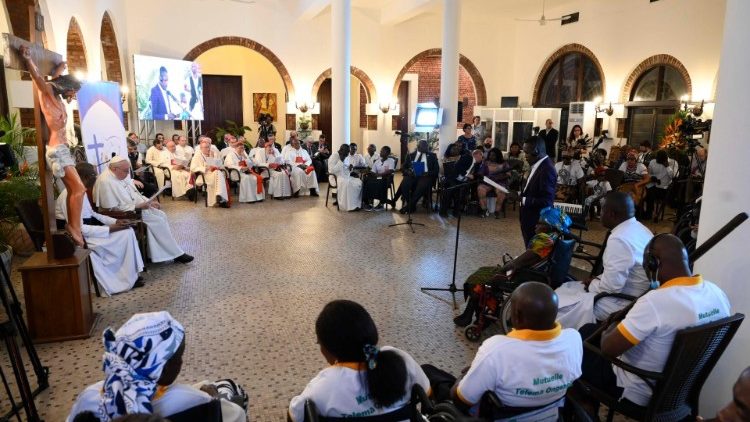
Survivors of unspeakable torture and violence in the DRC meet and share with the Pope


The Pope's meeting with survivors, victims of the violence in the eastern part of the Democratic Republic of the CongoThe Pope's meeting with survivors, victims of the violence in the eastern part of the Democratic Republic of the Congo  (VATICAN MEDIA Divisione Foto)

Survivors of violence in DRC share heartbreaking stories with Pope Francis

Pope Francis meets with survivors from the wartorn eastern part of the Democratic Republic of Congo

By Christopher Wells

Survivors of the ongoing conflict in the eastern part of the Democratic Republic of Congo shared stories of brutal violence, including mass killings and mutilation, abduction and lost relatives, serial rape and sexual slavery, and displaced people living in overcrowded and unsanitary refugee camps.

But amid the horrors of war and natural disasters, those who took part in Wednesday’s afternoon meeting with Pope Francis also spoke of forgiveness and hope, with one survivor expressing the hope of all: “We want to leave behind this dark past and be able to build a beautiful future.”

'I am close to you'

In his own remarks, the Holy Father said, “We continue to be shocked to hear of the inhumane violence that you have seen with your eyes and personally experienced.”

“We are left without words. We can only weep in silence.”

Pope Francis had originally intended to visit the eastern part of the country, but ongoing security issues made such a trip impossible. Instead, the Pope told the people of the region, “I am close to you: your tears are my tears; your pain is my pain,” adding, “To every family that grieves or is displaced by the burning of villages and other war crimes, to the survivors of sexual violence and to every injured child and adult, I say: I am with you; I want to bring you God’s caress.”

He went on to condemn, “in the name of God … the armed violence, the massacres, the rapes, the destruction and occupation of villages, the looting of fields and cattle … as well as the murderous, illegal exploitation of the wealth of this country, and the attempts to fragment the country in order to control.”

Listen to the cry of their blood!

The Pope made a heartfelt appeal to all people, and especially those that are fomenting war in the Democratic Republic of Congo: “Listen to the cry of their blood, open your ears to the voice of God … and to the voice of your conscience: put away your weapons, put an end to war!”

“Enough! Stop getting rich at the cost of the poor, stop getting rich from resources and money stained with blood!”

He then asked what we can do and where we can begin in order to promote peace. He proposed, in response, “starting again with two ways of saying ‘no’ and two ways of saying ‘yes’.”

No to violence and resignation

First, he said, we must say “no to violence, always and everywhere,” without exception. At the same time, he insisted that saying “no” to violence means more than avoiding acts of violence; it involves eliminating the roots of violence, including “greed, envy, and, above all, resentment.” Addressing the survivors present at the meeting, Pope Francis said, “I would like to ask everyone to behave as you, our courageous witnesses have suggested to us: Have the courage to disarm the heart.”

Pope Francis went on to call everyone to say “no” to resignation. “I once more invite all those living in the Democratic Congo not to give up but to commit themselves to building a better future,” he said.

“Even in the East, peace is possible! Let us believe this! And let us work for it, without delegating it to others.”

Yes to reconciliation and hope

The Holy Father then spoke about the two ways of saying “yes,” beginning with saying “yes” to reconciliation. Once more addressing the survivors, praised their desire to commit themselves “to forgiving one another and to rejecting war as a means of resolving differences.”

The prophetic voice of Christianity, he said, “means responding to evil with good, to hatred with love, to division with reconciliation.” All these things, he continued, “are more powerful than evil … because they transform reality from within, instead of destroying it from without.”

“Only in this way can we defeat evil, as Jesus did on the tree of the Cross, by taking it upon Himself and transforming it by His love.”

Finally, the Pope highlighted the “decisive ‘yes’, the yes to hope.” Hope, he said, has a source, like a wellspring: Jesus. “With Jesus, evil no longer has the last word over life,” he said, pointing again to Jesus triumphing over death and the grave.

“Brothers and sisters of the east of the country, this hope is meant for you, and you have a right to it,” he said. Yet, he continued, it is also a right that must be earned “by patiently sowing peace day after day.” To sow peace is good for us, he explained, adding “it sets us free from narrow concern for personal gain and gives us a reason for living each day; it seasons our lives with liberality and makes us more and more like God, the patient sower who sows seeds of hope.”

Sowers of peace

He then thanked and blessed those who have worked, and even given their lives to sow peace, saying, “They were sowers of hope, and their sacrifice will not be lost.

The Holy Father then concluded his address by emphasizing once again his closeness to the people of the East, and blessing all of them. “May Jesus, our May Jesus, our brother, the God of reconciliation who planted the tree of life of the Cross in the heart of the darkness of sin and suffering, the God of hope who believes in you, in your country and in your future, bless you and comfort you.”

“May He pour out his peace into your hearts, your families, and upon the entire Democratic Republic of the Congo.”

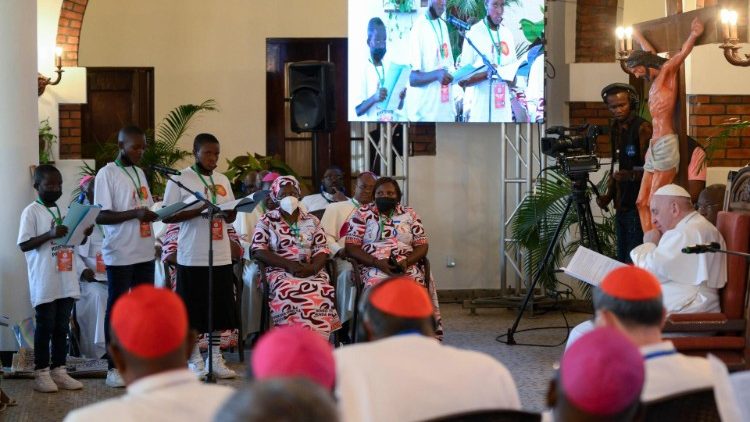
Pope Francis visits with several charities in the DRC


Pope meeting representatives of some charities in Kinshasa's Apostolic NunciaturePope meeting representatives of some charities in Kinshasa's Apostolic Nunciature  (Vatican Media)

Pope: Charities silently sowing seeds of hope in DRC and across the continent

Pope Francis concludes the second day of his Apostolic Journey to the Democratic Republic of Congo meeting representatives from some charities in Kinshasa. In his address, he thanks them for their widely ignored precious work for the most vulnerable, and says they are a “great treasure” for the country.

By Lisa Zengarini

Addressing a group of representatives of some charities in Kinshasa's Apostolic Nunciature on Wednesday, Pope Francis praised their work which, he said, is like a forest silently growing and bearing fruit, amid the “noise” of ongoing violence and injustice.

The six charities

Attending the meeting were operators and beneficiaries of six charitable organizations and institutions who described their experiences and presented their activities in the fields of healthcare, education, and human development for the poor and marginalized. These included people affected by various types of disabilities, by Hansen’s disease and other illnesses.

Among them, the DREAM Center (Disease Relief through Excellent and Advanced Means) of the Community of Sant’Egidio, the Fasta Association, an Argentinan-based humanitarian organization, whose objective is the social promotion and inclusion of marginalized people through integral formation and community participation, and “Telema Ongenge”, a local association supporting disabled people to improve their life conditions. Also present were the Trappist nuns of Our Lady of Mvanda, in Kikwit.


Embracing the poor, people with names and faces

Pope Francis commended their work, remarking that the testimonies didn’t simply list social problems or statistics on poverty, “but more importantly spoke with affection about the poor”, people “with names and faces”, whom Christians, “cannot turn their backs on”.

“While so many today dismiss the poor, you embrace them; while the world exploits them, you encourage them. Encouragement versus exploitation: Here is a forest that is growing, even as deforestation and waste runs rampant! I would like to make better known what you are doing, to promote growth and hope in the Democratic Republic of the Congo and on this entire continent. I came here out of a desire to be a voice for the voiceless.”

Poverty an offence against human beings

Noting that the media unfortunately don’t give much space to the “immense talents” and stories “of true human and Christian grandeur” in the DRC, and  Africa as a whole, Pope Francis said that by meeting them he wants to give “voice” to this reality and to the suffering of the many men and women, enduring violence, abuse, discrimination and marginalization in the country.

“Poverty and rejection are an offence against human beings, robbing them of their dignity”, the Pope reiterated. “Only by restoring dignity do we restore humanity”.

He added that he was also saddened to learn that in the DRC too, children and the elderly are discarded saying that this is scandalous as they represent the roots and future of every society.

“True human development cannot flourish where there is no memory or future.”

Goodness spreads

Pope Francis went telling those present that, despite difficulties, their arduous work is worth their while, as proven by their stories, showing that “goodness spreads” and “is not paralyzed by resignation or statistics, but impels us to give others what we ourselves freely received”.

“Young people in particular need to see this”, he stressed. “They need to see faces that overcome indifference by looking people in the eye, and hands that do not wield weapons or misuse money, but reach out to those who are down on the ground and raise them back up to their dignity, the dignity of a daughter and son of God”.

“True charity attunes us to God and He surprises us with unexpected wonders through those he loves.”

Christians must never sully the witness of charity

Pope Francis further insisted, that while the responsibility of healthcare and education and of caring for the most vulnerable, lies primarily with the State, “believers in Christ must never sully the witness of charity”, and therefore must “share what they have with those who lack the bare necessities”, remembering that “what causes poverty is not so much the absence of goods and opportunities, but their unequal distribution”.  

This, he emphasized, “is not philanthropy, but faith” for “as Scripture says, ‘faith without works is dead’.”

Pope Francis recalled that for Christian charity to become an ever more fruitful form of witness of Jesus’ love for the poor, three criteria must be followed by Catholic charities. The first is “setting an example”, by being credible and transparent in managing their finances and being competent.

Making the poor self-reliant

The second criterion is that of “having foresight”, which is not just providing for the immediate needs of the poor, but looking to the long term, promoting development projects that allow them to become self-sufficient in the future, which is what the Church in DRC and many other parts of the world is doing through its welfare services.

“Rather than distributing goods that will always be in short supply, it is better to transmit knowledge and the tools that make development autonomous and sustainable.”

Networking for the poor

Finally, the third criterion recalled by Pope Francis for Christian charity to be fruitful and effective, is that of Catholic organizations being connected, networking together and cooperating with each other, and with Christian communities, other religions, and humanitarian organizations “without remaining isolated or self-referential”.

Concluding Pope Francis blessed the Catholic charities in DRC and once again thanked them for their precious work:  “You are a great treasure”, he said. 

More than a million attend Mass with the Pope in the Democratic Republic of the Congo


Pope at Mass in DR Congo: Lay down your arms, embrace mercy

On the second day of his Apostolic Journey to the Democratic Republic of Congo, Pope Francis celebrates Mass for more than a million people at the "Ndolo" airport in Kinshasa, and urges them to lay down their arms, embrace mercy, and be missionaries of peace.

By Deborah Castellano Lubov

Lay down your arms, embrace mercy, and be missionaries of peace.

Pope Francis gave this encouragement in his homily at Mass for the nation's faithful in the capital of Kinshasa on Wednesday, the second day of his Apostolic Visit to the Democratic Republic of Congo.

Addressing the more than one million people gathered at the "Ndolo" airport, the Holy Father's homily began by expressing his joy to finally be in the DRC and among the Congolese people.

"Esengo, joy: to see and encounter you is a great joy," he said. "I have very much looked forward to this moment. Thank you for being here!"

The Holy Father recalled the Gospel reading which told of the four simple words Jesus offered to His disciples, on the evening of Easter, "Peace be with you!" These words, the Pope stressed, were "a gift" that enabled them to leave the past behind and start over.

The Pope invited those present to put themselves in the disciples' place. 

"That day they were completely mortified by the scandal of the Cross, interiorly wounded from having fled and abandoned Jesus, dismayed by the way His life had ended and fearful that their lives would end in the same way," he said. "They were feeling guilty, frustrated, sorrowful and afraid…  However, Jesus comes and proclaims peace, even as His disciples’ hearts were downcast."

Jesus, the Pope said, announces life, even as His disciples felt surrounded by death. 

God lifts us up from 'rock bottom'

The peace of Jesus, he stated, arrived at the very moment when, suddenly, and to their surprise, "everything seemed to be over for them, without even a glimmer of peace." 

“That is what the Lord does: He surprises us. He takes us by the hand when we are falling. He lifts us up when we are hitting rock bottom.”

With Jesus, the Pope insisted, "evil never wins, evil never has the last word." Those who belong to Jesus, he continued, "must never yield to sorrow," nor "permit resignation and fatalism to take hold" of them. 

"Even though that atmosphere reigns all around us," he said, "it must not be so for us."  

"In a world disheartened by violence and war, Christians must be like Jesus," he added. "As if to insist on the point, Jesus told the disciples once more: Peace be with you!"

The Pope said we are called to make our own "this inspired and prophetic message of peace" and proclaim it before the world.

Forgiveness, community, mission

The Holy Father then encouraged the faithful of DR Congo to ask themselves how to safeguard and cultivate Jesus' peace, before highlighting three "wellsprings of peace:" forgiveness, community and mission.

Looking at forgiveness, the Pope recalled how Jesus, faced with the sadness and shame of those who had denied him and fled, He shows His wounds and opens up the wellspring of mercy. 

He does not "multiply words," but opens wide his wounded heart, the Pope said.

"Brothers, sisters, when guilt and sadness overwhelm us, when things do not go well," the Pope reflected, "we know where to look: to the wounds of Jesus, who is ever ready to forgive us with His infinite, wounded love."

A great 'amnesty of the heart'

Jesus, the Pope told the country's faithful, "knows the wounds of your country, your people, your land!"  

"They are wounds that ache, continually infected by hatred and violence, while the medicine of justice and the balm of hope never seem to arrive. My brother, my sister, Jesus suffers with you.  He sees the wounds you carry within, and he desires to console and heal you," he said.

Together, the Pope added, "we believe that Jesus always gives us the possibility of being forgiven and starting over, but also the strength to forgive ourselves, others and history!" 

"That is what Christ wants," he said.

“"He wants to anoint us with His forgiveness, to give us peace and the courage to forgive others in turn, the courage to grant others a great amnesty of the heart. What great good it does us to cleanse our hearts of anger and remorse, of every trace of resentment and hostility!"”

The Pope prayed that today may "be a time of grace for you to accept and experience Jesus’ forgiveness!" 

'Lay down your arms, embrace mercy'

The Pope expressed his wish that those bearing heavy burdens in their heart, to be freed.

"And may it be a good time for all of you in this country who call yourselves Christians but engage in violence," he said. "The Lord is telling you: 'Lay down your arms, embrace mercy.'"  

The Pope then addressed all the DRC's wounded and oppressed people, saying that the Lord is urging them to bury their wounds in His.

"Do not be afraid to take the crucifix from your neck and out of your pockets, to take it between your hands and hold it close to your heart, in order to share your wounds with the wounds of Jesus.  Then, when you return home, take the crucifix from the wall and embrace it," he said.

"Give Christ the chance to heal your heart, hand your past over to him, along with all your fears and troubles," the Pope said. 

The Lord shows us the way

Pope Francis then turned to the second source of peace: community

"The Risen Jesus does not speak just to one of his disciples; he appears to them as a group," he said. "Upon this, the first Christian community, he bestows his peace. There is no Christianity without community, just as there is no peace without fraternity."

The Pope warned against our tendency, in society, "and even in the Church," to seek power, a career, our own ambitions.

"We go our own way instead of God’s, and we end up like the disciples: behind locked doors, without hope, and filled with fear and disappointment," he said. "In spite of this, thanks to the Holy Spirit, we can get past this individualistic tendency which divides us, and find unity."

While it is easy, he said, to be tempted by worldliness, which corrodes the sense of community, "the Lord shows us the way," he said. 

'Consciences of peace in our world'

The third source of peace, the Pope offered, was 'mission.'

"We are called to be missionaries of peace," the Pope said, saying this will bring us peace.

"We need to find room in our hearts for everyone; to believe that ethnic, regional, social and religious differences are secondary and not obstacles; that others are our brothers and sisters, members of the same human community; and that the peace brought into the world by Jesus is meant for everyone."  

“We need to believe that we Christians are called to cooperate with everyone, to break the cycle of violence, to dismantle the machinations of hatred. Yes, Christians, sent by Christ, are called by definition to be a conscience of peace in our world.”

The Pope said this cooperation requires not merely critical consciences, "but primarily witnesses of love." 

"'Peace be with you' Jesus says today to every family, community, ethnic group, neighbourhood and city in this great country."  

 Pope Francis concluded his homily at Mass in DR Congo by praying that our Lord's words resound in the silence of our hearts. 

"Let us hear them addressed to us and let us choose to be witnesses of forgiveness, builders of community, people charged with a mission of peace in our world," he said.

Let's meet the new Bishop for Houma-Thibodaux


Auxiliary Bishops

Bishop Mario E. Dorsonville

Mario E. Dorsonville was born October 31, 1960 in Bogotá, Colombia, the only child of Leonor M. Rodríguez and Carlos J. Dorsonville. He attended the Major Seminary of the Archdiocese of Bogotá, receiving a Bachelor’s degree in Philosophy in 1981 and a Bachelor’s degree in Sacred Theology in 1985. He was ordained to the priesthood on November 23, 1985 in Bogotá. Following ordination, he served as Parochial Vicar of Immaculate Heart of Mary parish, Bogotá (1986), Pastor of San Jose de Calasanz parish, Bogotá (1987-1991), Associate Chaplain (1988-1991) and Professor of Business Ethics (1990-1991) at the National University of Colombia, Bogotá.

Bishop Dorsonville received a Licentiate in Sacred Theology from the Pontificia Universidad Javeriana de Bogotá in 1991 and a Doctorate in Ministry from The Catholic University of America in 1996. From 1992-1994, while studying at Catholic University, he assisted the Hispanic community on weekends at Good Shepherd and Christ the Redeemer parishes in Arlington, Virginia, and served as a lecturer at the Inter-American Development Bank Headquarters in Washington, D.C. He served as Professor of Theology and Catechesis at the Institute for Hispanic Pastoral Studies of Arlington from 1993-1994. He returned briefly to Colombia to serve as Chaplain and Professor of Business Ethics to the National University of Colombia and Professor of Pastoral Counseling and Catechesis at the Major Seminary of the Archdiocese of Bogotá from 1995-1996.

His first appointment within the Archdiocese of Washington was as Parochial Vicar of Our Lady of Lourdes parish in Bethesda, Maryland (1997-2004). He also served as Parochial Vicar of St. Mark the Evangelist parish in Hyattsville, Maryland (2004-2005) and he was a member of the Board of Directors for Carroll Publishing Company from 2001-2004.

Bishop Dorsonville served as Vice President of Catholic Charities of the Archdiocese of Washington and Director of The Spanish Catholic Center from 2005 to 2015. He completed an Executive Certificate in Non-Profit Management at Georgetown University in 2009. He was also an Adjunct Spiritual Director of St. John Paul II Seminary in Washington, D.C., as well as a mentor for newly ordained priests (2011-2015).

He was named an Auxiliary Bishop for the Archdiocese of Washington by Pope Francis on March 20, 2015 and ordained to the episcopate on April 20, 2015. He has served as Vicar General for the Archdiocese of Washington since 2015. He is currently a member of the Board of Directors of the Maryland Catholic Conference and was a member of the Board of Directors of Catholic Charities (2015 to 2021). He has been a member of the Council of Priests for the Archdiocese of Washington since 2006, and a member of its College of Consultors since 2011. Bishop Dorsonville was the chairman for the Migration and Refugee Services Committee for the United States Conference of Catholic Bishops (2019-2022). Currently, he serves as a member of their Committee on Domestic Justice and Human Development, Committee on Migration, Committee for Religious Liberty, and the Ad Hoc Committee Against Racism.

A new Bishop for Houma-Thibodaux Diocese in south Louisiana


Pope Francis Appoints Bishop Mario Dorsonville as Bishop of Houma-Thibodaux

Pope Francis has appointed Most Reverend Mario E. Dorsonville, auxiliary bishop of the Archdiocese of Washington, as Bishop of Houma-Thibodaux.

WASHINGTON - Pope Francis has appointed Most Reverend Mario E. Dorsonville, auxiliary bishop of the Archdiocese of Washington, as Bishop of Houma-Thibodaux. The appointment was publicized in Washington, D.C. on February 1, 2023, by Archbishop Christophe Pierre, apostolic nuncio to the United States.

The biography for Bishop Dorsonville may be found here.

The Diocese of Houma-Thibodaux is comprised of 3,500 square miles in the State of Louisiana and has a total population of 257,423 of which 81,512 are Catholic.