Monday, October 31, 2022

Pope Francis prayer intention for November


Pope’s November prayer intention: 'For children who suffer'

Pope Francis releases his prayer intention for November, inviting everyone to pray for the millions of children who are suffering around the world, especially for those who are homeless, orphans, and victims of war.

By Vatican News staff writer

“An abandoned child is our fault,” says Pope Francis in the video prepared by the Pope’s Worldwide Prayer Network announcing his prayer intention for November.

In the video, Pope Francis calls on Catholics to pray for children who are suffering due to rejection, indigence, poverty, and conflict around the world.

“There are still millions of boys and girls who suffer and live in conditions very similar to slavery,” the Pope said, emphasizing that these children are not “numbers” but “human beings with names and an identity that God has given them.”

Every marginalized child living without schooling, without a family, without health care, the Pope continued, is “a cry;” a cry “that rises up to God and shames the system that we adults have built.”

Every child has the right to access basic needs

The Pope continued by saying every child should have the right to access basic services and be able to feel the warmth and love of a family: “We can no longer allow them to feel alone and abandoned — they are entitled to an education and to feel the love of a family so they know that God does not forget them.”

One billion children living in poverty

According to UNICEF, one billion children currently live in “multidimensional poverty” — that is without basic access to education, health care, shelter, food, sanitation, or water; the agency also estimates that 153 million children are orphans.

Fr. Frédéric Fornos, S.J., International Director of the Pope’s Worldwide Prayer Network, provided his thoughts on the November prayer intention, saying that this month, Pope Francis “opens our eyes, ears, and hearts to millions of forgotten children who suffer in silence on the streets and in hidden labour, victims of violence and war, migrants and refugees. In the face of indifference and impotence, we must pray.”

It is our responsibility, the Pope concluded in the video, that no child feels left alone or abandoned — “they are entitled to an education and to feel the love of a family so they know that God does not forget them.”

Sunday, October 30, 2022

Saint of Day for the last day of October


St. Wolfgang


Wolfgang (d. 994) + Bishop and reformer. Born in Swabia, Germany, he studied at Reichenau under the Benedictines and at Wurzburg before serving as a teacher in the cathedral school of Trier. He soon entered the Benedictines at Einsiedeln (964) and was appointed head of the monastery school, receiving ordination in 971. He then set out with a group of monks to preach among the Magyars of Hungary, but the following year (972) was named bishop of Regensburg by Emperor Otto II (r. 973-983). As bishop, he distinguished himself brilliantly for his reforming zeal and his skills as a statesman. He brought the clergy of the diocese into his reforms, restored monasteries, promoted education, preached enthusiastically, and was renowned for his charity and aid to the poor, receiving the title Eleemosynarius Major (Grand Almoner). He also served as tutor to Emperor Henry II (r. 1014-1024) while he was still king. Wolfgang died at Puppingen near Linz, Austria. He was canonized in 1052 by Pope St. Leo IX (r. 1049-1054). Feast day: October 31.

Exploring All Hallow's Eve, All Saints Day and All Souls Day


History of All Hallows' Eve

The Solemnity of All Saints (Overview - Calendar) is celebrated on November 1. It is a solemnity, a holyday of obligation and the day that the Church honors all of God's saints, even those who have not been canonized by the Church. It is a family day of celebration—we celebrate the memory of those family members (sharing with us in the Mystical Body, the doctrine of the Communion of Saints) now sharing eternal happiness in the presence of God. We rejoice that they have reached their eternal goal and ask their prayers on our behalf so that we, too, may join them in heaven and praise God through all eternity.

The honoring of all Christian martyrs of the Faith was originally celebrated on May 13, the date established by the fourth century. Pope Boniface IV in 615 established it as the "Feast of All Martyrs" commemorating the dedication of the Pantheon, an ancient Roman temple, into a Christian church dedicated to the Blessed Virgin Mary and all the martyrs. By 741, the feast included not only martyrs, but all the saints in heaven as well, with the title changing to "Feast of All Saints" by 840.

In 844, Pope Gregory IV transferred the feast to November 1st, timing it around the harvests to be able to provide food for the pilgrims. Some scholars believe this was to substitute a feast for the pagan celebrations during that time of year. Pope Sixtus IV in 1484 established November 1 as a holyday of obligation and gave it both a vigil (known today as "All Hallows' Eve" or "Hallowe'en") and an eight-day period or octave to celebrate the feast.

This feast is marked with liturgical observances that have changed over the centuries. By 1955, the octave and vigil of All Saints were abrogated. Instead of a separate vigil on the calendar, the celebration begins the evening before, as mentioned in The General Norms for the Liturgical Year and the Calendar:

Solemnities are counted as the principal days in the calendar and their observance begins with evening prayer of the preceding day. Some also have their own vigil Mass for use when Mass is celebrated in the evening of the preceding day.

In the Divine Office, or Liturgy of the Hours, solemnities and Sundays are begin with Evening Prayer I (the evening before) and Evening Prayer II (the evening of the solemnity).

Feastday Customs
In England, saints or holy people are called "hallowed", hence the name "All Hallows’ Day". The evening, or "e'en" before the feast became popularly known as "All Hallows' Eve" or even shorter, "Hallowe'en".

Many recipes and traditions have come down for this evening, "All Hallows’ Eve" (now known as Halloween), such as pancakes, boxty bread and boxty pancakes, barmbrack (Irish fruit bread with hidden charms), colcannon (combination of cabbage and boiled potatoes). This was also known as "Nutcrack Night" in England, where the family gathered around the hearth to enjoy cider and nuts and apples. In England "soul cakes" are another traditional food. People would go begging for a "soul cake" and promise to pray for the donor's departed friends and family in exchange for the treat, an early version of today's "Trick or Treat."

The Church designates November 2 as the Feast of All Souls, a day to pray for all the departed souls in Purgatory. The feasts of All Saints and All Souls fall back-to-back to express the Christian belief of the "Communion of Saints." The Communion of Saints is the union of all the faithful on earth (the Church Militant), the saints in Heaven (the Church Triumphant) and the Poor Souls in Purgatory (the Church Suffering), with Christ as the Head. They are bound together by a supernatural bond. The Church Militant (those on earth still engaged in the struggle to save their souls) can venerate the Church Triumphant, and the saints can intercede with God for those still on earth. Both the faithful on earth and the saints in heaven can pray for the souls in Purgatory. During these two days we see the Communion of Saints really in action!

On All Souls Day and November 1-8 one can gain plenary indulgences for the Poor Souls. See Praying for the Dead and Gaining Indulgences for more details.

Exploring the Christian Roots of Halloween
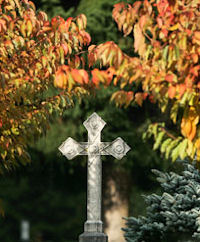
We have entered the 21st century. It is getting harder to be "in" the world but not "of" the world. How are we to tread carefully to find balance in a secular holiday? We have an onslaught of Halloween witches, ghosts, goblins, vampires, etc. everywhere we turn. How do we bring a message to our children to say that being a Christian does not mean that we cannot have fun and enjoy some secular practices? How do we convey that that we must not constantly be negative and condemn everything?

To answer this, we must to put on the mind of the Church. All through the centuries the Church has taken secular feasts and tried to "sanctify" or "Christianize" them. This is one of the reasons that December 25 was chosen for Christmas—that was the time of the winter solstice or Saturnalia festival, with many pagan traditions during their celebration. The feast day of All Saints itself came from the dedication of the Pantheon, a pagan temple, into a Christian church, undoubtedly another way of sanctifying the secular and pagan. Missionaries familiarize themselves with the culture and religion of the country before they can convert the native people. The missionaries have to be able find some elements in their culture that can help these people identify and understand Christianity at their level. St. Paul tried it with the Greeks. Seeing their altar to the Unknown God, he saw that through their own pagan altar he might bring them to Christianity.

It is beautiful to remember that we can recognize and enjoy simple earthly pleasures as gifts from God. Many of the practices of Halloween are innocent fun and some deal with healthy reminders of death, sin and the devil. Some parts of Halloween can be extreme. Since the All Saints and All Souls feasts are back-to-back, we can balance some of the focus of Halloween to the Communion of Saints in action. We combine honoring the saints in heaven, remembering our loved ones and then earn graces for our own souls by prayer and actions. Through this approach we see the Mystical Body in action.

There are many writings to help one explore the Christian roots of the Halloween festivities. In the activities section there are ideas for an All Hallows' Eve Party to present a fun atmosphere for children. See also other ideas from Florence Berger's Cooking for Christ and Mary Reed Newland's The Year and Our Children. These ideas help use every opportunity as a moment of grace, and a teaching lesson, not a spirit of avoidance of Halloween. One can use the opportunity to honor the saints, pray for the Poor Souls and prepare oneself spiritually for two great feastdays of the Catholic Church, All Saints' Day and All Souls' Day.

By Jennifer Gregory Miller, ©2003.

Pope prays for end to terrorism in Somalia


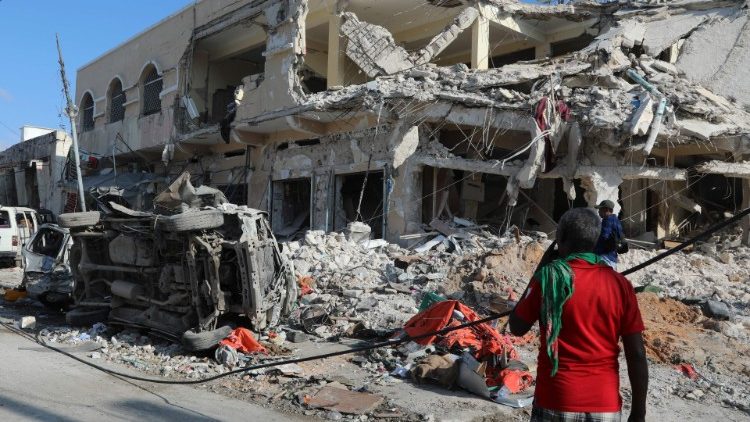
A local resident looks at the damage from Saturday's terrorist attack in MogadishuA local resident looks at the damage from Saturday's terrorist attack in Mogadishu  (AFP or licensors)

Pope Francis prays for victims of Somalia terrorist attack

As twin car bomb explosions kill over 100 people in Somalia’s capital of Mogadishu, Pope Francis prays that God may convert the hearts of the violent.

By Nathan Morley & Devin Watkins

Twin car bomb explosions on Saturday outside Somalia's Education Ministry building in Mogadishu killed at least 100 people and injured more than 300 others.

On Sunday, Pope Francis prayed for the victims of the terrorist attack while speaking at the Angelus prayer.

“As we celebrate Christ's victory over evil and death, we pray for the victims of the terrorist attack in Mogadishu which killed more than 100 people, including many children. May God convert the hearts of the violent!”

Death toll likely to rise

The al-Qaida-linked al-Shabab extremist group claimed responsibility for this latest outrage, which killed women, children, and several pensioners.

After visiting the scene of the atrocity, the Somali President Hassan Sheikh Mohamud said the number of fatalities would likely rise in the coming days.

President Mohamud declared an all-out war against the militants, and vowed to step up the offensive against terrorists behind a series of attacks across the country.

Giving details of the attack, police said a vehicle loaded with explosives drove into the education ministry building. Another explosion occurred later in the same area.

Journalists and police officers were also among the casualties, according to a spokesperson of the Somali Police Force.

Ongoing anti-terror offensive

Saturday’s explosions came as the Somali president and leaders of the federal member states were meeting to examine ongoing offensive actions against al-Shabab.

The incident occurred at the exact location where a lorry packed with explosives exploded in October 2017, killing 587 people, mostly civilians.

Meanwhile, the United Nations mission in Somalia, UNSOM, pledged to stand resolutely with all Somalis against terrorism.

Pope Francis prays for victims in South Korea tragedy


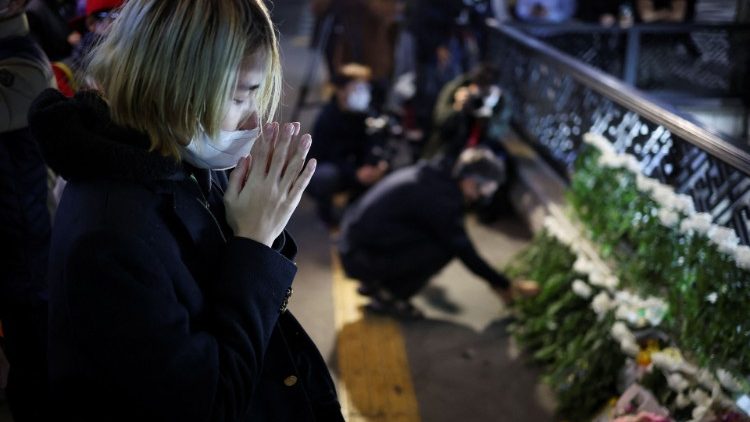
Mourners pay tribute near the scene of a stampede in SeoulMourners pay tribute near the scene of a stampede in Seoul 

South Korea: Pope prays for people killed in crush at Halloween event

Pope Francis expresses his sorrow for the over 150 people killed at a Halloween street party in Seoul, South Korea’s capital, as the country’s Catholic Bishops call for a thorough investigation into the causes.

By Alastair Wanklyn & Devin Watkins

At least 153 people are dead and another 82 are injured after being crushed and trampled at a Halloween street party in Seoul, most of whom were young people who suffocated to death.

Speaking on Sunday at the Angelus prayer, Pope Francis turned his thoughts to the tragedy in the South Korean capital.

“Let us pray to the Risen Lord for all those—mostly young people—who died last night in Seoul from the tragic consequences of a sudden crowd stampede.”

‘Preventable’ tragedy

Video posted to social media from Saturday night’s tragedy showed people crying out from within a crowd.

A few people were seen grasping at walls, trying to lift themselves out of the crush. When some people fell, others walked over them.

The disaster was not apparent at first. Loud music continued playing as bodies lay on the road. It happened in the nightclub district of Itaewon in Seoul. The victims were mostly young people.

The head of the local fire department said the victims had been attending a Halloween gathering.

It is unclear why the crush occurred, but eyewitnesses said there was little or no crowd control. Revellers kept arriving and pushing into streets that were already full.

South Korea’s President Yoon Suk Yeol called it a “tragedy that should not have happened.” He said South Koreans will mark a week of mourning.

Bishops’ call for investigation

In a written statement, the Catholic Bishops Conference of Korea said South Koreans must “break the cycle of injustice and irresponsibility that has become a common practice in this society.”

“To do that, we must first be faithful to our respective roles,” the Bishops said. “Authorities must thoroughly examine the cause and process of this tragedy, and ensure that irresponsibility and oblivion are not repeated.”

The bishops added that it is important to ensure there are “no further sacrifices” from people, especially young people.

“Human life and dignity are the most precious values, and nothing in our society can take precedence over it.”

The death toll is the worst in South Korea since the sinking of an overloaded ferry eight years ago.

In that disaster, 304 people died, many of them school children. But it led to a tightening of maritime transport regulations.

Sunday Papal angelus Address 10.30.2022


Pope at Angelus: ‘Jesus looks at us to restore our dignity’

Pope Francis reflects on the story of Jesus encountering Zacchaeus the tax collector, and says the Lord always gazes upon broken humanity with a desire to restore our dignity.

By Devin Watkins

Pope Francis prayed the Angelus on Sunday with pilgrims gathered in St. Peter’s Square, and reflected on the day’s Gospel (Lk 19:1-10), which recounts the story of Jesus inviting Himself to stay with Zacchaeus.

The Pope focused his comments on the “gaze” shared by Zacchaeus and Jesus, as the chief tax collector looked down on Jesus from a tree.

Zacchaeus, who was the chief tax collector in the city of Jericho, was seeking to see “who Jesus was”, but was short in stature and so had to climb a tree to see over the crowd.

Always a chance to start over

Pope Francis noted that Zacchaeus, as a tax collector for the Roman occupiers of Israel, surely took advantage of his position to extort money from others. Therefore, he was hated by everyone and branded a sinner.

Despite his short stature and public persona, Zacchaeus greatly desired to see Jesus, even though he does not yet know Him.

“Zacchaeus teaches us that, in life, all is never lost. We can always find space for the desire to begin again, to start over, to convert.”

God humbles Himself to lift us up

The Pope then turned his thoughts to the gaze of Jesus, who was sent by the Father to seek those who are lost.

The Gospel of Luke says Jesus looked up and said to him, “Zacchaeus, come down quickly, for today I must stay at your house.”

Pope Francis said these words present a beautiful image of Jesus “looking up” at Zacchaeus from below.

“This is the history of salvation: God has never looked down on us to humiliate and judge us. On the contrary, He lowered Himself to the point of washing our feet, looking at us from below and restoring our dignity to us.”

This episode, added the Pope, sums up all of salvation history. “Humanity, with its miseries, seeks redemption, but firstly, God, with mercy, seeks His creature to save it,” he said.

Compassionate gaze of the Church

Turning his attention what this Gospel means for us, Pope Francis pointed out that God never dwells on our past with all its errors, but rather looks “with infinite confidence at what we can become.”

Even when we are unable to confront the challenges of life, he added, Jesus always “looks on us with love” and invites Himself into our home, if we are willing to welcome Him.

We too, concluded the Pope, are called to consider both how we look upon ourselves and how we gaze upon others who struggle to arise from “the dust of their mistakes”.

“We Christians must have the gaze of Christ, who embraces from below, who seeks those who are lost, with compassion. This is, and must always be, the gaze of the Church.”

Saturday, October 29, 2022

Sunday Saint of the Day


St. Alphonsus Rodriguez


Confessor and Jay brother, also called Alonso. He was born in Segovia, Spain, on July 25, 1532, the son of a wealthy merchant, and was prepared for First Communion by Blessed Peter Favre, a friend of Alphonsus' father. While studying with the Jesuits at Alcala, Alphonsus had to return home when his father died. In Segovia he took over the family business, was married, and had a son. That son died, as did two other children and then his wife. Alphonsus sold his business and applied to the Jesuits. His lack of education and his poor health, undermined by his austerities, made him less than desirable as a candidate for the religious life, but he was accepted as a lay brother by the Jesuits on January 31, 1571. He underwent novitiate training and was sent to Montesion College on the island of Majorca. There he labored as a hall porter for twenty-four years. Overlooked by some of the Jesuits in the house, Alphonsus exerted a wondrous influence on many. Not only the young students, such as St. Peter Claver, but local civic tad and social leaders came to his porter's lodge for advice tad and direction. Obedience and penance were the hallmarks of his life, as well as his devotion to the Immaculate Conception. He experienced many spiritual consolations, and he wrote religious treatises, very simple in style but sound in doctrine. Alphonsus died after a long illness on October 31, 1617, and his funeral was attended by Church and government leaders. He was declared Venerable in 1626, and was named a patron of Majorca in 1633. Alphonsus was beatified in 1825 and canonized in September 1888 with St. Peter Claver.

USCCB announces Itinerary for mid-November Assembly


US Catholic Bishops Announce Plenary Assembly Date and Itinerary for Election of New President and Committee Chairs - USCCB FULL TEXT


Conference of Catholic Bishops (USCCB) will gather for the 2022 Fall Plenary Assembly in Baltimore, November 14-17.

The assembly will begin with an address by the Papal Nuncio to the United States, Archbishop Christophe Pierre. The bishops will hear from Archbishop José H. Gomez of Los Angeles, as he gives his final address as USCCB president upon completion of his three-year term. Prior to the general sessions, the bishops will spend time in prayer and fraternal dialogue with one another.

The bishops are anticipating a full agenda with plenary sessions including a number of items such as: the Synod of Bishops; the ongoing war in Ukraine; the bishops’ Eucharistic revival initiative and national congress; supporting women and families since the Supreme Court’s Dobbs decision this summer; an update from the migration committee chairman; a discussion of a new catechumenate model of marriage preparation; World Youth Day 2023; the review and approval of five translations for liturgical rituals; the Journeying Together intercultural dialogue and encounter process; a consultation of the bishops on causes of beatification and canonization; and a vote on the USCCB’s 2023 budget. The bishops are expected to decide their approach to Forming Consciences for Faithful Citizenship and related materials, to be executed over the following year. The agenda is expected to include presentations from Catholic Relief Services, Catholic Charities USA, and Catholic Legal Immigration Network (CLINIC). In acknowledgment of twenty years since the drafting and passage of the Charter for the Protection of Children and Young People, the bishops will also take time during the plenary for prayer and reflection.

During the assembly, the bishops will vote for the new Conference president and vice-president, as well as chairmen-elect of six Conference committees. The terms for the bishops elected for Conference president and vice president will begin at the conclusion of this November meeting, and the bishops elected for committee chairmen will serve for one year as chairman-elect before beginning a three-year term at the conclusion of the 2023 Fall Plenary Assembly.

Public sessions of the assembly will be held on November 15 and 16 will be livestreamed at: www.usccb.org/meetings. News updates, vote totals, texts of addresses and presentations, and other materials will be posted to this page. Those wishing to follow the meeting on social media can use the hashtag #USCCB22 and follow on Twitter (@USCCB) as well as on Facebook (www.facebook.com/usccb) and Instagram (https://instagram.com/usccb).