Tuesday, January 4, 2022

Papal message for World Day of the sick


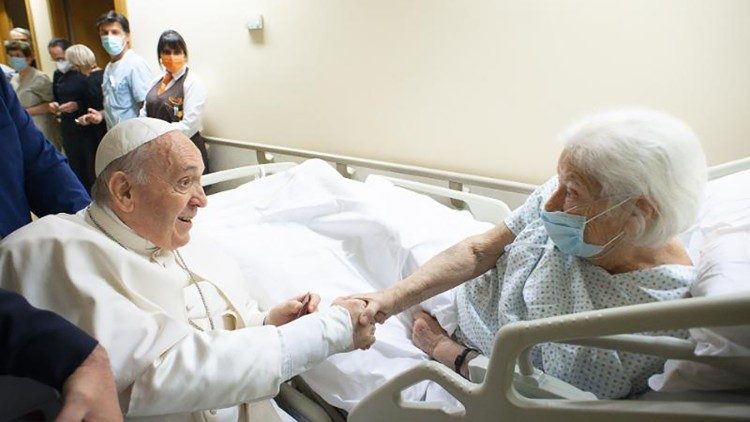
Pope Francis visits an ailing woman during his stay at Gemelli hospitalPope Francis visits an ailing woman during his stay at Gemelli hospital 

Pope’s World Day of Sick message: Nearness, charity for those who suffer

Pope Francis releases his message for the 30th World Day of the Sick, and urges Catholics and Church-run institutions to continue efforts to heal and soothe the wounds of those suffering illness.

By Devin Watkins

Be merciful, even as your Father is merciful” (Lk 6:36): Standing beside those who suffer on a path of charity.”

Those words formed the theme of Pope Francis’ message for the World Day of the Sick—scheduled for 11 February—which was released on Tuesday.

The Pope noted that this year’s occurrence marks 30 years since Pope St. John Paul II instituted the World Day to encourage all members of the Church to “be increasingly attentive to the sick and to those who care for them.”

He also expressed his gratitude for the great advances in healthcare and pastoral care of the sick in the intervening three decades, while recalling that many people still live in areas that are poorly served by healthcare systems and pastoral outreach.


He noted that the annual celebration of the World Day of the Sick is taking place in St. Peter’s Basilica, rather than in Arequipa, Peru, as originally planned, due to the ongoing health crisis.

Pope Francis’ message comes a few short months after his own brief hospital stay at Rome’s Gemelli Hospital following a scheduled surgery on his colon.

‘Merciful like the Father’

In his message, Pope Francis reflected on various aspects of “mercy,” starting with the mercy of the Father.

He said God’s mercy is part of His very nature and combines “strength and tenderness.”

“God cares for us with the strength of a father and the tenderness of a mother. He unceasingly desires to give us new life in the Holy Spirit.”

‘Jesus, the mercy of the Father’

The Pope said that Jesus offers the best witness to the Father’s merciful love for the sick.

In His earthly life, Jesus healed all manner of disease and illness, and made it an important part of His missionary mandate to the apostles, who were sent to “proclaim the Gospel and to heal the sick.”

Pope Francis drew on a consideration by French philosopher Emmanuel Levinas to explore why ministering to the sick is such an important part of the Christian mission.

“Pain isolates in an absolute way,” said Mr. Levinas, “and absolute isolation gives rise to the need to appeal to the other, to call out to the other.”

The Pope said acute experiences of our human frailty urge us to seek out those near to us, and it is the Church’s job to respond with concrete signs of God’s charity.

“When individuals experience frailty and suffering in their own flesh as a result of illness, their hearts become heavy, fear spreads, uncertainties multiply, and questions about the meaning of what is happening in their lives become all the more urgent.”

‘To touch the suffering flesh of Christ’

Pope Francis went on to consider the many healthcare workers who daily minister to “the suffering flesh of Christ.”

He thanked all healthcare professionals and volunteers for dedicating their lives to helping those who suffer.

“Dear healthcare workers, your service alongside the sick, carried out with love and competence, transcends the bounds of your profession and becomes a mission. Your hands, which touch the suffering flesh of Christ, can be a sign of the merciful hands of the Father. Be mindful of the great dignity of your profession, as well as the responsibility that it entails.”

At the same time, the Pope praised the technological and therapeutic advances made in the field of medicine.

Yet no advancement, he added, can allow us to “forget the uniqueness of each patient, his or her dignity and frailties.” Patients, he said, “are always more important than their diseases.”

‘Centres of care as “houses of mercy”’

The Pope said the World Day of the Sick allows the Church to take stock of her long-running dedication to providing healthcare to the poor and marginalized by opening hospitals and clinics in poverty-stricken areas.

He reaffirmed the work of Catholic healthcare institutions, calling them “a precious treasure to be protected and preserved” since they offer “the gift of charity”.

“At a time in which the culture of waste is widespread and life is not always acknowledged as worthy of being welcomed and lived, these structures, like ‘houses of mercy’, can be exemplary in protecting and caring for all life, even the most fragile, from its beginning until its natural end.”

‘Pastoral mercy: presence and proximity’

Pope Francis then expressed his appreciation for those who carry out pastoral care among the sick.

Those who act on Christ’s invitation include professionals like hospital chaplains, as well as ordinary Catholics who take the time to visit their ailing neighbors.

“If the worst discrimination suffered by the poor – including the sick, who are poor in health – is the lack of spiritual attention, we cannot fail to offer them God’s closeness, His blessing, and His word, as well as the celebration of the sacraments and the opportunity for a journey of growth and maturation in faith.”

United to Christ in our suffering

The Pope wrapped up his message for the 30th World Day of the Sick by entrusting all the sick and their families to the intercession of Mary, Health of the infirm.

“United with Christ, who bears the pain of the world, may they find meaning, consolation and trust,” he concluded. “I pray for healthcare workers everywhere, that, rich in mercy, they may offer patients, together with suitable care, their fraternal closeness.”

Pope Francis explains his January prayer intention for those who suffer religious persecution


Pope’s January prayer intention: For those who suffer religious persecution

Pope Francis dedicates his first prayer message of 2022 to combatting religious discrimination and persecution, reminding us that religious freedom is not limited to freedom of worship, but is tied to fraternity.

By Vatican News staff reporter

“How can we allow that in this society, which is so civilized, there are people who are persecuted simply because they publicly profess their faith?” asks Pope Francis in the video for his monthly prayer intention for January 2022.

“How is it possible that many religious minorities currently suffer discrimination or persecution?”

The January prayer intention marks the beginning of the seventh year of the Pope Video, a ministry of the Pope’s Worldwide Prayer Network.

In his message released on Tuesday, the Holy Father says that persecuting people simply because they publicly profess their faith is “inhuman” and “insane.”

A worldwide phenomenon

Catholic charity Aid to the Church in Need, which is supporting this month’s message, notes in its annual “Religious Freedom in the World” report that worldwide, religious freedom is violated in one out of every three countries, comprising around two-thirds of the total world population.

More than 646 million Christians, ACN reports, live in countries that do not respect religious freedom.

Recognising others as brothers and sisters

Pope Francis emphasizes that “religious freedom is not limited to freedom of worship,” but “makes us appreciate others in their differences and recognise them as true brothers and sisters.”

Even substantial differences, such as religious differences, should “not obscure the great unity of being brothers and sisters.”

“Let us choose the path of fraternity. Because either we are brothers and sisters, or we all lose.”

During this first month of 2022, Pope Francis invites us to pray “that those who suffer discrimination and suffer religious persecution, may find in the societies in which they live the rights and dignity that comes from being brothers and sisters.”

Monday, January 3, 2022

Stories of Catholic heroism from 2021


10 heroic Catholic stories from 2021


The Catholic Church has many heroic individuals, and CNA was fortunate to cover some of their stories this past year. We invite you to read about 10 heroic people and projects we covered in 2021—from doctors and healthcare workers fighting the COVID-19 pandemic, to underground bishops, religious, and refugees living in war-torn countries.

Afghan Christian’s plea to CNA: ‘You are my last hope’

Kareem* first contacted CNA on Aug. 24, amid the exodus of U.S. troops from Afghanistan. By that time, he had bid a painful goodbye to his family and joined throngs of other Afghan civilians at the gates to Hamid Karzai International Airport in Kabul, the Afghan capital. The Taliban had killed his father and brother because both men, who were Muslim, had worked with allied forces during the war. In the frenzy leading up to the Biden administration’s Aug. 31 exit deadline, Afghan civilians—like Kareem—and their advocates turned to aid groups, well-connected insiders, and anyone else they could think of asking for help, before it was too late.

*Kareem is a pseudonym used to protect his safety.

Myanmar Catholic nun says Eucharistic adoration gave her strength to kneel before police

On March 8, Sr. Ann Rose Nu Tawng captured the world’s attention when she knelt before police in the city of Myitkyina, urging them not to use violence against protesters after Burma’s military coup. The religious sister said that the Holy Spirit prompted her to kneel between the police and protesters and that she drew her strength from prayer before the Blessed Sacrament.  Myitkyina, the capital of Kachin State, has experienced some of the worst violence as security forces continue to crack down on protesters of the Feb. 1 military coup.


Eric Talley funeral: Catholic father of seven ‘died a hero’ 

Police officer Eric Talley, 51, was reportedly the first on the scene in response to a gunman opening fire at a King Soopers grocery store in Boulder, Colorado, on March 22. Talley, a Catholic father of seven, was one of 10 people killed during the shooting. Talley gave his life to save others, said Denver Archbishop Samuel Aquila during the funeral Mass, which was held at the Cathedral Basilica of the Immaculate Conception in downtown Denver.

Dan Lipinski calls for protection of 'most vulnerable' as he leaves US Congress

Dan Lipinksi, an eight-term Catholic House Democrat, said farewell to Congress in January after serving eight terms. Lipinski lost his March 2020 primary to new Congresswoman Marie Newman by fewer than 3,000 votes. He was known for being a reliable pro-life vote and one of the last remaining pro-life Democrats in the House, with a "B" rating from the Susan B. Anthony List and one of only two sitting House Democrats endorsed by Democrats for Life of America in 2020.

Pope Francis greets Colombian nun freed 4 years after kidnapping by Islamists in Mali

Sr. Gloria Cecilia Narváez Argoti, a nun from Columbia, was freed four years after being kidnapped by Islamists in Mali. Sr. Gloria, a member of the Congregation of the Franciscan Sisters of Mary Immaculate, was kidnapped in Karangasso, about 90 miles south of San, near the border with Burkina Faso, on Feb. 7, 2017. The kidnappers were going to take the youngest nun, but Sr. Gloria, who served 12 years before the kidnapping, reportedly volunteered to take her place. In October, after she was released, she received a blessing from Pope Francis at St. Peter’s Basilica in Rome.

Murdered British lawmaker was Catholic, pro-life

British lawmaker Sir David Amess died Oct. 15 after suffering multiple stab wounds at a Methodist church in southeast England. Amess, 69, was a Member of Parliament since 1983 and a member of the Conservative party. He was Catholic, pro-life, and reportedly a strong supporter of Catholic education and animal welfare. Amess was holding a meeting with his constituents at Belfairs Methodist Church when the attack took place.

‘I offer the pain I’m going through’: Shot Catholic bishop-elect prays for purification of S Sudan diocese

Fr. Christian Carlassare, the Bishop-Elect of Rumbek, was shot in both legs when two armed men fired multiple bullets at him after breaking into his room at the priests’ residence at Holy Family Cathedral in Rumbek in the early hours of April 26. He was later airlifted to the Kenyan capital, Nairobi, for specialized treatment. He offered up his pain with the hope that God would purify his diocese in South Sudan.

Underground Catholic bishop dies in China

Bishop Andrea Han Jingtao, 99, a leader in the underground Catholic Church in China, died Dec. 30. Han was the underground Bishop of Siping. He was secretly appointed bishop of Siping in 1982, but his consecration could only happen in 1986. After being put under strict house surveillance in 1997, he continued to tend his flock under constant threat, convening secret gatherings and encouraging the laity to remain steadfast in faith and charity.

Catholic doctor honored for service during COVID-19 pandemic

Major Daniel E. O'Connell, MD, MPH, received this year’s Catholic Doctor of the Year Award for his response to the COVID-19 pandemic. A neurologist, O’Connell said his Catholic faith is integral to his medical career. O’Connell is also a medical officer in the U.S. Air Force Reserves, and, on April 4, 2020, he was asked to deploy within 24 hours to New York City, in response to the COVID-19 pandemic. He served at Lincoln Hospital in the Bronx, which he said was the second-most hit hospital in the city at the time.

The Hero Art Project connects artists with families of healthcare workers lost to COVID-19

More than 100 healthcare workers have been honored in The Hero Art Project, a digital portrait art exhibit recognizing healthcare workers whose lives were lost to the COVID-19 pandemic over the last two years. Portrait artists were selected by family members of the healthcare workers with the help of ARTHOUSE.NYC, a digital art gallery. The portraits have been displayed in a variety of digital settings over the last year, including in the windows of large buildings, on digital kiosks at bus stops, and on billboards in the “Big Screen Plaza” at 29th Street and Sixth Avenue in New York City.

The first American born Saint


St. Elizabeth Ann Seton


Feastday: January 4
Patron: of in-law problems, against the death of children, widows, death of parents, and opposition of Church authorities
Birth: August 28, 1774
Death: January 4, 1821
Beatified: by Pope John XXIII on March 17, 1963
Canonized: by Pope Paul VI on September 14, 1975


Elizabeth Ann Bayley Seton was the first native born American to be canonized by the Catholic Church.

Born two years before the American Revolution, Elizabeth grew up in the upper class of New York society. She was a prolific reader, and read everything from the Bible to contemporary novels.

In spite of her high society background, Elizabeth's early life was quiet, simple, and often lonely. As she grew a little older, the Bible was to become her continual instruction, support and comfort -and she would continue to love the Scriptures for the rest of her life.

In 1794, Elizabeth married the wealthy young William Seton, with whom she was deeply in love. The first years of their marriage were happy and prosperous. Elizabeth wrote in her diary at first autumn, "My own home at twenty-the world-that and heaven too-quite impossible."

This time of Elizabeth's life was to be a brief moment of earthly happiness before the many deaths and partings she was to suffer. Within four years, William's father died, leaving the young couple in charge of William's seven half brothers and sisters, as well as the family's importing business.

Events moved quickly from there with devastating effect. Both William's business and health failed. He was finally forced to file a petition of bankruptcy and, in a final attempt to save William's health, the Setons sailed for Italy, where William had business friends.

Unfortunately, William died of tuberculosis while in Italy. Elizabeth's one consolation was that he had recently awakened to the things of God.

The many enforced separations from dear ones by death and distance served to draw Elizabeth's heart to God and eternity. The accepting and embracing of God's will - "The Will," as she called it - would be a keynote in her spiritual life.

Elizabeth's deep concern for the spiritual welfare of her family and friends eventually led her into the Catholic Church.

In Italy, Elizabeth captivated everyone by her kindness, patience, good sense, wit, and courtesy. During this time Elizabeth became interested in the Catholic Faith and, over a period of months, her Italian friends guided her in Catholic instruction.

Elizabeth's desire for the Bread of Life was to be a strong force leading her to the Catholic Church.

Having lost her mother at an early age, Elizabeth felt great comfort in the idea that the Blessed Virgin was truly her mother. She asked the Blessed Virgin to guide her to the True Faith and officially joined the Catholic Church in 1805.

At the suggestion of the president of St. Mary's College in Baltimore, Maryland, Elizabeth started a school in that city. The school had originally been secular but once news of her entrance to Catholicism spread, several girls were removed from her school. It was then Seton, and two other young women who helped her in her work, began plans for a Sisterhood. They established the first free Catholic school in America. When the young community adopted their rule, they made provisions for Elizabeth to continue raising her children.

On March 25, 1809, Elizabeth Seton pronounced her vows of poverty, chastity, and obedience, binding for one year. From that time she was called Mother Seton.

Although Mother Seton became afflicted with tuberculosis, she continued to guide her children. The Rule of the Sisterhood was formally ratified in 1812. It was based upon the Rule St. Vincent de Paul had written for his Daughters of Charity in France. By 1818, in addition to their first school, the sisters had established two orphanages and another school. Today, six groups of sisters can trace their origins to Mother Seton's initial foundation.

Seton's favorite prayer was the 23rd Psalm and she developed a deep devotion to the Eucharist, Sacred Scripture, and the Virgin Mary.

For the last three years of her life, Elizabeth felt that God was getting ready to call her, and this gave her great joy. Mother Seton died in 1821 at the age of 46, only sixteen years after becoming a Catholic. She was beatified by Pope John XXIII on March 17, 1963 and was canonized on September 14, 1975 by Pope Paul VI.

A wonderful prayer in Saint Elizabeth's name is:
Lord God, you blessed Elizabeth Seton with gifts of grace as wife and mother, educator and foundress, so that she might spend her life in service to your people. Through her example and prayers may we learn to express our love for you in love for our fellow men and women. We ask this through Christ our Lord Jesus Christ, your Son, who lives and reigns with you and the Holy Spirit, one God, for ever and ever. Amen.

Former Fox News Priest on becoming a dad and changes he would like to see in the church


FOX News Rundown EXTRA: From The Priesthood to Fatherhood

    FOX News Contributor Jonathan Morris was a Catholic priest for 17 years, from 2002 to 2019.

    The last ten of those years, serving in New York City, he says he struggled with not wanting to be a priest anymore.

    After taking a break for a few months, he decided to leave with the permission of Pope Francis.

    Since then, he has gotten married and has become a father.

    Recently on the FOX News Rundown, Jonathan Morris joined host Chris Foster to discuss his journey from priesthood and fatherhood and how the faith of many people has been tested since the beginning of the pandemic.

    Morris also discussed the state of the Catholic church in America, and what changes he thinks could be made to improve it.

    Due to time limitations, we could not include all of the interview in our original segment. On the FOX News Rundown Extra, you will hear our entire conversation with FOX News Contributor Jonathan Morris and hear him open up even more about family and faith.


    Here is the link so you can access the audio interview...FOX News Rundown EXTRA: From The Priesthood to Fatherhood | FOX News Rundown

    Sunday, January 2, 2022

    January 3rd: Most Holy Name of Jesus


    Christmas: January 3rd

    Monday after Epiphany; Optional Memorial of the Most Holy Name of Jesus


    MASS READINGS

    January 03, 2022 (Readings on USCCB website)

    COLLECT PRAYER

    O God, whose eternal Word adorns the face of the heavens yet accepted from the Virgin Mary the frailty of our flesh, grant, we pray, that he who appeared among us as the splendor of truth may go forth in the fullness of power for the redemption of the world. Who lives and reigns with you in the unity of the Holy Spirit, God, for ever and ever.


    O God, who founded the salvation of the human race on the Incarnation of your Word, give your peoples the mercy they implore, so that all may know there is no other name to be invoked but the Name of your Only Begotten Son. Who lives and reigns with you in the unity of the Holy Spirit, God, for ever and ever.

    show

    RECIPES (1)

    show

    ACTIVITIES (8)

    show

    PRAYERS (18)

    show

    LIBRARY (1)

    BLOG (0)


    Today the Church celebrates the Optional Memorial of the Most Holy Name of Jesus. According to the previous liturgical calendar (1962), this feast is celebrated on January 2. In the liturgical revisions of Vatican II, the feast was removed, though a votive Mass to the Holy Name of Jesus had been retained for devotional use. With the release of the revised Roman Missal in March 2002, the feast was restored as an Optional Memorial on January 3.

    The Church reveals to us the wonders of the Incarnate Word by singing the glories of His name. The name of Jesus means Savior; it had been shown in a dream to Joseph together with its meaning and to Our Lady at the annunciation by the Archangel Gabriel.

    Devotion to the Holy Name is deeply rooted in the Sacred Scriptures, especially in the Acts of the Apostles. It was promoted in a special manner by St. Bernard, St. Bernardine of Siena, St. John Capistrano and by the Franciscan Order. It was extended to the whole Church in 1727 during the pontificate of Innocent XIII. The month of January has traditionally been dedicated to the Holy Name of Jesus.

    Most Holy Name of Jesus - Day Ten
    The name of Jesus is a name of gladness, a name of hope and a name of love. A name of gladness, because if the remembrance of past transgressions afflicts us, this name comforts us, reminding us that the Son of God became man for this purpose, to make himself our Savior.

    A name of hope, because he that prays to the Eternal Father in the name of Jesus may hope for every grace he asks for: If you ask the Father anything in My name, He will give it you.

    A name of love. For the name of Jesus brings to our remembrance all the sufferings which Jesus has endured for us in his life and at his death. — Excerpted from St. Alphonsus de Liguori, The Incarnation Birth and Infancy of Jesus Christ

    Click here for commentary on the readings from the 1962 Roman Missal of St. John XXIII.

    Holy Name of Jesus
    This feast marks no progress in the development of the Church year. It merely embellishes the occasion just observed when the Child received the Name Jesus as had been foretold by the angel. The feast is meant to impress on us Christians the dignity of the Holy Name. It is a relatively new feast, stemming out of devotional piety. Nevertheless, it is not difficult to find in it some liturgical or ancient Christian dogma. What did a name signify originally? The name should express the nature of a thing. Thus Adam in paradise gave the animals names in accordance with their being. Among the Jews God's name expressed His essence, Yahweh, i.e., I (alone) am who am (and cause all else to be). The Jews had the highest respect for the name of God, a reverence that finds continuation in the Our Father: "Hallowed be Thy Name."

    Persons who played prominent roles in the history of salvation often received their names from God Himself. Adam — man of the earth; Eve — mother of all the living; Abraham — father of many nations; Peter — the rock. The Savior's precursor was given the name God assigned him. According to divine precedent, then, the name of the Redeemer should not be accidental, of human choosing, but given by God Himself. For His name should express His mission. We read in Sacred Scripture how the angel Gabriel revealed that name to Mary: "You shall call His name Jesus." And to St. Joseph the angel not merely revealed the name but explained its meaning: "You shall call His name Jesus, for He shall save His people from their sins." The Messiah should not only be the savior, but should be called Savior. With Jesus, therefore, the name actually tells the purpose of His existence. This is why we must esteem His name as sacred. Whenever we pronounce it, we ought to bow our heads; for the very name reminds us of the greatest favor we have ever received, salvation.

    --Excerpted from The Church's Year of Grace, Pius Parsch


    His name was called Jesus, which was called by the Angel before He was conceived in the womb." Luke 2:21.
    1. It is not difficult to meditate upon the Holy Name, or to use the Holy Name in prayer. More than any other name, perhaps alone among all proper names, it is appropriate to the One Who owned it. Usually the names of men are given at random; they mean nothing in themselves; a man who happens to be called John might just as well have been called Thomas or William; the mere name tells us nothing about him; it is a convenient means of distinguishing him from others, a label put upon him and little or no more With a few human beings it has been otherwise: Adam, Abraham, Josue, John the Baptist were given names that signified the men on whom they were bestowed. But with none is this so true as it is with our Lord and Saviour Jesus Christ. With care the Angel impressed it on His Mother's mind: "Thou shalt call His name Jesus," he said, and there followed the description of His future greatness. With care it was repeated to Joseph: Thou shalt call His name Jesus, for He shall save His people from their sins.

    2. The Name stands as a complete summary and description of our Lord's character and office, and it is under this aspect that it has been regarded by thousands of saints, whose hearts have melted at its mere sound. To them Jesus is their God, Jesus is their King, Jesus is their Redeemer, Jesus is their Mediator, Jesus is their Saviour, Jesus is their great Priest, Jesus is their Intercessor, Jesus is the Captain under Whom they fight, Jesus is the Leader Whom they follow, Jesus is their Teacher, Jesus is the Giver of their law, Jesus is the Spouse and Shepherd of their souls, Jesus is their Light, Jesus is their Life, Jesus is the Judge before Whom they rejoice to think that they must one day stand, Jesus is their final and eternal Reward, for which alone they live.
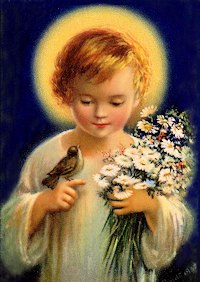
    3. But He is also to them the mirror of all the most glorious and winning virtues. He is, and His Name tells them that He is, unbounded Charity, infinite Mercy, extremest Kindness, deepest Humility, most devoted Piety, transparent Simplicity, uttermost Poverty, Chastity without a stain. It is the prerogative of love to transform those who love into the likeness of Him Whom they love; and as the mere name of one who is loved cannot sound in the ear or be thought of in the mind without adding to the love which is already there, so the thought of the Holy Name and the mention of the Holy Name have a kind of sacramental power in the hearts of His saints. They seem to convey the grace which enables men to think like Him, to speak like Him, to act like Him, to sacrifice themselves like Him, and to Him, and for Him, and along with Him, to make Him known to others, not by word only, but also by reproduction of Him in themselves, and to win all men to love Him.

    Bless the Lord, O my soul, and let all that is within thee bless His Holy Name. Bless the Lord, O my soul, and never forget all He hath done for thee. Ps. cii. i, 2.

    1. The great saint of the Holy Name is St. Bernardine of Siena. In his missionary expeditions he carried it on a banner, and used it continually in his sermons. He has a long treatise on the Holy Name, which teems with matter for prayer. The Holy Name, he says, is first of all fruitful for beginners. For these, for sinners, " it shows the immense mercifulness of God, it enables a devout man to gain a victory in every conflict, whether with the devil, the flesh, or the world, it has the power of healing sickness when rightly used, it fills with joy and exultation those who are in any adversity." He quotes St. Peter, that "through His name all receive remission of sin who believe in Him"; St. John : "Your sins are forgiven you for His name's sake"; St. Peter again: "There is no other name under heaven given to men whereby we must be saved"; the prayer of the Church in the Acts of the Apostles, that God would "stretch forth his hand to signs and cures and wonders, to be done by the name of thy only Son Jesus"; the further statement in the Acts, that the Apostles went forth "from the presence of the Council, rejoicing that they were accounted worthy to suffer reproach for the name of Jesus."
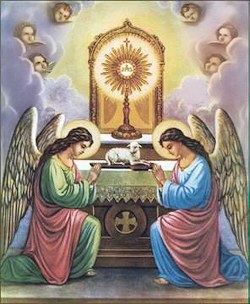
    2. Next it is fruitful for the proficient. "It is cherished in their hearts and fed upon by faith, it is taken into their mouths and preached or spoken about, it is made the spring of their actions, which then become a great accumulation of merits, it is appropriated in a new way by perseverance, and then it becomes a principle of abiding and enduring life, the remedy of the frailty and fickleness which belong to our poor nature."

    By virtue of this Holy Name, he tells us, we ourselves have become the sons of God. In the virtue of this Holy Name St. Paul placed all his hope of doing good. The power of the Holy Name is the power of the Holy Ghost. And for its power of endurance he asks: "Art thou not refreshed as often as thou rememberest the name of Jesus? What is there equal to it for the feeding of the mind that thinks of it, for repairing weariness, for strengthening virtues, for nourishing good and upright ways, for fostering true affections?"

    3. Lastly it is fruitful for those whom he calls the perfect. The first fruit is "the sweetness with which those who meditate upon it are filled," according to the beautiful rhythm of St. Bernard, Jesu dulcis memoria. The second is the wonderful power which this Holy Name gives to the prayers and petitions of the devout soul. The third is the immense sweetness which it gives to those who continually renew its memory. The fourth is the triumph and glory which it will produce in eternity: "They shall glory in Thee, all who love Thy name/ And thus for the sake of the name of Jesus the whole soul will live, and be endowed and enriched and beautified with all its powers; it will be made like to God three and one, united to Him, enlightened by Him, and plunged in perfect peace through Him, for it is to live for ever in the state of perfect bliss, furnished with the accumulation of all good."

    --Excerpted from The Prince of Peace by Alban Goodier
    Monday Saint of the Day


    St. Genevieve


    St. Genevieve was a fair and courageous peasant girl who was born around 422 in Nanterre, France, to a man named Severus and a woman named Gerontia.

    When Genevieve was only seven-years-old, St. Germanus, Bishop of Auxerre visited Nanterre on his way to Britain. While he was there, many people flocked to receive his blessing. The young Genevieve stood amid a crowd which had gathered around the man of God who singled her out and foretold her future sanctity. At her request, the holy Bishop led her to a church, accompanied by all the faithful, and consecrated her to God as a virgin.

    The next day, Germanus asked Genevieve if she had remembered the promise she made to God. She did and proclaimed she would always fulfill it faithfully. He presented her with a cross engraved brass medal to always wear around her neck, as a reminder of the consecration she made of herself to God. He ordered her to never wear any other bracelets, necklaces or jewelry, to avoid falling into vanity.

    Encouraged by Germanus, Genevieve dedicated her life to prayer, practices of devotion and a acts of penance. When she was only 15-years-old, she met with the Bishop of Paris and asked to become a nun. From this moment, she also began praying continuously and fasting, eating only twice a week, as a sign of her complete dedication to the Lord.


    Following the death of her parents, Genevieve went on to live with her grandmother in Paris and traveled, sharing the faith, performing acts of charity, praying for the sick and prophesying. Her dedicated Christian way of life was filled with the signs of the Holy Spirit working through her.

    The signs of the working of the Holy Spirit accompanying this holy young woman included miracles and spiritually inspired predictions. She frequently had visions of heavenly angels and saints. However, when she shared those visions and experiences of the Lord, people began to turn against her. They called her a hypocrite and accused her of being a false visionary. In fact, they were determined to drown her in a lake of fire. However, the Bishop Germanus intervened and silenced those who were accusing her of false statements, and persecuting her.

    Genevieve was appointed by the Bishop to look after the welfare of the consecrated virgins. She did so faithfully and helped to lead them into a greater degree of holiness as they grew closer to the Lord Jesus.

    Genevieve had a great influence over Childeric, the King of Gaul who overtook Paris. During a time when Paris suffered with great famine, Genevieve traveled by boat to Troyes and brought back several boats full of corn. Although he was a pagan, Childeric respected her and spared the lives of several prisoners on her behalf.

    She also had an effect on King Clovis. He listened to her advice and under her request, he granted freedom to several of his prisoners.

    When Attila and his army of Huns came upon Paris, the Parisian Christians were prepared to run, but Genevieve spoke to them and convinced them to stay within their homes, fast and pray to the Lord. She assured them they would have the protection of Heaven. Her prediction came true as Attila suddenly changed his path and turned away from Paris.

    Genevieve died at 89-years-old on January 3, 512.

    Shortly after she was buried, the people built a small church over her tomb, asking for the intercession of Saints Peter and Paul. Although her tomb remains there and can still be seen today, it is empty.

    Her relics were encased by St. Eligius in a handmade gold and silver shrine around 630. Over the years, the Normans destroyed the church several times. Once it was rebuilt around 856, St. Genevieve's relics were returned and miracles began happening, making this church famous all throughout France.

    Paris experienced proof of Genevieve's intercession on many occasions. The most famous occurrence was the miracle of Des Ardens, or the burning fever. In 1129, a violent fever swept through the city, and doctors couldn't stop the people from dying. The shrine of Genevieve was carried in a procession to the cathedral, and during the ceremony, those who touched her shrine were healed by the power of the Lord. Throughout the whole town, no one else became sick, all the ill recovered and only three people died.

    Pope Innocent visited the city the following year and asked that an annual festival be held in commemoration of the miracle every year on November 26. His goal, as is always the case with such practices, was to keep their faith alive by reminding the faithful that the Lord always works in the lives of those who pray and draw close to Him.

    St. Genevieve is the patron saint of Paris. She is depicted dressed in a long flowing gown with a mantle covering her shoulders and is often shown with a loaf of bread, representing her generosity toward those in need. Her feast day is celebrated on January 3.

    Papal Angelus Address 01.02.2022


    Pope at Angelus: Be open to God who loves to dwell among us

    At the first Sunday Angelus of the New Year, Pope Francis encourages us to invite Jesus into our lives, especially the difficult areas where we struggle, since "God loves to dwell among us".

    By Devin Watkins

    Pope Francis prayed the Angelus on the second Sunday during Christmastide, and reflected on the true meaning of Christmas, recited in the traditional Marian prayer: “The Word became flesh and dwelt among us.”

    He told the crowds gathered in St. Peter’s Square—and those across the world joining the broadcast—that these words contain a paradox.

    Opposites reconciled in Jesus

    The Eternal Word and human flesh were polar opposites before the Incarnation, said the Pope.

    “‘Word’ indicates that Jesus is the eternal Word of the Father, infinite, existing from all time, before all created things; ‘flesh’, on the other hand, indicates precisely our created reality, fragile, limited, mortal.”

    He added that “heaven and earth”, “infinite and finite”, “spirit and matter”, and “light and darkness” are other opposites that apparently have nothing to do with each other.

    Yet, said Pope Francis, in Jesus all of these polar opposites come together and are reconciled in the Incarnation of the Son of God.

    “Jesus is the light of God who has entered into the darkness of the world. God is light: in Him there is no opacity; in us, on the other hand, there is much darkness. Now, with Jesus, light and darkness meet: holiness and sin, grace and sin.”

    Dwelling in our midst

    Pope Francis said the Gospel uses these polarities to announce God’s “splendid” way of acting.

    When God is confronted with our frailties, He does not pull back and retreat into His eternal, infinite light.

    Rather, God “descends into darkness, and dwells in lands that are foreign to Him,” said the Pope.

    “This is God's work: to come among us. If we consider ourselves unworthy, that does not stop Him. If we reject Him, He does not tire of seeking us out. If we are not ready and willing to receive Him, He prefers to come anyway.”

    Incarnate in our poverty

    The Pope noted that we often keep our distance from God because we doubt our worthiness. Christmas, however, invites us to see things from God’s point of view.

    “God wishes to be incarnate,” he said, urging us to overcome our fears by drawing near to Jesus.

    “Think of the stable in Bethlehem. Jesus was born there, in that poverty, to tell us that He is certainly not afraid of visiting your heart, of dwelling in a shabby life.”

    The Gospel, he noted, uses the word “to dwell”, which expresses great intimacy and “total sharing.”

    Living in our ‘inner stables’

    Pope Francis therefore called on Christians to welcome the Christmas message by making space for Jesus in our hearts, no matter their sinful condition.

    He said we can welcome Jesus by pausing for a moment before a Nativity Scene.

    A creche, said the Pope, “shows Jesus who came to dwell in all our real, ordinary life, where not everything goes well, where there are many problems.”

    God, concluded Pope Francis, is there in the midst of all the situations of our daily lives, waiting for us to speak with Him about them.

    “Let us invite Him officially into our lives, especially in the dark areas… in our ‘inner stables’. And let us also tell Him, without fear, about the social and ecclesial problems of our time, even our personal, difficult problems: God loves to dwell among us.”