Saturday, January 1, 2022

January 2nd is also Memorials of Sts. Basil and Gregory


Christmas: January 2nd

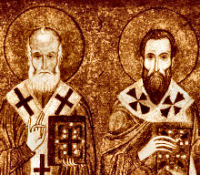
Memorials of St. Basil the Great and St. Gregory Nazianzen, bishops and doctors
     

MASS READINGS

January 02, 2021 (Readings on USCCB website)

COLLECT PRAYER

O God, who were pleased to give light to your Church by the example and teaching of the Bishops Saints Basil and Gregory, grant, we pray, that in humility we may learn your truth and practice it faithfully in charity. Through our Lord Jesus Christ, your Son, who lives and reigns with you in the unity of the Holy Spirit, God, for ever and ever.

show

RECIPES (15)

show

ACTIVITIES (6)

show

PRAYERS (9)

show

LIBRARY (5)

BLOG (0)


Today the Church celebrates the memorial of St. Basil the Great and St. Gregory Nazianzen, bishops and doctors. This is the ninth day of the Christmas season.

St. Basil was a brilliant student born of a Christian family in Caesarea, Cappadocia (Turkey). For some years, he followed the monastic way of life. He vigorously fought the Arian heresy. He became Bishop of Caesarea in 370. The monks of the Eastern Church today still follow the monastic rules which he set down.

St. Gregory was also from Cappadocia. A friend of Basil, he too followed the monastic way of life for some years. He was ordained priest and in 381 became Bishop of Constantinople. It was during this period when the Arian heresy was at its height. He was called "The Theologian" because of his great learning and talent for oratory.


St. Basil the Great and St. Gregory Nazianzen - Day Nine
Although New Year's Day is not celebrated by the Church, this day has been observed as a holy day of obligation since early times due to the Solemnity of Mary, Mother of God. Each family and country has different traditional foods to eat on New Year's Day, with lentils being the main superstition: ill luck befalling those who do not eat lentils at the beginning of the year.

New Year's is a day of traditional hospitality, visiting and good cheer, mostly with a secular view, but there is no reason that this day, too, could not be sanctified in Christ.

St. Basil
St. Basil was born about 330, the oldest of four sons; three of his brothers became bishops, one of whom was St. Gregory of Nyssa. His pious grandmother Macrina exercised a great influence upon his religious education: "Never shall I forget the deep impression that the words and example of this venerable woman made upon my soul." Between St. Basil and St. Gregory of Nazianzen an intimate friendship existed from youth to old age. Of Western monasticism St. Benedict was the father and founder, of Eastern monasticism, St. Basil.
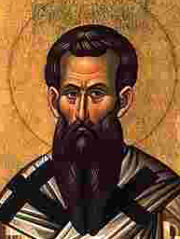
As bishop, Basil was a courageous and heroic champion of the Catholic faith against the Arian heresy. In 372 Emperor Valens sent Modestus, the prefect, to Cappadocia to introduce Arianism as the state religion. Modestus approached the holy bishop, upbraided him for his teaching, and threatened despoliation, exile, martyrdom, and death. To these words of the Byzantine despot, Basil replied with the peace of divine faith: "Is that all? Nothing of what you mentioned touches me. We possess nothing, we can be robbed of nothing. Exile will be impossible, since everywhere on God's earth I am at home. Torments cannot afflict me, for I have no body. And death is welcome, for it will bring me more quickly to God. To a great extent I am already dead; for a long time I have been hastening to the grave." Astonished, the prefect remarked: "Till today no one has ever spoken to me so courageously." "Perhaps," rejoined Basil, "you have never before met a bishop." Modestus hastened back to Valens. "Emperor," he said, "we are bested by this leader of the Church. He is too strong for threats, too firm for words, too clever for persuasion."

Basil was a strong character, a burning lamp during his time. But as the fire from this lamp illumined and warmed the world, it consumed itself; as the saint's spiritual stature grew, his body wasted away, and at the early age of forty-nine his appearance was that of an old man. In every phase of ecclesiastical activity he showed superior talent and zeal. He was a great theologian, a powerful preacher, a gifted writer, the author of two rules for monastic life, a reformer of the Oriental liturgy. He died in 379, hardly forty-nine years old, yet so emaciated that only skin and bones remained, as though he had stayed alive in soul alone.

Patron: Cappadocia; hospital administrators; reformers; Russia.

Symbols: Supernatural fire, often with a dove present.

St. Gregory Nazianzen
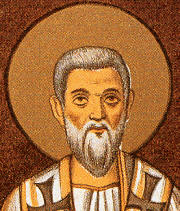
Gregory, surnamed the "Theologian" by the Greeks, was born at Nazianz in Cappadocia in 339. He was one of the "Three Lights of the Church from Cappadocia." To his mother, St. Nonna, is due the foundation for his saintly life as an adult. He was educated at the most famous schools of his time - Caesarea, Alexandria, Athens. At Athens he formed that storied bond of friendship with St. Basil which was still flaming with all the fervor of youthful enthusiasm when he delivered the funeral oration at the grave of his friend in 381.

Gregory was baptized in 360, and for a while lived the quiet life of a hermit. In 372 he was consecrated bishop by St. Basil. At the urgent wish of Gregory, his father and bishop of Nazianz, he assisted him in the care of souls. In 381 he accepted the see of Constantinople, but grieved by the constant controversies retired again to the quiet life he cherished so highly and dedicated himself entirely to contemplation.

During his life span the pendulum was continually swinging back and forth between contemplation and the active ministry. He longed for solitude, but the exigencies of the times called him repeatedly to do pastoral work and to participate in the ecclesiastical movements of the day. He was unquestionably one of the greatest orators of Christian antiquity; his many and great accomplishments were due in great measure to his exceptional eloquence. His writings have merited for him the title of "Doctor of the Church."

Excerpted from The Church's Year of Grace, Pius Parsch.

20 C + M + B 22


How to bless your home with Epiphany chalk

EPIPHANY CHALK

Wrote | CC BY 2.0

Philip Kosloski - published on 01/05/18 - updated on 12/27/21

It is a powerful blessing that lasts the whole year.

Each year around the feast of the Epiphany many parishes throughout the world participate in an annual blessing of chalk. It is an ancient tradition that not only places God at the entrance of your home, it places your entire family under his protection.

The Epiphany blessing of chalk and homes is a centuries old tradition where priests would visit each home in their parish after the Feast of the Epiphany. Over time it became more difficult to accomplish such a feat as parishes became larger and larger and priests were stretched thin. For this reason it became an accepted tradition that a member of the household is able to lead this blessing in place of the priest.

The blessing has biblical roots, deeply tied to the Passover in the book of Exodus.

The Lord said to Moses and Aaron in the land of Egypt … “take some of the blood [of the lamb], and put it on the two doorposts and the lintel of the houses in which they eat them. They shall eat the flesh that night, roasted; with unleavened bread and bitter herbs they shall eat it … The blood shall be a sign for you, upon the houses where you are; and when I see the blood, I will pass over you, and no plague shall fall upon you to destroy you, when I smite the land of Egypt.” (cf. Exodus 12:1-13)

It is no coincidence that the Epiphany blessing is traditionally written on the lintel of the main doorway and even some of the prayers echo God’s words of protection that he gave to Moses. While the Epiphany blessing was not given in the same manner as it was to Moses, the Church provides it for our own spiritual benefit. The Church desires our salvation and so gives us beautiful sacramentals to assist us along the path to Eternal Life.

Traditionally a priest blesses chalk on the Feast of the Epiphany by saying the following prayer (from the Roman Ritual):

Bless, + O Lord God, this creature, chalk, and let it be a help to mankind. Grant that those who will use it with faith in your most holy name, and with it inscribe on the doors of their homes the names of your saints, Casper, Melchior, and Baltassar, may through their merits and intercession enjoy health in body and protection of soul; through Christ our Lord.

The chalk is then distributed after Mass. If your local parish does not administer such a blessing, inquire around and see if any neighboring parishes do. Parishioners then take the chalk home and use it while invoking God’s blessing upon their home.

It is a beautiful blessing, one that brings many graces upon those who practice it in faith and is an added protection against any spiritual enemies that may be lurking around.

The Blessing

Once you acquire the blessed chalk, either a priest or another member of the household can bless the home in the following manner (adapted from the Roman Ritual):

Upon entering the house [or at the front door]:

Priest/Head of Household: Peace be to this house.
All: And to all who dwell herein.
Priest: From the east came the Magi to Bethlehem to adore the Lord; and opening their treasures they offered precious gifts: gold for the great King, incense for the true God, and myrrh in symbol of His burial.

During the Magnificat, the room is sprinkled with holy water and incensed.

All: My soul proclaims the greatness of the Lord,
my spirit rejoices in God my Savior
for he has looked with favor on his lowly servant.
From this day all generations will call me blessed:
the Almighty has done great things for me,
and holy is his Name.

He has mercy on those who fear him
in every generation.
He has shown the strength of his arm,
he has scattered the proud in their conceit.

He has cast down the mighty from their thrones,
and has lifted up the lowly.
He has filled the hungry with good things,
and the rich he has sent away empty.

He has come to the help of his servant Israel
for he remembered his promise of mercy,
the promise he made to our fathers,
to Abraham and his children forever.

After this is completed:

All: From the east came the Magi to Bethlehem to adore the Lord; and opening their treasures they offered precious gifts: gold for the great King, incense for the true God, and myrrh in symbol of His burial.

Priest: Our Father Who art in Heaven, hallowed be Thy Name. Thy Kingdom come, Thy will be done on earth as it is in Heaven. Give us this day our daily bread, and forgive us our trespasses as we forgive those who trespass against us. And lead and lead us not into temptation,
All: But deliver us from evil.
Priest: All they from Saba shall come
All: Bringing gold and frankincense.
Priest: O Lord, hear my prayer.
All: And let my cry come unto Thee.

Priest:
Let us pray. O God, who by the guidance of a star didst on this day manifest Thine only-begotten Son to the Gentiles, mercifully grant that we who know Thee by faith may also attain the vision of Thy glorious majesty. Through Christ our Lord.

All: Amen.
Priest: Be enlightened, be enlightened, O Jerusalem, for thy light is come, and the glory of the Lord is risen upon thee– Jesus Christ born of the Virgin Mary.
All: And the Gentiles shall walk in thy light and kings in the splendor of thy rising, and the glory of the Lord has risen upon thee.

Priest: Let us pray. Bless, O Lord God almighty, this home, that in it there may be health, purity, the strength of victory, humility, goodness and mercy, the fulfillment of Thy law, the thanksgiving to God the Father and to the Son and to the Holy Spirit. And may this blessing remain upon this home and upon all who dwell herein. Through Christ our Lord.
All: Amen.

After the prayers of the blessing are recited, walk through the house and bless each room by sprinkling with Epiphany/holy water and incensing it.

Take the blessed chalk and first write the initials of the three Wise Men, connected with Crosses, over the inside of your front door (on the lintel, if possible). Then write the year, breaking up the numbers and the year so that they fall on both sides of the initials. It should look like this, for example

20 C+M+B 22

with the “20 “being the millennium and century, the “C” standing for the first Wise Man, Caspar, the “M” standing for Melchior, the “B” standing for Balthasar, and the “22” standing for the decade and year. It is also popularly believed that the Kings’ initials stand for “Christus mansionem benedicat” (“Christ bless this house”).

Sunday, January 2nd is the Solemnity of the Epiphany


Christmas: January 2nd

Solemnity of the Epiphany of the Lord


MASS READINGS

January 02, 2022 (Readings on USCCB website)

COLLECT PRAYER

O God, who on this day revealed your Only Begotten Son to the nations by the guidance of a star, grant in your mercy that we, who know you already by faith, may be brought to behold the beauty of your sublime glory. Through our Lord Jesus Christ, your Son, who lives and reigns with you in the unity of the Holy Spirit, God, for ever and ever.

show

RECIPES (35)

show

ACTIVITIES (30)

show

PRAYERS (26)

show

LIBRARY (4)

show

BLOG (4)

» Enjoy our Liturgical Seasons series of e-books!

Previous Calendar: Holy Name of Jesus

Today the Church celebrates the Solemnity of the Epiphany. "The Lord and ruler is coming; kingship is his, and government and power." With these words, the Church proclaims that today's feast brings to a perfect fulfillment all the purposes of Advent. Epiphany, therefore, marks the liturgical zenith of the Advent-Christmas season. — Pius Parsch
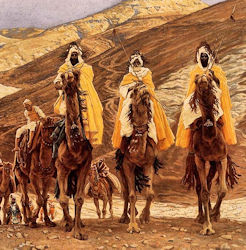
The Solemnity of the Epiphany is celebrated either on January 6 or, according to the decision of the episcopal conference, on the Sunday between January 2 and January 8. The young Messiah is revealed as the light of the nations. Yet, as the antiphon for the Magnificat at Second Vespers reminds us, three mysteries are encompassed in this solemnity: the adoration of the Christ Child by the Magi, the Baptism of Christ and the wedding feast at Cana. Extra candles and/or lamps may be placed around the sanctuary and in other parts of the church to honor Christ revealed as the Light of the Gentiles (Ceremonial of Bishops). It is customary to replace the images of the shepherds at the crib with the three Magi and their gifts. — Ceremonies of the Liturgical Year, Msgr. Peter J. Elliott, Ignatius Press.

The Memorials of St. Basil the Great and St. Gregory Nazianzen, bishops and doctors, which is ordinarily celebrated today, is superseded by the Sunday liturgy.

The feast of the Epiphany, which was kept in the East and in certain Western Churches before being observed in Rome, seems to have been originally a feast of the nativity; January 6, for those churches where it was kept, was the equivalent of Christmas (December 25) in the Roman Church. The feast was introduced at Rome in the second half of the sixth century and became the complement and, so to say, the crown of the Christmas festival.
Epiphany means manifestation. What the Church celebrates today is the manifestation of our Lord to the whole world; after being made known to the shepherds of Bethlehem He is revealed to the Magi who have come from the East to adore Him. Christian tradition has ever seen in the Magi the first fruits of the Gentiles; they lead in their wake all the peoples of the earth, and thus the Epiphany is an affirmation of universal salvation. St. Leo brings out this point admirably in a sermon, read at Matins, in which he shows in the adoration of the Magi the beginnings of Christian faith, the time when the great mass of the heathen sets off to follow the star which summons it to seek its Saviour.

That is the meaning, too, of the wonderful prophecy from Isaias which the liturgy appoints to be read in the first nocturn at Matins and at the Epistle of the Mass. This same thought of universal redemption the Church returns to as she sings, in the antiphon to the Magnificat at 2nd Vespers, applying the words to herself, of the union with Christ typified by the wedding feast at Cana, by the baptism of her children foreshadowed by that of Christ in the waters of the Jordan. Formerly the Epiphany was an additional day for solemn baptisms.

Solemnity of the Epiphany - Day Nine
Epiphany is a large celebration, especially in Spanish speaking countries. Things look different around the household: the infant Jesus in the manger now has a small gold crown and is wearing regal robes. The figures of the wise men have reached Bethlehem, completing the nativity scene.

The Church extends itself on Epiphany to the homes of the faithful. The custom of blessing the home on this day probably originated from these words in the Gospel, "And entering into the house, they found the Child with Mary, His Mother, and falling down they adored Him." The priest blesses the house if he can be present, but if not, the father of the family may do so.

New Years Day Angelus Address 01.01.2022


Pope at Angelus: May Mary inspire harmony in our hearts and world

At the New Year's Day Angelus, Pope Francis encourages us to "roll up our sleeves to build peace" praying that Mary, Queen of Peace, may obtain harmony in our hearts and in the entire world.

By Vatican News staff writer

After presiding over the morning celebration of the Solemnity of Mary, Mother of God, Pope Francis greeted pilgrims in St. Peter's Square, offering his New Year's good wishes and reflecting on the day's liturgy. In the Church, the first day of the civil New Year is also observed as the Solemnity of Mary, the Mother of God, as well as the World Day of Peace.
 

In today's Gospel, we hear about the wonder of the crib when the shepherds hasten to see the Christ Child announced to them by the angel. The Pope said we can imagine Mary, "like a tender and caring mother," placing Jesus in the manger, not only holding Him in her arms, but inviting us to look at Him in adoration and with welcome. "Behold Mary’s maternity," he said. "She offers the Son who is born to all of us."

God is near, within our reach

Mary's presentation of Jesus gives us "a wonderful message" that "God is near, within our reach," the Pope said, not in order to be feared but with the "frailness of someone who asks to be loved." He added that God shared in our human condition to be with us as one of us, "born little and in need so that no one would ever again be ashamed," and to draw ever nearer to us, excluding no one, making us all brothers and sisters.

God gives us courage with tenderness

"God with us" in the Christ Child gives us "courage with tenderness," the Pope pointed out, and this needed encouragement is light in these uncertain and difficult times caused by the pandemic. The resulting economic and social problems cause fear for the future, the Pope acknowledged, recalling modern-day young mothers and their children fleeing conflicts and famine, or waiting in refugee camps. Like Mary, we too can make ourselves available to others to bring positive change in our world. "If we become craftsmen of fraternity, we will be able to mend the threads of a world torn apart by war and violence."

Peace is a gift and shared commitment

Recalling today's World Day of Peace, the Pope pointed out that peace comes from God and is the fruit of a shared commitment. We need to implore the gift of peace from on high, the Pope stressed, since we are not capable of preserving it without His help. We need to have peace in our hearts from the Prince of peace, he reiterated, saying we must also be committed to peace, by taking concrete actions. This means being attentive to the poor, working for justice, and having the courage to forgive others in order to put out the fire of hatred. We also need a positive outlook, he said, both in the Church and in society, that is fostered by seeing the "good that unites us." The Pope added that "getting depressed or complaining is useless," saying we need to "roll up our sleeves" and work for peace, praying that Mary, the Queen of Peace, may "obtain harmony in our hearts and in the entire world."


After imparting his apostolic blessing, Pope Francis wished everyone peace in a special way on this New Year's Day when the Church celebrates the annual World Day of Peace started by Saint Pope Paul VI back in 1968. He recalled this year's message, which has as its theme: "Dialogue Between Generations, Education and Work: Tools for Building Lasting Peace," recalling that these three elements are key for establishing a solid base for building peace in our world. The Pope also thanked the President of Italy, Sergio Mattarella, for his New Year's Year's greetings wishing him the same. He also paid tribute to all the pilgirms gathered in the Square, in particular members of the Sant'Egidio community working for peace around the world.

Mass with the Pope for the Solemnity of Mary, Mother of God


Pope at Mass: May Mary help us to keep and ponder all things

Presiding over Mass on the Solemnity of the Blessed Virgin Mary, the Mother of God, Pope Francis encourages us to place ourselves under her maternal protection. May she give us courage and joyful certainty that the Lord is faithful and can transform every cross into a resurrection.

By Vatican News staff writer

Pope Francis presided over morning Mass on New Year's Day in Saint Peter's Basilica with a smaller congregation present in accordance with pandemic health guidelines.

In his homily for this Solemnity of the Blessed Virgin Mary, the Mother of God - also marked as the World Day of Peace - the Pope recalled the joy experienced by the shepherds at Bethlehem upon visiting the baby Jesus lying in the manger, proof of God's closeness to them and to all who are poor or marginalized. Jesus being born in "littleness and poverty" fills our hearts "with love, not fear."

The scandal of the manger

Mary's experience of this time required enduring “the scandal of the manger,” the Pope explained. Long before the shepherds, she received the message of an angel announcing she would bear a son and name him Jesus, who would be called Son of the Most High; but now "Mary has to lay Him in a trough for animals." How can "she reconcile the glory of the Most High and the bitter poverty of a stable?" the Pope asked, adding how this must have caused her distress, especially seeing her new born child suffering such a precarious situation. Yet, Mary "does not lose heart" and “kept all these things, pondering them in her heart.”

To keep and to ponder

The shepherds instead are joyous and tell everyone about their experience of the angel that appeared in the night and his words about the Child to whom they went to pay homage. The Pope noted that "words and amazement" describe their reaction, whereas, Mary is "pensive," pondering this reality in her heart. These two different reactions recall aspects of faith experience in general, the Pope said: where the shepherds remind us of the beginnings of faith, when all seems easy and clear, Mary's "pensiveness" expresses a "mature, adult faith." 

The Pope said we can learn from the Mother of God here by taking on the same attitude of "keeping and pondering," since we may also have to endure great challenges in life where our expectations clash with reality, putting our joy of the Gospel to the test. Mary teaches us that we can learn, grow, and mature in faith from these difficult situations, as "it is the narrow path to achieve the goal, the Cross, without which there can be no resurrection." 

The ideal and the real

The Pope explained that managing and overcoming this clash between the ideal and the real requires "keeping," as Mary did, the experiences of what happens to us, and not trying to forget or reject them. Mary kept in her heart both the amazing and the troubling life experiences - the angel who gave her great news, the lowly stable where she had to give birth: "she does not pick and choose; she preserves. She accepts life, without trying to camouflage or embellish it."

She keeps and ponders

The Pope went on to describe Mary's "second" attitude: "she keeps and she ponders," bringing together in her heart and prayer the beautiful and challenging aspects, discerning greater meaning in them by considering them from God's perspective. She realizes that "the glory of the Most High appears in humility," and "she welcomes the plan of salvation whereby God must lie in a manger." The Pope observed that this inclusive vision of "keeping" and "pondering" is "the way of mothers" who embrace the challenges in raising their children. This maternal "gaze" and love is able to see everything from a wider perspective, he noted, both "conscious and realistic" and "one of care and love that gives birth to new hope." The Pope said we need such people, "capable of weaving the threads of communion in place of the barbed wire of conflict and division."

A mother's gaze, a path to rebirth

As this New Year begins under the sign of Mary, our Mother, whose gaze is "the path to rebirth and growth," the Pope encouraged everyone to make greater efforts to safeguard mothers and protect women, lamenting the terrible problem of violence again women today. "To hurt a woman is to insult God, who took on our humanity from a woman." The Pope prayed that, through Mary's maternal protection, she might help us all "to keep and ponder all things, unafraid of trials and with the joyful certainty that the Lord is faithful and can transform every cross into a resurrection." He encouraged everyone to call upon her as did the People of God at Ephesus, repeating three times her title: “Holy Mother of God, Holy Mother of God, Holy Mother of God!”