Tuesday, October 31, 2017

The real deal today: it's All Hallow's Eve; what does it mean?

All Hallow's Eve
  • MARY REED NEWLAND
One of the nicest surprises of living around the year with the Church is to find that Halloween is part of it.
AddThis Sharing Buttons

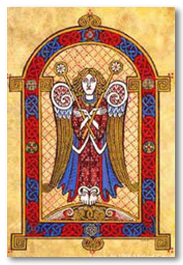
Angel12.jpg
Not that the Mass of the day has mention of black cats, or the Divine Office of witches, but for so long Halloween meant nothing but parties and vandalism that when someone first proposed that it came out of the liturgy, I asked: "Are you sure?"
You still hear people doubt it, even when you show them that Halloween is All-Hallows'-Eve which is the night-before-All-Saints'- Day. Some tell me they understand that Halloween pranks were a post-Reformation contribution to plague Catholics who kept the vigil of All Saints. Now it is possible that Halloween was abused for such a purpose; nevertheless, during all the Christian centuries up until the simplification of the Church calendar in 1956, it was a liturgical vigil in its own right and thus has a reason for being. Learning this, one pious lady of our acquaintance was heard to say: "Oh, I'm so glad to know that. I was about to write my congressman and suggest the whole thing be outlawed."
A celebration much like our Halloween, with bonfires and feasting on apples and nuts and harvest fruits, was part of pagan worship for centuries. The Britons celebrated in honor of their sun-god with bonfires, a tribute to the light that brought them abundant harvest. At the same time they saluted Samhain, their "lord of death," who was thought to gather together at last the souls of the year's dead which had been consigned to the bodies of animals in punishment for their sins. The Romans celebrated the same kind of festival at this time in honor of their goddess Pomona, a patroness of fruits and gardens. Whether the Church "baptized" these customs or chose this season for her feasts of the dead independent of them, their coincidence shows again how alike men are when they seek God and His ways, give praise, use the language of symbols to express the inexpressible.
It was in the eighth century that the Church appointed a special date for the feast of All Saints, followed by a day in honor of her soon-to-be saints, the feast of All Souls. She chose this time of year, it is supposed, because in her part of the world it was the time of barrenness on the earth. The harvest was in, the summer done, the world brown and drab and mindful of death. Snow had not yet descended to comfort and hide the bony trees or blackened fields; so with little effort man could look about and see a meditation on death and life hereafter.
Apparently how you spent the vigil of All Saints depended on where you lived in Christendom. In Brittany the night was solemn and without a trace of merriment. On their "night of the dead" and for forty-eight hours thereafter, the Bretons believed the poor souls were liberated from Purgatory and were free to visit their old homes. The vigil for the souls, as well as the saints, had to be kept on this night because of course the two days were consecutive feasts and a vigil is never kept on a feast.
Breton families prayed by their beloveds' graves during the day, attended church for "black vespers" in the evening and in some parishes proceeded thence to the charnel house in the cemetery to pray by the bones of those not yet buried or for whom no room could be found in the cemetery. Here they sang hymns to call on all Christians to pray for the dead and, speaking for the dead, they asked prayers and more prayers.
Late in the evening in the country parishes, after supper was over, the housewives would spread a clean cloth on the table, set out pancakes, curds, and cider. And after the fire was banked and chairs set round the table for the returning loved ones, the family would recite the De Profundis (Psalm 129) again and go to bed. During the night a townsman would go about the streets ringing a bell to warn them that it was unwise to roam abroad at the time of returning souls.
It was in Ireland and Scotland and England that All Hallows' Eve became a combination of prayer and merriment. Following the break with the Holy See, Queen Elizabeth forbade all observances connected with All Souls' Day. In spite of her laws, however, customs survived; even Shakespeare in his Two Gentlemen of Verona has Speed tell Valentine that he knows he is in love because he has learned to speak "puling like a beggar at Hallowmas." This line must have escaped the Queen.

Tricks or treats old style

Begging at the door grew from an ancient English custom of knocking at doors to beg for a "soul cake" in return for which the beggars promised to pray for the dead of the household. Soul cakes, a form of shortbread and sometimes quite fancy, with currants for eyes became more important for the beggars than prayers for the dead, it is said. Florence Berger tells in her Cooking for Christ a legend of a zealous cook who vowed she would invent soul cakes to remind them of eternity at every bite. So she cut a hole in the middle and dropped it in hot fat, and lo a doughnut. Circle that it is, it suggests the never-ending of eternity. Truth or legend, it serves a good purpose at Halloween.
The refrains sung at the door varied from "a soul cake, a soul cake, have mercy on all Christian souls for a soul cake," to the later:
Soul, soul, an apple or two,
If you haven't an apple, a pear will do,
One for Peter, two for Paul,
Three for the Man Who made us all.
Here they had either run out of soul cakes or plain didn't care. Charades, pantomimes, and little dramas, popular remnants of the miracle and morality plays of the Middle Ages, commonly rehearsed the folk in the reality of life after death and the means to attain it. It is probably from these that the custom of masquerading on Halloween had its beginning. The folly of a life of selfishness would be the message pantomimed by the damned; the torment of waiting, the message of the souls from Purgatory; the delights of the beatific vision, the message of the Heaven-sent. Together they warned the living to heed the means of salvation before it was too late. Doubtless the presence of goblins and witches with cats (ancient symbols of the devil) were remnants of pagan times bespeaking to Christians of spirits loosed from hell to keep track of their own and herd them back at cockcrow. Saint- Saens' Danse Macabre with death fiddling his eerie spell over the graveyard fascinated us all the years of growing up. Waiting for the sound of cockcrow, which would send the souls scuttling back to their graves, was almost too much suspense to bear. Little did we know that it was inspired by old French customs and superstitions on All Hallows' Eve.
The familiar harvest fruits, cornstalks, and pumpkins were seasonal. Although there is an old Irish legend about a miser named Jack who was too stingy to go to Heaven and too clever to go to hell, so that he had to spend eternity roaming the earth with a lighted pumpkin for a lantern, the appearance of jack-o'-lanterns has always seemed much more reasonable than that. These were ages when death was a serious and acceptable meditation. Christian art shows skulls and bones as a commonplace of interior decoration, at least in the cells of the convents and monasteries. Vigils were kept by the graves, and lights and bread left for the dead, all for the twofold purpose of recalling those dead and remembering that one day you would be dead. Surely it was some bright boy, stumbling over a pile of pumpkins by his father's barn, who hit on the notion of carving a grinning death's-head to carry, lighted by a candle, under his arm. If you know small boys, this is the most reasonable of all explanations.

Prayers and party fun together

Our family's Halloween parties are now planned around the custom of begging for soul cakes. Among the neighborhood children who attend, Catholics together with non-Catholics, there is no one who is not intrigued to learn the stories of these customs and join in the prayers and the fun.
Frying doughnuts is a big undertaking, but this one time of the year we have a doughnut session the day before Halloween. Soul cakes need not be doughnuts, but we like to tell Mrs. Berger's story; and this, of course, leads to much tasting to see if one does think of eternity at every bite. Other refreshments for the party are natural sweets apples, nuts, popcorn all perfect companions to the soul cakes.
Next, costumes. Saint costumes have been much in vogue in our circle since the rediscovery of Christian Halloween. These are lots of fun to make, but if you are having non-Catholic children who do not know about patron saints, a full course on the subject is not possible before the party. You might suggest that these come as some departed soul, one of those from eternity who come to warn the living to mend their ways. This gives much leeway and justifies the inevitable cowboys and space cadets. Cowboys do eventually depart, I am confident, and space cadets look as though they already have.
A rhymed invitation tells everybody that this is a real party and also keeps enough of the familiar Halloween ghostliness to enhance the rest, which sounds a little unfamiliar. Our invitation goes like this:
Come to keep vigil on All Hallows' Even,
With Monica, Jamie, Peter and Stephen,
With John, Philip, Christopher, dressed up like souls;
Bring berries of red to help warn off the ghouls.
Come knock at the door and beg for soul cakes,
Pray hard for the souls, for the prayers that it takes<
To speed them to Heav'n go too often unsaid, Band who prays for poor souls will ne'er want for bread.
This hints at what is going to happen. Followed by a telephone call or a note to the mothers of the guests, it gives everyone time to get the "feel of it." This is important. If it isn't clearly explained how they will beg at the door and say a prayer for the dead, the party will disintegrate right there with the "gimmes."
The berries of red and their use have their origin 'way back when holly and evergreens bearing red berries were used to remind the Christians of the blood of Christ and the burning love of Mary for her Child. It is not hard for country children to find a spray of red berries, but even in the city there is bittersweet on sale at the street corner; or if you live near a barberry hedge, you might prevail on the owner to let you have a sprig and to show your good will tell him that it is a wise way to ward off witches.
An old witch patrols the lawn at our house this night, riding a broomstick and fleeing in fright from the groups of guests, terrified at the sight of the berries. Barred from the house by these berries (some of which are combined with autumn leaves and fastened to the front door in a swag), she has to be content to hoot and screech, pop out from behind trees; and when the time comes, bade by what she knows is the truth, she gives directions for begging at the door.
"I am forced to tell ye this, miserable dearies, whether I would or no; so mark it well. If ye pray for the dead, they are released sooner from their torment of waiting in Purgatory and sped on the wings of light to their eternal reward. So go and knock and the woman will open to your knock, and sing as loud as ye can: 'A soul cake, a soul cake, a prayer for a soul cake!' She will bear on her arm a basket of cakes and tell ye for whom ye are to pray. And may ye all choke on every crumb and find praying and eating at one and the same time as miserable as the torment I endure forever riding hungry on my broomstick!"
Everyone is delighted by her useless malice, and finds that simultaneous praying and eating is not difficult. Better yet, bade by the woman of the house, they pray before they eat (much more respectful). They pray for grandfathers and grandmothers and aunts and uncles and cousins and friends and all the souls in Purgatory. The Catholic children and the non-Catholic children say together for their dead the one prayer they share in common, the Our Father; and after the voices of the Catholic children have died away, the rest continue with "for thine is the kingdom and the power and the glory forever." This, incidentally, was appended to the Our Father long before the so-called Reformation; it is one of those liturgical additions that was eventually dropped for the sake of purity. Knowing this helps eliminate some of the irritation Catholics feel when hearing it. It is not something the Protestants dreamed up just to be difficult.
Around the house to the various doors (because we live in the country we must confine our party to one house), and then inside for the celebration. In the city, children could go to several houses close together, or to several apartment doors. The old witch, spying one door without red berries, makes a last appearance cackling and greeting the guests from behind the puppet show. She shakes the children's hands with a wet glove and presses an ice cube in each unsuspecting palm, whereupon they shriek and scream and pile through the door into the living room to duck for apples, chase them on strings, eat popcorn and soul cakes, and drink cider.
If there are many small children, plan the party for them and let the older children help give it. If there are more older children, it is best to plan the party for them. Sometimes it will work both ways, but more often than not, widely divergent age groups do not combine successfully for parties because the same games and entertainments do not appeal to both. If you have both small fry and older children, you might plan with the mothers of the neighborhood to hold two parties one for little children at one house, one for older children at another.
For very small children, ducking for apples, apples on strings, refreshments, the chance to make noise and antics in their costumes, can be nicely gathered up and rounded off by reading one or two stories. If they have come in saint costumes, the outstanding game can be telling your saint's story after the others have guessed who you are.
For older children or even adults, "A Trayful of Saints" is a good game. On a tray place a dozen or more objects that symbolize familiar saints. For example: key St. Peter; flower Little Flower; rose St. Rose of Lima; dog St. Dominic; bird St. Francis of Assisi; cross St. Helena; crown St. Elizabeth of Hungary; eagle St. John the Evangelist; shell St. James; Sacred Heart St. Margaret Mary Alacoque; kitchen utensil St. Martha; half coat (paper cut-out) St. Martin of Tours. Go slowly from one guest to another, giving them time to memorize what is on the tray. Then pass out paper and pencils and have them list what they remember, and what saint they think they symbolize.
Charades depicting outstanding events in the lives of the saints are always fun at such a party, and ghost stories are in order when the apple ducking is done and people are sitting around the fire. Here is one for the little ones who may not be quite ready for those of the grimmer sort. This one is told by Granny Newland and it is true, about a Jack Doyle who lived with his grandmother in Antrim, which is where St. Kevin's well is with the two hollows in the stone from where he rested his elbows at prayer, and they were forever after filled with water. Many's the time she went as a child and tried to dry them out but the water was back in a wink.
Anyway, Jack lived with his grandmother, who was always growling because he came in so late at night. This night he was late again and hurrying home past the Blind Piers, where it was said there was always a ghost with blinking lights (but that's another story). So he began to get nervous. He started to run and when he started to run he heard a noise right behind him. He ran faster and the faster he ran, the louder the noise behind him, until finally he reached his grandmother's house in such a sweat it was rolling off him in great drops, and he fell in the kitchen over the half-door. His grandmother was sitting on a low stool in front of the fire saying her beads and she began to cross herself and call on all the saints and angels and the Blessed Mother of God to come to her protection. When Jack explained why he was in such a fit she gave a look and thought a thought, what do you think it was?

Monday, October 30, 2017

Halloween Saint of the Day

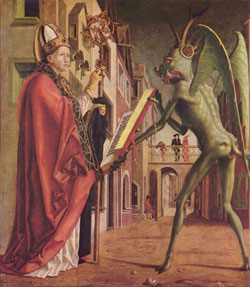
St. Wolfgang

Image of St. Wolfgang

Facts

Feastday: October 31
Death: 994


Wolfgang (d. 994) + Bishop and reformer. Born in Swabia, Germany, he studied at Reichenau under the Benedictines and at Wurzburg before serving as a teacher in the cathedral school of Trier. He soon entered the Benedictines at Einsiedeln (964) and was appointed head of the monastery school, receiving ordination in 971. He then set out with a group of monks to preach among the Magyars of Hungary, but the following year (972) was named bishop of Regensburg by Emperor Otto II (r. 973-983). As bishop, he distinguished himself brilliantly for his reforming zeal and his skills as a statesman. He brought the clergy of the diocese into his reforms, restored monasteries, promoted education, preached enthusiastically, and was renowned for his charity and aid to the poor, receiving the title Eleemosynarius Major (Grand Almoner). He also served as tutor to Emperor Henry II (r. 1014-1024) while he was still king. Wolfgang died at Puppingen near Linz, Austria. He was canonized in 1052 by Pope St. Leo IX (r. 1049-1054). Feast day: October 31.

A defense and support of Pope Francis and Amoris Laetitia froman unexpected source

Cardinal Muller backs Pope Francis against critics of ‘Amoris Laetitia’

Cardinal Muller backs Pope Francis against critics of ‘Amoris Laetitia’
Pope Francis is pictured with Cardinal Gerhard Müller, former prefect of the Congregation for the Doctrine of the Faith, during his general audience in St. Peter's Square at the Vatican Nov. 19. (Credit: Paul Haring/CNS.)
Cardinal Gerhard Müller acknowledges in his writing that there can be “mitigating factors in guilt,” referring to the case of access to the sacraments for divorced and civilly remarried people. The prelate also argued against the self-proclaimed liberal-progressive theologians who raise the phrases they like of Pope Francis to the level of dogma while they question papal magisterium in 'Humanae Vitae.'
ROME- Cardinal Gerhard Müller, allegedly replaced by the pontiff as the Vatican’s doctrinal chief for his rejection of Amoris Laetitia, has penned an essay defending it.
Among other things, Müller acknowledges that there can be “mitigating factors in guilt,” referring to the case of access to the sacraments to divorced and civilly remarried people. Hence, it’s possible that, “through a pastoral discernment in an internal forum,” Catholics in this situation might be able to receive communion.
Müller also writes that the “bitter controversy” that’s developed around chapter 8 of the apostolic exhortation, called “Accompanying, discerning and integrating weakness,” is “regrettable.”
The question of communion for the “divorced and civilly remarried,” he writes, has been “falsely elevated to the rank of a decisive question of Catholicism and a measure of ideological comparison in order to decide whether one is conservative or liberal, in favor or against the pope.”
According to Müller, Pope Francis is more concerned with the pastoral effort to strengthen marriages and preventing their breakdown than the “pastoral care of [marital] failures.”
Therefore, from a new evangelization perspective, the effort to ensure that all of the baptized participate in the Mass on Sundays and holy days of obligation is more important than “the problem of the possibility of receiving communion in a legitimate and valid way from a limited group of Catholics with an uncertain marital situation.”
Up until earlier this year, Müller served as the Vatican’s doctrinal chief, but Francis decided to replace him at the end of his five-year mandate.
The cardinal’s words come in a preface to a book by Rocco Buttiglione titled Friendly responses to the critics of Amoris Laetitia, which will be released in Italy Nov. 10. Excerpts from the preface were released on Monday by Italian daily La Stampa.
Buttiglione is an Italian moral theologian and politician, member of the conservative Union of Christian and Centre Democrats party. He was perceived as close to St. John Paul II.
In his preface, Müller also writes that Buttiglione offers a “reasoned and not controversial answer to the cardinals’ five dubia,” referring to a list of questions posed to Francis by four cardinals, including American Raymond Burke, who believe the pope’s document sewed confusion and was altering Catholic teaching.
Though he himself addresses the dubia too, the cardinal denounces that there’s a “paradoxical reversal of the fronts” when it comes to papal defenders and critics. On the one hand, there are those who question the “correctness of the pope’s faith” while others boast about papal consent to a “radical paradigm shift in the moral and sacramental theology that they desire.”
For this reason, liberal-progressive theologians who questioned papal magisterium when it comes to Humanae Vitae, written by Pope Paul VI and which confirmed the Catholic Church’s ban on contraception, “now raise any of [Francis’s] phrases, which they like, almost to the rank of a dogma.”
The first dubia posed to the pope questioned if, after Amoris Laetitia, a Catholic “still bound by a valid marital bond” can receive absolution through the sacrament of confession and receive the Eucharist, contradicting St. John Paul II’s document Familiaris Consotrio, and other statements from John Paul and Benedict XVI.
It is evident, Müller writes, that Francis’s document doesn’t teach, nor propose, that a Catholic in “present and habitual mortal sin” can receive the sacraments without repentance and without the intention to refrain from sin in the future.
He also says that there are “different levels” of gravity depending on the type of sin, which he defines as the “the departure from God and his will.”
“Spirit’s sins” such as spiritual pride and avarice can be worse than the “sins of the flesh” which are a result of a “human weakness.”
Quoting Thomas Aquinas, Müller argues that “the apostasy of faith, the denial of the divinity of Christ weighs more than theft and adultery; adultery among married people weighs more than among the unmarried and, the adultery of the faithful, who know God’s will, weighs more than that of the unbelievers.”
In addition, in the “assessment of guilt” there can be “mitigating circumstances,” which don’t turn an act which is “objectively bad” into a “subjectively good” one, as dubia number 4 posed. The cardinal gives the example of the care for children in common, “which is a duty deriving from natural law.”
He also writes about Catholics being abandoned by their spouse “without their own fault.” A special spiritual discernment is needed to find a path of conversion, “going beyond an easy adaptation to the relativistic spirit of time or a cold application of dogmatic precepts and canonical dispositions

Catholics and Halloween; this Priest says yes indeed

It's Time for Catholics to Embrace Halloween

by Fr. Steve GrunowOctober 30, 2017
63.2K
 
2314
 
317
 
72.4K
 

As we near All Hallows Eve, aka Halloween, we fired some questions at the walking encyclopedia that is Father Steve Grunow, and he responded with everything you ever wanted to know about Halloween and its deeply Catholic roots.
QUESTION: I always figured that Halloween had pagan roots, but you are telling me they are Catholic. Huh? How so?
Fr. Steve: The origin and traditional customs associated with Halloween require no other explanation than that they are examples of the kinds of festivity that served as a means of celebrating the various holy days of the Catholic Liturgical Year. This includes everything from masquerades, feasting, and the associations of a given day of the year with supernatural or spiritual truths.
I would draw a distinction between the violent, macabre imagery that characterizes the modern appropriation of Halloween as a kind of secular celebration and the more traditional customs that are characteristic of a Catholic cultural ethos. The descent of Halloween into the madness of an annual fright fest is a relatively recent development, but the true substance of Halloween belongs to the Church. Halloween (or “All Hallows Eve”) is the festive precursor to the celebration of the Church’s public commemoration of All Saints Day.
There has been an appropriation of the festivities of Halloween by modern pagans, but please understand that modern paganism is precisely modern and should be distinguished from the cults of ancient religions. The origins and practices of the modern paganism do not extend farther back than the late nineteenth century. Also, remember, the term “pagan” is a slippery one. What does it mean? The worship of the gods and goddesses from long ago? Those cults have long since passed away with the cultural matrix that once supported the world views that were the conditions for their possibility. You can’t just reinvent those cults without the culture that supported them.
The paganism that exists today is a romantic and very selective attempt at a re-appropriation of an ancient religious ethos, but it isn’t and cannot be the same thing that paganism was in its original cultural expressions. I think that the practitioners need to justify their beliefs by insisting on an association with what they are doing and ancient forms and styles of worship. This gives the impression that the modern pagan élan has more gravitas (especially in relation to Christianity) but it doesn’t make it the same thing as the ancient cults. The association that modern paganism makes between itself and the forms and styles of ancient culture is more about desire than it is about reality.
I think that the association of Halloween with paganism has much more to do with the Protestant Reformation than anything else. The Protestant reformers were concerned about the practices of medieval Christianity that to them seemed contrary to what they believed the Church should be. They knew that these practices had clear precedents in the history of the Church, but insisted that they represented a corruption of the original form of Christianity that had become degraded over time. The degradation was explained as a regression into cultural forms that the Protestants described as pagan.
I realize popular religiosity is a complex phenomenon and the Church in Europe did intentionally assimilate many cultural practices that were more ancient than it’s own practices, but it did so selectively and with a keen sense of discernment. The end result was not simply that a veneer of Christianity was placed on top of an ancient pagan ethos, but that a new cultural matrix was created, one that was Christian to its core. It is a gross mischaracterization and oversimplification to assert that you can just scratch the surface of medieval Christianity and what rises up is paganism.
And yet this perception endures in contemporary culture. You see it, for example, in works of fiction like Marion Zimmer Bradley’s The Mists of Avalon, which appropriates ideas from a lot of spurious, pseudo scholarship that permeated British intellectual culture throughout the nineteenth and early twentieth century. Unfortunately, this has become a standard and widely accepted narrative of how Europe became Christian. It is a modern myth born of the prejudices and propaganda of the Protestant reformation that mutated into the secular critique of Catholicism. As an ideological construct it represents the simultaneous fascination and aversion to Medieval culture in general and Catholicism in particular. The reality is far more complex and interesting.
Protestantism was and is proposing what its adherents believe to be an alternative to Catholicism. This means that Protestantism will distinguish itself from the forms and styles of religious life that preceded their own culture and that this culture will be presented as a purified form of Christian faith and practice. One argument that is advanced to justify Protestant distinctiveness is that the beliefs and practices of the Catholic Church are pagan.
Placing all this in an American cultural context, the United States set its cultural roots in forms of Protestantism that were keenly aware of the distinction between themselves and a Catholic Europe that they had rejected and whose influence they had hoped to leave behind. Remember, the Puritans left Protestant England for the New World because England wasn’t Protestant enough! The Puritans detested the residual forms of Catholicism that they believed remained in the state church of England.
The arrival of Catholic immigrants to the shores of Protestant America was a source of great cultural consternation. The public festivals of the Catholic Faith were characterized as a corrupting and dangerous form of paganism. Halloween with all its carousing and shenanigans was especially problematic, as it represented the incursion of a specifically Catholic cultural form into a public life that was supposed to be Protestant. Everything associated with these Catholic festivities was caricatured as pagan and the association stuck with even the Catholics internalizing the critique and believing that their own customs were holdovers from paganism.
As a result, the distinctly Catholic nature of Halloween became more and more muted and it was Catholics pulling back from their own festival that gave rise to the contemporary version of Halloween. The goulish version of the festival that we have today is in many respects a result of Catholic accommodation to a Protestant culture. And in a another strange twist in the history of Halloween, most everything that the devout Protestant detests about Halloween have become all the more pronounced as a result of their protests.
QUESTION: What is the relation of Halloween to All Saints/All Souls? Which came first?
Fr. Steve: All Saints Day appears to have a more ancient genealogy than All Souls Day. 
The practice of a festival day to honor the whole communion of Saints, rather than that just a single saint, seems to happen for the first time in the Catholic Church with the consecration of the Pantheon as a public place for the Church’s worship. This happened in the year 609 (or 610) on May 13th. The Pantheon had been originally dedicated for the use of Roman religion as a place where all the gods would be honored. Boniface displaced the images of the gods from their shrines and gave the building over to the Saints of the Church, particularly the Martyrs. This was a kind of “in your face” to pagan culture. Boniface was saying that the old gods had been defeated and were defeated by the faith of the Church’s Martyrs.
Also, May 13th was a day associated in Roman religion with what was called the festival of the Lemurs or ancestral spirits. It is likely that Boniface’s choice of this day to claim the Pantheon for Christian worship was intentional and it was a way of saying that the Martyrs are the great ancestors of all the baptized and it is their memory and witness that is rightly honored on the day that Romans recalled their ancestors.
How we get from May 13th to November 1st is interesting. The festival of All Saints seems to emerge from the dedication of another Roman church that was consecrated by Pope Gregory III. The church is named St. Peter and all the Saints. It was a subsequent pope, Gregory IV, who extended the annual festival that commemorates this church dedication to the whole Church as All Saints Day. The extension of festivals specific to the Church of Rome is an part and parcel of how the Catholic Faith becomes the underlying cultural matrix from which a new kind of European civilization would emerge.
All Souls Day (celebrated November 2nd) seems to emerge with the growth and spread of monastic communities and the practice of commemorating deceased members of monasteries. This practice gained broad cultural traction and in time was extended to the whole Church.
Halloween is the precursor to All Saints Day and as such is kind of like what December 24th is to Christmas Day. Remember, the calendar of the Church is filled with festival days, all of which were once associated with great, public celebrations. A holy day of obligation has not always meant spending 45 minutes in church for Mass and then going back to work. Holy Days were times for a party and if you look at the Church’s calendar, past and present, with this ethos in mind you will discover that the reasons for a party happened with great frequency.. 
QUESTION: I know that there are some Celtic or Germanic elements to the holiday that we’ve come to embrace as Halloween. Which traditions are Catholic and which are not?
Fr. Steve: The festival is not ethnic or nationalistic. It is Catholic. Certainly there were regional appropriations of the festivals of the Church, and Halloween was no exception, but bottom line these festal days belonged to the Church as a whole which meant pretty much all of Europe. You might have some customs that were specific to regions, but the festival itself is a distinctly Catholic practice.
There are some folks that have come to believe that there is some association of Halloween with a pagan festival called Samhain, but I have come to understand that this association is more coincidental than actual.
In terms of customs that are specific to Catholicism, it is all pretty much derivative from the kinds of stuff that you find in the public festivities of Catholic culture. In this regard Mardi Gras is probably the best point of reference. We think of Mardi Gras and its attendant festivities as specific to one day, but it used to be that that kind of festival environment occurred with great frequency throughout the Church’s year. Think of all the customs associated with Halloween as a Mardi Gras before All Saints Day and I think you get a perspective in regards to all the excess and tomfoolery. The party was meant to culminate in Solemn Worship, after which one returned to the routine of life. Unfortunately, the Church has surrendered the party to the secular culture. It has happened with Halloween. It is happening with Christmas. 
QUESTION: What do you think of the trend of parents boycotting Halloweenpur on account of it being evil? What would you say to them if they told you such? Not safety or healthy concerns keeping kids indoors, but abject opposition to something believed to be satanic or terrorizing?
Fr. Steve: There is a lot that is unsavory about the contemporary celebration of Halloween. What does the singular focus on violence, horror and death have to say about our culture? The traditional, Catholic Halloween placed these realities within the context of Christ’s victory over sin, death and the devil. The current secularized version of the festival has no salvific content and has been loosed from its theological moorings. It looks very much like a festival of death for a culture of death and for that reason I can see why parents might be concerned.
But what is the proper response to a culture of death? To lock the Church behind closed doors or to let her out into the world? I think it is time for Catholics to accept the religious liberties that this culture claims to afford them and go public with their own festivals- and to do so dramatically and with a great deal of public fervor. What is holding us back? What are we afraid will happen? The reticence and fear that characterizes Catholics is costing the Church its unique culture and it is allowing the culture of death to flourish.  Halloween should not be a day when our churches go dark and Christians retreat into the shadows, but when we fill the darkness with Christ's light and go out into the culture, inviting everyone to the prepare for the festival of the Saints with all the joy we can muster.
QUESTION: What does the Catechism have to say about Halloween?
Fr. Steve: The Catechism has a lot to say about the characteristics of heroic virtue and holiness of life that create the Church’s saints. It also has a lot to say about Christ’s victory over sin, death and the devil. These are the kinds of things that the festivities of Catholic Halloween should be celebrating with great gusto and panache.
QUESTION: One of the appealing elements of celebrating Halloween as a child, aside from the candy and costume stuff, is the spookiness factor — the thrill of being scared without any real risk. From a Catholic perspective, is that important? Is the experience of being fearful or having an awareness of evil an essential element for a Catholic kid to learn?
Fr. Steve: I think that all cultures employ cautionary tales which are replete with supernatural imagery and use this imagery as a means of teaching boundaries and inculcating a sense that there are dangerous people and situations that they could encounter and should be wary of. Further, I think that stories told to a group will have the ability to evoke a shared emotional experience and as such bond the community together. It is not only Christian cultures that will employ a narrative, even a frightening one, to communicate their worldview and impart values.
I do think that Catholics need to learn from an early age to look at the world realistically and without the blurring lenses of sentimentality. The world is fallen and finite. People will hurt one another. We are sinners. But this darkness is illuminated by the light of God’s revelation in Christ that makes the deepest truth of what it means to be human available to us in the Incarnation and Paschal Mystery of the Lord Jesus. Yes, look honestly at sin and death. Know about the lure and deceptions of fallen, spiritual powers. Realize that greater than all the fallen powers of heaven and earth is the power of God in Christ, which is a love that is stronger than sin, death and the devil. It is this divine power that is given to the believer in a personal way through Jesus Christ. He is victorious over everything that we are afraid of. His love is stronger than death. The power of his divine life dispels evil. Even as we gaze into the shadows we see his light.
QUESTION: I read somewhere that Halloween is seen as the day when the veil between heaven and earth and purgatory is thinnest, hence the presence of souls. That seems like some seriously “new agey” stuff. Is this a Catholic thing or is that where Wiccans and imaginative Hollywood types step in?
Fr. Steve: I don’t know precisely the metaphysical precedents that one would use to justify the belief that there are on specific days thicker and thinner veils between the natural and supernatural realms. It seems esoteric and speculative.
I do think that the reality that such a perspective represents has great power as a narrative that explains for some folks how they think that the natural and the supernatural interact with one another. Is it true? I don’t know how one would adjudicate such a claim definitively. As such, it remains a supposition or a possibility. 
The Catholic Faith describes natural and supernatural realities existing in a relationship of communion or co-inherence that is called sacramental. This means that because of the Incarnation of God in Christ, natural realities can express supernatural realities. Physical realities can truly be bearers of divine grace.
The divine grace that is revealed in the Church’s commemoration of Halloween should be our participation in what is called the Communion of Saints. This Communion of Saints means that this world is not all that there is and that those who have passed through the experience of death continue to love us, care for us and even through God’s permissive will, can interact with us. It also means that that the Christian can hope that God’s power in Christ to save and redeem extends beyond this world to the next and as such we can hope that few of us will be lost causes. The festivities of Halloween should affirm that these beliefs about the Communion of Saints are real and are also the deepest reality of what this world has become because of the revelation of God in Christ.

Monday Saint of the Day

St. Alphonsus Rodriguez

Image of St. Alphonsus Rodriguez

Facts

Feastday: October 30
Birth: 1532
Death: 1617


Confessor and Jay brother, also called Alonso. He was born in Segovia, Spain, on July 25, 1532, the son of a wealthy merchant, and was prepared for First Communion by Blessed Peter Favre, a friend of Alphonsus' father. While studying with the Jesuits at Alcala, Alphonsus had to return home when his father died. In Segovia he took over the family business, was married, and had a son. That son died, as did two other children and then his wife. Alphonsus sold his business and applied to the Jesuits. His lack of education and his poor health, undermined by his austerities, made him less than desirable as a candidate for the religious life, but he was accepted as a lay brother by the Jesuits on January 31, 1571. He underwent novitiate training and was sent to Montesion College on the island of Majorca. There he labored as a hall porter for twenty-four years. Overlooked by some of the Jesuits in the house, Alphonsus exerted a wondrous influence on many. Not only the young students, such as St. Peter Claver, but local civic tad and social leaders came to his porter's lodge for advice tad and direction. Obedience and penance were the hallmarks of his life, as well as his devotion to the Immaculate Conception. He experienced many spiritual consolations, and he wrote religious treatises, very simple in style but sound in doctrine. Alphonsus died after a long illness on October 31, 1617, and his funeral was attended by Church and government leaders. He was declared Venerable in 1626, and was named a patron of Majorca in 1633. Alphonsus was beatified in 1825 and canonized in September 1888 with St. Peter Claver.

Monday Morning Papal Preaching

Santa Marta: Pope Explains What Makes a ‘Good Shepherd’
During Morning Mass, Francis Says We Will Be Judged on Our Closeness to Others

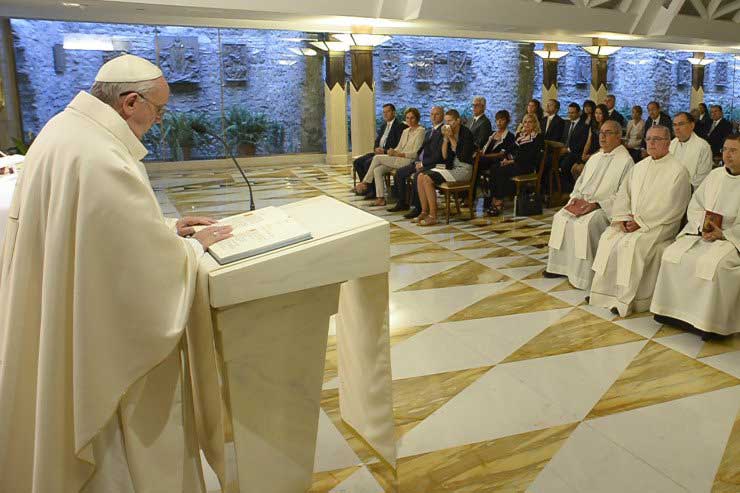
Pope Francis During Mass in Santa Marta
Pope Francis During Mass in Santa Marta © L'OSSERVATORE ROMANO
Pope Francis has explained what makes a ‘good shepherd.’
According to Vatican Radio, Pope Francis gave this reminder today, Oct. 30, 2017, during his daily morning Mass in his residence Casa Santa Marta, as he reflected on today’s Gospel from St. Luke.
In the reading, Jesus meets a woman in the synagogue who, for years, has been crippled and is unable to stand up straight. Jesus did five things: He saw, called, spoke to, laid hands on and cured her. These five actions, the Argentine Pope noted, illustrate a good shepherd.
Jesus, the Pope stressed, was constantly rebuked by the doctors of the Law, the Pharisees and Sadducees, for this closeness. However, their not being genuinely interested in their people and being closed off in their own worlds made it impossible for them to ever be good shepherds, the Pope observed. They were more interested in money, Francis said.
Such people, the Holy Father reminded, are hypocrites since they are not interested in their people, but became offended when Jesus accuses them of their misdoings.
On the other hand, Francis said, Jesus felt compassion for the marginalized and was close to his people. Whether someone was poor, sick, a sinner or leper, the Pontiff said, Jesus was always there.
Likewise, God teaches us to be close to others, the Pope reminded. Good shepherds do as Jesus did, they show mercy and make themselves a servant to others.
The good shepherd, Francis continued, sees, calls, speaks, touches and heals.
Pope Francis concluded, saying that just as God came close to us through Jesus Christ, “all of us will be judged by how we try to be close to those who are hungry, sick, in prison or in any kind of need.”

Sunday, October 29, 2017

New Orleans Saints 2017; better than expected; still not good enough

So the 2017 season has taken a decidedly surprising turn with a now 5 game winning streak.  Nobody, and I really believe nobody, saw this coming.  The Saints have been 7-9 since like forever and have never been above .500 since the end of the 2013 season.  Then this team marches out for the regular season and are absolutely spanked by the Vikings and the Patriots at home.  Both of these games were complete butt whippings and both offense and defense had tons of question marks.  Another 7-9, or worse, seemed imminent.  I had predicted just that and had even opined that the Saints could be as bad as 6-10.

And then it began.  A where have you been lately defense showed up and the offense starting clicking; down goes Carolina, then the Dolphins, shut out and shut down by the Saints defense.  Surely these were anomalies and the upcoming games against the Lions and Packers would prove that.  But the Saints came out strong against the Lions; the defense created scoring opportunities early and often and the Saints commanded 20+ point leads most of the day.  Then it turned into a track meet and all of a sudden the Saints could not stop anything and you had that sinking feeling that we could lose this.  But the Saints held ground and made that victory happen.  Next up, Green Bay on the road but breaking news, Aaron Rogers is out for the year.  What!  Bad news for him but great news for the Saints; they get the victory, 4th in a row in Lambeau Field.  Today it was Chicago and the Saints, on paper, should be far superior.  Today they won, despite trying to give this one away to the eager Bears.  Despite turnovers and big gains against this defense, the Saints manage to pull off the win and are sitting at the improbable 5-2 and 1st place in NFC South.

Here are some Saintly reasons why:  incredible improvement by Saints defense, especially when compared to recent years.  And this is just since week 3.  Great pressure, solid tackling, yet the line can still get gashed for those long runs that drive you nuts.  Linebacker play has been solid but the best improvement is in the d-backfield.  This rookie Lattimore is a stud and everyone else is playing well too.  Very encouraging.  And on special teams this Lutz guy has turned out to be pretty accurate lately so there is that!

But I still believe they are still not good enough.  Now when I say that I mean to be included among the NFL elites.  Sure they are a 1st place team for 2 weeks in a row but to stay there will take much improvement and hard work.  I still believe, on paper and in theory that Atlanta is a more talented team and Carolina will be tough and more than willing to revenge us here in the rematch.  Some of the reasons I think we are still not good enough:  the Ingram curse bit us today and is capable of coming around at any time, the injury to Larry Wofford, the absence of Willie Snead, the incredible ho-hum play of TE Fleener.  Drew Brees, as great as he once was and as good as he still may be, must shut down the interceptions.  Defensively there is something needed to be done to shut down the big play, especially the run right up the middle.  In the d-backfield I am still concerned about the overall play skills of Bell and Williams.  Perhaps Williams will get it; this is year #2 for Bell.

I know some will say I am nitpicking and being too negative and that's ok.  I will state again, at this point of the season I'm thinking 3-4 at best.  Winning is great and resolves a lot of issues.  What is most important here is that the Saints keep improving and every week take steps forward.  I am not so sure that happened from last week to this week but indeed they won!

So here the Saints sit at 5-2 and far above anyone's expectations.  Am I ready to amend my overall record prediction?  Yep; I'm conservative and still see warts so I'll go with 8-8.  And I'm doing this on purpose!  The way this year has played out they will probably beat my record so let's go with that strategy.

Geaux Saints; I am pleasantly surprised and do whatever you have to do to make me say, good enough now!

Sunday Angelus Address on the Great Commandment

Angelus Address: On the Great Commandment
‘You Shall Love the Lord your God with All your Heart, and with All your Soul, and with All your Mind and Your Neighbor as Yourself’

Angelus 10 29 17 CTV Screenshot
Here is a ZENIT translation of the Address Pope Francis gave today before and after praying the midday Angelus with those gathered in St. Peter’s Square.
* * *
Before the Angelus
Dear Brothers and Sisters, good morning!
This Sunday’s liturgy presents to us a brief but very important evangelical passage (Cf. Matthew 22:34-40). The evangelist Matthew recounts that the Pharisees came together to put Jesus to the test. One of them, a Doctor of the Law, asked Him this question: “Teacher, which is the great commandment in the Law?” (v. 36). It’s an insidious question because in the Law of Moses more than six hundred precepts are mentioned. How can one distinguish, among all these, the great commandment? However, Jesus has no hesitation and answers: “You shall love the Lord your God with all your heart, and with all your soul, and with all your mind.” And He adds: “You shall love your neighbor as yourself” (vv. 37.39).
Jesus’ answer is not a given because, among the many precepts of the Jewish Law, the most important were the Ten Commandments, communicated directly by God to Moses, as conditions of the pact of the Covenant with the people.  However, Jesus wants it understood that without the love of God and of one’s neighbor there isn’t true fidelity to this Covenant with the Lord. You can do many good things, fulfill many precepts, many good things, but if you don’t have love it’s all for nought.
It’s confirmed by another text of the book of Exodus, called “Code of the Covenant,” where it states that one can’t be in the Covenant with the Lord and mistreat those that enjoy His protection. And who are those that enjoy His protection? The Bible says: the widow, the orphan, the stranger, the migrant, namely, the people most alone and vulnerable (Cf. Exodus 22:20-21). Answering those Pharisees who had questioned Him, Jesus tries to help them put their religiosity in order, to re-establish what really counts and what is less important. Jesus says: “On these two commandments depend all the Law and the Prophets” (Matthew 22:40). They are the most important and the others depend on these two. And Jesus in fact lived His life precisely thus: preaching and doing what really counts and is essential, namely, love. Love gives impetus and fruitfulness to life and to the journey of faith: without love, life and faith remain sterile.
What Jesus proposes in this evangelical page is a stupendous ideal, which corresponds to the most authentic desire of our heart. In fact, we were created to love and to be loved. God, who is Love, has created us to make us participants in His life, to be loved by Him and to love Him and, with Him, to love other people. This is God’s “dream” for man. And, to realize it, we need His grace; we need to receive in ourselves the capacity to love, which comes from God Himself. Jesus offers us the Eucharist in fact for this. In it we receive Jesus in the greatest expression of His love, when He offered Himself to the Father for our salvation.
May the Holy Virgin help us to receive in our life the “great commandment” of love of God and of our neighbor. In fact, even if we have known it since we were children, we will never end being converted to it and putting it into practice in the different situations in which we find ourselves.
[Original text: Italian]  [ZENIT’s translation by Virginia M. Forrester]

 After the Angelus
Dear Brothers and Sisters,
Giovanni Schiavo, priest of the Fathers of St. Joseph of Murialdo, was proclaimed Blessed yesterday at Caxias do Sul, Brazil. Born in the early 1900s in the hills of Vicenza, as a young priest he was sent to Brazil, where he worked zealously at the service of the people of God and of the formation of men and women religious. May his example help us to live fully our adherence to Christ and to the Gospel.
I greet you all affectionately, Italian pilgrims and those from various countries, in particular, those form Ballygawley (Ireland), Salzburg (Austria) and from the Traunstein and Berchtesgaden region (Germany). I greet the participants in the congress of the Italian Secular Institutes, whom I encourage in their witness of the Gospel in the world, and the FIDAS Blood Donors Association of Orta Nova (Foggia). I see there are Colombians there!
I greet the Togolese community in Italy, as well as that of Venezuela with the image of Our Lady of Chiquinquira, the “Chinita.” We entrust to the Virgin Mary the hopes and legitimate expectations of these two nations!
I wish you all a good Sunday. Please, don’t forget to pray for me. Have a good lunch and goodbye!

Homily for 30th Sunday in OT Year A

I delivered this homily three years ago; who is my neighbor?


Lucy and Ricky had Fred & Ethel, Archie Bunker had the Jefferson’s and Tim “the tool man” Taylor had the eccentric Wilson.  Neighbors!!  Everybody has them.  Mr. Rogers had a whole neighborhood full of them!  Knowing our neighbors is important and loving our neighbors; ah, that may be a whole other story.

Let me tell you about a special neighborhood, filled with special neighbors in the town of West Jordan, Utah.  An entire neighborhood came together to celebrate a little boy’s birthday with a party and parade and cake and ice cream and balloons; yet it was not the little boy’s birthday.  Then a few days later, the entire neighborhood came together to celebrate Halloween for this same little boy with a block party and costumes and trick or treating; yet it was not Halloween.  Then just yesterday the entire neighborhood came together to celebrate Christmas Eve for the little boy; they decorated every house in the neighborhood with lights and gathered together awaiting the arrival of Santa!  And today they celebrated Christmas Day with the little boy, complete with toys and gifts and a feast.  We all know it is not Christmas Eve or Christmas Day. 

These neighbors were responding to the life story of 4 year old Ethan van Leuven, diagnosed 2 years ago with a rare form of cancer.  Recently Ethan’s mom & dad were given very sad news; he only had about 2 weeks to live.  As the neighbors found out, everyone came together to make sure little Ethan would get to celebrate every holiday possible, one last time.  Tomorrow it will be New Year’s Eve!  What neighbors!  What love!  What a gift!  And the greatest present they all are giving to Ethan is their presence, presence filled with love.

As people of faith, Jesus tells each of us to love God with our whole everything and oh, by the way, love your neighbor as yourself!

In this 22nd chapter of Matthew, we find the Pharisees still trying to trap Jesus with his own words.  Last week he silenced the Sadducees with his answer about the coin and paying taxes, this week he silences the Pharisees with this incredible answer.  You see the Pharisees were not just asking Jesus to pick a favorite commandment from the 10 Commandments, they wanted him to recall from the 613 ritual laws and commandments found in the Torah, which command was the greatest.  Jesus simply says: “You shall love the Lord your God with all your heart, soul and mind.  This is the greatest commandment.  The second is like it.  You shall love your neighbor as yourself. 

Jesus took the whole law and the prophets, everything the Pharisees would know well, and teaches that love of God, while first, can hardly be separated from love of neighbor.  Love of God is evidenced by how we love our neighbor.  Now we may indeed love our next door neighbor, and we all would probably rush to the aid of a neighbor like little Ethan van Leuven.  But who is our neighbor?  What does Scripture say and the Church teach when we ask: who is my neighbor?

We glimpse a hint in our 1st reading today, from Exodus: widows, orphans, aliens, the poor.  Yes, our neighbor in Jesus’ neighborhood is often the marginalized, the discriminated, the oppressed, the beaten down, the misunderstood, the seemingly unlovable, the outcast, those who the world deems the worst of the worst.  And if we profess to love God, Jesus tells us, just like loving God, love them too.  How can we love them?  Like those neighbors in West Jordan, Utah, love them with our whole being; with our everything!  Be the present of presence.  For these neighbors we must be a solid example of our Christian witness.  Pray for them; do acts of kindness for them.  I am still the beneficiary of neighbors, dear friends, who cut my grass and take care of my yard, as they recognize my need of time spent in various ministries.  For me, my dearest neighbors are those men in Rayburn Prison, those men that the world would rather throw away or simply forget about.  And to me, they love me as their neighbor.

In the week ahead, can we spend some quiet time and truly examine: how do I demonstrate my love for God, a love that must be with my whole heart, my whole mind, and my whole soul.  Would others know I love God by the way I love my neighbor? Examine in that same quiet time: do I love those who don’t look like me, act like me, or even worship like me?  Do I love my neighbor next door, and do I love my neighbor half-way around the country and even half-way around the world?  And remember, that love of neighbor Jesus speaks of includes our own loved ones and family, even those who have let us down or may be estranged.  If this be the case, these great commandments compel us to reconcile.  Do we need to reconcile with someone?  Re-read this Gospel, in the week ahead, for the faith and courage needed to take the first step toward that reconciliation!

The Ricardo’s and the Mertz’s; the Bunker’s and the Jefferson’s; the Taylors and Wilson!  Yep, neighbors.  Who is our neighbor?  What does my neighborhood look like?  I hope it looks like that of Ethan van Leuven.  And as Mr. Rogers might ask: would you be mine, could you be mine, won’t you be my neighbor; and as Jesus might ask: won’t you love my neighbors!