Friday, May 5, 2017

One of the earliest Carmelites and a martyr for the faith

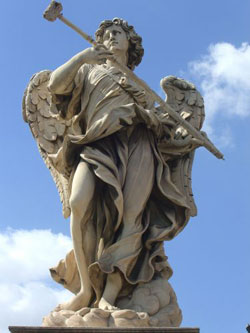
St. Angelo


Image of St. Angelo

Facts

Feastday: May 5
Birth: 1185
Death: 1220


St. Angelo, who was one of the early members of the Carmelite Order, suffered martyrdom for the Faith at Leocata, Sicily. The story of his life, as it has come down, is not very reliable. It may be summarized as follows: His parents were Jews of Jerusalem who were converted to Christianity by a vision of our Lady. She told them that the Messiah they were awaiting had already come to pass and had redeemed His people, and she promised them two sons, who would grow up as flourishing olive trees on the heights of Carmel-the one as a patriarch and the other as a glorious martyr. From childhood the twins displayed great mental and spiritual gifts when, at the age of eighteen, they entered the Carmelite Order, they already spoke Greek, Latin, and Hebrew. After Angelo had been a hermit on Mount Carmel for five years, Our Lord appeared to him and bade him go to Sicily, where he would have the grace to offer the sacrifice of his life. The saint immediately obeyed the call. During his journey from the East as well as after his arrival in Sicily, he converted many sinners by his teaching, no less than by his miracles. At Palermo over two hundred Jews sought Baptism as the result of his eloquence. Similar success attended his efforts in Leocata, but he aroused the fury of a man called Berengarius, whose shameless wickedness he had denounced. As he was preaching to a crowd, a band of ruffians headed by Berengarius broke through the throng and stabbed him. Mortally wounded, Angelo fell on his knees, praying for the people, but especially for his murderer.

Thursday, May 4, 2017

Beatification announced for American Priest

Pope Francis announces beatification of Detroit priest Father Solanus Casey

Casey now one step closer to sainthood


DETROIT - It has been 60 years since Father Solanus Casey died, but his life's work lives on in Metro Detroit.

Now, Pope Francis is recognizing the Catholic priest's dedication to his community with one of the highest declarations the church can make: beatification. Casey was a member of the Capuchin Franciscan Order of St. Joseph in Detroit and one of the co-founders of the city’s Capuchin Soup Kitchen


"On behalf of the Archdiocese of Detroit and the Capuchin Franciscan Order of St. Joseph in Detroit, we are humbled and overjoyed by this momentous announcement," the Archdiocese of Detroit announced in a statement Thursday morning.
The Catholic Dictionary defines beatification as:
A declaration by the Pope as head of the Church that one of the deceased faithful lived a holy life and/or died a martyr's death and is now dwelling in heaven. As a process, the beatification consists of a years-long examination of the life, virtues, writings, and reputation for holiness of the servant of God under consideration.
This is ordinarily conducted by the bishop of the place where he or she resided or died. For a martyr miracles worked through the person's intercession need not be considered in this primary process. The second, or Apostolic, process is instituted by the Holy See when the first process reveals that the servant of God practiced virtue in a heroic degree or died a martyr for the faith. Beatified persons are called "Blessed" and may be venerated by the faithful but not throughout the universal Church.
Casey's admirers have been pointing to many miracles to support sainthood for the priest who died in 1957. This recognition from Pope Francis could be a step closer to making sainthood a reality for Casey. A panel of doctors must rule out a scientific explanation for the history of healing attributed to the Capuchin priest.
Casey was declared venerable in 1995, the first American man to have that distinction. One must be declared venerable and blessed before sainthood can be declared. Casey joined Detroit's Order of Friars Minor Capuchin in 1897 and struggled through his seminary studies before being ordained a priest in 1904 at the age of 33.

From today's press conference in Detroit:

At 10:30 this morning in Rome, the Holy Father Pope Francis received in audience His Eminence Cardinal Angelo Amato, S.D.B., prefect for the Congregation of the Causes of Saints. During this audience, the Holy Father authorized the Congregation for the Causes of Saints to promulgate the following decree regarding a miracle, attributed to the intercession of the Venerable Servant of God Solanus Casey, professed priest of the Order of Friars Minor Capuchins; born November 25, 1870 and died July 31, 1957.
Father Solanus Casey was a member of the Capuchin Franciscan Order of St. Joseph in Detroit and one of the co-founders of the city’s Capuchin Soup Kitchen.
"The beatification of Father Solanus Casey is an incomparable grace for the Church in the Archdiocese of Detroit and for the whole community of Southeast Michigan,” stated Archbishop Allen H. Vigneron, Archdiocese of Detroit. “He is an inspiration to all us Catholics – and to all – of the power of grace to transform one’s life.”

“Long before we knew and loved Pope Francis, we had the example of Fr. Solanus who lived the Gospel of Mercy,”

Pope reminds Church to get up and go

During Morning Homily, Pope Reminds Church of 3 Responsibilities
At Casa Santa Marta, Francis Reminds How Church Ought to Be Joyful, Listen to Restlessness, and Must Be Ready to ‘Get Up and Go’
Pope Francis celebrates Mass in Santa Marta
PHOTO.VA - OSSERVATORE ROMANO
Pope Francis has highlighted three needed characteristics of the Church: to be on her feet, listen to the ‘restlessness’ of the people, and be joyful.
According to Vatican Radio, Pope Francis underscored this today, May 4, 2017, during his daily morning Mass at Casa Santa Marta.
The Pope’s homily noted how in the first eight chapters of the Acts of the Apostles, the Pope said, “there is a summary of the whole history of the Church,” including preaching, baptism, conversion, miracles, persecution, joy, but also the “ugly sin of those who join themselves to the Church for their own ends.
Drawing inspiration from today’s readings, Francis first emphasized that from the beginning, the Lord accompanied His disciples. With miraculous signs, He confirmed the Word, Francis said, pointing out that even in the worst of moments, He never left them alone.
“Get up and go,” “Listen to the Restlessness”
Pope Francis then focused on three phrases taken from the reading, the first being the angel’s words to Philip: “Get up and go.”
Noting that this is a sign of evangelization, Francis reminded that the “vocation” and “great consolation of the Church” is to evangelize.
“But in order to evangelize: ‘Get up and go!’ One doesn’t say: ‘Stay seated, calm, in your house’: No! In order to be faithful to the Lord, the Church should always be on its feet and on the journey: ‘Get up and go.’ A Church that does not rise up, that is not on the journey, is sick.”
Noting that this can cause the Church to be closed in on itself, even into “a little world of gossiping, of things… closed, without horizons,” he stressed,  the Church must “get up and go.”
“Go up and join with that chariot,”
The next expression Pope Francis noted was the second message Philip received from the Spirit: “Go up and join with that chariot.”
In the chariot was an Ethiopian, a proselyte of the Jewish religion, a eunuch who had come to Jerusalem to worship God. As he travelled, he was reading the prophet Isaiah, a passage concerned with the conversion of a “finance minister.” Philip was called by the Spirit called to join himself to that man, Francis highlighted, to emphasize how important it was for the Church to know she must listen to the restlessness in the heart of every man.
“All men, all women have a restlessness in their hearts – they may be good or bad, but there is a restlessness. Listen to that restlessness,” Francis observed. “It’s not saying: ‘Go out and proselytise.’ No, no! ‘Go and listen.’ Listening is the second step. The first: ‘Get up and go’; the second: ‘Listen.’
“That ability to listen: What do people feel? What does the heart of the people feel? What does it think? But do they think mistaken things? But I want to hear these mistaken things, in order to understand where the restlessness is. We all have this restlessness within.”
Therefore, the second step for the Church, Francis reiterated, “is to find the restlessness of the people.”
It is, then, the Ethiopian himself who, seeing Philip approach, asks who the prophet is speaking about, and asks him to join him in the chariot. And so, the Pope said, Philip began to preach “with meekness.” The restlessness in the heart of that man found an explanation that responded to the hope in his heart.
This was possible, Pope Francis continued, “because Philip joined him and listened to him.”
Joy of the Christian
This “joy of the Christian,” Pope Francis said, is the third “word” or “expression” from the reading.
While the Ethiopian listened, the Jesuit Pope explained, the Lord was working within him. In this way, the man understood that the Prophet Isaiah was speaking of Jesus.
His faith in Jesus then grew to such a point that when they arrived at a place where there was water, he asked to be baptized. “He asked for Baptism because the Lord had worked in his heart,” the Pope said.  After he had been baptized, when the Spirit took Philip and bore him away, the eunuch continued on his way, filled with joy, the Pope noted.
Pope Francis concluded his homily, praying, “May the Lord give to all of us the grace to live the Church in this way: on our feet and going out, listening to the restlessness of the people, and always in joy.”

Wednesday, May 3, 2017

Martyrs in England because they killed you for being Catholics

85 Martyrs of England and Wales


Facts

Feastday: May 4
Beatified By: 22 November 1987 by Pope John Paul II


The Eighty-five Martyrs of England and Wales are a group of men who were executed on charges of treason and related offences in the Kingdom of England between 1584 and 1679. They are considered martyrs in the Roman Catholic Church and were beatified on 22 November 1987 by Pope John Paul II.

Wednesday General Audience with Pope Francis

Pope at General Audience: ‘I Saw the Beauty of the Church in Egypt’
To Pilgrims in St. Peter’s Square, Prays: ‘May the Holy Family, who once found refuge in Egypt, bless and protect its people with prosperity, fraternity and peace’
CTV Screenshot
‘May the Holy Family, who once found refuge in Egypt, bless and protect its people with prosperity, fraternity and peace.’
Pope Francis gave this advice during his weekly General Audience in St. Peter’s Square, his first since his April 28-29 trip to Egypt, which marked his 18th Apostolic Visit abroad and 27th country visited.
It also marked the second time that a Pope goes to the north African nation, after the visit of St. Pope John Paul II in 2000.
As he usually does following Apostolic Journeys, the Pontiff’s catechesis focuses on his recent trip.
In addition however, ahead of his upcoming Apostolic Visit to Fatima, May 12-13, for the centenary of the Marian apparitions, the Holy Father also took into account that it is May, Mary’s month, and encouraged all faithful to pray to her, especially with the rosary.
In his catechesis, the Pope recalled that he had been invited to Egypt by its President, the Coptic Orthodox Patriarch, the Grand Imam of Al-Azhar and the Catholic Coptic Patriarch, and thanked all those who helped in planning and organization.
“I saw the beauty of the Church in Egypt,” Francis highlighted. Especially at Mass with the Catholic community, and in my meeting with priests, religious and seminarians, he noted, “I encouraged everyone to persevere in the hope of the Gospel.”
Egypt has some 90 million inhabitants, a majority of whom, at least 85%, are Muslims. About 10% of the population are Orthodox Coptic Christians. The Catholics, who are broken up between Coptic Catholics and different rites: Coptic, Latin, Armenian , Melkite, Maronite, Syro-Catholic, etc., make up less than 1% of the population. Their bishops are gathered in the Assembly of the Catholic Hierarchy presided over by the Coptic Catholic Patriarch of Alexandria, Ibrahim Isaac Sidrak.
The Holy Father pointed out that his meeting with the Grand Imam, and his message to the International Conference for Peace, “recalled that peace is the fruit of an education to wisdom and a humanism that respects the religious dimension of our existence.”
Our Covenant With God
“Our covenant with God, grounded in the commandment of love of God and neighbour, inspires our efforts to build a just and peaceful civil order in which all have a part to play.”
“Egypt’s great cultural and religious heritage,” Francis said, “gives the nation a special role in this work of peacemaking.”
Turning to his meeting with the Coptic Orthodox Patriarch, Pope Tawadros II, Francis noted: “we reaffirmed our mutual commitment to unity and prayed together for the victims of the recent attacks.”
During the two-day journey, the Pope was accompanied by Cardinal Pietro Parolin, Secretary of State, Cardinals Leonardo Sandri, Prefect of the Congregation for Eastern Churches and Kurt Koch, President of the Pontifical Council for Unity, and Apostolic Nuncio in Egypt, Bishop Bruno Musaró. The interpreter of the Pope was his private secretary, official of the secretariat of state, Msgr. Yoannis Lahzi Gaid, a Catholic Coptic priest of the Patriarchate of Alexandria.
***
On ZENIT’s Web page:
Full Text of General Audience:  https://zenit.org/articles/general-audience-on-popes-visit-to-egypt/

The Feast Day of two Apostles

Feast of Saint Philip and Saint James, Apostles
Saints Philip and James

May 3rd, is the feast of Saint Philip and Saint James. St. Philip was born in Bethsaida and may have been a disciple of John the Baptist. He was called by Jesus himself and brought Nathaniel to Christ. Scripture records he was present at the miracle of the loaves and the fishes just before the Lord’s Passion. Jesus answered Philips’ request to show the apostles the Father. No further mention of Philip is made in the New Testament beyond his being listing among the apostles awaiting the Holy Spirit in the upper room. According to tradition, he preached in Greece and was crucified upside down at Hierapolis under the Emperor Domitian.

St. James the Lesser, the author of the first Catholic epistle, was the son of Alpheus or Cleophas. His mother Mary, was a close relative of the Blessed Virgin, and for that reason, according to Jewish custom, he is sometimes called the brother of the Lord. He held a distinguished position in the early Christian community of Jerusalem, as a pillar of the Church. Saint Paul testifies that James was favored by an appearance of the Risen Christ (I Cor. 15:7). Popular piety contends he was the first bishop of Jerusalem. In that capacity, he attended the Council of Jerusalem, Christianity's first episcopal council, in the year 50 AD.

The Divine Office contains this moving description of his death. "When he was ninety-six years old and had governed the Church for thirty years in a most holy manner, the Jews sought to stone him, then took him to the pinnacle of the temple and cast him off headlong. As he lay there half dead, with legs broken by the fall, he lifted his hands toward heaven and prayed to God for the salvation of his enemies, saying: Lord, forgive them for they know not what they do! While the apostle was still praying, a fuller struck his head a mortal blow."

His relics rest next to those of St. Philip in the Church of the Holy Apostles in Rome, and their names are mentioned in the first list in the Canon of the Mass. James and Philip are very human disciples who ultimately display heroic virtue in establishing the Church. They remind us that faith and holiness are entirely gifts from Our Heavenly Father. O God, who gladdens us each year with the feast day of the Apostles Philip and James, grant us, through their prayers, a share in the Passion and Resurrection of your Only Begotten Son, so that we may merit to behold you for eternity. Through our Lord Jesus Christ, your Son, who lives and reigns with you in the unity of the Holy Spirit, one God, for ever and ever.
You might also like:

Tuesday, May 2, 2017

Tuesday Papal Preaching

Pope’s Morning Homily: ‘The Lord Softens Those With Hard Hearts’
At Casa Santa Marta, Francis Reminds Closed Hearts Cannot Allow Spirit to Enter
Pope Francis celebrates Mass in Santa Marta
PHOTO.VA - OSSERVATORE ROMANO
“The Lord softens those with hard hearts, those who condemn all who are outside the law.”
According to Vatican Radio, Pope Francis underscored this today, May 2, 2017, during his daily morning Mass at Casa Santa Marta.
The Pope’s homily focused on today’s first reading, in which St Stephen was stoned to death by the temple authorities in Jerusalem. Those who stoned Stephen to death, the Pontiff noted, did not understand the Word of God. He also noted that Stephen had called them “circumcised of heart,” the equivalent of calling someone a pagan.
There are different ways of not understanding the Word of God, the Jesuit Pope pointed out.
For example, he noted, when Jesus had met the two disciples on the road to Emmaus, he had called them “fools.” This, the Pontiff noted, was not an expression of praise, but it was also not a strong word either, unlike Stephen’s expression.
Hearts of Stone
“They did not understand, they were afraid, because they did not want problems, they had fear, but they were good men, open to the truth” said the Pope.
“And when Jesus rebuked them, they let his words enter them and their hearts burned within them, whilst those who stoned Stephen were furious and did not want to listen!”
This  is, the Pope stressed, the drama of the closed hearted.
The Jesuit Pontiff recalled how in Psalm 94, the Lord admonished his people not to harden their hearts. The prophet Ezekiel, Francis said, makes a “beautiful promise” to change the heart of stone into a heart of flesh, a heart that knows how to listen and receive the witness of obedience.
“This causes suffering in the Church. The closed hearts, the hearts of stone, the hearts which do not want to be open, do not want to hear, the hearts which only know the language of condemnation.”
“They know how to condemn, they do not know how to say ‘Explain it to me, why do you say this? Why this? Explain it to me.’ No, they are closed. That’s all they know. They have no need of explanations,” said Pope Francis.
Closed Hearts Cannot Let Spirit In
The rebuke that Jesus speaks of also led to the killing of the prophets, “because they spoke to you what you did not want to hear. A closed heart cannot let the Holy Spirit enter in.”
“There was no place in their hearts,” Francis observed, “for the Holy Spirit.
The letter today, the Jesuit Pontiff recalled, speaks of how Stephen was filled with the Holy Spirit, had understood everything, and was a witness to the obedience of the Word made flesh, and this was done by the Holy Spirit. “He was filled,” the Pope said.
“A closed heart, a hardened heart, a pagan heart, doesn’t let the spirit in and feels himself in himself.”
The Pope underscored that the disciples on the road to Emmaus represent us, “with our many doubts, many sins. Many times we want to move away from the Cross, from the truth, but let us make space to hear Jesus, who makes our hearts burn.
“The other group, who are closed in the rigidity of the law, who do not want to hear Jesus, are saying worse things than Stephen did,” he said.
A Reflection
The Pope concluded with the following reflection on the meeting between Jesus and the woman caught in adultery.
“Today, we look at the tenderness of Jesus, the witness of obedience, that great witness, Jesus, who has given life, which makes us look for the tenderness of God, confronting us, our sins, our weaknesses.
“Let us enter this dialogue and let us call for the grace of the Lord which softens the rigid hearts of those people who are always closed in the law and condemn all who are outside the law. They do not know that the word became flesh, that the word is a witness to obedience. They do not know the tenderness of God and his ability to take out the heart of stone and replace it with a heart of flesh.”

Monday, May 1, 2017

This Church Father defeated the heresy of Arianism

Saint Athanasius of Alexandria

Byzantine icon of Saint Athanasius of Alexandria, author unknownAlso known as
  • Athanasius of Egypt
  • Athanasius the Great
  • Champion of Christ’s Divinity
  • Champion of Orthodoxy
  • Father of Orthodoxy
  • Greek Doctor of the Church
  • Holy Hierarch
  • Pillar of the Church
Memorial
Profile
Studied the classics and theology in Alexandria, Egypt. Deacon, secretary, and student of bishop Alexander of Alexandria. Attended the Council of Nicea in 325 where he fought for the defeat of Arianism and acceptance of the divinity of Jesus. Formulated the doctrine of homo-ousianism which says that Christ is the same substance as the Father; Arianism taught that Christ was different from and a creation of the Father, a creature and not part of God. Bishop of Alexandria c.328; he served for 46 years. When the dispute over Arianism spilled over from theology to politics, Athanasius got exiled five times, spending more than a third of his episcopate in exile. Biographer of Saint Anthony the Abbot and Saint Potamon of Heraclea. Confessor of the faith and Doctor of the Church, he fought for the acceptance of the Nicene Creed.
Born
Died

On this feast of St. Joseph the Worker we pray the Litany of Work

Litany of Work: Saint Joseph, the Worker


With St. Joseph the Worker, we praise you, O Lord.

We give thanks to God for the work of our lives,
For the work of our hands,
For the work of our minds,
For the work of our hearts,
For the enlightening work of teachers, librarians, students, and coaches,
For the healing work of doctors, nurses, and counselors,
For the creative work of artists, musicians, painters, and sculptors,
For the precise work of engineers, scientists, and computer specialists,
For the nurturing work of homemakers, parents, and guardians,
For the wise work of retirees and grandparents,
For the proclaiming work of writers, photographers, editors, and publishers,
For the trustworthy work of accountants, bankers, lawyers, politicians, and salespeople,
For the faith-filled work of ordained, religious, and lay ministers,
For the protective work of police, firefighters, and military personnel,
For the dedicated work of secretaries, receptionists, and bookkeepers,
For the compassionate work of volunteers,
For the fruitful work of farmers, fishers, growers, and gardeners,
For the judicious work of managers, administrators, directors, and supervisors,
For the steadfast work of those who manufacture products,
For the constructive work of builders, surveyors, architects, masons, and carpenters,
For the efficient work of those who transport people and things by bus, train, plane, taxi, and boat,
For the hospitable work of cooks, waiters and waitresses, cashiers, hotel and motel workers,
For the clarifying work of television, radio, and news media workers,
For the dependable work of telephone and postal workers,
For the good work of all other co-workers,
For our work which sheds light in the darkness,
For our work which crates order from chaos,
For our work which builds peace out of hostility,
For our work which helps others,
For our work which empowers others,
For our work which inspires others,
For our work which builds the Reign of God,
Let us pray:
Joseph, it was to you that the Father entrusted his Son and the Virgin Mother. Continue to be the sign of the Father's love for us.
Form us in the ways of work as you formed Christ, so that we may labor for the building of the City of God.
Teach us a profound respect for the mystery of creation and a reverence for the Father's presence in the material world around us.
Help us bear witness to the sanctity of work in our daily living.
May God grant us this grace through your intercession in union with Jesus and Mary.
Amen