Tuesday, September 29, 2015

Archbishop Aymond shares memories of his time with Pope Francis

Pope Francis described as 'bridge builder' by Archbishop Gregory Aymond, paper reports


Archbishop Gregory Aymond of New Orleans
New Orleans Archbishop Gregory Aymond. (NOLA.com | The Times-Picayune archives)                                             
 
Kim Chatelain, NOLA.com | The Times-Picayune By Kim Chatelain, NOLA.com | The Times-Picayune The Times-Picayune
Email the author | Follow on Twitter
on September 29, 2015 


Archbishop Gregory Aymond, who saw Pope Francis at three events during a visit last week to Washington, D.C., said he came away from that trip with an image of the pope as "bridge builder" who believes "we must be united as a society and as a church," according to the Clarion Herald. He described the pope's address to Congress as strong, but at the same time gentle.
"He didn't come across in any way with a preachy tone," Aymond said in the Clarion Herald question and answer piece. The archbishop said he thought Pope Francis was "brilliant" in using the examples of President Abraham Lincoln, Dr. Martin Luther King, social activist Dorothy Day and Catholic writer Thomas Merton to talk about fundamental American moral values.
Click here to read the entire Clarion Herald item.

Even though this article was written in 2008, it cleary explains why we have a Pope. My summary: because Jesus said so and it's in the Bible!

Why Do Catholics Have a Pope?

  • Sarah PhillipsCrosswalk.com Contributing Writer
  • 2008
                                          
Why Do Catholics Have a Pope?                
    Editor's note: This piece first ran in 2008 when Pope Benedict XVI visited the U.S. We're re-running it in light of Pope Francis's 2015 visit.
    Pope: From the Greek word papas, a term of endearment meaning "papa" or "daddy."
    With the recent, historic visit of Pope Benedict XVI to the U.S., many Christians may be wondering what exactly Catholics believe about the robed figure with the German accent and his line of predecessors. Why do Catholics have a Pope? Do Catholics worship him? Is his authority political, spiritual, or is he just a figurehead?
    While I had a basic understanding of the Catholic papacy before his visit, I didn't fully grasp it. So, in an effort to better understand this central figure in Christendom and to help Christians more effectively dialogue, I dove into some heady reading materials from both Catholic and non-Catholic sources. Hopefully, my explanation here will offer some clarity on what Catholics really believe.
    First, a summary: For Catholics, the Pope is more than a ceremonial leader. The Pope is considered the spiritual successor to the Apostle Peter. As successor to the "Chair of Peter," he is the Supreme Pastor of the Catholic Church, God's steward ordained to authoritatively teach, unify, and protect God's people, keeping them free from error and deception (CCC 882, 890).
    Of his many official titles, the Pope is the Bishop of Rome and the head of the Magisterium (the teaching authority of the Church made up of the college of Bishops). He holds the final word on matters of faith and morals (known as "papal infallibility"). In the words of the Catechism of the Catholic Church (937): The Pope enjoys, by divine institution, 'supreme, full, immediate, and universal power in the care of souls' (CD 2)."
    There's a lot of strong wording here, but before we dive into some of the details, it's important to clarify that Catholics, in fact, do not worship the Pope or see him as a replacement of Christ or the Heavenly Father. From the Catholic perspective, the office of the papacy affirms Christ's Kingship and the Church's confidence in the Holy Spirit to guide believers. So, to fully understand the relationship Catholics have with the man they call both "Papa" and "Supreme Pontiff," let's look at a source all Christians have in common: Scripture.
    Matthew 16: 13-19
    While Catholic doctrine pulls from many Scriptures when defining Church authority, Matthew 16:13-19 is one of the most important. Indeed, Catholic teachings point to Matthew 16: 18 as the moment when Christ officially instituted Peter as the first Pope, so it's worth spending the bulk of our time here.
    The scene opens with Jesus and the Twelve in the region of Caesarea Philippi – an area where ancient pagan worship of the Greek god Pan, the god of Spring and shepherds, once flourished (Ray 1999, 32-33). It was a dramatic place located on the side of a mountain with a sheer rock wall overshadowing the town with Pan's namesake, Paneas. Adding to the already stunning landscape, a temple to the Roman Caesar Augustus stood at the wall's highest point. The scene is ripe with symbolism for Catholics. Catholic apologist Stephen Ray points out, "By choosing this location for the appointment, Jesus clearly shows that he is setting up his divine kingdom in opposition to the worldly kingdom of the Roman Caesars, who claimed divinity for themselves" (1999, 32).
    When Jesus came to the region of Ceasarea Philippi, he asked his disciples "Who do people say the Son of Man is?"
    They replied, "Some say John the Baptist; others say Elijah; and still others, Jeremiah or one of the prophets."
    "But what about you?' he asked. "Who do you say I am?'
    Simon Peter answered, "You are the Christ, the Son of the living God."
    Jesus replied, "Blessed are you, Simon son of Jonah, for this was not revealed to you by man, but by my Father in heaven. And I tell you that you are Peter, and on this rock I will build my church, and the gates of Hades will not overcome it. I will give you the keys of the kingdom of heaven; whatever you bind on earth will be bound in heaven, and whatever you loose on earth will be loosed in heaven."
    The Catholic Church sees three important points here:
    1. The Primacy of Simon Bar-Jonah above the other apostles demonstrated through his divinely-inspired response to Jesus.
    2. The establishment of Simon Bar-Jonah, renamed "Peter," as the Rock from which Christ expressed intention to build His Church.
    3. The handing over of the keys to the kingdom with the authority to "loose" and "bind."
    Simon's divinely-inspired response. While our ears may have become numb to these passages over the centuries, this moment was, no doubt, as dramatic as the surrounding landscape – one on which Protestants and Catholics alike hinge their faith. Jesus' earthly ministry had made waves among the Jews and Gentiles. The apostles here recount how, in awe of Jesus' teaching and miracles, many surmised he must be an Old Testament prophet come back from the dead. But the truth about Jesus' identity was even more astonishing than the rumors, so amazing that even His closest followers had yet to make the connection. When Jesus turns to His chosen twelve to identify Him, Simon Bar-Jonah ("son of Jonah") speaks first among all – a pattern of leadership the Catholic Church teaches can be found throughout the New Testament (CCC 880). In this defining moment, Simon asserts Jesus is not merely a prophet but the Messiah, God Incarnate. The Apostle's astounding profession of faith – directly inspired by the Heavenly Father – leads into Christ's words that for Catholics have had tangible implications to this very day.
    The renaming of Simon. And I tell you that you are Peter, and on this rock I will build my church, and the gates of Hades will not overcome it.
    When a person in the Bible is renamed, it is a sign of God's intention to work in a special way through that individual. Abram became the father of nations after being renamed "Abraham," and Sarai the mother after being renamed "Sarah." Other pivotal renamings in Biblical history include Jacob becoming "Israel" and Saul becoming "Paul."
    In regards to Catholic doctrine, the implication of Simon's new name is easiest to understand when going back to Jesus' native language, Aramaic -- the language scholars believe the original words were spoken (Ray 1999, 34). Unlike modern English and New Testament Greek, the Aramaic word for "Peter" and the word "rock" are identical: Kepha. So this verse, when spoken, would have sounded something like this:
    And I tell you that you are Rock (Kepha), and on this rock (kepha) I will build my church…
    Catholic doctrine asserts that linguistically, Christ links the person and position of Peter – not Himself or a general profession of faith – to the founding of His Church here (CCC 881). While both Christ and the Apostles are referred to as "rocks" (kepha) and "small stones" (Greek, petros) in other areas of Scripture, Catholic teaching points to Peter as the only person in the Bible given the proper name "Kepha," later spelled "Cephas"(Ray 1999, 35).
    While some Christians might see the assertion that Peter was the rock upon which Christ would build His Church as an affront to Christ's Headship and status as the true Rock, Catholics take a different view. To better understand why, let's move to the next Scripture, involving the keys to the kingdom.
    The keys to the kingdom
    I will give you the keys of the kingdom of heaven; whatever you bind on earth will be bound in heaven, and whatever you loose on earth will be loosed in heaven.
    If you've ever seen the official Papal seal, you'll notice a set of golden keys included in it. Catholic teaching puts this verse in context with Isaiah 22:22, where God tells Isaiah to go to King Hezekiah's steward, Shebna, and inform him of God's intention to replace him with Eliakim. In regards to the new steward, Eliakim, God says: I will place on his shoulder the key to the house of David; what he opens no one can shut, and what he shuts no one can open.
    In Old Testament times, the steward of the palace was the king's right-hand man, the second-in-command. When the king was away, the royal steward was keeper of the keys to the kingdom, ruling in the king's stead. While he looked after the affairs of the kingdom as the king instructed, he never replaced the king but awaited his return. When the present steward died (or in this case, when the Almighty intervened), the office was filled by another.
    The office of the Papacy works in the same manner. Catholics believe Christ, to ensure the unity and health of His flock, gave Peter governing authority over His Church by handing over the keys to His Kingdom. Like the ancient "key keepers," Catholics do not believe the Pope is the new king but instead a steward awaiting the King's return. Even the Pope's title "Father" imitates the role and title of the steward of Judah, also called "father." Until Christ's second coming, the keys will be passed on to each successor to the Papal office (Ray 1999, 29-40; CCC 857-860).
    Now, what do the terms "binding" and "loosing" refer to? These words sounded strange to my modern ears, so I looked for some historical context. Apparently, the terms were common in Rabbinic canon-law, representing the legislative and judicial powers held by a Rabbi (Ray 1999, 40). In this context, Catholics view Peter's key-keeping status as one that makes him "Supreme Pastor," with final authority over what is permitted and what is denied in matters of doctrine and spiritual discipline.
    How does Papal Infallibility work?
    The issue of religious authority brings up an often misunderstood doctrine of Catholic teaching: Papal infallibility. We see that Catholics believe the Pope has great authority in matters of the faith, but this doesn't mean that Catholics believe every word the Pope says comes straight from the Heavenly Father like Peter's first pronouncement.
    Papal infallibility refers to the belief that while all Christians have personal access to the Holy Spirit in prayer, Christ promised a unique protection over the Apostles’ teachings, ensuring they would preach without error (John 16:12-15). In order for a papal teaching to be considered free of error or "infallible," the Pope must a) be speaking on a matter of faith and morals (not on his recent vacation plans) and b) make it clear he is speaking from the "Chair of Peter" and that what he is about to say is binding. Back to the concept of guardianship, the Catholic Church teaches that infallible statements are for affirming what has always been true and is not a method of creating new beliefs (CCC 86, 888-891). Official statements of infallibility are rare today – the last one was made in 1950, long before Pope Benedict XVI.
    Another important clarification: Papal Infallibility refers to doctrine being protected from error, not the man holding the Papal office being free of imperfection or sin. Catholics point to Peter's sinfulness as an example of failings in a Pope, and John Paul II was known to confess his sins weekly.
    Servant of the Servants of God
    One last "key" element of Catholic teaching on the Papacy is worth mentioning. As is typical with the Christian faith, a great paradox exists that endears Catholics further to their "Papa." Three times after Christ's resurrection, Jesus asked Peter if he loved Him, and in response to each of Peter's professions of love, Jesus instructed him to feed and care for His sheep (John 21: 15-17). Catholics believe that in imitation of Christ, Peter's successor is a shepherd called to embrace the biblical model of servant-leadership, earning him the official title "Servant of the Servants of God." The sacrifices made of Pontiffs are often so great, that it is not uncommon for Popes, including the current Pope, to accept their appointment out of a sense of obedience instead of personal desire. So the office, while powerful, is meant to be authoritative in nature, not authoritarian like a dictatorship.

    Today's prayer

    St. Michael the Archangel defend us in battle, be our protection against the wickednes and snares of the devil.  May God rebuke him we humbly pray, and do thou oh prince of the Heavenly Host, cast into hell Satan and all the evil spirits who prowl around the world seeking the ruin of souls.  Amen.

    Monday, September 28, 2015

    The Feast Day of the Archangels Michael, Gabriel and Raphael

    Feast Day: The Archangels Michael, Gabriel and Raphael, Messengers of God


    By F. K. Bartels
    9/29/2010
    Catholic Online (www.catholic.org)
    Who are the archangels?
    Pope St. Gregory the Great distinguishes between angels and archangels: "Those who deliver messages of lesser importance are called angels; and those who proclaim messages of supreme importance are called archangels." The Catechism explains: "From infancy to death human life is surrounded by their watchful care and intercession. 'Beside each believer stands an angel as protector and shepherd leading him to life.' Already here on earth the Christian life shares by faith in the blessed company of angels and men united in God" (No. 336).
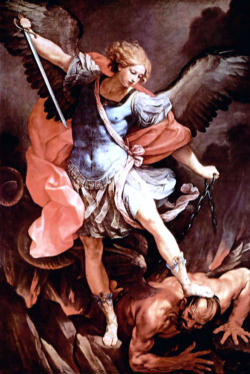
    St. Michael the Archangel battles Satan. St. Michael the Archangel battles Satan.


    By F. K. Bartels
    Catholic Online (www.catholic.org)
    9/29/2010


    GLADE PARK, CO (Catholic Online) - "The existence of the spiritual, non-corporeal beings that Sacred Scripture usually calls 'angels' is a truth of faith. The witness of Scripture is as clear as the unanimity of Tradition" (Catechism of the Catholic Church, No. 328).

    Today we celebrate the Feast of Sts. Michael, Gabriel and Raphael: Archangels. Though we cannot know of all the many times these magnificent spirits and powerful allies have entered into history to accomplish God's will, protecting us, driving away demons, and bearing forth messages of God's providential plan of salvation, some of their specific actions are recorded in Sacred Scripture, and, in each case, we obtain a glimpse into their ardent love for God, intently focused wills and formidable intellects.

    "Who Is Like God"
    In the Office of Readings -- from The Liturgy Of The Hours, which is a part of the official, liturgical and public prayer of the Church --  antiphon we read: "The sea grew turbulent and the earth trembled when Michael the archangel came down from heaven."

    As we read in Scripture, it was St. Michael who long ago led the battle against Satan: "Then war broke out in heaven; Michael and his angels battled against the dragon. Although the dragon and his angels fought back, they were overpowered and lost their place in heaven. The huge dragon, the ancient serpent known as the devil or Satan, the seducer of the whole world, was driven out; he was hurled down to earth and his minions with him" (Rev 12:7-9).

    The name Michael means "who is like God." St. Michael's will is focused, immovable, and entirely driven toward accomplishing goodness: he is a protector of souls, and wields his unrelenting sword of righteous justice against the poisonous and vindictive aspirations of the one who is known as a liar from the beginning. During a visit to the Sanctuary of Saint Michael the Archangel, the Venerable John Paul II said, "The battle against the devil . . . is the principal task of Saint Michael the archangel."

    When St. Michael the Archangel appeared to the three children at Fatima in 1916, preparing the way for the apparition of our Blessed Mother which was soon to follow, he said to them, "Fear not. I am the Angel of Peace. Pray with me." Then, prostrating himself, he repeated three times: "My God; I believe, I adore, I hope, and I love Thee! I beg Thee forgiveness for those who do not believe, do not adore, do not hope, and do not love Thee!" In this simple yet wonderful prayer of profound meaning, St. Michael clearly reveals his burning adoration and love for God, as well as the fact that, deep within the center of his being, he also bears great love and concern for men. How serious and committed this warrior is! St. Michael offers us a model of unwavering dedication, focus, fearlessness, and trust in God's sovereign goodness and power.

    "God Is My Strength"
    Gabriel means "God is my strength." As we read in the second antiphon of the Office of Readings, the angel Gabriel appeared to Zechariah and said, "Your wife Elizabeth will bear you a son, and you shall name him John" (see Lk 1:13). Thus St. Gabriel announced the coming of John the Baptist, the greatest prophet of the Most High, who would go before the Lord to prepare his way.

    It was St. Gabriel who was sent from God to Nazareth, "to a virgin betrothed to a man named Joseph, . . . and the virgin's name was Mary. And coming to her, he said, 'Hail, favored one! The Lord is with you'" (Lk 1:27-28).

    St. Gabriel's message announced a pivotal moment in humankind's history: the Savior was, by the power of the Holy Spirit, to be conceived in the womb of the Virgin Mary. The Archangel who draws his strength from God brought us the message of strength in which we draw our hope: God Incarnate was soon to enter history for love of man.

    Pope St. Gregory the Great wrote: "He [Gabriel] came to announce the One who appeared as a humble man to quell the cosmic powers. Thus God's strength announced the coming of the Lord of the heavenly powers, mighty in battle" (excerpt from Hom. 34, 8-9).

    "God Is My Health"
    Raphael means "God is my health." St. Raphael is one of seven angels "who enter and serve before the Glory of the Lord" (Tob 12:15). The meaning of Raphael's name reflects the fact that he touched Tobit's eyes in order to heal them of blindness.

    In the third antiphon of the Office of Readings, we are reminded that Raphael stands before God: "I am the angel Raphael, I stand in the presence of the Lord; as for you, bless the Lord, and proclaim his wonderful deeds."

    When Tobit and his son Tobiah were discussing how they should repay St. Raphael for all that he had done for them, "Raphael called the two men aside privately and said to them: 'Thank God! Give him the praise and the glory. Before all the living, acknowledge the many good things he has done for you, by blessing and extolling his name in song. Before all men, honor and proclaim God's deeds, and do not be slack in praising him'" (Tobit 12:6).

    There is a great deal we can learn from the Archangels, who are powerful messengers, allies and friends of men.

    What Is An Angel?
    St. Augustine says: "'Angel' is the name of their office, not of their nature. If you seek the name of their nature, it is 'spirit'; if you seek the name of their office, it is 'angel': from what they are, 'spirit,' from what they do, 'angel.'" As incorporeal beings, creatures made of spirit and without a material body, angels are not in themselves perceptible by the senses.

    Pope St. Gregory the Great distinguishes between angles and archangels: "Those who deliver messages of lesser importance are called angels; and those who proclaim messages of supreme importance are called archangels."

    The Catechism of the Catholic Church reminds us that with their whole being the angels are servants God. Because they "always behold the face of my Father who is in heaven" they are the "mighty ones who do his word, hearkening to the voice of his word" (CCC No. 329; Mt 18:10).

    As we reflect upon the beauty, power and strength of the angels, we are drawn toward a deeper and clearer understanding of God's love for man; for billions of angels, to be sure, are given personal charge over their own child of God. Every moment of each day, day after day, year after year, our faithful guardian angels stand at our sides, focused on our well-being with far greater power than even we ourselves can summon.

    The Catechism explains: "From infancy to death human life is surrounded by their watchful care and intercession. 'Beside each believer stands an angel as protector and shepherd leading him to life.' Already here on earth the Christian life shares by faith in the blessed company of angels and men united in God" (No. 336).

    More On The Angels
    In the Catechism we read that "As purely spiritual creatures angels have intelligence and will: they are personal and immortal creatures, surpassing in perfection all visible creatures, as the splendor of their glory bears witness" (CCC No. 330; Dan 10:9-12).

    Michael Schmaus writes: "The angels' free and powerful will corresponds to their comprehensive knowledge. It is on account of this penetrating understanding and great power of will that they make decisions without vacillating, without deliberation and with concentrated intellectual assertion, and hence never revoke them." Schmaus also notes that the angelic intellect possesses an "extraordinary power of penetration," and that the angels enjoy an intensity of intellectual life which "corresponds to their close association with God" (Dogma, New York: Sheed and Ward).

    God created the angels, like man, with an intellect and will, yet these shared attributes cannot be exactly compared, for they differ greatly in strength and power. For instance, we might compare the intellect and will of a child to that of an adult: the former is not nearly so strong as the latter. The angels' intellect is far advanced over that of man, and, as for their will, they do not struggle with doubt, weakness, and the tendency to fall into sin. On the contrary, the angels' will is of unwavering force, unceasingly directed toward and powerfully focused on the Ultimate Good, which is, of course, God.

    As for how the angels move, we are all familiar with pictures of winged cherubs. Yet, as wonderful as wings might be, they do no justice as a description of the angels' movement. The angels are able to travel from our bedside to the sun's corona, from there to the most distant star and back again in less than an instant. In fact, it is actually irrelevant to include the element of time in a discussion of angels' movement. The speed of light is really no speed at all for our powerful guardians; for they are not constrained by the laws of time and space as are men. Their movement is as quick and effortless as a thought. It is best to think of the angels' movement as one of entering in and out of time, rather than a movement of direction from one point to another, as we experience it in the material world.

    Though the angels surpass in perfection all visible creatures, we should be mindful of the close relationship we share with them. While there are significant differences between us, both men and angels were created in and through Christ; therefore we are truly brothers, if you will, who exist for Christ, each drawing our light and life from Christ. We share with the angels our beginning and end in God, the Origin of life and the Source of all that is visible and invisible.

    St. Gabriel announced the most wonderful and sublime event ever to occur in the universe, the coming of the Incarnate God into the world through the womb of our precious Virgin Mary. Though we now look back twenty centuries to that moment of his wondrous announcement, we can still feel the joy in his words, and, this moment, we continually share in that joy. We belong to that Savior of which Gabriel spoke; along with Gabriel we pledge our allegiance to Christ, our Master and King.

    On this Feast day, let us thank our Lord for the Archangels who have often entered into history as messengers in God's providential plan of salvation. Let us also remember our close connection with them in Christ, and frequently turn to them for their intercessory protection and assistance in times of trouble.

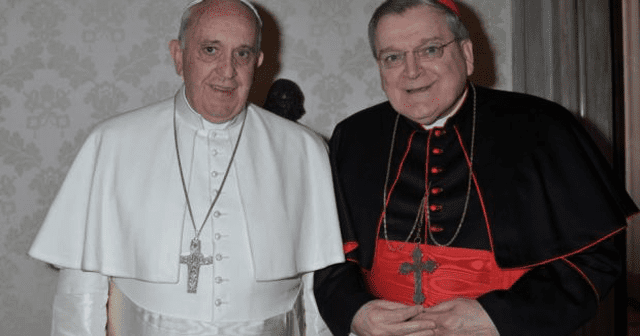
    Pope Francis reappoints Cardinal Burke back to the Roman Curia; maybe some of you can relax just a little now

    Cardinal Burke Brought Back Into Roman Curia By Pope Francis

                                 
    Raymond Cardinal Burke has been re-appointed to Congregation for the Causes of Saints from which he had been removed in December of 2013.
    Via Zenit
    The Vatican announced today that Pope Francis has appointed Cardinal Carlo Caffarra, metropolitan archbishop of Bologna, and Cardinal Raymond Leo Burke, patron of the Sovereign Military Order of Malta, as members of the Congregation for the Causes of Saints.
    The Congregation for the Causes of Saints controls the process that leads to the canonization of saints.  The congregation prepares each year everything necessary for the Pope to be able to set forth new examples of holiness. After approving results on miracles, martyrdom and heroic virtues of various Servants of God, the Holy Father proceeds to a series of canonizations and beatifications.
    At the time of his removal, the move stirred speculation of a rift between Pope Francis and Cardinal Burke along ‘liberal and conservative’ lines. After his subsequent removal from office of prefect of the Apostolic Signatura, the highest non-papal judicial authority within the Church, Cardinal Burke was appointed patron of the Sovereign Military Order of Malta, a largely ceremonial position, that many saw as a demotion or a forced exile.

    In case you got confused; it's all about Jesus Christ

    Me and hundreds of other Catholic bloggers were on Pope Francis overload these past few days and rightfully so.  His visit to Cuba and America, like his other visits around the world have brought hope, joy and inspiration to a hurting world.  I equally loved these visits as well from Pope Benedict XVI, John Paul II and the earliest visit that I can recall from Pope Paul VI.  That's pretty amazing if you think about it, the Papacy is two-thousand years old and Pope's traveling the world is only a 50-60 year phenomena.

    My posts were kind of like a current events of what the Pope was doing, saying and planning to do next.  I also post very frequently about Pope Francis throughout the year from his daily homilies, his Wednesday weekly audience and the Sunday Angelus.

    If you were to glance at my blog frequently you may also note the frequency with which I post about the Saints, not the football team, the real deal Saints.  I may also post about the happenings at my parishes where I have served, both St. Jane's and Most Holy Trinity and the activities surrounding my prison ministry at Rayburn Prison.

    Any blog can get into the cultural, social and human dimensions of life and faith for that matter.  It can give some, hopefully a small number of folks, the wrong impression.  No matter what I choose to blog about, this blog, as well as my ministry is about Jesus Christ, my Lord and my God.

    I believe beyond anything else worthy of belief that Jesus Christ is my Savior; He is everything He says He is in Scripture and He is my way to the Father.  I believe Jesus Christ is the Son of God and is the 2nd person of the Trinity; a community of love shared with the Father and the Holy Spirit, three persons and yet one God!

    I believe beyond a shadow of any doubt that Jesus Christ, the incarnate Word of God, is also truly, fully, completely present in the Eucharist.  The simple gifts of bread and wine presented at every Mass become, through Transubstantiation, the real Body and Blood of Jesus.  He is always present in the Eucharistic species.  At Mass, as time is truly suspended, the sacrifice on the Cross by Jesus Christ is re-presented, not represented, in an un-bloody manner and concealed in the forms of bread and wine so all may do exactly what He commanded we do: eat my body and drink my blood.  Not a holy suggestion, a command from Jesus my Lord!

    I believe fully and totally that Jesus Christ died for my sins and paved the way for me to eternal life.  I really believe that if I would be the last known sinner on this earth, He would still have gone to the Cross for me; so great is his love!

    I also know with total assurance that Jesus Christ is truly present in the person of the Priest when I go to reconciliation and confess my sins.  And when I physically hear the words, I absolve you of your sins, spoken by the lips of a priest, these are the words of Jesus Christ.  It is Jesus who forgives me.

    Jesus is my everything; it is He and He alone, who sustains and saves me, who feeds me with His Word and His Body & Blood, who forgives my sins, who dries my tears, who comforts me and gives me strength.  It is Jesus who shows me the way to the Father and it is Jesus who left me my advocate, the Holy Spirit.

    When we marvel about the richness of our faith, when we share our Catholicity, when we are amazed by the witness of the Pope, when we ask Mary to help us or pray through the Saints, when we participate in each and every Sacrament, when we wash one another's feet, when we visit the sick, the lonely and the imprisoned; when all of this is shared, don't be confused, it's all about Jesus Christ!

    Jesus Christ, my all in all; my Alpha and Omega!
    Jesus Christ, the same yesterday, today and forever!!

    Jesus Christ, you are my life!

    Getting Pope Francis; this author does; do you??

    Connecting the Dots with Pope Francis By Joshua Bowman

    During his all too brief tour of the United States over the last several days, Pope Francis gave multiple speeches each day covering a wide range of topics, but with several recurring themes. He spoke often of entering into dialogue with different viewpoints, ideologies, and religions–many of which are in direct opposition and some of which are antagonistic to the teachings of the Catholic Church. Most of all, Pope Francis recognizes the seriousness of the threat posed by the forces of secularism to the future of Western Civilization, but he is not afraid to engage with those forces on their own terms. Many Catholics and non-Catholics on the political right have criticized Pope Francis for his apparent emphasis on subjects like protecting the environment and caring for the poor, but this misunderstands what Pope Francis is up to. The Pope is not a mere politician. Pope Francis has said in his own words that he wishes to enter into dialogue, so we should listen to him. In his speech to the UN, he said, “Any harm done to the environment, therefore, is harm done to humanity.” He also said in his remarks to Congress, “The Golden Rule also reminds us of our responsibility to protect and defend human life at every stage of its development.” We care about the environment and the poor because we care about people. In his remarks, Pope Francis again and again returned to the dignity of the human person. The Catholic Church exists to carry forth the Gospel and preserve the sacraments, but also to perform the works of spiritual and corporal mercy. Moreover, the teachings of the Catholic Church with regard to the sanctity of human life and marriage are essential to carrying out those works. There is no mercy in killing the unborn or the elderly. There is no mercy in abandoning the souls of people tormented by addictions and passions. There is no mercy in tolerating evil, and certainly not in celebrating it. The Venerable Fulton Sheen once wrote, “It may take a long time for Western civilization to realize that the good it is seeking is the good that it left,” and it was Flannery O’Connor who spoke of the “Christ-haunted” culture. The priorities of modern liberalism in the United States would not even be possible if not for the influence of Christianity on Western philosophical and political thought. The founding fathers were mainly Deist free-thinkers of the Enlightenment, but they were informed by our universal cultural patrimony of centuries of Christian exegesis and scholasticism. More recently, the progressive movement owes its entire existence to various Christian denominations which advocated for social concern as a moral imperative in the late 19th and early 20th centuries. When Pope Francis engages in this dialogue on subjects of great interest to the secular and largely anti-Catholic American left, he is in a way employing the Socratic method and forcing secular liberals to ask the question: “Why?” Why do we care about conservation of natural resources? Why do we care about feeding the homeless? Why do we care about the plight of immigrants and refugees? As Pope Francis has alluded, technology allows people to make a superficial show of enthusiasm, emotion, or sympathy for these popular causes, but how many have asked themselves about the deeper ethical and moral propositions that are implied by such frothy sentimentalism? The entire history of Western Civilization cannot be summarized in 140 characters, much less a lame hashtag. As an example, environmentalists often ask the question, “What kind of world do we want to leave for our children?” Before we can get there though, we should start by asking what kind of world we want to make for our children today. In his address to Congress, Pope Francis said, “I also want to dialogue with all those young people who are working to realize their great and noble aspirations, who are not led astray by facile proposals, and who face difficult situations, often as a result of immaturity on the part of many adults.” Where we see the decay of infrastructure and of morals, it is because the family is being assaulted and destroyed by our popular culture, our laws, and most of all, by our own apathy and laziness. The greatest struggle of the 21st century will be for the rights of children. Children have the right to be born. Children deserve to know and to be loved by both a mother and a father. Children need parents who teach by example how to become respectable adults. Unfortunately, this is desperately lacking in our feel-good culture of moral relativism, anything-goes carnival of government corruption, and the Hollywood freak-show of bottomless depravity. As a consequence, for too many people, children are treated as an afterthought, a commodity, or simply as a burden. This is a culture with no future. Pope Francis spoke emotionally and powerfully in his native tongue to the Festival of Families in Philadelphia of the antidote for this secularization and atomization of Western Civilization. He joined generations of conservative writers from Burke to Buckley who have all pointed to the family as the most important and basic foundation of society. Pope Francis called young people to have the courage to build families, and it will take courage, because building strong families takes work–a lot of work–and it is hard, thankless, and even exhausting. However, we must do it, because this is the price of civilization. Above all, Pope Francis is an optimist. He is not afraid to say that Western Civilization–Christian civilization–is capable of great things. We should be able to use our resources more efficiently. We should be able to bring prosperity to more people. We should be able to ensure peace for future generations. However, liberals are mistaken if they think for a moment that we can achieve anything towards these worthy goals unless we first learn how to love and care for one another in the protecting embrace of strong families guided by a firm reliance on divine providence. Liberals forget that the Golden Rule is prefaced by an even greater commandment: to love and serve God with all our hearts, all our souls, and all our minds. Only if we get that right do we have any hope in the field of human endeavor.

     - See more at: http://www.catholicvote.org/connecting-the-dots-with-pope-francis/#sthash.lWztcTW8.dpuf.

    Remembering the good smiling pope who served but 33 days: Pope John Paul I

    >>> Think about it; the Catholic Church was emerging from the post Vatican II age, the post VietNam war age and a time of great change and renewal. Paul VI had been the Holy Father for 15 years and became known to a larger part of the world thanks to travel and technology. And then he was gone. But soon we would have a new Holy Father, the first Pope to take a double name; John Paul I. The world in general and the Catholic faithful were just getting to know him. He seemed happy, personable, somewhat shy but a hint of being media savvy. And just 33 days after his election he too was gone. Today is the 37th anniversary of John Paul I's death. I've included this short bio for more info:


    John Paul I Biography
    Religious Figure

    Name at birth: Albino Luciani

    Albino Luciani was elected to replace Paul VI as head of the worldwide Catholic Church in 1978 -- only to die himself 33 days after his election. Born in rural Italy, Luciani was ordained as a priest in 1935. After three decades of service he became Patriarch of Venice in 1969 and then was made cardinal in 1973. Luciani was elected as the supreme pontiff on 26 August 1978. He combined the names of his two immediate predecessors, Paul VI and John XXIII, to become Pope John Paul. Cheerful and low-key, he was soon dubbed the Smiling Pope and the Laughing Pope by admirers. His time as leader was short: on the night of 28 September he died of a heart attack, apparently while reading in bed. He was succeeded by Karol Wojtyla, John Paul II, the first non-Italian pope in more than four centuries.

    Pope John Paul I; pray for us!

    The amazing interview as Pope Francis returned to Rome from Philadelphia

    Full transcript of Pope Francis' inflight interview from Philadelphia to Rome

    Pope Francis speaks to journalists aboard his flight from Philadelphia to Rome Sept. 27, 2015. Credit: Alan Holdren/CNA.
    Pope Francis speaks to journalists aboard his flight from Philadelphia to Rome Sept. 27, 2015. Credit: Alan Holdren/CNA.
    .- In a 47 minute Q&A with journalists on his way back to Rome Pope Francis touched on sensitive topics such as forgiving abusers and conscientious objection, as well as the upcoming synod of bishops and women’s ordination.
    The Pope answered 11 questions posed in English, Spanish and Italian Sept. 27 while on board his American Airlines overnight flight from Philadelphia to Rome.
    Among the themes addressed were the new, streamlined annulment process, women’s ordination to the priesthood, the migrant crisis and whether or not government officials have a right to conscientious objection.
    He reaffirmed the Catholic Church’s position on women’s ordination to the priesthood, saying that St. John Paul II led the lengthy reflections and discussion on the topic and it “cannot be done,” though it’s not because women “don’t have the capacity.”


    Here it is in it's entirety:

    http://www.catholicnewsagency.com/news/full-transcript-of-pope-francis-inflight-interview-from-philadelphia-to-rome-60499/