Wednesday, January 29, 2014

Pope Francis lays it out for Catholic parents: make sure your kids are confirmed!!!

Pope at audience: Make sure your children are confirmed

Pope Francis blesses a child as he arrives to lead his general audience in St. Peter's Square at the Vatican Jan. 29. (CNS/Reuters)
By Cindy Wooden
Catholic News Service

VATICAN CITY (CNS) -- Many Catholic parents go to great lengths to ensure their children are baptized, and they must make similar efforts to see that their children are confirmed, Pope Francis said.

Without confirmation, he said, young people will remain "halfway" on the path of Christian maturity and membership in the church.

Confirmation "unites us more solidly to Christ. It completes our bond with the church," Pope Francis said Jan. 29 at his weekly general audience.

The sacrament "gives us the special strength of the Holy Spirit to spread and defend the faith, to confess the name of Christ and to never be ashamed of his cross," the pope said.

Confirmation solidifies and increases the grace given at baptism, "which is why it's important to make sure our children and young people receive this sacrament. We all make sure that our children are baptized, which is good, but perhaps we're not quite so diligent in making sure they are confirmed."

"If you have a child or young person at home who hasn't been confirmed and is the right age to receive the sacrament, do everything possible to make sure it happens," he said.

Especially for those who were baptized as infants, the pope said, confirmation is a time to affirm one's personal decision to follow Christ and to be a member of his church.

Pope Francis told the crowd, estimated by the Vatican at about 25,000 people, that the Holy Spirit, "so important for the Christian life," is given to believers in a special way through confirmation.

The Bible and Catholic tradition speak of seven specific gifts of the Holy Spirit, the pope said, but he promised not to give the crowd a pop quiz by asking people to list them. Instead, he gave the answers: wisdom, understanding, counsel, fortitude, knowledge, piety and fear of the Lord.

Through the Holy Spirit, Pope Francis said, "Christ himself is present in us and takes form in our lives. Through us, he is the one -- listen carefully -- he is the one who prays, forgives, spreads hope and consolation, serves our brothers and sisters, draws close to the needy and the least, creates unity and sows peace."

At the end of the audience, Pope Francis greeted members of an Italian national association dedicated to fighting usury and loan sharking. When a family can't eat because they are paying exorbitant interest rates, he said, "this is not Christian. This is not humane!"

Tuesday, January 28, 2014

Defended the faith against Arianism to the point of martyrdom

St. Aquilinus


St. Aquilinus
St. Aquilinus

Feastday: January 29
Patron of hotel porters (facchini) in Milan

Aquilinus was born in Bavaria. He left his native land to avoid being made a bishop, went to Italy and settled in Milan. A vigorous opponent of Arianism, he was so effective in his preaching against the heresy that a group of Arians murdered him. He died in 650. His feast day is January 29th.

Deacon Bill Ditewig tells us about the last Permanent Deacon before Vatican II, and he was a Cardinal too

The Last Permanent Deacon (before Vatican II)


Just for fun. . .
Reginald Pole
Deacon Reginald Pole, who was Cardinal President for the First Session of the Council of Trent
Most people recognize that the diaconate enjoyed a “golden age” which ended in the 4th Century.  The transformation of the diaconate, including the decline of a diaconate permanently exercised began shortly after, although there are the famous exceptions usually given: the English Cardinal Reginald Pole, for example, or Francis of Assisi.  However, the last known “permanent” deacon prior to the Second Vatican Council was probably Italian jurist Teodolfo Mertel (1806-1899).
Kardinal_Mertel_5JS
Deacon Teodolfo Mertel, jurist and Cardinal-Prefect of the Roman Rota
Teodolfo studied in the seminary with the Capuchins, and in 1828, at the age of 22, the brilliant young lawyer received a joint doctorate in both civil and canon law from La Sapienza University in Rome.  By the time he was 25 he was serving as a lawyer for the Roman Curia.  He served in positions of increasing responsibility between 1831 till 1853, when he was assigned as Minister of the Interior and of Grace and Justice.
Although he received first tonsure in 1843 and the minor orders shortly thereafter, he did not proceed further at that time.  At the consistory of 15 March 1858, Mertel was made a Cardinal by Pope Pius IX.  On the same day he was appointed President of the Supreme Council for Internal Affairs of the State, and on the next day, 16 May 1858, the pope ordained him a deacon at Castelgandolfo.   Cardinal Mertel served in several other major assignments and participated in the First Vatican Council (1869-1870).  He continued in various positions, eventually serving as Prefect of the Tribunal of the Signature of Justice from 1877 until his death in 1899.  He participated in the conclave of 1878 which elected Pope Leo XIII; he served as Protodeacon of the Mass of Coronation and placed the triple tiara on the pope’s head.
A well-known story from his time observed that, when the Prefect wished to go to Mass, he had to take one of his priest-staff members along to say the Mass.
In his later years, due to illness, he returned to his hometown, where he died 11 July 1899, at the age of 93.
We deacons do not need to be made Cardinals.  However, we should always strive to find new and creative ways to serve God and God’s people!

USCCB files an Amicus Brief in support of Hobby Lobby; uniting in the Pro-Life fight

U.S. Bishops File Amicus Curiae Brief Supporting Hobby Lobby and Conestoga Wood Specialties in Supreme Court Cases Challenging HHS Mandate


January 28, 2014
Brief highlights 'potentially fatal fines' confronting closely held businesses
Reiterates support for business owners challenging HHS mandate
Laws must protect individuals and families who seek to practice faith in daily life
WASHINGTON—The U.S. Conference of Catholic Bishops (USCCB) on January 28 filed an amicus curiae brief with the U.S. Supreme Court in support of the plaintiffs in Sebelius v. Hobby Lobby Stores, Inc. and Conestoga Wood Specialties Corp. v. Sebelius.In both cases, family-owned businesses are challenging the legality of the U.S. Department of Health and Human Services (HHS) regulation that forces virtually all employers to include in their employee health plans coverage of sterilization, contraceptives, and drugs and devices that may cause abortions, as well as related education and counseling.
The USCCB explained in its amicus brief that it opposes "any rule that would require faithful Catholics and other religiously motivated business owners to choose between providing coverage for products and speech that violate their religious beliefs, and exposing their businesses to devastating penalties." These penalties include "potentially fatal fines" of $100 a day per affected individual.
The brief reflects and implements the U.S. bishops' consistent support for litigants from the non-profit and for-profit sectors alike who have challenged the HHS mandate in court.
Archbishop William E. Lori of Baltimore, chairman of the USCCB's Ad Hoc Committee for Religious Liberty, stated that "Catholics believe that the right to religious freedom proceeds from the inherent dignity of each and every human person, and that includes people who run businesses. They should not be specially excluded from the freedom to practice their faith in daily life."
The amicus brief argued that religious exercise cannot, and should not, be excluded from the marketplace; that the mandate substantially burdens Hobby Lobby's and Conestoga's religious exercise; and that the mandate cannot survive strict scrutiny review by the Court.
Hobby Lobby and Conestoga Wood Specialties are among over 90 lawsuits filed by more than 300 plaintiffs challenging the HHS mandate in courts around the country.
The brief is available online: http://www.usccb.org/about/general-counsel/amicus-briefs/upload/amicus-13-354-13-356-sebelius-hobby-lobby-conestoga-wood.pdf

As a Bishop is ordained, the Deacon proclaiming the Gospel is his dad. Bishop Mike Sis, San Angelo, TX.

"I Believe In His Promise" – At "Sismas," A Family Affair
In the annals of American Catholicism, and indeed beyond, the shot there is without any sort of known precedent: a deacon proclaiming the Gospel at his son's ordination as a bishop, the latter looking on from the background.

Today in San Angelo marked the third time a deacon's son has been raised to the episcopacy in the last five years. Unlike both instances before, though, this time the Reverend Dad was able to take part, and did... and his son now leads a diocese, to boot.

Sure, it might be far from the newfound rush of interest in near-Pope-bird-watching, etc... yet as a new reality keeps unfolding inside the walls, not even a sudden onslaught of cardinals could trump a moment like this.
* * *
The Man. The Myth. The Legend – for the last several years, the top prospect of a blossoming Texas Catholicism... and now, Aggies and Church beyond, at long last, here's today's post-ordination remarks from Deacon Ray's son, Bishop Mike Sis:


Apologies for the wide shot – at least on things like this, you've gotta work with what you're given.

On a host of fronts, this Monday's made for something extraordinary... and for the Lone Star Church beyond, it was just the beginning.

A two-fer without recent precedent, the "Texas Throne 'Em" series now begun is set to culminate on Wednesday in Fort Worth with the ordination of Bishop-elect Michael Olson, the 750,000-member fold's first-ever priest to be called to the bench, let alone as the hometown boss.


>>From Whispers in the Loggia, Rocco Palma

We just don't do winter very well

Believe it or not I am relaxing, for now, at home in the early afternoon on a Tuesday, here in south east Louisiana, because of a "snow" day.  More accurately, it really is a frozen precipitation day.  In a winter that has been incredibly cold by southern standards, we were all ginned up by the forecasts of a few days ago that promised remarkable amounts of snow and ice and very cold temperatures.  Keep this in mind, just this past Friday, we had quite a sleet event that, unfortunately, caught many home bound commuters by surprise and even resulted in some messy wrecks and even a couple of fatalities.  Not being properly prepared then, local officials and business owners made darn sure we would be prepared today.  Unfortunately, many pulled the plug on all day Tuesday and all day Wednesday because the forecast looked more like Bismarck, ND than New Orleans, LA.


As of this hour, we have indeed felt some impacts from freezing rain, perhaps sleet but the snow is far to our north.  Where I work, we were able to put a couple of hours in before local officials got very weary about road conditions as the day progressed.  While the children want to see it, the chances for snow are growing less and less as we speak.  With the frozen stuff still falling and temps predicted to stay at or below 32 until mid-afternoon Wednesday, here we sit, at home waiting to venture out.  True, we cannot drive in anything winter-like.  And we do face the possibility of power outages and other inconveniences because we just don't do winter very well.


Now if you are up north and reading this and starting to feel a little sorry for us, check this out: despite what we are going through today and tomorrow, hang around to Friday-Saturday and Sunday when lows will be 52 and highs 75.  Yep, that's right!  And that's part of why we don't do winter very well.


So this afternoon I have a chance to do some ministry paperwork, watch some TV, smell the wonderful aromas coming from the kitchen (yes, Wendy is cooking) and get prepared for the work week that will return soon enough.


So we are hunkered down here in south east Louisiana and for sure, we do not know what else to do because, quite frankly, we just don't do winter very well!

Monday, January 27, 2014

Amazing theologian, preacher, teacher, writer, Doctor of the Church

St. Thomas Aquinas


St. Thomas Aquinas
St. Thomas Aquinas

Feastday: January 28
Died: 1274

St. Thomas Aquinas, priest and doctor of the Church, patron of all universities and of students. His feast day is January 28th. He was born toward the end of the year 1226. He was the son of Landulph, Count of Aquino, who, when St. Thomas was five years old, placed him under the care of the Benedictines of Monte Casino. His teachers were surprised at the progress he made, for he surpassed all his fellow pupils in learning as well as in the practice of virtue.
When he became of age to choose his state of life, St. Thomas renounced the things of this world and resolved to enter the Order of St. Dominic in spite of the opposition of his family. In 1243, at the age of seventeen, he joined the Dominicans of Naples. Some members of his family resorted to all manner of means over a two year period to break his constancy. They even went so far as to send an impure woman to tempt him. But all their efforts were in vain and St. Thomas persevered in his vocation. As a reward for his fidelity, God conferred upon him the gift of perfect chastity, which has merited for him the title of the "Angelic Doctor".
After making his profession at Naples, he studied at Cologne under the celebrated St. Albert the Great. Here he was nicknamed the "dumb ox" because of his silent ways and huge size, but he was really a brilliant student. At the age of twenty-two, he was appointed to teach in the same city. At the same time, he also began to publish his first works. After four years he was sent to Paris. The saint was then a priest. At the age of thirty-one, he received his doctorate.
At Paris he was honored with the friendship of the King, St. Louis, with whom he frequently dined. In 1261, Urban IV called him to Rome where he was appointed to teach, but he positively declined to accept any ecclesiastical dignity. St. Thomas not only wrote (his writings filled twenty hefty tomes characterized by brilliance of thought and lucidity of language), but he preached often and with greatest fruit. Clement IV offered him the archbishopric of Naples which he also refused. He left the great monument of his learning, the "Summa Theologica", unfinished, for on his way to the second Council of Lyons, ordered there by Gregory X, he fell sick and died at the Cistercian monastery of Fossa Nuova in 1274.
St. Thomas was one of the greatest and most influential theologians of all time. He was canonized in 1323 and declared Doctor of the Church by Pope Pius V.

Good grief; what kind of evil would steal the blood of John Paul the Great?

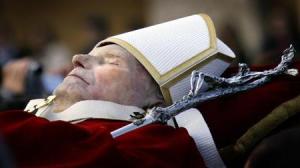
Thieves steal Pope John Paul's blood from Italy church

Reuters
           

    Pall bearers carry the body of the late Pope John Paul II through a packed Saint Peter's ...
    .
    View gallery


    By Philip Pullella
    ROME (Reuters) - Thieves broke into a small church in the mountains east of Rome over the weekend and stole a reliquary with the blood of the late Pope John Paul II, a custodian said on Monday.
    Dozens of police with sniffer dogs scoured the remote area for clues to what the Italian Catholic magazine Famiglia Cristiana called "a sacrilegious theft that was probably commissioned by someone".
    Franca Corrieri told Reuters she had discovered a broken window early on Sunday morning and had called the police. When they entered the small stone church they found the gold reliquary and a crucifix missing.
    John Paul, who died in 2005, loved the mountains in the Abruzzo region. He would sometimes slip away from the Vatican secretly to hike or ski there and pray in the church.
    Polish-born John Paul, who reigned for 27 years, is due to be made a saint of the Roman Catholic Church in May, meaning the relic will become more noteworthy and valuable.
    In 2011, John Paul's former private secretary, Cardinal Stanislaw Dziwisz, now archbishop of Krakow in Poland, gave the local Abruzzo community some of the late pontiff's blood as a token of the love he had felt for the mountainous area.
    It was put in a gold and glass circular case and kept in a niche of the small mountain church of San Pietro della Ienca, near the city of L'Aquila.
    Corrieri, who is part of an association that looks after the small church, said the incident felt more like a "kidnapping" than a theft. "In a sense, a person has been stolen," she said by telephone.
    She said she could not say if the intention of the thieves may have been to seek a ransom for the blood.
    Apart from the reliquary and a crucifix, nothing else was stolen from the isolated church, even though Corrieri said the thieves would probably have had time to take other objects during the night-time theft.
    Some of John Paul's blood was saved after an assassination attempt that nearly killed him in St. Peter's Square on May 13, 1981.

    Holy holy orders; a priest seems to have trouble with deacons; Deacon Bill Ditewig sets the record straight!

    Priest to Deacon: “Being a deacon is not a REAL vocation.”

    laying on of handsFrom the inbox comes a note from a very concerned brother deacon.  A priest recently told him that there was no real sacramental significance to being a deacon, unlike the ordinations of presbyters or bishops, which change a person at the very core of their being.  As another deacon once remarked to me after a Conference, a priest once told him that “being a deacon is not a REAL vocation, like being a priest or a religious.”  I have heard both of these observations before, and want to reassure my brother deacons that, contrary to the mistaken opinions of some of the priests involved (and others, of course): being a deacon IS a real vocation, and our ordination is just as “sacramentally effective and significant” as any other ordination to the other orders that make up the Sacrament of Holy Orders!
    What’s going on here?  Why is there such confusion about this?  Let me suggest a few answers.  Perhaps this could be part of a conversation and ongoing formation offered to our seminarians and priests (and it wouldn’t hurt for deacons and lay folks to remember it, too!).
    1) A “theology of the diaconate” is only just now being developed.  This may seem surprising, but when you think about it, it makes sense.  For about a millennium or so, “being ordained” was usually summed up in (reduced to?)  reflections on “being a priest.”  That was the order that mattered the most, since this was the order (of presbyters) who “confected the Eucharist”, and all other orders were preliminary to, and led to, the presbyterate.  For quite a while, even being a bishop was understood primarily through the lens of the priesthood, with the responsibilities of being a bishop understood primarily as a matter of jurisdiction, not sacramental significance.  This point of view was overturned at the Second Vatican Council, which restored a more ancient understanding of Orders, first by reclaiming the more ancient theological understandings of the episcopate (see Lumen gentium, ##18-27), returning the diaconate to an order to be exercised permanently, and by authorizing the restructuring of the entire Sacrament of Holy Orders; Pope Paul VI implemented those decisions between 1967 (when he adjusted canon law to permit the ordination of “permanent” deacons) and 1972 (when he suppressed, in the Latin Church, first tonsure, the minor orders of porter, lector, exorcist and acolyte, and the subdiaconate; he concurrently authorized LAY ministries of lector and acolyte, no longer to be ordinations, but lay institutions).  This means, vis-a-vis the diaconate, that for the first time in more than a millennium, a person could be ordained to a major and permanent order of the ministry (the diaconate) without eventually seeking ordination to the presbyterate.  Therefore, given the large scale absence of “permanent” deacons for so long, there was no proper theology of the diaconate-qua-diaconate.
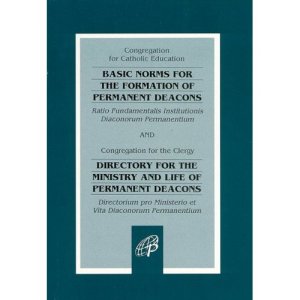
    The Holy See recognized this in a 1998 document from the Congregation for Catholic Education (#3):Ratio et Directorium
    The almost total disappearance of the permanent diaconate from the Church of the West for more than a millennium has certainly made it more difficult to understand the profound reality of this ministry. However, it cannot be said for that reason that the theology of the diaconate has no authoritative points of reference, completely at the mercy of different theological opinions. There are points of reference, and they are very clear, even if they need to be developed and deepened.
    So, what are these “points of reference” offered by the Holy See?
    A.  First of all we must consider the diaconate, like every other Christian identity, from within the Church which is understood as a mystery of Trinitarian communion in missionary tension. This is a necessary, even if not the first, reference in the definition of the identity of every ordained minister insofar as its full truth consists in being a specific participation in and representation of the ministry of Christ. This is why the deacon receives the laying on of hands and is sustained by a specific sacramental grace which inserts him into the sacrament of Orders.
    B. The diaconate is conferred through a special outpouring of the Spirit (ordination), which brings about in the one who receives it a specific conformation to Christ, Lord and servant of all. Quoting a text of the Constitutiones Ecclesiae Aegypticae, Lumen gentium (n. 29) defines the laying on of hands on the deacon as being not “ad sacerdotium sed ad ministerium”,(6) that is, not for the celebration of the eucharist, but for service. This indication, together with the admonition of Saint Polycarp, also taken up again by Lumen gentium, n. 29,(7) outlines the specific theological identity of the deacon: as a participation in the one ecclesiastical ministry, he is a specific sacramental sign, in the Church, of Christ the servant. His role is to “express the needs and desires of the Christian communities” and to be “a driving force for service, or diakonia”, which is an essential part of the mission of the Church.
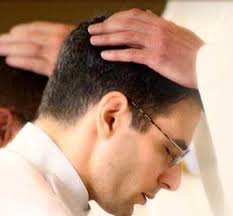
    C.  The matter of diaconal ordination is the laying on of the hands of the Bishop; the form is constituted by the words of the prayer of ordination, which is expressed in the three moments of anamnesis, epiclesis and intercession. . . .  [NOTE: The matter and form of the diaconate, presbyterate and episcopate were clarified and promulgated by Pope Pius XII in his 1947 Sacramentum Ordinis.   One would hope that by now this document would have found its way into seminary curricula! ]
    holyorders2D. Insofar as it is a grade of holy orders, the diaconate imprints a character and communicates a specific sacramental grace. The diaconal character is the configurative and distinguishing sign indelibly impressed in the soul, which configures the one ordained to Christ, who made himself the deacon or servant of all. It brings with it a specific sacramental grace, which is strength, vigor specialis, a gift for living the new reality wrought by the sacrament. “With regard to deacons, ‘strengthened by sacramental grace they are dedicated to the People of God, in conjunction with the bishop and his body of priests, in the service (diakonia) of the liturgy, of the Gospel and of works of charity’”.  Just as in all sacraments which imprint character, grace has a permanent virtuality [The Latin original has: Sicut in omnibus sacramentis characterem imprimentibus, gratia permanentem virtualem vim continet]. It flowers again and again in the same measure in which it is received and accepted again and again in faith.
    E. In the exercise of their power, deacons, since they share in a lower grade of ecclesiastical ministry, necessarily depend on the Bishops, who have the fullness of the sacrament of orders. In addition, they are placed in a special relationship with the priests, in communion with whom they are called to serve the People of God.
    F. From the point of view of discipline, with diaconal ordination, the deacon is incardinated into a particular Church or personal prelature to whose service he has been admitted, or else, as a cleric, into a religious institute of consecrated life or a clerical society of apostolic life.(13) Incardination does not represent something which is more or less accidental, but is characteristically a constant bond of service to a concrete portion of the People of God. This entails ecclesial membership at the juridical, affective and spiritual level and the obligation of ministerial service.
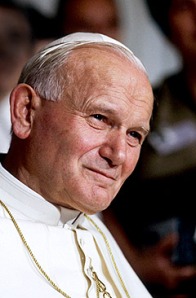
    jpii2.  If this were not enough to demonstrate the proper character of a vocation to the diaconate, consider the words of soon-to-be Saint John Paul II, who offered a series of catecheses on the diaconate in 1993.  He observed with great clarity a theme he would make several times during his papacy:
    The exercise of the diaconal ministry—like that of other ministries in the Church—requires per se of all deacons, celibate or married, a spiritual attitude of total dedication.  Although in certain cases it is necessary to make the ministry of the diaconate compatible with other obligations, to think of oneself and to act in practice as a ‘part-time deacon’ would make no sense. The deacon is not a part-time employee or ecclesiastical official, but a minister of the Church. His is not a profession, but a mission!  
    So, why does any confusion persist on this matter?  Let me offer a couple of suggestions.
    3.  The sacramental question of HOW the deacon participates in the one Sacrament of Holy Orders has developed since the release of the documents on the diaconate in 1998.  Following some initial changes to the Latin editio typica of the Catechism of the Catholic Church back in 1994, Pope Benedict in 2009 issued motu proprio Omnium et Mentem.  In this document, canon law (specifically cc. 1008 and 1009) was changed to reflect that only presbyters and bishops act in persona Christi Capitis (“in the person of Christ, the Head of the Church”), while deacons serve in a ministry of word, sacrament and charity.  This distinction, however, does not — and should not — be taken to suggest that deacons are no less ORDAINED into sacred ministry (which is the point of the canons on this point!) or that our ordination is no less sacramentally significant.  The canons simply reflect a theological position that there are two modalities of participation in the ONE Sacrament of Holy Orders. [Here's an interesting side note: the change to canon law only affected the Code of Canon Law for the Latin Church; the Code of Canons for the Eastern Catholic Churches does not use the language of in persona Christi Capitis, so the distinction did not need to be made there.]
    4.  I think that, since the Council, there has been legitimate concern on the part of many presbyters that the specific nature of the presbyterate has been under assault.  One bishop who participated in all four sessions of the Council as a young bishop, once remarked to me that he considered it a great shortcoming of the Council that they did not spend more time on the nature of the priesthood itself.  “After all,” this bishop said, “We spent considerable time talking about the sacramental nature of the episcopate, and we developed wonderful texts on the nature and role of the laity.  We even renewed the diaconate!  But we did not take into proper account the profound impact all of that would have on the presbyterate itself.”  As a result, many of the functions which had become part of the presbyterate prior to the Council now began to be disbursed to other ministers, both lay and, now, deacons.  This means that there is a certain concern that the presbyterate itself is being somehow “eroded” as others assume their own rightful and legitimate places in ministry, both within the Church and in the world.
    But the bottom line remains:vocation
    Deacons are ordained, and are permanently changed in the core of our being by that ordination (what we used to call in days gone by as “ontologically changed”).  We are always and everywhere full-time ministers, as St. John Paul II so passionately proclaimed, even when that ministry occurs outside the normal institutional structures of the Church.  During those same catecheses in 1993, John Paul II also reminded people that “a deeply felt need in the decision to re-establish the permanent diaconate was and is that of greater and more direct presence of Church ministers in the various spheres of the family, work, school, etc., in addition to existing pastoral structures.”  The diaconate is a sacrament and a proper vocation.  It is perhaps also a useful reminder to many of our sisters and brothers that we are all gifted with many “proper vocations” — calls from God! — in our lifetimes.  Our baptisms themselves constitute our primal vocation, before all others, for example!  Some of us are called to religious life, some are called to matrimony, some are called to Orders, and some of us are called to several of these at the same time!  Our God is a most generous God, and attempts to characterize one vocation over against another is to deny that divine generosity and to misunderstand the nature of vocation in the first place.
    Now,  let us all go out and serve one another!