Showing posts with label Vespers. Show all posts

Sunday, January 25, 2026

An Ecumenical Evening Vespers with Pope Leo XIV


Pope at Ecumenical Vespers: We are one, let's make it visible

On the feast of the Conversion of St Paul, which marks the close of the Week of Prayer for Christian Unity, Pope Leo invites Christians to continue on their shared mission of spreading the Gospel to all.

By Isabella H. de Carvalho

Pope Leo emphasized how different Christian religions share the same faith and encouraged them to continue together the mission of spreading the Gospel throughout the world, on Sunday, January 25, 2026, at the conclusion of the Week of Prayer for Christian Unity.

“We are one!  We already are!  Let us recognize it, experience it and make it visible!” he said in his homily during the celebration of Second Vespers on the Feast of the Conversion of St. Paul, marking the end of the Week of Prayer.

He pointed out that this annual event reminds Christians of their commitment to the mission of spreading the Gospel, “bearing in mind that the divisions among us – while they do not prevent the light of Christ from shining – nonetheless make the face which must reflect it to the world less radiant.”

The service was celebrated at the Basilica of St. Paul Outside the Walls in Rome, the resting place of the Apostle. The Week of Prayer for Christian Unity takes place every year in the northern hemisphere from January 18 to 25.

Several representatives of various Christian Churches were present, including Metropolitan Polykarpos, representing the Ecumenical Patriarchate of Constantinople, Archbishop Khajag Barsamian, from the Armenian Apostolic Church, and Bishop Anthony Ball, of the Anglican Communion. There was also Cardinal Kurt Koch, Prefect of the Dicastery for Promoting Christian Unity, along with other ecumenical groups and pilgrims.

The ecumenical celebration at St Paul's Outside the Walls (@VATICAN MEDIA)


St. Paul, an example for all Christians in their mission

In the passage from St. Paul’s Letter to the Ephesians, chosen as the theme for this year’s Week of Prayer, “we repeatedly hear the adjective 'one': one body, one Spirit, one hope, one Lord, one faith, one baptism, one God,” the Pope explained in his homily.

“Dear brothers and sisters, how can these inspired words not touch us deeply?  How can our hearts not burn within us when we hear them?” he asked, underlining how we share the same faith in God, Jesus Christ and the Holy Spirit. 

He pointed to St. Paul’s conversion, from a persecutor of the Church to someone who preached Jesus’s “love with burning zeal,” as an example. As the participants of the Vespers gathered before the tomb of the Apostle, Pope Leo highlighted that it served as a reminder that his mission is the same as that of all Christians: “to proclaim Christ and to invite everyone to place their trust in him.”

The Pope also cited the Second Vatican Council’s Constitution Lumen Gentium, in which the Church “expressed its ardent desire to proclaim the Gospel to all creation” and thus “bring to all humanity that light of Christ which is resplendent on the face of the Church.”

 “It is the shared task of all Christians to say humbly and joyfully to the world: ‘Look to Christ!  Come closer to him!  Welcome his word that enlightens and consoles!’,” the Pope insisted.

Commemorating Nicaea and the importance of synodality  

The Pope also recalled the ecumenical prayer service he celebrated along with various other Christian leaders in Iznik, Türkiye, in November 2025, to commemorate the 1700th anniversary of the Council of Nicaea.

“Reciting the Nicene Creed together in the very place where it was formulated was a profound and unforgettable testimony to our unity in Christ,” the Pope said.

“May the Holy Spirit find in us docile minds even today, so that we may proclaim the faith with one voice to the men and women of our time!”

Looking instead to the future, Pope Leo mentioned the 2000th anniversary of the passion, death and resurrection of Christ, which will be celebrated in 2033. In light of this event, he called those present to “commit ourselves to further developing ecumenical synodal practices and to sharing with one another who we are, what we do and what we teach.”

Citing Pope Francis, Pope Leo explained how the Catholic Church’s synodal journey is ecumenical and vice versa, and he recalled the participation of several fraternal Christian delegates to the 2023 and 2024 sessions of the Assemblies of the Synod of Bishops at the Vatican.

“I believe this is a path for growing together in mutual knowledge of our respective synodal structures and traditions,” the Pope insisted.

The witness of the Armenian people

Lastly, the Pope mentioned how this year’s materials for the Week of Prayer for Christian Unity were prepared by the Armenian Apostolic Church, along with the local Churches in the country.

“With deep gratitude, we remember the courageous Christian witness of the Armenian people throughout history, a history in which martyrdom has been a constant feature,” he reflected.

He highlighted “Saint Nersès Šnorhali “the Gracious,” the holy Catholicos who worked for the unity of the Church in the 12th century and was ahead of his time in his ecumenical commitment.  

“As my venerable predecessor Saint John Paul II recalled, Saint Nerses also teaches us the attitude we should adopt on our ecumenical journey: ‘Christians must have a profound interior conviction that unity is essential, not for strategic advantage or political gain but for the sake of preaching the Gospel’,” the Pope explained.

Emphasizing how, according to tradition, Armenia was the first Christian nation, “after King Tiridates was baptized by Saint Gregory the Illuminator in the year 301,” Pope Leo thanked “the intrepid heralds of the saving Word who spread the faith in Jesus Christ throughout Eastern and Western Europe.”

“We pray that the seeds of the Gospel may continue to bear fruit on this continent in unity, justice and holiness, for the benefit of peace among the peoples and nations of the whole world,” the Pope concluded.

Wednesday, December 31, 2025

First Vespers on the eve of the Solemnity of Mary, mother of God, closes out the 2025 calendar


Pope Leo reads his homilyPope Leo reads his homily  (@Vatican Media)

Pope Leo: Jubilee Year ‘a powerful sign of a new world’

In a homily delivered at the final liturgy of the year, Pope Leo reflects on “the mystery of Christ, which points to a plan for human history” - a plan that stands in stark contrast to “armed strategies, concealed beneath hypocritical rhetoric.”

By Vatican News

On Wednesday, 31 December, the last day of the year, Pope Leo XIV presided over the First Vespers of the Solemnity of Mary, Mother of God, his final celebration of 2025.

In St. Peter’s Basilica in Rome, with roughly 5,500 of the faithful in attendance, the Pope said that the evening’s liturgy possesses “a singular richness that flows both from the awe-inspiring mystery it celebrates and from its place at the end of the civil year.”

God’s plan for the world

“When the fullness of time had come, God sent his Son, born of a woman, born under the law, to redeem those who were under the law, so that we might receive adoption as sons.” This biblical passage from Saint Paul’s Letter to the Galatians, read out during the vespers, was at the centre of Pope Leo’s homily.

The Pope said that this way of presenting the mystery of Christ “calls to mind a great plan for human history—a mysterious plan, but one with a clear center, like a high mountain lit by the sun in the midst of a dense forest: the ‘fullness of time.’”

Today, in a society weighed down by the burden of sin, we keenly feel “the need for a wise, benevolent, merciful plan”, the Pope said.

However, he warned, there are other plans at work in the world: “strategies aimed at conquering markets, territories, and spheres of influence; armed strategies, concealed beneath hypocritical rhetoric, ideological proclamations, and false religious motives.”


The Jubilee: A time of grace

In St Peter’s Basilica, speaking before the recitation of the traditional thanksgiving hymn of the Te Deum, Pope Leo expressed his gratitude to God for the “gift of the Jubilee, which has been a powerful sign of his plan of hope for humanity and for the world.”

He also offered thanks to all those who, throughout the months and days of 2025, worked at the service of pilgrims to make Rome more welcoming.

This hospitality was, Pope Leo said, the wish Pope Francis expressed a year ago. “I would like it to continue to be so—and I would even say, all the more so after this period of grace”.

The city of Rome and the blood of the martyrs

Pope Leo noted that “the Jubilee is a great sign of a new world, renewed and reconciled according to God’s plan.”

And “within this plan, Providence has reserved a special place for this city of Rome—not because of its glories, not because of its power, but because Peter and Paul and so many other martyrs shed their blood here for Christ. That is why Rome is the city of the Jubilee”.

Pope Leo expressed the hope that the city would take care of the poor and weak: “May this city, animated by Christian hope, be at the service of God’s plan of love for the human family.”

Following the liturgy, the Pope then went out to St. Peter’s Square to pray before the nativity scene there and to greet the faithful and pilgrims who had gathered.

Monday, April 28, 2025

Second Vespers on Sunday was prayed at the tomb of Pope Francis


Cardinals visit the tomb of Pope Francis, pray Second Vespers

Members of the College of Cardinals pay homage to Pope Francis visiting his tomb at the papal Basilica of Saint Mary Major, followed by praying Second Vespers together.

Vatican News

During the late afternoon of the Second Sunday of Easter, Divine Mercy Sunday, members of the College of Cardinals went to the papal Basilica of Saint Mary Major to pay their homage to Pope Francis at his tomb open to the public since seven in the morning.

They then gathered there for evening prayer, Second Vespers, led by the Basilica's Coadjutor Archpriest, Lithuanian Cardinal Rolanda Makrickas.

Behind them, groups of worshippers joined in, while others continued to arrive during the celebration to pay their respects to Pope Francis. An estimated twenty thousand people had already visited the tomb since the early morning.

Thursday, July 11, 2024

Special plans at St. Mary Major in Rome for the Solemnity of August 5th


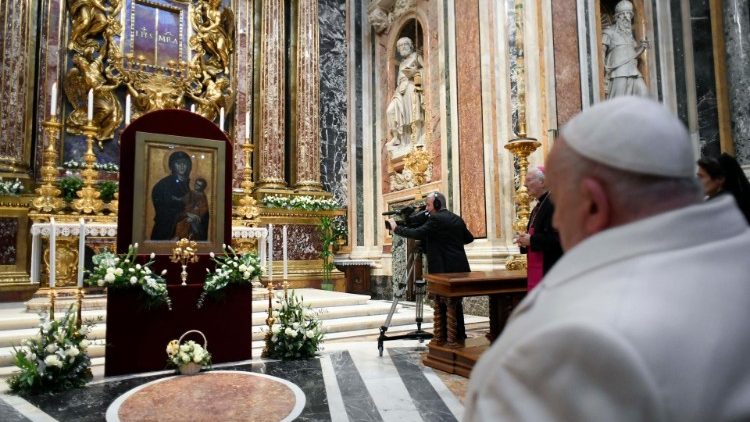
File Photo: Pope Francis praying before icon of Mary 'Salus Populi Romani' in Rome's Marian BasilicaFile Photo: Pope Francis praying before icon of Mary 'Salus Populi Romani' in Rome's Marian Basilica  (Vatican Media)

Pope to pray Vespers at St. Mary Major on feast of Our Lady of the Snows

Pope Francis, who holds the Marian Basilica of St. Mary Major close to his heart, will take part in the Vespers for the Solemnity of Our Lady of the Snows and the Anniversary of the Dedication of the Basilica on August 5.

By Deborah Castellano Lubov

Each August 5, the faithful of Rome and pilgrims commemorate the Solemnity of Our Lady of the Snows at the Marian Basilica of St. Mary Major, and Pope Francis will join them this year.

According to the Holy See Press Office, the Pope will be attending the Vespers of the Day's events at 5:30 p.m., which will be presided over by Archbishop Rolandas Makrickas, Coadjutor Archpriest of the Basilica.

The Holy Father has had a special affection for the Marian Basilica throughout his pontificate, evidenced by his numerous visits, especially before and after his Apostolic Journeys, when he prays before the icon of Maria Salus Populi Romani.

Per his personal tradition, the Pope will likely visit St. Mary Major's a month later before his Apostolic Journey to Indonesia, Papua New Guinea, Timor-Leste, and Singapore, at the beginning of September.

Solemnity and Anniversary of Dedication of Basilica

According to Thursday's announcement, Pope Francis will join the Roman faithful at the liturgy for the Solemnity and for the Anniversary for the Dedication of the Basilica.

Earlier in the day, there will be a 10 a.m. Mass in honour of Our Lady of the Snows, in which white flower petals are dropped from the ceiling.

The same showering of the 'snow' is repeated at the 5 p.m. Vespers.

Following the Vespers,  Archbishop Emilio Nappa, the President of the Pontifical Missions Societies, will preside over another Eucharistic celebration at 7 p.m.

Miraculous August snowfall of 352

Tradition holds that the Blessed Virgin Mary made snow fall on the Esquiline Hill in the midst of the sweltering August heat of 352.

A Roman nobleman and his wife, who were without heirs, prayed to God to reveal how they should spend their wealth. In a dream shared by both the patrician and Pope Liberius, Mary expressed her wish for a church to be built at the site on the Esquiline Hill.

Despite the scorching summer heat, on August 5, 352, snow fell in a rectangular pattern and did not melt.

The Basilica of St. Mary Major was built on the spot, and completed in 354. 

Gradually resuming activities

The Pope's involvement in this annual tradition for the Blessed Mother this year follows his customary July break from most activities, with the exception of his Sunday Angelus addresses to the faithful in St. Peter's Square.

Later that week, on August 7, the Holy Father will resume his weekly Wednesday General Audiences in the Vatican.