Showing posts with label Ukraine Orthodox Church. Show all posts

Thursday, July 27, 2023

Russia severely damages Orthodox Cathedral in Ukraine they have no shame


Russian Missile Destroys

 Transfiguration Cathedral’s

 Central Altar In Odesa
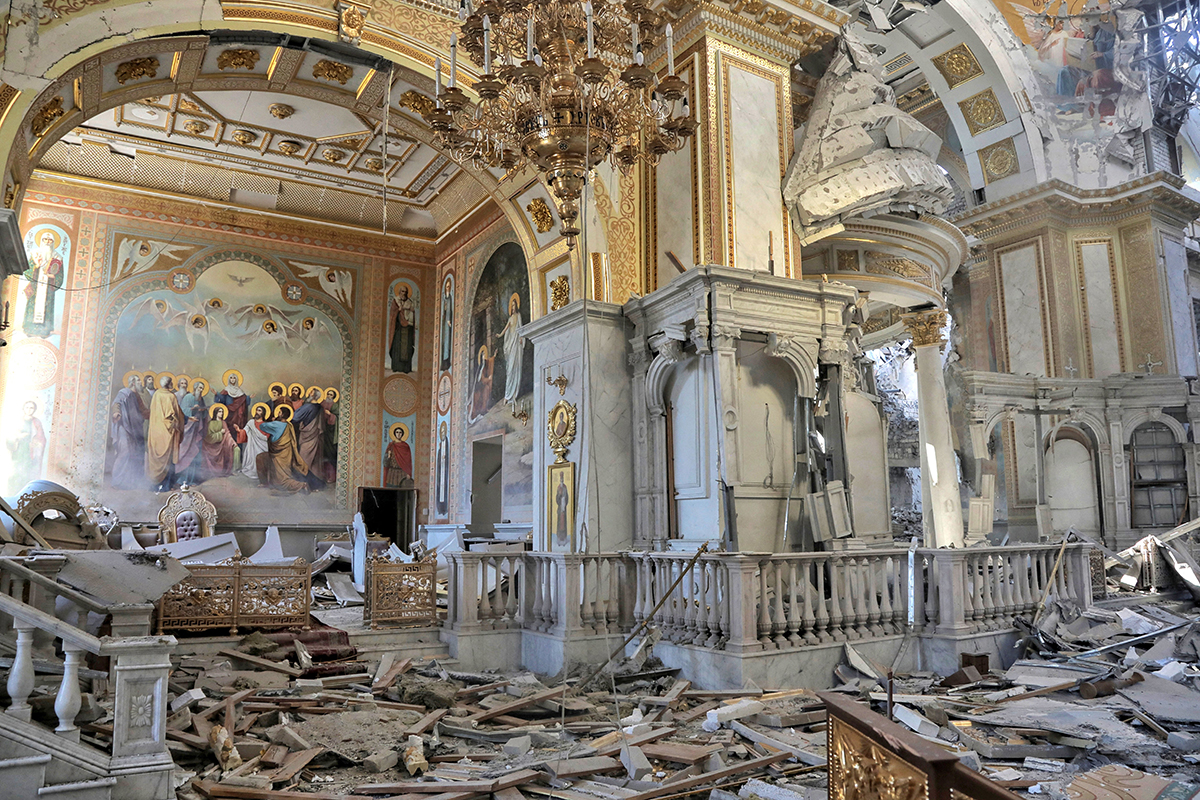


(OSV News) — A Russian attack on a key Ukrainian port city has partially destroyed a historic Ukrainian Orthodox cathedral and UNESCO World Heritage site, prompting international outrage and pledges to rebuild.

Amid a July 23 nighttime attack by Russia on Odesa, an X-22 anti-ship missile struck the Ukrainian Orthodox Holy Transfiguration Cathedral (Spaso-Preobrazhensky Cathedral). The missile directly hit the central altar, as a result of which the cathedral building and the three lower floors were partially destroyed, while the interior and icons were significantly damaged.

The missile was one of 19 various kinds launched against the city that evening in a barrage that killed one and injured 22, including four children.

Since abandoning the Black Sea Grain Initiative on July 17 — a deal brokered by Turkey and the United Nations to ensure vital grain supplies from Ukraine to Africa, the Middle East and Asia — Russia has relentlessly targeted Odesa, the key port for such shipments.

The Odesa Diocese of the Ukrainian Orthodox Church condemned Russia’s aggression against Ukraine. “This act of terrorism against the main shrine and spiritual heart of the city of Odesa — the Holy Transfiguration Cathedral, around which peaceful civilians reside, and the cathedral itself is in no way connected with military facilities,” the diocese added.

Ukrainian President Volodymyr Zelenskyy in his evening video message of July 23 announced that Ukraine will “definitely restore” Spaso-Preobrazhensky Cathedral in Odesa.

“We cannot allow people around the world to get used to terrorist attacks. The target of all these missiles is not just cities, villages or people. Their target is humanity and the foundations of our entire European culture,” said Zelenskyy.

Along with the cathedral, almost 50 other buildings, 25 of them architectural monuments, had also been destroyed that night in Odesa’s historic center, which as a whole forms a UNESCO World Heritage site. The consulate of Greece also sustained damage, as did China’s consulate three days prior.

Zelenskyy noted that the cathedral — consecrated in 1809 as the first and primary Orthodox church in Odesa — had been “looted and destroyed by Bolsheviks” in 1936, and “restored in independent Ukraine.”

“And now terrorists are trying to destroy it again,” he said.

Italian Prime Minister Georgia Meloni pledged Italy’s assistance in restoring the cathedral.

UNESCO condemned “in the strongest terms the brazen attack carried out by the Russian forces, hit several cultural sites in the city center of Odesa, home to the World Heritage property ‘The Historic Centre of Odesa.'”

“The people who went to that cathedral to pray are crying today,” said Major Archbishop Sviatoslav Shevchuk, head of the Ukrainian Greek Catholic Church, while speaking in Lviv, Ukraine, to youth commemorating the founding of the “Ukrainian Youth – Christ” movement.

“Today a Russian missile hit not just the sanctuary of their temple, it hit their heart,” he said, adding “the actions of these criminals are not God’s, but the devil’s logic.”

“I don’t know if that Russian criminal, who pressed the button, understood that this rocket would not hit the Odesa port, but the Transfiguration Cathedral,” Major Archbishop Shevchuk said.

The attack on the cathedral also drew condemnation from Ukrainian community leaders in the U.S.

Father Taras Naumenko, mitered protopriest of St. Vladimir Ukrainian Orthodox Church in Philadelphia, told OSV News that Russian Orthodox Patriarch Kirill has “more than once blessed (Russian) soldiers” in their efforts to commit genocide in Ukraine.

“He has told them to have this victory for Russia — that even if they die, they will reach the eternal kingdom because they are fighting for the purity of the faith,” said Father Naumenko. “But this is not about religion. It’s about greed, money; the purity of power.”

“This is but another item to add to the long list of crimes against humanity the Russians are racking up,” said Nicholas Rudnytzky, professor of history and dean of academic services Manor College, located in Jenkintown, Pennsylvania, which has deep roots in the Ukrainian-American community.

“Russia has plundered our museums, killed our local officials, tortured and stolen our children and is destroying our churches,” Rudnytzky told OSV News. “If that does not show how this is an existential war for the Ukrainians, nothing will.”

The attack was “yet another signature piece of (Russia’s) campaign of genocide and terror,” said Eugene Luciw, president of the Ukrainian Congress Committee of America’s Philadelphia chapter and a member of Presentation of Our Lord Ukrainian Catholic Church in Lansdale, Pennsylvania.

Luciw added the need for greater support for Ukraine to ensure “a decisive victory against evil” that includes “bringing the perpetrators of these war crimes against humanity to swift justice and punishment before a war tribunal.”

UNESCO will send a mission to Odesa to carry out a preliminary damage assessment.

The organization noted that a number of significant cultural objects were damaged as a result of the attack, including the Transfiguration Cathedral, the first and main Orthodox church in Odesa, founded in 1794.

“This act of hostility comes only days after other attacks that impacted many cultural heritage sites in areas protected under the World Heritage Convention in Lviv and Odesa,” UNESCO noted.

Lilia Kovalyk Vasiuta writes for OSV News from Lviv. Gina Christian is a national reporter for OSV News. Follow her on Twitter at @GinaJesseReina.

Tuesday, May 30, 2023

Orthodox Church of Ukraine moves Christmas to December 25th


In snub to Russia, Ukraine’s Orthodox Church moves Christmas to Dec. 25

Elise Ann Allen


ROME – In a decision seen as an act of defiance towards the Russian Orthodox Church, which also has the effect of promoting closer ties with Roman Catholics and other Western branches of Christianity, the Orthodox Church of Ukraine has decided to move Christmas to Dec. 25.

Traditionally, Ukrainian Christians, the bulk of whom are Orthodox, have celebrated Christmas on Jan. 7, along with other predominantly Orthodox nations, including Russia, which invaded Ukraine in February of last year.

On May 24, the Council of Bishops of the Orthodox Church of Ukraine voted nearly unanimously to switch from the Julian calendar to the Gregorian calendar as regards most major feasts, except for Easter and a handful of other feast days, such as the feast of the Trinity.

In a statement following the Council’s decision, Metropolitan Epiphany, head of the Orthodox Church of Ukraine, said the decision “is not an easy one, we have been coming to it for a long time, gradually, step by step, and we are making it carefully.”

However, Epiphany said the decision was “as necessary as the decision to introduce the Ukrainian language in worship instead of the traditional Slavic language, to introduce an autocephalous structure of the Church’s life instead of centuries of subordination.”

The Ukrainian Greek Catholic Church, one of several Byzantine-rite churches in full communion with Rome, was the first to make the switch to a new calendar in early 2023.

Adherents to Orthodoxy still follow the Julian calendar, while the Catholic Church and most of the world follow the Gregorian calendar, introduced via papal bull Pope Gregory XIII on February 24, going into effect in October 1582 as a modification of, and replacement for, the Julian calendar.

The transition from the Julian calendar without making a change regarding the celebration of Easter is called the “New Julian” calendar, which is already used by many Orthodox churches in Europe.

In Ukraine there are two primary branches of Orthodox, the autocephalous Orthodox Church of Ukraine, and the Ukrainian Orthodox Church of the Moscow Patriarchate – a branch of Orthodoxy in Ukraine that reports to Moscow.

Following their recent vote, as of Sept. 1, which marks the beginning of their new church year, the Orthodox Church of Ukraine (OCU) will celebrate Christmas on Dec. 25, rather than on Jan. 7.

The Orthodox Saint Nicholas Day will now take place on Dec. 6, and the church will join Catholics in celebrating the feast of the Epiphany on Jan. 6.

In a decree announcing their decision, the OCU said they made the decision to switch the date of their observance of Christmas not only because the Julian calendar is of secular origin and “has no sacred significance,” but also because it is associated with Russian Orthodoxy.

“In the modern realities of the existence of the Orthodox Church of Ukraine in Ukrainian society, especially in connection with the aggressive Russian war against Ukraine,” the demand for a change in the calendar increased “significantly,” they said.

For centuries, the traditional Julian calendar “was perceived as one of the main identifiers of Ukrainian church culture. At first, it was a sign of resistance to Latinization, and after the Bolshevik revolution, it was also a sign of resistance to the Soviet system,” they said.

However, the social and cultural context in Ukraine has changed dramatically since then, the OCU’s statement said.

Nowadays, it said, the Julian calendar “is perceived by the majority not so much as connected with ancient Ukrainian traditions, but as connected with Russian church culture. After all, the Orthodox Churches that support the Orthodox Church of Ukraine use the modern calendar, while its opponents, and primarily the Russian Orthodox Church, follow the old calendar.”

“Therefore, the desire to preserve and affirm one’s own, Ukrainian, spiritual identity, protection from the aggression of the ‘Russian world,’ requires a timely decision – to join the majority of Local Orthodox Churches – in introducing into use the New Julian calendar, as more accurate astronomically and ecclesiastically accepted, with the preservation of the traditional Easter,” the statement said.

The outbreak of the Russia-Ukraine war last year has caused a fracture inside the Orthodox world, with several local Russian Orthodox churches opting to break away from the Moscow Patriarchate over Russian Orthodox Patriarch Kirill’s support of the war, requesting to switch jurisdiction to the Ecumenical Patriarchate of Constantinople, led by Patriarch Bartholomew, instead.

Traditionally, the Ecumenical Patriarchate of Constantinople and the Moscow Patriarchate have been at odds, seen as representing two different strains of Orthodoxy, with Moscow accusing the former of being too indulgent of the West and, therefore, of Western secular values.

However, with Russia’s invasion of Ukraine last year, this sentiment has changed among many Orthodox, sparking a significant shift in sentiment among Ukrainian Orthodox, particularly those who are loyal to Moscow.

Last spring, shortly after the war broke out, priests within the Ukrainian Orthodox Church of the Moscow Patriarchate began collecting signatures for a petition to oust Russian Orthodox Patriarch Kirill from his position of leadership over his support for Russia’s invasion of Ukraine.

This follows a similar petition launched at the beginning of the war that was signed by nearly 300 Russian Orthodox priests, including several prominent members of the Russian Orthodox Church, and which urged Kirill to condemn the war, which over a year later, he still has not done.

Ecclesial tensions in Ukraine are also being felt at the political level, as the Ukrainian parliament debates a bill banning all activities of the Moscow Patriarchate in Ukraine.

Despite his frequent condemnations of Russia’s invasion, the leader of the Ukrainian Greek Catholic Church, Major Archbishop Sviatoslav Shevchuk, has condemned the bill, saying it is not only problematic on grounds of religious freedom, but would have the counterproductive effect of turning supporters of Russia into martyrs.

RELATED: Ukraine’s top Catholic frowns on banning Orthodox church loyal to Moscow

The UOC’s statement specified that despite the shift in calendar, parishes that wish to continue following the old Julian calendar for economic or other reasons may do so, but the decision must be approved by a two-thirds majority of community members and it must be “properly documented.”