Showing posts with label Eastern Catholics. Show all posts

Saturday, August 29, 2026

Pope Leo XIV grants the Eastern Synod of Bishops to remove Patriarchs ammending canons 106 & 126


The Apostolic PalaceThe Apostolic Palace  (@Vatican Media)

Pope Leo grants Eastern Synods the faculty to remove Patriarchs

With an Apostolic Letter issued motu proprio on 29 August, Pope Leo XIV provides the Synods of Bishops of Eastern Catholic Churches the faculty to remove their respective Patriarchs in order “to restore the wounded communion, even by removing him from office for grave cause”, in the event their “bond” is “irreparably compromised.” In such an event, the Roman Pontiff must grant assent to the Synod’s judgment.

By Vatican News

An Apostolic Letter in the form of a motu proprio by Pope Leo XIV, with the incipit Mutua concordia, which was published today, 29 August, amends canons 106 and 126 of the Code of Canons of the Eastern Churches and grants the Synod of Bishops the power, through “an orderly procedure”, to remove a Patriarch from office should their relationship be irreparably compromised for serious reasons.

Without prejudice to the prerogatives of the Apostolic See, therefore, the Synods of Bishops in such cases are called upon “to restore the wounded communion” through a procedure which, in accordance with the norms, guarantees the Patriarch “the right to a full defence before the Synod”.

It will, however, remain for the Pope to “grant his assent to the synodal decision, to ensure that the Fathers’ full freedom to express their choice is guaranteed, free from any possible undue internal or external pressure”.

The Pontiff has ordered that a new paragraph, §3, be inserted after §2 of Canon 106, specifying that “should the Patriarch fail to fulfil the obligations” laid down by the Code itself “the Synod of Bishops of the patriarchal Church may be lawfully convoked by the Bishop who is the most senior in terms of episcopal ordination and who is entitled to vote; and if he too fails to proceed with the convocation, this power passes to the subsequent Bishops, who are more senior in terms of episcopal ordination, who are available to do so and who are entitled to vote”.

Canon 126 is also modified by the addition of a new paragraph stipulating that “for a grave cause recognized as such by the Synod of Bishops of the patriarchal Church, that same Synod—convoked in accordance with Canons 106 § 1, no. 3, and 108 § 3—may request the Patriarch to resign from office.”.

The following paragraph establishes that if, following such a request, “the Patriarch does not resign from his office, the Bishop who is the most senior in terms of episcopal ordination, and who is entitled to vote, shall arrange for the election of a new President by the Synod, which shall submit the removal of the Patriarch to a secret ballot of at least two-thirds of the members of the Synod entitled to vote, whilst respecting [the Patriarch’s] right to defend himself before the Synod itself”. It is also the President’s responsibility to inform the Pope, who must give “his assent to the removal, which renders the patriarchal see vacant”.

Given that in the Eastern Churches there exists a close relationship uniting the Patriarch – who presides over his patriarchal Church as father and head, tamquam pater et caput (CCEO, can. 55) – and the Synod of Bishops, which he himself convokes and leads, a harmonious relationship between them is essential for a fruitful ecclesial life, in the unity of the Spirit and in the sole interest of the Church itself, the motu proprio says.

However, the Code of Canons of the Eastern Churches, which governs the functioning and duties of the Synods of Bishops, made no provision for the event that “the sacred bond between the Pater et Caput and the other Bishops should be irreparably compromised”, resulting in ‘a grave wound requiring remedy, as also urged by numerous Eastern Prelates’,

With the Motu Proprio, therefore, a set of rules comes into force to be followed in the event of an irreconcilable rift between the Patriarch and the Synod, should the Patriarch fail to resign. It is established that it is the responsibility of the Synod to set out the serious reasons that led to the rift, to determine who is to convene the Synod in such a situation and how this is to be done, to specify the majority of votes required to bring the Patriarch’s term of office to an end, and to ensure that the Patriarch’s rights of defence are safeguarded.

The Pope’s provisions are intended to enhance the prerogatives of the Synod of Bishops of the Eastern Catholic Churches, endowing them with a new power consistent with their nature as Churches sui iuris and restoring to them that which originates within them, since they are better placed to understand and assess the situation, whilst reserving for the Roman Pontiff a role of guarantor. The provisions set out in the Motu Proprio also apply, by their very nature, to the major archiepiscopal Churches (cf. can. 152).

Wednesday, May 14, 2025

Pope Leo XIV welcomes Eastern Catholic Churches to Rome for the Jubilee of the Eastern Churches


Pope Leo XIV meets with participants in the Jubilee of Eastern Churches


Pope Leo XIV to Eastern Catholics: The Church needs you

Pope Leo XIV welcomes Eastern Catholics to the Vatican for the Jubilee of Eastern Churches, and highlights the need to preserve their traditions and pray for true peace, “which is reconciliation, forgiveness, and the courage to turn the page and start anew."

By Christopher Wells

Pope Leo XIV welcomed Eastern Catholics to the Vatican with the traditional Easter greeting, “Christ is risen! He is truly risen!”

Addressing the faithful from the 23 sui iuris Churches in full communion with Rome, the Holy Father said, “You are precious in God’s eyes,” and expressed his happiness at being able to devote one of the first encounters of his pontificate to the Eastern faithful.

“Looking at you,” he said, “I think of the diversity of your origins, your glorious history, and the bitter sufferings that many of your communities have endured or continue to endure.”

At the same time, he reaffirmed “the conviction of Pope Francis that the Eastern Churches are to be ‘cherished and esteemed for the unique spiritual and sapiential traditions that they preserve, and for all that they have to say to us about the Christian life, synodality, and the liturgy’.”

Recalling the teachings of previous Popes, including Leo XIII and St. John Paul II, Pope Leo XIV emphasized the importance of Eastern traditions, especially the liturgy.

He also expressed concern for “many of our Eastern brothers and sisters” who have been exiled from their homelands “and risk losing not only their native lands,” but also their religious identity.

Pope Leo insisted on the importance of preserving the Eastern rites and asked the Dicastery for Eastern Churches “to help define principles, norms, and guidelines” to help Latin Bishops support Eastern Catholics in the diaspora to preserve their heritage.

The Church needs the East

“The Church needs you!” Pope Leo said. “The contribution that the Christian East can offer us today is immense,” he continued, pointing to the need to recover the sense of mystery expressed in Eastern liturgies; the importance of rediscovering the sense of the primacy of God and of mystagogy; and the need for “penance, fasting, and weeping for one’s own sins and for those of all humanity.”

“It is vital then, that you preserve your traditions without attenuating them," he said.

The Holy Father went on to highlight the “medicinal” value of eastern traditions of spirituality that combine “the drama of human misery with wonder at God’s mercy.”

“Who better than you,” he asked, “can sing a song of hope even amid the abyss of violence.”

Taking up Pope Francis’ recognition of eastern communities as “martyr Churches,” Pope Leo lamented the violence that continues to plague regions as diverse as the Holy Land, Ukraine, the Middle East, Tigray, and the Caucasus.”

“Rising up from this horror, from the slaughter of so many young people, which ought to provoke outrage because lives are being sacrificed in the name of military conquest, there resounds an appeal” for peace.

He made the appeal, he said, “not so much of the Pope, but of Christ Himself, who repeats, ‘Peace be with you!’”

“Let us pray for this peace,” the Pope said, “which is reconciliation, forgiveness, and the courage to turn the page and start anew.”

Commitment to peace

Pope Leo XIV forcefully expressed his commitment “to make every effort so that peace may prevail,” reaffirming the Holy See’s willingness to do everything possible “to help bring enemies together, face to face, to talk to one another,” to dialogue, “so that peoples everywhere may find hope and recover… the dignity of peace.”

Appealing directly to the people of the world and their leaders, Pope Leo made a heartfelt appeal: “Let us meet, let us talk, let us negotiate!”

He insisted that “war is never inevitable” and called for the silencing of weapons, “which do not resolve problems, but only increase them.”

He went on to thank God for all those who are “sowing peace,” while also expressing gratitude for those Christians, “who, above all in the Middle East, persevere and remain in their homelands, resisting the temptation to abandon them.”

The Pope affirmed the need for eastern Christians to be given “the opportunity, and not just in words, to remain in their native lands with all the rights needed for a secure existence.”

Recalling once again that “Jesus, the Son of Justice, dawned” in their lands, he thanked Eastern Christians “for being ‘lights in the world’” and encouraged them to “be outstanding for your faith, hope, and charity, and nothing else.”

He called for the pastors of the Eastern Churches to promote “community with integrity,” so that their communities might be “places of fraternity and co-responsibility.”

"Today more than ever," concluded Pope Leo XIV, "the splendour of the Christian East demands freedom from all worldly attachments, and from every tendency contrary to communion, in order to remain faithful in obedience and in evangelical witness.”

Saturday, May 10, 2025

Eastern rite Churches welcome the election of Pope Leo XIV


Metropolitan Archbishop Fulop Kocsis of Hajdudorog, Hungary (C) speaks with then-Archbishop Robert Francis Prevost as they await the arrival of Pope Francis at the Buda Castle in Budapest on 28 April 2023. Archbishop Michael Wallace Banach, Apostolic Nuncio to Hungary, stands to the left. (Photo: Magyar Kurir/Attila Lambert)Metropolitan Archbishop Fulop Kocsis of Hajdudorog, Hungary (C) speaks with then-Archbishop Robert Francis Prevost as they await the arrival of Pope Francis at the Buda Castle in Budapest on 28 April 2023. Archbishop Michael Wallace Banach, Apostolic Nuncio to Hungary, stands to the left. (Photo: Magyar Kurir/Attila Lambert) 

Eastern Church leaders welcome election of Pope Leo XIV

Leaders of Eastern-rite Catholic Churches and Orthodox Churches have welcomed the election of Cardinal Robert Prevost as Pope Leo XIV.

By Barb Fraze and Laura Ieraci - CNEWA

Church leaders in the Christian East welcomed the election of Pope Leo XIV on 8 May, noting his first words to the crowd in St. Peter’s Square were about peace.

Ecumenical Patriarch Bartholomew of Constantinople was at an event in his honor in Athens when he learned of the election, according to a report in The Orthodox Times. 

In an English-language video message published by the Ecumenical Patriarchate, he welcomed the new Bishop of Rome, adding he hopes Pope Leo will “be a dear brother and collaborator … for the rapprochement of our churches, for the unity of the whole Christian family, and for the benefit of all of humankind.”

Bartholomew spoke of his collaboration with Pope Francis in the areas of dialogue and care for creation. “We have done a lot,” he said.

The Ecumenical Patriarch, who had hoped to visit Iznik, Turkey, with Pope Francis in May to mark the 1,700th anniversary of the First Ecumenical Council of Nicaea, said he hoped Pope Leo would “combine a visit to Nicaea with an official visit to the Ecumenical Patriarchate, on the occasion of our feast of St. Andrew on 30 November.”

“We look toward the new pontiff with Christian hope,” he told those gathered at the event in Athens, adding that he intends to attend Pope Leo XIV’s Mass of Inauguration in Rome.

“May he inspire the Church and the world with the universal ideals of freedom, equality, justice and solidarity. May he help end wars in Ukraine, the Middle East, and prevent conflict between India and Pakistan,” he said. “I hope we can inaugurate a new era in our bilateral relations and in relations between East and West.”

In a message posted on the website of the Ukrainian Greek Catholic Church, Major Archbishop Sviatoslav Shevchuk of Kyiv-Halych noted that the first words Pope Leo spoke from the balcony were “Peace be with you.” He said that “suffering Ukraine hears these words as words of hope and special God’s blessing.”

“His Holiness Pope Leo XIV expressed the wish these words ‘reach all nations, all the earth.’ We sincerely believe the new bishop of Rome will become for the long-suffering Ukrainian people a herald of peace that comes from the risen Lord,” said Archbishop Shevchuk.


Metropolitan Fulop Kocsis, Archbishop of Hajdudorog, Hungary, who heads the Hungarian Greek Catholic Church, also commented on the Pope’s words of peace.

“Not only did he literally wish them peace, but he quoted the risen Christ, who also greeted the apostles with these words,” he said. “Of course, peace after the resurrection is quite different, since Jesus Christ gives peace in a way that is different from the way the world gives it.”

The new pontiff had visited Hungary twice in recent years, first as Bishop of Chiclayo, Peru, for the 52nd International Eucharistic Congress in Budapest in September 2021, and then as Prefect of the Dicastery for Bishops in April 2023, when he accompanied Pope Francis on his Apostolic Visit to Hungary, which included a visit to the Greek Catholic Protection of the Mother of God Church in Budapest.

The Metropolitan Archbishop said the choice of the name Leo expresses the Pope’s intention to “emphasize his social sensitivity, since Pope Leo XIII wrote the first encyclical on the subject in 1891, ‘Rerum Novarum,’ which was about poverty and the working class.”

Leo XIII was also the first pontiff to acknowledge the dignity of the Eastern Catholic Churches within the Catholic communion with his 1894 encyclical, “Orientalium Dignitatis” (“On the Churches of the East”), he noted. 

“So, the choice of the name Leo is particularly dear to us,” Archbishop Kocsis said, referring to Eastern Catholics.

While he thought the new Pope would choose the name Francis II, he said he was “glad the Pope dared to reach back into tradition.”

“I am convinced that Leo XIV will take the same line as Pope Francis. Dialogue and the inclusion of the poor are important to him,” Archbishop Kocsis said. “The two of them were excellent collaborators; they discussed many things together.”

In New York, Greek Orthodox Archbishop Elpidophoros of America recognized Pope Leo’s election “with fraternal esteem” and renewed the church’s “unwavering commitment to strengthening dialogue and fellowship between our churches, guided by humility, openness and mutual respect.”

“His ministry, deeply inspired by the example of Pope Francis, resonates strongly with the enduring commitment of His All Holiness Ecumenical Patriarch Bartholomew toward ecumenical dialogue, reconciliation and care for the most vulnerable among us,” he said.

Mar Joy Alappatt of the Syro-Malabar Catholic Eparchy of St. Thomas of Chicago, where Pope Leo XIV was born, said Eastern Catholics “anticipate a renewed focus on synodality, honoring liturgical identity, and engaging in genuine dialogue with our ancient practices.”

In his first message to the crowd in St. Peter’s Square after his election on 8 May, Pope Leo XIV underlined the importance of walking as a synodal Church.

Mar Alappatt said, as a Cardinal, the new pontiff had served as a member of the Dicastery for the Eastern Churches since 2023, and “witnessed the beautiful unity of our universal Catholic communion between East and West.” 

The bishop said the Pope’s previous ministry in Peru “showcases a pastor who truly listens, walks humbly with his community, and amplifies the voices from the margins."

“His deep love for the impoverished and his presence among Indigenous populations strongly reflect the many missions led by Eastern churches around the world,” Mar Alappatt said. He noted especially the numerous pastoral and charitable works of the Syro-Malabar Catholic Church in mission territories across central and north India. 

The Pope’s “pastoral spirit, nurtured in Chicago and Peru, now opens pathways in the East through a welcoming and enriching approach,” he continued. “His papacy will inspire us to embrace our missionary calling with greater courage and compassion.”

The Order of St. Augustine, which the Pope entered as a friar, posted on its website an interview he gave when he was created a Cardinal in 2023. In that interview, he said, “Being a synodal Church that knows how to listen to everyone is the way not only to live the faith personally, but also to grow in true Christian brotherhood.” 

“The Church is fully such only when it truly listens,” he said, “when it walks as the new people of God in its wonderful diversity, continually rediscovering its own baptismal call to contribute to the spread of the Gospel and the Kingdom of God.”

Friday, May 2, 2025

The 7th Novemdiales Mass presided by Cardinal Gugerotti focuses on Eastern Churches


Cardinal Gugerotti: Our Eastern brothers and sisters enrich the Church's universality

In his homily for the 7th Novemdiales Mass, the Cardinal urges the faithful to welcome and help our brothers and sisters in the Eastern Churches persevere in their faith.

By Vatican News

Still at the beginning of the Easter season, Cardinal Claudio Gugerotti reflected on faith in the resurrection, especially in light of the passing of Pope Francis on Easter Monday. During the 7th Novemdiales Mass in St. Peter’s Basilica, the Cardinal underlined that the resurrection is not “not a phenomenon inherent to human nature” rather it comes from God “through His Spirit.”

It is through this same Spirit, he stressed that man becomes adopted children of God, who cry out to Him: “Abba, Father” with all of creation. Despite this, “creation and the human person seem to hold so little value today”, the Cardinal emphasized. And yet, there remains an interconnectedness between man and nature.

Creation, he pointed out, is “a companion on humanity’s journey, in solidarity with us and seeking our solidarity in return,” and this was a theme very dear to Pope Francis.

Fraternity between the Eastern and Western Churches

At the heart of his homily, the Cardinal, Prefect Emeritus of the Dicastery for the Eastern Churches, reflected on the richness of the Eastern Christian spirituality. United in the Mass despite our differences, he recalled their history rooted in the earliest days of Christianity, in “the fragrance of the Lord’s land.”

St. Peter’s Basilica was filled many members of the Eastern Catholic Churches for the Eucharistic celebration, and in their presence, the Cardinal expressed his gratitude for their acceptance of “the invitation to enrich the Church’s universality” through their experiences, cultures, and spirituality.


“Pope Francis, who taught us to love the diversity and richness of human expression, surely rejoices today to see us united in prayer for him and with him.”   (@VATICAN MEDIA)


As Cardinal Gugerotti noted, “at times in history, we in the West failed to understand” our brothers and sisters in the East. But this 7th Novemdiales Mass where hymns and readings were led by members of the Eastern Churches, “Pope Francis, who taught us to love the diversity and richness of human expression, surely rejoices today to see us united in prayer for him and with him.”

The Cardinal offered the Mass as a moment to recommit ourselves to welcome and help our brothers and sisters in the Eastern Churches persevere in their faith “especially now, as so many of them are forced to flee their ancient homelands, which were the Holy Land.”

To close his reflection, he urged his fellow Cardinals to recite the prayer of an Eastern father, St. Symeon the New Theologian, ahead of the upcoming conclave:

“Come, true light; come, eternal life; come, hidden mystery; come, nameless treasure; come, ineffable reality; come, inconceivable person; come, endless joy; come, light without evening; come, unfailing hope of all who are to be saved. Come, you who have always desired and desire my miserable soul…”

Tuesday, January 28, 2025

Catholic Church will accept a common date for Easter in both the West and the East


Catholics will accept a common date for Easter in East, West, pope says

Cindy Wooden

Catholic News Service


Pope Francis gives his homily during an ecumenical evening prayer service marking the end of the Week of Prayer for Christian Unity Jan. 25, 2025, at Rome's Basilica of St. Paul Outside the Walls. (CNS/Vatican Media)


Rome — January 27, 2025

Celebrating the Week of Prayer for Christian Unity, Pope Francis reaffirmed the Catholic Church's willingness to accept a proposal for a common date for celebrating Easter in the West and the East.

Noting that in 2025 the date coincides on the West's Gregorian calendar and the East's Julian calendar, Francis said that "I renew my appeal that this coincidence may serve as an appeal to all Christians to take a decisive step forward toward unity around a common date for Easter."

"The Catholic Church is open to accepting the date that everyone wants: a date of unity," he said Jan. 25 during an ecumenical evening prayer service at Rome's Basilica of St. Paul Outside the Walls.

The service marked the end of the Week of Prayer for Christian Unity, which focused on this year's celebration of the 1,700th anniversary of the Council of Nicaea, which gave Christians a common Creed and a formula for determining a common date for the celebration of Easter.

Before the Council of Nicaea in 325, different Christian communities celebrated Easter on different dates; the council decided that for the unity of the Christian community and its witness, Easter would be celebrated on the first Sunday after the first full moon after the spring equinox.

But the Julian calendar, which is what Christians used in the fourth century, was increasingly out of sync with the actual solar year, so March 21 — generally assumed to be the date of the Northern Hemisphere's spring equinox — gradually "drifted" away from the actual equinox.

In 1582, Pope Gregory XIII reformed the calendar, dropping 10 days and making the equinox fall on March 21 again. Most Eastern Christians did not adopt the new calendar, leading to a situation where Easter occasionally is on the same day, but Eastern Christians' celebration can be as much as four weeks later.

Francis has reaffirmed on several occasions the position officially taken by St. Paul VI in the 1960s that if Eastern Christians agree on a way to determine a common date for Easter, the Catholic Church would accept it.

The ecumenical prayer service began with Francis praying before the tomb of St. Paul. He was joined by Orthodox Metropolitan Polykarpos of Italy and Malta and by Anglican Archbishop Ian Ernest, director of the Anglican Center in Rome. The Orthodox and Anglican bishops also joined the pope at the end of the liturgy in giving their blessing to the crowd.

The theme of the 2025 week of prayer was Jesus' question to Martha of Bethany: "Do you believe this?"

In the Gospel of John, Martha tells Jesus that if he had been there, her brother Lazarus would not have died. Jesus tells Martha, "I am the resurrection and the life; whoever believes in me, even if he dies, will live," and then he asks if she believes. Martha responds with a declaration of faith: "Yes, Lord. I have come to believe that you are the Messiah, the Son of God, the one who is coming into the world."

Francis said, "This tender encounter between Jesus and Martha from the Gospel teaches us that even in times of desolation, we are not alone, and we can continue to hope. Jesus gives life even when it seems that all hope has vanished."

"Hope can falter following difficult experiences such as a painful loss, an illness, a bitter disappointment or a sudden betrayal," the pope said. "Although each of us may experience moments of despair or know people who have lost hope, the Gospel tells us that Jesus always restores hope because he raises us up from the ashes of death."

Sometimes, the pope said, people may feel like the search for Christian unity has reached a dead end or that ecumenical dialogue is "doomed to failure."

"All of this makes us experience the same anguish as Martha, but the Lord comes to us," he said. "Do we believe this? Do we believe that he is the resurrection and the life? That he rewards our efforts and always gives us the grace to continue our journey together? Do we believe this?"

The anniversary of the Council of Nicaea is "a year of grace, an opportunity for all Christians who recite the same Creed and believe in the same God," the pope said. "Let us rediscover the common roots of the faith; let us preserve unity! Let us always move forward! May the unity we all are searching for be found."

Thursday, June 27, 2024

Pope addresses the Oriental (Eastern) Churches and appeals to end war


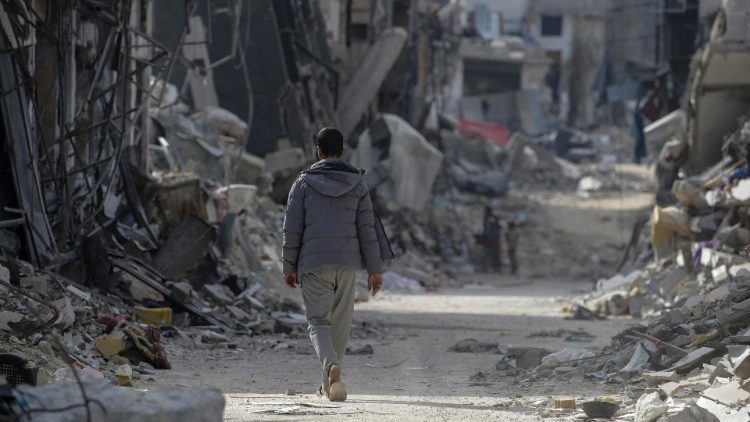
Destruction in Khan Younis, southern Gaza StripDestruction in Khan Younis, southern Gaza Strip  (ANSA)

Pope: ‘Stop spiral of war now! War is always a defeat’

Pope Francis addresses members of ROACO, the Holy See’s humanitarian arm for the Oriental Churches, and renews his plea for peace, calling for solidarity with Eastern Christians fleeing conflicts.

By Lisa Zengarini

Meeting the Reunion of Aid Agencies for the Oriental Churches (ROACO) on Thursday, Pope Francis restated his heartfelt plea for peace in the world, and particularly in the Middle East and Ukraine.

“To those who fuel the spiral of conflicts and reap profit from them, I once again say: Stop! Stop because violence will never bring peace,” the Pope pleaded as he addressed participants in the 97th plenary assembly of the Holy See’s humanitarian arm for the Oriental Churches concluding Thursday.

Focus on Middle East and Ukraine 

The four-day meeting held in the General Curia of the Society of Jesus in Rome included a focus on the dramatic situation in the Holy Land, as well as Ukraine and Ethiopia. Participants also discussed the pastoral care of the many Eastern Catholics outside their territories.


Martyr Churches

In his address, Pope Francis lamented that many Eastern Churches have become “martyr Churches”.

“Just as the Lord’s flesh was pierced by nails and a lance, so many Eastern communities are suffering and bleeding because of the conflicts and violence they endure," he said.

The Pope recalled the Holy Land and Ukraine, but also Syria, Lebanon, the entire Middle East, the Caucasus, and Tigray in Ethiopia. “It is in these very places, where great numbers of Eastern Catholics are found, that the brutality of war is felt most fiercely.”

“Many Eastern Churches are bearing a heavy cross and have become 'martyr Churches'.”

He then renewed his appeal for solidarity. “We cannot remain indifferent," the Pope said.

He encouraged the members of ROACO “to persevere” in their support for the Eastern Catholic Churches, “assisting them, in these dramatic times, to remain firmly rooted in the Gospel.”

The Pope further urged the clergy and religious of Eastern Churches to be ever “attentive” to the cries of their flock, “exemplary” in faith, “putting the Gospel before all forms of dissension or self-interest, and united in service to the common good.”

Pope Francis warmly thanked the representatives of the various agencies of ROACO “for responding to the malign logic of power with the Christian logic of service.” 

"The seeds you plant in fields poisoned by hatred and war,” he noted, “will be a prophecy of a different world, one that does not believe that might makes right, but in the non-violent power of peace.”

“You are sowers of hope, witnesses called to act, as the Gospel tells us, with kindness and discretion.”

Call for a ceasefire in the Holy Land

Referring specifically to the dramatic situation in the Holy Land, Pope Francis reiterated his call on the faithful throughout the world to show their closeness to Christians in the Middle East, encouraging them “to rise above the temptation to abandon their lands torn by conflicts.”

He insisted on the urgent need for a ceasefire in the Holy Land and for dialogue, so as to allow the peaceful coexistence of different peoples in those lands.

“This is the only possible path to a stable future, “he said. “With war, a senseless and inconclusive venture, no one emerges a winner; everyone ends up defeated, because war, right from the beginning, is already a defeat, always.”

“Let us listen to those who suffer its consequences, the victims and those who have lost everything. Let us hear the cry of the young, of ordinary individuals and peoples, who are weary of the rhetoric of war and the empty slogans that constantly put the blame on others, dividing the world into good and evil, weary of leaders who find it difficult to sit at a table, negotiate and find solutions”

Pray for peace in Ukraine and release of prisoners

Pope Francis then turned his thoughts to war-torn Ukraine.

He again called for prayers so that “paths of peace may open for those beloved people, that prisoners of war may be freed, and children repatriated.” 

He also conveyed his “fraternal greetings” to His Holiness Karekin II and to the dear people of Armenia facing conflict

Supporting Eastern Christians living in the diaspora

Bringing his address to a close, Pope Francis referred to the many Eastern Christians fleeing conflicts or migrating in search of work and better living conditions.

He recalled the risk of these diaspora communities “losing their religious identity” and of the precious “spiritual heritage” of the East being "weakened.”

While expressing his gratitude to the Latin dioceses that welcome Eastern Christians, he urged them to show them “particular concern” so that they may keep the Eastern rites alive and flourishing.

He concluded by encouraging the Dicastery for the Eastern Churches to work to this end, “by establishing principles and norms that can help Latin bishops support Eastern Catholics living in the diaspora."

Sunday, May 5, 2024

Celebrating Easter in Ukraine amidst war


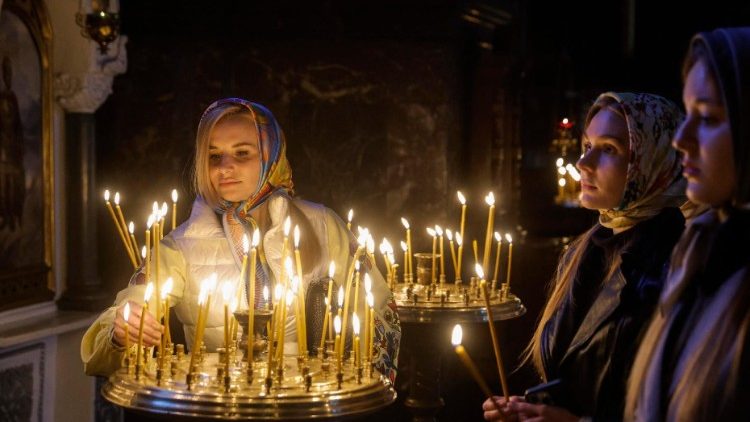
Orthodox believers light candles at St Volodomyr Cathedral in Kyiv ahead of the Divine Liturgy for EasterOrthodox believers light candles at St Volodomyr Cathedral in Kyiv ahead of the Divine Liturgy for Easter  (ANSA)

Ukraine celebrates Easter in the shadow of war

Ukrainian Greek Catholics and others are celebrating Easter Sunday amid reports of heavy fighting as Russian troops are further advancing in Eastern Ukraine. Sunday marks the third Easter in Ukraine since Russia invaded the nation in February 2022.

By Stefan J. Bos 

Worshipers in churches observing Easter according to the Julian calendar gather across Ukraine to celebrate Christ's resurrection amid destruction and death.

As the war against Russia enters its third year, people put their trust in the hope of the Gospel, including in Kyiv, where Orthodox believers were seen flocking to St. Volodymyr's Cathedral.

Elsewhere, Ukrainian soldiers received blessings before Easter, when many will be fighting on battlefields against advancing Russian troops.


Praying for peace

St. Volodymyr's Cathedral in Kyiv, many received blessings and prayed for peace after hundreds of thousands of people were killed and injured in the ongoing war.

Their sentiments are shared by the Ukrainian Greek Catholics, who also celebrate Easter this Sunday.

The head of Ukraine's five million-strong Greek Catholic Church, Archbishop Sviatoslav Shevchuk, says that "each day probably 200 Ukrainians are killed. When a young widow is crying on the tomb of her husband killed in the front line in this situation, where is God? And that question is a very important and deep religious question," he said.

Seeing Christ in the wounds of the people

"But God is with us," he noticed. "Jesus Christ today is [in a way] the crucified body of Ukraine. And He is with the wounds of the simple people," the archbishop stressed.     

And the church leader makes clear that while Easter celebrates the resurrection of Christ from death, the same Lord understands the suffering of people in war. "Very often when I am visiting hospitals, and I see those young soldiers, young civilians with amputations - we have 1,500 amputations right now in Ukraine - I had the feeling: 'Lord, those wounds are yours.' 

And there were more injuries as Ukraine marked its third Easter at war, with Russia launching a barrage of drones in Ukraine's east, wounding more than a dozen people.

It also claimed that its troops had taken control of the village of Ocheretyne, the scene of heavy fighting.

Ukraine's air force said that Russia had launched 24 Shahed drones overnight, of which 23 were shot down.

But in Kyiv, people expressed hope and prayed that the fighting would stop and peace would return to this wartorn, shaken nation.