Showing posts with label Orthodox. Show all posts

Thursday, February 5, 2026

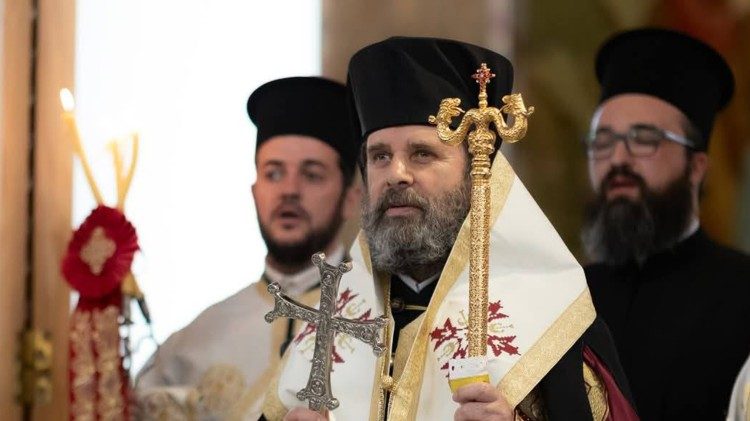
Pope Leo XIV speaks to priests and monks from the Eastern Orthodox Church


Pope Leo XIV meets with priests and monks of Eastern Orthodox ChurchesPope Leo XIV meets with priests and monks of Eastern Orthodox Churches  (@Vatican Media)

Pope invites Eastern Orthodox priests and monks to 'grow in shared faith'

Addressing young priests and monks from the Eastern Orthodox Churches, Pope Leo XIV upholds their shared common heritage and encourages all efforts to support one another, 'so that we may grow in our shared faith in Christ, who is the ultimate source of our peace.'

By Deborah Castellano Lubov

“The historic and cultural differences in our Churches represent a wonderful mosaic of our shared Christian heritage, which is something we can all appreciate.”

Pope Leo XIV made this observation on Thursday in the Vatican, addressing young priests and monks from the Eastern Orthodox Churches participating in a study visit, organized by the Dicastery for Promoting Christian Unity. 

Greeting those before him representing the Armenian, Coptic, Ethiopian, Eritrean, Malankara, and Syriac Orthodox Churches, the Pope recalled the words of Saint Peter, "Peace to all of you who are in Christ."


Supporting one another

The Pope remembered that the Church recently celebrated the Week of Prayer for Christian Unity, whose theme was taken from Saint Paul’s Letter to the Ephesians, in which the Apostle stresses the importance of being united in the faith, noting “There is one body and one Spirit, just as you were called to the one hope of your calling.”

Pope Leo reflected on St. Paul's extensive travels throughout Israel, Asia Minor, Syria, Arabia, and even Europe, where he founded and visited numerous Christian communities. These journeys, the Pope noted, made him more aware of the particular characteristics of each Church, including their ethnic backgrounds, customs, and specific challenges, and even the risk that communities could become inward-looking or overly focused on their own concerns.

For this reason, “throughout his letters," Pope Leo said, "Saint Paul was determined to remind them that they were part of the one Mystical Body of Christ.” “In doing so,” the Pope added, “he encouraged them to support one another and to preserve the unity of faith and teaching that reflects the transcendent nature and oneness of God.”

Learning to ‘disarm’ ourselves

Pope Leo praised the shared Christian heritage of the Churches represented at the morning audience, while underscoring the need to work and pray together.

 “We should continue to support one another," he said, "so that we may grow in our shared faith in Christ, who is the ultimate source of our peace,” noting that this growth requires learning how to “disarm ourselves.”

May we grow in unity and charity

Pope Leo quoted when the late Ecumenical Patriarch of Constantinople, Athenagoras I, whom the Pope called a "pioneer of the ecumenical movement," stated, “I am disarmed of the need to be right, to justify myself by judging others.” Instead, the Ecumenical Patriarch said he was engaging in “the hardest war," namely "the war against myself.”

Pope Leo therefore observed that “when we remove the prejudices we carry within ourselves and disarm our hearts, we grow in charity, work more closely together, and strengthen our bonds of unity in Christ,” thus making Christian unity become “a leaven for peace on earth and for the reconciliation of all.”

Pope Leo concluded by renewing his gratitude for their visit, inviting them to join him in praying together an Our Father, and asking the Lord to bless them and keep them safe.

Sunday, January 25, 2026

An Ecumenical Evening Vespers with Pope Leo XIV


Pope at Ecumenical Vespers: We are one, let's make it visible

On the feast of the Conversion of St Paul, which marks the close of the Week of Prayer for Christian Unity, Pope Leo invites Christians to continue on their shared mission of spreading the Gospel to all.

By Isabella H. de Carvalho

Pope Leo emphasized how different Christian religions share the same faith and encouraged them to continue together the mission of spreading the Gospel throughout the world, on Sunday, January 25, 2026, at the conclusion of the Week of Prayer for Christian Unity.

“We are one!  We already are!  Let us recognize it, experience it and make it visible!” he said in his homily during the celebration of Second Vespers on the Feast of the Conversion of St. Paul, marking the end of the Week of Prayer.

He pointed out that this annual event reminds Christians of their commitment to the mission of spreading the Gospel, “bearing in mind that the divisions among us – while they do not prevent the light of Christ from shining – nonetheless make the face which must reflect it to the world less radiant.”

The service was celebrated at the Basilica of St. Paul Outside the Walls in Rome, the resting place of the Apostle. The Week of Prayer for Christian Unity takes place every year in the northern hemisphere from January 18 to 25.

Several representatives of various Christian Churches were present, including Metropolitan Polykarpos, representing the Ecumenical Patriarchate of Constantinople, Archbishop Khajag Barsamian, from the Armenian Apostolic Church, and Bishop Anthony Ball, of the Anglican Communion. There was also Cardinal Kurt Koch, Prefect of the Dicastery for Promoting Christian Unity, along with other ecumenical groups and pilgrims.

The ecumenical celebration at St Paul's Outside the Walls (@VATICAN MEDIA)


St. Paul, an example for all Christians in their mission

In the passage from St. Paul’s Letter to the Ephesians, chosen as the theme for this year’s Week of Prayer, “we repeatedly hear the adjective 'one': one body, one Spirit, one hope, one Lord, one faith, one baptism, one God,” the Pope explained in his homily.

“Dear brothers and sisters, how can these inspired words not touch us deeply?  How can our hearts not burn within us when we hear them?” he asked, underlining how we share the same faith in God, Jesus Christ and the Holy Spirit. 

He pointed to St. Paul’s conversion, from a persecutor of the Church to someone who preached Jesus’s “love with burning zeal,” as an example. As the participants of the Vespers gathered before the tomb of the Apostle, Pope Leo highlighted that it served as a reminder that his mission is the same as that of all Christians: “to proclaim Christ and to invite everyone to place their trust in him.”

The Pope also cited the Second Vatican Council’s Constitution Lumen Gentium, in which the Church “expressed its ardent desire to proclaim the Gospel to all creation” and thus “bring to all humanity that light of Christ which is resplendent on the face of the Church.”

 “It is the shared task of all Christians to say humbly and joyfully to the world: ‘Look to Christ!  Come closer to him!  Welcome his word that enlightens and consoles!’,” the Pope insisted.

Commemorating Nicaea and the importance of synodality  

The Pope also recalled the ecumenical prayer service he celebrated along with various other Christian leaders in Iznik, Türkiye, in November 2025, to commemorate the 1700th anniversary of the Council of Nicaea.

“Reciting the Nicene Creed together in the very place where it was formulated was a profound and unforgettable testimony to our unity in Christ,” the Pope said.

“May the Holy Spirit find in us docile minds even today, so that we may proclaim the faith with one voice to the men and women of our time!”

Looking instead to the future, Pope Leo mentioned the 2000th anniversary of the passion, death and resurrection of Christ, which will be celebrated in 2033. In light of this event, he called those present to “commit ourselves to further developing ecumenical synodal practices and to sharing with one another who we are, what we do and what we teach.”

Citing Pope Francis, Pope Leo explained how the Catholic Church’s synodal journey is ecumenical and vice versa, and he recalled the participation of several fraternal Christian delegates to the 2023 and 2024 sessions of the Assemblies of the Synod of Bishops at the Vatican.

“I believe this is a path for growing together in mutual knowledge of our respective synodal structures and traditions,” the Pope insisted.

The witness of the Armenian people

Lastly, the Pope mentioned how this year’s materials for the Week of Prayer for Christian Unity were prepared by the Armenian Apostolic Church, along with the local Churches in the country.

“With deep gratitude, we remember the courageous Christian witness of the Armenian people throughout history, a history in which martyrdom has been a constant feature,” he reflected.

He highlighted “Saint Nersès Šnorhali “the Gracious,” the holy Catholicos who worked for the unity of the Church in the 12th century and was ahead of his time in his ecumenical commitment.  

“As my venerable predecessor Saint John Paul II recalled, Saint Nerses also teaches us the attitude we should adopt on our ecumenical journey: ‘Christians must have a profound interior conviction that unity is essential, not for strategic advantage or political gain but for the sake of preaching the Gospel’,” the Pope explained.

Emphasizing how, according to tradition, Armenia was the first Christian nation, “after King Tiridates was baptized by Saint Gregory the Illuminator in the year 301,” Pope Leo thanked “the intrepid heralds of the saving Word who spread the faith in Jesus Christ throughout Eastern and Western Europe.”

“We pray that the seeds of the Gospel may continue to bear fruit on this continent in unity, justice and holiness, for the benefit of peace among the peoples and nations of the whole world,” the Pope concluded.

Wednesday, October 8, 2025

Among the Orthodox hierarchy is great joy at the news of Pope Leo's visit to Turkey


Pope Leo XIV shakes hands with Metropolitan Emmanuel of Chalcedon at an audience in the Vatican on June 7, 2025Pope Leo XIV shakes hands with Metropolitan Emmanuel of Chalcedon at an audience in the Vatican on June 7, 2025  (@Vatican Media)

Metropolitan Emmanuel welcomes Pope Leo XIV’s upcoming visit to Türkiye

After the announcement of Pope Leo XIV’s visit to Türkiye for the 1,700th anniversary of the Council of Nicaea, Metropolitan Emmanuel of Chalcedon explains the importance of the ecumenical ties between the Popes and the Patriarchs of Constantinople.

By Delphine Allaire

Pope Leo XIV will make an Apostolic Journey to Türkiye on November 27-30 to celebrate the 1,700th anniversary of the Ecumenical Council of Nicaea with a pilgrimage to the city now known as İznik.

After the announcement on October 7, Metropolitan Emmanuel of Chalcedon, who works closely with the Ecumenical Patriarch of Constantinople, Bartholomew I, spoke to Vatican News about the Pope’s visit.

Each year, the Patriarchate sends a delegation to Rome for the feast of Sts. Peter and Paul on June 29, and the Pope reciprocates by sending a delegation to Istanbul for the feast of St. Andrew the Apostle on November 30.

This year, Pope Leo himself will make the ecumenical visit that has become a yearly exchange to build unity and understanding between the Orthodox and Catholic Churches.

Q: What does the upcoming visit of Pope Leo XIV to İznik (Nicaea), the city that will become the destination of his first Apostolic Journey abroad, represent for you?

His is a visit to the Ecumenical Patriarchate, at the invitation of His Holiness Patriarch Bartholomew, for a pilgrimage together to celebrate the 17th centenary of the First Ecumenical Council of Nicaea. We approach this visit with great joy.

This exchange and this visit to the Church of Constantinople, in Istanbul, has been taking place since Pope Paul VI. Until now, the visit was limited only to Ankara, the capital, then to Istanbul for the visit to the Ecumenical Patriarchate and to the Catholic communities.

That is why Nicaea was not, until now, on the agenda, but the 17th centenary—the anniversary that we are celebrating this year to mark the centenary of the 17th centenary of the Council of Nicaea of 325—provides the opportunity for this joint visit.

It will be a celebration with the presence of other guests, primates, and fraternal delegates of other Christian Churches, since this Council is the one that notably produced the first seven articles of the Creed, the other five having been completed by the Second Ecumenical Council of 381.

The Council of Nicaea was important for our faith and for dogma—especially the Creed, which is shared by all Christians.

Q: How are relations today between the Catholic Church and the Greek Orthodox Church?

Relations between the Church of Rome and the Church of Constantinople are excellent. The dialogue continues. The theological dialogue is advancing—not only with the Ecumenical Patriarchate, but with all the autocephalous Orthodox Churches.

We still have points to clarify, but we have made much progress up to now, thanks to the initiatives of recent decades, after the lifting of the anathemas (mutual excommunications, ed.) of 1054. This year, we are celebrating the 60th anniversary of that lifting, which shows that we have nevertheless overcome many obstacles.

We are on the right path toward the realization—in the near future, I hope—of communion between our two sister Churches.

Q: Patriarch Bartholomew has fostered several friendships with the most recent Popes—Francis, Benedict XVI, John Paul II. What can be said about these personal and friendly ties?

One could, moreover, go back to Paul VI and Athenagoras. It was in the time of Paul VI and Athenagoras that these relations began, thanks to the meeting in Jerusalem in 1964.

During the pontificates of John Paul II, Benedict XVI, and Francis, these contacts—made up of reciprocal visits and exchanges—have shown that personal contacts and mutual knowledge are also necessary to advance in the dialogue.

It is not only a dialogue on a theoretical level; it is also advancing on a practical level.

Q: So, we’re looking at the period spanning 1964 to2025. After the “spirit of Jerusalem,” will the “spirit of Nicaea” blow?

Absolutely. It is enough to see how, following the meeting in Jerusalem in 1964, after the lifting of the anathemas in 1965, there has been a new stage, a new period in relations between our two Churches that shows there is a possible future.

There is certainly still work to be done, but there is, at this moment, a better knowledge of one another—whereas for a long period there was ignorance…

Now we are entering a period in which we accept the other, we know the other better, and we are now, notably through these exchanges, establishing much deeper ties that will help us to accomplish Christ’s own will: that all may be one.

Friday, June 27, 2025

Orthodox visits Rome to mark the upcoming Feast of Saints Peter & Paul


File phot of Pope Leo XIV's encounter with Ecumenical Patriarch Bartholomew I of Constantinople in the VaticanFile phot of Pope Leo XIV's encounter with Ecumenical Patriarch Bartholomew I of Constantinople in the Vatican  (@Vatican Media)

Orthodox delegation visits Rome for the Feast of Saints Peter and Paul

Following a long-standing tradition, a delegation of the Ecumenical Patriarchate of Constantinople is in Rome this week to help build unity between the Catholic and Orthodox Churches.

By Deborah Castellano Lubov

An official delegation of the Ecumenical Patriarchate of Constantinople is visiting Rome from 27-29 June 2025, the Holy See Press Office announced in a statement on Friday.

The visit comes as part of the traditional exchange of delegations for the respective feasts of the Patron Saints: 29 June in Rome for the celebration of the Holy Apostles Peter and Paul and 30 November in Istanbul for the celebration of St. Andrew the Apostle.

The Orthodox delegation is being led by Metropolitan Emmanuel of Chalcedon, President of the Synodal Commission of the Ecumenical Patriarchate for Relations with the Catholic Church. The Metropolitan is Patriarch Bartholomew's envoy to the celebration who will be accompanied by the Reverend Fathers Aetios and Ieronymos.

The delegation will attend the Mass presided over by Pope Leo XIV on Sunday, 29 June, to mark the Feast of Sts. Peter and Paul, and will meet with Pope on Saturday, 28 June.

Tuesday, June 24, 2025

Prayers continue for the victims of the devastating church bombing in Damascus, Syria.


Vigil, prayers for victims of suicide bombing at Damascus churchVigil, prayers for victims of suicide bombing at Damascus church (ANSA)

Damascus church bombing: ‘There is no justification’

Following the bombing of the St. Elias Church in Damascus, Syria, the Assembly of the Catholic Ordinaries in Holy Land issues a statement condemning the violence and calling for protection of Christians.

By Kielce Gussie

Following the suicide bombing of St. Elias Church in Damascus—which killed 25 people and injured 63 others—the Assembly of Catholic Ordinaries of the Holy Land issued a statement expressing its “profound shock and deep revulsion.”

An act of unspeakable evil

The Assembly of the Catholic Ordinaries in Holy Land (ACOHL) brings together the Bishops/Eparchs/Exarchs of the Catholic Church holding jurisdiction over the territory of the Holy Land in Jerusalem, Palestine, Israel, Jordan, and Cyprus.


“There is no justification—religious, moral, or rational—for the slaughter of innocents, least of all in a sacred space,” the ACOHL statement continued. The Assembly argued that claiming faith as the reason to justify this violence “is a grave perversion of all that is holy.”

It is an act of “unspeakable evil—a crime against humanity and a sin before God.”

Referencing the Pope Francis-signed Document on Human Fraternity (Abu Dhabi, 2019), the Assembly highlighted that this attack violated the right to worship in peace and safety:

“The protection of places of worship—synagogues, churches and mosques—is a duty guaranteed by religions, human values, laws and international agreements. Every attempt to attack places of worship or threaten them by violent assaults, bombings or destruction, is a deviation from the teachings of religions.”

May they live in peace

Moreover, the Assembly extended its condolences to the Greek Patriarchate of Antioch and All the East, condemning the “barbaric act” and rejecting “ideologies that seek to justify violence in the name of religion.”

Expressing their solidarity with all the Christian communities in Syria who have been living for years with persecution, the statement offered prayers for the victims, healing for the wounded, and comfort for the families affected.


People attend a mass inside Mar Elias Church in the Dweila neighborhood of Damascus that was damaged following the suicide bombing on Sunday, in Damascus

In addition, the Assembly urged the Syrian authorities to work to ensure the protection and freedom of Christians around the country, so “that they may live in safety and contribute fully to the life of their homeland.”

Reflecting on Pope Leo XIV’s words from his Angelus address on June 22, the statement ended, praying that “the swamps of hatred and fanaticism be decisively eradicated so that the peoples of the Middle East—and beloved Syria in particular—may finally live in peace, dignity, and shared humanity.”

Saturday, March 29, 2025

Pope seeks closer relationship with Orthodox in Albania


His Beatitude Joan, Archbishop of Tirana, Durrës, and All AlbaniaHis Beatitude Joan, Archbishop of Tirana, Durrës, and All Albania 

Pope Francis hopes for closer ties with Orthodox Church of Albania

As His Beatitude Joan is enthroned as the Archbishop of Tirana, Durrës, and All Albania, Pope Francis expresses his hopes for renewed commitment to deepening relations between the Catholic Church and the Autocephalous Orthodox Church of Albania.

By Devin Watkins

The Holy See sent a delegation to the enthronement of His Beatitude Joan as Archbishop of Tirana, Durrës, and All Albania, which took place in Tirana on Saturday.

Archbishop Flavio Pace, Secretary of the Dicastery for Promoting Christian Unity led the delegation, accompanied by Msgr. Andrea Palmieri, Undersecretary of the same Dicastery, and Msgr. Ionuţ Paul Strejac, Chargé d’Affaires ad interim of the Apostolic Nunciature in Tirana.

Pope Francis sent a letter to Archbishop Joan to extend his “fraternal greetings in the love of Christ.”

“In expressing my spiritual closeness,” wrote the Pope, “I assure you of my prayers that God the Father, source of all good, will grant you the abundant gifts of the Holy Spirit as you guide the flock entrusted to your care.”

He recalled Archbishop Joan’s predecessor, His Beatitude Anastas, whose apostolic zeal “left a deep and lasting legacy on Albania.”

“Anastas distinguished himself by his commitment to the peaceful coexistence of men and women belonging to different Churches and religious traditions,” said the Pope, “and he contributed significantly to the improvement of relations between our Churches.”

Pope Francis went on to invite Archbishop Joan to continue to foster dialogue as a way to overcome divisions and seek full communion among Christians.

“In these difficult times marked by war and violence,” he said, “it is ever more urgent that Christians bear credible witness to unity, so that the world may fully embrace the Gospel message of fraternal solidarity and peace.”

The Pope noted that Christians bear responsibility for showing the world the “real communion, if alas not yet complete, that already unites us.”

“It is my heartfelt hope,” wrote Pope Francis, “that under your paternal guidance, relations between the Church of Albania and the Catholic Church will develop further, seeking new forms of fruitful cooperation in proclaiming the Gospel, serving those most in need and renewing our commitment to resolving the issues that still separate us through the dialogue of charity and truth.”

In conclusion, the Pope assured Archbishop Joan of his prayers for his ministry and extended to him “a fraternal embrace in Christ our Lord.”

Friday, June 28, 2024

Pope Francis hopes to visit Turkey on the anniversary of Nicea


Pope Francis with the Delegation of the Ecumenical PatriarchatePope Francis with the Delegation of the Ecumenical Patriarchate  (Vatican Media)

Pope hopes to visit Türkiye for anniversary of Council of Nicea

In remarks to a delegation from the Ecumenical Patriarchate of Constantinople, Pope Francis expresses his hopes of travelling to Türkiye in 2025 to celebrate the 1,700th anniversary of the Council of Nicea.

By Christopher Wells

Pope Francis expressed his desire to visit the area of Nicaea in 2025 to mark the 1,700th anniversary of the first Ecumenical Council.

“It is a trip I wholeheartedly desire to make,” the Pope said on Friday morning, as he greeted a delegation from the Ecumenical Patriarchate of Constantinople, which is in Rome for the feast of Sts Peter and Paul, the founders of the Church in Rome.

The customary visit is reciprocated by a delegation from the Catholic Church to Istanbul on the feast of St. Andrew, who tradition holds founded the Church at Constantinople.

The joy of fraternal encounter

In his address to the delegation, the Holy Father welcomed the opportunity “to experience the joy of fraternal encounter” and to bear witness both to the “profound bonds” that unite the two Churches and to the “firm resolve to progress together” towards the restoration of unity between them.

Pope Francis highlighted in particular his numerous meetings with the current Ecumenical Patriarch, Bartholomew I, especially their encounter in Jerusalem in 2014 to mark the 50th anniversary of the historic meeting between Pope St Paul VI and Athenagoras I.

Emphasizing the commitment to “journeying together” towards full unity, the Pope reaffirmed “that dialogue between our Churches poses no risk to the integrity of the faith; rather, it is a necessity arising from our fidelity to the Lord and leading us to the whole truth through an exchange of gifts and under the guidance of the Holy Spirit.”

Prayers for peace

The Pope recalled, too, the peace ceremony in Vatican Gardens, which took place shortly after the meeting in Jerusalem. Together, Pope Francis and Patriarch Bartholomew welcomed representatives of Israel and Palestine “in order to invoke peace in the Holy Land, in the Middle East, and throughout the world.”

“Present events have shown us the necessity and urgency of praying together for peace,” the Pope said, “so that the war may end, the leaders of nations and the parties in conflict may rediscover the path to concord, and all parties come to recognize one another as brothers and sisters.”

He noted that this invocation for peace is extended to all conflicts, especially the ongoing war in Ukraine.

The way of love, reconciliation, and mercy

The need for hope in the world, at “a time when so many men and women are prisoners of fear for the future,” suggested the motto for the upcoming Jubilee Year, “Pilgrims of Hope.”

The Pope invited the Eastern Orthodox Churches to “accompany and support” the upcoming Holy Year with their prayers, “so that abundant spiritual fruits may not be lacking.”

Pope Francis concluded his address with prayer that “the Lord might grant that we may continue to walk on the path that He points out to us, which is always the way of love, reconciliation, and mercy.”