Showing posts with label Armenia. Show all posts

Sunday, January 25, 2026

An Ecumenical Evening Vespers with Pope Leo XIV


Pope at Ecumenical Vespers: We are one, let's make it visible

On the feast of the Conversion of St Paul, which marks the close of the Week of Prayer for Christian Unity, Pope Leo invites Christians to continue on their shared mission of spreading the Gospel to all.

By Isabella H. de Carvalho

Pope Leo emphasized how different Christian religions share the same faith and encouraged them to continue together the mission of spreading the Gospel throughout the world, on Sunday, January 25, 2026, at the conclusion of the Week of Prayer for Christian Unity.

“We are one!  We already are!  Let us recognize it, experience it and make it visible!” he said in his homily during the celebration of Second Vespers on the Feast of the Conversion of St. Paul, marking the end of the Week of Prayer.

He pointed out that this annual event reminds Christians of their commitment to the mission of spreading the Gospel, “bearing in mind that the divisions among us – while they do not prevent the light of Christ from shining – nonetheless make the face which must reflect it to the world less radiant.”

The service was celebrated at the Basilica of St. Paul Outside the Walls in Rome, the resting place of the Apostle. The Week of Prayer for Christian Unity takes place every year in the northern hemisphere from January 18 to 25.

Several representatives of various Christian Churches were present, including Metropolitan Polykarpos, representing the Ecumenical Patriarchate of Constantinople, Archbishop Khajag Barsamian, from the Armenian Apostolic Church, and Bishop Anthony Ball, of the Anglican Communion. There was also Cardinal Kurt Koch, Prefect of the Dicastery for Promoting Christian Unity, along with other ecumenical groups and pilgrims.

The ecumenical celebration at St Paul's Outside the Walls (@VATICAN MEDIA)


St. Paul, an example for all Christians in their mission

In the passage from St. Paul’s Letter to the Ephesians, chosen as the theme for this year’s Week of Prayer, “we repeatedly hear the adjective 'one': one body, one Spirit, one hope, one Lord, one faith, one baptism, one God,” the Pope explained in his homily.

“Dear brothers and sisters, how can these inspired words not touch us deeply?  How can our hearts not burn within us when we hear them?” he asked, underlining how we share the same faith in God, Jesus Christ and the Holy Spirit. 

He pointed to St. Paul’s conversion, from a persecutor of the Church to someone who preached Jesus’s “love with burning zeal,” as an example. As the participants of the Vespers gathered before the tomb of the Apostle, Pope Leo highlighted that it served as a reminder that his mission is the same as that of all Christians: “to proclaim Christ and to invite everyone to place their trust in him.”

The Pope also cited the Second Vatican Council’s Constitution Lumen Gentium, in which the Church “expressed its ardent desire to proclaim the Gospel to all creation” and thus “bring to all humanity that light of Christ which is resplendent on the face of the Church.”

 “It is the shared task of all Christians to say humbly and joyfully to the world: ‘Look to Christ!  Come closer to him!  Welcome his word that enlightens and consoles!’,” the Pope insisted.

Commemorating Nicaea and the importance of synodality  

The Pope also recalled the ecumenical prayer service he celebrated along with various other Christian leaders in Iznik, Türkiye, in November 2025, to commemorate the 1700th anniversary of the Council of Nicaea.

“Reciting the Nicene Creed together in the very place where it was formulated was a profound and unforgettable testimony to our unity in Christ,” the Pope said.

“May the Holy Spirit find in us docile minds even today, so that we may proclaim the faith with one voice to the men and women of our time!”

Looking instead to the future, Pope Leo mentioned the 2000th anniversary of the passion, death and resurrection of Christ, which will be celebrated in 2033. In light of this event, he called those present to “commit ourselves to further developing ecumenical synodal practices and to sharing with one another who we are, what we do and what we teach.”

Citing Pope Francis, Pope Leo explained how the Catholic Church’s synodal journey is ecumenical and vice versa, and he recalled the participation of several fraternal Christian delegates to the 2023 and 2024 sessions of the Assemblies of the Synod of Bishops at the Vatican.

“I believe this is a path for growing together in mutual knowledge of our respective synodal structures and traditions,” the Pope insisted.

The witness of the Armenian people

Lastly, the Pope mentioned how this year’s materials for the Week of Prayer for Christian Unity were prepared by the Armenian Apostolic Church, along with the local Churches in the country.

“With deep gratitude, we remember the courageous Christian witness of the Armenian people throughout history, a history in which martyrdom has been a constant feature,” he reflected.

He highlighted “Saint Nersès Šnorhali “the Gracious,” the holy Catholicos who worked for the unity of the Church in the 12th century and was ahead of his time in his ecumenical commitment.  

“As my venerable predecessor Saint John Paul II recalled, Saint Nerses also teaches us the attitude we should adopt on our ecumenical journey: ‘Christians must have a profound interior conviction that unity is essential, not for strategic advantage or political gain but for the sake of preaching the Gospel’,” the Pope explained.

Emphasizing how, according to tradition, Armenia was the first Christian nation, “after King Tiridates was baptized by Saint Gregory the Illuminator in the year 301,” Pope Leo thanked “the intrepid heralds of the saving Word who spread the faith in Jesus Christ throughout Eastern and Western Europe.”

“We pray that the seeds of the Gospel may continue to bear fruit on this continent in unity, justice and holiness, for the benefit of peace among the peoples and nations of the whole world,” the Pope concluded.

Sunday, November 30, 2025

Sunday with Pope Leo XIV: Prayer at the Armenian Apostolic Cathedral in Istanbul


Pope: Christian communion not domination but exchange of God-given gifts

Pope Leo XIV prays at the Armenian Apostolic Cathedral in Istanbul, and thanks God for the courageous witness offered by Armenians throughout history, often amid tragic circumstances.

By Devin Watkins & Isabella H. de Carvalho - Istanbul

On the fourth and final day of his Apostolic Journey to Türkiye, Pope Leo XIV began the day with prayer at the Armenian Apostolic Cathedral in Istanbul.

In his address, the Pope sent his greetings to His Holiness Karekin II, Supreme Patriarch and Catholicos of All Armenians, and the entire Armenian Apostolic community in Türkiye.

He thanked God for the “courageous Christian witness of the Armenian people throughout history, often amid tragic circumstances.”

Pope Leo expressed his gratitude for the growing fraternal bonds that unite the Apostolic Armenian Church and the Catholic Church.

He recalled that the first join declaration between a Pope and an Oriental Orthodox Patriarch was signed in May 1970 between Pope Paul VI and Catholicos Vasken I.

“Since then, by God’s grace, the ‘dialogue of charity’ between our Churches has flourished,” he said.

Pope Leo said his visit to Türkiye celebrates the Nicene Creed, as the Church marks the 1,700th anniversary of the Council of Nicaea, saying it calls to mind the unity that existed between East and West in the early centuries of the Church.

“We must also take inspiration from the experience of the early Church in order to restore full communion, a communion which does not imply absorption or domination, but rather an exchange of the gifts received by our Churches from the Holy Spirit for the glory of God the Father and the edification of the body of Christ,” said Pope Leo XIV.

He expressed his hopes that the Joint International Commission for Theological Dialogue between the Catholic Church and the Oriental Orthodox Churches may soon be able to resume its work to seek full communion.

The Pope pointed to the 12th-century Armenian Catholicos St. Nerses IV Shnorhali and his tireless work to “reconcile the churches in order to fulfil Christ’s prayer that ‘they may all be one’.”

“May the example of Saint Nerses inspire us and his prayer strengthen us on the path to full communion!” he prayed.

In conclusion, Pope Leo XIV thanked Armenian Patriarch Sahak II for his warm welcome to the Patriarchal Cathedral of the Armenian Apostolic Church.

“May we receive this gift from above with open hearts,” he said, “so that we may be ever more convincing witnesses to the truth of the Gospel and better servants of the mission of the one Church of Christ.”

Armenian faithful welcome Pope's visit

Several children lined the aisle of the Cathedral as Pope Leo entered in procession with Patriarch Sahak II and the priests of the Armenian Apostolic Church, as a choir sung, instruments rang out and incense filled the air.

Above the entrance to the Church, those present could see a man standing on a ledge through the window, sounding the Cathedral’s bells. 

One woman in the crowd wiped tears from her cheeks as the procession passed by. The children stood excitedly next to one another with scarves draped around their necks featuring the papal visit’s logo. 

“We are the largest Christian community in Türkiye, so to welcome the Pope in our Church is very significant for us,” said Dr. Drtad Uzunyan, Archpriest and Member of the religious council. 

“I hope this will bring an even closer ecumenical relationship between the two Churches. It is already very good, but I hope that it will increase in the future.” 

He remembered that, although Pope Leo XIV is the fourth Pope to come to the Cathedral—after Paul VI, John Paul II, and Benedict XIV—in 2014, Pope Francis visited the Armenian Patriarch at the time, who was sick in the hospital in Istanbul.

“So Pope Leo is the fourth Pope in the Cathedral but fifth Pope with the Armenian community,” Archpriest Uzunyan said, smiling.

Sunday, August 10, 2025

After Sunday Angelus, Pope Leo XIV mentions Armenia, Azerbaijan, Haiti


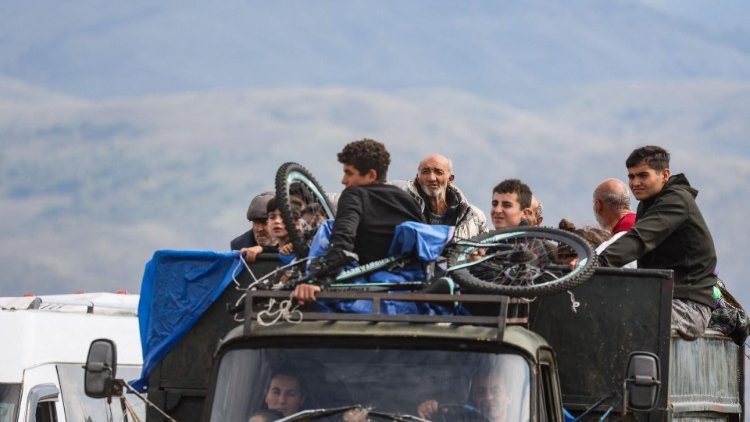
Armenian refugees flee Nagorno-Karabakh following Azerbaijan's 2023 offensiveArmenian refugees flee Nagorno-Karabakh following Azerbaijan's 2023 offensive  (AFP or licensors)

Pope Leo hails Armenia-Azerbaijan peace deal

At the Sunday Angelus, the Pope makes a heartfelt appeal to international decision-makers to take responsibility for seeking solutions to conflicts. He expresses satisfaction over the new peace deal between Armenia and Azerbaijan, but also deep sorrow for the violence that continues to devastate Haiti.

By Francesca Sabatinelli

War must be rejected as a “means of resolving conflicts.” That was the urgent appeal issued by Pope Leo XIV to the international community and its leaders, delivered following the Sunday Angelus prayer. The Pope called on leaders to take responsibility and work actively toward peace, a goal he urged the faithful never to stop praying for.

“Let us continue to pray for an end to all wars,” the Pope said. The 80th anniversary of the bombings of Hiroshima and Nagasaki, he noted, has stirred a global awakening to the need to firmly reject war as a solution to conflict. “Those in positions of power must never lose sight of the consequences their decisions have on people’s lives,” he said. “They must not ignore the needs of the most vulnerable or the universal longing for peace.”

Armenia and Azerbaijan: A Path to Peace

Pope Leo then pointed to the agreement signed on August 8th by Armenian Prime Minister Nikol Pashinyan and Azerbaijani President Ilham Aliyev as a sign of hope. Their joint declaration, he said, is a significant step forward and one that “we all hope will contribute to a stable and lasting peace in the South Caucasus.”


Grief for Haiti

The Pope also turned his attention to the ongoing crisis in Haiti, expressing deep sorrow over the suffering of a population “increasingly overwhelmed by despair.” He condemned the country’s widespread “violence of all kinds, human trafficking, forced displacement, and kidnappings.”

“I make a heartfelt appeal to all responsible parties to release the hostages immediately,” the Pope said. He also called on the international community to provide tangible support to help create the social and institutional conditions “that will allow the Haitian people to live in peace.”

Monday, March 31, 2025

Pope approves Sainthood for three blesseds


Pope Francis was presented with an image of Blessed Peter To Rot in Port Moresby on September 9, 2024Pope Francis was presented with an image of Blessed Peter To Rot in Port Moresby on September 9, 2024  (Vatican Media)

Pope clears path for canonization of PNG Blessed Peter To Rot

Pope Francis approves decrees related to the canonization of martyred layman Peter To Rot from Papua New Guinea, Archbishop Ignatius Choukrallah Maloyan, who was murdered during the Armenian genocide, and Venezuelan religious founder Mother Maria del Monte Carmelo.

By Tiziana Campisi & Devin Watkins

The Church will soon have three new saints and a new blessed, as well as a new venerable, after Pope Francis authorized the publication of decrees related to several causes of canonization on Monday.

The Pope cleared the path to canonization for Blessed Peter To Rot, a layman martyred for the faith in present-day Papua New Guinea (PNG).

First Papuan Saint

Born on March 5, 1912, Blessed Peter was educated in the Christian faith and became a catechist, and his life was characterized by charity, humility, and dedication to the poor and orphans.

During the Japanese occupation of PNG during the Second World War, Blessed Peter continued to prepare couples for marriage as missionaries were imprisoned. When his pastoral activity was forbidden, he carried out his apostolate in secret, fully aware that he was risking his life.

He staunchly defended the sanctity of marriage and opposed the practice of polygamy, confronting even his older brother, who had taken a second wife. Blessed Peter’s brother reported him to the police, and he was sentenced to two months in prison, where he died of poisoning in July 1945.

Pope St. John Paul II beatified Blessed Peter To Rot on January 17, 1995, in Port Moresby.

Armenian Archbishop martyred during genocide

The Pope also cleared the way for the canonization of Blessed Ignatius Choukrallah Maloyan, who was born in 1869 in Mardin, in present-day Türkiye.

Ordained a priest in 1883 in Lebanon, he took the Christian name Ignatius and became known as an excellent preacher in both Arabic and Turkish, devoting himself to parish ministry and the study of sacred texts in Alexandria, Egypt.

In 1911, Pope Pius X appointed him Archbishop of Mardin during the Synod of Armenian Bishops in Rome, which examined the situation in Turkey after the rise of the Young Turks movement.

After Turkish forces entered the First World War, Archbishop Maloyan was arrested along with 13 priests and 600 other Christians in the tumult that included forced enlistments and harassment against Christians, particularly Armenian Christians.

Archbishop Maloyan and his companions were executed on June 3, 1915, when they refused to renounce the faith. He was beatified by Pope St. John Paul II on October 7, 2001.

First Venezuelan-born saint

Venezuela will also have its first native-born saint, as the Pope recognized a miracle attributed to Blessed Maria del Monte Carmelo, born Carmen Elena Rendíles Martínez in Caracas on August 11, 1903.

She joined the Congregation of the Servants of Jesus of the Blessed Sacrament in 1927 and then left with several other Latin American sisters to found the Congregation of the Servants of Jesus in 1946.

She spent the final years of her life in a wheelchair following a car accident in 1974 and died on May 9, 1977.

The miracle attributed to her intercession involved the 2015 healing of a young woman in Caracas with a heart condition.

Miracle of Italian priest, heroic virtues of Brazilian priest

Pope Francis also recognized a miracle attributed to Fr. Carmelo De Palma, an Italian priest from Bari, who was born on January 27, 1876.

Inspired by the Benedictine charism, Venerable De Palma dedicated himself to offering spiritual direction for priests, nuns, and seminarians, becoming known as a “hero of the confessional.”

The miracle involved the healing of a Benedictine nun in 2013 afflicted by a debilitating degenerative illness.

On Monday, the Pope also recognized the heroic virtues of Servant of God José Antônio de Maria Ibiapina, a 19th-century Brazilian politician-turned-priest.

Thursday, April 5, 2018

Putting the spotlight at the Vatican on one of the newest Doctors of the Church

In Vatican Gardens, Pope Francis Presides Over Inauguration & Blessing of Statue of St Gregory of Narek
Patriarchs of the Armenian Apostolic Church and of the Armenian Catholic Church Participated

The gardens and the radio station of the Vatican City
WIKIMEDIA COMMONS - Jean-Pol Grandmont
This morning, April 5, 2018, Pope Francis presided over the inauguration and blessing of the statue of St Gregory of Narek in the Vatican Gardens. Two Patriarchs of the Armenian Apostolic Church, and the Patriarch of the Armenian Catholic Church participated in the blessing, where the President of Armenia Serzh Sargsyan, and a delegation from the country were also present.
In both the Catholic Church and the Armenian Apostolic Church, St. Gregory of Narek is recognized as a saint. During a Mass in St. Peter’s Basilica on April 12, 2015, to mark the centenary of the genocide of some million and a half Armenians, Pope Francis made St Gregory of Narek a Doctor of the Church.
During that Mass, the Pope recalled “that horrific massacre,” which was “a true martyrdom of your people, in which many innocent people died as confessors and martyrs for the name of Christ.”
In June 24-26 2016, Pope Francis visited Armenia. On his first day hours after landing, in the nation’s capital of Yerevan, the Pope deviated from his prepared remarks at the presidential palace and called the massacre of ethnic Armenians by Ottoman Turks a “genocide,” noting it marked “the start of a sad series of great catastrophes of the last century.”
A 10th Century Armenian monk, mystical writer and poet, Gregory of Narek is known especially for his “Book of Lamentations,” a book of prayers he wrote, considered to be a masterpiece of Armenian literature.
According to Vatican News, there will be an inauguration ceremony at the end of 2018 in the gardens of the mother church of the Armenian Apostolic Church, the Cathedral of Etchmiadzin, where a copy of the same statue is being produced and will be placed.

Sunday, June 26, 2016

Get ready for the aftermath; the Pope is on a plane and talking to reporters

Francis: Christians must apologize to gay people for marginalizing them

  • Pope Francis answers questions from journalists aboard his flight from Yerevan, Armenia, to Rome June 26. (CNS/Paul Haring)
Aboard the papal flight to Rome
The Catholic church and other Christian communities must apologize to gay people and to many groups they have let down or offended throughout history, Pope Francis has said.
In a press conference Sunday on the flight back to Rome after his weekend trip to Armenia, the pontiff said bluntly: "The church must say it's sorry for not having comported itself well many times, many times."
"I believe that the church not only must say it's sorry ... to this person that is gay that it has offended," said the pope. "But it must say it's sorry to the poor, also, to mistreated women, to children forced to work."
"When I say the church: Christians," Francis clarified. "The church is healthy. We are the sinners."
The pope was responding to a question about remarks German Cardinal Reinhard Marx made last week that the Catholic church should apologize to the gay community for marginalizing them.
Want more NCR content? Follow us on YouTube to watch some great videos.
Video-thumb.jpg
"I will repeat the same thing I said on the first trip," Francis said today, referencing the press conference he held on a return flight from Rio de Janeiro, Brazil, in 2013. "I will also repeat what the Catechism of the Catholic Church says: that [gay people] should not be discriminated against, that they have to be respected, pastorally accompanied."
"The matter is a person that has that condition [and] that has good will because they search for God," said the pontiff.
"Who are we to judge them?" he asked, reframing his famous phrase from 2013 into the plural. "We must accompany well -- what the Catechism says. The Catechism is clear."
Francis also said that the culture in which he grew up in Argentina many years ago was a "closed Catholic culture," giving the example of how it was looked down upon to even enter the home of a couple who had been married civilly after one of the partners had previously divorced.
"The culture has changed -- and thank God!" the pope exclaimed. "Christians; we must say we are sorry many times; not only on this."
"This is the life of the church," said the pontiff. "We are all saints because we all have the Holy Spirit inside us. But we are also all sinners."
The pope's words about apologizing to those the church has let down were part of a nearly hour-long press conference that focused on a wide array of issues.
Topics included: Francis' decision to create a commission to study the possibility of ordaining women as deacons in the Catholic church, whether the pope might consider removing the excommunication of Protestant reformation leader Martin Luther, and his decision to continue to label the World War I-era killings of 1.5 Armenians as a genocide.
Women Deacons
On women deacons, the pontiff was asked whether he had yet acted to create a commission to study the matter. As NCR first reported, Francis said he would create such a group during a meeting in May with the International Union of Superiors General (UISG), the umbrella organization of global Catholic women religious.
Francis first criticized the media coverage that decision received, mimicking headlines the next day that read: "The church opens the door to women deacons."
"Really?" the pope asked aloud. "I was a bit angry with the media because this is not saying the truth of the thing to the people."
Francis said the women religious had asked him only to study the matter. "Nothing more was asked," he said.
The pope said that after the meeting he asked both Cardinal Gerhard Muller, the prefect of the Vatican's Congregation for the Doctrine of the Faith, and Sr. Carmen Sammut, the UISG president, to make a list of people he might consider for the group.
The cardinal and sister responded with names and "now, it is still on my desk to make this commission," said the pontiff.
"I believe we have studied this theme a lot in the 1980s and it will not be difficult to put light on this topic," he continued, mentioning a study the International Theological Commission did some decades ago.
500th Anniversary of Reformation
Francis was asked about Martin Luther, and the possibility of removing his excommunication, in relation to the pope's upcoming October trip to Sweden for the commemoration of the 500th anniversary of the Reformation.
"I believe the intentions of Martin Luther were not wrong," the pontiff responded. "He was a reformer."
"Maybe some methods were not the right ones," the pope continued. "But in that time ... the church was not really a model to imitate. There was corruption in the church. There was worldliness; there was attachment to money, power."
"We have to put it into the story of that time," he cautioned. "It is a story that is not easy to understand; not easy."
After 500 years, Francis said, it's time to "take up again the path of meeting each other," adding that Lutherans and Catholics must pray and work together.
"This is a very long path," the pontiff said. "One time I said I know when the day of full unity will come: the day after the coming of the Son of Man."
"You do not know," he continued. "The Holy Spirit will give the grace. In the meantime: pray, love each other, and work together, most of all for the poor and for the people that suffer."
Armenian genocide
Francis was asked at the beginning of the press conference why he had chosen to revise a prepared text on his first day in Armenia to refer to the historic killings, undertaken starting in 1915 by the Ottoman Empire, as a genocide.
The pope had previously used the term in a 2015 Mass at the Vatican that drew protest from Turkey, Armenia's eastern neighbor. Turkey, the successor state to the Ottomans, claims the word genocide does not accurately describe the killings.
Francis said Sunday he added the word to his text after hearing Armenian President Serzh Sargsyan use it when he spoke in remarks before the pontiff's.
"After having heard the tone of the president's discourse and with my past with this word -- I have said this word publicly last year at St. Peter's -- it would have sounded very strange to not at least say the same," said the pope.
"I wanted to underline another thing," the pontiff continued: "In this genocide ... the great international powers looked away."
Francis was in Armenia Friday-Sunday on his fourteenth trip outside Italy as pontiff.
While there he met with the country's president, attended a Divine Liturgy of the Oriental Orthodox Armenian Apostolic church, and issue a common declaration with their leader, Catholicos Karekin II.
[Joshua J. McElwee is NCR Vatican correspondent. His email address is jmcelwee@ncronline.org. Follow him on Twitter: @joshjmac.]